



Exams Prep Master
In our day-to-day life, we experience different types of sounds like birdsong, sounds of vehicles, airport sounds, etc. A man has a different sound compared to a woman. Again, an adult has a different sound compared to a child. Our human brain is well-equipped with a mechanism that enables it to understand the variations in the sound pattern. Sound is also a type of energy just like heat, electricity, or light. Let’s have a closer look at the loudness of sound and discuss some important questions.
| Table of Content |
Keyterms: Sound, Heat, Electricity, Light, Amplitude, Energy, Sound wave, Decibel, Human ears, Breathing
Loudness of Sound
[Click Here for Sample Questions]
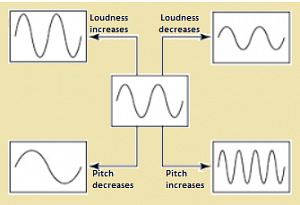
The phenomenon of sound is based on the amplitude of the sound wave. The sound is said to be loud if the amplitude of the sound wave is large. The phenomenon is directly proportional to the square of the amplitude of vibration. Meaning, if the amplitude of the sound wave becomes double, then the loudness of the sound will quadruple.It is expressed in decibel (dB). Sounds that are above 80 dB become noise to human ears.
Loudness of Sound
Given below is the table that shows the data for various sources of sound:
| Normal Breathing | 10 dB |
| Soft Whisper (at 5 m) | 30 dB |
| Normal Conversation | 60 dB |
| Busy Traffic | 70 dB |
| Average Factory | 80 dB |
Loudness of Sound Formula
[Click Here for Sample Questions]
L = log (I)
Where I: Intensity of sound.
Difference of loudness, L2 - L1 = 10 log10 (I1 / I0)
Also Read:
| Related Articles | ||
|---|---|---|
| Speed of Sound Formula | Timbre | Inaudible and Audible Sound |
| Noise Pollution | Relation Between Amplitude and Frequency | Tympanic Membrane |
Intensity of Sound
[Click Here for Sample Questions]
Loudness is the property by which one can differentiate between two sounds of the same frequency and pitch. The loudness of sound is determined by the intensity as well as the amplitude of the sound waves. The intensity of sound is referred to as the energy per unit time per unit area. As the energy or the time ratio is equal to the power, the intensity is simply the power per unit area.
Intensity = Energy/(Time x Area)
or, Intensity = Power/Area
The units used for expressing the intensity of a wave of the sound are Watts per meter square.

Intensity of Sound
Read More: Sound Important Questions
Pitch of Sound
[Click Here for Sample Questions]
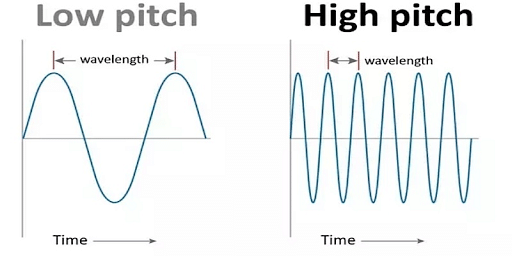
The pitch of sound depends on the frequency of vibration of the waves. If the frequency of vibration is higher, the sound is said to be shrill and has a high pitch. Whereas, if the sound with a lower pitch, has a lower frequency of vibration. For instance, a bird produces a high-pitched sound whereas the roaring of a lion is a low-pitched sound. The voice of a woman has a higher pitch as compared to a man.
Pitch of Sound
Process of Making Sound
[Click Here for Sample Questions]
All sound-producing instruments, from loudspeakers to guitars, have one thing in common: vibration. The numerous sounds our ears can distinguish are determined by the amount of vibration as well as the pace of vibration.The sound is heard through our ears.The waves produced by vibration, whether in the form of a bass drum or an acoustic guitar, may be detected by the sophisticated internal structure of our ears. A medium is the matter or substance through which sound is transferred. The propagation of sound waves requires the presence of a medium. A solid, liquid, or gas can be used as the medium. In a vacuum, sound cannot travel.
Mechanical waves are waves that propagate through a medium. A wave is a phenomenon or disturbance in which energy is transported from one location to another without the two points coming into direct touch. For instance, heat, light, and sound are all considered waves.
Read More: NCERT Solutions for Class 11 Physics Waves
Types of Sound Waves
[Click Here for Sample Questions]
Waves are divided into two categories based on their propagation direction:
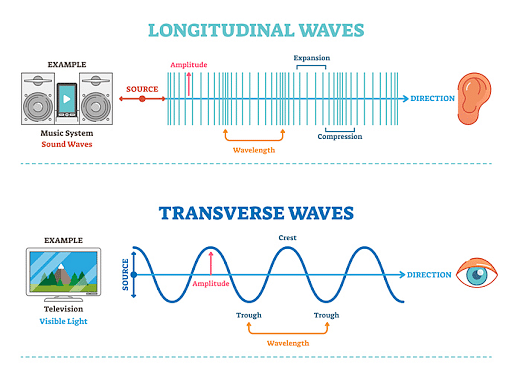
(i) Longitudinal waves: These are waves in which the medium's particles vibrate in the wave's propagation direction. Consider the example of a sound wave.
(ii) Transverse waves: In this sort of wave, the medium particles vibrate in a direction that is perpendicular to the wave's propagation direction. Consider the waves created by a stretched string.
(iii) Electromagnetic waves: Such waves are another sort of wave that does not require a medium to propagate. These waves can also travel in a vacuum. Consider light waves and X-rays.
Types of Sound Waves
Characteristics of Sound Waves
[Click Here for Sample Questions]
The characteristics of sound waves are as follows:
(1) Amplitude (2) Wavelength (3) Frequency (4) Period of time (5) Velocity
When an instrument vibrates, oscillating sound waves are created. Some of these waves are audible to humans, whereas others are extremely deep or high-pitched, and so beyond their hearing range. The amplitude of the sound wave determines the phenomena of sound. The amplitude per unit area in a point in space, which is intensity, is used to determine the loudness of a sound. The unit of intensity will be used to quantify loudness. The sound is said to be loud if the amplitude of the sound wave is large.It is proportional to the square of the vibration’s amplitude. The loudness of the sound will be quadrupled if the amplitude of the sound wave is doubled.It A sound wave’s loudness is governed by its relationship to its amplitude; all waves have a particular amplitude. On a quiet ocean, for example, a wave’s height will be less than 1 foot, yet good surfing waves can be 10 feet or more in amplitude. The amplitude might reach 40 to 50 feet during a storm.

Characteristics of Sound Waves
Consider listening to music over a speaker; if the volume is low, you move closer to the speaker to hear it. We will enhance the amplitude of the song to make it audible from a distance. The amplitude is determined by the amount of energy used to make the sound. It’s all about the power of energy. Consider a point source of sound that, since sound travels at the same speed everywhere, reaches the surface of a sphere with radius R at the same moment. As a result, the energy it communicated has essentially diffused throughout the sphere. Intensity is the amount of energy per unit of area.
- A listener’s perception of how loud or soft a sound is is referred to as loudness.
- The intensity of sound waves determines the loudness of the sound. The quantity of energy in sound waves is measured by intensity.
- The decibel is a measurement of intensity (dB). The decibel scale is based on a logarithmic scale with a base of ten. Loudness is calculated using the following formula: Loudness = 10 log10(I/I0) where I0 is a constant in this case.
- That is, for every 10 decibel increase in sound intensity, loudness increases by tenfold.Human ears perceive sounds exceeding 80 decibels as noise.
Also Read:
Things to Remember
- Loudness is defined as a measure of the response of the ear to the sound. Our ear may find one sound louder than other even though they may have same intensity
- The loudness of a sound is directly proportional to its amplitude. Louder sounds can travel longer distances.
- Loudness is measured in decibels (db). As decibel levels increase, sound waves also become greater intensity and sounds are louder.
- With the increase of 10-decibel in the intensity of sound, the loudness is 10 times greater.
- The formula of the loudness of sound is: L = log (I); Where I: Intensity of sound. Difference of loudness, L2 - L1 = 10 log10 (I1 / I0)
- Loudness is the property by which one can differentiate between two sounds of the same frequency and pitch. The loudness of sound is determined by the intensity as well as the amplitude of the sound waves.
Sample Questions
Ques: What is the average human ear’s audible range? (1 mark)
Ans: Sound waves with frequencies ranging from 20 Hz to 20,000 Hz can be heard by the typical human ear.
Ques: What exactly is sound, and how is it created? (1 mark)
Ans: Sound is mechanical energy that causes a hearing sensation. Sound is created when an object is made to vibrate.
Ques: We can hear which of the following sound waves: 10 Hz, 500 Hz, 1500 Hz, 12000 Hz, and 25000 Hz? (1 mark)
Ans: 500 Hz, 1500 Hz, and 12000 Hz are the frequencies used.
Ques: Which of the following wave properties determines (a) loudness and (b) pitch? (2 marks)
Ans: (a) The loudness of a wave is determined by its amplitude. The louder a wave becomes, the greater its amplitude.
(b) The frequency of the wave determines the pitch. The higher the frequency of a wave, the higher the pitch and the quieter the sound.
Ques: Distinguish between loudness and intensity of sound. (3 marks)
Ans:
| Intensity | Loudness |
|---|---|
| It is the power of sound per unit area which is independent of the sensitivity of the human ears | It is the measure of the response of the ear to the sound received. It is dependent on the sensitivity of the human ears. |
| It is measured in Watt per meter square. | It is measured in decibels. |
| It is an objective quantity. | It is a subjective quantity. |
Ques: What is meant by loudness of sound? (3 marks)
Ans: The phenomenon of sound is based on the amplitude of the sound wave. The sound is said to be loud if the amplitude of the sound wave is large. The phenomenon is directly proportional to the square of the amplitude of vibration. Meaning, if the amplitude of the sound wave becomes double, then the loudness of the sound will quadruple.It is expressed in decibel (dB). Sounds that are above 80 dB become noise to human ears.
Ques: What are the characteristics of sound? (4 marks)
Ans: The characteristics of sound are pitch, loudness and quality.
Pitch: it depends on the frequency of sound waves. When a frequency is low, a note has a lower pitch while a note of a higher frequency has a higher pitch.
Loudness: Loudness means how loud or soft a sound seems to a listener. The loudness of sound is determined by the intensity or amount of energy in sound waves. The unit of intensity is the decibel (dB).
Quality: The term quality is also known as Timbre. We know that different sources produce a different variety of sounds and the timbre helps us distinguish between them.
Ques: What are the types of sound waves? (3 marks)
Ans: Waves are divided into two categories based on their propagation direction:
(i) Longitudinal waves: These are waves in which the medium's particles vibrate in the wave's propagation direction. Consider the example of a sound wave.
(ii) Transverse waves: In this sort of wave, the medium particles vibrate in a direction that is perpendicular to the wave's propagation direction. Consider the waves created by a stretched string.
(iii) Electromagnetic waves: Such waves are another sort of wave that does not require a medium to propagate. These waves can also travel in a vacuum. Consider light waves and X-rays.
Ques: What do you mean by pitch of sound? (3 marks)
Ans: The pitch of sound depends on the frequency of vibration of the waves. If the frequency of vibration is higher, the sound is said to be shrill and has a high pitch. Whereas, if the sound with a lower pitch, has a lower frequency of vibration. For instance, a bird produces a high-pitched sound whereas the roaring of a lion is a low-pitched sound. The voice of a woman has a higher pitch as compared to a man.
Ques: Distinguish between loudness and pitch of sound. (3 marks)
Ans: The difference between the loudness and pitch of sound are:
| Loudness | Pitch |
|---|---|
| Loudness is the property of sound that is used for differentiating between the loud and faint sound | Pitch is referred to as the characteristic of sound and is used for differentiating between the shrill and flat sound |
| Loudness is based on the energy received by the ear in unit time | Pitch is independent of the energy that is received by the ear in unit time |
| Loudness is independent of the change in frequency | Pitch depends on the change in the frequency. The shrillness of the sound increases as the frequency increases. |
Check-Out:




Comments