



Content Writer
Musical Instruments are devices that are being designed to create musical sound. It is considered as an art wherein a piece is written, and sounds are arranged using harmony, rhythm and melody.
- Musical instruments such as guitars help in producing music.
- The guitar helps in understanding the concept of harmonic frequencies.
- Science and art combine to form music.
- The person playing the musical instruments is called an instrumentalist.
- Music is a universal component that exists across all cultures.
- The various elements of music are its rhythm, pitch, timbre, dynamics, and texture.
- There are various music genres depending on the music's genre or style.
- Music elements can be omitted, balanced, de-emphasized or highlighted.
- Musical instruments are designed in different streams of styles and shapes.
Read More: Frequency and Wavelength
Key Terms: Musical Instruments, Music, Sound, Percussion Instruments, Stringed Instruments, Wind Instruments, Rhythm, Pitch, Frequency, Resonance, Vibrations
What is a Musical Instruments?
[Click Here for Sample Questions]
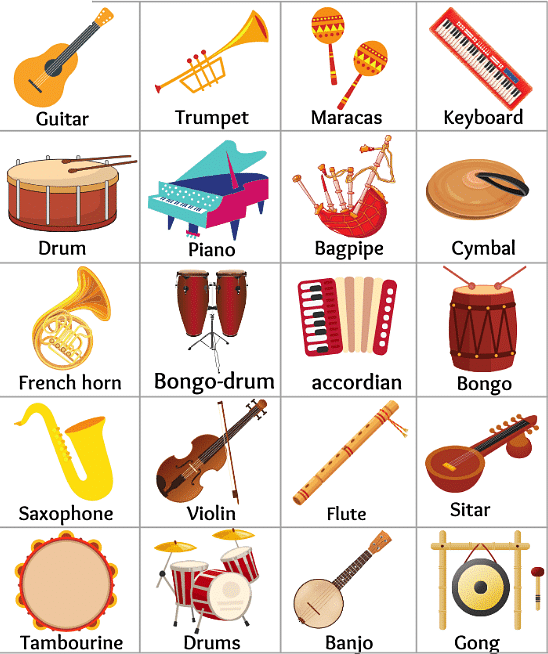
Musical instruments are instruments that help in the production of sound. Earlier, it was created for ritual purposes. Now, it has evolved with changing applications and technologies.
- Musical Instruments are created in different regions of the world.
- The purpose of instruments depends upon the range, material composition, size and role.
- Nowadays, musical instruments are designed for entertainment purposes.
- In earlier days, musical instruments were designed from shells and plant parts.
- Rattles and stampers were the first designed instruments.
- In the modern era, the design of musical instruments was dominated by the occident.
Musical instruments
Read More:
What is music?
[Click Here for Sample Questions]
Music refers to an ordered arrangement of sound. The arrangement of sound in a disordered way is referred to as noise. Music and noise are both a mixture of sound which has varying frequencies.
- The frequencies that make up sound are discrete and rational.
- It has a dominant frequency.
- Noise is composed of continuous and random frequencies.
- People have discovered various musical instruments for centuries in order to produce sound in order to create music.
- Music is derived from successive precursors named Old English, which means music.
- A musical sound is a continuous, good, and uniform sound.
- It is created through periodic and normal vibrations.
- Musical sounds are produced by various musical instruments such as flute, violin, tuning fork, etc.
- Noise is formed through an irregular and discontinuous series of disturbances.
- It is produced by cracker bombs, gunshots, explosive devices, etc.

Music and Noise
Read More: Oscillations
Types of Music
[Click Here for Sample Questions]
Music has various genres, such as pop music, indie music, religious music, secular music, etc. As music is a kind of art, the boundaries between various genres often blur at times and are open to interpretations on a personal level.
- It plays a vital role in our lives.
- Music makes every activity fun, from social events to religious practices and rites.

Classification of Music
Read More: Difference between Resistance and Impedance
Types of Musical instruments
[Click Here for Sample Questions]
Musical instruments are classified into three categories, which are as follows:
Percussion Musical Instruments
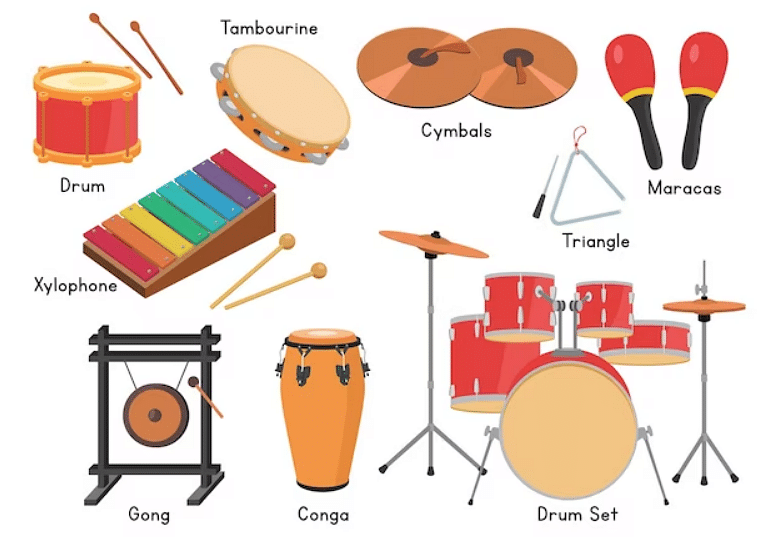
Percussion instruments are the ones that can produce a sound when these instruments are struck upon. Examples of percussion instruments are cymbals, bass drums, xylophones, etc. Percussion instruments are further divided into two types, which are as follows:
Membrane Musical Instruments
One kind of percussion musical instrument is the membrane musical instrument, where membrane refers to a thin sheet of skin. Through the stretching of this membrane, vibrations are produced, which in turn produces sound.
- A thin membrane is tightly fixed over a wooden drum.
- It is hollow, which vibrates and then produces sound when it is stuck.
- Examples of these types of instruments are dholak, tabla, drums, mridangam, etc.
Plate-Type Musical Instruments
Another category of percussion musical instruments is plate-type musical instruments that produce sounds through the vibration of the thick plates. When we beat the plates, the sound is produced. For example, cymbals, Jal Tarang, etc.
Percussion Musical Instruments
Wind Musical Instruments
When air is blown into a column of the resonator of wind instruments, vibrations are produced, producing sound. In wind musical instruments, we have to pump the air in order to produce the sound. Examples of wind instruments are clarinets, flutes, and saxophones.

Wind Musical Instruments
Stringed Musical Instruments
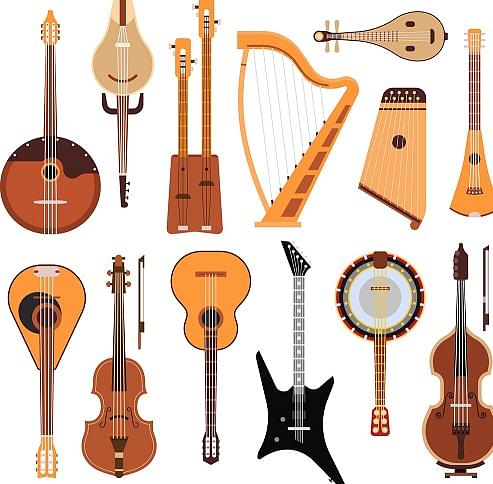
Stringed Musical Instruments are played when the strings of the instruments are either plucked or when a pick or bow is rubbed across the strings. A string refers to a thin piece of wire.
- In stringed musical instruments, thin strings of metal are tightly fixed between any two points.
- When a stretched string is bowed or plucked, the string starts to vibrate, producing sound.
- The strings are tightly fixed to a large soundbox.
- The air in the soundbox increases the loudness of the produced sound through the vibration of the strings.
- Examples: piano, guitar, tanpura, veena, ektara, violin, etc.
Stringed Musical Instruments
Read More: Brewster’s Law Formula
Rhythm
[Click Here for Sample Questions]
Rhythm refers to the arrangement of silences and sounds in an ordered way in time. In the case of classical, traditional, modern, and Western music, the meter animates time in standard groupings of pulse, which are called bars or measures.
- Meters are easy to hear and recognize as the song often emphasizes the first beat of grouping.
- There are exceptions, such as western rock and pop music with a four-beat measure.
- The rhythms of any section of a rock and pop song are composed of chord-playing instruments.
- Some chord instruments are keyboards, electric guitar, piano, acoustic guitar, etc.
- The bass instrument includes typical electric or double bass for bluegrass, jazz, and a drummer.

Rhythm
Read More: Sharpness of Resonance
Frequency and resonance
[Click Here for Sample Questions]
Frequency is the number of vibrations made by an individual particle in a specific period of time that is usually taken as a second. For a wave, frequency refers to the number of times a wave passes through a given point.
- Objects that vibrate at the natural frequencies they have cause resonance.
- Resonance is caused when objects with the same natural frequency as the vibrating source also start to vibrate.
- The effects of resonance can be observed to be very powerful.

Frequency and Resonance
Read More:
| Related Articles | |||
|---|---|---|---|
| Oscillations | Maxwell's Equations | Resistance | |
| Electromagnetic Field | Electrical Insulators | Continuous Charge Distribution | |
Changing Pitch
[Click Here for Sample Questions]
A particular string vibrates at a given frequency. However, it is possible to produce pitches having varying frequencies from a single string. The four properties of a string that affect the frequency at which the string vibrates are its diameter, length, density and tension. They affect the pitch in the following ways:
- Diameter of a string refers to its thickness.
- Thin strings usually vibrate faster and have higher frequencies than thick strings that have large diameters.
- The frequency of the string changes with its length.
- Strings with short lengths have higher frequencies and higher pitches.
- The density of strings is affected by the frequency.
- The molecules that are denser vibrate at a slower speed and, therefore, will have a lower frequency.
- A string that is stretched has tension.
- Tension can be understood as to how tightly a string is stretched.
- The more tension the string has, the higher its frequency will be, and loosening the string will lower the frequency of the sound produced.
Read More:Coherent Sources
Experiment to study relation between frequency and length of a wire
[Click Here for Sample Questions]
In the given experiment, we will look at the effect that the length of the string has on a collection of harmonic frequencies of musical instruments.
Materials required
The material required for experiment with musical instruments are as follows:
Objective
To determine how changing the length of the string, for example doubling, tripling, or quadrupling it can affect the collection of harmonic frequencies at which the string naturally vibrates and also impact the speed at which the waves travel within that string.
Procedure
- Secure a steel wire approximately 1.5 meters in length.
- Clamp the wire upon a lab pole and place it on one end of a lab table.
- To the other end of the wire, secure a hooked mass of 500 g.
- Drape it over a pulley at the opposite end of the lab table.
- Set up a wave machine by connecting the wave driver to the output of a digital function generator.
- Attach the wave driver to the wire at about 1.2 m distance from the point the wire is attached to the pole.
- Adjust the generator's frequency so the wire can vibrate with the second harmonic pattern.
- Record the harmonic number and the frequency.
- Slowly increase the frequency of the harmonies that are recorded.
- Carefully repeat the measurements for the 2nd, 3rd, and 4th harmonics for vibration of varying lengths, such as 0.9 m, 0.6 m, and 0.3 m from the pole.
- Data is analyzed so that the answer is determined.

Experimental Setup to study the relation between frequency and length of string
Conclusion
The shorter the strings are, the higher the frequency of the sound and therefore the sound that is produced will have a higher pitch. Hence, whenever a musician presses their finger on the string of the musical instrument, the length of the string is shortened.
- The more the musician adds fingers to the string of the musical instruments.
- The shorter the string length will be and hence the higher the pitch of the sound produced.
Read More: Destructive Interference
Things to Remember
- Musical Instruments are created to produce different types of sound.
- Music refers to an ordered arrangement of sound.
- The arrangement of sound in a disordered way is referred to as noise.
- Musical instruments are classified into three categories: string instruments, percussion instruments, and wind instruments.
- Rhythm refers to the arrangement of silences and sounds in an ordered way in time.
- When a part of any musical instrument rapidly vibrates, a sound is produced.
- The strings with short lengths have higher frequencies and higher pitches.
Read More: Wave Theory of Light
Sample Questions
Ques. List down the five types of musical instruments. Also, name some instruments that fall under these categories. (5 marks)
Ans. The five types of musical instruments are as follows:
- Keyboard: Piano, Harpsichord, Synthesizer, Organ, Accordion, etc.
- Brass: Trumpet, French Horn, Trombone, Bugle, Tuba, Didgeridoo, and Cornet.
- Woodwind: Saxophone, Ocarina, Oboe, Clarinet, Bassoon, Flute, Piccolo, Tin Whistle, and Bansuri.
- String: Bass guitar, violin, electric guitar, cello, harp, sitar, mandolin, viola, flute, kora, fiddle, and veena
- Percussion: Drum, Cymbal, Bell, Electronic Drum, Tambourine, Gong, Xylophone, Tabla, Bongo Drum, etc.
When a part of any musical instrument rapidly vibrates, a sound is produced. Whenever a wind instrument is played, the air column that exists within the instrument also vibrates. In the case of a string instrument, the string vibrates and in a similar manner, the stretched skin of a drum also vibrates. These vibrations allow the waves of sound to move in the air, which is interpreted by us as musical notes.
Ques. Explain the difference between music and noise. (5 marks)
Ans. The differences between music and sound are:
- While music is an arrangement of sound that generates a pleasing, smooth, and agreeable sensation, noise generally refers to an unpleasant, jarring, and unwanted sound.
- Music is produced in nature and through musical instruments while machines and horns of vehicles are mainly responsible for causing the noise.
- Music is produced through the periodic vibrations that occur at a regular and continuous interval while noise is produced through irregular vibrations that are discontinuous in nature.
- In music, there is no sudden loss or change in the pitch or loudness of the musical sound while in noise sudden changes in pitch and loudness of sound can be observed.
- When played at higher volumes, music at times can transform into noise.
Ques. How the length of the string of the musical instruments can have an effect on the sound produced by them. (3 marks)
Ans. The frequency of the string changes with the length of the string of musical instruments. The strings with short lengths have higher frequencies and higher pitches while the strings with larger lengths have lower frequencies and therefore lower pitches. In short, we can say that:
- When we tighten the string of a musical instrument, the pitch of the sound produced increases.
- When the length of the vibrating string is increased, the pitch of the sound produced decreases.
Ques. What factors impact the pitch and loudness of the song produced by various musical instruments. (5 marks)
Ans. The factors that affect the sound produced by musical instruments are:
- A thick string will produce a sound with decreased pitch.
- The more the length of the vibrating string, the lower is the pitch.
- As the air column is shortened, the pitch of the produced sound increases.
- As a string is tightened, the pitch increases.
- The harder you pluck a string, the louder the song will be produced.
Ques. Define frequency. (2 marks)
Ans. Frequency refers to the number of oscillations that are completed by any vibrating body in a single second. The SI unit of frequency is Hertz, which is denoted by Hz. If any vibrating body completes 30 oscillations in a second, we can say that the frequency of that body is 30 Hz. The frequency produced by the human voice can range from 60 Hz to 13000 Hz. Our human ear can hear a sound of frequency that ranges between 20 Hz to 20000 Hz.
Ques. What factors influence or change the pitch of the sound produced by any object or musical instrument. (5 marks)
Ans. It is possible to produce pitches having varying frequencies from a single string. The four properties of a string that affect the frequency at which the string vibrates are its diameter, length, density, and tension. They affect the pitch in the following ways:
- Diameter: The thin strings usually vibrate faster and have higher frequencies than the thick strings that have large diameters.
- Length: The strings with short lengths have higher frequencies and higher pitches.
- Density: The molecules that are denser vibrate at a slower speed and therefore will have a lower frequency.
- Tension: The more tension the string has, the more it is tightened, the higher will be its frequency, and loosening the string will therefore lower the frequency of the sound produced.
Ques. Describe various types of musical instruments. Give examples. (5 marks)
Ans. The instruments that help in producing sound are known as musical instruments. Musical instruments are classified as:
- Percussion instruments are the ones that can produce a sound when they are struck upon. Examples of percussion instruments are cymbals, bass drums, xylophones, etc.
- Membrane musical instrument: Membrane refers to a thin sheet of skin. Through the stretching of this membrane, the vibrations are produced which in turn produces sound. Examples of these types of instruments are dholak, tabla, drums, etc.
- Another type of percussion musical instrument is plate-type musical instruments that produce sounds through the vibration of the thick plates. For example, cymbals.
- Wind Instruments: When air is blown into a column of the resonator of wind instruments, vibrations are produced which leads to the production of sound. Examples are clarinets, flutes, and saxophones.
- Stringed Musical Instruments: When the strings of the stringed instruments are either plucked or when a pick or bow is rubbed across the strings, the sound is produced. A string refers to a thin piece of wire. Example: piano, guitar, tanpura, veena, ektara, violin, etc.
Ques. What are the material required for experiment to study relation between frequency and length of a wire. (2 marks)
Ans. The material required for experiment to study relation between frequency and length of a wire are as follows:
- Clamps
- Wire
- Pulley
- Hooked mass (500 gm)
- Wave driver
- Lab poles
- Digital function generator
Ques. Explain the term resonance. (3 marks)
Ans. Resonance is caused when objects with the same natural frequency as the vibrating source also start to vibrate. It is created when external force is applied to the object. In this case, the object observes energy from the external source. It takes place in various mechanical, electrical, and acoustic systems. The object transfers energy between two or more different storage modes. Playground swing is another example of resonance where the swing acts as a pendulum.
Ques. What are different types of percussion musical instruments. (3 marks)
Ans. Percussion instruments are the ones that can produce a sound when these instruments are struck upon. Examples of percussion instruments are cymbals, bass drums, xylophones, etc. Percussion instruments are further divided into two types, which are as follows:
- Membrane Musical Instruments: Membrane musical instrument are instrument where membrane refers to a thin sheet of skin. Through the stretching of this membrane, vibrations are produced, which in turn produces sound. In these instruments, a thin membrane is tightly fixed over a wooden drum. Examples of these types of instruments are dholak, tabla, drums, mridangam, etc.
- Plate-Type Musical Instruments: Plate-type musical instruments that produce sounds through the vibration of the thick plates. When we beat the plates, the sound is produced. For example, cymbals, Jal Tarang, etc.
Ques. What is the difference between frequency and amplitude. (3 marks)
Ans. The difference between frequency and amplitude are as follows:
| Frequency | Amplitude |
|---|---|
| Frequency is defined as number of waves passing through a point in a second. | Amplitude is defined as the distance between resting position of the wave and its displacement. |
| Its unit is hertz. | Its unit is meter. |
| Frequency has limited range. | Amplitude have limited range. |
Ques. What is rhythm. (2 marks)
Ans. Rhythm refers to the arrangement of silences and sounds in an ordered way in time. In the case of classical, traditional, modern, and Western music, the meter animates time in standard groupings of pulse, which are called bars or measures. The rhythms of any section of a rock and pop song are composed of chord-playing instruments. Some chord instruments are keyboards, electric guitar, piano, acoustic guitar, etc
For Latest Updates on Upcoming Board Exams, Click Here: https://t.me/class_10_12_board_updates
Also Check:



Comments