




The MET Exam Pattern 2026 has been published on the Manipal University’s official website, manipal.edu. The exam is scheduled tentatively in 2 phases- Phase 1 on 13 and 14 April, 2026, and Phase 2 on 23 and 24 May, 2026. It will be held in the Computer-based Test Mode (CBT) and is conducted annually by the Manipal Academy of Higher Education (MAHE).
- The MET 2026 is a 2-hour exam featuring 60 questions worth a total of 240 marks.
- The MET exam pattern includes Physics and Chemistry question papers, each comprising 10 MCQs and 5 NATs.
- MET 2026 Mathematics question paper includes 15 MCQs and 5 NATs, and the English paper consists of only 10 MCQs.
- Students receive +4 for correct responses, -1 for incorrect responses, and 0 for unattempted responses in the MET exam pattern 2026.
Before 2025, there was no negative marking in the exam. But since the 2025 MET Exam, the negative marking has been introduced only for the MCQ questions.
The MET Exam Pattern 2026 is set to follow the MET 2025 Exam Pattern, which moved away from the traditional 100-question pattern to a more focused 60-question paper pattern. The total marks were also decreased from 400 to 240.
To stay updated with the MET Exam Pattern 2026, check the MET 2026 website regularly.
Related Links:
- MET 2026 Check Question Paper Pattern and Previous Year Papers
- MET 2026 Syllabus Out @manipal.edu; Check Subject-wise Topics Here
- MET 2026 Slot Booking Begins @manipal.edu; Book Your Slot by April 2, 2026
Key Summary
In this article, we have discussed the MET Exam Pattern for 2026, including the marking scheme, syllabus, pattern, weightage, and preparation tips.
- The XAT Exam Pattern 2026 has been released on the official website manipal.edu.
- The MET exam pattern 2026 is online and computer-based. The MET exam is conducted for 2 hours, and you are supposed to answer a total of 60 questions.
- The MET exam pattern includes Physics and Chemistry question papers that consist of 10 MCQs and 5 NATs.
- MET 2026 Mathematics question paper includes 15 MCQs and 5 NATs, and the English paper consists of only 10 MCQs.
- You will be marked with +4 for correct, -1 for incorrect, and +0 for every unattempted response in the MET 2026 exam. Students' marks for the MET 2026 exam are calculated out of a total of 240.
MET Exam Pattern 2026: Highlights
| Feature | Overview |
|---|---|
| Exam Name | Manipal Entrance Test |
| Conducting Body | Manipal Academy of Higher Education |
| Exam Mode | Online |
| Marking Scheme |
|
| Duration of the Exam | 2 hours (120 minutes) |
| Types of Question | MCQs and Numerical Answer Type (NAT) |
| Sections | Varies as per the course |
| Sectional Time Limit | No sectional time limit |
What is the MET Exam Pattern 2026?
The MET Exam pattern 2026 is a single-session, 2-hour exam covering four core sections with a specific mix of objective and numerical questions.
- The MET Exam Pattern 2026 varies by course.
- English is compulsory for all programmes.
- The other sections depend on the stream — Physics, Chemistry & Mathematics for B.Tech, Numeracy & General Awareness for BBA (Hons.).
- For PG courses, the subjects are domain-specific.
- The exam includes two distinct types of questions: Multiple Choice Questions (MCQs) and Numerical Answer Type (NAT) questions.
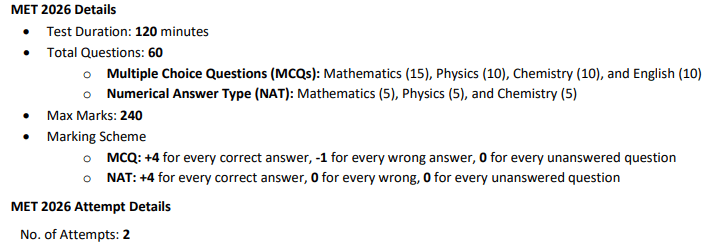
MET Exam Pattern for B.Tech
Source: MET 2026 Syllabus
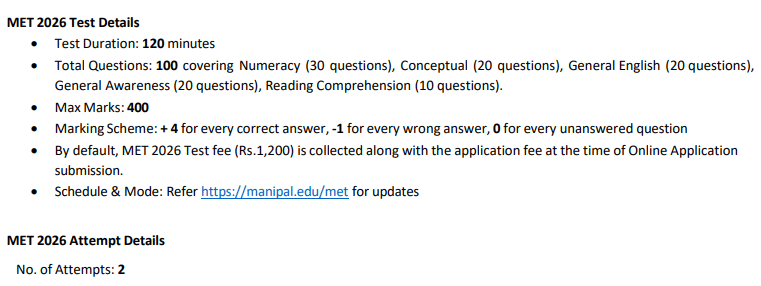
MET Exam Pattern for BBA (Hons.)
Source: MET 2026 Syllabus
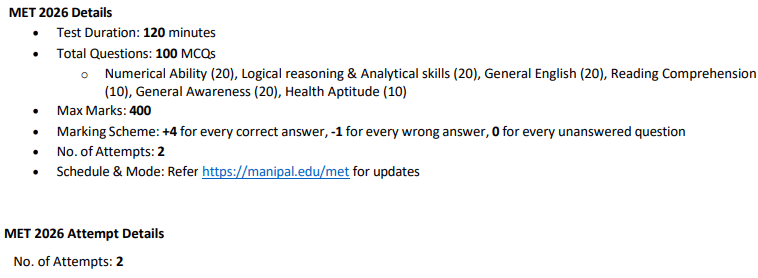
MET Exam Pattern for Bachelor of Psychology
Source: MET 2026 Syllabus
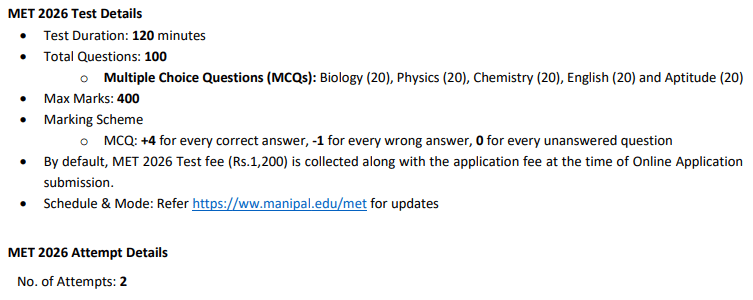
MET Exam Pattern for B.Sc Nursing
Source: MET 2026 Syllabus
Ques. Can I switch back and forth between the Mathematics and Physics sections?
Ans. No. A critical rule for MET 2026 is that you can only visit each section once. After you complete and submit a section, you cannot return to it to change or add answers, even if you have time remaining in the overall 120 minutes.
Ques. Are there individual timers for each section?
Ans. No, there are no sectional time limits. You have the freedom to distribute the total 120 minutes across the four sections as you see fit. However, once you click "Submit" on a section, your time for that specific subject is over.
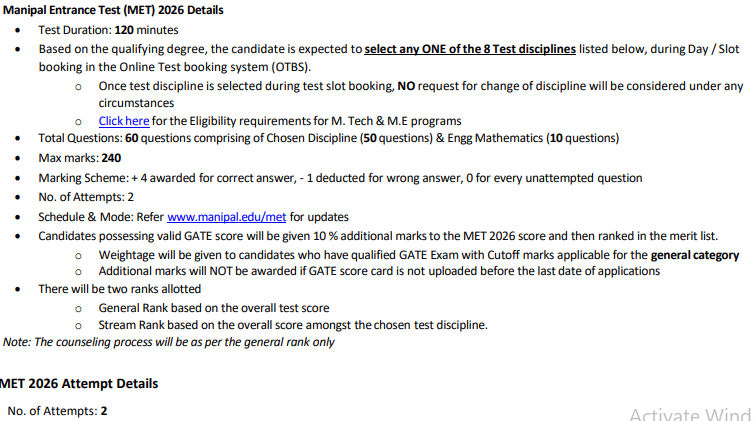
MET Exam Pattern for M.Tech & M.E Programs
Source: MET 2026 Syllabus
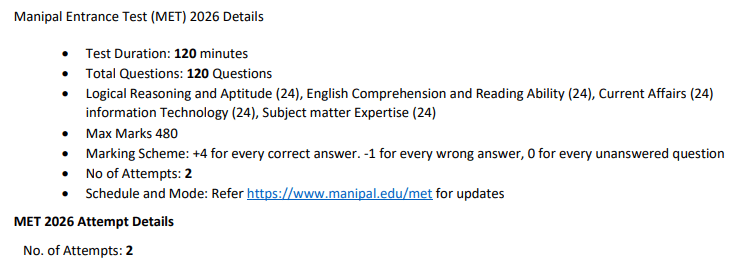
MET Exam Pattern for M.A. Media & Communications
Source: MET 2026 Syllabus
MET 2026 Exam Pattern: Total Questions
The MET 2026 exam pattern varies by program. Below is the detailed breakup of total questions and section-wise distribution:
| Programs/Stream | Core Subjects | Total Questions |
|---|---|---|
| B.Tech | MCQs: Maths (15), Physics (10), Chemistry (10), English (10)NAT: Maths (5), Physics (5), Chemistry (5) | 60 |
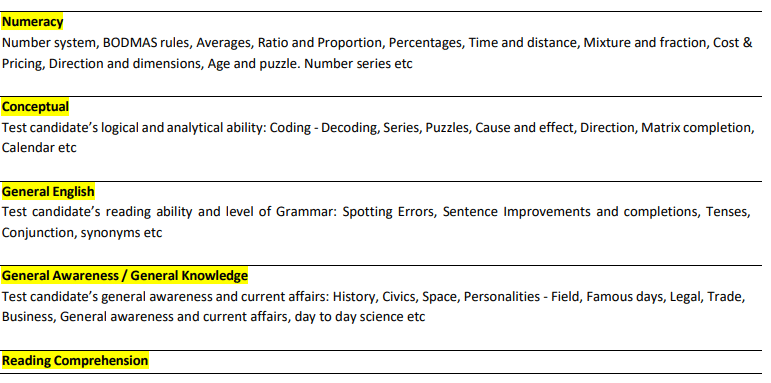
| BBA (Hons.) | MCQs: Numeracy (30), Conceptual (30), General English (20), General Awareness (20), Reading Comprehension (10) | 100 |
| Bachelor's of Psychology | MCQs: Numerical Ability (20), Logical Reasoning and Analytical Skills (20), General English (20), Reading Comprehension (10), General Awareness (20), Health Aptitude (10) | 100 |
| B.Sc Nursing | MCQs: Biology (20), Physics (20), Chemistry (20), English (20), Aptitude (20) | 100 |
| M.Tech and M.E | MCQs: Eng. and Maths (Common) + Branch Specific Subjects | 60 |
| M.A Media and Communication | MCQs: Logical Reasoning and Aptitude (24), English Comprehension and Reading Ability (24), Current Affairs (24), Information Technology (24), Subject-matter Expertise (24) | 120 |
- In the B.Tech program, Physics, Chemistry, and Mathematics sections include both Multiple Choice Questions (MCQs) and Numerical Answer Type (NAT) questions. The English section contains only MCQs.
- For all other programs (BBA, Bachelor's of Psychology, B.Sc Nursing, etc.), the entire question paper consists of MCQs only. There are no NAT questions.
MET 2026 Exam Pattern: Types of Questions
MET 2026 consists of only two types of questions across all programs:
- Multiple Choice Questions (MCQs): Candidates have to choose one correct option out of four given choices.
- Numerical Answer Type (NAT): Candidates must enter the numerical value as the answer (no options are given).
Program-wise Distribution of Question Types:
| Program/Stream | Types of Questions | Details |
|---|---|---|
| B.Tech | MCQs + NAT | Physics, Chemistry & Mathematics have both MCQs and NATs.While English has only MCQs |
| BBA | MCQs only | NO NAT questions |
| Bachelor’s of Psychology | MCQs only | NO NAT questions |
| B.Sc Nursing | MCQ only | NO NAT questions |
| M.Tech and M.E. | MCQs + NAT (mostly) | Combination of MCQs and NATs (varies slightly by branch) |
| M.A Media and Communication | MCQs only | NO NAT questions |
MET 2026 Exam Pattern: Total Marks
The total marks in MET 2026 vary significantly across programs, ranging from 240 marks for B.Tech and 400 marks for management and science streams, and 480 marks for M.A. Media and Communication.
| Program/Stream | Total Marks |
|---|---|
| B.Tech | 240 |
| BBA (Hons.) | 400 |
| Bachelor’s of Psychology | 400 |
| B.Sc Nursing | 400 |
| M.Tech & M.E. | 240 |
| M.A. Media & Communication | 480 |
MET Exam Pattern 2026: Marking Scheme
The MET 2026 exam follows a clear marking scheme with positive marks for correct answers and negative marking only for MCQ questions.
| Question Type | Correct Answer | Wrong Answer | Unanswered |
|---|---|---|---|
| Multiple Choice Questions (MCQs) | +4 marks | -1 mark | 0 marks |
| Numerical Answer Type (NAT) | +4 marks | No negative marking | 0 marks |
- Negative marking applies only to MCQs.
- There is no negative marking in NAT questions — so you can attempt them without fear, even if you are not 100% sure.
MET Exam Pattern 2026: Preparation Tips
With Phase 1 of MET 2026 just 4–5 days away, this is no longer the time for full syllabus coverage or new concepts. So smart last-minute revision & accuracy-focused practice can still boost your score significantly, especially for non-CSE branches or to improve your Phase 2 attempt.
Watch this video for your last-minute preparation
MET Exam Pattern 2026: MET Question Paper with Solution PDF
To have an analysis of the MET Exam pattern, you should also practice the MET Previous Year question paper.
Download MET Previous Year Question Papers from the links provided below.
| Year | Question Paper PDF | Solution PDF |
|---|---|---|
| 2024 | Download PDF | Check Solutions |
| 2023 | Download PDF | Check Solutions |
| 2022 | Download PDF | Check Solutions |
| 2021 | Download PDF | Check Solutions |
| 2020 | Download PDF | Check Solutions |
MET Exam Pattern 2026: Important Books
The syllabus remains unchanged from previous years (Class 11 + 12 CBSE/NCERT level, moderate difficulty, similar to JEE Main but less tricky). NCERT textbooks (Class 11 & 12) are the foundation for all PCM subjects; start here before reference books. Focus on books that build concepts + provide MCQ/NAT practice.
Physics
| Recommended | Author | Remarks |
|---|---|---|
| Concepts of Physics (Vol. 1 & 2) | H.C. Verma | Best for strong conceptual clarity & solved examples |
| Understanding Physics Series | D.C. Pandey | Excellent for MCQs, NAT numericals, and high-weightage topics |
| NCERT Physics (Class 11 & 12) | NCERT | Must-read; most MET questions are NCERT-based |
Chemistry
| Recommended | Author | Remarks |
|---|---|---|
| Organic Chemistry | O.P.Tandon | Best for Mechanisms and Reactions |
| Numerical/Physical Chemistry | P. Bahadur | Excellent for Numerical Problem Solving |
| Concise Inorganic Chemistry | J.D. Lee | Standard for Inorganic Chemistry |
| NCERT Chemistry (Class 11 & 12) | NCERT | Direct Questions often appear |
Mathematics
| Recommended | Author | Remarks |
|---|---|---|
| Problems in Calculus of One Variable | S.L. Loney | High weightage Calculus questions are asked from here |
| Higher Algebra | Hall & Knight | Good choice for Algebra and Probability |
| Plane Trigonometry + Coordinate Geometry | I.A. Maron | Focused and concise for Trigonometry and Geometry |
| NCERT Mathematics (Class 11 & 12) | NCERT | Must for foundation building |
English & General Aptitude
| Recommended | Author | Remarks |
|---|---|---|
| High School English Grammar and Composition | Wren and Martin | Classic for Grammar & Sentence Correction |
| Objective General English | S.P. Bakshi | Good for MCQs and vocabulary |
| Quantitative Aptitude | R.S. Agarwal | Good for Logical Reasoning and Basic Aptitude |
Also Check: List of Top Colleges in India Accepting MET Based on 2026 Ranking
MET Exam pattern 2026: Syllabus
The MET 2026 syllabus has been officially released by Manipal Academy of Higher Education (MAHE) on its official website, manipal.edu. The syllabus is not very different from what you have already studied in Class 11 and Class 12. If you have covered your board exam syllabus well, you are already halfway there.
MET Syllabus for B.Tech
The MET Syllabus for B.Tech includes topics of Mathematics, Physics, Chemistry, and English.
| Subjects | Syllabus |
|---|---|
| Mathematics | SETS, RELATIONS, & FUNCTIONS, COMPLEX NUMBERS & QUADRATIC EQUATIONS, MATRICES AND DETERMINANTS, PERMUTATIONS AND COMBINATIONS, BINOMIAL THEOREM AND ITS SIMPLE APPLICATIONS, SEQUENCE AND SERIES, LIMIT, CONTINUITY AND DIFFERENTIABILITY, INTEGRAL CALCULUS, DIFFERENTIAL EQUATIONS, CO-ORDINATE GEOMETRY, THREE-DIMENSIONAL GEOMETRY, VECTOR ALGEBRA, STATISTICS & PROBABILITY, TRIGONOMETRY. |
| Physics | UNITS & MEASUREMENT, KINEMATICS, LAWS OF MOTION, WORK, ENERGY AND POWER, ROTATIONAL MOTION, GRAVITATION, PROPERTIES OF SOLIDS AND LIQUIDS, THERMODYNAMICS, KINETIC THEORY OF GASES, OSCILLATIONS AND WAVES, ELECTROSTATICS, CURRENT ELECTRICITY, MAGNETIC EFFECTS OF CURRENT AND MAGNETISM, ELECTROMAGNETIC INDUCTION AND ALTERNATING CURRENTS, ELECTROMAGNETIC WAVES, OPTICS, DUAL NATURE OF MATTER AND RADIATION, ATOMS AND NUCLEI, ELECTRONIC DEVICES, EXPERIMENTAL SKILLS |
| Chemistry | Physical Chemistry SOME BASIC CONCEPTS IN CHEMISTRY, ATOMIC STRUCTURE, CHEMICAL BONDING AND MOLECULAR STRUCTURE, CHEMICAL THERMODYNAMICS, SOLUTIONS, EQUILIBRIUM, REDOX REACTIONS AND ELECTROCHEMISTRY, CHEMICAL KINETICS Inorganic Chemistry CLASSIFICATION OF ELEMENTS AND PERIODICITY IN PROPERTIES, p- BLOCK ELEMENTS (Group -13 to Group 18 Elements), d - and f - BLOCK ELEMENTS (Inner Transition Elements- Lanthanoids, Actinoids), COORDINATION COMPOUNDS Organic Chemistry PURIFICATION AND CHARACTERISATION OF ORGANIC COMPOUNDS, SOME BASIC PRINCIPLES OF ORGANIC CHEMISTRY, Nomenclature (Trivial and IUPAC), HYDROCARBONS (Alkanes, Alkenes, Alkynes, Aromatic hydrocarbons), ORGANIC COMPOUNDS CONTAINING HALOGENS, ORGANIC COMPOUNDS CONTAINING OXYGEN, ALCOHOLS, PHENOLS AND ETHERS, ORGANIC COMPOUNDS CONTAINING NITROGEN, BIOMOLECULES (CARBOHYDRATES, PROTEINS, VITAMINS, NUCLEIC ACIDS), PRINCIPLES RELATED TO PRACTICAL CHEMISTRY. |
| English | GRAMMAR AND LANGUAGE USE, VOCABULARY, PUNCTUATION, AND USAGE, READING COMPREHENSION |
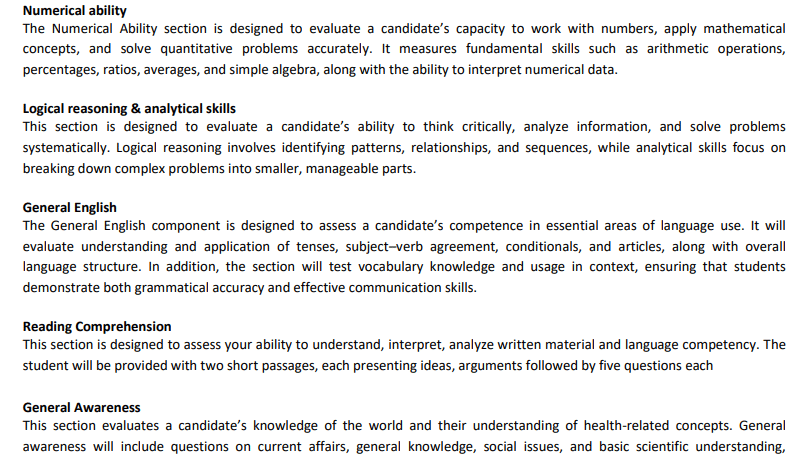
MET Syllabus for B.Sc Nursing
| Subjects | Syllabus |
|---|---|
| Biology | DIVERSITY IN THE LIVING WORLD, STRUCTURAL ORGANISATION IN ANIMALS AND PLANTS, CELL STRUCTURE AND FUNCTION, PLANT PHYSIOLOGY, HUMAN PHYSIOLOGY, REPRODUCTION, GENETICS AND EVOLUTION, BIOLOGY AND HUMAN WELFARE, BIOTECHNOLOGY AND ITS APPLICATIONS, ECOLOGY AND ENVIRONMENT |
| Physics | UNITS & MEASUREMENT, KINEMATICS, LAWS OF MOTION, WORK, ENERGY AND POWER, ROTATIONAL MOTION, GRAVITATION, PROPERTIES OF SOLIDS AND LIQUIDS, THERMODYNAMICS, KINETIC THEORY OF GASES, OSCILLATIONS AND WAVES, ELECTROSTATICS, CURRENT ELECTRICITY, MAGNETIC EFFECTS OF CURRENT AND MAGNETISM, ELECTROMAGNETIC INDUCTION AND ALTERNATING CURRENTS, ELECTROMAGNETIC WAVES, OPTICS, DUAL NATURE OF MATTER AND RADIATION, ATOMS AND NUCLEI, ELECTRONIC DEVICES, EXPERIMENTAL SKILLS |
| Chemistry | Physical Chemistry SOME BASIC CONCEPTS IN CHEMISTRY, ATOMIC STRUCTURE, CHEMICAL BONDING AND MOLECULAR STRUCTURE, CHEMICAL THERMODYNAMICS, SOLUTIONS, EQUILIBRIUM, REDOX REACTIONS AND ELECTROCHEMISTRY, CHEMICAL KINETICS Inorganic Chemistry CLASSIFICATION OF ELEMENTS AND PERIODICITY IN PROPERTIES, p- BLOCK ELEMENTS (Group -13 to Group 18 Elements), d - and f - BLOCK ELEMENTS (Inner Transition Elements- Lanthanoids, Actinoids), COORDINATION COMPOUNDS Organic Chemistry PURIFICATION AND CHARACTERISATION OF ORGANIC COMPOUNDS, SOME BASIC PRINCIPLES OF ORGANIC CHEMISTRY, Nomenclature (Trivial and IUPAC), HYDROCARBONS (Alkanes, Alkenes, Alkynes, Aromatic hydrocarbons), ORGANIC COMPOUNDS CONTAINING HALOGENS, ORGANIC COMPOUNDS CONTAINING OXYGEN, ALCOHOLS, PHENOLS AND ETHERS, ORGANIC COMPOUNDS CONTAINING NITROGEN, BIOMOLECULES (CARBOHYDRATES, PROTEINS, VITAMINS, NUCLEIC ACIDS), PRINCIPLES RELATED TO PRACTICAL CHEMISTRY. |
| English | GRAMMAR AND LANGUAGE USE, VOCABULARY, PUNCTUATION, AND USAGE, READING COMPREHENSION |
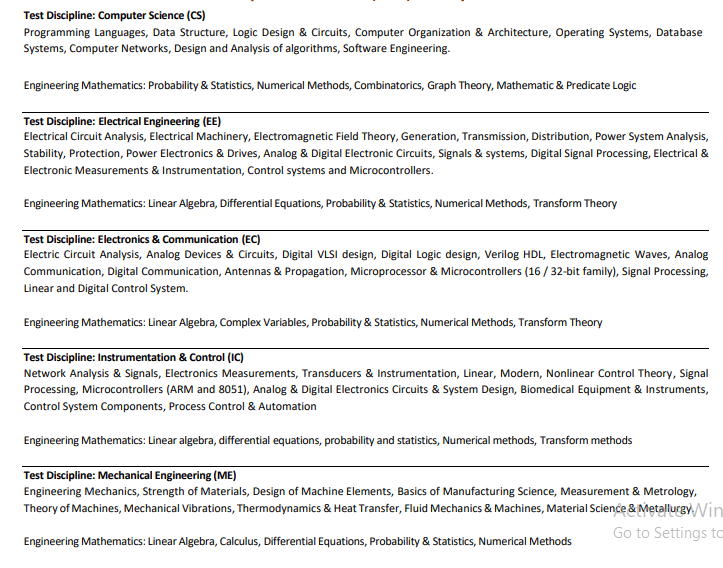
MET Syllabus for M.A Media and Communication
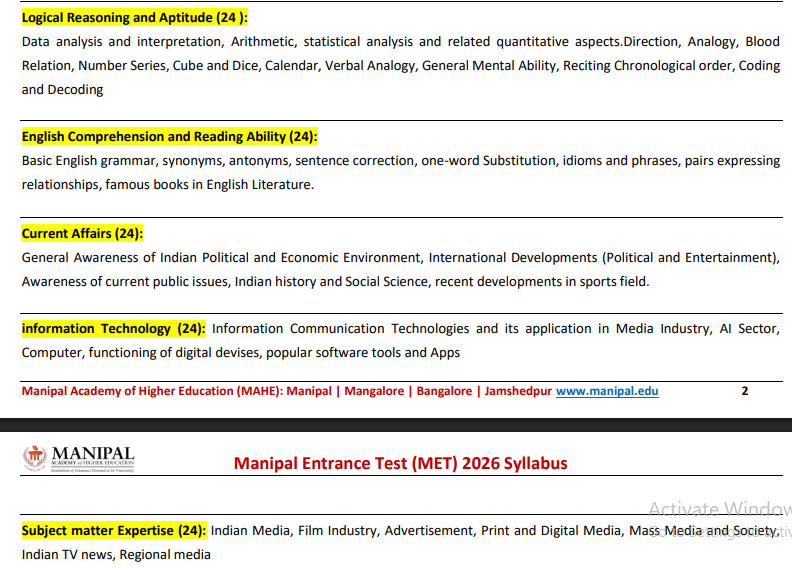
Source: MET 2026 Syllabus
Ques. From where are the maximum questions asked in the MET Exam?
Ans. In the MET entrance exam, for bachelor’s streams, questions are mostly asked from the NCERT 11th & 12th chapters.
Ques. Is the MET syllabus easy to cover when a few days are left?
Ans. No, the MET (Manipal Entrance Test) syllabus is not particularly easy to cover thoroughly if only a few days are left, especially if your basics from Class 11 and 12 are weak. However, it is manageable for scoring decently (for many branches) with a focused last-minute preparation, as the exam is considered moderate overall and heavily based on NCERT-level concepts.
MET Exam Pattern 2026: Changes in the last 3 years
The MET exam pattern saw a major adjustment starting from 2025. Here is a simple comparison of the pattern from 2024 to 2026:
| Year | Total Questions | Duration | Question Types | Marking Scheme | Major Change |
|---|---|---|---|---|---|
| 2026 | 60 | 2 hours | MCQs + NAT Questions | Same as 2025 (+4/-1 for MCQ, 0 for NAT) | No major change (same as 2025) |
| 2025 | 60 | 2 hours | MCQs + NAT questions | +4 for correct-1 for wrong MCQ&No negative for NAT | Questions reduced drastically, shorter duration, NAT introduced, and negative marking started |
| 2024 | ~200 | 2.5 – 3 hrs | Mostly MCQs | +4 for correct, usually no negative marking | Old lengthy format |
FAQs
Ques. Is MET held twice a year?
Ans. Yes, the MET (Manipal Entrance Test) 2026 is held twice a year, specifically in two phases within the same admission cycle (not spread across different years). This pattern has been consistent in recent years (e.g., 2025, 2024). A rare Phase 3 is sometimes announced in June, but for 2026, only two main phases are officially scheduled so far.
Ques. Do I have to prepare the entire MET syllabus?
Ans. No, you do not have to prepare the entire MET syllabus thoroughly, especially with only 4–5 days left for Phase 1 (April 13–14, 2026). However, in reality, MET is not that strict. It follows a clear high-weightage pattern, and smart students score well (even 180–220+ marks) by mastering 60–70% of the important topics.
Ques. A candidate on Quora was asking, “I am scoring 138/240 in Manipal (MET) and can expect around 90-95% in the boards. Can I get CSE at the main branch of Manipal?”
Ans. With 138-145 marks in the MET, you have a decent but not strong chance of getting CSE at the main campus (MIT Manipal).
Manipal gives 50% weightage to MET score and 50% weightage to your 10+2 marks (PCM + English) for preparing the final merit rank.
- MET score (138-145) is average to good.
- Board percentage (90-95%) is solid and helps boost your rank.
Ques. Is MET conducted in regional languages?
Ans. No, MET (Manipal Entrance Test) 2026 is not conducted in any regional languages. The exam is conducted only in English medium across all phases and for all programs (including B.Tech).



Comments