


NCERT Solutions for class 11 Physics Chapter 15: Waves

NCERT Solutions for Class 11 Physics Chapter 15: Waves deals with the concepts of wave and wave motion. Wave motion is referred to as the energy and momentum movement from one point to another in a medium instead of actually transferring the substances between the places. 

Class 11 Physics Chapter 15 Waves is a part of Unit 10 Oscillations and Waves which has a weightage of 10 marks in the Class 11 Physics Examination. The chapter covers concepts of transverse and longitudinal waves, the principle of superposition of waves, and the Doppler effect.


Download PDF: NCERT Solutions for Class 11 Physics Waves

NCERT Solutions for Class 11 Physics Chapter 15

The NCERT Solutions for Chapter 15 of Class 11 Physics are as given below – 
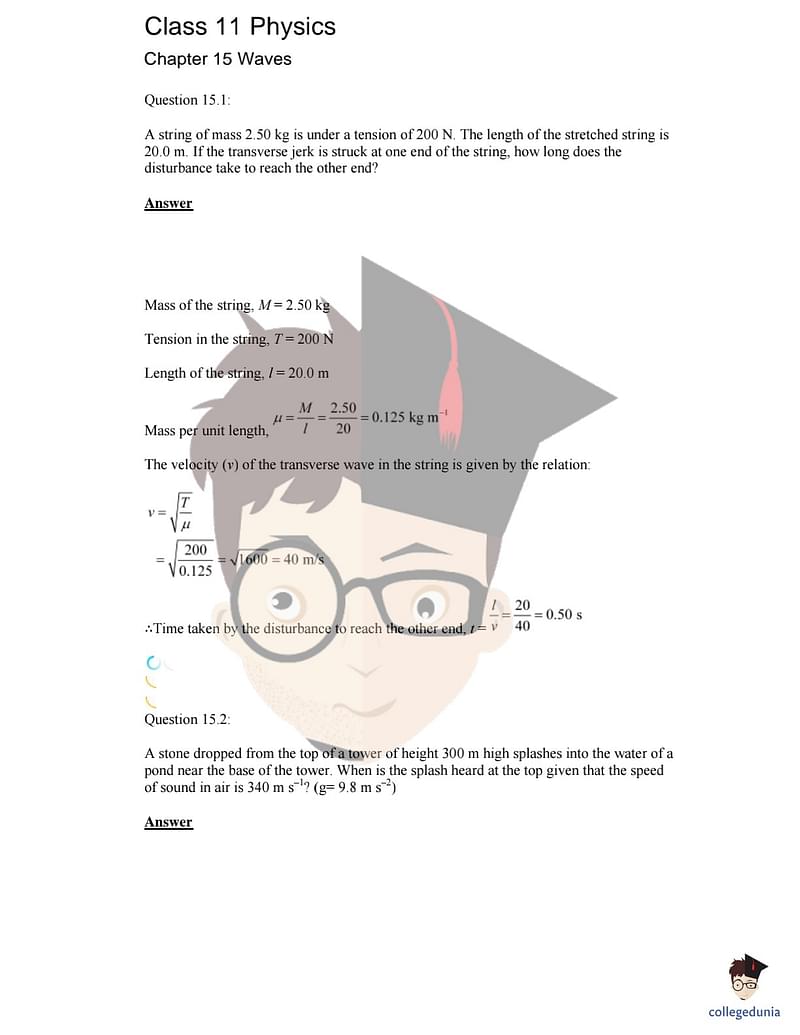
NCERT SolutionsNCERT SolutionsNCERT SolutionsNCERT SolutionsNCERT SolutionsNCERT SolutionsNCERT SolutionsNCERT SolutionsNCERT SolutionsNCERT SolutionsNCERT SolutionsNCERT SolutionsNCERT SolutionsNCERT SolutionsNCERT SolutionsNCERT SolutionsNCERT SolutionsNCERT SolutionsNCERT SolutionsNCERT SolutionsNCERT SolutionsNCERT SolutionsNCERT SolutionsNCERT SolutionsNCERT SolutionsNCERT SolutionsNCERT SolutionsNCERT SolutionsNCERT SolutionsNCERT SolutionsNCERT SolutionsNCERT SolutionsNCERT SolutionsNCERT Solutions

Class 11 Physics Chapter 15 – Concepts Covered

  • A wave is a disturbance that travels through a material medium as a result of the repeated periodic motion of the particles of the medium about their mean positions without any actual transportation of matter.
The particles of the medium traversed by a wave have relatively small vibrations about their mean positions. However, the particles are not displaced permanently in the direction of propagation of the wave.
  • Mechanical waves can be propagated or produced only in a material medium.
These waves work on Newton’s laws of motion. For example, waves on strings, waves on the water surface, sound waves etc.
  • Electromagnetic Waves are waves that do not require any material medium for their production and propagation. They can pass through a vacuum or any other material medium.
Some examples of electromagnetic waves are visible light, ultraviolet light, microwaves, radio waves, etc.
  • Wave velocity is the time rate of propagation of wave motion in a given medium. It depends upon the nature of the medium.
Wave velocity (υ) = frequency (v) x wavelength (λ)
  • Matter waves are associated with moving particles of matter, like protons, electrons, neutrons etc.

CBSE CLASS XII Related Questions

  • 1.
    Consider a cylindrical conductor of length \( l \) and area of cross-section \( A \). Current \( I \) is maintained in the conductor and electrons drift with velocity \( \vec{v}_d \, (|\vec{v}_d| = \frac{eE}{m} \tau) \), where symbols have their usual meanings. Show that the conductivity of the material of the conductor is given by \[ \sigma = \frac{n e^2 \tau}{m}. \]


      • 2.
        The magnetic field in a plane electromagnetic wave travelling in glass (\( n = 1.5 \)) is given by \[ B_y = (2 \times 10^{-7} \text{ T}) \sin(\alpha x + 1.5 \times 10^{11} t) \] where \( x \) is in metres and \( t \) is in seconds. The value of \( \alpha \) is:

          • \( 0.5 \times 10^3 \, \text{m}^{-1} \)
          • \( 6.0 \times 10^2 \, \text{m}^{-1} \)
          • \( 7.5 \times 10^2 \, \text{m}^{-1} \)
          • \( 1.5 \times 10^3 \, \text{m}^{-1} \)

        • 3.
          Four long straight thin wires are held vertically at the corners A, B, C and D of a square of side \( a \), kept on a table and carry equal current \( I \). The wire at A carries current in upward direction whereas the current in the remaining wires flows in downward direction. The net magnetic field at the centre of the square will have the magnitude:

            • \( \dfrac{\mu_0 I}{\pi a} \) and directed along OC
            • \( \dfrac{\mu_0 I}{\pi a \sqrt{2}} \) and directed along OD
            • \( \dfrac{\mu_0 I \sqrt{2}}{\pi a} \) and directed along OB
            • \( \dfrac{2\mu_0 I}{\pi a} \) and directed along OA

          • 4.
            A square loop of side 0.50 m is placed in a uniform magnetic field of 0.4 T perpendicular to the plane of the loop. The loop is rotated through an angle of 60° in 0.2 s. The value of emf induced in the loop will be:

              • 5 V
              • 3.5 V
              • 2.5 V
              • Zero V

            • 5.
              Nuclides with the same number of neutrons are called:

                • Isobars
                • Isotones
                • Isotopes
                • Isomers

              • 6.
                Assertion : In Young’s double-slit experiment, the fringe width for dark and bright fringes is the same. Reason (R): Fringe width is given by \( \beta = \frac{\lambda D}{d} \), where symbols have their usual meanings.

                  • Both Assertion (A) and Reason (R) are true and Reason (R) is the correct explanation of the Assertion (A).
                  • Both Assertion (A) and Reason (R) are true, but Reason (R) is not the correct explanation of the Assertion (A).
                  • Assertion (A) is true, but Reason (R) is false.
                  • Both Assertion (A) and Reason (R) are false.
                CBSE CLASS XII Previous Year Papers

                Comments


                No Comments To Show


