



Content Curator
The NCERT Solutions for Class 9 Maths Chapter 2 Polynomials are provided in this article. A polynomial is an expression composed of variables and coefficients that contain fundamental arithmetic operations such as addition, subtraction, and multiplication, as well as the exponential negative exponential of variables.
Chapter 2 Polynomials belongs to Unit 2 Algebra which has a weightage of 20 marks in the CBSE Class 9 Maths Examination. NCERT Solutions for Class 9 Maths for Chapter 2 cover the following important concepts:
- Remainder Theorem
- Degree of polynomial
- Algebraic Identities
- Polynomials in One Variable
- Factorisation of Polynomials
Download: NCERT Solutions for Class 9 Mathematics Chapter 2 pdf
NCERT Solutions for Class 9 Maths Chapter 2
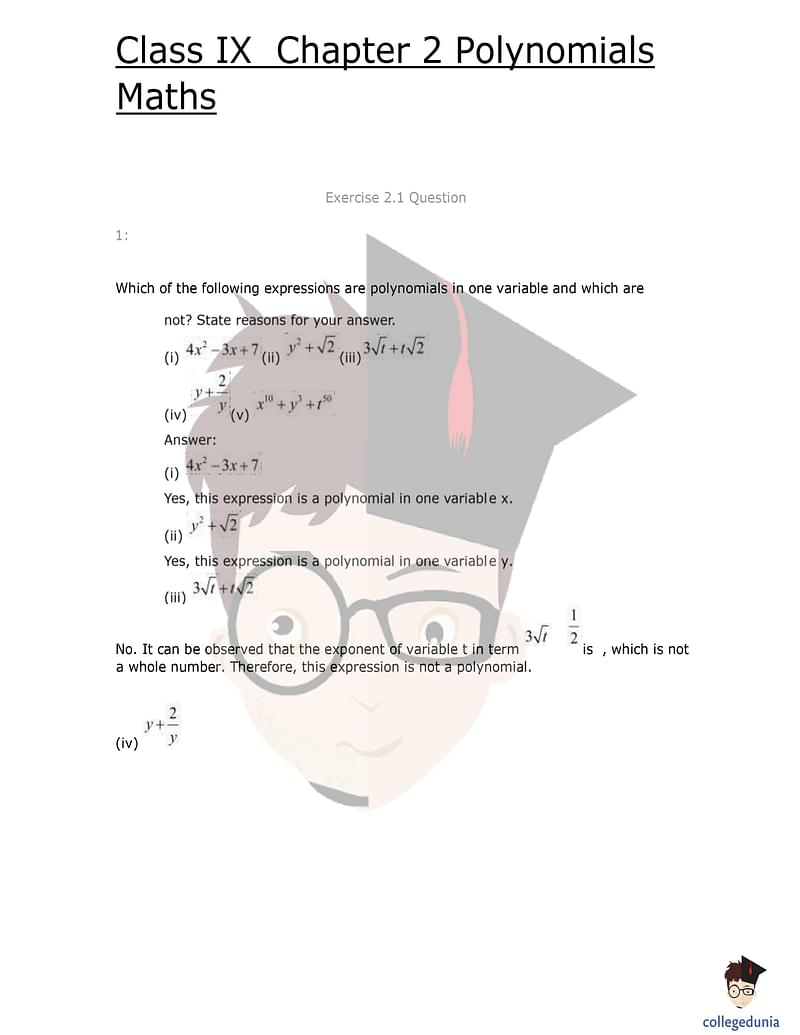
Class 9 Chapter 2 NCERT Solutions are given below:


Important Topics in Class 9 Maths Chapter 2 Polynomials
Important Topics in Class 9 Maths Chapter 2 Polynomials are elaborated below:
- Remainder Theorem
Remainder Theorem is an Euclidean approach of division of polynomials. It says that if we divide a polynomial P(x) by a factor ( x – a); which is not necessarily an element of the polynomial; then we can find a smaller polynomial along with a remainder.
| Example: Assume that f(a) = a3-12a2-42 is divided by (a-3). The quotient will be a2-9a-27 and the remainder is -123. Determine whether it satifies the Reaminder Theorem? Solution: First let’s put a-3 = 0 |
- Degree of Polynomial
Degree of a polynomial is known to be the greatest exponent of a variable in the polynomial.
| Example: Determine the degree of polynomial: 3x8+ 4x3 + 9x + 1. Solution: As pe the question, the degree of the polynomial, 3x8+ 4x3 + 9x + 1 is 8. |
- Algebraic Identities
Algebraic identities are equations that are valid for every value of variables in them. Algebraic identities are also widely used for the factorization of polynomials.
| A few examples of Algebraic Identities:
|
- Polynomials in One Variable
Polynomials in one variable are simply algebraic expressions. These can be found in axn, where n is a non-negative integer (i.e. positive or zero) and a is a real number, also known as the coefficient of the term.
| Example:
|
- Factorisation of Polynomials
Polynomials can also be represented as the product of its factors with a degree less than or equal to the original polynomial. In other words, the method of factoring is called factorization of polynomials.
| Example: Factorise the Polynomial: x4 – 16. Solution: Let’s consider the following |
NCERT Solutions for Class 9 Maths Chapter 2 Exercises:
The detailed solutions for all the NCERT Solutions for Real Numbers under different exercises are:
- NCERT Solutions for Class 9 Maths Chapter 2 Exercise 2.1 Solutions
- NCERT Solutions for Class 9 Maths Chapter 2 Exercise 2.2 Solutions
- NCERT Solutions for Class 9 Maths Chapter 2 Exercise 2.3 Solutions
- NCERT Solutions for Class 9 Maths Chapter 2 Exercise 2.4 Solutions
- NCERT Solutions for Class 9 Maths Chapter 2 Exercise 2.5 Solutions
Read More:
Check out:





Comments