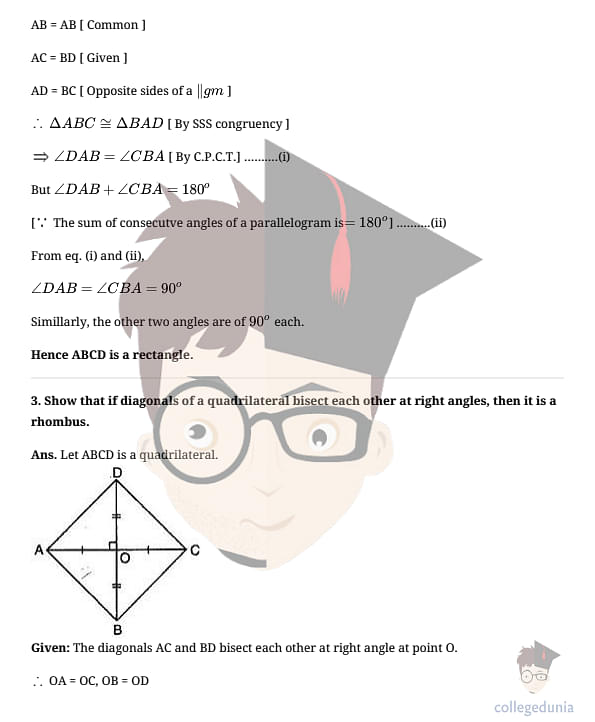
NCERT Solutions for Class 9 Maths Chapter 8 Triangles Exercise 8.1 Solutions

Collegedunia Team logo

Collegedunia Team

Content Curator

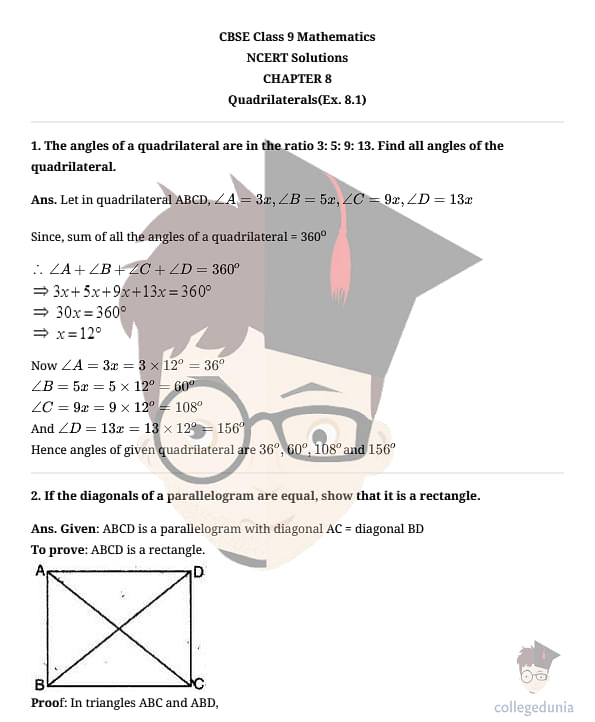
NCERT Solutions for Class 9 Maths Chapter 8 Quadrilaterals Exercise 8.1 Solutions are based on different types of quadrilaterals, and their properties.

Download PDF: NCERT Solutions for Class 9 Maths Chapter 8 Exercise 8.1 Solutions

Check out NCERT Solutions for Class 9 Maths Chapter 8 Exercise 8.1 Solutions
Read More: NCERT Solutions For Class 9 Maths Chapter 8 Quadrilaterals

Exercise Solutions of Class 9 Maths Chapter 8 Quadrilaterals

Also check other Exercise Solutions of Class 9 Maths Chapter 8 Quadrilaterals

Also Check:

Also check:

CBSE X Related Questions

  • 1.
    A trader has three different types of oils of volume \(870 \text{ l}\), \(812 \text{ l}\) and \(638 \text{ l}\). Find the least number of containers of equal size required to store all the oil without getting mixed.


      • 2.
        Prove that \(2 + 3\sqrt{5}\) is an irrational number given that \(\sqrt{5}\) is an irrational number.


          • 3.
            Assertion (A) : If probability of happening of an event is \(0.2p\), \(p>0\), then \(p\) can't be more than 5.
            Reason (R) : \(P(\bar{E}) = 1 - P(E)\) for an event \(E\).

              • Both Assertion (A) and Reason (R) are true and Reason (R) is the correct explanation of the Assertion (A).
              • Both Assertion (A) and Reason (R) are true, but Reason (R) is not the correct explanation of Assertion (A).
              • Assertion (A) is true, but Reason (R) is false.
              • Assertion (A) is false, but Reason (R) is true.

            • 4.
              Assertion (A) : \((\sqrt{3} + \sqrt{5})\) is an irrational number.
              Reason (R) : Sum of the any two irrational numbers is always irrational.

                • Both Assertion (A) and Reason (R) are true and Reason (R) is the correct explanation of the Assertion (A).
                • Both Assertion (A) and Reason (R) are true, but Reason (R) is not the correct explanation of Assertion (A).
                • Assertion (A) is true, but Reason (R) is false.
                • Assertion (A) is false, but Reason (R) is true.

              • 5.
                If \(PQ\) and \(PR\) are tangents to the circle with centre \(O\) and radius \(4 \text{ cm}\) such that \(\angle QPR = 90^{\circ}\), then the length \(OP\) is

                  • \(4 \text{ cm}\)
                  • \(4\sqrt{2} \text{ cm}\)
                  • \(8 \text{ cm}\)
                  • \(2\sqrt{2} \text{ cm}\)

                • 6.
                  For any natural number n, \( 5^n \) ends with the digit :

                    • 0
                    • 5
                    • 3
                    • 2

                  Comments


                  No Comments To Show