


NCERT Solutions for Class 9 Science Chapter 3: Atoms and Molecules

Collegedunia Team logo

Collegedunia Team

Content Curator

The NCERT Solutions for Class 9 Science are provided in this article. Some of the important topics in Chapter 3 Atoms and Molecules include:

Download: NCERT Solutions for Class 9 Science Chapter 4 pdf


NCERT Solutions for Class 9 Science Chapter 3
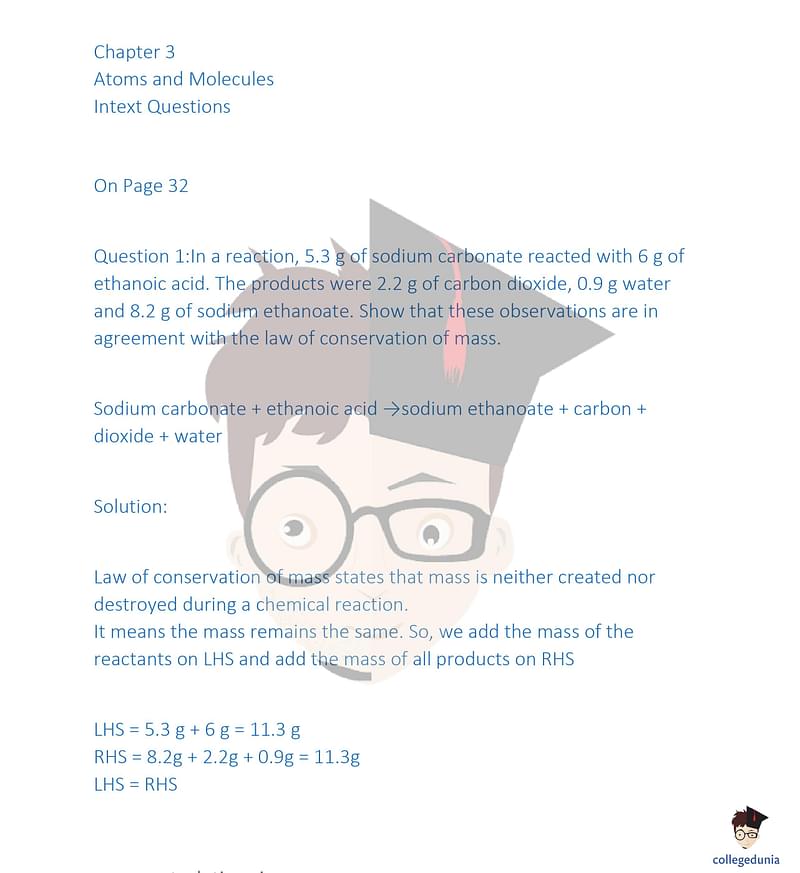
NCERT Solutions

NCERT Solution

NCERT Solution

NCERT SolutionNCERT Solution

NCERT Solution

NCERT Solution

NCERT Solution

NCERT Solution

NCERT Solution

NCERT Solution

NCERT Solution

NCERT Solution

NCERT Solution

NCERT Solution

NCERT Solution

NCERT Solution

NCERT Solution


Class 9 Science Chapter 3 Atoms and Molecules – Important Topics

Atom is the smallest constituent unit of matter that possess the properties of the chemical element. Atoms don’t exist independently, instead, they form ions and molecules which further combine in large numbers to form matter that we see, feel and touch.

Dalton’s Atomic Theory

Dalton’s Atomic Theory hypothesized and further claimed that the law of conservation of mass and the law of definite proportions could possibly de elaborated by using the idea of atoms. According to him, all substances are indestructible building units.

Example: What are two postulates of Dalton’s Atomic Theory?

Solution: The two postulates of Dalton’s Atomic Theory are:

  • The substances around us are composed of matter, which are tiny, indestructible particles called atoms.
  • Every atom of a particular element are identical according to their mass, size, and several other properties. 

Atomic Mass

The complete mass of one atom of a distinct element can be otherwise called as its atomic mass. The unit it has is known as unified atomic mass unit, that is represented by the letter ‘u.’

Example: Calculate the atomic mass of an oxygen isotope that has 9 neutrons.

Solution: To calculate the atomic mass of an oxygen isotope, we need to know the number of protons and neutrons it has.
Number of protons in an oxygen atom = 8
As per the question, the Number of neutrons in oxygen atom = 9
Hence, the Atomic mass of given oxygen atom = number of protons + number of neutrons = 8 + 9 = 17

Mole Concept

Mole concept can be defined as the atomic mass of a mole which is usually measured in grams. Ideally, the gram atomic mass of an element is otherwise referred to as a mole. 

Example: What is the formula of Mole Concept?

Solution: The number of units responsible to compose mole can be evaluated by 6.022 ×10²³. The fundamental constant is called the Avogadro's number (NA) or Avogadro constant. It can be represented using an explicit unit termed per mole. Thus, to calculate Mole Concept,
Number of Moles = (Mass of the Sample)/(Molar Mass)

Read Also:

Also Check:

CBSE X Related Questions

  • 1.
    Which of the following set of compounds does not belong to same homologous series?

      • CH$_4$ and C$_4$H$_{10}$
      • C$_2$H$_6$ and C$_3$H$_8$
      • C$_3$H$_8$ and C$_5$H$_{12}$
      • C$_4$H$_8$ and C$_5$H$_{12}$

    • 2.
      Which of the following is a poor conductor of electricity?

        • Pb
        • Cu
        • Ag
        • Al

      • 3.
        Show the formation of ionic compound CaO with electron dot structure.


          • 4.
            State two differences between the act of chewing food and salivation on sight of food.


              • 5.
                Assertion : In human beings, the respiratory pigment is haemoglobin present in red blood cells.
                Reason (R) : Haemoglobin has a very high affinity for carbon dioxide.

                  • Both, Assertion (A) and Reason (R) are true and Reason (R) is the correct explanation of the Assertion (A).
                  • Both, Assertion (A) and Reason (R) are true, but Reason (R) is not the correct explanation of the Assertion (A).
                  • Assertion (A) is true, but Reason (R) is false.
                  • Assertion (A) is false, but Reason (R) is true.

                • 6.
                  Assertion (A): Carbon shares its valence electrons with other atoms of carbon or with atoms of other elements.
                  Reason (R): The shared electrons belong to the outermost shells of both the atoms and lead to both atoms attaining the noble gas configuration.

                    • Both Assertion (A) and Reason (R) are true and Reason (R) is the correct explanation of the Assertion (A).
                    • Both Assertion (A) and Reason (R) are true, but Reason (R) is not the correct explanation of the Assertion (A).
                    • Assertion (A) is true, but Reason (R) is false.
                    • Assertion (A) is false, but Reason (R) is true.

                  Comments


                  No Comments To Show


