


NCERT Solutions for Class 9 Science Chapter 9 : Force And Laws Of Motion

Collegedunia Team logo

Collegedunia Team

Content Curator

The NCERT Solutions for Class 9 Science Chapter 9 Force And Laws Of Motion are provided in this article below. Some of the important concepts of Class 9 Science Chapter 9 Force and Laws of Motion are:

Download: NCERT Solutions for Class 9 Science Chapter 9 pdf


NCERT Solutions for Class 9 Science Chapter 9
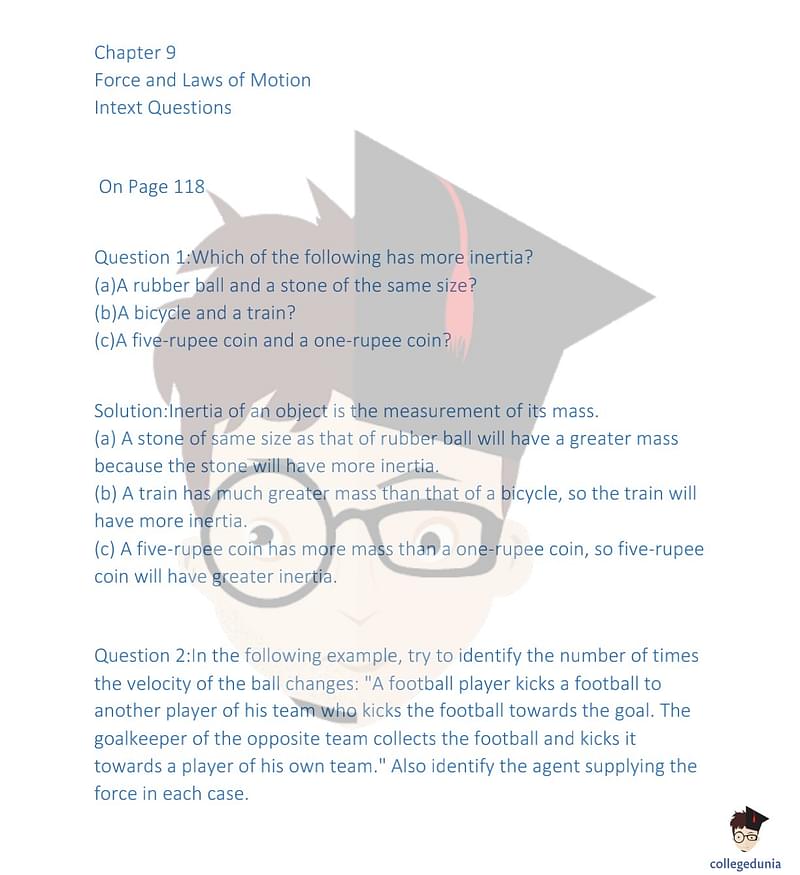
NCERT Solutions for Class 9 Science chapter 9NCERT Solutions for Class 9 Science chapter 9NCERT Solutions for Class 9 Science chapter 9NCERT Solutions for Class 9 Science chapter 9NCERT Solutions for Class 9 Science chapter 9NCERT Solutions for Class 9 Science chapter 9NCERT Solutions for Class 9 Science chapter 9NCERT Solutions for Class 9 Science chapter 9NCERT Solutions for Class 9 Science chapter 9NCERT Solutions for Class 9 Science chapter 9NCERT Solutions for Class 9 Science chapter 9NCERT Solutions for Class 9 Science chapter 9NCERT Solutions for Class 9 Science chapter 9NCERT Solutions for Class 9 Science chapter 9NCERT Solutions for Class 9 Science chapter 9NCERT Solutions for Class 9 Science chapter 9NCERT Solutions for Class 9 Science chapter 9NCERT Solutions for Class 9 Science chapter 9NCERT Solutions for Class 9 Science chapter 9NCERT Solutions for Class 9 Science chapter 9NCERT Solutions for Class 9 Science chapter 9


Important Topics for Class 9 Science Chapter 9 Force and Laws of Motion

Force can be used to change the magnitude of velocity of an object (that is, to make the object move faster or slower) or to change its direction of motion. It is an external agent that can potentially change the state of rest or motion of any body. 

Balanced and Unbalanced Forces

Balanced force can be expressed as two magnitudes, typically equally, with opposite directional forces acting on a body. Unbalanced forces occurs when two forces are seen to act in opposite directions on a body and aren’t equal in either magnitude or in size.

Example of Balanced Force: When a vehicle is pushed with equal force from either sides, it will keep remaining at a resting state. 
Example of Unbalanced Force: The movement of a seesaw.

Laws of Motion

Newton’s laws of motion are the fundamental building blocks of classical mechanics. Motion can be defined as the change in position of a body on basis of its surroundings in a respective time interval. 

Example: What are the Newton’s laws of Motion?

Solution: Newton’s laws of Motion are:

  • First Law of Motion claims that a body will not change its state of rest or motion, unless an external force acts on it.
  • Second Law of Motion claims that the greater the mass of the body, the greater will the required force in order to accelerate it.
  • The Third Law of Motion claims that for every action, there is an equal and opposite reaction.

Conservation Laws

The laws of conservation include but are not limited to conservation of mass, energy, linear momentum and angular momentum. Conservation laws are known to deal with the fundamental forces of nature. 

Example: Give two primary examples of conservation of energy. 

Solution: The two primary examples of conservation of energy are:

  • Electrical energy being converted into sound energy.
  • Mechanical energy being converted into electrical energy.

Also Read:

Read More:

CBSE X Related Questions

  • 1.
    Yeast multiplies by which of the following methods?

      • Fragmentation
      • Binary Fission
      • Multiple Fission
      • Budding

    • 2.
      What is the function of diaphragm in human respiratory system ? Where is it present in human body ?


        • 3.
          In human beings, the implantation of fertilised egg takes place in which part of female reproductive system?

            • Oviduct
            • Cervix
            • Uterus
            • Vagina

          • 4.
            Assertion (A): Carbon shares its valence electrons with other atoms of carbon or with atoms of other elements.
            Reason (R): The shared electrons belong to the outermost shells of both the atoms and lead to both atoms attaining the noble gas configuration.

              • Both Assertion (A) and Reason (R) are true and Reason (R) is the correct explanation of the Assertion (A).
              • Both Assertion (A) and Reason (R) are true, but Reason (R) is not the correct explanation of the Assertion (A).
              • Assertion (A) is true, but Reason (R) is false.
              • Assertion (A) is false, but Reason (R) is true.

            • 5.
              State two differences between pollination and fertilization.


                • 6.
                  The pattern of magnetic field due to a current carrying wire depends upon the shape made by that wire. Justify.

                    Comments


                    No Comments To Show


