



Education Journalist | Study Abroad Strategy Lead
Power is termed as the rate at which work is completed (or similarly, at which energy is transferred). It is a term that refers to anything that gives something the force or energy it needs to function effectively. Using the Power Formula, we can solve the problems and calculations efficiently. A unit of power is equal to one unit of work divided by one unit of time, according to the Power Formula. Simply said, the power of something can be calculated by dividing the amount of work done by the amount of time it took to complete that job. This is the general concept of power; nevertheless, the Power Formula might differ in many situations. As power is defined as the work done by the thing or body divided by the total time taken, the Power Formula varies depending on the required assertions.
| Table of Contents |
Key Terms: Power, Energy, Watt, Work, Force, Horsepower, Power Formula, Joules, Electric Power, Unit of Power, Time, Velocity
Definition of Power Formula
[Click Here for Sample Questions]
The quantity of work performed by a body is referred to as power. Quantity work also involves a force that causes a displacement. Furthermore, the period of time that this force acts to induce the displacement has nothing to do with work. Furthermore, there are moments when we work swiftly and other times when we work more slowly. As a result, power is defined as the rate at which work is completed. It can alternatively be phrased as the rate at which energy is consumed.
Hence in simple words, the Power Formula can be articulated as P = W/t where P stands for Power, W stands for Work and t symbolizes time respectively.
\(P_{av} = \frac{W}{T}\)
Power Formula
The video below explains this:
Power Formula Detailed Video Explanation:
Also Read: Difference between Work and Energy
Power Formula and Its Derivation
[Click Here for Sample Questions]
The Power Formula can be defined as the rate at which we work. It is also the work-to-time ratio. Furthermore, we use this formula or equation to calculate it mathematically.
If a device performs work (W) over time (t), the formula gives its power (P), then the formula will be-
P = W/t
Work (W) can be calculated using the formula: F is the applied force, and s is the displacement induced by the force along its direction.
We can also write the power equation as P = W/Δt
Here, Δt = Change in time
As a result, the Power Formula can also be expressed as-
W F * s
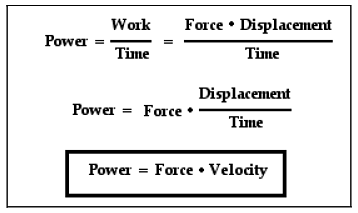
P = W/t = F * s/t
Power is also the rate at which energy is consumed. As a result, the Power Formula may be expressed as-
P = E/t
where Energy (E) denotes the amount of energy consumed and Force (F) and velocity (v) can also be used to express power.
Power
Derivation of Power Formula
Given the above formula- P = W/t
- Power is the unit of a measure calculated in watt,
- W is the work done by the body, and
- t is the time taken to complete the work.
Furthermore, the watt is the standard unit of power measurement. A unit of power is equal to a unit of work divided by a unit of time, according to the Power Formula. A watt is also equal to a Joule per second.
The term "power" is sometimes used to describe the amount of energy delivered by a machine. Similarly, one horsepower is equal to 750 Watt.
Assume you have a 40 horsepower vehicle engine that can accelerate from 0 to 60 miles per hour in 16 seconds. Furthermore, an automobile with four times the horsepower could complete the same task in one-fourth the time. That means a 160 horsepower engine could propel the car from zero to sixty miles per hour in only four seconds. The conclusion is that power and time are inversely related to a given amount of work. Furthermore, a more powerful engine can complete the same task in less time.
Unit of Power Formula
[Click Here for Sample Questions]
Joule (J) is the SI unit of work, and the second is the SI unit of time (s). As a result, Js–1 is the SI unit of power. The watt (W) is a unit of power that was named after James Watt.
If a device can work at a rate of one joule per second, it is said to have one watt of power.
The horsepower (hp) unit is another typical unit for measuring power, with 1hp equaling 746W.
-
Dimensional Formula of the Power Formula
Power (P) = Work (W) × time-1 (t inverse)= Joule × second-1 — (1)
We know that Work (J) = N × m = M1 L1 T-2 × L
Hence, the dimensional formula of work will be = M1 L2 T-2 — (2)
When we substitute equation (2) for equation (1), we get
Power (P) = Work (W )× time–1 (t inverse)
or, P = [M1 L2 T-2] × [T–1]
= [M1 L2 T-3]
The dimensional formula of power is hence represented as [M1 L2 T-3] where M stands for Mass, L stands for Length and T stands for time respectively.
Electric Power Formula
[Click Here for Sample Questions]
Power can be calculated with the help of the following formulas:
1st Electrical Power Formula: P = V × I (Eq. 1)
2nd Electrical Power Formula: P = I2R (Eq. 2)
Combine Eq. 1 and Eq. 2
P = V2/R
Here,
- V: potential difference in the circuit
- I: Electric current
- R: Resistance
The power factor formula is used to calculate the power in a circuit with active voltage and current within the specified time along with the unknown parameters of resistance, voltage, and current.
Solved Examples on Electric Power Formula
[Click Here for Sample Questions]
Example 1: A mobile phone’s battery works at 12.0 V and requires to provide a current of 0.9 A whenever music plays. How much power will be required for the same?
Solution: The Power required from the battery can be found by applying the electric power formula.
Thus, P = VI
P = (12.0 V) (0.9 A)
P = (12.0 J/C) (0.9 C/s)
P = 10.8 J/s
P = 10.8 W
Hence, the power required by the battery of the mobile phone is 10.8 W.
Example 2: An electrical circuit consists of resistance 3Ω and a current 4A flowing through it. Calculate the power.
Solution: I = 4A & R = 3Ω
Electric power formula= P = I2R
P = 42×3
P = 16×3 = 48 Watts
Also Read: Difference Between Voltage and Current
Power Formula for Other Relations and Units
[Click Here for Sample Questions]
The work done by any specified object or source per unit of time can be defined as the Power Formula. Suppose for instance- what does it mean if A and B are two people working on the same assignment, but A completes the task before B?
Simply said, A is more efficient than B, and since efficiency is proportional to power, we may say that A is more powerful than B. This is precise what power is; it is defined as the amount of work performed by a body in a certain amount of time.
As power is defined as the work done by the thing or body divided by the total time taken, the Power Formula varies depending on the required assertions; for example, it may differ for force-related things and electronic equipment. Below given the Power Formula for other relations and units-
- P = VI
According to Ohm's Law, power is proportional to the conductor's potential difference. Here, P denotes power, V denotes potential difference, and I denotes current. The watt is the SI unit of measurement. The unit of V is volt, while the unit of I is Coulumb.

Ohm’s Law
- P = R × I2 or V2/ R
Ohm's law is a version of these formulas. R denotes resistance, V denotes potential difference, and I denotes current. According to this formula, power is proportional to the square of potential difference and inversely proportional to the conductor resistance.
- P = E/t
The mechanical power equation is another name for this formula. E denotes energy in joules, while t denotes time in seconds. Power is defined as the use of energy per unit of time, according to this formula.
- P = w/t
The work-energy theorem is used to generate this formula. Power is defined as the amount of work done per unit of time. W denotes work in joules, and t denotes time in seconds.
- P = (F × s) / t
F stands for the force applied in this formula. The object's displacement is denoted by s, and the total time taken is denoted by t. It asserts that power is the whole time it takes for an object to move from one location to another when an external force is applied to it.
As previously stated, the Power Formula varies for each field, but its meaning is nearly the same across the board.
Check More:
Applications of Power Formula
[Click Here for Sample Questions]
- The Power Formula is used to calculate the amount of work done by a specific object or person at a specific moment.
- It can be used to determine which objects are more efficient and which are less efficient. For example, suppose x and y are working on the same activity and x finishes in 4 hours while y finishes in 6 hours. It indicates that "x" is more efficient than "y." It's only that x has greater power than y.
- From the above example, it is clear how power can aid in establishing how much work is completed and when it was completed. We can also make appropriate evaluations and conclusions based on our knowledge of someone's or something's work efficiency.
Things to Remember
- The rate of doing work is defined as power. It's also known as the rate at which energy is consumed.
- In simple terms, the power of something may be calculated by dividing the amount of work done by the amount of time it took to complete that job. It is known as Power Formula.
- The formula is known as "Ohm's law," after the physicist Ohm who devised it. P = VI is a formula in which p denotes power, V denotes potential difference, and I denotes current.
- Ohm's law has a variation that runs like P = r × l2 or V2/ R, which is the electric Power Formula. The letters R, V, and l stand for resistance, potential difference, and current, respectively.
- P = E/t, or mechanical power equation, where P denotes power, E denotes energy, and t denotes time in seconds. Power is defined as the use of energy per unit of time, according to this formula.
Sample Questions
Ques. Is there a difference between power and electricity? (3 Marks)
Ans. Though Electricity and Power are the terms that are used interchangeably, however, there is a major difference between Power and Electricity.
Electricity is the type of energy used to power household equipment such as fans, tube lights, refrigerators, and so on, whereas power is the rate at which electrical energy is consumed. However, Electricity is also considered as power as it is produced by electrical means and thus is called “electric power”.
Ques. John, who weighs 60 kg, can jump 12 metres in 40 seconds. Calculate his power. (3 Marks)
Ans. The solution is as follows:
Mass (m) = 60 kg,
Height (h) = 12 m,
Time taken (t) = 40 seconds.
As formula for Power will be = work done/time taken
Power = mgh/t = (60 * 9.8 * 12)/40 = 588 Watt
Ques. Calculate how much power it takes a person to raise an object to a height of 8 metres in 10 seconds. In addition, the object weighs 5 kg. Take g = 10 m/s2 . (3 Marks)
Ans. To calculate work, start by determining the person's work that is equivalent to the potential energy at that height.
Mass (m) = 5 kg
Height (h) = 8 metres
Time (t) = 10 seconds
Given g = 10 m/s2
Work (W) = mgh = 5 × 8 × 10 = 400J
Power = Work/Time = 400/10 = 40J/s
Ques. In 2 minutes, a 50-kg person can run up 10 metres of stairs. Gravitational acceleration (g) is 10 m/s2. Determine the power. (5 Marks)
Ans. Mass = 50 kg
Height = 10 m
Acceleration due to gravity = 10 m/s2
Time interval (t) = 2 minute = 2 * 60 = 120 seconds
P = W / t
W = F s = w h = m g h = (50)(10)(10) = 5000 Joule.
P = W / t = 5000 / 120 = 41.7 J/s
Ques. Five rounds are rotated by a rotary comedy with a power of 300 watts and a time of 5 minutes. Calculate the power. (5 Marks)
Ans. Power (P) = 300 Watt = 300 J/s
Period (T) = 5 mins = 5 (60 secs) = 300 secs
Number of rotations = 5
Power= Energy/Time
Energy= Power*Time
Energy used during 1 rotation:
Energy=300*300= 90,000 Joule
Energy used during 5 rotations:
Energy=5*90000 Joule= 450,000 Joule
Energy= 450 Kilo Joule
Ques. Which of the two bulbs with 50W and 100W power ratings will be brighter? (2 Marks)
Ans. Because the 100W bulb consumes more electrical energy and converts it into light energy in less time, it is brighter than the 50W bulb.
Ques. What is the relationship between power, force, and velocity? (3 Marks)
Ans. The formula for linking power to force and velocity is P = Fv, where P denotes power, F denotes force, and v denotes velocity.
Assume that force F is acting on a body for a time t. If the body moves along the direction of the applied force to a distance s during this time, then the work done by that force will be W = F x s
Again, P = W/t= Fs/t = Fv (As = v/t)
Power = Applied Force x Velocity of the Body
Ques. An electric machine uses 300 J of energy to do a task in tens of seconds. How much energy does it consume? (3 Marks)
Ans. Work done by the machine W = 300 J,
Time taken t = 10 s.
Power P = W/t = 300/10 = 30 Watt
Check More:



Comments