



Content Curator
Electrical Formula Important Questions include important Class 12 Current Electricity formulas including Capacitance, Charge, Inductance, Power, Resistance, among others. The most commonly used electrical formulas are voltage, current, power, and resistance.
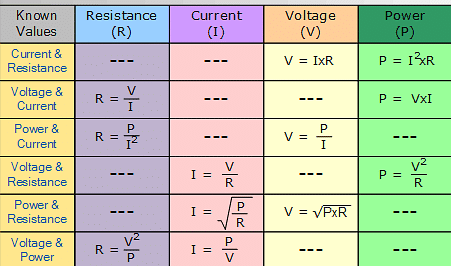
Electrical Formula
Very Short Answer Questions [1 Marks Question]
Ques. Define the term ‘Mobility’ of charge carriers in a conductor. Write its S.I. unit. (Delhi 2014)
Ans. Mobility of charge carriers is defined as the magnitude of the drift velocity per unit of electric field E.
\(\therefore \mu = | \frac{V_d}{E} | = \frac{e\pi}{m}\)
Ques. A wire or resistivity ρ is stretched to double its length. What will be its new resistivity?
Ans. The resistivity remains the same as it does not depend upon the length of the wire.
Ques. Which physical quantity does the voltage versus current graph for a metallic conductor depict? Give its SI unit.
Ans. It represents resistance. It is measured in ohm.
Ques. A resistance R is connected across a cell of emf ε and internal resistance r. A potentiometer now measures the potential difference between the terminals, of the cell as V., Write the expression for ‘r’ in terms of ε, V and R. (CBSE Delhi 2011)
Ans. The required relation is r = (ε/V−1)R
Ques. Define the term ‘Mobility’ of charge carriers in a conductor. Write its S.l. unit. (CBSE Delhi 2014, AI 2015)
Ans. Mobility of charge carriers in a conductor is defined as the magnitude of their drift velocity per unit applied electric field. Its SI unit is m2 V-1 s-1.
Ques. Nichrome and copper wires of the same length and same radius are connected in series. Current l is passed through them. Which wire gets heated up more? Justify your answer. (CBSEAI 2017)
Ans. Nichrome, as it has more resistivity.
Short Answer Questions [2 Marks Question]
Ques. State the underlying principle of a potentiometer. Write two factors on which the sensitivity of a potentiometer depends. In the potentiometer circuit shown in the figure, the balance point is at X. State, giving a reason, for how the balance point is shifted when

(i) resistance R is increased?
(ii) resistance S is increased, keeping R constant? (Comptt. Delhi 2012)
Ans. Potentiometer: A potentiometer is a device used to measure potential differences.

Principle. When a current flows through a wire of uniform thickness, the potential difference between its two points is directly proportional to the length of the wire between these two points.
Two factors :
(a) Potential gradient
(b) Length of potentiometer wire.
(i) When R is increased, the balance point will shift towards B.
(ii) If resistance S increases keeping ‘R’ constant, the balance points will not change.
Ques. Define the mobility of a charge carrier. Write the relation expressing mobility in terms of relaxation time. Give its SI unit. (Comptt. All India 2013)
Ans. Mobility of electron p is defined as the magnitude of the drift velocity per unit of electric field E

Ques. In the electric network shown in the figure use Kirchhoff's rules to calculate the power consumed by the resistance R = 8 Ω. (Comptt. Delhi 2012)
Ans. In loop BCDA,
I1 × 4 + (I1 + I2) × 8 = 12
4I1 + 8I1 + 8I2 = 12
12I1 + 8I2 = 12
∴ 3I1 + 2I2 = 3 … (Dividing by 4) … (i)
In loop ADFE,
(I1+ I2) × 8 = 8 => 8I1, + 8I2 = 8
∴ I1 + I2 = 1 …(Dividing by 8)
Solving equations (i) and (ii), we get
I1 = 1A and I2 = 0A
∴ Power consumed in 80 resistance (R) = I2R
= (I1 + I2)2 × R
= (1 + 0)2 × 8 = 8 watt
Long Answer Questions [3 Marks Question]
Ques. In a meter bridge, the null point is found at a distance of l1 cm from A. If now resistance of X is connected in parallel with S, the null point occurs at l2. Obtain a formula for X in terms of l1 l2 and S. (Delhi 2010)

Ans. (i) Meter bridge: Meter bridge is an arrangement of four resistances used for measuring one unknown resistance in terms of the other three known resistances.

At the balance condition, no current flows through the galvanometer arm. By using the balance condition of meter bridge, the value of unknown resistance can be determined, knowing the other three resistances.
(ii) With R and S alone, we have
\(\frac{R}{S}=\frac{l_1}{(100-l_1)}...(i) \implies R((100-l_1)=Sl_1\)
With S and X in parallel and R on the left gap

Also check:



Comments