



Education Journalist | Study Abroad Strategy Lead
Ribosomes are macromolecular compounds involved in the synthesis or translation of proteins in all cells. Ribosomes are a kind of cell organelle present in all living beings that are found in both prokaryotic and eukaryotic cells. Prokaryotes have 70S ribosomes whereas eukaryotes have 80S ribosomes. The main function of ribosomes is protein synthesis, which is essential for many cell activities such as damage repair and other chemical processes. Ribosomes are composed of two subunits namely the small ribosomal subunits, which read the mRNA and the large ribosomal subunits, which form polypeptide chains of amino acids.
| Table of Content |
Key Terms: Ribosomes, Polynucleotides, Ribonucleoproteins, Protein Synthesis, Amino Acids, Cells, 70S Ribosomes, 80S Ribosomes, Prokaryotes, Eukaryotes
What are Ribosomes?
[Click Here for Sample Questions]
The ribosome is a complex molecular structural mechanism found in cells that produce proteins from amino acids in protein synthesis or translation. The process of protein synthesis plays an important role in every cell. Ribosomes are present in both types of cells- prokaryotic, and eukaryotic cells.
Ribosomes are needed in each cell to make the protein synthesis and exports. These subunits act by binding to the messenger ribonucleic acid (mRNA) and encrypting the information provided by the nucleotide of the mRNA. They circulate RNAs with amino acids and enter the receptor site into the ribosome. When it binds, it binds amino acids to the RNA growing protein chain.
70S ribosomes are found in prokaryotic cells, mitochondria, and plastids, whereas 80s ribosomes are in eukaryotic cells. Different enzymes catalyze different stages of protein synthesis from ribosome mutations. The synthesis of ribosomal proteins follows a similar pattern in many organisms.

Ribosomes in A Cell
Read More: Difference between 70s and 80s Ribosomes
Occurrence of Ribosomes
[Click Here for Sample Questions]
Ribosomes are found in all animal and plant kingdoms. They are also found in prokaryotes. Red blood cells are the only type of cell that does not have ribosomes. The density of ribosomes for each species is constant. Cells with high protein synthesis are abundant in ribosomes, and cells without protein synthesis have fewer ribosomes.
Distribution of Ribosomes
[Click Here for Sample Questions]
Ribosomes are present in the cytoplasm of prokaryotic cells. Ribosomes appear in the cytoplasm of eukaryotic cells or bind to the outer membrane of the endoplasmic reticulum. If they do not bind to the ER, they are called bound ribosomes. Free ribosomes synthesise the proteins required for the enzymatic composition of the cytoplasmic matrix.
Read More: Difference between Lysosome and Ribosome
Number and Concentration of Ribosomes
[Click Here for Sample Questions]
Ribosomes can be found in all cells and in the endoplasmic reticulum. Rabbit reticulocytes have about 100 μ3 ribosomes, which correspond to about 1x10⁵ cells per reticulocyte. About 5% of the total cell volume. The size of the cell is 20,000 to 30,000. However, as malnutrition reduces protein synthesis, the number of ribosomes in cells and the number of pathogens leading to protein depletion decreases.
Chemical Composition of Ribosomes
[Click Here for Sample Questions]
Proteins and RNA are the main constituents of ribosomes. Lipids cannot be seen. 60-65% RNA and 35-40% protein by weight of E. coli ribosomes. Ribosomal RNA differs from most tRNAs and other classes of RNA in size and important content in most cells. Each ribosome has two different RNAs.
Structure of Ribosomes
[Click Here for Sample Questions]
A ribosome is a group of RNAs and proteins called ribonucleoproteins. It has two sections - small and large subunits. Amino acids are added to the larger subunit, which is the smaller subunit that binds the mRNA. Both groups contain protein and ribonucleic acid components. The two groups join with the interaction of RNAs in one group and proteins in the other. Ribosomes are found in the cytosol of plant cells and animal cells. Prokaryotes have 70S ribosomes and eukaryotes have 80S ribosomes. 62% of the ribosomes are made up of RNA and the rest are made up of proteins. The structure of free and bound ribosomes is uniform and involved in protein synthesis.
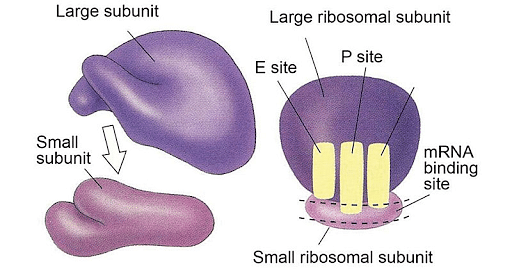
Structure of Ribosomes
Read More: Nucleoplasm
Functions of Ribosomes
[Click Here for Sample Questions]
The important functions of ribosomes are as follows:
- They organise amino acids to produce the proteins needed for cell function.
- DNA produces mRNA through the process of transcription.
- mRNA is synthesized in the nucleus and sent to the cytoplasm for protein synthesis.
- Ribosomal subunits in the protoplasm bind to mRNA polymers. Then tRNA synthesizes proteins.
- The proteins synthesised in the protoplasm are used in the cytoplasm, while the proteins synthesised by the associated ribosomes on the endoplasmic reticulum are transported to other cells.
Things to Remember
- Ribosomes are important cellular organelles that work together with accumulated proteins, hence the cellular protein plant.
- There are two types of ribosomes namely 70s ribosomes found only in prokaryotic cells, and the 80s are found only in eukaryotic cells.
- There are many ribosomes. Thousands of ribosomes can be found in a single cell.
- Ribosomes are organelles involved in protein synthesis. It should be used for cellular functions such as protein synthesis, detoxification and other chemical processes.
- The ribosome has a unique structure, which is the basis of the ribonucleoprotein or RNA protein. The size of the ribosome varies between 20-30 nanometers.
- The prokaryotic ribosomes are in the 70s. Eukaryotic ribosomes are in the 80s.
Read More: Stages of Transcription and RNA Polymerase
Sample Questions
Ques. What are ribosomes? Who discovered and named ribosomes? (3 Marks)
Ans. Ribosomes are electron microscopy without membranes, ribonucleoproteins, RER-bound, or free-flowing in the cytoplasm and with protein synthesis.
In 1943, Claude discovered a basophilic body and named it a microsome. Palad (1955) coined the term ribosome (the formation of animal cells).
Ques. Write about the occurrence of ribosomes in the cell. (3 Marks)
Ans. In prokaryotes, ribosomes are found only in the free form in the cytoplasm. Ribosomes in the eukaryotes are in two forms in the cytoplasm, the free form and the binding form (binding to the RER and the outer nuclear membrane). It is also found in mitochondria and plastids
Ques. What are the two types of ribosomes? (3 Marks)
Ans. There are two types of ribosomes namely:
- 70S Ribosomes: These are found in eukaryotic prokaryotes, mitochondria and plastids.
- 80S Ribosomes: These are found in the cytoplasm of eukaryotes.
Ques. Write the structure of ribosomes. (3 Marks)
Ans. Each ribosome consists of two uneven subunits that bind only during protein synthesis. The ribosomes have large and small subunits 70S and 80S, 50S and 30S, 60S and 40S. Large subunits bind to ER with glycoproteins called "riboforins". Ribosomes bind to ER through hydrophobic interactions.
Ques. What is the chemical composition of ribosomes? What are polysomes? (3 Marks)
Ans. Ribosomes are composed of rRNA and proteins. So the ribosomes are biochemically termed ribonucleoprotein (RNP) proteins.
When several ribosomes (usually 68) bind to some mRNA binding, the structure is called Polyribosomes or polysomes: It is a functional unit for the production of many proteins.
Ques. What are the functions of ribosomes? (3 Marks)
Ans. The functions of ribosomes are:
- Ribosomes are also called protein production cells or protein benches.
- Free ribosomes synthesize structural proteins, while limited ribosomes synthesize transport proteins.
- Ribosomes are needed for the production of enzymes (all enzymes are proteins).
Ques. How do ribosomes function? (2 Marks)
Ans. The two ribosomal subunits come close together and link with the mRNA during the process of protein synthesis. After binding to the mRNA they start the process of protein.
Ques. What are the differences between prokaryotic and eukaryotic ribosomes? (5 Marks)
Ans. The major differences between prokaryotic and eukaryotic ribosomes are tabulated below:
| Prokaryotic Ribosomes | Eukaryotic Ribosomes |
|---|---|
| They are present in bacteria and blue-green algae. | They are present in protists, fungi, plants and animals. |
| The sedimentation coefficient of prokaryotic ribosomes is given as 70S. | The sedimentation coefficient of eukaryotic ribosomes is given as 80S. |
| They are 70s ribosomes with 30s and 50s subunits | They are 80s ribosomes with 40s and 60s subunits |
| They are comparatively smaller. | They are comparatively larger. |
| They are freely floating in the cytoplasm. | They are free in the cytoplasm and attached to the endoplasmic reticulum and nuclear membrane. |
Also Read:
Also Read:




Comments