



Content Curator
Taxonomical aids are preserved specimens of living organisms that aid in extensive research for taxonomic hierarchy identification. This classification of organisms into distinct categories helps in extensive field and laboratory research. This taxonomic categorization further facilitates the identification of numerous species that are required in various domains such as agriculture, industry, bio resources, etc. This article briefs on the types and applications of taxonomical aids.
| Table of Content |
Key Terms: Taxonomic Aid, Taxonomy, Herbarium, Museum, Zoological Park, Scientific Names, Binomial Nomenclature
Also Read: Classification of Animal Kingdom
What are Taxonomical Aids?
[Click Here for Sample Questions]
The living world consists of billions of microbes, plants, and animal species. To learn more about these, it is critical to classify the species into groups based on comparable characteristics. Taxonomy is a scientific method for classifying and organizing living organisms into groups based on similar traits. Taxa are the groups into which organisms are classified, and they are given a taxonomic rank to indicate a hierarchy in taxonomic classification.
Modern taxonomy, founded by Carl Linnaeus, a Swedish botanist, is also called Linnaean taxonomy. This classification contains descending ranks of kingdom, phylum, class, order, family, genus, and species. This contemporary taxonomic system has further progressed into phylogenetics and has established evolutionary links between living and extinct animals and species.
Also Read: Diversity in Living Organisms
Types of Taxonomical Aids
[Click Here for Sample Questions]
Herbarium
Herbarium is a store where one can find a variety of preserved plant species. Plant specimens are kept on herbarium sheets, which are made by drying, pressing, and preserving samples on sheets. These sheets are then organized in the taxonomic hierarchy in order of classification. These herbarium sheets provide all of the relevant information about the specimen.
Botanical Garden
Botanical Gardens have specific plants grown and labeled based on their taxonomic classification. The labels include their scientific names as well as their family names. The primary goal of botanical gardens is to identify the plants that are being studied.
Museum
Biological museums, like the biology laboratories in our classrooms, can be found in schools and colleges. Plants and animals are preserved in jars or suitable containers in these museums. They can be dried and kept as well. Birds and larger animals are typically stuffed before being preserved, whereas insects are killed and pinned in boxes. We occasionally come across skeletons of numerous animals.
Zoological Park
Zoological parks are areas where animals and birds are housed in secure enclosures. Their habitat is tried to be kept as close to their natural habitat as possible. As a result, there is ample opportunity to learn about their natural habits and behavior. Humans are welcome to visit zoological parks.
Key
A key is a taxonomic aid in which plants and animals are identified using keys that contrast their traits. In most cases, two contrasting keys are retained together as a pair, resulting in acceptance of one and rejection of the other.
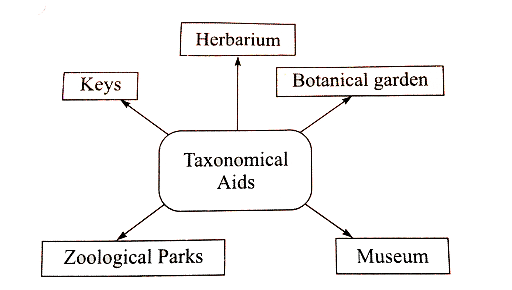
Taxonomical Aids Classification
Uses of Taxonomical Aids
[Click Here for Sample Questions]
Following are the advantages of categorizing living things:
- Animals can be classified into appropriate categories using plainly observable characteristics. This makes the patterns in them easier to comprehend.
- The classification of living things aids in the study of evolutionary links among all organisms.
- Classification makes it easier to deal with newly discovered organisms by grouping them together.
- Information on specimens can be stored and preserved for a very long time.
- Training in systematics becomes useful while classifying an organism.
- Identification of organisms is helpful in both laboratory and field research.
Also Read: Structural Organisation in Animals
Binomial Nomenclature
[Click Here for Sample Questions]
- Binomial Nomenclature is a system for naming creatures. Giving organisms scientific names aids in their classification. Different names make it easier to see how a species interacts with other organisms in the same genus. Binomial Nomenclature is crucial in this regard. The following are the rules of binomial nomenclature: -
- Any organism's scientific name is made up of two words.
- The first term is the genus name, while the second is the species name for the provided organism.
- The name of the 'genus' is given the first word, which always begins with a capital letter.
- The specific name, which is the second word, always begins with a small letter.
- Biological names are usually in Latin and it is written in italics.
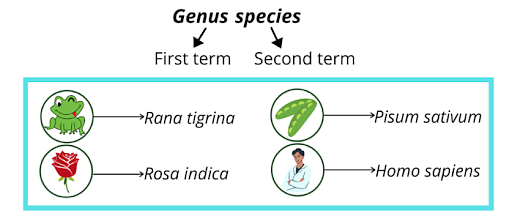
Binomial Nomenclature Example
Things to Remember
- Taxonomic aids are a collection of diverse preserved creatures that aid in conducting extensive research in order to determine the type of taxonomic hierarchy.
- Taxonomy is the branch of biology concerned with the study of an organism's identification, categorization, and naming.
- Taxonomic categorization aids in the identification of various species that play important roles in bio resources, industries, agriculture, and other fields.
- Types of taxonomical aids are Herbarium, botanical garden, zoological parks, museums, and key.
- Binomial nomenclature and its rules are used in naming any species of living organisms.
- In much of Herbaria, the Bentham and Hooker system is used.
Also Read: Classification of Organisms
Sample Questions
Ques. What is taxonomy? (3 marks)
Ans. Taxonomy is the branch of biology concerned with the study of an organism's identification, categorization, and naming. The method used to categorize diverse species into distinct groups necessitates a large quantity of laboratory and field research. Taxonomic categorization aids in the identification of various species that play important roles in bio resources, industries, agriculture, and other fields.
Ques. What are taxonomic aids? Give two examples? (2 marks)
Ans. Taxonomic aid is the study of numerous plant, animal, and microbial species that require accurate identification, categorization, and information. Herbarium and Botanical Garden are two examples.
Ques. What is a Herbarium sheet and write its procedure? (5 marks)
Ans. A herbarium is a collection of preserved plant specimens as well as the data associated with that plant. The method of making herbarium was first described in Italy in the year 1532, bu Luca Ghini, an Italian physician and botanist, and his students devised the method.
The procedure is as follows:
- The specimens that are stored can be the entire plant or a component of it, such as leaves, flowers, and so on.
- A correct approach must be followed to ensure that the kept specimen has the longest possible shelf life.
- After gathering the plant or its parts, they are usually cleaned and dried before being mounted on sheets of paper. Exsiccatae is the name given to this procedure.
- Depending on the specimen being maintained, multiple storage methods are used to create a herbarium.
- Samples are sometimes kept in boxes or preserved in chemicals such as alcohol. A fungarium is a collection of fungi maintained in a similar way, and a xylarium is a collection of wood specimens.
Ques. What is Key? (5 marks)
Ans. Keys (also known as identification keys) are tools that enhance the process of identifying plants, animals, and other biological beings based on their features in the study of taxonomy. Keys can be printed or computer-based. Some interesting features of a key are:
- To identify the organism, the user must answer a question about the biological entity's characteristics or qualities.
- The keys are commonly defined as single-access, which has a certain sequence of steps for the identification process.
- A dichotomous key has two choices in each step; a polytomous key has more than two alternatives in each phase.
- The pair of alternatives in dichotomous keys is known as a couplet, and each alternate is known as a lead.
- Multi-access keys have recently been implemented, allowing users to choose the procedures for identifying their organism as well as the order in which the stages are performed.
- Keys can be used to identify a wide range of microbes and fossils.
Ques. Write the significance of Taxonomical aid? (5 marks)
Ans. The following are some of the benefits of Taxonomical Aids:
- Taxonomic tools assist in the storage and preservation of data as well as specimens.
- Actual specimens of animal and plant species are required for taxonomic investigations and are the major source of data.
- These skills are also necessary for systematics training, which is used to classify organisms.
- As a result, taxonomic aids make it easier to identify, name, and classify creatures using actual specimens obtained from the field and kept as referrals in herbaria, museums, and other places.
- Ex-situ conservation approaches for plants and animals include botanic gardens and zoological parks.
Ques. Write the rules of Binomial Nomenclature? (3 marks)
Ans. The following are the rules of binomial nomenclature:
- Any organism's scientific name is made up of two words.
- The first term is the genus name, while the second is the species name for the provided organism.
- The name of the 'genus' is given the first word, which always begins with a capital letter.
- The specific name, which is the second word, always begins with a small letter.
- Biological names are usually in Latin and it is written in italics.
Ques. What is a Museum? (4 marks)
Ans. A museum is a place where artifacts and specimens of archaeological, cultural, aesthetic, and scientific interest are preserved. These exhibitions are open to the public and are used for both study and presentation.
Following are the features of a museum:
- The museum has extensive collections of life-sized animal models, plant specimens, diverse fossils, geological samples, fungi, and other natural history exhibits.
- They are useful not just in taxonomic studies, but also in evolutionary studies, paleontological studies, and geological research.
- The collections are kept in the best possible condition, with proper storage and security.
- The Natural Museum of China (Beijing, China), the Swedish Museum of Natural History (Stockholm, Sweden), etc.
Read More:
Also Read:



Comments