



Content Writer
Types of sets are classified on the basis of number of elements. A set is defined as a collection of objects that have elements of the same type. These elements are fixed, and they cannot be changed.
- There are basically nine different types of sets, including empty set, finite set, singleton set, equivalent set and subset.
- Power set, Universal set, superset and infinite set are other different categories of sets.
- The concept of a collection of objects and elements is included in NCERT Class 11 Mathematics.
- A set is represented by a capital letter, and its elements are represented by curly brackets.
- The total number of elements in the set is called the cardinal number.
- For example, Rivers like Ganga, Yamuna, and Krishna can be put under the collection of rivers in India and form a set of rivers.
- If we add another river, say the Nile, it will not be a part of this set as the Nile does not flow in India.
| Table of Content |
Key Terms: Set, Types of set, Functions, Empty set, Finite set, Equivalent set, Subset, Universal set, Superset, Infinite set, Singleton set, Equal set, Power set, Cardinal Numbers, Elements
What is a Set?
[Click Here for Sample Questions]
Sets are a well-defined collection of objects. In simple words, the elements of a set are distinct, but their type remains the same. It gives us an idea about relations and function.
- The elements in the set cannot be repeated.
- A set is represented by capital letters, while the elements inside it are represented by small letters.
- It can be represented in Semantic and Roster Forms.
- The theory was introduced by Georg Cantor, a German mathematician.
- The elements could be numbers, letters, shapes, etc.
- All the elements in the set are interrelated to each other and share a common property.
Example of What is a Set?Example: Find A U B and A ⋂ B and A – B. If A = {a, b, c, e} and B = {c, d, f}. Ans. A = {a, b, c, e} and B = {c, d, f} A U B = {a, b, c, d, e, f} A ⋂ B = {c} and A – B = {a, b, e} |

Sets
Also check:
| Related Topics | ||
|---|---|---|
| Set Operations | De Morgan’s Laws | Set Theory Symbols |
| Set Formulas | Number Theory | Group Theory |
Types of Sets
[Click Here for Sample Questions]
Sets are of various types depending on their characteristics, which are as follows:
Empty Set
As the name suggests, an empty set is that set that has no element in it. It is also known as a null or void set and is represented by
Φ or {}. Example of Empty SetExample: For example: Let Set A= {a: a is the number of students studying in class 9th and 10th}. Since no student can study in two classes simultaneously, therefore there will be no element in Set A. Thus, Set A is an example of an empty set. |

Empty Set
Singleton Set
A set containing only one element is called a singleton set. It is also known as Unit Set.
Example of Singleton SetExample: For example Set A= {9} is a singleton set as the only element of Set A here is 9. |

Singleton Sets
Finite Set
As the name suggests, a finite set has a finite number of elements. It consist of countable elements.
Example of Finite SetExample 1: For example: Set A= {2, 3, 4, 5, 6}. Example 2: Set of all days in a week can also be another example of a finite set. |
Infinite Set
Any set that has an infinite number of elements in it is called an infinite set. It consists of uncountable elements.
Example of Infinite SetExample 1: For example Set A= {Number of birds in India}. Example 2: We can only get an approximate idea about the number of birds in India as they are really large and it can be difficult to calculate. Example 3: Another example can be a set of all integers. |
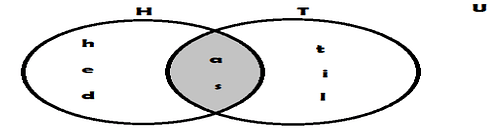
Infinite Sets
Equal Set
Equal Set are those sets in which elements of one set are the same as elements of another set. The sequence of elements can be any but the same elements are present in both sets.
Example of Equal SetExample: For example: if Set A= { 4,5,6,7} and Set B= {7,6,5,4} , then Set A and Set B are equal sets. |

Equal Sets
Subset
Set X will be a subset of Y if all the elements of set X are also the element of set Y. Therefore X will be a subset of Y and will be represented as X⊂Y. One thing to note about the set is every set is a subset of itself.
Example of SubsetExample: For example, Set Y= all the students of a school and set X= all the students of class 9th. |
Power Set
The collection of all subsets of a set X is called the power set of X. It is denoted by P(X) where every element of it is a set.
Example of Power SetExample: For example: For Set A= {a, b, c}, {}, {a}, {b},{c}, {a, b},{b, c}, {a, c} and {a, b, c} are all subsets of set A and together they are power set of set A. |

Power Sets
Universal Set
Universal Set is the basic set that has all the elements of other sets. It forms the base for all other sets. It is represented by the U. A point to note is that all the sets are the subsets of the universal set.
Example of Universal SetExample: For example: Set A= {3,4,5}, Set B={5,6,7,8} and Set C={8,9,7}
|
Disjoint Set
If there is no common element between two sets, i.e if there is no element of Set A present in Set B and vice versa, then they are called disjoint sets. It is represented as A ∩ B = Φ
Example of Disjoint SetExample: A = {1,8,9} and B = {4,5,2}. Set A and B are disjoint sets as they have all different elements. |
Overlapping Set
Two sets that have at least one common element are called overlapping sets.
Example of Overlapping SetExample: For example: Set A= {1, 2, 3} and set B= {3, 4, 5}, then they are overlapping sets as 3 is common in both. |

Types of Sets
Things to Remember
- A set is defined as a collection of elements or objects.
- Elements of the set are denoted by the symbol '∈'.
- There are nine different types of sets.
- The complement of a set is the set of all elements in the given universal set U that are not present in A.
- The difference of sets can be calculated by finding the elements of one set that are not present in another.
- The common elements among two sets make the intersection of sets.
- The union, as the name suggests, is when the elements of two sets are united.
Also check:
Sample Questions
Ques: A = {1, 2, 3, 4} and B = {5, 6, 7, 8}.
Find the difference between the two sets:
(i) A and B
(ii) B and A? (2 marks)
Ans: The given two sets are disjoint sets since there is no common element in both.
(i) A - B = {1, 2, 3, 4} = A
(ii) B - A = {5, 6, 7, 8} = B
Ques: In the following, state whether A=B or not,
A= { a, b, c, d}
B= {d, c, b, a}? (2 marks)
Ans: Elements of Set A= a, b, c, d
Elements of Set B= a, b, c, d
Each element of Set A is the same as each element Set B
Therefore A=B
Ques: Is a set of odd natural numbers divided by 2 a null set? Explain? (2 marks)
Ans: Natural numbers are 1, 2, 3, 4, 5, 6…
Odd natural numbers are 1, 3, 5, 7, 9…
The number 2 doesn’t divide any odd number.
Since there are no elements in this set, hence it is a null set.
Ques: Consider the set Φ, A= {1,3}, B={1,5,9}, C={1,3,5,7,9} Insert the symbol ⊂ or ⊄ between each of the following pair of sets:
Φ…B
A…B ?(2 marks)
Ans: i) 3 is in Set A but not in Set B
i.e 3∈A but 3∉ B.
So A is not a subset of B
Therefore A ⊄ B.
ii) 1 and 3 are in Set A and 1 and 3 are also in Set C
So all elements of Set A is in Set C
So A is a subset of C. Therefore A⊂C.
Ques: Given L, = {1,2, 3,4},M= {3,4, 5, 6} and N= {1,3,5}
Verify that L-(MυN) = (L-M)∩(L-N)? (2 marks)
Ans: Given L,= {1,2, 3,4}, M= {3,4,5,6} and N= {1,3,5}
MυN= {1,3,4, 5,6}
L – (M
υN) = {2}Now, L-M= {1, 2} and L-N= {2,4}
{L-M) ∩{L-N)= {2}
Hence, L-{M
υN) = {L-M) ∩ (L-N).Ques: State if the given statement is true
For all sets A and B, (A – B)∪ (A∩ B) = A? (1 mark)
Ans: True
L.H.S. = (A-B) ∪ (A∩B) = [(A-B) ∪A] ∩ [(A – B) ∪B]
= A∩ (A-B) = A= R.H.S.
Hence, the given statement is true.
Ques: Let F1 be the set of parallelograms, F2 the set of rectangles, F3 the set of rhombuses, F4 the set of squares and F5 the set of trapeziums in a plane. Then F 1 May be equal to
(a) F2 ∩F3
(b) F3 ∩F4
(c) F2 u Fs
(d) F2 ∪ F3 ∪ F4 ∪ F1? (1 mark)
Ans: (d) Every rectangle, rhombus, square in a plane is a parallelogram but every trapezium is not a parallelogram.
F1 = F2 ∪ F3 ∪ F4 ∪ F1
Ques: Let A and B be two sets containing 3 and 6 elements respectively. Find the maximum and the minimum number of elements in A ∪ B? (2 marks)
Ans: There may be the case when at least 3 elements are common between both sets
Let a set A = {a, b, c} and B = {a, b, c, d, e, f}
∴ A ∪ B = {a, b, c, d, e, f} implies that the minimum number of elements in A ∪ B are = 6
Sometimes there might be that there are no elements that are common between both sets
lf A = {a, b, c}, B = { d, e, f, g, h, i}
A ∪ B = {a, b, c, d, e, f, g, h, i} implies that the maximum number of elements in A ∪ B is = 9
Ques: If A and B are two finite sets such that n(A) = 20, n(B) = 20, and n(A ∪ B) = 10, find n(A ∩ B)? (2 marks)
Ans. Using the formula, n(A ∪ B) = n(A) + n(B) – n(A ∩ B)
n(A ∩ B) = n(A) + n(B) – n(A ∪ B)
= 20 + 20 – 10
= 40 – 10
= 30
Ques: What will be the given set in a set-builder form: A = {6,12,18,24,30,36}? (2 marks)
Ans. The set is given as A = {6,12,18,24,30,36}
It can be represented in Set-Builder form as follows:
A = {x | x is set of multiple of 6 less than 40}
Ques: What are different types of sets? (2 marks)
Ans: The different types of sets are as follows:
- Empty Set
- Non-Empty Set
- Finite Set
- Infinite Set
- Singleton Set
- Equivalent Set
- Subset
- Superset
- Power Set
- Universal Set
For Latest Updates on Upcoming Board Exams, Click Here: https://t.me/class_10_12_board_updates
Check-Out:





Comments