




If you are someone preparing for the GATE 2025 Electrical Engineering examination, you must start early to stay ahead. IIT Roorkee will conduct the GATE 2025 exam for the Electrical Engineering branch will be hosted on 1, 2, 15, and 16 February 2025. In order to understand the GATE Electrical Engineering syllabus, you must focus on important subjects such as Engineering Mathematics, Electric Circuits, Electromagnetic Fields, Signals and Systems, Power Systems, and other disciplines.
With tough competition, less time, and a large syllabus to cover, you must follow the proper and strategic preparation method to pass the exam. The GATE 2025 strategies consist of several steps to be well-prepared for the upcoming examination. The GATE 2025 Electrical Engineering Preparation Tips are listed below in chronological sequence.
- Learn the syllabus and how to use the marking system
- Find engineering textbooks and study materials for preparation
- Improve time management skills for more productive studying
- Prepare by taking online practice examinations and solving sample papers.
- Take notes and revise essential concepts before the test
Strategic Study Approaches for GATE EE
Following a strict discipline and strategy will definitely help your scores and provide better GATE Results. We have collated some strategies and study plans for aspiring students. This includes:
Understand the GATE EE Exam Pattern and Question Types
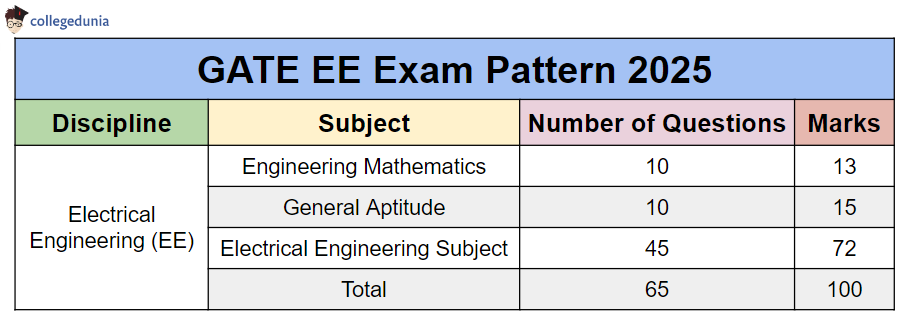
You must thoroughly review the GATE Exam Pattern and Syllabus to become aware of the format of the question paper. Refer to the table below to understand the GATE EE Exam Pattern along with the number of questions and allocation of marks.
Develop a Comprehensive Study Plan for GATE Preparation
Creating a structured study plan is crucial. You can break the syllabus into smaller sections, and allocate specific time for each topic. This will help you to understand each and every section and their concepts separately.
Emphasize Conceptual Understanding in Electrical Engineering
Focus on grasping the fundamental concepts rather tan memorizing problems and their answers. This method will help you solve complex problems and answer theoretical questions effectively.
Tip: Utilize visual aids such as concept maps or flowcharts, particularly for “Electrical Machines and Drives,” to simplify complex relationships.
Utilize Recommended Books and Online Resources for GATE Preparation
Refer to established textbooks and online resources that are known for GATE preparation. Some essential readings include:
- “Electrical Engineering: Fundamentals and Applications” by J. David Irwin
- “Control Systems Engineering” by Norman S. Nise
- “Power System Analysis” by John J. Grainger and William D. Stevenson
Check: GATE Books 2025 PDF Download for CSE, DA, Civil, Mechanical, ECE, EE
Some other common books for GATE Electrical Engineering are:
| Best Books for GATE EE Preparation 2025 | |
|---|---|
| Subjects | Standard Books |
| Engineering Mathematics | Advanced Engineering Mathematics by E.Kreyszig |
| Networks | Engineering Circuit Analysis by Hayt and Kemmerly |
| Signal and systems | Signals and Systems by Oppenheim and WilskySignals and Systems – Nagoor Kani |
| Electrical Machines | Electrical Machinery by P.S.Bimbhra |
| Power system | Power Systems Engineering by Nagrath and KothariPower Systems by JB Guptha & CL Wadhwa |
| Power Electronics | Power Electronics by MH RashidPower Electronics by P.S.Bimbhra |
| Control system | Control Systems Engineering by Nagrath and Gopal |
| Measurement | Electrical and Electronic Measurement and Instrumentation by AK Sawhney |
| Analog | Electronic Devices and Circuit Theory by Boylestad |
| Digital Circuits | For Digital Electronics, refer to Digital Design by M.Morris Mano |
| Electro Magnetics | Mathew N. O. SADIKU – Elements of ElectromagneticsWilliam .H.Hayt – Engineering Electromagnetics |
| For Problem Solving | GATE Electrical by RK Kanodia |
| Circuit analysis | Transient Analysis Of Electric Power Circuits by Arieh L Shenkmann and also Chakrabarti |
Practice GATE Previous Years Papers for Effective Preparation
One of the best ways to understand and practice for the GATE EE exam is by solving past GATE papers. This will also help you understand the exam format and question styles. This practice will also highlight areas that need more attention.
Check Previous Year Question Paper with Answer:
| Question Paper | Download Link |
|---|---|
| GATE 2024 EE Question Paper | Download PDF |
| GATE 2024 EE Answer Key | Download PDF |
| GATE 2023 EE Question Paper PDF | Download PDF |
| GATE 2023 EE Answer Key PDF | Download PDF |
Take Regular Mock Tests to Assess Progress
Incorporate regular mock tests into your study routine. These tests will help you manage your time during the actual exam and identify your strengths and weaknesses.
Check:
- GATE Question Paper for EE (Available): Download Previous Year Papers with Solution PDFs
- GATE Electrical Engineering Year Wise Paper Analysis, Answer Key, Question Paper, Cut-off
Join Online Study Groups and Forums for Collaborative Learning
Engaging with peers can enhance your understanding of complex topics. Participate in online forums and study groups dedicated to GATE preparation.
Implement Effective Revision Techniques for GATE Subjects
Regular revision is key to retaining information. Create concise summary notes for quick reviews and concentrate on important formulas and concepts.
Personalized Study Plan for Gate Electrical Engineering
We have provided a detailed study plan for GATE Electrical Engineering over one, two, and three months, including descriptive strategies and a section-wise study plan. If you want a last-minute revision plan or GATE preparation plan, we have also provided a one-week plan for revision.
1 Week Study Plan
| Day | 1–2 hours | 2 hours | 1 hour |
|---|---|---|---|
| Monday | Engineering Mathematics | Core Discipline Subjects | Numerical Ability |
| Tuesday | Core Discipline Subjects | Core Discipline Subjects | Verbal Ability |
| Wednesday | Engineering Mathematics | Core Discipline Subjects | Core Discipline Subjects (Pick a Relatively Easy Topic) |
| Thursday | Engineering Mathematics | Core Discipline Subjects | Numerical Ability |
| Friday | Core Discipline Subjects (Pick a Relatively Easy Topic) | Verbal Ability | Numerical Ability |
| Saturday | Take a Full-length Timed Mock (3 Hours) | ||
| Sunday | Mock Analysis (2–3 Hours) and retaking the same mock (3 Hours) | ||
1 Month Study Plan
| Week | Topics | Descriptive Strategies | Activities |
|---|---|---|---|
| Week 1 | Electrical Circuits & Networks | Focus on fundamental concepts (Ohm's Law, Kirchhoff's Laws).Use circuit simulators for practical understanding. | Study core theories.Solve basic problems.Use visual aids like circuit diagrams. |
| Week 2 | Electromagnetic Theory | Understand Maxwell's equations and their applications.Use visualizations for field concepts. | Study theory.Practice numerical problems.Utilize online resources for additional explanations. |
| Week 3 | Signals and Systems | Learn about time and frequency domain analysis.Use MATLAB for simulations. | Focus on system stability and transformation.Solve example problems. |
| Week 4 | Control Systems | Grasp feedback mechanisms and stability criteria.Use block diagrams for clarity. | Revise all topics.Take a mock test.Identify weak areas for further study. |
2-Month Study Plan
| Week | Topics | Descriptive Strategies | Activities |
|---|---|---|---|
| Week 1 | Electrical Circuits & Networks | Deepen understanding of RLC circuits and transient analysis.Use practice problems from previous papers. | Solve advanced circuit problems.Engage in peer discussions for concept clarity. |
| Week 2 | Electromagnetic Theory | Focus on applications in communication systems and antenna theory.Create summary notes. | Advanced problem solving.Review practical applications. |
| Week 3 | Signals and Systems | Study discrete-time signals and systems.Focus on Z-transform and frequency response. | Practice with MATLAB simulations.Solve a mix of problems. |
| Week 4 | Control Systems | Learn about PID controllers and system response.Use real-world examples for better understanding. | Solve control system problems.Take a quiz for self-assessment. |
| Week 5 | Electrical Machines | Understand operation principles of transformers, motors, and generators.Focus on power ratings and efficiency. | Study theory.Solve numerical problems related to machines. |
| Week 6 | Power Systems | Learn about load flow analysis and fault analysis.Use case studies for a better grasp. | Solve previous years' questions.Focus on power generation and transmission topics. |
| Week 7 | Power Electronics | Understand converters and inverters.Focus on switching devices and applications. | Solve design problems.Engage in simulations. |
| Week 8 | Revision & Mock Tests | Review all topics systematically.Create a summary sheet for quick revision. | Take multiple mock tests.Analyze performance and focus on weak areas. |
3-Month Study Plan
| Week | Topics | Study Plan |
|---|---|---|
| Week 1 | Electrical Circuits & Networks | Review basic and advanced circuit theories.Create practice problems and scenarios. |
| Week 2 | Electromagnetic Theory | Study field theory and wave propagation.Visualize concepts with diagrams. |
| Week 3 | Signals and Systems | Focus on both continuous and discrete systems.Use software tools for analysis. |
| Week 4 | Control Systems | Deepen understanding of system stability and control strategies.Apply theoretical knowledge to practical scenarios. |
| Week 5 | Electrical Machines | Study machine design principles and performance analysis.Focus on transformer ratings. |
| Week 6 | Power Systems | Explore power quality issues and system stability.Review fault analysis techniques. |
| Week 7 | Power Electronics | Study applications of power electronics in various systems.Focus on energy efficiency. |
| Week 8 | Instrumentation | Understand measurement techniques and devices.Focus on signal conditioning. |
| Week 9 | Revision (All Topics) | Create a comprehensive review schedule.Use flashcards for quick revisions. |
| Week 10 | Mock Tests & Analysis | Simulate exam conditions during tests.Analyze mistakes for improvement. |
| Week 11 | Focus on Weak Areas | Target specific topics that need reinforcement.Use different resources for varied perspectives. |
| Week 12 | Final Revision & Exam Strategy | Summarize key concepts and formulas.Plan exam day strategies (timing, stress management). |
Preparing for the GATE Electrical Engineering exam requires a strategic and organized approach. By understanding the syllabus, employing effective study techniques, and maintaining a healthy lifestyle, you can enhance your chances of success.



Comments