




GATE Electrical Engineering questions help to understand the patterns in previous year's question papers. This will assist you in understanding the question types and important sections of the GATE Electrical Engineering topic. You will be able to understand the frequently tested concepts and the level of difficulty in the GATE exam.
The GATE EE exam consists of 65 questions divided into General Aptitude (GA) and Core Subject Questions. The distribution of weightage is as follows:
- General Aptitude (GA): 15 marks
- Core Subject Questions: 85 marks
GATE Electrical Engineering features three main types of questions: MCQ, MSQ and NAT. GATE Electrical Engineering is scored on a total of 100 marks. The types of questions are:
- MCQ (Multiple Choice Questions): You must select a single correct answer.
- MSQ (Multiple Select Questions): These questions will be more than one correct answer.
- NAT (Numerical Answer Type): Provide a numerical answer, emphasizing problem-solving skills.
Must Read Articles related to GATE EE Questions
- GATE Exam Pattern 2025, Paper-wise Question Paper Pattern, Total Marks, Marking Scheme, Negative Marking
- GATE Question Paper for EE (Available): Download Previous Year Papers with Solution PDFs
- GATE Exam Pattern for EE 2025, Total Marks, No. of Questions, Negative Marking, Weightage
- GATE Electrical Engineering Year Wise Paper Analysis, Answer Key, Question Paper, Cut-off
- Understanding GATE Electrical Engineering
- GATE Electrical Engineering Question Patterns
- Analysis of Previous Years Papers
- Question Distribution in Core Subjects
4.1 Common Questions in GATE EE
4.2 GATE EE Marks Distribution
4.3 GATE EE Trends in Question Patterns
4.4 Preparing for GATE Electrical Engineering
Understanding GATE Electrical Engineering
GATE EE exam will check your skills in a range of subjects that includes:
- Electrical Circuits
- Signals and Systems
- Control Systems
- Electrical Machines
- Power Systems
- Power Electronics
- Analog and Digital Electronics
- Electromagnetic Fields
GATE Electrical Engineering Question Patterns
The two types of questions for the GATE EE syllabus include the General Aptitude section and the Core Subject section. The general aptitude will test your quantitative, verbal, and analytical skills. The Core subject questions will test your knowledge of Electrical Engineering.
Analysis of Previous Years Papers
After analyzing GATE EE's previous question papers, we have noticed several trends and patterns. These patterns can guide you while preparing for the GATE exam. You can also follow GATE Online Coaching for better results.
1. Weightage of Important Topics
Few topics have a higher weightage in GATE Electrical Engineering papers over the years. These include:
- Electrical Circuits: Contribute around 10-15% of the total marks.
- Control Systems and Signal Processing: These subjects are frequently tested, with each accounting for approximately 10-12% of the paper.
- Power Systems and Machines: These topics also hold significant weight, with questions often focusing on real-world applications and problem-solving.
2. Conceptual Understanding
Understanding and having concepts of GATE EE is important to answer most questions in the GATE EE exam. For instance:
- Numerical Problems: Many questions in Power Electronics and Electrical Machines focus on calculations related to efficiency, losses, and circuit parameters.
- Theoretical Questions: Control Systems often include questions on stability criteria, transfer functions, and feedback.
3. Application-Based Questions
Recent GATE papers have shown an increasing trend towards application-based questions, where candidates are asked to apply their knowledge to solve practical problems. This trend emphasizes the importance of not only understanding theory but also being able to implement it.
Check Previous Year Question Paper with Answer:
| GATE Question Paper | Download Link |
|---|---|
| GATE 2024 EE Question Paper | Download PDF |
| GATE 2024 EE Answer Key | Download PDF |
| GATE 2023 EE Question Paper PDF | Download PDF |
| GATE 2023 EE Answer Key PDF | Download PDF |
Question Distribution in Core Subjects
Over the years, the questions of each section vary. We have provided a trend of the questions for the last 5 years:
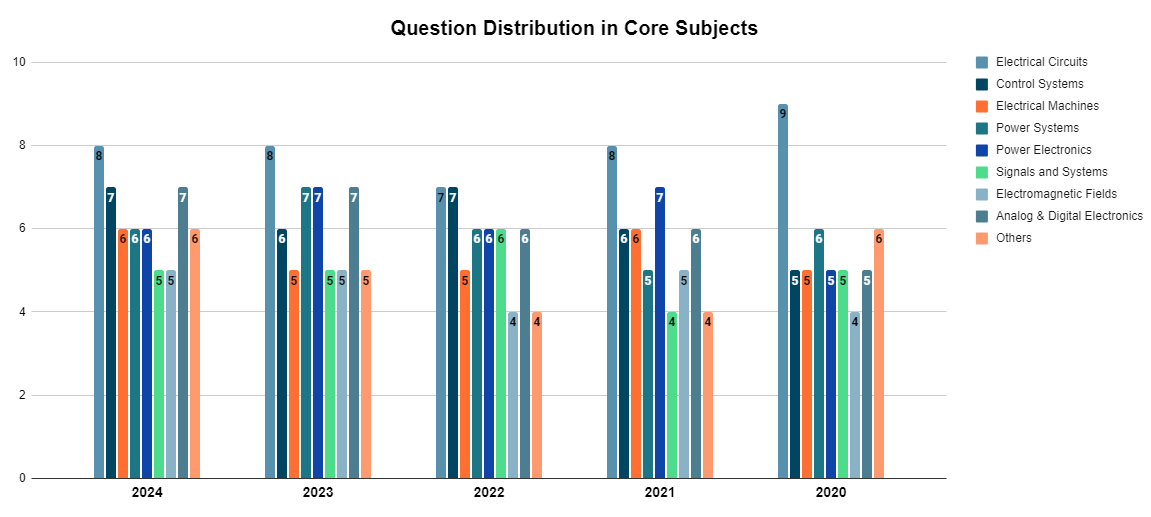
| Year | Electrical Circuits | Control Systems | Electrical Machines | Power Systems | Power Electronics | Signals and Systems | Electromagnetic Fields | Analog & Digital Electronics | Others |
|---|---|---|---|---|---|---|---|---|---|
| 2024 | 8 | 7 | 6 | 6 | 6 | 5 | 5 | 7 | 6 |
| 2023 | 8 | 6 | 5 | 7 | 7 | 5 | 5 | 7 | 5 |
| 2022 | 7 | 7 | 5 | 6 | 6 | 6 | 4 | 6 | 4 |
| 2021 | 8 | 6 | 6 | 5 | 7 | 4 | 5 | 6 | 4 |
| 2020 | 9 | 5 | 5 | 6 | 5 | 5 | 4 | 5 | 6 |
Check: In-Depth Analysis of Previous Year Question Papers
Common Questions in GATE EE
Some of the common questions of the previous 5 years along with examples are:
| Section | Common Topics/Questions | Example Question |
|---|---|---|
| General Aptitude (GA) | 1. Numerical Ability2. Verbal Ability | Problems with percentages, ratios, and basic arithmetic.Comprehension of passages and sentence corrections. |
| Electrical Circuits | 1. Circuit Theorems (Norton, Thevenin)2. Transient Analysis | "Determine the Thevenin equivalent of the circuit." "Find the time constant of an RL circuit." |
| Control Systems | 1. Stability Analysis2. Time Domain Response | "What is the stability condition for a closed-loop system?""Find the rise time of a second-order system." |
| Electrical Machines | 1. Transformer Parameters2. Induction Motor Performance | "Calculate the efficiency of a transformer.""What is the slip in an induction motor at a given load?" |
| Power Systems | 1. Fault Analysis2. Power Flow Studies | "Determine the fault current in a three-phase fault.""What are the types of power flow equations?" |
| Power Electronics | 1. Converter Operation2. Switching Devices | "Describe the operation of a buck converter.""What is the function of a diode in a rectifier circuit?" |
| Signals and Systems | 1. Signal Classification2. Fourier Transform | "Classify the given signal as continuous or discrete.""Compute the Fourier transform of a given signal." |
| Electromagnetic Fields | 1. Maxwell's Equations2. Electromagnetic Waves | "State Maxwell's equations in integral form.""What is the propagation velocity of electromagnetic waves?" |
| Analog & Digital Electronics | 1. Operational Amplifiers2. Logic Gates | "Analyze the output of an op-amp circuit with given parameters.""What is the truth table for a NAND gate?" |
GATE EE Marks Distribution
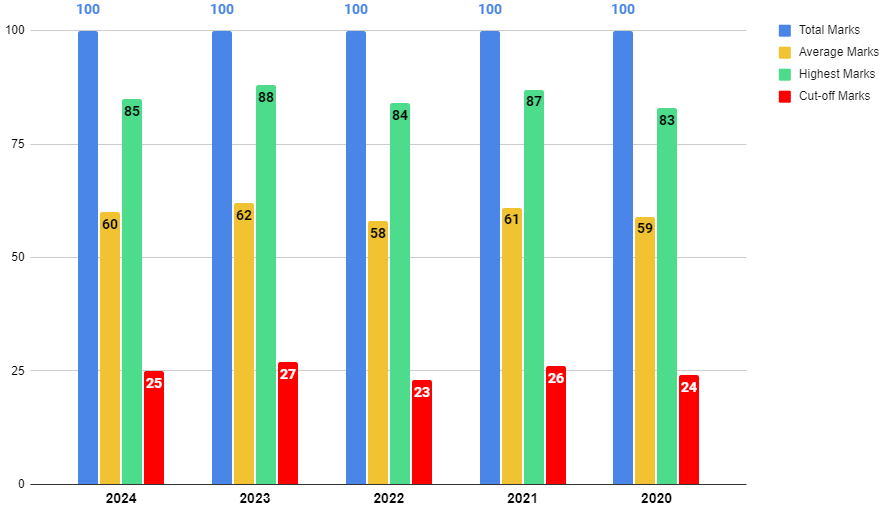
| Year | Total Marks | Average Marks | Highest Marks | Cut-off Marks |
|---|---|---|---|---|
| 2024 | 100 | 60 | 85 | 25 |
| 2023 | 100 | 62 | 88 | 27 |
| 2022 | 100 | 58 | 84 | 23 |
| 2021 | 100 | 61 | 87 | 26 |
| 2020 | 100 | 59 | 83 | 24 |
GATE EE Trends in Question Patterns
- Conceptual Focus: Many questions will test your fundamental understanding skills, particularly in topics like Control Systems and Power Electronics.
- Application-Based Questions: Practical applications indicate the importance of problem-solving skills in real-world scenarios.
- Difficulty Levels: The difficulty level expected is a mix of straightforward and challenging questions. Analyzing past papers suggests that 60-70% of questions can be addressed with a solid grasp of concepts.
Preparing for GATE Electrical Engineering
To excel in the GATE examination, candidates should adopt a strategic preparation approach:
- Syllabus Familiarity: Thoroughly review the GATE syllabus and prioritize high-weightage topics.
- Previous Years' Papers: Regularly practice with previous years' question papers to familiarize yourself with the format and types of questions.
- Mock Tests: Participate in mock tests to assess your preparation level and improve time management.
- Conceptual Clarity: Focus on understanding core concepts rather than rote memorization. Use textbooks, online resources, and video lectures for deeper insights.
- Revision: Regularly revise important formulas, theorems, and problem-solving techniques.
The analysis of question patterns in GATE Electrical Engineering over the last five years shows a consistent level of competition among candidates. Understanding these trends can help you set realistic targets and improve your preparation strategies accordingly.



Comments