



Education Journalist | Study Abroad Strategy Lead | Updated On - Apr 18, 2026
Indian students enrolled at top US universities — not just Harvard — now face a risk that did not exist before May 2025: their university's legal right to host international students could be revoked by the federal government, with as little as one letter and no prior due process.
The Trump administration's attempt to strip Harvard of its SEVP certification on May 22, 2025 — the accreditation every US university must hold to enrol F-1 and J-1 visa students — was blocked by a federal court. But the legal case is still active at the First Circuit Court of Appeals as of April 2026, and the policy framework that enabled the revocation attempt applies to every university in the United States.
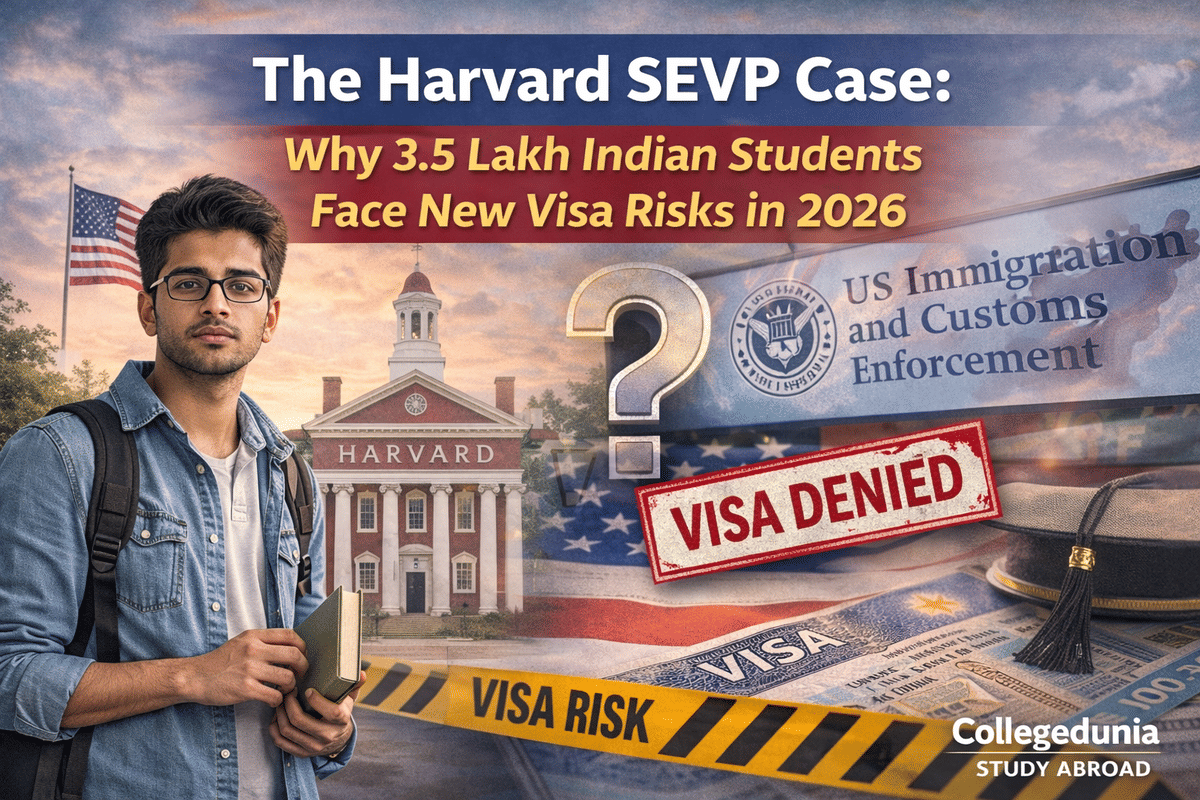
What SEVP Certification Is — and Why Its Loss Ends Everything?
Every US university that wishes to enrol international students must be certified under the Student and Exchange Visitor Program (SEVP), administered by the Department of Homeland Security's Immigration and Customs Enforcement (ICE) agency. SEVP certification is not a formality. It is the legal foundation of every F-1 and J-1 student's status in the United States.
- Without SEVP certification, a university cannot issue I-20 forms.
- Without an I-20, an international student cannot obtain or maintain an F-1 visa.
- Without a valid F-1 visa, a student cannot legally remain in the US.
- The chain is direct: if a university loses SEVP certification, every international student enrolled there — including the approximately 800 Indian students at Harvard — loses their legal basis to stay.
This is not a theoretical risk. On May 22, 2025, DHS Secretary Kristi Noem sent Harvard a letter revoking its SEVP certification, stating that existing international students "must transfer or lose their legal status." Harvard filed suit the following day. A federal judge issued a temporary restraining order on May 23, a further court order blocking the revocation on June 20, and a preliminary injunction on June 23, 2025 — allowing Harvard to continue enrolling international students while the case proceeds.
The same administration that attempted this revocation has already terminated over 4,700 individual SEVIS records, with Indian students accounting for 50% of tracked cases.
Where the Harvard Case Stands in April 2026?
The legal battle has moved to the US Court of Appeals for the First Circuit. Harvard filed its response brief on January 12, 2026, arguing that the presidential proclamation suspending entry for Harvard's international students was directed at a domestic institution — not foreign nationals — and therefore falls outside the broad deference courts typically give the executive on immigration matters.
On January 20, 2026, 23 higher education associations — including the American Council on Education and the Association of American Universities — filed an amicus brief supporting Harvard. Their argument extends well beyond one university:
"If the federal government may punish a university for its perceived ideology or that of its students, then the marketplace of ideas collapses into a monopoly of dogma. That is the antithesis of America's constitutional values, and it jeopardizes the richness of the spectrum of higher education that has long been one of our country's greatest strengths."
In February 2026, Columbia University and Barnard College formally joined Harvard's legal fight, filing in support of the challenge to the administration's blocking of international student enrolment. Columbia has particular exposure: the Trump administration separately froze all NIH research grants to Columbia — over $400 million — in early 2026. Columbia has proposed cutting its incoming PhD cohort by up to 65% as a direct result.
The preliminary injunction protecting Harvard's SEVP certification remains in force. But the government has not sought to have the case declared moot — meaning it is actively pursuing the legal authority to revoke SEVP certification from universities it deems non-compliant.
The Domino Risk: Which Universities Are Exposed
The Harvard case established a template. The administration's stated trigger was Harvard's refusal to hand over disciplinary records of international students and its perceived failure to comply with federal demands. The same logic — non-compliance with federal demands as grounds for SEVP revocation — can be applied to any university that receives federal funding and has international students.
The universities most exposed share a common profile: large international student populations, significant federal research funding, and a history of campus activism or public disagreement with administration policy.
| University | Indian Students (est.) | Federal Funding Dispute | SEVP Risk Level |
|---|---|---|---|
| Harvard | ~800 | Billions in grants frozen; SEVP revocation attempted | Active legal case |
| Columbia | ~3,500 | $400M+ NIH grants frozen; joined Harvard's legal fight | High |
| Stanford | ~2,800 | Research grants frozen; student visa revocations reported | Elevated |
| University of California system | ~12,000+ | Student visa revocations at UCLA, UC Berkeley, UC San Diego | Elevated |
| MIT | ~2,200 | Research funding under pressure; travel ban impacts reported | Moderate-Elevated |
The risk is not uniform. Universities that have complied with federal demands — handing over student records, disciplining campus activists, or settling with the administration — face lower immediate exposure. Universities that have publicly resisted or are in active litigation face higher risk. For Indian students, the practical question is not abstract: if my university loses SEVP certification, what happens to my visa status?
What Happens to Indian Students If Their University Loses SEVP
The scenario is not hypothetical — it nearly happened at Harvard in May 2025. Here is the precise sequence of consequences for an Indian student if their university's SEVP certification is revoked and not immediately blocked by a court:
- The university can no longer issue or maintain I-20 forms. Your I-20 is the document that authorises your F-1 status. Without a valid I-20, your F-1 status has no legal basis.
- You must transfer to a SEVP-certified institution or leave the US. DHS's May 2025 letter to Harvard stated students must transfer or lose legal status. There is no grace period specified in the regulations for this scenario.
- If you are outside the US when revocation occurs, you cannot re-enter. Your F-1 visa is tied to your university's SEVP certification. A revoked certification means your visa is effectively void for re-entry purposes.
- OPT and STEM OPT are immediately affected. Indian students on OPT — who account for a disproportionate share of SEVIS termination cases — would lose work authorisation if their sponsoring university loses SEVP status.
- Transfer is possible but not instant. Transferring your SEVIS record to a new SEVP-certified university requires your current DSO to initiate the transfer, the new university to accept you, and USCIS to process the change. In a crisis scenario, this process could take weeks.
What Indian Students at US Universities Must Do Now
The court injunction protecting Harvard is currently holding. But the First Circuit case is unresolved, the government has not abandoned its position, and the policy framework enabling SEVP revocation remains active. Every Indian student at a US university — not just Harvard — should take the following steps now, not after a crisis develops.
Know your university's SEVP status.
Check your university's International Student Services Office (ISSO) website for any updates on federal compliance disputes or funding freezes. Universities in active litigation or with frozen federal grants are higher risk. If your university has issued any statement about federal government demands, read it carefully.
Keep your I-20 current and your DSO informed.
Ensure your I-20 reflects your current programme, enrolment status, and expected graduation date. Any change — programme extension, leave of absence, change of major — requires a DSO update. An outdated I-20 is a compliance gap that becomes critical in a SEVP dispute.
Do not travel outside the US without verifying your re-entry position.
If your university is in a federal funding dispute or has received compliance demands from DHS, consult your ISSO before any international travel. A student who leaves the US while their university's SEVP status is under challenge may not be able to return.
Have a transfer plan ready.
Identify at least one alternative SEVP-certified university where you could transfer your programme if necessary. This is not pessimism — it is the same contingency planning that Harvard's own international office advised its students to consider in May 2025.
Monitor the First Circuit ruling.
The Harvard v. DHS appeal at the First Circuit will set the legal standard for whether the executive can revoke SEVP certification without due process. A ruling against Harvard would remove the primary legal protection currently shielding international students at universities in federal disputes. Watch for updates from your university's ISSO and from NAFSA.
Harvard's Case Is Every Indian Student's Case
Harvard's own federal lawsuits page states it plainly: "This action imperils the futures of thousands of students and scholars across Harvard and serves as a warning to countless others at colleges and universities." That warning is not rhetorical. The legal precedent being set in the First Circuit will determine whether the federal government can use SEVP certification as a lever of compliance against any university — and whether the 3.52 lakh Indian students currently enrolled across US institutions have a stable legal foundation under their feet.
Indian student enrolment in the US has already fallen 6.9% to 3.52 lakh — the sharpest drop in a decade. The SEVP case is not the only pressure point. But it is the one with the most direct, immediate consequence: a court ruling in the government's favour would give DHS the legal authority to end international student enrolment at any university in the United States, without prior notice, without due process, and without a clear path to appeal. For Indian students and families investing ₹50–90 lakh in a US education, that is a risk that now requires active monitoring — not passive assumption that the courts will always intervene in time.







Comments