



Education Journalist | Study Abroad Strategy Lead | Updated On - Apr 18, 2026
Indians hold 71% of all H-1B skilled worker visas approved in the United States — 283,397 out of 399,395 approvals in FY2024, according to the USCIS FY2024 Annual Report to Congress. Yet F-1 student visa issuances to Indian students collapsed 69% in June–July 2025 compared to the same months in 2024, and the overall F-1 refusal rate hit a decade high of 41% in FY2024, per US Department of State data. The US is simultaneously more dependent on Indian talent than ever — and more aggressively restricting the student visa pipeline that produces it.

Indians Power 71% of H-1B Approvals — By a Massive Margin
The scale of India's dominance in the H-1B programme is not widely understood. It is not a plurality — it is structural dominance. According to the USCIS FY2024 Characteristics of H-1B Specialty Occupation Workers report, submitted to the US Congress in April 2025:
| Country of Birth | H-1B Approvals FY2024 | Share of Total |
|---|---|---|
| India | 283,397 | 71% |
| China | 46,680 | 11.7% |
| Philippines | 5,248 | 1.3% |
| All other countries combined | ~64,000 | ~16% |
India's share is six times that of China, the second-largest cohort. Every other country in the world combined accounts for less than India alone. The H-1B programme — which underpins the US technology sector, hospital system, and research universities — runs on Indian talent at a structural level.
The same USCIS report reveals a stat that makes the F-1 connection explicit: of all H-1B petitions approved for new employment in FY2024 where the beneficiary was already in the US and requested a change of status, 71% came from F-1 or F-2 visa holders — students and their dependants. The F-1 student visa is not just a pathway to H-1B. It is the primary pipeline. Blocking it does not just affect students. It affects the future supply of the workforce the US economy depends on most.
The F-1 Pipeline Is Collapsing — US DoS and MEA Data
While the H-1B programme continues to run on Indian talent already in the system, the incoming pipeline is under severe pressure. Three government data points tell the story:
F-1 issuances to Indians fell 69% in peak months.
In June and July 2025 — the two most critical months before the US Fall semester — only 12,776 F-1 visas were issued to Indian students, down from 41,336 in the same period in 2024. That 69% collapse is the steepest peacetime decline on record, driven by the Trump administration's interview suspension, mandatory social media screening, and SEVIS termination wave.
The global F-1 refusal rate hit a decade high of 41% in FY2024.
According to US Department of State visa statistics published at travel.state.gov, 278,553 F-1 visa applications were refused in FY2024 — a 41% refusal rate, the highest since 2017. The trend has worsened further in 2025 as new screening requirements took effect.
Indian enrolment in the US fell 6.9% to 3.52 lakh.
India's Ministry of External Affairs confirmed in a Rajya Sabha reply on April 2, 2026 that Indian student enrolment dropped from 3,78,787 in February 2025 to 3,52,644 in February 2026 — the sharpest year-on-year decline in over a decade. The MEA directly cited the US State Department's June 2025 expanded vetting announcement as the policy backdrop.
What Changed in 2025 — Four Policy Shifts That Broke the Pipeline
The F-1 collapse is not the result of reduced Indian interest in US education. It is the direct consequence of four simultaneous policy changes introduced under the Trump administration.
Interview suspension (May–June 2025).
Secretary of State Marco Rubio paused all F-1 visa interviews for nearly a month to implement new social media screening infrastructure. The backlog compressed the entire peak visa season into a fraction of its normal capacity.
Mandatory social media screening (from June 18, 2025).
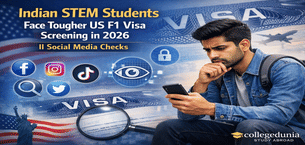
All F, M, and J visa applicants must now set every social media account to public, list all usernames used in the past five years on the DS-160, and submit to automated and manual review of their online presence. Indian STEM applicants in AI, cybersecurity, and biotech face additional scrutiny through the Technology Alert List — GitHub repositories and LinkedIn profiles are now actively reviewed before interview decisions are made.
SEVIS terminations (March–April 2025).
Over 6,400 student visa records were cancelled after a criminal database sweep. Indian nationals accounted for 50% of tracked revocation cases. The legal framework enabling these terminations remains in force.
Structural tightening of the H-1B pathway itself.
Even for Indian students who successfully obtain an F-1 visa, complete their degree, and enter OPT, the H-1B route has become harder. A new wage-weighted lottery system and a $100,000 per-petition fee for certain employers have reshaped who can realistically access the visa. FY2027 H-1B lottery selection no longer guarantees a visa — it only guarantees the right to apply.
What Indian Students Applying for Fall 2026 Must Do Now
The data is clear: the F-1 to H-1B pathway remains the most powerful career route available to Indian STEM graduates globally. But it now requires more preparation, earlier action, and a genuine backup plan than at any point in the last decade.
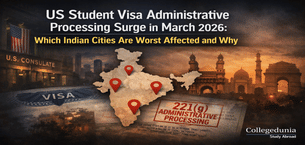
Book your visa interview as soon as you receive your I-20. Do not wait until April or May for a September intake. Mumbai and Hyderabad currently have the longest queues — New Delhi and Chennai are faster. Every week of delay in booking narrows your options.
Audit every social media account before your interview. Set all accounts to public. List every username used in the last five years on your DS-160 — including platforms you no longer actively use. Omitting any platform is a false certification and grounds for permanent ineligibility.
Prepare a complete financial and academic profile. A consistent 6–12 month bank statement history, a clear Statement of Purpose, and strong ties to India are the three pillars of a credible F-1 application under current scrutiny levels. Vague documentation is the most common avoidable reason for refusal.
Have a verified backup destination before you apply. Germany, Ireland, and Canada all offer post-study work pathways with significantly higher visa approval rates for Indian applicants. If your US application is refused, you need an alternative that does not require starting from scratch.
The USCIS data makes the dependency explicit: 71% of H-1B approvals go to Indians, and 71% of those H-1B status changes come from F-1 visa holders. The pipeline is not abstract — it is a direct, documented chain from an Indian student's visa interview to a US tech company's workforce. That chain is now under sustained pressure at its first link.
Indian graduate enrolments in the US fell 9.5% in 2024–25, reversing 18.5% growth the year before. Germany, Ireland, and Canada are reducing barriers for Indian applicants at precisely the moment the US is raising them. The students who cannot get an F-1 visa in 2025 and 2026 will not disappear — they will build careers elsewhere.







Comments