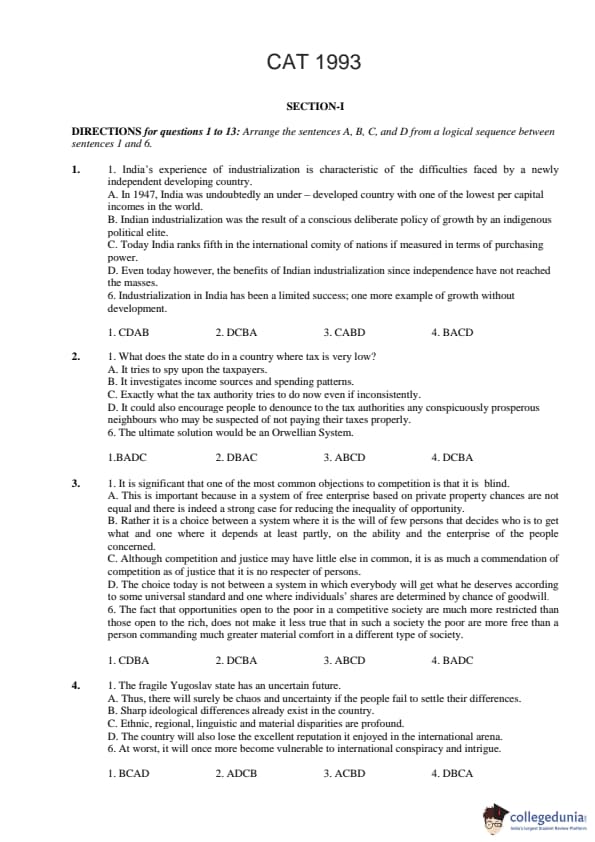
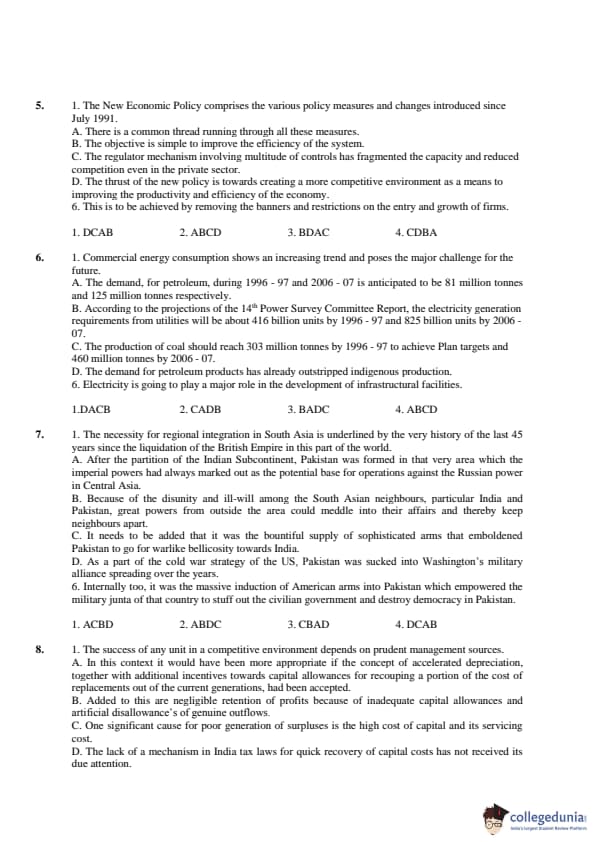
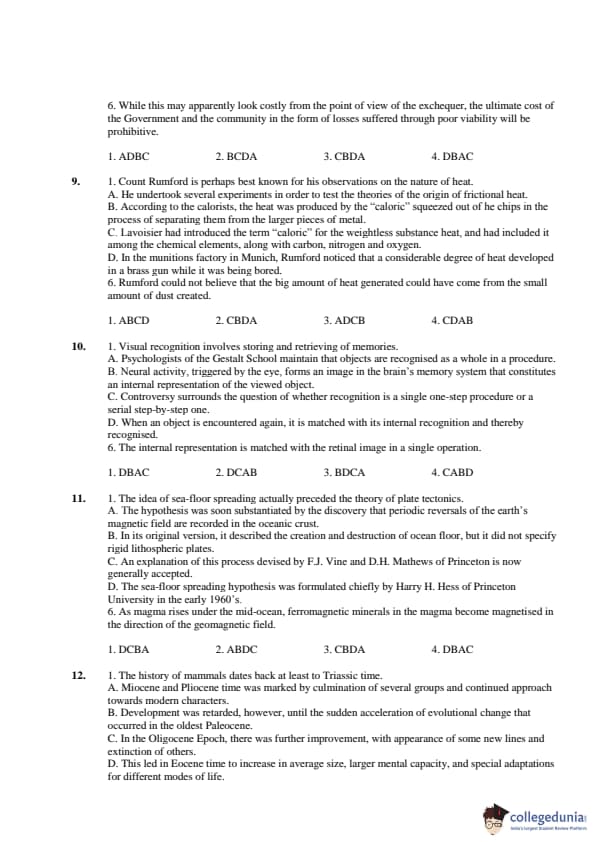
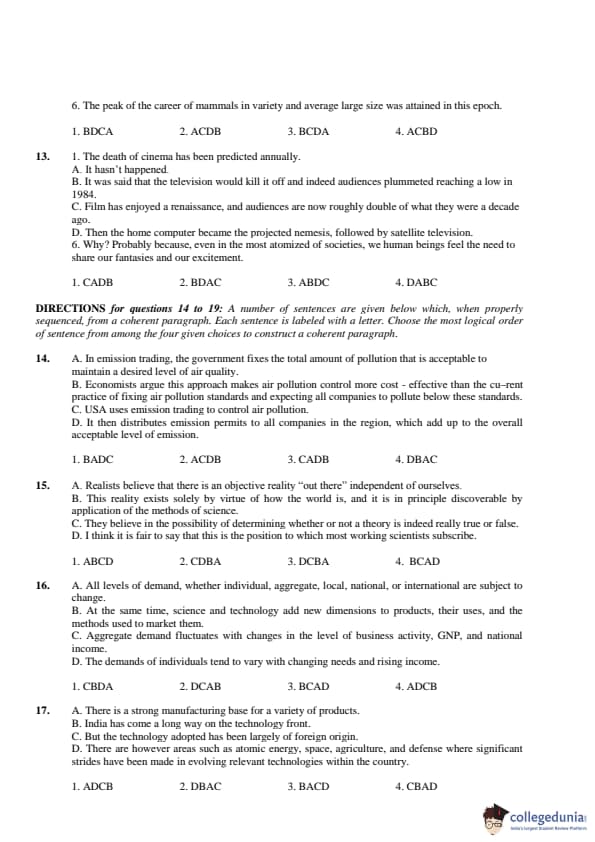
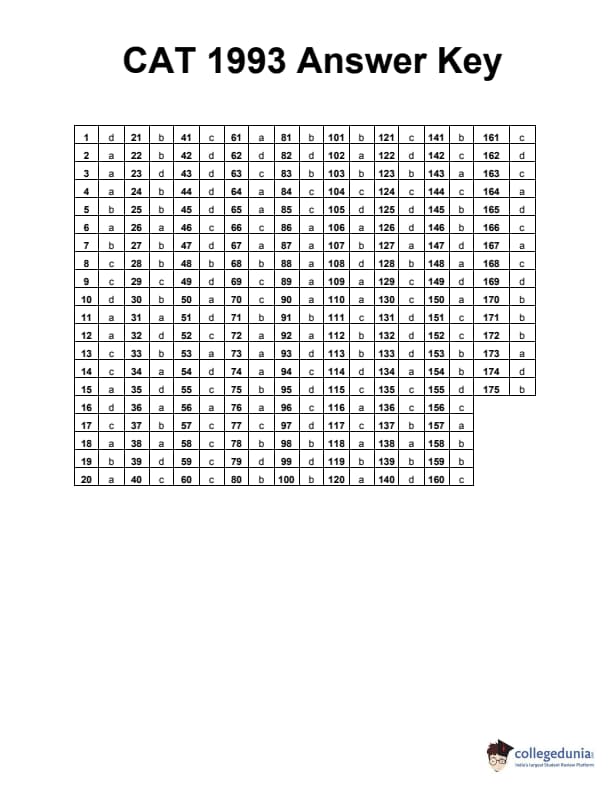
CAT 1993 Question Paper with Answer Key PDF is available for download. CAT 1993 Question Paper was a set of 175 questions. A total of 120 minutes or 2 hours were allotted to complete the 175 questions. All the questions were distributed across 4 sections I e. Verbal Ability, Data Interpretation, Problem Solving/ Quant, and Reading Comprehension

Candidates preparing for CAT 2025 can download the CAT 1993 question paper with the solution PDF to get a better idea about the type of questions asked in the paper and their difficulty level.

Also Check:

CAT 1993 Question Paper with Answer Key PDF

CAT 1993 Question Paper with Answer Key

Download PDF Check Solutions

CAT 1993 question paper with solution

Question 1:

(1)) India’s experience of industrialization is characteristic of the difficulties faced by a newly independent developing country.

(A) In 1947, India was undoubtedly an under-developed country with one of the lowest per capita incomes in the world.

(B) Indian industrialization was the result of a conscious deliberate policy of growth by an indigenous political elite.

(C) Today India ranks fifth in the international comity of nations if measured in terms of purchasing power.

(D) Even today however, the benefits of Indian industrialization since independence have not reached the masses.

(6) Industrialization in India has been a limited success; one more example of growth without development.

  • (a) CDAB
  • (b) DCBA
  • (c) CABD
  • (d) BACD
Correct Answer: (d) BACD
View Solution

Question 2:

(1) What does the state do in a country where tax is very low?

(A) It tries to spy upon the taxpayers.

(B) It investigates income sources and spending patterns.

(C) Exactly what the tax authority tries to do now even if inconsistently.

(D) It could also encourage people to denounce to the tax authorities any conspicuously prosperous neighbours who may be suspected of not paying their taxes properly.

(6) The ultimate solution would be an Orwellian System.

  • (a) BADC
  • (b) DBAC
  • (c) ABCD
  • (d) DCBA
Correct Answer: (c) ABCD
View Solution

Question 3:

(1) It is significant that one of the most common objections to competition is that it is blind.

(A) This is important because in a system of free enterprise based on private property chances are not equal and there is indeed a strong case for reducing the inequality of opportunity.

(B) Rather it is a choice between a system where it is the will of few persons that decides who is to get what and one where it depends at least partly, on the ability and the enterprise of the people concerned.

(C) Although competition and justice may have little else in common, it is as much a commendation of competition as of justice that it is no respecter of persons.

(D) The choice today is not between a system in which everybody will get what he deserves according to some universal standard and one where individuals’ shares are determined by chance of goodwill.

(6) The fact that opportunities open to the poor in a competitive society are much more restricted than those open to the rich, does not make it less true that in such a society the poor are more free than a person commanding much greater material comfort in a different type of society.

  • (a) CDBA
  • (b) DCBA
  • (c) ABCD
  • (d) BADC
Correct Answer: (a) CDBA
View Solution

Question 4:

(1) The fragile Yugoslav state has an uncertain future.

(A) Thus, there will surely be chaos and uncertainty if the people fail to settle their differences.

(B) Sharp ideological differences already exist in the country.

(C) Ethnic, regional, linguistic and material disparities are profound.

(D) The country will also lose the excellent reputation it enjoyed in the international arena.

(6) At worst, it will once more become vulnerable to international conspiracy and intrigue.

  • (a) BCAD
  • (b) ADCB
  • (c) ACBD
  • (d) DBCA
Correct Answer: (a) BCAD
View Solution

Question 5:

(1) The New Economic Policy comprises the various policy measures and changes introduced since July 1991.

(A) There is a common thread running through all these measures.

(B) The objective is simple to improve the efficiency of the system.

(C) The regulator mechanism involving multitude of controls has fragmented the capacity and reduced competition even in the private sector.

(D) The thrust of the new policy is towards creating a more competitive environment as a means to improving the productivity and efficiency of the economy.

(6) This is to be achieved by removing the banners and restrictions on the entry and growth of firms.

  • (a) DCAB
  • (b) ABCD
  • (c) BDAC
  • (d) CDBA
Correct Answer: (b) ABCD
View Solution

Question 6:

(1) Commercial energy consumption shows an increasing trend and poses the major challenge for the future.

(A) The demand, for petroleum, during 1996 – 97 and 2006 – 07 is anticipated to be 81 million tonnes and 125 million tonnes respectively.

(B) According to the projections of the 14th Power Survey Committee Report, the electricity generation requirements from utilities will be about 416 billion units by 1996 – 97 and 825 billion units by 2006 – 07.

(C) The production of coal should reach 303 million tonnes by 1996 – 97 to achieve Plan targets and 460 million tonnes by 2006 – 07.

(D) The demand for petroleum products has already outstripped indigenous production.

(6) Electricity is going to play a major role in the development of infrastructural facilities.

  • (a) DACB
  • (b) CADB
  • (c) BADC
  • (d) ABCD
Correct Answer: (a) DACB
View Solution

Question 7:

(1) The necessity for regional integration in South Asia is underlined by the very history of the last 45 years since the liquidation of the British Empire in this part of the world.

(A) After the partition of the Indian Subcontinent, Pakistan was formed in that very area which the imperial powers had always marked out as the potential base for operations against the Russian power in Central Asia.

(B) Because of the disunity and ill-will among the South Asian neighbours, particular India and Pakistan, great powers from outside the area could meddle into their affairs and thereby keep neighbours apart.

(C) It needs to be added that it was the bountiful supply of sophisticated arms that emboldened Pakistan to go for warlike bellicosity towards India.

(D) As a part of the cold war strategy of the US, Pakistan was sucked into Washington’s military alliance spreading over the years.

(6) Internally too, it was the massive induction of American arms into Pakistan which empowered the military junta of that country to stuff out the civilian government and destroy democracy in Pakistan.

  • (a) ACBD
  • (b) ABDC
  • (c) CBAD
  • (d) DCAB
Correct Answer: (b) ABDC
View Solution

Question 8:

(1) The success of any unit in a competitive environment depends on prudent management sources.

(A) In this context it would have been more appropriate if the concept of accelerated depreciation, together with additional incentives towards capital allowances for recouping a portion of the cost of replacements out of the current generations, had been accepted.

(B) Added to this are negligible retention of profits because of inadequate capital allowances and artificial disallowance’s of genuine outflows.

(C) One significant cause for poor generation of surpluses is the high cost of capital and its servicing cost.

(D) The lack of a mechanism in India tax laws for quick recovery of capital costs has not received its due attention.

(6) While this may apparently look costly from the point of view of the exchequer, the ultimate cost of the Government and the community in the form of losses suffered through poor viability will be prohibitive.

  • (a) ADBC
  • (b) BCDA
  • (c) CBDA
  • (d) DBAC
Correct Answer: (c) CBDA
View Solution

Question 9:

(1) Count Rumford is perhaps best known for his observations on the nature of heat.

(A) He undertook several experiments in order to test the theories of the origin of frictional heat.

(B) According to the calorists, the heat was produced by the “caloric” squeezed out of he chips in the process of separating them from the larger pieces of metal.

(C) Lavoisier had introduced the term “caloric” for the weightless substance heat, and had included it among the chemical elements, along with carbon, nitrogen and oxygen.

(D) In the munitions factory in Munich, Rumford noticed that a considerable degree of heat developed in a brass gun while it was being bored.

(6) Rumford could not believe that the big amount of heat generated could have come from the small amount of dust created.

  • (a) ABCD
  • (b) CBDA
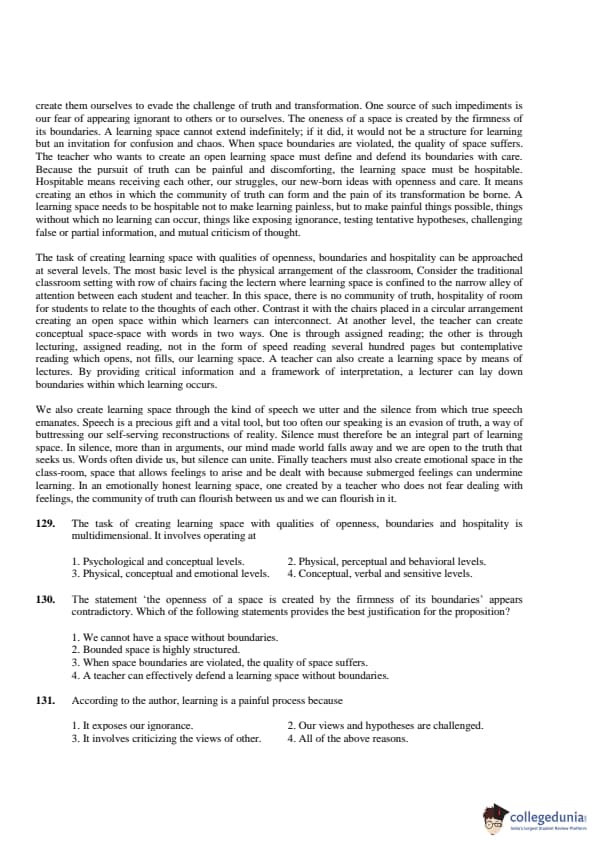
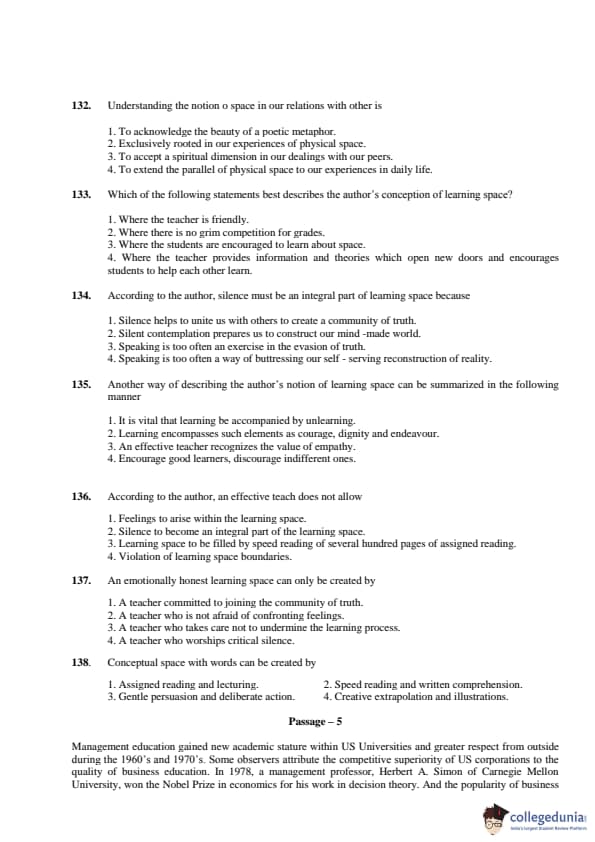
  • (c) ADCB
  • (d) CDAB
Correct Answer: (c) ADCB
View Solution

Question 10:

Visual recognition involves storing and retrieving of memories.

(A) Psychologists of the Gestalt School maintain that objects are recognised as a whole in a procedure.

(B) Neural activity, triggered by the eye, forms an image in the brain’s memory system that constitutes an internal representation of the viewed object.

(C) Controversy surrounds the question of whether recognition is a single one-step procedure or a serial step-by-step one.

(D) When an object is encountered again, it is matched with its internal recognition and thereby recognised.

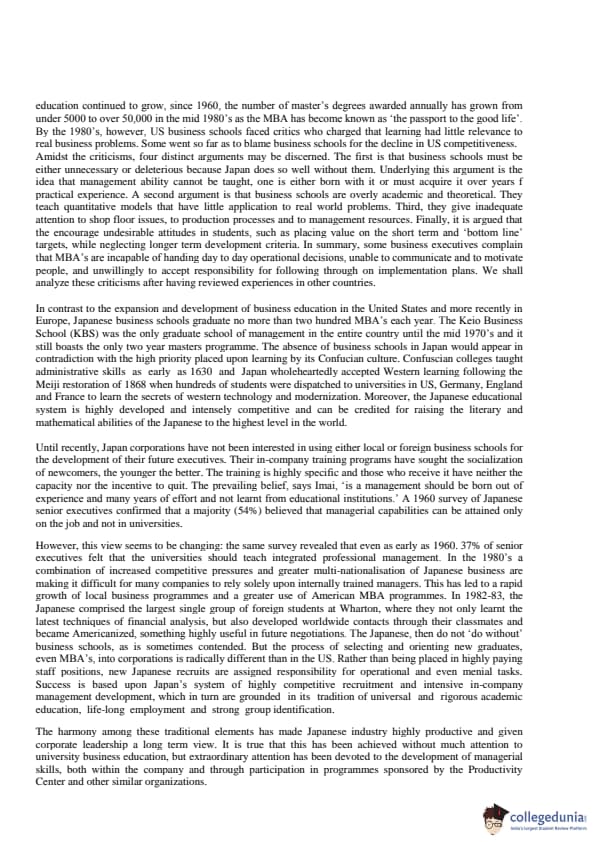
The internal representation is matched with the retinal image in a single operation.

  • (a) DBAC
  • (b) DCAB
  • (c) BDCA
  • (d) CABD
Correct Answer: (d) CABD
View Solution

Question 11:

The idea of sea-floor spreading actually preceded the theory of plate tectonics.

(A) The hypothesis was soon substantiated by the discovery that periodic reversals of the earth’s magnetic field are recorded in the oceanic crust.

(B) In its original version, it described the creation and destruction of ocean floor, but it did not specify rigid lithospheric plates.

(C) An explanation of this process devised by F.J. Vine and D.H. Mathews of Princeton is now generally accepted.

(D) The sea-floor spreading hypothesis was formulated chiefly by Harry H. Hess of Princeton University in the early 1960’s.

As magma rises under the mid-ocean, ferromagnetic minerals in the magma become magnetised in the direction of the geomagnetic field.

  • (a) DCBA
  • (b) ABDC
  • (c) CBDA
  • (d) DBAC
Correct Answer: (a) DCBA
View Solution

Question 12:

The history of mammals dates back at least to Triassic time.

(A) Miocene and Pliocene time was marked by culmination of several groups and continued approach towards modern characters.

(B) Development was retarded, however, until the sudden acceleration of evolutional change that occurred in the oldest Paleocene.

(C) In the Oligocene Epoch, there was further improvement, with appearance of some new lines and extinction of others.

(D) This led in Eocene time to increase in average size, larger mental capacity, and special adaptations for different modes of life.

The peak of the career of mammals in variety and average large size was attained in this epoch.

  • (a) BDCA
  • (b) ACDB
  • (c) BCDA
  • (d) ACBD
Correct Answer: (a) BDCA
View Solution

Question 13:

The death of cinema has been predicted annually.

(A) It hasn’t happened.

(B) It was said that the television would kill it off and indeed audiences plummeted reaching a low in 1984.

(C) Film has enjoyed a renaissance, and audiences are now roughly double of what they were a decade ago.

(D) Then the home computer became the projected nemesis, followed by satellite television.

Why? Probably because, even in the most atomized of societies, we human beings feel the need to share our fantasies and our excitement.

  • (a) CADB
  • (b) BDAC
  • (c) ABDC
  • (d) DABC
Correct Answer: (c) ABDC
View Solution

Question 14:

In emission trading, the government fixes the total amount of pollution that is acceptable to maintain a desired level of air quality.

(A) In emission trading, the government fixes the total amount of pollution that is acceptable to maintain a desired level of air quality.

(B) Economists argue this approach makes air pollution control more cost–effective than the current practice of fixing air pollution standards and expecting all companies to pollute below these standards.

(C) USA uses emission trading to control air pollution.

(D) It then distributes emission permits to all companies in the region, which add up to the overall acceptable level of emission.

  • (a) BADC
  • (b) ACDB
  • (c) CADB
  • (d) DBAC
Correct Answer: (c) CADB
View Solution

Question 15:

Realists believe that there is an objective reality “out there” independent of ourselves.

(A) Realists believe that there is an objective reality “out there” independent of ourselves.

(B) This reality exists solely by virtue of how the world is, and it is in principle discoverable by application of the methods of science.

(C) They believe in the possibility of determining whether or not a theory is indeed really true or false.

(D) I think it is fair to say that this is the position to which most working scientists subscribe.

  • (a) ABCD
  • (b) CDBA
  • (c) DCBA
  • (d) BCAD
Correct Answer: (a) ABCD
View Solution

Question 16:

All levels of demand, whether individual, aggregate, local, national, or international are subject to change.

(A) All levels of demand, whether individual, aggregate, local, national, or international are subject to change.

(B) At the same time, science and technology add new dimensions to products, their uses, and the methods used to market them.

(C) Aggregate demand fluctuates with changes in the level of business activity, GNP, and national income.

(D) The demands of individuals tend to vary with changing needs and rising income.

  • (a) CBDA
  • (b) DCAB
  • (c) BCAD
  • (d) ADCB
Correct Answer: (d) ADCB
View Solution

Question 17:

India has come a long way on the technology front.

(A) There is a strong manufacturing base for a variety of products.

(B) India has come a long way on the technology front.

(C) But the technology adopted has been largely of foreign origin.

(D) There are however areas such as atomic energy, space, agriculture, and defense where significant strides have been made in evolving relevant technologies within the country.

  • (a) ADCB
  • (b) DBAC
  • (c) BACD
  • (d) CBAD
Correct Answer: (c) BACD
View Solution

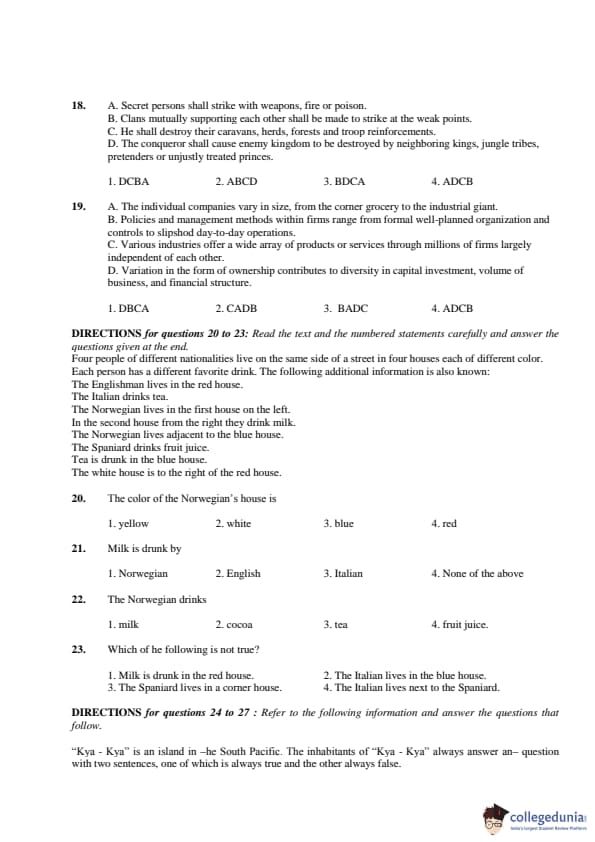
Question 18:

Secret persons shall strike with weapons, fire or poison.

(A) Secret persons shall strike with weapons, fire or poison.

(B) Clans mutually supporting each other shall be made to strike at the weak points.

(C) He shall destroy their caravans, herds, forests and troop reinforcements.

(D) The conqueror shall cause enemy kingdom to be destroyed by neighboring kings, jungle tribes, pretenders or unjustly treated princes.

  • (a) DCBA
  • (b) ABCD
  • (c) BDCA
  • (d) ADCB
Correct Answer: (a) DCBA
View Solution

Question 19:

The individual companies vary in size, from the corner grocery to the industrial giant.

(A) The individual companies vary in size, from the corner grocery to the industrial giant.

(B) Policies and management methods within firms range from formal well-planned organization and controls to slipshod day-to-day operations.

(C) Various industries offer a wide array of products or services through millions of firms largely independent of each other.

(D) Variation in the form of ownership contributes to diversity in capital investment, volume of business, and financial structure.

  • (a) DBCA
  • (b) CADB
  • (c) BADC
  • (d) ADCB
Correct Answer: (b) CADB
View Solution

Question 20:

The color of the Norwegian’s house is

  • (a) yellow
  • (b) white
  • (c) blue
  • (d) red
Correct Answer: (a) yellow
View Solution

Question 21:

Milk is drunk by

  • (a) Norwegian
  • (b) English
  • (c) Italian
  • (d) None of the above
Correct Answer: (b) English
View Solution

Question 22:

The Norwegian drinks

  • (a) milk
  • (b) cocoa
  • (c) tea
  • (d) fruit juice
Correct Answer: (b) cocoa
View Solution

Question 23:

Which of the following is not true?

  • (a) Milk is drunk in the red house.
  • (b) The Italian lives in the blue house.
  • (c) The Spaniard lives in a corner house.
  • (d) The Italian lives next to the Spaniard.
Correct Answer: (d) The Italian lives next to the Spaniard.
View Solution

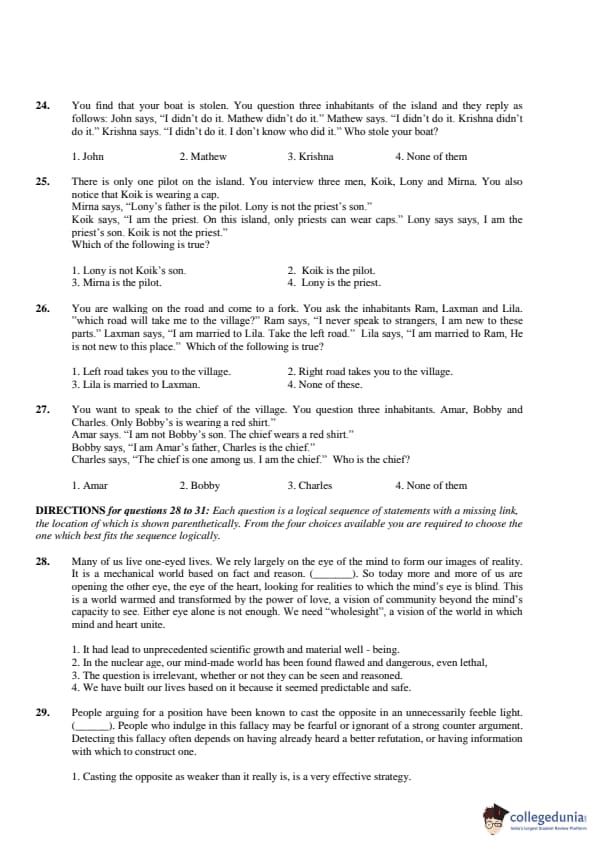
Question 24:

You find that your boat is stolen. You question three inhabitants of the island and they reply as follows:

John says, “I didn’t do it. Mathew didn’t do it.”

Mathew says. “I didn’t do it. Krishna didn’t do it.”

Krishna says. “I didn’t do it. I don’t know who did it.”

Who stole your boat?

  • (a) John
  • (b) Mathew
  • (c) Krishna
  • (d) None of them
Correct Answer: (b) Mathew
View Solution

Question 25:

There is only one pilot on the island. You interview three men, Koik, Lony and Mirna. You also notice that Koik is wearing a cap.


Mirna says, “Lony’s father is the pilot. Lony is not the priest’s son.”

Koik says, “I am the priest. On this island, only priests can wear caps.”

Lony says, “I am the priest’s son. Koik is not the priest.”


Which of the following is true?

  • (a) Lony is not Koik’s son.
  • (b) Koik is the pilot.
  • (c) Mirna is the pilot.
  • (d) Lony is the priest.
Correct Answer: (b) Koik is the pilot
View Solution

Question 26:

You are walking on the road and come to a fork. You ask the inhabitants Ram, Laxman and Lila,

"Which road will take me to the village?"

Ram says, “I never speak to strangers. I am new to these parts.”

Laxman says, “I am married to Lila. Take the left road.”

Lila says, “I am married to Ram. He is not new to this place.”


Which of the following is true?

  • (a) Left road takes you to the village.
  • (b) Right road takes you to the village.
  • (c) Lila is married to Laxman.
  • (d) None of these.
Correct Answer: (a) Left road takes you to the village.
View Solution

Question 27:

You want to speak to the chief of the village. You question three inhabitants. Amar, Bobby and Charles. Only Bobby is wearing a red shirt.


Amar says: “I am not Bobby’s son. The chief wears a red shirt.”

Bobby says: “I am Amar’s father. Charles is the chief.”

Charles says: “The chief is one among us. I am the chief.”


Who is the chief?

  • (a) Amar
  • (b) Bobby
  • (c) Charles
  • (d) None of them
Correct Answer: (b) Bobby
View Solution

Question 28:

Many of us live one-eyed lives. We rely largely on the eye of the mind to form our images of reality. It is a mechanical world based on fact and reason. (______) So today more and more of us are opening the other eye, the eye of the heart, looking for realities to which the mind’s eye is blind. This is a world warmed and transformed by the power of love, a vision of community beyond the mind’s capacity to see. Either eye alone is not enough. We need “wholesight”, a vision of the world in which mind and heart unite.

  • (a) It had led to unprecedented scientific growth and material well-being.
  • (b) In the nuclear age, our mind-made world has been found flawed and dangerous, even lethal.
  • (c) The question is irrelevant, whether or not they can be seen and reasoned.
  • (d) We have built our lives based on it because it seemed predictable and safe.
Correct Answer: (b) In the nuclear age, our mind-made world has been found flawed and dangerous, even lethal.
View Solution

Question 29:

People arguing for a position have been known to cast the opposite in an unnecessarily feeble light. (________). People who indulge in this fallacy may be fearful or ignorant of a strong counter argument. Detecting this fallacy often depends on having already heard a better refutation, or having information with which to construct one.

  • (a) Casting the opposite as weaker than it really is, is a very effective strategy.
  • (b) This portrayal of a refutation as weaker than it really is, is a sure way of proving your point.
  • (c) Casting the opposite as weaker than it really is, is not a very effective strategy.
  • (d) This portrayal of refutation as weaker than it really is, is unwarranted.
Correct Answer: (c) Casting the opposite as weaker than it really is, is not a very effective strategy.
View Solution

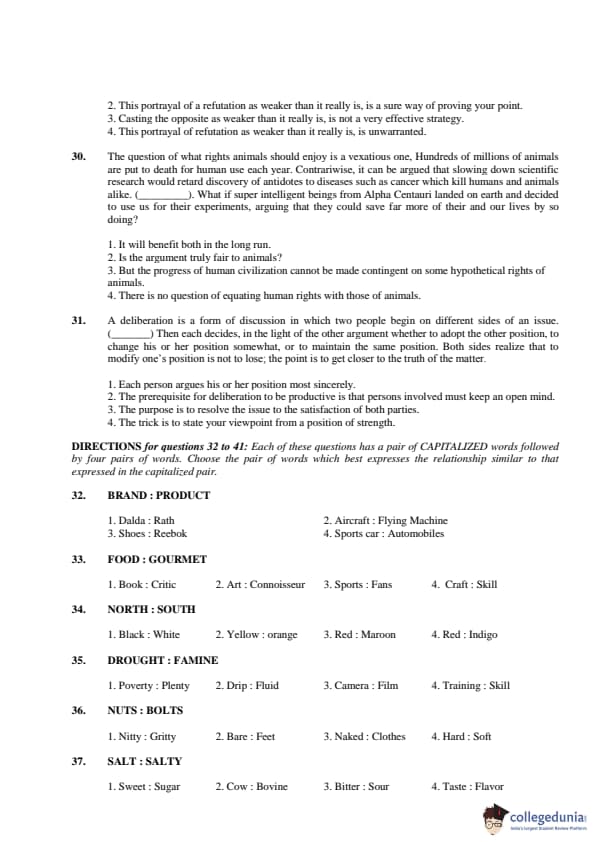
Question 30:

The question of what rights animals should enjoy is a vexatious one. Hundreds of millions of animals are put to death for human use each year. Contrariwise, it can be argued that slowing down scientific research would retard discovery of antidotes to diseases such as cancer which kill humans and animals alike. (________). What if super intelligent beings from Alpha Centauri landed on earth and decided to use us for their experiments, arguing that they could save far more of their and our lives by so doing?

  • (a) It will benefit both in the long run.
  • (b) Is the argument truly fair to animals?
  • (c) But the progress of human civilization cannot be made contingent on some hypothetical rights of animals.
  • (d) There is no question of equating human rights with those of animals.
Correct Answer: (b) Is the argument truly fair to animals?
View Solution

Question 31:

A deliberation is a form of discussion in which two people begin on different sides of an issue. (________). Then each decides, in the light of the other argument whether to adopt the other position, to change his or her position somewhat, or to maintain the same position. Both sides realize that to modify one’s position is not to lose; the point is to get closer to the truth of the matter.

  • (a) Each person argues his or her position most sincerely.
  • (b) The prerequisite for deliberation to be productive is that persons involved must keep an open mind.
  • (c) The purpose is to resolve the issue to the satisfaction of both parties.
  • (d) The trick is to state your viewpoint from a position of strength.
Correct Answer: (a) Each person argues his or her position most sincerely.
View Solution

Question 32:

BRAND : PRODUCT

Choose the pair of words which best expresses the relationship similar to that expressed in the capitalized pair.

  • (a) Dalda : Rath
  • (b) Aircraft : Flying Machine
  • (c) Shoes : Reebok
  • (d) Sports car : Automobiles
Correct Answer: (d) Sports car : Automobiles
View Solution

Question 33:

FOOD : GOURMET

Choose the pair of words which best expresses the relationship similar to that expressed in the capitalized pair.

  • (a) Book : Critic
  • (b) Art : Connoisseur
  • (c) Sports : Fans
  • (d) Craft : Skill
Correct Answer: (b) Art : Connoisseur
View Solution

Question 34:

NORTH : SOUTH

Choose the pair of words which best expresses the relationship similar to that expressed in the capitalized pair.

  • (a) Black : White
  • (b) Yellow : Orange
  • (c) Red : Maroon
  • (d) Red : Indigo
Correct Answer: (a) Black : White
View Solution

Question 35:

DROUGHT : FAMINE

Choose the pair of words which best expresses the relationship similar to that expressed in the capitalized pair.

  • (a) Poverty : Plenty
  • (b) Drip : Fluid
  • (c) Camera : Film
  • (d) Training : Skill
Correct Answer: (d) Training : Skill
View Solution

Question 36:

NUTS : BOLTS

Choose the pair of words which best expresses the relationship similar to that expressed in the capitalized pair.

  • (a) Nitty : Gritty
  • (b) Bare : Feet
  • (c) Naked : Clothes
  • (d) Hard : Soft
Correct Answer: (a) Nitty : Gritty
View Solution

Question 37:

SALT : SALTY

Choose the pair of words which best expresses the relationship similar to that expressed in the capitalized pair.

  • (a) Sweet : Sugar
  • (b) Cow : Bovine
  • (c) Bitter : Sour
  • (d) Taste : Flavor
Correct Answer: (b) Cow : Bovine
View Solution

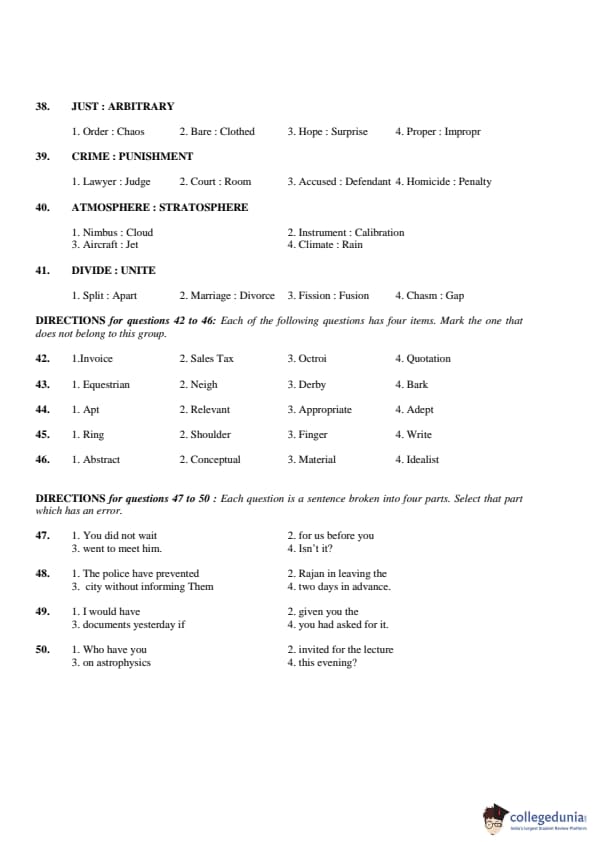
Question 38:

JUST : ARBITRARY

Choose the pair of words which best expresses the relationship similar to that expressed in the capitalized pair.

  • (a) Order : Chaos
  • (b) Bare : Clothed
  • (c) Hope : Surprise
  • (d) Proper : Improper
Correct Answer: (a) Order : Chaos
View Solution

Question 39:

ATMOSPHERE : STRATOSPHERE

Choose the pair of words which best expresses the relationship similar to that expressed in the capitalized pair.

  • (a) Nimbus : Cloud
  • (b) Instrument : Calibration
  • (c) Aircraft : Jet
  • (d) Climate : Rain
Correct Answer: (c) Aircraft : Jet
View Solution

Question 40:

DIVIDE : UNITE

Choose the pair of words which best expresses the relationship similar to that expressed in the capitalized pair.

  • (a) Split : Apart
  • (b) Fission : Fusion
  • (c) Marriage : Divorce
  • (d) Chasm : Gap
Correct Answer: (c) Marriage : Divorce
View Solution

Question 41:

This questions has four items. Mark the one that does not belong to this group.

Options given relate to commercial documents or tax instruments.

  • (a) Invoice
  • (b) Sales Tax
  • (c) Octroi
  • (d) Quotation
Correct Answer: (d) Quotation
View Solution

Question 42:

This question has four items. Mark the one that does not belong to this group.

Options relate to horses and related terms.

  • (a) Equestrian
  • (b) Neigh
  • (c) Derby
  • (d) Bark
Correct Answer: (d) Bark
View Solution

Question 43:

This question has four items. Mark the one that does not belong to this group.

Options relate to synonymy of suitability or skill.

  • (a) Apt
  • (b) Relevant
  • (c) Appropriate
  • (d) Adept
Correct Answer: (d) Adept
View Solution

Question 44:

This question has four items. Mark the one that does not belong to this group.

Options relate to body parts or accessories.

  • (a) Ring
  • (b) Shoulder
  • (c) Finger
  • (d) Write
Correct Answer: (d) Write
View Solution

Question 45:

This question has four items. Mark the one that does not belong to this group.

Options relate to philosophy and level of tangibility.

  • (a) Abstract
  • (b) Conceptual
  • (c) Material
  • (d) Idealist
Correct Answer: (c) Material
View Solution

Question 46:

Each sentence is broken into four parts. Identify the part with an error.

  • (a) You did not wait
  • (b) for us before you
  • (c) went to meet him.
  • (d) Isn’t it?
Correct Answer: (d) Isn’t it?
View Solution

Question 47:

Each sentence is broken into four parts. Identify the part with an error.

  • (a) The police have prevented
  • (b) Rajan in leaving the
  • (c) city without informing them
  • (d) two days in advance.
Correct Answer: (b) Rajan in leaving the
View Solution

Question 48:

Each sentence is broken into four parts. Identify the part with an error.

  • (a) I would have
  • (b) given you the
  • (c) documents yesterday if
  • (d) you had asked for it.
Correct Answer: (d) you had asked for it.
View Solution

Question 49:

Each sentence is broken into four parts. Identify the part with an error.

  • (a) Who have you
  • (b) invited for the lecture
  • (c) on astrophysics
  • (d) this evening?
Correct Answer: (a) Who have you
View Solution

Question 50:

Each sentence is broken into four parts. Identify the part with an error.

  • (a) Who have you
  • (b) invited for the lecture
  • (c) on astrophysics
  • (d) this evening?
Correct Answer: (a) Who have you
View Solution

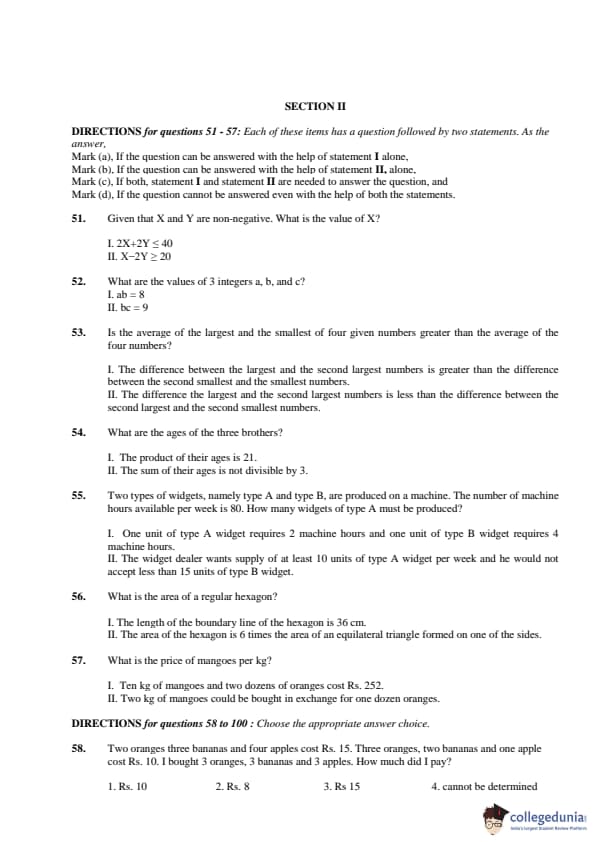
Question 51:

Given that X and Y are non-negative. What is the value of X?


% Statement I
I. \(2X + 2Y \leq 40\)

% Statement II
II. \(X - 2Y \geq 20\)

  • (a) If the question can be answered with the help of statement I alone
  • (b) If the question can be answered with the help of statement II alone
  • (c) If both, statement I and statement II are needed to answer the question
  • (d) If the question cannot be answered even with the help of both the statements
Correct Answer: (c) If both, statement I and statement II are needed to answer the question
View Solution

Question 52:

What are the values of three integers \( a, b, \) and \( c \)?


% Statement I
I. \( ab = 8 \)

% Statement II
II. \( bc = 9 \)

  • (a) If the question can be answered with the help of statement I alone
  • (b) If the question can be answered with the help of statement II alone
  • (c) If both, statement I and statement II are needed to answer the question
  • (d) If the question cannot be answered even with the help of both the statements
Correct Answer: (c) If both, statement I and statement II are needed to answer the question
View Solution

Question 53:

Is the average of the largest and the smallest of four given numbers greater than the average of the four numbers?


% Statement I
I. The difference between the largest and the second largest numbers is greater than the difference between the second smallest and the smallest numbers.

% Statement II
II. The difference between the largest and the second largest numbers is less than the difference between the second largest and the second smallest numbers.

  • (a) If the question can be answered with the help of statement I alone
  • (b) If the question can be answered with the help of statement II alone
  • (c) If both, statement I and statement II are needed to answer the question
  • (d) If the question cannot be answered even with the help of both the statements
Correct Answer: (a) If the question can be answered with the help of statement I alone
View Solution

Question 54:

What are the ages of the three brothers?


% Statement I
I. The product of their ages is 21.

% Statement II
II. The sum of their ages is not divisible by 3.

  • (a) If the question can be answered with the help of statement I alone
  • (b) If the question can be answered with the help of statement II alone
  • (c) If both, statement I and statement II are needed to answer the question
  • (d) If the question cannot be answered even with the help of both the statements
Correct Answer: (d) If the question cannot be answered even with the help of both the statements
View Solution

Question 55:

Two types of widgets, namely type A and type B, are produced on a machine. The number of machine hours available per week is 80. How many widgets of type A must be produced?


% Statement I
I. One unit of type A widget requires 2 machine hours and one unit of type B widget requires 4 machine hours.

% Statement II
II. The widget dealer wants supply of at least 10 units of type A widget per week and he would not accept less than 15 units of type B widget.

  • (a) If the question can be answered with the help of statement I alone
  • (b) If the question can be answered with the help of statement II alone
  • (c) If both, statement I and statement II are needed to answer the question
  • (d) If the question cannot be answered even with the help of both the statements
Correct Answer: (c) If both, statement I and statement II are needed to answer the question
View Solution

Question 56:

What is the price of mangoes per kg?


% Statement I
I. Ten kg of mangoes and two dozens of oranges cost Rs. 252.

% Statement II
II. Two kg of mangoes could be bought in exchange for one dozen oranges.

  • (a) If the question can be answered with the help of statement I alone
  • (b) If the question can be answered with the help of statement II alone
  • (c) If both, statement I and statement II are needed to answer the question
  • (d) If the question cannot be answered even with the help of both the statements
Correct Answer: (c) If both, statement I and statement II are needed to answer the question
View Solution

Question 57:

Two oranges, three bananas and four apples cost Rs.15. Three oranges, two bananas and one apple cost Rs.10. I bought 3 oranges, 3 bananas and 3 apples. How much did I pay?

  • (a) Rs.10
  • (b) Rs.8
  • (c) Rs.15
  • (d) cannot be determined
Correct Answer: (c) Rs.15
View Solution

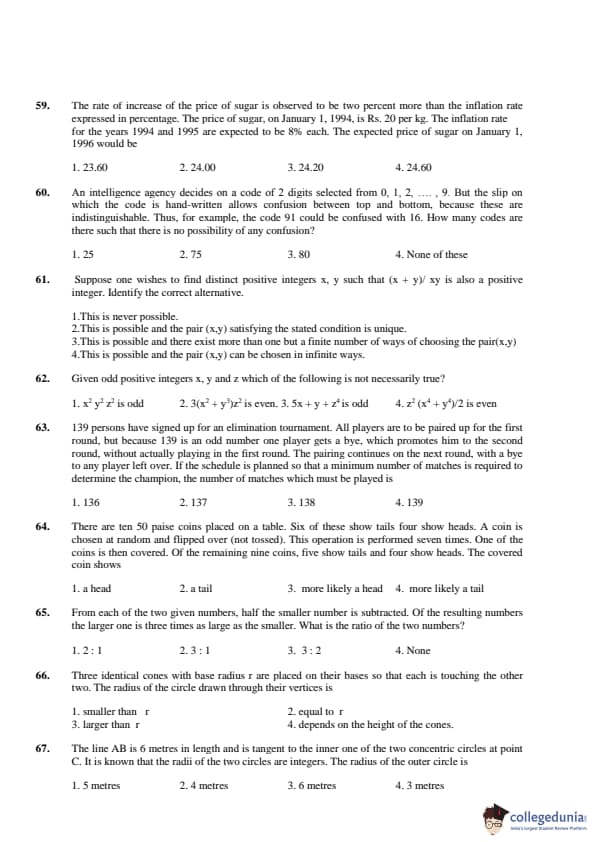
Question 58:

The rate of increase of the price of sugar is observed to be two percent more than the inflation rate expressed in percentage. The price of sugar, on January 1, 1994, is Rs. 20 per kg. The inflation rate for the years 1994 and 1995 are expected to be 8% each. The expected price of sugar on January 1, 1996 would be

  • (a) Rs.23.60
  • (b) Rs.24.00
  • (c) Rs.24.20
  • (d) Rs.24.60
Correct Answer: (c) Rs.24.20
View Solution

Question 59:

An intelligence agency decides on a code of 2 digits selected from 0–9. But handwritten codes may confuse digits like 6/9, etc. How many 2-digit codes are possible that avoid such confusion?

  • (a) 25
  • (b) 75
  • (c) 80
  • (d) None of these
Correct Answer: (c) 80
View Solution

Question 60:

Suppose one wishes to find distinct positive integers \( x, y \) such that \( \frac{x + y}{xy} \) is also a positive integer. What can be said about the number of such valid pairs?

  • (a) This is never possible.
  • (b) This is possible and the pair (x,y) is unique.
  • (c) This is possible and there are finite such pairs.
  • (d) This is possible and there are infinite such pairs.
Correct Answer: (a) This is never possible
View Solution

Question 61:

Given odd positive integers \( x, y, z \), which of the following is \textit{not necessarily true?

  • (a) \( x^2 y^2 z^2 \) is odd
  • (b) \( 3(x^2 + y^3)z^2 \) is even
  • (c) \( 5x + y + z^4 \) is odd
  • (d) \( \frac{z^2(x^4 + y^4)}{2} \) is even
Correct Answer: (d) \( \frac{z^2(x^4 + y^4)}{2} \) is even
View Solution

Question 62:

139 persons have signed up for an elimination tournament. All players are to be paired for the first round, with one bye in case of odd number. What is the minimum number of matches to determine the champion?

  • (a) 136
  • (b) 137
  • (c) 138
  • (d) 139
Correct Answer: (c) 138
View Solution

Question 63:

Ten 50 paise coins: 6 tails, 4 heads. One coin is flipped randomly, seven times in total. One coin is covered. The rest show 5 tails and 4 heads. What does the covered coin show?

  • (a) a head
  • (b) a tail
  • (c) more likely a head
  • (d) more likely a tail
Correct Answer: (a) a head
View Solution

Question 64:

From two numbers, subtract half of the smaller. The result for larger is 3× that of the smaller. What is their original ratio?

  • (a) 2 : 1
  • (b) 3 : 1
  • (c) 3 : 2
  • (d) None
Correct Answer: (a) 2 : 1
View Solution

Question 65:

Three identical cones with base radius \( r \) are placed so each touches the other two. What is the radius of the circle drawn through their vertices?

  • (a) smaller than \( r \)
  • (b) equal to \( r \)
  • (c) larger than \( r \)
  • (d) depends on height of cones
Correct Answer: (c) larger than \( r \)
View Solution

Question 66:

The line AB is 6 metres and is tangent to the inner of two concentric circles at point C. Radii of the two circles are integers. What is the radius of the outer circle?

  • (a) 5 metres
  • (b) 4 metres
  • (c) 6 metres
  • (d) 3 metres
Correct Answer: (a) 5 metres
View Solution

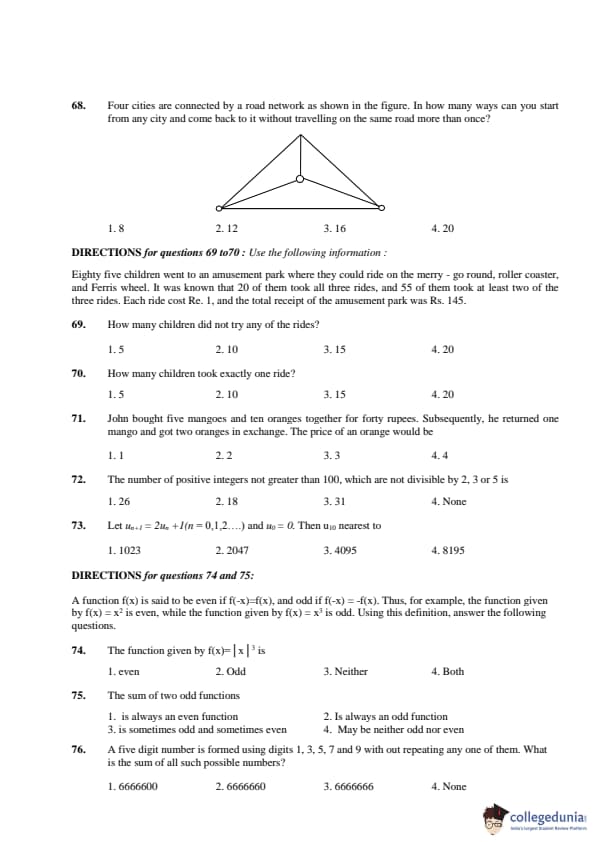
Question 67:

Four cities are connected by roads as shown. In how many ways can you start at a city and come back to it without travelling the same road more than once?

  • (a) 1
  • (b) 2
  • (c) 3
  • (d) 4
Correct Answer: (b) 2
View Solution
Question 68:

85 children went to an amusement park with 3 rides. Each ride costs Re.1. 20 children took all 3 rides, 55 took at least 2 rides, and the total receipt was Rs.145. How many children did not take any rides?

  • (a) 5
  • (b) 10
  • (c) 15
  • (d) 20
Correct Answer: (c) 15
View Solution
Question 69:

Based on the same amusement park data, how many children took exactly one ride?

  • (a) 5
  • (b) 10
  • (c) 15
  • (d) 20
Correct Answer: (c) 15
View Solution
Question 70:

John bought 5 mangoes and 10 oranges for Rs. 40. He then returned 1 mango and got 2 oranges in exchange. What is the price of one orange?

  • (a) Rs.1
  • (b) Rs.2
  • (c) Rs.3
  • (d) Rs.4
Correct Answer: (b) Rs.2
View Solution
Question 71:

How many positive integers less than or equal to 100 are not divisible by 2, 3, or 5?

  • (a) 26
  • (b) 18
  • (c) 31
  • (d) None
Correct Answer: (a) 26
View Solution
Question 72:

Let \( u_0 = 0 \), and \( u_{n+1} = 2u_n + 1 \). What is the value of \( u_{10} \)? (nearest to)

  • (a) 1023
  • (b) 2047
  • (c) 4095
  • (d) 8195
Correct Answer: (a) 1023
View Solution
Question 73:

The function given by \( f(x) = |x|^3 \) is

  • (a) even
  • (b) odd
  • (c) neither
  • (d) both
Correct Answer: (a) even
View Solution

Question 74:

The sum of two odd functions

  • (a) is always an even function
  • (b) is always an odd function
  • (c) is sometimes odd and sometimes even
  • (d) may be neither odd nor even
Correct Answer: (b) is always an odd function
View Solution

Question 75:

A five-digit number is formed using digits 1, 3, 5, 7, and 9 without repetition. What is the sum of all such possible numbers?

  • (a) 6666600
  • (b) 6666660
  • (c) 6666666
  • (d) None
Correct Answer: (a) 6666600
View Solution

Question 76:

A box contains 6 red, 7 green, and 5 blue balls (all distinct in size). What is the probability that the selected red ball is the smallest red ball?

  • (a) 1/18
  • (b) 1/3
  • (c) 1/6
  • (d) 2/3
Correct Answer: (c) 1/6
View Solution

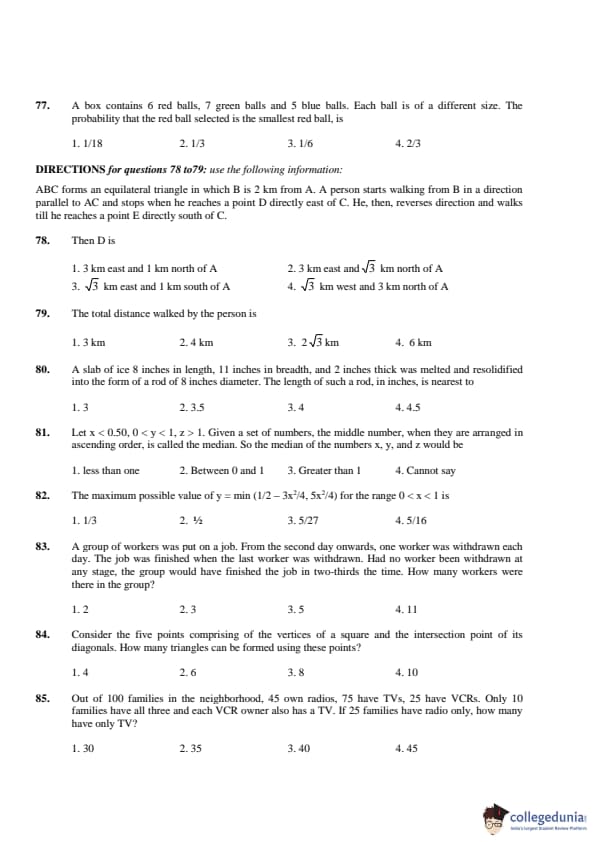
Question 77:

ABC is an equilateral triangle with AB = AC, and B is 2 km north of A. A person walks from B parallel to AC, stops when directly east of C (point D). Where is D with respect to A?

  • (a) 3 km east and 1 km north of A
  • (b) 3 km east and \( \sqrt{3} \) km north of A
  • (c) \( \sqrt{3} \) km east and 1 km south of A
  • (d) \( \sqrt{3} \) km west and 3 km north of A
Correct Answer: (b) 3 km east and \( \sqrt{3} \) km north of A
View Solution

Question 78:

What is the total distance walked by the person (from B to D to E)?

  • (a) 3 km
  • (b) 4 km
  • (c) \( 2\sqrt{3} \) km
  • (d) 6 km
Correct Answer: (d) 6 km
View Solution

Question 79:

A slab of ice 8 in × 11 in × 2 in is melted and recast into a cylinder of 8 in diameter. What is the length of the cylinder?

  • (a) 3
  • (b) 3.5
  • (c) 4
  • (d) 4.5
Correct Answer: (b) 3.5
View Solution

Question 80:

Let \( x < 0.50 \), \( 0 < y < 1 \), \( z > 1 \). What is the median of x, y, z?

  • (a) less than 1
  • (b) between 0 and 1
  • (c) greater than 1
  • (d) cannot say
Correct Answer: (b) between 0 and 1
View Solution

Question 81:

Find the maximum value of \( y = \min\left(\frac{1}{2} - \frac{3x^2}{4}, \frac{5x^2}{4}\right) \) for \( 0 < x < 1 \)

  • (a) 1/3
  • (b) 1/2
  • (c) 5/27
  • (d) 5/16
Correct Answer: (d) 5/16
View Solution

Question 82:

A group of workers starts a job. From Day 2 onward, 1 worker is removed each day. The job ends when the last worker is withdrawn. If all had worked full time, the work would’ve been done in 2/3 time. How many workers were initially in the group?

  • (a) 2
  • (b) 3
  • (c) 5
  • (d) 11
Correct Answer: (b) 3
View Solution

Question 83:

From 5 points (4 vertices of a square + 1 intersection point of diagonals), how many triangles can be formed?

  • (a) 4
  • (b) 6
  • (c) 8
  • (d) 10
Correct Answer: (c) 8
View Solution

Question 84:

In a locality of 100 families: 45 have radios, 75 have TVs, 25 have VCRs. 10 have all three. Every VCR owner has TV. 25 have radio only. How many families have only TV?

  • (a) 30
  • (b) 35
  • (c) 40
  • (d) 45
Correct Answer: (c) 40
View Solution

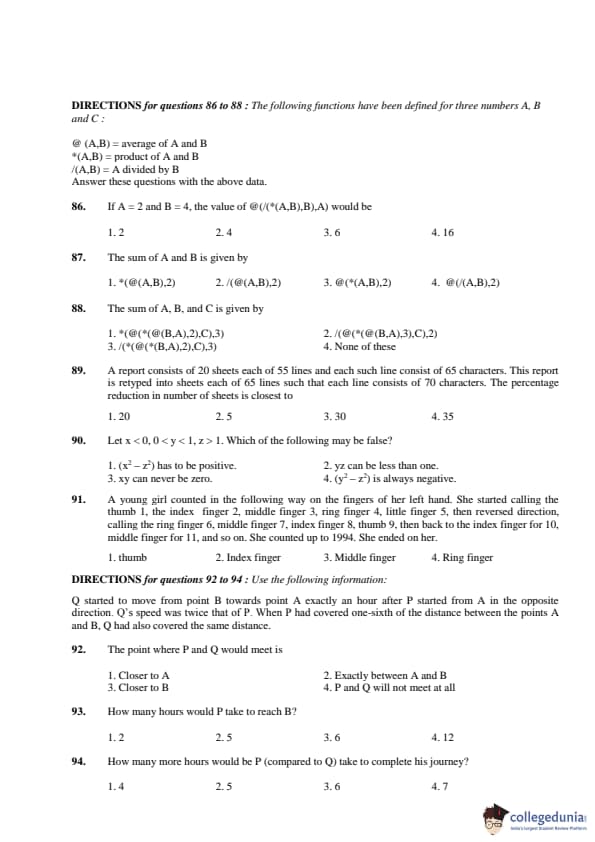
Question 85:

If A = 2 and B = 4, what is the value of \(@(/(*(A, B), B), A)\)?

  • (a) 2
  • (b) 4
  • (c) 6
  • (d) 16
Correct Answer: (a) 2
View Solution

Question 86:

Which expression gives the sum of A and B?

  • (a) *(@(A, B), 2)
  • (b) /(@(A, B), 2)
  • (c) @( *(A, B), 2)
  • (d) @( /(A, B), 2)
Correct Answer: (a) *(@(A, B), 2)
View Solution

Question 87:

Which expression gives the sum of A, B, and C?

  • (a) *(@(*( @(B, A), 2), C), 3)
  • (b) /(@(*( @(B, A), 3), C), 2)
  • (c) /(*(@(B, A), 2), C), 3)
  • (d) None of these
Correct Answer: (a) *(@(*( @(B, A), 2), C), 3)
View Solution

Question 88:

A report has 20 sheets, each with 55 lines of 65 characters. It's retyped on pages of 65 lines and 70 characters per line. What is the percentage reduction in sheets?

  • (a) 20
  • (b) 5
  • (c) 30
  • (d) 35
Correct Answer: (a) 20
View Solution

Question 89:

Given: \( x < 0 \), \( 0 < y < 1 \), \( z > 1 \). Which of the following may be false?

  • (a) \( x^2 - z^2 \) is positive
  • (b) \( yz < 1 \)
  • (c) \( xy \neq 0 \)
  • (d) \( y^2 - z^2 \) is always negative
Correct Answer: (a) \( x^2 - z^2 \) is positive
View Solution

Question 90:

A girl counts fingers: 1 = thumb, 2 = index, ..., 5 = little finger, then reverses. Count reaches 1994. Which finger does she end on?

  • (a) thumb
  • (b) index finger
  • (c) middle finger
  • (d) ring finger
Correct Answer: (b) index finger
View Solution

Question 91:

P and Q start from opposite ends, with Q starting an hour later and at twice the speed. When P has covered 1/6th the distance, Q has also covered the same. Where do they meet?

  • (a) Closer to A
  • (b) Exactly between A and B
  • (c) Closer to B
  • (d) They never meet
Correct Answer: (a) Closer to A
View Solution

Question 92:

How many hours would P take to reach point B?

  • (a) 2
  • (b) 5
  • (c) 6
  • (d) 12
Correct Answer: (d) 12
View Solution

Question 93:

How many more hours would P take compared to Q to complete the journey?

  • (a) 4
  • (b) 5
  • (c) 6
  • (d) 7
Correct Answer: (c) 6
View Solution

Question 94:

The smallest number which when divided by 4, 6, or 7 leaves a remainder of 2 is

  • (a) 44
    (b) 62
    (c) 80
    (d) 86
Correct Answer: (d) 86
View Solution

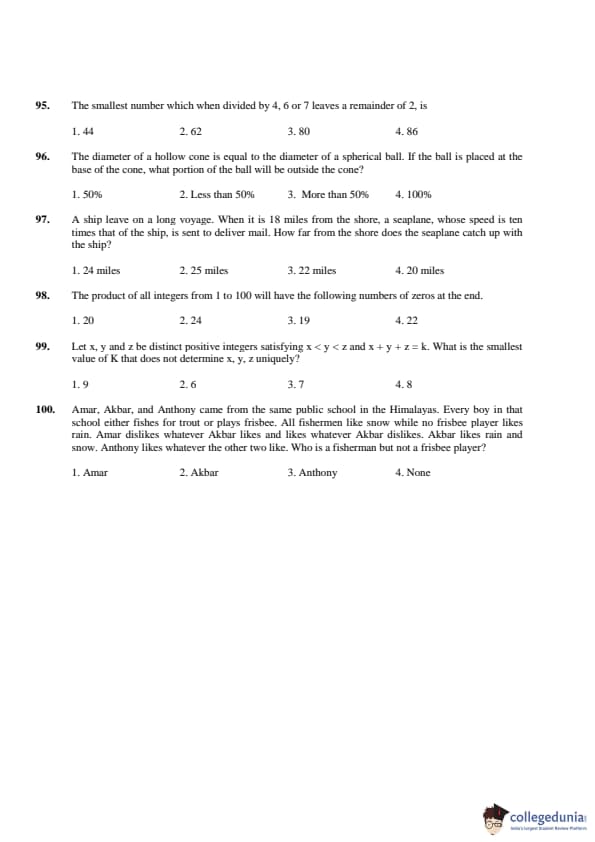
Question 95:

If a spherical ball is placed on a hollow cone with same diameter, what portion will be outside?

  • (a) 50%
    (b) Less than 50%
    (c) More than 50%
    (d) 100%
Correct Answer: (c) More than 50%
View Solution

Question 96:

Ship is 18 miles from shore when a seaplane, 10x faster, is sent. Where does it catch up?

  • (a) 24 miles
    (b) 25 miles
    (c) 22 miles
    (d) 20 miles
Correct Answer: (d) 20 miles
View Solution

Question 97:

Trailing zeroes in 100! (product of 1 to 100)?

  • (a) 20
    (b) 24
    (c) 19
    (d) 22
Correct Answer: (b) 24
View Solution

Question 98:

Minimum value of \( K \) for which \( x + y + z = K \), \( x < y < z \) does NOT uniquely determine the triplet?

  • (a) 9
    (b) 6
    (c) 7
    (d) 8
Correct Answer: (d) 8
View Solution

Question 99:

Logic puzzle involving Amar, Akbar, Anthony, and rain/frisbee preferences. Who is fisherman but not frisbee player?

  • (a) Amar
    (b) Akbar
    (c) Anthony
    (d) None
Correct Answer: (b) Akbar
View Solution

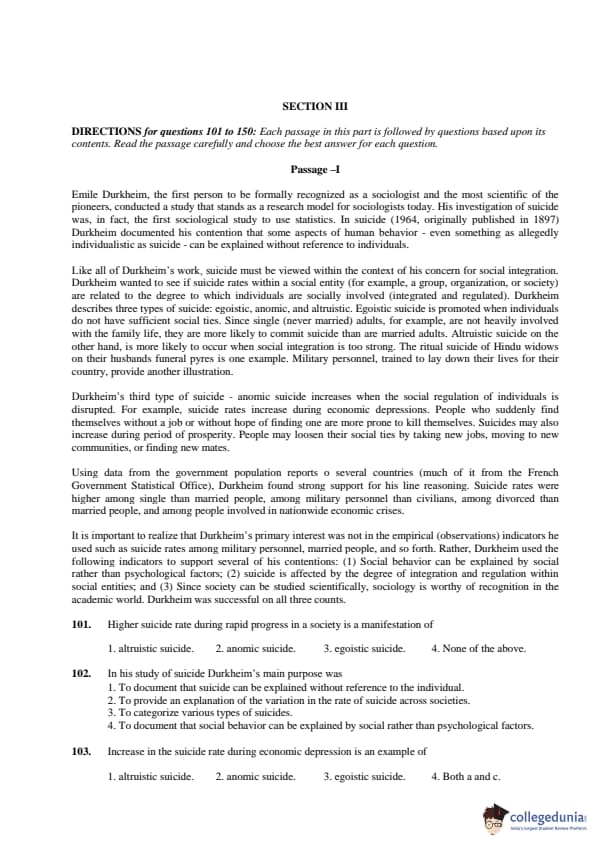
Question 100:

Higher suicide rate during rapid progress in a society is a manifestation of

  • (a) altruistic suicide.
  • (b) anomic suicide.
  • (c) egoistic suicide.
  • (d) None of the above.
Correct Answer: (b) anomic suicide.
View Solution

Question 101:

In his study of suicide Durkheim’s main purpose was

  • (a) to document that suicide can be explained without reference to the individual.
  • (b) to provide an explanation of the variation in the rate of suicide across societies.
  • (c) to categorize various types of suicides.
  • (d) to document that social behavior can be explained by social rather than psychological factors.
Correct Answer: (a) to document that suicide can be explained without reference to the individual.
View Solution

Question 102:

Increase in the suicide rate during economic depression is an example of

  • (a) altruistic suicide.
  • (b) anomic suicide.
  • (c) egoistic suicide.
  • (d) Both a and c.
Correct Answer: (b) anomic suicide.
View Solution

Question 103:

Single adults not heavily involved with family life are more likely to commit suicide. Durkheim categorized this as

  • (a) anomic suicide.
  • (b) altruistic suicide.
  • (c) egoistic suicide.
  • (d) Both (b) and (c).
Correct Answer: (c) egoistic suicide.
View Solution

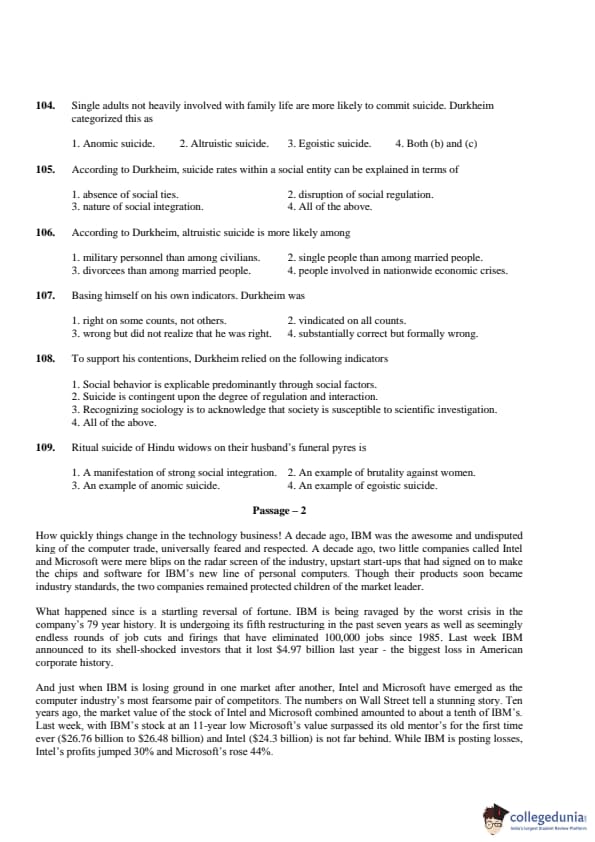
Question 104:

According to Durkheim, suicide rates within a social entity can be explained in terms of

  • (a) absence of social ties.
  • (b) disruption of social regulation.
  • (c) nature of social integration.
  • (d) All of the above.
Correct Answer: (d) All of the above.
View Solution

Question 105:

According to Durkheim, altruistic suicide is more likely among

  • (a) military personnel than among civilians.
  • (b) single people than among married people.
  • (c) divorcees than among married people.
  • (d) people involved in nationwide economic crises.
Correct Answer: (a) military personnel than among civilians.
View Solution

Question 106:

Basing himself on his own indicators, Durkheim was

  • (a) right on some counts, not others.
  • (b) vindicated on all counts.
  • (c) wrong but did not realize that he was right.
  • (d) substantially correct but formally wrong.
Correct Answer: (b) vindicated on all counts.
View Solution

Question 107:

To support his contentions, Durkheim relied on the following indicators

  • (a) social behaviour is explicable predominantly through social factors.
  • (b) suicide is contingent upon the degree of regulation and interaction.
  • (c) recognizing sociology is to acknowledge that society is susceptible to scientific investigation.
  • (d) All of the above.
Correct Answer: (d) All of the above.
View Solution

Question 108:

Ritual suicide of Hindu widows on their husband’s funeral pyres is

  • (a) a manifestation of strong social integration.
  • (b) an example of brutality against women.
  • (c) an example of anomic suicide.
  • (d) an example of egoistic suicide.
  • (a) some computer companies are expanding while others are contracting.
  • (b) employment in the industry is going down.
  • (c) the industry is becoming more monopolized.
  • (d) the share value of IBM is going up relative to that of Intel and Microsoft.
  • (a) The market of microchips and software’s are becoming leaders in the computer industry.
  • (b) Wang and Unisys are primarily manufacturers of computers.
  • (c) IBM laying off workers in the biggest job cut in American corporate history.
  • (d) Intel is based in California.
  • (a) Cyrix.
  • (b) IBM.
  • (c) Intel.
  • (d) Microsoft.
  • (a) General Motors broke away from Ford Motors.
  • (b) A new company went ahead of an established market leader.
  • (c) Like Dr. Frankenstein, Ford Motor created a monster in General Motors.
  • (d) Microsoft, Intel and AT \& T were originally created by IBM.
  • (a) AT\&T.
  • (b) Microsoft.
  • (c) Cyrix.
  • (d) Intel.
  • (a) share prices are not a good indicator of a company’s performance.
  • (b) firing workers restores a company’s health.
  • (c) all companies ultimately regret being a Dr. Frankenstein to some other company.
  • (d) consumers gain as a result of competition among producers.
  • (a) IBM plans to introduce a new system that will run on a variety of machines.
  • (b) IBM’s new generation desk top computers will run only on Motorola’s chips.
  • (c) IBM is working out a joint strategy with Apple to force Motorola to supply chips at a lower price.
  • (d) IBM is going to sell its own chips to Apple and Motorola.
    \textbf{Correct Answer:} (a) IBM plans to introduce a new system that will run on a variety of machines.
  • (a) IBM.
  • (b) Apple.
  • (c) Microsoft.
  • (d) None of the above.
    \textbf{Correct Answer:} (c) Microsoft.
  • (a) The two companies developed competing software’s.
  • (b) Microsoft and Intel teamed up against IBM.
  • (c) IBM began to purchase microchips from Intel instead of Microsoft.
  • (d) IBM made loses while Microsoft made profits.
    \textbf{Correct Answer:} (a) The two companies developed competing software’s.
  • (a) IBM plans to introduce a new system that will run on a variety of machines.
  • (b) IBM’s new generation desk top computers will run only on Motorola’s chips.
  • (c) IBM is working out a joint strategy with Apple to force Motorola to supply chips at a lower price.
  • (d) IBM is going to sell its own chips to Apple and Motorola.
    \textbf{Correct Answer:} (a) IBM plans to introduce a new system that will run on a variety of machines.
  • (a) IBM.
  • (b) Apple.
  • (c) Microsoft.
  • (d) None of the above.
    \textbf{Correct Answer:} (c) Microsoft.
  • (a) The two companies developed competing software’s.
  • (b) Microsoft and Intel teamed up against IBM.
  • (c) IBM began to purchase microchips from Intel instead of Microsoft.
  • (d) IBM made losses while Microsoft made profits.
    \textbf{Correct Answer:} (a) The two companies developed competing software’s.
Correct Answer: (a) a manifestation of strong social integration.
View Solution

Question 109:

According to NEERI

  • (a) the extent of water pollution in the Dal Lake is grim.
  • (b) 70 percent of the total water available in the country is polluted.
  • (c) only 217 out of 3119 towns and cities have sewage treatment facilities.
  • (d) all the 14 major rivers of India are highly polluted.
Correct Answer: (b) 70 percent of the total water available in the country is polluted.
View Solution

Question 110:

The degradation of natural resources will necessarily lead to

  • (a) poor economic utilization of resources.
  • (b) contamination of water from municipal sewage.
  • (c) water unfit for human consumption.
  • (d) none of the above.
Correct Answer: (a) poor economic utilization of resources.
View Solution

Question 111:

Which of the following statements has/ have been made by the W.H.O.?

  • (a) Water-borne diseases account for 80 percent of all diseases prevalent in India.
  • (b) Water-borne diseases in India create a loss of Rs.600 crores every year.
  • (c) Both (a) and (b).
  • (d) None of the above.
Correct Answer: (c) Both (a) and (b).
View Solution

Question 112:

Which of the following statements is correct?

  • (a) The river Periyar is in the South India.
  • (b) The river Periyar is the largest river of Kerala.
  • (c) The river Gomti is also extremely polluted.
  • (d) All of the above are correct.
Correct Answer: (d) All of the above are correct.
View Solution

Question 113:

Municipal sewage pollutants account for

  • (a) the lowest percentage of water pollution
  • (b) 75 percent of the Ganga’s water pollution load.
  • (c) twice the volume of the waste water of industrial origin.
  • (d) three times as much as the discharge from agricultural fields.
Correct Answer: (b) 75 percent of the Ganga’s water pollution load.
View Solution

Question 114:

The crisis of drinking water is caused chiefly by

  • (a) the green house effect.
  • (b) water pollution caused by industrial development.
  • (c) drying up of water sources and over pumping.
  • (d) increasing urbanization.
Correct Answer: (c) drying up of water sources and over pumping.
View Solution

Question 115:

The cost of the ‘Clean-the–Ganga Pollution’ Project Action Plan is likely to be sourced from

  • (a) the Indian exchequer.
  • (b) France, UK, US and the Netherlands.
  • (c) the World Bank, Poland, UK.
  • (d) the US, UK, Netherlands, Poland, France, the World Bank and India.
Correct Answer: (d) the US, UK, Netherlands, Poland, France, the World Bank and India.
View Solution

Question 116:

Considerable amounts of metal pollutants are found in the river(s)

  • (a) Chambal of Rajasthan.
  • (b) Rushikula in Orissa.
  • (c) Damodar, Hoogly, Krishna and Gomti.
  • (d) Ganga, Yamuna, Kali, Hindon, Cauvery and Kapila.
Correct Answer: (d) Ganga, Yamuna, Kali, Hindon, Cauvery and Kapila.
View Solution

Question 117:

Out of the total outlay for water supply and sanitation in the seventh plan, rural water supply sector would receive

  • (a) about 53 percent.
  • (b) over 80 percent.
  • (c) between 65 to 80 percent.
  • (d) equal to 44.7 percent.
Correct Answer: (a) about 53 percent.
View Solution

Question 118:

The best remedy for shortage lies in

  • (a) putting up more pumps in rural areas.
  • (b) cleaning up polluted water.
  • (c) reducing the waste level of 25-30 percent of the total flow of water.
  • (d) constructing large sized dams.
Correct Answer: (b) cleaning up polluted water.
View Solution

Question 119:

The best remedy for shortage lies in

  • (a) putting up more pumps in rural areas.
  • (b) cleaning up polluted water.
  • (c) reducing the waste level of 25-30 percent of the total flow of water.
  • (d) constructing large sized dams.
Correct Answer: (b) cleaning up polluted water.
View Solution

Question 120:

The task of creating learning space with qualities of openness, boundaries and hospitality is multidimensional. It involves operating at

  • (a) psychological and conceptual levels.
  • (b) physical, perceptual and behavioral levels.
  • (c) physical, conceptual and emotional levels.
  • (d) conceptual, verbal and sensitive levels.
Correct Answer: (c) physical, conceptual and emotional levels.
View Solution

Question 121:

The statement ‘the openness of a space is created by the firmness of its boundaries’ appears contradictory. Which of the following statements provides the best justification for the proposition?

  • (a) We cannot have a space without boundaries.
  • (b) Bounded space is highly structured.
  • (c) When space boundaries are violated, the quality of space suffers.
  • (d) A teacher can effectively defend a learning space without boundaries.
Correct Answer: (c) When space boundaries are violated, the quality of space suffers.
View Solution

Question 122:

According to the author, learning is a painful process because

  • (a) it exposes our ignorance.
  • (b) our views and hypotheses are challenged.
  • (c) it involves criticizing the views of other.
  • (d) All of the above reasons.
Correct Answer: (d) All of the above reasons.
View Solution

Question 123:

Understanding the notion of space in our relations with other is

  • (a) to acknowledge the beauty of a poetic metaphor.
  • (b) exclusively rooted in our experiences of physical space.
  • (c) to accept a spiritual dimension in our dealings with our peers.
  • (d) to extend the parallel of physical space to our experiences in daily life.
Correct Answer: (d) to extend the parallel of physical space to our experiences in daily life.
View Solution

Question 124:

Which of the following statements best describes the author’s conception of learning space?

  • (a) Where the teacher is friendly.
  • (b) Where there is no grim competition for grades.
  • (c) Where the students are encouraged to learn about space.
  • (d) Where the teacher provides information and theories which open new doors and encourages students to help each other learn.
Correct Answer: (d) Where the teacher provides information and theories which open new doors and encourages students to help each other learn.
View Solution

Question 125:

According to the author, silence must be an integral part of learning space because

  • (a) silence helps to unite us with others to create a community of truth.
  • (b) silent contemplation prepares us to construct our mind–made world.
  • (c) speaking is too often an exercise in the evasion of truth.
  • (d) speaking is too often a way of buttressing our self–serving reconstruction of reality.
Correct Answer: (a) silence helps to unite us with others to create a community of truth.
View Solution

Question 126:

Another way of describing the author’s notion of learning space can be summarized in the following manner

  • (a) It is vital that learning be accompanied by unlearning.
  • (b) Learning encompasses such elements as courage, dignity and endeavour.
  • (c) An effective teacher recognizes the value of empathy.
  • (d) Encourage good learners, discourage indifferent ones.
Correct Answer: (c) An effective teacher recognizes the value of empathy.
View Solution

Question 127:

According to the author, an effective teacher does not allow

  • (a) feelings to arise within the learning space.
  • (b) silence to become an integral part of the learning space.
  • (c) learning space to be filled by speed reading of several hundred pages of assigned reading.
  • (d) violation of learning space boundaries.
Correct Answer: (c) learning space to be filled by speed reading of several hundred pages of assigned reading.
View Solution

Question 128:

An emotionally honest learning space can only be created by

  • (a) a teacher committed to joining the community of truth.
  • (b) a teacher who is not afraid of confronting feelings.
  • (c) a teacher who takes care not to undermine the learning process.
  • (d) a teacher who worships critical silence.
Correct Answer: (b) a teacher who is not afraid of confronting feelings.
View Solution

Question 129:

Conceptual space with words can be created by

  • (a) assigned reading and lecturing.
  • (b) speed reading and written comprehension.
  • (c) gentle persuasion and deliberate action.
  • (d) creative extrapolation and illustrations.
Correct Answer: (a) assigned reading and lecturing.
View Solution

Question 130:

The author argues that the Japanese system

  • (a) is better than the American system.
  • (b) is highly productive and gives corporate leadership a long term view as a result of its strong traditions.
  • (c) is slowly becoming Americanized.
  • (d) succeeds without business schools, whereas the US system fails because of it.
Correct Answer: (b) is highly productive and gives corporate leadership a long term view as a result of its strong traditions.
View Solution

Question 131:

The growth of popularity of business schools among students was most probably due to

  • (a) Herbert A. Simon a management professor winning the Nobel Prize in economics.
  • (b) the gain in academic stature.
  • (c) the large number of MBA degree awarded.
  • (d) a perception that it was a ‘passport to good life.’
Correct Answer: (d) a perception that it was a ‘passport to good life.’
View Solution

Question 132:

According to the passage

  • (a) learning, which was useful in the 1960’s and 1970’s became irrelevant in the 1980’s.
  • (b) management education faced criticisms in the 1980’s.
  • (c) business schools are insensitive to the needs of industry.
  • (d) by the 1980’s business schools contributed to the decline in US competitiveness.
Correct Answer: (b) management education faced criticisms in the 1980’s.
View Solution

Question 133:

A criticism that management education did not face was that

  • (a) it imparted poor quantitative skills to MBAs.
  • (b) it was unnecessarily and deleterious.
  • (c) it was irrevocably irrelevant.
  • (d) it inculcated undesirable attitudes in students.
Correct Answer: (c) it was irrevocably irrelevant.
View Solution

Question 134:

The absence of business schools in Japan

  • (a) is due to the prevalent belief that management ability can only be acquired over years of practical experience.
  • (b) was due to the high priority placed on learning as opposed to doing in Confucian culture.
  • (c) is hard to explain for the proponents of business education.
  • (d) contributed a great deal to their success in international trade and business.
Correct Answer: (a) is due to the prevalent belief that management ability can only be acquired over years of practical experience.
View Solution

Question 135:

The 1960’s and 1970’s can best be described as a period

  • (a) when quality business education contributed to the superiority of US corporations.
  • (b) when the number of MBAs rose from under 5,000 to over 50,000.
  • (c) when management education gained new academic stature and greater respect.
  • (d) when the MBA became more disreputable.
Correct Answer: (c) when management education gained new academic stature and greater respect.
View Solution

Question 136:

US business schools faced criticism in the 1980’s because

  • (a) of the decline in Japanese competitiveness.
  • (b) many critics felt the learning had little relevance to business problems.
  • (c) people realized that management ability cannot be taught.
  • (d) MBAs were unwilling to accept responsibility for implementation on the shop floor.
Correct Answer: (b) many critics felt the learning had little relevance to business problems.
View Solution

Question 137:

Training programmes in Japanese corporations have

  • (a) been based upon Confucian culture.
  • (b) sought the socialization of newcomers.
  • (c) been targeted at people who have neither the capacity nor the incentive to quit.
  • (d) been teaching people to do menial tasks.
Correct Answer: (b) sought the socialization of newcomers.
View Solution

Question 138:

The Japanese modified their views on management education because of

  • (a) greater exposure to US MBA programmes.
  • (b) the need to develop worldwide contacts and become Americanized.
  • (c) the outstanding success of business schools in the US during the 1960’s and 1970’s.
  • (d) a combination of increased competitive pressures and greater multi-nationalisation of Japanese business.
Correct Answer: (d) a combination of increased competitive pressures and greater multi-nationalisation of Japanese business.
View Solution

Question 139:

The Japanese were initially able to do without business schools as a result of

  • (a) their highly developed and intensively competitive education system.
  • (b) dispatching hundreds of Western technology and modernization.
  • (c) their highly specific in-company training programmes.
  • (d) prevailing beliefs regarding educational institutions.
Correct Answer: (a) their highly developed and intensively competitive education system.
View Solution

Question 140:

The main difference between US and Japanese corporations is

  • (a) that one employs MBAs, the other does not.
  • (b) that US corporations do not employ Japanese people.
  • (c) that US corporations pay more to fresh recruits.
  • (d) in the process of selecting and orienting new recruits.
Correct Answer: (d) in the process of selecting and orienting new recruits.
View Solution

Question 141:

The author argues that

  • (a) Japanese do not do without business schools as is generally perceived.
  • (b) Japanese corporations do not hire MBAs because of traditions of universal and rigorous academic education, life long employment and strong group identification.
  • (c) placing MBAs in operational and menial tasks is a major factor in Japanese business success.
  • (d) US corporations should emulate the Japanese and change the way new recruits are induced.
Correct Answer: (a) Japanese do not do without business schools as is generally perceived.
View Solution

Question 142:

In which year is the profit per rupee of equity the highest?

  • (a) 1991
  • (b) 1992
  • (c) 1993
  • (d) 1990 and 1991
Correct Answer: (c) 1993
View Solution

Question 143:

The simple annual growth rate in sales was the highest between the years?

  • (a) 1990–91
  • (b) 1991–92
  • (c) 1992–93
  • (d) 1990–92
Correct Answer: (c) 1992–93
View Solution

Question 144:

In which year is the sales per rupee of expenditure the lowest?

  • (a) 1990
  • (b) 1991
  • (c) 1992
  • (d) 1993
Correct Answer: (b) 1991
View Solution

Question 145:

In which year is sales per rupee of equity the highest?

  • (a) 1990
  • (b) 1991
  • (c) 1992
  • (d) 1994
Correct Answer: (b) 1991
View Solution

Question 146:

Which company had the lowest sales?

  • (a) ANT
  • (b) BAT
  • (c) CAT
  • (d) DAT
Correct Answer: (d) DAT
View Solution

Question 147:

Which company had the highest total expenses?

  • (a) ANT
  • (b) BAT
  • (c) CAT
  • (d) DAT
Correct Answer: (c) CAT
View Solution

Question 148:

Which company had the lowest profits?

  • (a) ANT
  • (b) BAT
  • (c) CAT
  • (d) DAT
Correct Answer: (a) ANT
View Solution

Question 149:

Which company had the highest profits?

  • (a) ANT
  • (b) BAT
  • (c) CAT
  • (d) DAT
Correct Answer: (b) BAT
View Solution

Question 150:

What is the approximate simple annual growth rate of Total Assets between 1990 and 1993?

  • (a) 36%
  • (b) 12%
  • (c) 9%
  • (d) 27%
Correct Answer: (b) 12%
View Solution

Question 151:

In any two consecutive years, the growth rate is lowest for

  • (a) Net Fixed Assets.
  • (b) Net Current Assets.
  • (c) Investments.
  • (d) Total Assets.
Correct Answer: (c) Investments.
View Solution

Question 152:

Between 1991 and 1992, the highest growth rate was seen for

  • (a) Net Fixed Assets.
  • (b) Net Current Assets.
  • (c) Investments.
  • (d) Total Assets.
Correct Answer: (c) Investments.
View Solution

Question 153:

The only item which has not shown a negative growth in any year between 1990 and 1993 is

  • (a) Net Fixed Assets.
  • (b) Net Current Assets.
  • (c) Investments.
  • (d) Total Assets.
Correct Answer: (d) Total Assets.
View Solution

Question 154:

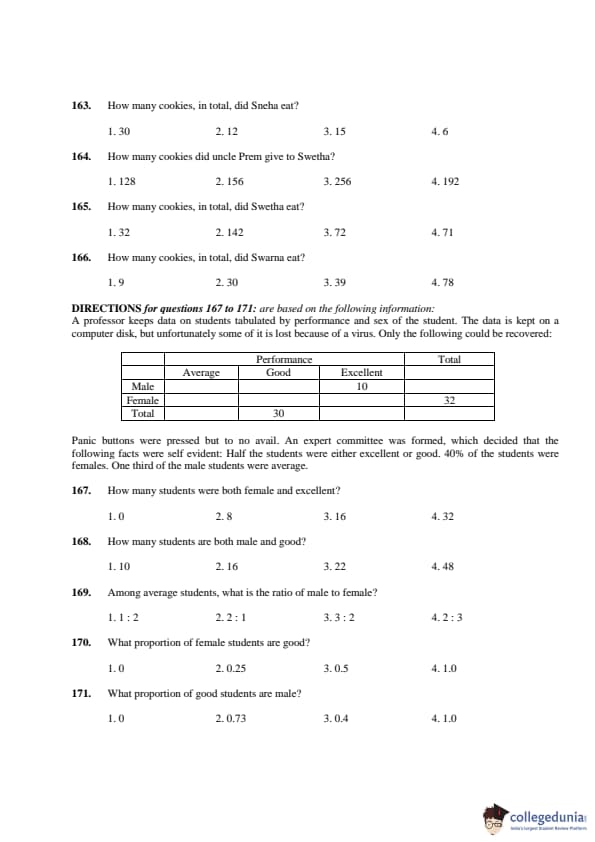
How many cookies, in total, did Sneha eat?

  • (a) 30
  • (b) 12
  • (c) 15
  • (d) 6
Correct Answer: (c) 15
View Solution

Question 155:

How many cookies did uncle Prem give to Swetha?

  • (a) 128
  • (b) 156
  • (c) 256
  • (d) 192
Correct Answer: (a) 128
View Solution

Question 156:

How many cookies, in total, did Swetha eat?

  • (a) 32
  • (b) 142
  • (c) 72
  • (d) 71
Correct Answer: (d) 71
View Solution

Question 157:

How many cookies, in total, did Swarna eat?

  • (a) 9
  • (b) 30
  • (c) 39
  • (d) 78
Correct Answer: (c) 39
View Solution

Question 158:

How many students were both female and excellent?

  • (a) 0
  • (b) 8
  • (c) 16
  • (d) 32
Correct Answer: (a) 0
View Solution

Question 159:

How many students were both male and good?

  • (a) 10
  • (b) 16
  • (c) 22
  • (d) 48
Correct Answer: (c) 22
View Solution

Question 160:

Among average students, what was the ratio of male to female?

  • (a) 1 : 2
  • (b) 2 : 1
  • (c) 3 : 2
  • (d) 2 : 3
Correct Answer: (d) 2 : 3
View Solution

Question 161:

What proportion of female students were good?

  • (a) 0
  • (b) 0.25
  • (c) 0.5
  • (d) 1.0
Correct Answer: (b) 0.25
View Solution

Question 162:

What proportion of good students were male?

  • (a) 0
  • (b) 0.73
  • (c) 0.4
  • (d) 1.0
Correct Answer: (b) 0.73
View Solution

Question 163:

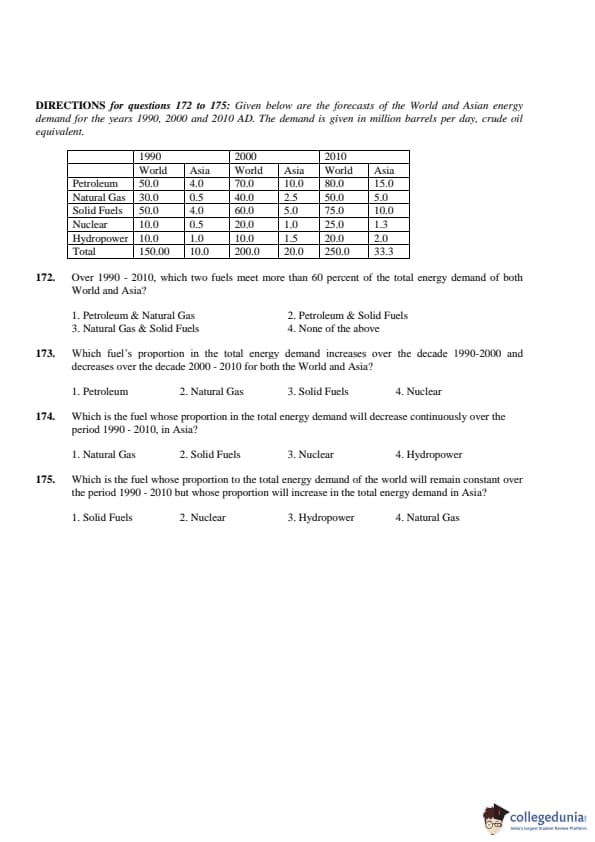
Over 1990–2010, which two fuels meet more than 60 percent of the total energy demand of both World and Asia?

  • (a) Petroleum \& Natural Gas
  • (b) Petroleum \& Solid Fuels
  • (c) Natural Gas \& Solid Fuels
  • (d) None of the above
Correct Answer: (b) Petroleum \& Solid Fuels
View Solution

Question 164:

Which fuel’s proportion in the total energy demand increases over the decade 1990–2000 and decreases over the decade 2000–2010 for both the World and Asia?

  • (a) Petroleum
  • (b) Natural Gas
  • (c) Solid Fuels
  • (d) Nuclear
Correct Answer: (a) Petroleum
View Solution

Question 165:

Which is the fuel whose proportion in the total energy demand will decrease continuously over the period 1990–2010, in Asia?

  • (a) Natural Gas
  • (b) Solid Fuels
  • (c) Nuclear
  • (d) Hydropower
Correct Answer: (d) Hydropower
View Solution

Question 166:

Which is the fuel whose proportion to the total energy demand of the world will remain constant over the period 1990–2010 but whose proportion will increase in the total energy demand in Asia?

  • (a) Solid Fuels
  • (b) Nuclear
  • (c) Hydropower
  • (d) Natural Gas
Correct Answer: (d) Natural Gas
View Solution


CAT Previous Year Question Papers

Candidates preparing for CAT exam are recommended to solve CAT previous year question papers to improve their time management and problem-solving skills.

Other MBA Exam Question Papers