




The IIM Indore is expected to conduct the CAT 2026 exam and will likely release the detailed CAT syllabus along with the official notification in July 2026.
The CAT Syllabus will have 3 main sections: Verbal Ability & Reading Comprehension (VARC), Data Interpretation & Logical Reasoning (DILR), and Quantitative Aptitude (QA).
The CAT 2026 exam is expected to follow a similar pattern to the CAT 2025.
A total of 68 questions will be divided into 3 sections in 120 minutes, with a 40-minute strict sectional limit.
Over the last 5 years, Arithmetic and Algebra have contributed to 45–50% of QA questions, while Reading Comprehension forms about 70% of the VARC section.
Related Links:
- CAT Exam Pattern 2026 - Topic Wise, Marking Scheme, Duration, Type of Questions, and Syllabus
- CAT Topic Wise Weightage for QA, VARC, and DILR, Check Previous Years’ Questions
What is the Syllabus for CAT Exam 2026?
The CAT syllabus refers to the list of topics and skills tested in the CAT exam for admission to MBA and PGDM programs at IIMs and other top B-schools in India. The exam tests analytical thinking, problem-solving ability, and reading comprehension skills.
The CAT Syllabus will be divided into 3 sections:
- Verbal Ability & Reading Comprehension (VARC)
- Data Interpretation & Logical Reasoning (DILR)
- Quantitative Aptitude (QA).
Overview of the CAT Exam Pattern
- It is a computer-based test of 3 hours.
- The question paper consists of 100 questions divided into 3 sections.
- Every section is allocated a time of 40 mins each.
- The switching of sections is not allowed. But switching of questions within a section is allowed.
- Each section consists of TITA (Type in the answer) questions and MCQs (Multiple Choice Questions).
- No negative marking for TITA questions but -1 negative marking for each wrong answer in MCQs.
CAT Syllabus 2026
The CAT exam is conducted by the Indian Institutes of Management for admission to MBA and PGDM programs in top B-schools such as IIM Ahmedabad, IIM Bangalore, and IIM Calcutta.
Based on the recent pattern (CAT 2025 reference), the exam consists of three sections with 40 minutes each.
| Section | Questions | Marks | Time |
|---|---|---|---|
| VARC | 24 | 72 | 40 minutes |
| LRDI | 22 | 66 | 40 minutes |
| Quantitative Ability | 22 | 66 | 40 minutes |
| Total | 68 | 204 | 120 minutes |
CAT Subject Wise Syllabus
Quantitative Ability (QA) Syllabus
The Quant section tests basic mathematics concepts up to Class 10 level but with higher logical complexity.
- Algebra contributes 30–32% of Quant questions.
- Quadratic equations and inequalities are among the most frequently asked problems.
| Topic | Key Sub-topics | Approx. Number of Questions | Weightage (%) |
|---|---|---|---|
| Arithmetic | Percentages, Profit & Loss, Averages, Ratio & Proportion, Mixtures & Alligations, Time-Speed-Distance (TSD), Time & Work | 8–10 | ~40% |
| Algebra | Linear & Quadratic Equations, Inequalities, Functions, Progressions (AP/GP), Logarithms | 6–8 | ~30% |
| Geometry & Mensuration | Lines, Angles, Triangles, Circles, Polygons, Coordinate Geometry, Mensuration (2D & 3D) | 3–5 | ~20% |
| Number System | Divisibility, HCF & LCM, Remainders, Base Systems, Factors, Unit Digits | 2–4 | ~10% |
| Modern Mathematics | Permutation & Combination, Probability, Set Theory, Basic Statistics | 2–3 | ~10% |
VARC (Verbal Ability & Reading Comprehension) Syllabus
The VARC Section tests the verbal and reading ability of the students. As per the previous years' exam, the candidates have faced long and complex questions from this section, especially in Reading Comprehension.
- Reading Comprehension (RC) dominates VARC, contributing 65–70% weightage with around 16 questions.
- The remaining 30–35% comes from Verbal Ability topics, which have low individual weightage but together impact the overall score.
| Topic | Key Sub-topics | Approx. Number of Questions | Weightage (%) |
|---|---|---|---|
| Reading Comprehension | Philosophy, Economics, Sociology, Science, Abstract Passages | 16 | ~65–70% |
| Para Jumbles | Sentence Arrangement (TITA-based questions common) | 2–3 | ~10% |
| Para Summary | Identifying the correct summary of a paragraph | 2–3 | ~10% |
| Odd One Out | Identify the irrelevant sentence in the paragraph | 2–3 | ~10% |
| Para Completion | Fill missing sentence logically in the paragraph | 1–2 | ~5% |
DILR (Data Interpretation & Logical Reasoning) Syllabus
The DILR section tests the analytical and logical thinking ability of the students. In CAT 2025, this section was considered one of the most unpredictable, with a mix of data-based and logic-driven sets that require careful selection and time management.
- Logical Reasoning (LR) and Data Interpretation (DI) have a balanced weightage, each contributing around 40–50% with 8–10 questions.
- Mixed LRDI sets form about 20% of the section (4–6 questions), combining both logic and data interpretation.
| Topic | Key Sub-topics | Approx. Number of Questions | Weightage (%) |
|---|---|---|---|
| Logical Reasoning | Seating Arrangement, Scheduling, Games & Tournaments, Arrangements, Binary Logic | 8–10 | ~40–50% |
| Data Interpretation | Tables, Bar Graphs, Pie Charts, Line Graphs, Caselets | 8–10 | ~40–50% |
| Mixed Sets (LRDI) | Combination of LR + DI puzzles | 4–6 | ~20% |
| Advanced Puzzles | Routes & Networks, Venn Diagrams, Distribution, Hybrid Sets | 2–4 | Included above |
CAT 2025 DILR Slot-wise Topic & Question Distribution
CAT 2025 DILR showed clear slot-wise variation, with each slot having around 20- 22 questions across 4- 5 sets.
- Slot 1 was LR-heavy, with nearly 60–65% sets from arrangements and puzzles, leading to lower attempts around 10-12 questions.
- Slot 2 was balanced; it had caselets and graphs, allowing slightly higher attempts of 12-14 questions.
- Slot 3 focused on integrated DI-LR sets, with ~60% mixed caselets and table-based DI, making it conceptually tougher.
Overall, the section emphasized hybrid sets and accuracy around 80–85% over attempts.
CAT 2025 Slot 1 (DILR)
| Set No. | Topic | Sub-topic / Type | Description | No. of Questions |
|---|---|---|---|---|
| 1 | Logical Reasoning | Circular Arrangement + Movement | 4 people moving chairs with conditions across turns | 4 |
| 2 | Logical Reasoning | Games & Tournaments / Group Switching | Employee promotion/demotion across quarters with ratings | 5 |
| 3 | Data Interpretation | Charts (Radar + Bar) + Trade | Tariffs, imports, exports, trade surplus/deficit | 4 |
| 4 | Data Interpretation | Caselet (Train Seating) | Seat occupancy, segments, booking constraints | 5 |
| 5 | Logical Reasoning | Puzzle (Taps/Responses) | Coding of responses (Yes/No/Maybe) with constraints | 4 |
Source - CAT 2025 DILR Slot 1 Question Paper
CAT 2025 Slot 2 (DILR)
| Set No. | Topic | Sub-topic / Type | Description | No. of Questions |
|---|---|---|---|---|
| 1 | Logical Reasoning | Arrangement / Ordering | Balls & hoops (size comparison via conditions) | 4 |
| 2 | Data Interpretation | Caselet (Weighted Average) | Pollution Index with cities & NUR | 5 |
| 3 | Data Interpretation | Charts (Bar/Line) | Research papers by authors (multi-variable analysis) | 4 |
| 4 | Data Interpretation | Graph Analysis | Sustainability Index across years (growth rates) | 4 |
| 5 | Logical Reasoning | Scheduling Puzzle | Guru–student timeline with overlaps | 5 |
Source - CAT 2025 DILR Slot 2 Question Paper
CAT 2025 Slot 3 (DILR)
| Set No. | Topic | Sub-topic / Type | Description | No. of Questions |
|---|---|---|---|---|
| 1 | Data Interpretation + LR | Table + Missing Data | Call records between friends (matrix-based puzzle) | 4 |
| 2 | Logical Reasoning | Caselet + Currency/Travel | Multi-variable puzzle (countries, currency, travel cost) | 5 |
| 3 | Data Interpretation | Charts (Progress Tracking) | Puzzle-solving competition (time vs puzzles) | 4 |
| 4 | Logical Reasoning | Circular Arrangement + Passing | Passing object in a circle with rules | 4 |
| 5 | Data Interpretation | Caselet (Trade & Economics) | Trade balance, normalized trade, exports/imports | 5 |
Source - CAT 2025 DILR Slot 3 Question Paper
CAT 2025 VARC Slot-wise Topic & Question Distribution
CAT 2025 VARC was RC-dominated across all slots, with 16–17 questions (~67–70%) out of 24questions.
- Slot 1 focused on abstract, theory-heavy passages,
- Slot 2 emphasized science and tech-based RCs with a strong inference focus.
- Slot 3 featured inference-heavy RC along with logic-driven VA (para jumbles, insertion). Overall, inference-based questions were the most frequent.
CAT 2025 Slot 1 VARC
| Section Type | Topic | No. of Questions | Question Type |
|---|---|---|---|
| Reading Comprehension (RC) | Electronic Music & Aesthetics | 4 | MCQ |
| Complex Systems, Contagion & Markets | 4 | MCQ | |
| Insanity, Law & Alienists | 4 | MCQ | |
| Income Inequality & Economic Growth | 4 | MCQ | |
| Verbal Ability (VA) | Para Jumbles (4 sentences) | 2 | TITA |
| Para Jumbles (5 sentences – odd one out) | 2 | TITA | |
| Para Summary | 2 | MCQ | |
| Sentence Insertion | 2 | MCQ |
Source - CAT 2025 VARC Slot 1 Question Paper
CAT 2025 Slot 2 VARC
| Section Type | Topic | No. of Questions | Question Type |
|---|---|---|---|
| Reading Comprehension (RC) | Humans & Biodiversity | 1 | MCQ (Summary-based) |
| Literary Geography & Interdisciplinary Studies | 4 | MCQ | |
| AI, Big Tech & Bias | 4 | MCQ | |
| Cavefish Evolution & Adaptation | 4 | MCQ | |
| Science & Instrumentation (Astronomy vs Biology) | 4 | MCQ | |
| Verbal Ability (VA) | Para Summary | 3 | MCQ |
| Para Jumbles (4 sentences) | 2 | TITA | |
| Odd One Out (5 sentences) | 2 | TITA | |
| Sentence Insertion | 2 | MCQ |
Source - CAT 2025 VARC Slot 2 Question Paper
CAT 2025 Slot 3 VARC
| Section Type | Topic | No. of Questions | Question Types |
|---|---|---|---|
| Reading Comprehension (RC) | Artificial Intelligence & Ethics | 4 | Inference, Summary, Assumption, Vocabulary |
| Forest Act & Colonial Policy | 4 | Inference, Main Idea, Critical Reasoning | |
| Dams & Environmental Impact | 4 | Vocabulary, Inference, Author’s Argument | |
| Tribal Imagination & Art | 4 | Inference, Conceptual Questions | |
| Memory & Philosophy | 1 | Summary | |
| Verbal Ability (VA) | Para Insertion | 2 | Sentence Placement |
| Para Jumble | 2 | Sentence Sequencing | |
| Odd Sentence Out | 2 | Odd Sentence Identification | |
| Summary Questions | 2 | Passage Summary |
Source - CAT 2025 VARC Slot 3 Question Paper
CAT 2025 QA Slot-wise Topic & Question Distribution
CAT 2025 QA was dominated by Arithmetic and Algebra across all slots (~70–80% weightage) with 22–23 questions each.
- Slot 1 was Arithmetic-heavy (~45–50%), Slot 2 was more balanced between Arithmetic and Algebra (~40–45% each).
- Slot 3 was more diverse and concept-driven with mixed/advanced questions (~18%), making it slightly tougher overall.
CAT 2025 Slot 1 QA
| Topic | Key Sub-topics | No. of Questions | Weightage (%) |
|---|---|---|---|
| Arithmetic | Profit & Loss, SI/CI, Ratio & Mixtures, Time-Speed-Distance, Time & Work | 10–11 | ~45–50% |
| Algebra | Linear & Quadratic Equations, Logarithms, Exponents, Functions, Inequalities | 6–7 | ~27–32% |
| Geometry & Mensuration | Circles, Coordinate Geometry, Mensuration (Rhombus), Chords | 3–4 | ~14–18% |
| Modern Mathematics | Permutation & Combination, Inequalities (Integer solutions) | 2 | ~9% |
| Number System | Digits, Factors, Series (Patterns) | 2–3 | ~9–11% |
| Total | — | 22 | 100% |
Source - CAT 2025 QA Slot 1 Question Paper
CAT 2025 Slot 2 (QA)
| Topic | Key Sub-topics | No. of Questions | Weightage (%) |
|---|---|---|---|
| Arithmetic | Ratio, Averages, Percentages, Profit & Loss, CI, Time-Speed-Distance, Time & Work, Mixtures | 9–10 | ~40–45% |
| Algebra | GP, Logarithms, Exponents, Functions, Modulus, Quadratics, Equations, Minimization | 8–9 | ~36–41% |
| Geometry & Mensuration | Circles (Tangents), Polygons, Triangles | 4–5 | ~18–23% |
| Number System | Divisors, Powers, Digits | 2–3 | ~9–11% |
| Total | — | 22–23 | 100% |
Source - CAT 2025 QA Slot 2 Question Paper
CAT 2025 Slot 3 QA
| Topic | Key Sub-topics | No. of Questions | Weightage (%) |
|---|---|---|---|
| Arithmetic | Ratio & Mixtures, Time-Speed-Distance, Time & Work, Profit & Loss, Averages | 7 | ~32% |
| Algebra | Logarithms, Functions, Inequalities, Algebraic Expressions, Equations | 4 | ~18% |
| Geometry & Mensuration | Triangles, Circles, Trapezium, Properties of Geometry | 3 | ~14% |
| Number System | Digits, Divisibility, Powers, Base Concepts | 2 | ~9% |
| Modern Mathematics | Set Theory, AP/Series, P&C/Probability | 2 | ~9% |
| Mixed / Advanced (Number + Algebra + Logic) | Exponents, Number Logic, Multi-concept Problems | 4 | ~18% |
| Total | — | 22 | 100% |
Source - CAT 2025 QA Slot 3 Question Paper
CAT Syllabus 2026 Preparation Strategy
If there’s one thing every CAT topper agrees on, it’s this: CAT is not about solving everything, it’s about solving the right questions with the right strategy.
Based on recent trends and experts analysis, even in a slightly tougher paper, 30–33 correct questions out of 68 can get you a 95–99th percentile. That’s less than 50% accuracy.
CAT 9-Month Phase-Wise Plan to Target 99 Percentile
You can prepare well for the CAT 2026 Exam in 9 months with a full, detailed, and strategic approach.
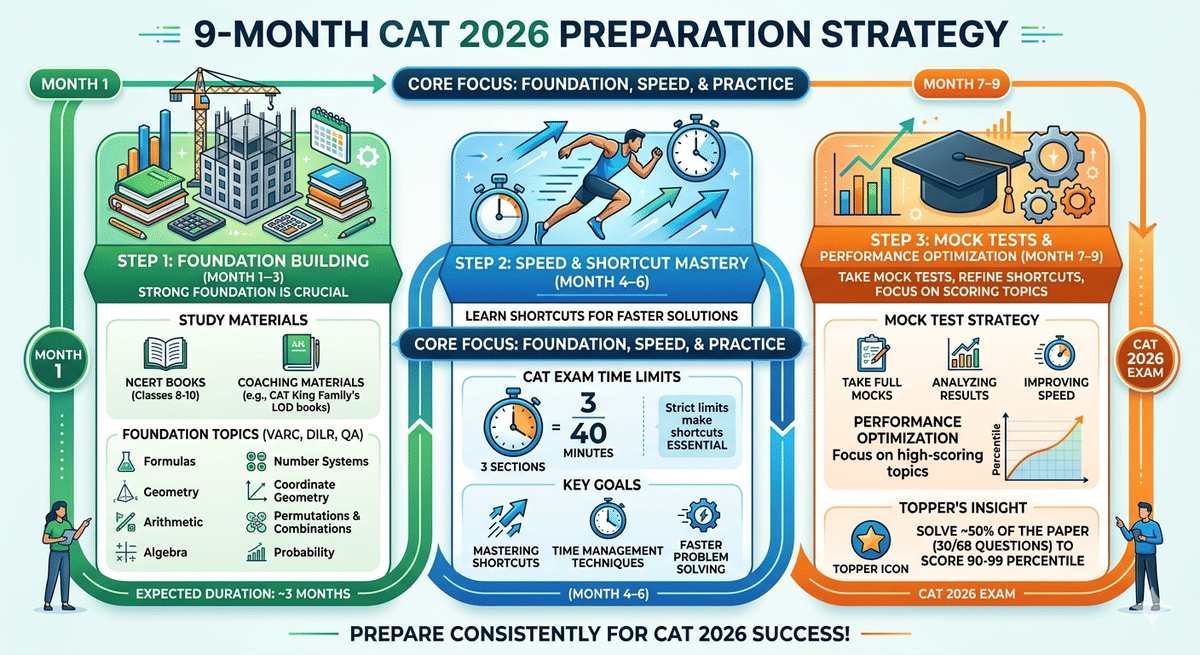
Step 1: Foundation Building (Month 1–3)
- A strong foundation is crucial; it includes NCERT books from classes 8-10 and coaching materials such as CAT King Family’s LOD (Level of Difficulty) books.
- Foundation topics include formulas, geometry, arithmetic, algebra, number systems, coordinate geometry, permutations, combinations, and probability.
- This foundational phase is expected to take about 3 months.
Step 2: Speed & Shortcut Mastery (Month 4–6)
- The next 3 months focus on learning shortcuts to solve questions faster, as the CAT exam has strict time limits: 3 sections of 40 minutes each.
- Without shortcuts, solving the paper within the time frame is not feasible.
Step 3: Mock Tests & Performance Optimization (Months 7–9)
- The last 3 months involve taking mock tests, refining shortcuts, and focusing on important and scoring topics.
- The speaker stresses honesty and realism: even toppers solve around 50% of the paper, with 30 questions out of 68 often enough to score 90-99 percentile.
CAT 2026 Subject-wise Preparation
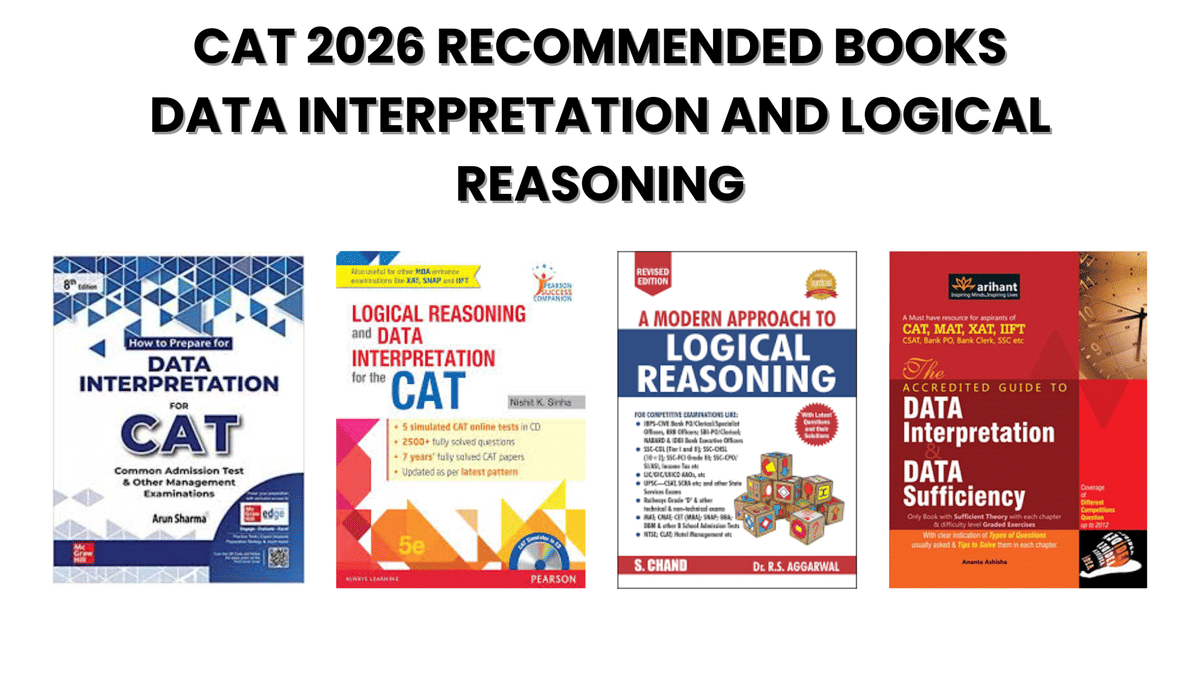
CAT 2026 Recommended Books
The following Books are recommended by
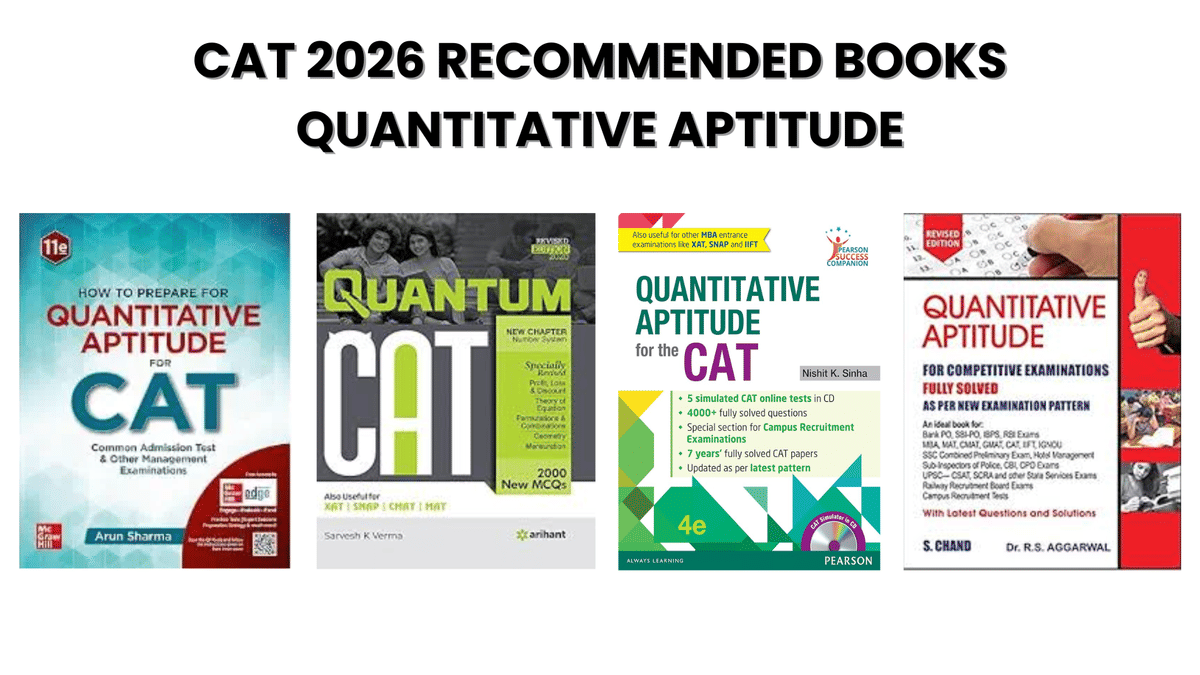
@catking To prepare for the CAT 2026, you only require 2–3 good books per section, along with deep practice. Most books take you from beginner to advanced, so you don’t need too many resources- Quant: Start with basics (NCERT, R.S. Aggarwal), then move to concept building (Arun Sharma), and finally advanced problems & shortcuts (Sarvesh Verma)
- VARC: Focus more on reading and understanding, not mugging; books like Word Power Made Easy help, but RC practice is more important
- DILR: Fewer books are enough, but consistent practice of different sets is the key
Quantitative Aptitude (QA)
| Book Name | Author | Level | Best For |
|---|---|---|---|
| How to Prepare for Quantitative Aptitude for CAT | Arun Sharma | Beginner → Advanced | Concept building + practice |
| Quantum CAT | Sarvesh Verma | Advanced | Shortcuts & high-level problems |
| Quantitative Aptitude for CAT | Nishit Sinha | Beginner → Intermediate | Concept clarity + structured learning |
| Quantitative Aptitude for Competitive Examinations | R.S. Aggarwal | Beginner | Basics & practice |
| NCERT Mathematics Class 6-10 | NCERT | Beginner | Basic maths foundation |
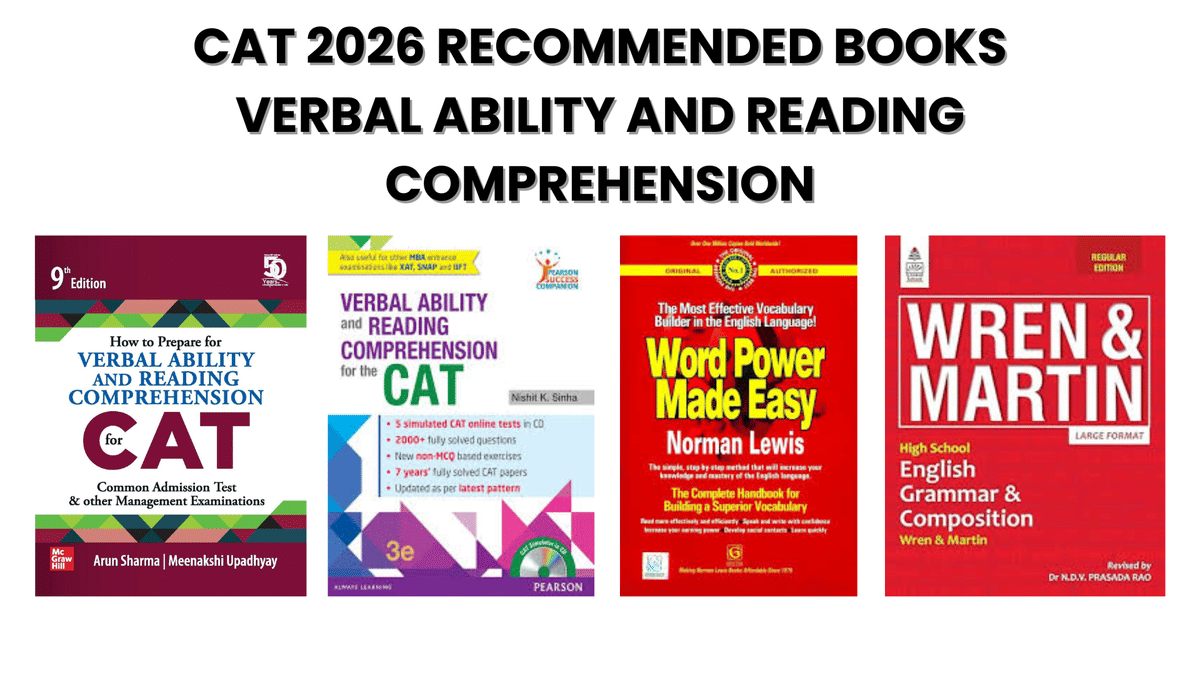
VARC (Verbal Ability & RC)
| Book Name | Author | Level | Best For |
|---|---|---|---|
| How to Prepare for Verbal Ability and Reading Comprehension for CAT | Arun Sharma & Meenakshi | Beginner → Advanced | RC + VA complete prep |
| Verbal Ability and Reading Comprehension for CAT | Nishit Sinha | Intermediate | RC practice + reasoning |
| Word Power Made Easy | Norman Lewis | Beginner | Vocabulary building |
| High School English Grammar and Composition | Wren & Martin | Beginner | Grammar basics |
| The Pearson Guide to Verbal Ability and Reading Comprehension | Nishit Sinha | Advanced | RC + critical reasoning |
DILR (Data Interpretation & Logical Reasoning)
| Book Name | Author | Level | Best For |
|---|---|---|---|
| How to Prepare for Data Interpretation and Logical Reasoning for CAT | Arun Sharma | Beginner → Advanced | DI + LR fundamentals |
| Logical Reasoning and Data Interpretation for CAT | Nishit Sinha | Intermediate → Advanced | CAT-level sets |
| A Modern Approach to Logical Reasoning | R.S. Aggarwal | Beginner | Basic reasoning |
| Data Interpretation and Data Sufficiency | Ananta Ashisha | Intermediate | DI practice |
CAT 2026 Mock Test
The mock tests play an important role in the preparation for the CAT exam. It provides you with the real time simulation of the exam.
- In the first 3 months (0–2 mocks), the focus is on building concepts, so mocks are not very important at this stage.
- In the next 3 months (around 10–12 mocks), mocks help in improving speed, accuracy, and understanding the exam pattern.
- In the last 3 months (20–30 mocks), most of the practice happens, making it the most important phase.
Overall, taking 30–40 mocks is ideal for achieving a 99th percentile.
Ideal CAT Mock Test Plan for 99 Percentile
| Preparation Phase | Duration | Mock Frequency | Total Mocks in Phase | Purpose of Mocks |
|---|---|---|---|---|
| Foundation Building | First 3 months | 0–2 (optional) | 0–2 | Concept clarity, no heavy focus on mocks |
| Shortcut Learning | Next 3 months | 1 mock per week | ~10–12 | Build speed & basic exam strategy |
| Mock & Refinement Phase | Last 3 months | 2–3 mocks per week | ~20–30 | Full exam simulation & performance tuning |
| Total (Overall) | 9 months | — | 30–40 mocks (ideal) | Required range for 99 percentile readiness |
CAT Subject-wise Mock Test
| Subjects | Mock Test Link |
|---|---|
| CAT QA Mock Test | Take Test |
| CAT VARC Mock Test | Take Test |
| CAT DILR Mock Test | Take Tes |
Also Check: CAT Mock Test 2026: Free Mock Test Series, Topic, Sectional, Full CAT Mock Tests
CAT Previous Year Exam Analysis (2025-2022)
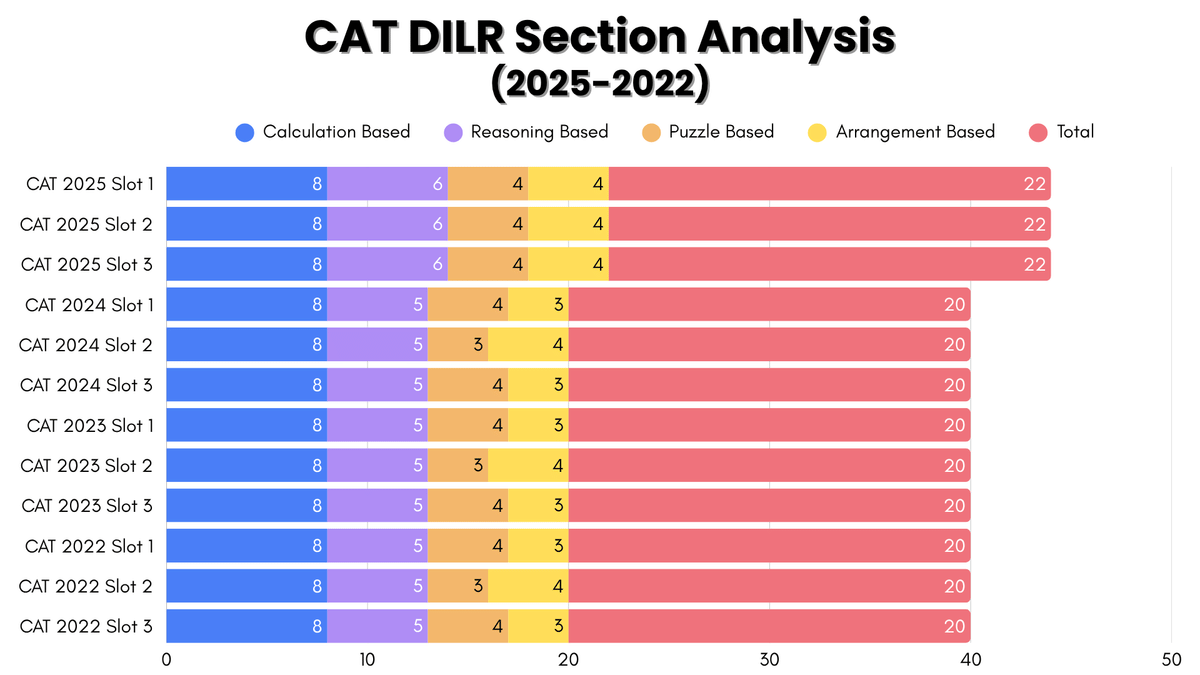
The CAT Previous years Question Papers analysis shows clear and consistent trends across sections. In CAT 2025, there was a change in the exam pattern; 2 questions were added in the DILR section, making it a total of 22 questions in DILR from 20.
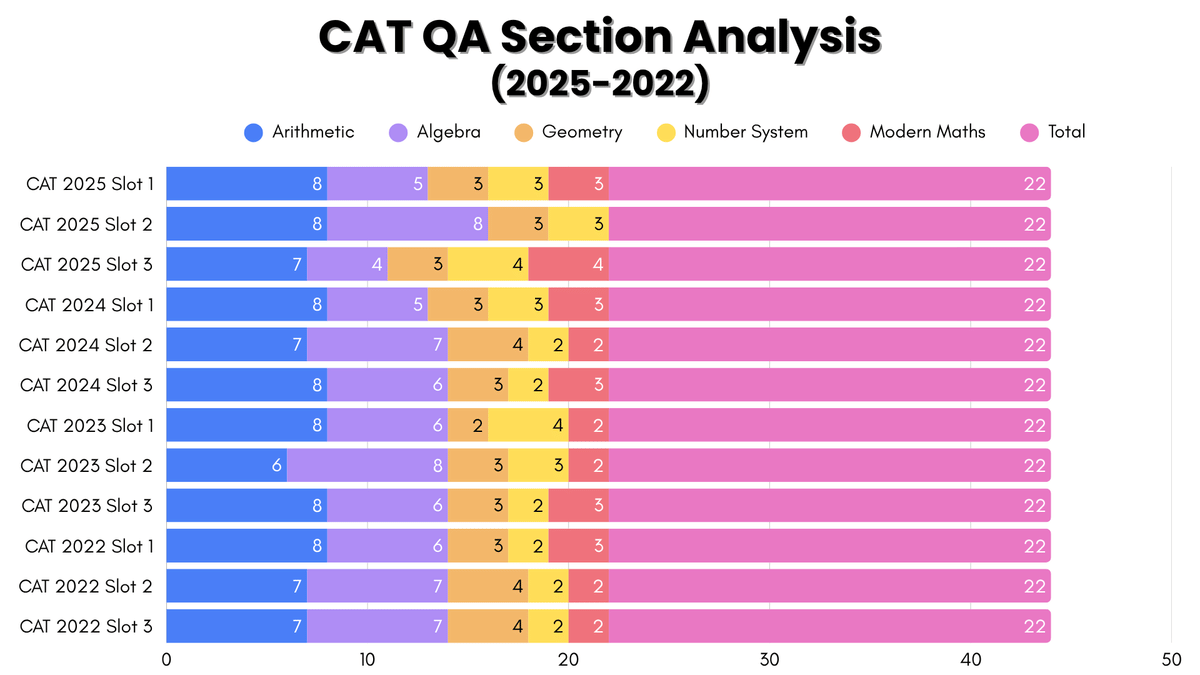
CAT QA Section analysis
Arithmetic has the highest weightage with 7–8 questions, followed by Algebra (5–8 questions). Geometry, Number System, and Modern Math have lower but consistent presence.
| Slot | Arithmetic | Algebra | Geometry | Number System | Modern Maths | Total |
|---|---|---|---|---|---|---|
| CAT 2025 Slot 1 | 8 | 5 | 3 | 3 | 3 | 22 |
| CAT 2025 Slot 2 | 8 | 8 | 3 | 3 | 0 | 22 |
| CAT 2025 Slot 3 | 7 | 4 | 3 | 4 | 4 | 22 |
| CAT 2024 Slot 1 | 8 | 5 | 3 | 3 | 3 | 22 |
| CAT 2024 Slot 2 | 7 | 7 | 4 | 2 | 2 | 22 |
| CAT 2024 Slot 3 | 8 | 6 | 3 | 2 | 3 | 22 |
| CAT 2023 Slot 1 | 8 | 6 | 2 | 4 | 2 | 22 |
| CAT 2023 Slot 2 | 6 | 8 | 3 | 3 | 2 | 22 |
| CAT 2023 Slot 3 | 8 | 6 | 3 | 2 | 3 | 22 |
| CAT 2022 Slot 1 | 8 | 6 | 3 | 2 | 3 | 22 |
| CAT 2022 Slot 2 | 7 | 7 | 4 | 2 | 2 | 22 |
| CAT 2022 Slot 3 | 7 | 7 | 4 | 2 | 2 | 22 |
CAT VARC Section analysis
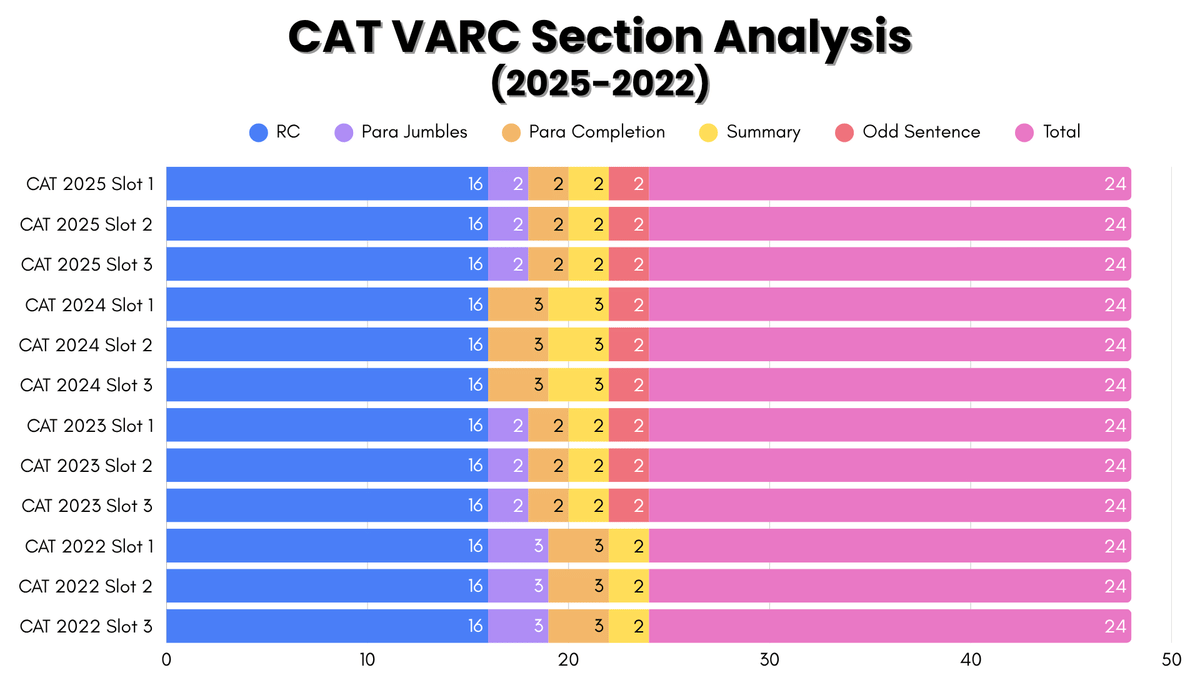
Reading Comprehension dominates with 65–70% weightage with 16 questions out of 24, while other topics like Para Jumbles and Summary vary each year.
| Year and Slot | RC | Para Jumbles | Para Completion | Summary | Odd Sentence | Total |
|---|---|---|---|---|---|---|
| 2025 Slot 1 | 16 | 2 | 2 | 2 | 2 | 24 |
| 2025 Slot 2 | 16 | 2 | 2 | 2 | 2 | 24 |
| 2025 Slot 3 | 16 | 2 | 2 | 2 | 2 | 24 |
| 2024 Slot 1 | 16 | 0 | 3 | 3 | 2 | 24 |
| 2024 Slot 2 | 16 | 0 | 3 | 3 | 2 | 24 |
| 2024 Slot 3 | 16 | 0 | 3 | 3 | 2 | 24 |
| 2023 Slot 1 | 16 | 2 | 2 | 2 | 2 | 24 |
| 2023 Slot 2 | 16 | 2 | 2 | 2 | 2 | 24 |
| 2023 Slot 3 | 16 | 2 | 2 | 2 | 2 | 24 |
| 2022 Slot 1 | 16 | 3 | 3 | 2 | 0 | 24 |
| 2022 Slot 2 | 16 | 3 | 3 | 2 | 0 | 24 |
| 2022 Slot 3 | 16 | 3 | 3 | 2 | 0 | 24 |
CAT DILR Section analysis
Calculation-based sets carry the most weight (~8 questions), followed by puzzles and reasoning. Total questions increased from 20 to 22 in 2025, indicating a slight rise in difficulty.
| Slot | Calculation Based | Reasoning Based | Puzzle Based | Arrangement Based | Total |
|---|---|---|---|---|---|
| CAT 2025Slot 1 | 8 | 6 | 4 | 4 | 22 |
| CAT 2025Slot 2 | 8 | 6 | 4 | 4 | 22 |
| CAT 2025Slot 3 | 8 | 6 | 4 | 4 | 22 |
| CAT 2024 Slot 1 | 8 | 5 | 4 | 3 | 20 |
| CAT 2024 Slot 2 | 8 | 5 | 3 | 4 | 20 |
| CAT 2024 Slot 3 | 8 | 5 | 4 | 3 | 20 |
| CAT 2023 Slot 1 | 8 | 5 | 4 | 3 | 20 |
| CAT 2023Slot 2 | 8 | 5 | 3 | 4 | 20 |
| CAT 2023Slot 3 | 8 | 5 | 4 | 3 | 20 |
| CAT 2022Slot 1 | 8 | 5 | 4 | 3 | 20 |
| CAT 2022 Slot 2 | 8 | 5 | 3 | 4 | 20 |
| CAT 2022 Slot 3 | 8 | 5 | 4 | 3 | 20 |
CAT Syllabus 2026 FAQs
Ques. Can I clear my CAT in 1 month?
Ans. Yes, you can clear the CAT in 1 month, but scoring a very high percentile like 99+ is challenging, unless you already have a strong basics. With a limited time, your focus should be on the smart strategy rather than completing the whole syllabus.
- VARC: In the VARC section solve on atleast 2 RCs as it contributes around 65-70% weightage and 5-8 questions from topics like Para Summary, Para Summary and Odd one Out.
- QA: In quants section focus on solving atleast 20-25 questions from Arithmetic (Percentages, Profit & Loss, Time & Work) and Algebra (Equations, Inequalities).
- DILR: Focus DI (Tables, Bar Graphs) and LR (Seating Arrangement, Puzzles) atleast 2 sets daily each and try to solve 8-10 questions.
Ques. What marks is 99.9 percentile in cat?
Ans. To score 99.9 percentile in CAT, you typically need around 95–110 marks out of 204, depending on exam difficulty.
Scoring 99.9 percentile means that you are in top 0.1% candidates, which can get you admission into top IIMs like IIM Ahmedabad, IIM Bangalore, and IIM Calcutta.
Ques. Which IIM will prepare CAT 2026?
Ans. The CAT 2026 is expected to conduct and prepare by the IIM Indore, which is likely to be conducted on 29 November 2026.
The CAT exam is conducted on the rotational basis by the older IIMs. As per the previous years trends, IIM Lucknow conducted it in 2023, IIM Calcutta in 2024, and IIM Kozhikode in 2025, setting the stage for IIM Indore in 2026.



Comments