




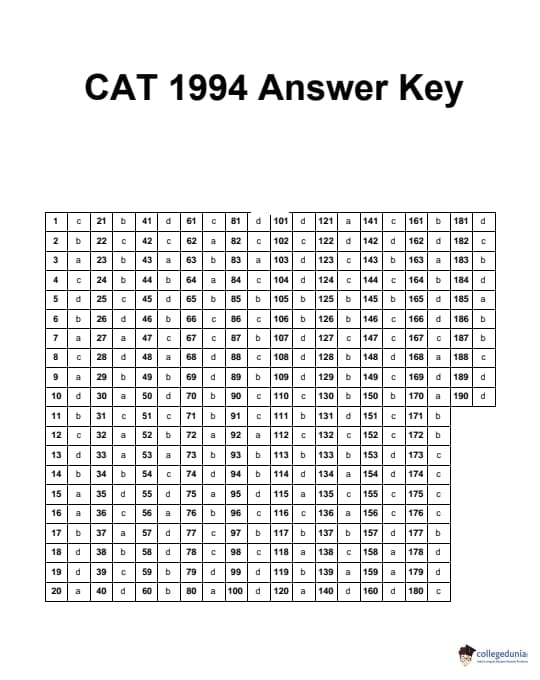
CAT 1994 Question Paper with Answer Key PDF is available for download. CAT 1994 Question Paper was a set of 190 questions. A total of 120 minutes or 2 hours were allotted to complete the 190 questions. All the questions were distributed across 4 sections I e. Verbal Ability, Data Interpretation, Problem Solving/ Quant, and Reading Comprehension
Candidates preparing for CAT 2025 can download the CAT 1994 Question paper with the solution PDF to get a better idea about the type of questions asked in the paper and their difficulty level
Also Check:
CAT 1994 Question Paper with Solution PDF
| CAT 1994 Question Paper with Answer Key | Download PDF | Check Solutions |

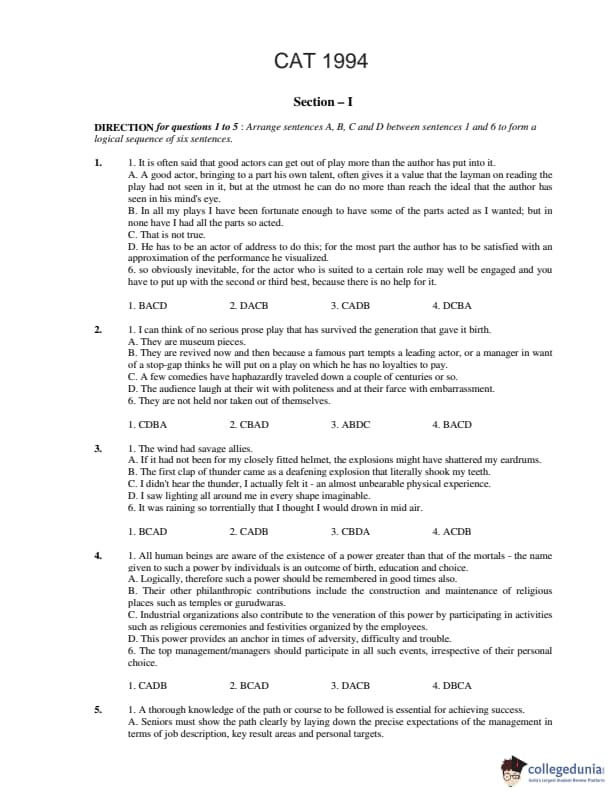
Question 1:
It is often said that good actors can get out of a play more than the author has put into it.
A. A good actor, bringing to a part his own talent, often gives it a value that the layman on reading the play had not seen in it, but at the utmost he can do no more than reach the ideal that the author has seen in his mind’s eye.
B. In all my plays I have been fortunate enough to have some of the parts acted as I wanted; but in none have I had all the parts so acted.
C. That is not true.
D. He has to be an actor of address to do this; for the most part the author has to be satisfied with an approximation of the performance he visualized.
6. This is obviously inevitable, for the actor who is suited to a certain role may well be engaged and you have to put up with the second or third best, because there is no help for it.
I can think of no serious prose play that has survived the generation that gave it birth.
A. They are museum pieces.
B. They are revived now and then because a famous part tempts a leading actor, or a manager in want of a stop-gap thinks he will put on a play on which he has no loyalties to pay.
C. A few comedies have haphazardly traveled down a couple of centuries or so.
D. The audience laugh at their wit with politeness and at their farce with embarrassment.
6. They are not held nor taken out of themselves.
View Solution
The wind had savage allies.
A. If it had not been for my closely fitted helmet, the explosions might have shattered my eardrums.
B. The first clap of thunder came as a deafening explosion that literally shook my teeth.
C. I didn’t hear the thunder, I actually felt it — an almost unbearable physical experience.
D. I saw lighting all around me in every shape imaginable.
6. It was raining so torrentially that I thought I would drown in mid air.
View Solution
All human beings are aware of the existence of a power greater than that of the mortals – the name given to such a power by individuals is an outcome of birth, education and choice.
A. Logically, therefore such a power should be remembered in good times also.
B. Their other philanthropic contributions include the construction and maintenance of religious places such as temples or gurudwaras.
C. Industrial organizations also contribute to the veneration of this power by participating in activities such as religious ceremonies and festivities organized by the employees.
D. This power provides an anchor in times of adversity, difficulty and trouble.
6. The top management/managers should participate in all such events, irrespective of their personal choice.
View Solution
A thorough knowledge of the path or course to be followed is essential for achieving success.
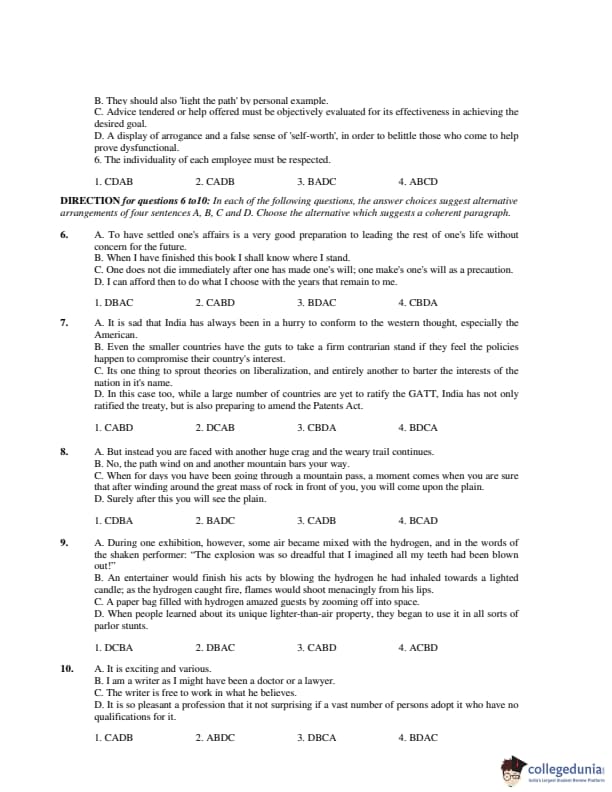
A. Seniors must show the path clearly by laying down the precise expectations of the management in terms of job description, key result areas and personal targets.
B. They should also ‘light the path’ by personal example.
C. Advice tendered or help offered must be objectively evaluated for its effectiveness in achieving the desired goal.
D. A display of arrogance and a false sense of ‘self-worth’, in order to belittle those who come to help, prove dysfunctional.
6. The individuality of each employee must be respected.
View Solution
A. To have settled one’s affairs is a very good preparation to leading the rest of one’s life without concern for the future.
B. When I have finished this book I shall know where I stand.
C. One does not die immediately after one has made one’s will; one makes one’s will as a precaution.
D. I can afford then to do what I choose with the years that remain to me.
View Solution
A. It is sad that India has always been in a hurry to conform to the western thought, especially the American.
B. Even the smaller countries have the guts to take a firm contrarian stand if they feel the policies happen to compromise their country’s interest.
C. It’s one thing to sprout theories on liberalization, and entirely another to barter the interests of the nation in its name.
D. In this case too, while a large number of countries are yet to ratify the GATT, India has not only ratified the treaty, but is also preparing to amend the Patents Act.
View Solution
A. But instead you are faced with another huge crag and the weary trail continues.
B. No, the path winds on and another mountain bars your way.
C. When for days you have been going through a mountain pass, a moment comes when you are sure that after winding around the great mass of rock in front of you, you will come upon the plain.
D. Surely after this you will see the plain.
View Solution
A. During one exhibition, however, some air became mixed with the hydrogen, and in the words of the shaken performer: "The explosion was so dreadful that I imagined all my teeth had been blown out!"
B. An entertainer would finish his acts by blowing the hydrogen he had inhaled towards a lighted candle; as the hydrogen caught fire, flames would shoot menacingly from his lips.
C. A paper bag filled with hydrogen amazed guests by zooming off into space.
D. When people learned about its unique lighter-than-air property, they began to use it in all sorts of parlor stunts.
View Solution
A. It is exciting and various.
B. I am a writer as I might have been a doctor or a lawyer.
C. The writer is free to work in what he believes.
D. It is so pleasant a profession that it not surprising if a vast number of persons adopt it who have no qualifications for it.
View Solution
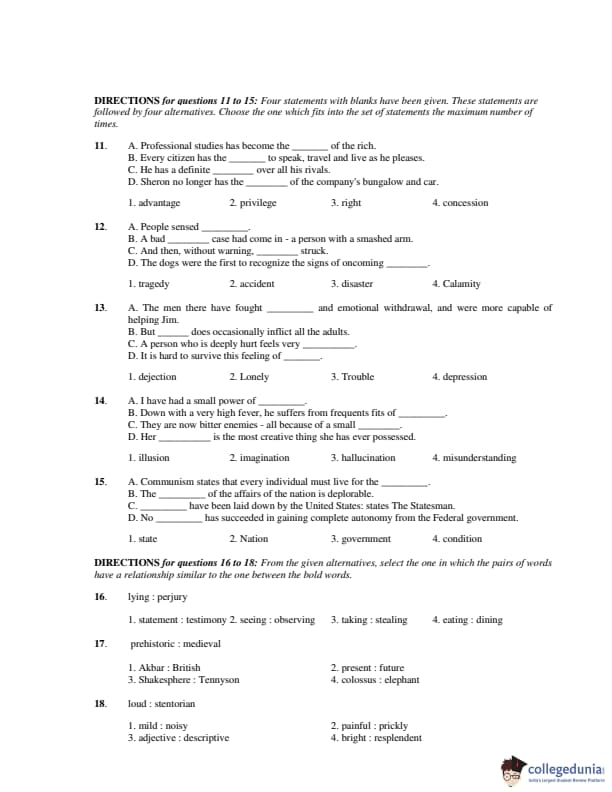
A. Professional studies has become the ............. of the rich.
B. Every citizen has the ............. to speak, travel and live as he pleases.
C. He has a definite ............. over all his rivals.
D. Sheron no longer has the ............. of the company’s bungalow and car.
View Solution
A. People sensed .............
B. A bad ............. case had come in – a person with a smashed arm.
C. And then, without warning, ............. struck.
D. The dogs were the first to recognize the signs of oncoming .............
View Solution
A. The men there have fought ............. and emotional withdrawal, and were more capable of helping Jim.
B. But ............. does occasionally inflict all the adults.
C. A person who is deeply hurt feels very .............
D. It is hard to survive this feeling of .............
View Solution
A. I have had a small power of .............
B. Down with a very high fever, he suffers from frequent fits of .............
C. They are now bitter enemies – all because of a small .............
D. Her ............. is the most creative thing she has ever possessed.
View Solution
A. Communism states that every individual must live for the .............
B. The ............. of the affairs of the nation is deplorable.
C. ............. have been laid down by the United States: states The Statesman.
D. No ............. has succeeded in gaining complete autonomy from the Federal government.
View Solution
lying : perjury
View Solution
prehistoric : medieval
View Solution
loud : stentorian
View Solution
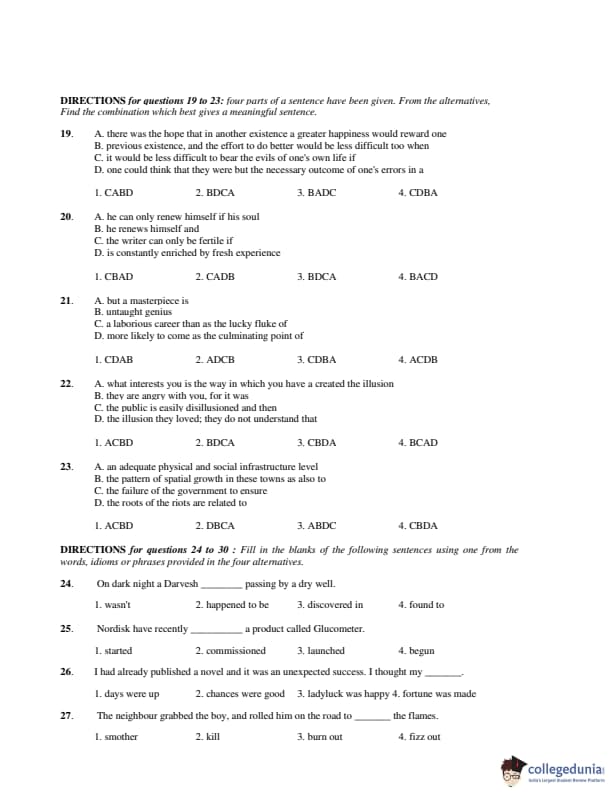
A. there was the hope that in another existence a greater happiness would reward one
B. previous existence, and the effort to do better would be less difficult too when
C. it would be less difficult to bear the evils of one’s own life if
D. one could think that they were but the necessary outcome of one’s errors in a
View Solution
A. he can only renew himself if his soul
B. he renews himself and
C. the writer can only be fertile if
D. is constantly enriched by fresh experience
View Solution
A. but a masterpiece is
B. untaught genius
C. a laborious career than as the lucky fluke of
D. more likely to come as the culminating point of
View Solution
A. what interests you is the way in which you have created the illusion
B. they are angry with you, for it was
C. the public is easily disillusioned and then
D. the illusion they loved; they do not understand that
View Solution
A. an adequate physical and social infrastructure level
B. the pattern of spatial growth in these towns as also to
C. the failure of the government to ensure
D. the roots of the riots are related to
View Solution
One dark night a Darvesh ............. passing by a dry well.
View Solution
Nordisk have recently ............. a product called Glucometer.
View Solution
I had already published a novel and it was an unexpected success. I thought my .............
View Solution
The neighbour grabbed the boy, and rolled him on the road to ............. the flames.
View Solution
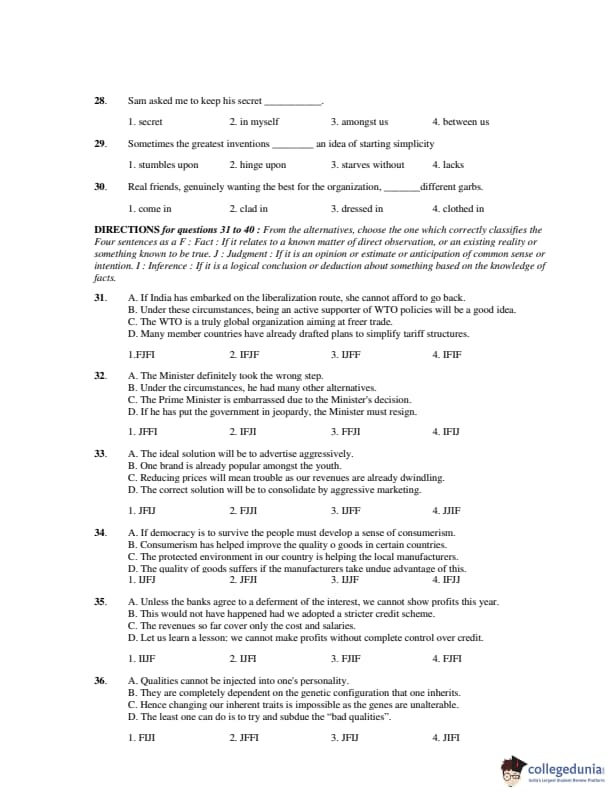
Sam asked me to keep his secret .............
View Solution
Sometimes the greatest inventions ............. an idea of starting simplicity
View Solution
Real friends, genuinely wanting the best for the organization, ............. different garbs.
View Solution
Classify each sentence as:
J: Judgement — opinion, estimate, or intention based on common sense.
F: Fact — something known to be true or directly observed.
I: Inference — a conclusion drawn from known facts.
A. If India has embarked on the liberalization route, she cannot afford to go back.
B. Under these circumstances, being an active supporter of WTO policies will be a good idea.
C. The WTO is a truly global organization aiming at freer trade.
D. Many member countries have already drafted plans to simplify tariff structures.
View Solution
Classify each sentence as:
J: Judgement — opinion, estimate, or intention based on common sense.
F: Fact — something known to be true or directly observed.
I: Inference — a conclusion drawn from known facts.
A. The Minister definitely took the wrong step.
B. Under the circumstances, he had many other alternatives.
C. The Prime Minister is embarrassed due to the Minister’s decision.
D. If he has put the government in jeopardy, the Minister must resign.
View Solution
Classify each sentence as:
J: Judgement — opinion, recommendation, or evaluation.
F: Fact — a verifiable statement or observable truth.
I: Inference — a logical conclusion drawn from facts.
A. The ideal solution will be to advertise aggressively.
B. One brand is already popular amongst the youth.
C. Reducing prices will mean trouble as our revenues are already dwindling.
D. The correct solution will be to consolidate by aggressive marketing.
View Solution
Classify each sentence as:
J: Judgement — opinion, recommendation, or evaluation.
F: Fact — a verifiable statement or observable truth.
I: Inference — a logical conclusion drawn from facts.
A. If democracy is to survive the people must develop a sense of consumerism.
B. Consumerism has helped improve the quality of goods in certain countries.
C. The protected environment in our country is helping the local manufacturers.
D. The quality of goods suffers if the manufacturers take undue advantage of this.
View Solution
Classify each sentence as:
J: Judgement — opinion, recommendation, or evaluation.
F: Fact — a verifiable statement or observable truth.
I: Inference — a logical conclusion drawn from facts.
A. Unless the banks agree to a deferment of the interest, we cannot show profits this year.
B. This would not have happened had we adopted a stricter credit scheme.
C. The revenues so far cover only the cost and salaries.
D. Let us learn a lesson: we cannot make profits without complete control over credit.
View Solution
Classify each sentence as:
J: Judgement — opinion, recommendation, or evaluation.
F: Fact — a verifiable statement or observable truth.
I: Inference — a logical conclusion drawn from facts.
A. Qualities cannot be injected into one’s personality.
B. They are completely dependent on the genetic configuration that one inherits.
C. Hence changing our inherent traits is impossible as the genes are unalterable.
D. The least one can do is to try and subdue the “bad qualities”.
View Solution
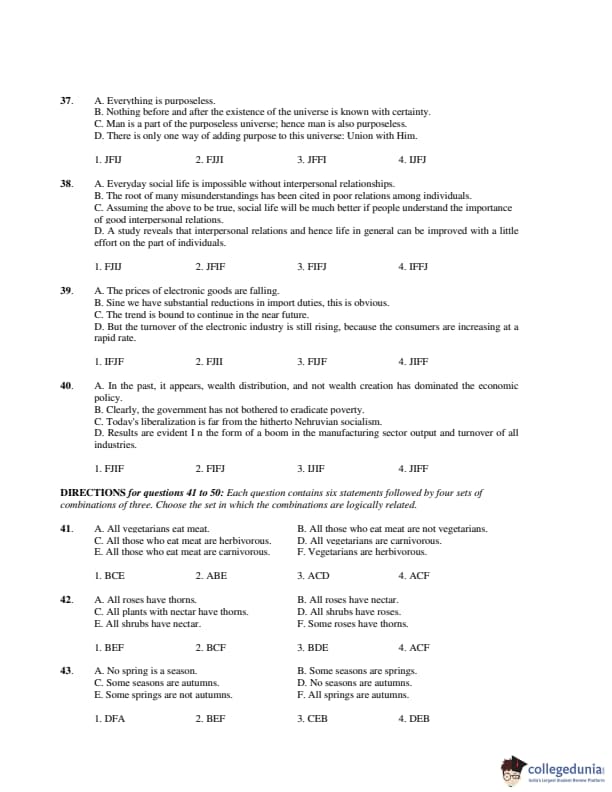
Classify each sentence as:
J: Judgement — opinion, recommendation, or evaluation.
F: Fact — a verifiable statement or observable truth.
I: Inference — a logical conclusion drawn from facts.
A. Everything is purposeless.
B. Nothing before and after the existence of the universe is known with certainty.
C. Man is a part of the purposeless universe; hence man is also purposeless.
D. There is only one way of adding purpose to this universe: Union with Him.
View Solution
Classify each sentence as:
J: Judgement — opinion, recommendation, or evaluation.
F: Fact — a verifiable statement or observable truth.
I: Inference — a logical conclusion drawn from facts.
A. Everyday social life is impossible without interpersonal relationships.
B. The root of many misunderstandings has been cited in poor relations among individuals.
C. Assuming the above to be true, social life will be much better if people understand the importance of good interpersonal relations.
D. A study reveals that interpersonal relations and hence life in general can be improved with a little effort on the part of individuals.
View Solution
Classify each sentence as:
J: Judgement — opinion, recommendation, or evaluation.
F: Fact — a verifiable statement or observable truth.
I: Inference — a logical conclusion drawn from facts.
A. The prices of electronic goods are falling.
B. Since we have substantial reductions in import duties, this is obvious.
C. The trend is bound to continue in the near future.
D. But the turnover of the electronic industry is still rising, because the consumers are increasing at a rapid rate.
View Solution
Classify each sentence as:
J: Judgement — opinion, recommendation, or evaluation.
F: Fact — a verifiable statement or observable truth.
I: Inference — a logical conclusion drawn from facts.
A. In the past, it appears, wealth distribution, and not wealth creation has dominated the economic policy.
B. Clearly, the government has not bothered to eradicate poverty.
C. Today’s liberalization is far from the hitherto Nehruvian socialism.
D. Results are evident in the form of a boom in the manufacturing sector output and turnover of all industries.
View Solution
Identify the set of three statements that are logically related.
A. All vegetarians eat meat.
B. All those who eat meat are not vegetarians.
C. All those who eat meat are herbivorous.
D. All vegetarians are carnivorous.
E. All those who eat meat are carnivorous.
F. Vegetarians are herbivorous.
View Solution
Identify the set of three statements that are logically related.
A. All roses have thorns.
B. All roses have nectar.
C. All plants with nectar have thorns.
D. All shrubs have roses.
E. All shrubs have nectar.
F. Some roses have thorns.
View Solution
Identify the set of three statements that are logically related.
A. No spring is a season.
B. Some seasons are springs.
C. Some seasons are autumns.
D. No seasons are autumns.
E. Some springs are not autumns.
F. All springs are autumns.
View Solution
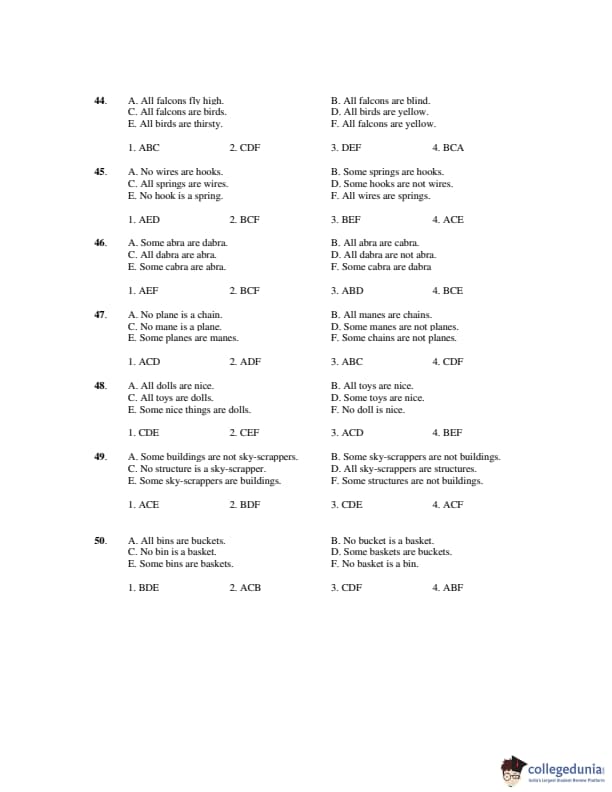
Identify the set of three statements that are logically related.
A. All falcons fly high.
B. All falcons are blind.
C. All falcons are birds.
D. All birds are yellow.
E. All birds are thirsty.
F. All falcons are yellow.
View Solution
Identify the set of three statements that are logically related.
A. No wires are hooks.
B. Some springs are hooks.
C. All springs are wires.
D. Some hooks are not wires.
E. No hook is a spring.
F. All wires are springs.
View Solution
Identify the set of three statements that are logically related.
A. Some abra are dabra.
B. All abra are cabra.
C. All dabra are abra.
D. All dabra are not abra.
E. Some cabra are abra.
F. Some cabra are dabra.
View Solution
Identify the set of three statements that are logically related.
A. No plane is a chain.
B. All manes are chains.
C. No mane is a plane.
D. Some manes are not planes.
E. Some planes are manes.
F. Some chains are not planes.
View Solution
Identify the set of three statements that are logically related.
A. All dolls are nice.
B. All toys are nice.
C. All toys are dolls.
D. Some toys are nice.
E. Some nice things are dolls.
F. No doll is nice.
View Solution
Identify the set of three statements that are logically related.
A. Some buildings are not sky-scrappers.
B. Some sky-scrappers are not buildings.
C. No structure is a sky-scrapper.
D. All sky-scrappers are structures.
E. Some sky-scrappers are buildings.
F. Some structures are not buildings.
View Solution
Identify the set of three statements that are logically related.
A. All bins are buckets.
B. No bucket is a basket.
C. No bin is a basket.
D. Some baskets are buckets.
E. Some bins are baskets.
F. No basket is a bin.
View Solution
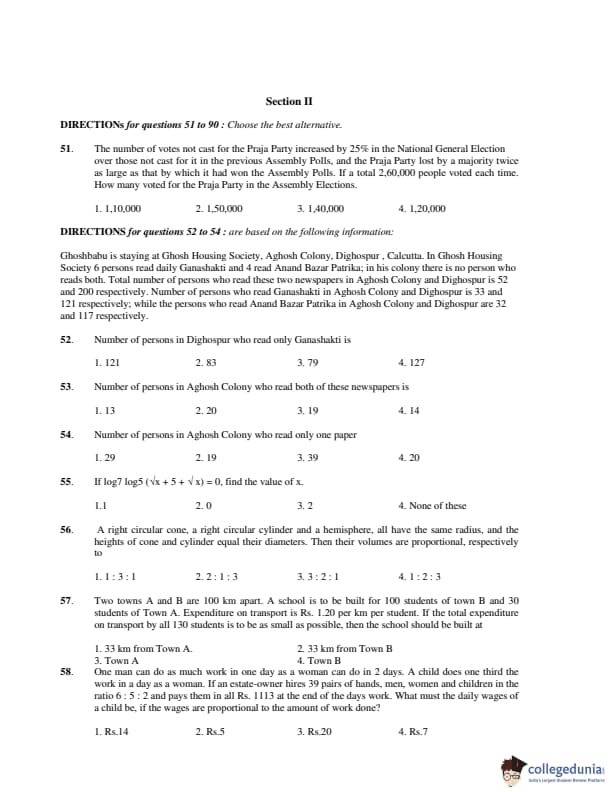
The number of votes not cast for the Praja Party increased by 25% in the National General Election over those not cast for it in the previous Assembly Polls, and the Praja Party lost by a majority twice as large as that by which it had won the Assembly Polls. If a total 2,60,000 people voted each time, how many voted for the Praja Party in the Assembly Elections?
View Solution
Number of persons in Dighospur who read only Ganashakti is:
View Solution
Number of persons in Aghosh Colony who read both of these newspapers is:
View Solution
Number of persons in Aghosh Colony who read only one paper is:
View Solution
If \(\log_{9} \log_{5} \left( \sqrt{x+5} + \sqrt{x} \right) = 0\), find the value of \(x\).
View Solution
A right circular cone, a right circular cylinder and a hemisphere, all have the same radius, and the heights of the cone and cylinder are equal to their diameters. Then their volumes are proportional, respectively, to:
View Solution
Two towns A and B are 100 km apart. A school is to be built for 100 students of town B and 30 students of Town A. Expenditure on transport is Rs. 1.20 per km per student. If the total expenditure on transport by all 130 students is to be as small as possible, then the school should be built at:
View Solution
One man can do as much work in one day as a woman can do in 2 days. A child does one-third the work in a day as a woman. If an estate-owner hires 39 pairs of hands — men, women, and children — in the ratio 6 : 5 : 2 and pays them in all Rs. 1113 at the end of the day's work, what must the daily wages of a child be, if the wages are proportional to the amount of work done?
View Solution
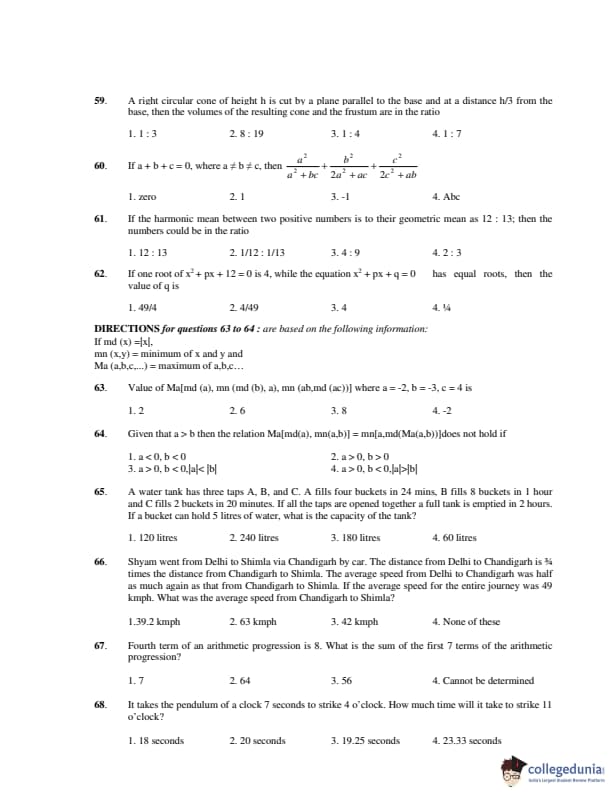
A right circular cone of height \(h\) is cut by a plane parallel to the base and at a distance \(h/3\) from the base. Then the volumes of the resulting cone and the frustum are in the ratio:
View Solution
If \(a + b + c = 0\), where \(a \neq b \neq c\), then \[ \frac{a}{2a^2 + bc} + \frac{b}{2b^2 + ac} + \frac{c}{2c^2 + ab} \]
is equal to:
View Solution
If the harmonic mean between two positive numbers is to their geometric mean as \(12 : 13\), then the numbers could be in the ratio:
View Solution
If one root of \(x^{2} - 7 + 12 = 0\) is \(4\), while the equation \(x^{2} - 7x + q = 0\) has equal roots, then the value of \(q\) is:
View Solution
Value of \(Ma \left[ md(a), \ mn(md(b), a), \ mn(ab, md(ac)) \right]\) where \(a = -2\), \(b = -3\), \(c = 4\) is:
View Solution
Given that \(a > b\) then the relation \(Ma[md(a), \ mn(a, b)] = mn[a, \ md(Ma(a, b))]\) does not hold if:
View Solution
A water tank has three taps A, B, and C. A fills four buckets in 24 minutes, B fills 8 buckets in 1 hour, and C fills 2 buckets in 20 minutes. If all the taps are opened together a full tank is emptied in 2 hours. If a bucket can hold 5 litres of water, what is the capacity of the tank?
View Solution
Shyam went from Delhi to Shimla via Chandigarh by car. The distance from Delhi to Chandigarh is \(\frac{3}{4}\) times the distance from Chandigarh to Shimla. The average speed from Delhi to Chandigarh was half as much again as that from Chandigarh to Shimla. If the average speed for the entire journey was 49 kmph, what was the average speed from Chandigarh to Shimla?
View Solution
Fourth term of an arithmetic progression is \(8\). What is the sum of the first \(7\) terms of the arithmetic progression?
View Solution
It takes the pendulum of a clock 7 seconds to strike 4 o’clock. How much time will it take to strike 11 o’clock?
View Solution
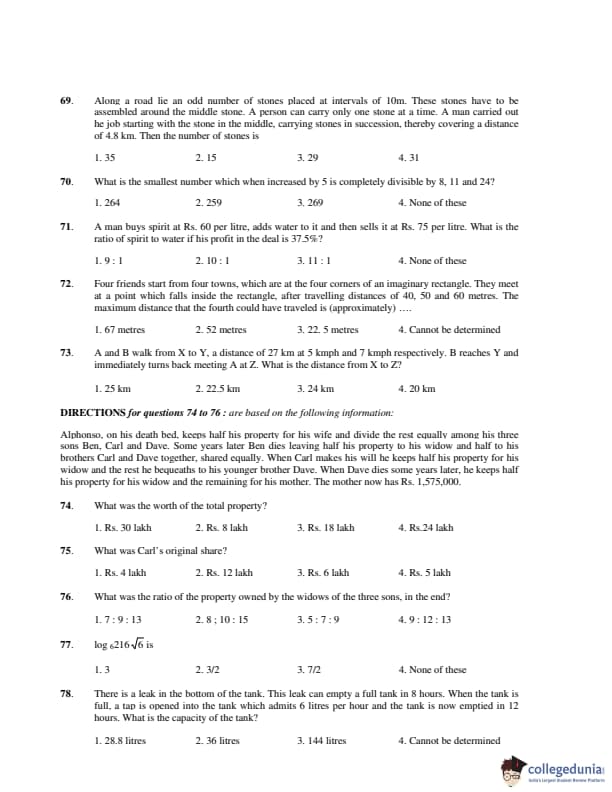
Along a road lie an odd number of stones placed at intervals of 10 m. These stones have to be assembled around the middle stone. A person can carry only one stone at a time. A man carried out the job starting with the stone in the middle, carrying stones in succession, thereby covering a distance of 4.8 km. Then the number of stones is:
View Solution
What is the smallest number which when increased by 5 is completely divisible by 8, 11 and 24?
View Solution
A man buys spirit at Rs. 60 per litre, adds water to it and then sells it at Rs. 75 per litre. What is the ratio of spirit to water if his profit in the deal is 37.5%?
View Solution
Four friends start from four towns, which are at the four corners of an imaginary rectangle. They meet at a point which falls inside the rectangle, after travelling distances of 40, 50 and 60 metres. The maximum distance that the fourth could have traveled is (approximately)….
View Solution
A and B walk from X to Y, a distance of 27 km at 5 kmph and 7 kmph respectively. B reaches Y and immediately turns back meeting A at Z. What is the distance from X to Z?
View Solution
What was the worth of the total property?
View Solution
What was Carl’s original share?
View Solution
What was the ratio of the property owned by the widows of the three sons, in the end?
View Solution
\(\log_{6} 216 \sqrt{6}\) is:
View Solution
There is a leak in the bottom of the tank. This leak can empty a full tank in 8 hours. When the tank is full, a tap is opened into the tank which admits \(6\) litres per hour and the tank is now emptied in 12 hours. What is the capacity of the tank?
View Solution
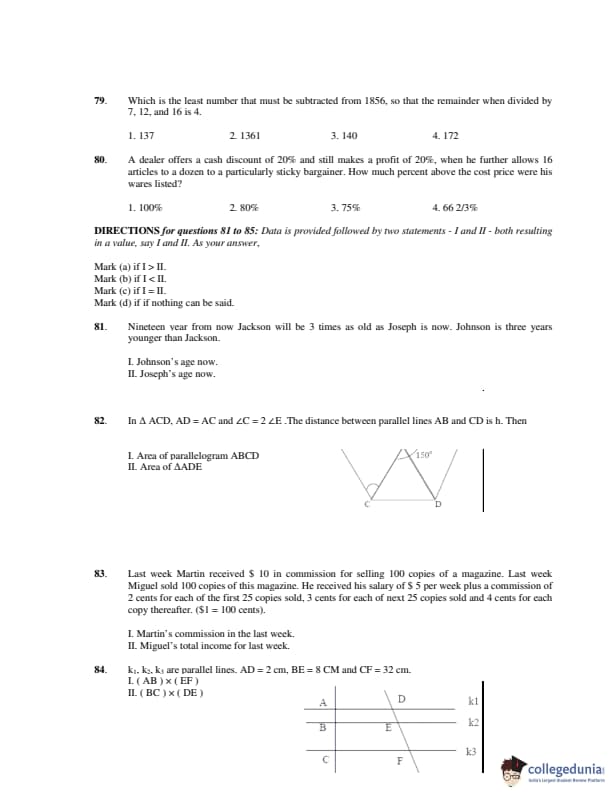
Which is the least number that must be subtracted from \(1856\), so that the remainder when divided by \(7\), \(12\), and \(16\) is \(4\)?
View Solution
A dealer offers a cash discount of \(20%\) and still makes a profit of \(20%\), when he further allows \(16\) articles to a dozen to a particularly sticky bargainer. How much percent above the cost price were his wares listed?
View Solution
Nineteen years from now Jackson will be 3 times as old as Joseph is now. Johnson is three years younger than Jackson.
I. Johnson’s age now.
II. Joseph’s age now.
View Solution
In \(\triangle ACD\), \(AD = AC\) and \(\angle C = 2\angle E\). The distance between parallel lines \(AB\) and \(CD\) is \(h\). Then:
I. Area of parallelogram \(ABCD\)
II. Area of \(\triangle ADE\)
View Solution
Last week Martin received
(10 in commission for selling 100 copies of a magazine. Last week Miguel sold 100 copies of this magazine. He received his salary of
)5 per week plus a commission of 2 cents for each of the first 25 copies sold, 3 cents for each of the next 25 copies sold, and 4 cents for each copy thereafter. (
(1 = 100 cents)
I. Martin’s commission in the last week.
II. Miguel’s total income for last week.
View Solution
\(k_1, k_2, k_3\) are parallel lines. \(AD = 2 \ cm\), \(BE = 8 \ cm\) and \(CF = 32 \ cm\).

View Solution
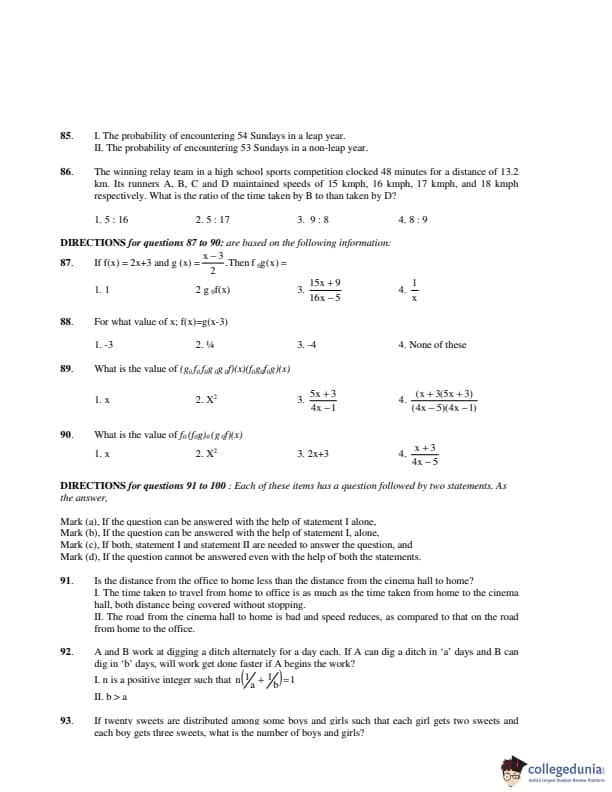
I. The probability of encountering \(54\) Sundays in a leap year.
II. The probability of encountering \(53\) Sundays in a non-leap year.
View Solution
The winning relay team in a high school sports competition clocked \(48\) minutes for a distance of \(13.2\) km. Its runners A, B, C, and D maintained speeds of \(15\) kmph, \(16\) kmph, \(17\) kmph, and \(18\) kmph respectively. What is the ratio of the time taken by B to that taken by D?
View Solution
\(f \circ g(x)\) is equal to:
View Solution
For what value of \(x\), \(f(x) = g(x - 3)\)?
View Solution
What is the value of \((g \circ f \circ g \circ f \circ g \circ f \circ g \circ f)(x) \cdot (f \circ g \circ f \circ g)(x)\)?
View Solution
What is the value of \(f \circ (f \circ g) \circ (g \circ f)(x)\)?
View Solution
Is the distance from the office to home less than the distance from the cinema hall to home?
I. The time taken to travel from home to office is as much as the time taken from home to the cinema hall, both distances being covered without stopping.
II. The road from the cinema hall to home is bad and speed reduces, as compared to that on the road from home to the office.
View Solution
A and B work at digging a ditch alternately for a day each. If A can dig a ditch in \(a\) days and B can dig that ditch in \(b\) days, will work get done faster if A begins the work?
I. \(n\) is a positive integer such that \(n\left(\frac{1}{a} + \frac{1}{b}\right) = 1\).
II. \(b > a\).
View Solution
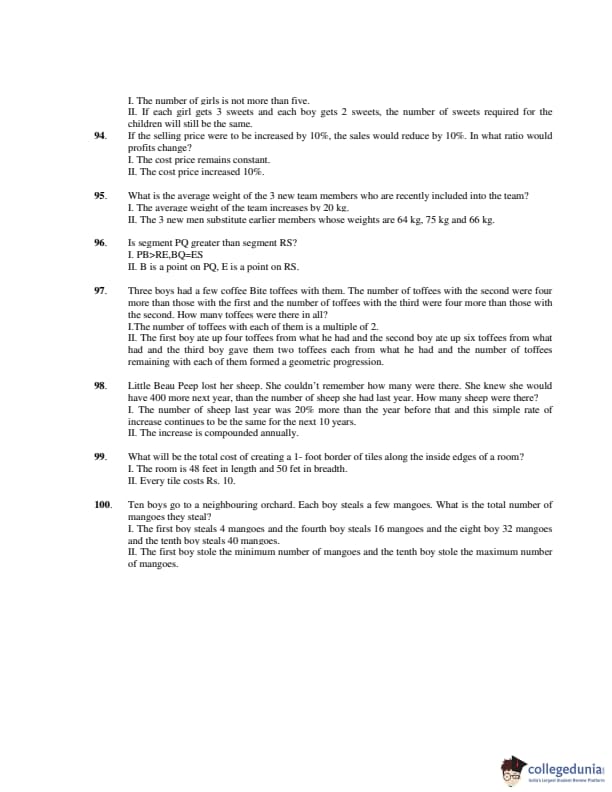
If twenty sweets are distributed among some boys and girls such that each girl gets \(2\) sweets and each boy gets \(3\) sweets, what is the number of boys and girls?
I. The number of girls is not more than five.
II. If each girl gets \(3\) sweets and each boy gets \(2\) sweets, the number of sweets required for the children will still be the same.
View Solution
If the selling price were to be increased by \(10%\), the sales would reduce by \(10%\). In what ratio would profits change?
I. The cost price remains constant.
II. The cost price increased \(10%\).
View Solution
What is the average weight of the 3 new team members who are recently included into the team?
I. The average weight of the team increases by \(20\) kg.
II. The 3 new men substitute earlier members whose weights are \(64\) kg, \(75\) kg and \(66\) kg.
View Solution
Is segment \(PQ\) greater than segment \(RS\)?
I. \(PB > RE\), \(BQ = ES\).
II. \(B\) is a point on \(PQ\), \(E\) is a point on \(RS\).
View Solution
Three boys had a few Coffee Bite toffees with them. The number of toffees with the second were four more than those with the first and the number of toffees with the third were four more than those with the second. How many toffees were there in all?
I. The number of toffees with each of them is a multiple of 2.
II. The first boy ate up four toffees from what he had and the second boy ate up six toffees from what he had and the third boy gave them two toffees each from what he had and the number of toffees remaining with each of them formed a geometric progression.
View Solution
Little Beau Peep lost her sheep. She couldn’t remember how many there were. She knew she would have \(400\) more next year, than the number of sheep she had last year. How many sheep were there?
I. The number of sheep last year was \(20%\) more than the year before that and this simple rate of increase continues to be the same for the next \(10\) years.
II. The increase is compounded annually.
View Solution
What will be the total cost of creating a 1-foot border of tiles along the inside edges of a room?
I. The room is \(48\) feet in length and \(50\) feet in breadth.
II. Every tile costs Rs. \(10\).
View Solution
Ten boys go to a neighbouring orchard. Each boy steals a few mangoes. What is the total number of mangoes they steal?
I. The first boy steals \(4\) mangoes and the fourth boy steals \(16\) mangoes and the eighth boy \(32\) mangoes and the tenth boy steals \(40\) mangoes.
II. The first boy stole the minimum number of mangoes and the tenth boy stole the maximum number of mangoes.
View Solution
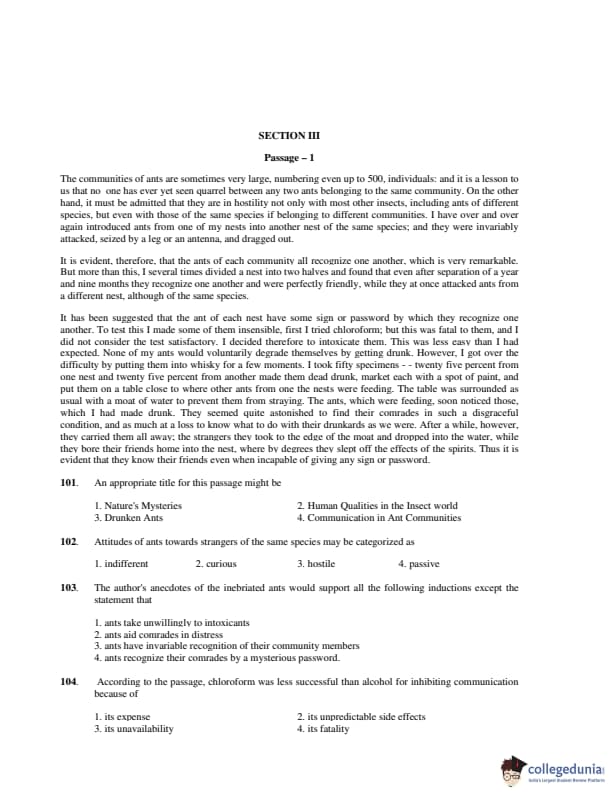
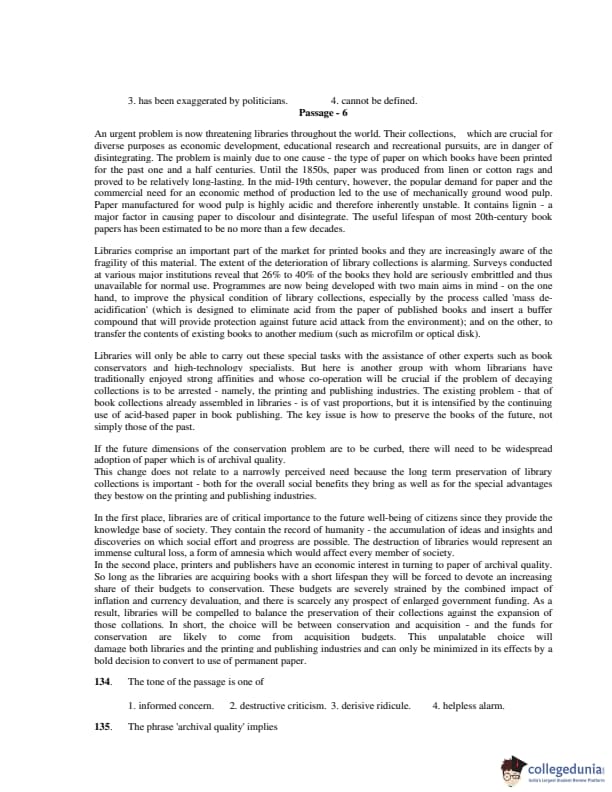
An appropriate title for this passage might be:
View Solution
Attitudes of ants towards strangers of the same species may be categorized as:
View Solution
The author’s anecdotes of the inebriated ants would support all the following inductions except:
View Solution
According to the passage, chloroform was less successful than alcohol for inhibiting communication because of:
View Solution
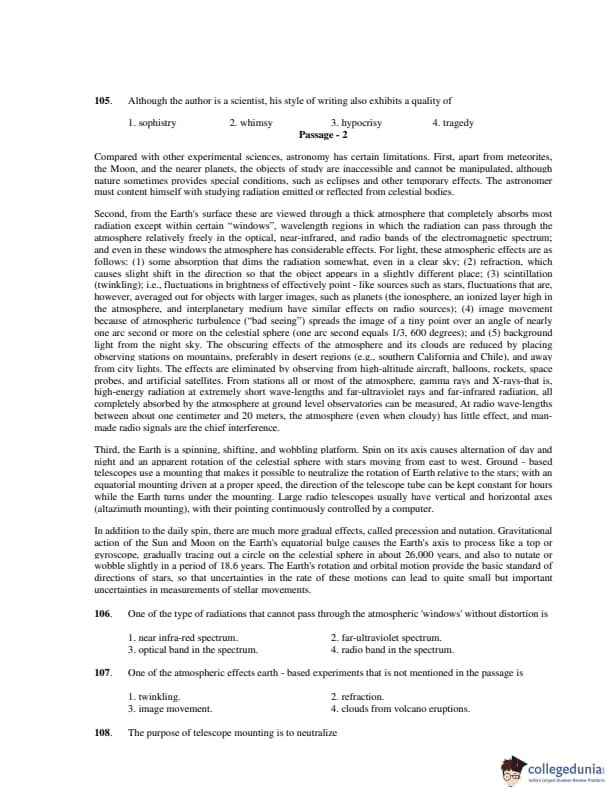
Although the author is a scientist, his style of writing also exhibits a quality of:
View Solution
One of the types of radiation that cannot pass through the atmospheric 'windows' without distortion is:
View Solution
One of the atmospheric effects on Earth-based experiments that is not mentioned in the passage is:
View Solution
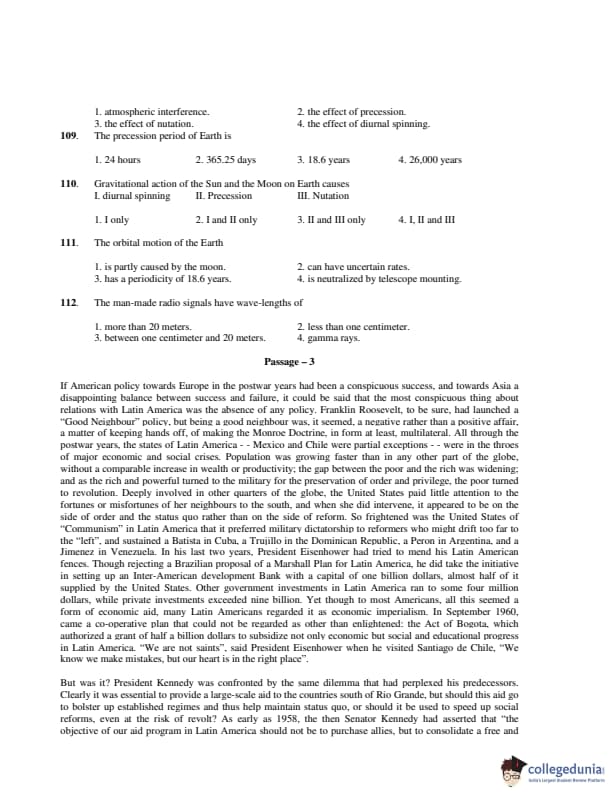
The purpose of telescope mounting is to neutralize:
View Solution
The precession period of Earth is:
View Solution
Gravitational action of the Sun and the Moon on Earth causes:
I. Diurnal spinning
II. Precession
III. Nutation
View Solution
The orbital motion of the Earth:
View Solution
The man-made radio signals have wavelengths of:
View Solution
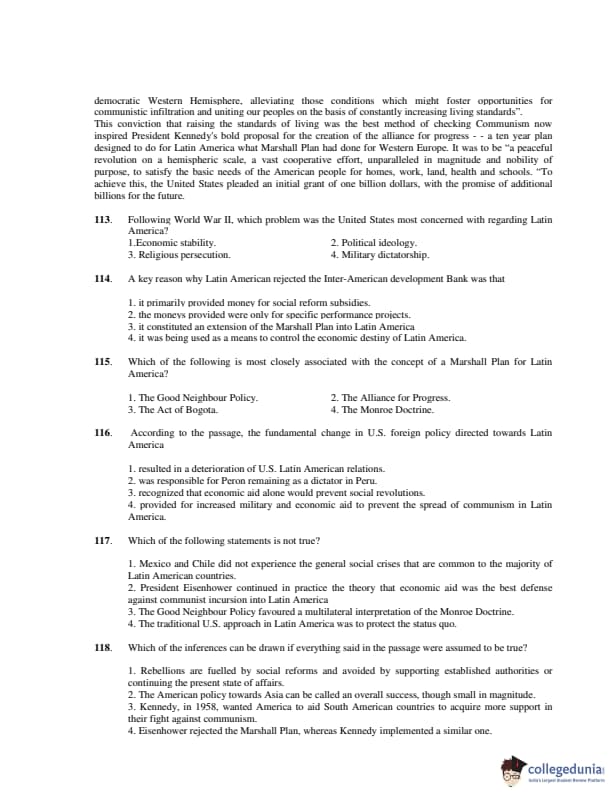
Following World War II, which problem was the United States most concerned with regarding Latin America?
View Solution
A key reason why Latin Americans rejected the Inter-American development Bank was that:
View Solution
Which of the following is most closely associated with the concept of a Marshall Plan for Latin America?
View Solution
According to the passage, the fundamental change in U.S. foreign policy directed towards Latin America:
View Solution
Which of the following statements is not true?
View Solution
Which of the inferences can be drawn if everything said in the passage were assumed to be true?
View Solution
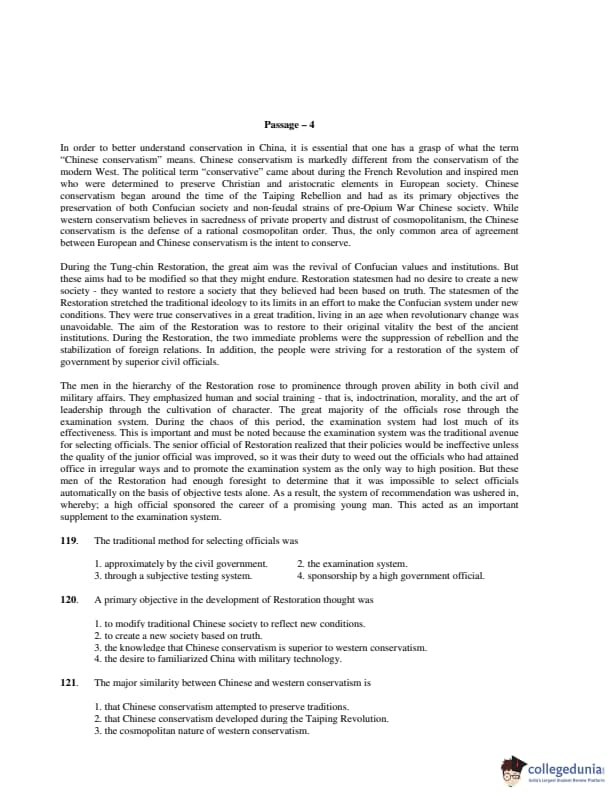
The traditional method for selecting officials was:
View Solution
A primary objective in the development of Restoration thought was:
View Solution
The major similarity between Chinese and western conservatism is:
View Solution
The most significant Chinese philosopher mentioned in the passage is:
View Solution
During the Restoration, ancient institutions:
View Solution
The western conservatives intended to preserve all the following except:
View Solution
The most appropriate title for the passage will be:
View Solution
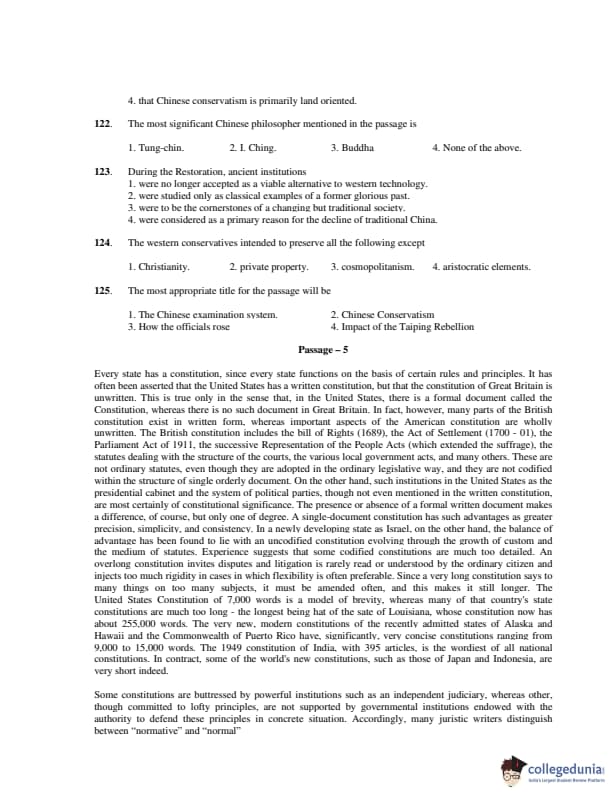
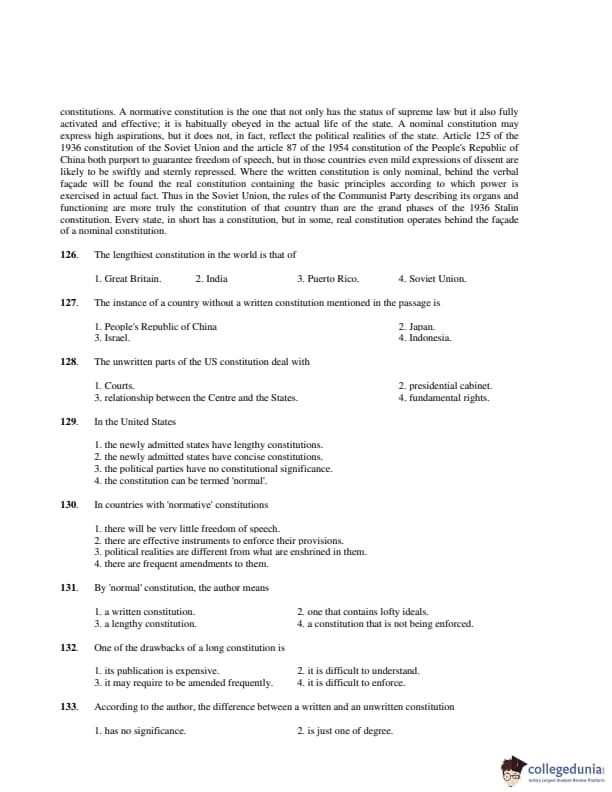
The lengthiest constitution in the world is that of:
View Solution
The instance of a country without a written constitution mentioned in the passage is:
View Solution
The unwritten parts of the US constitution deal with:
View Solution
In the United States:
View Solution
In countries with ‘normative’ constitutions:
View Solution
By ‘normal’ constitution, the author means:
View Solution
One of the drawbacks of a long constitution is:
View Solution
According to the author, the difference between a written and an unwritten constitution:
View Solution
The tone of the passage is one of:
View Solution
The phrase ‘archival quality’ implies:
View Solution
Wood-pulp as raw material for paper was developed because of:
View Solution
If paper has to last long …
View Solution
One of the reasons not mentioned in the passage in favour of producing long-lasting paper is:
View Solution
Purchase of new books by libraries are bound to be curtailed because of all the following reasons except:
View Solution
Continued use of wood-pulp paper in books will affect:
I. Libraries.
II. General public.
III. The publishing industry.
IV. The governments.
View Solution
The substance which causes paper to discolour is:
View Solution
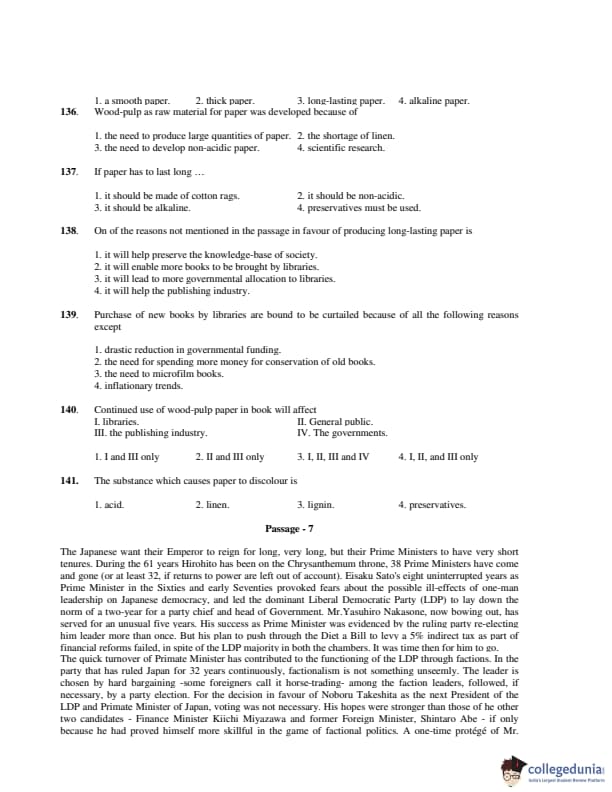
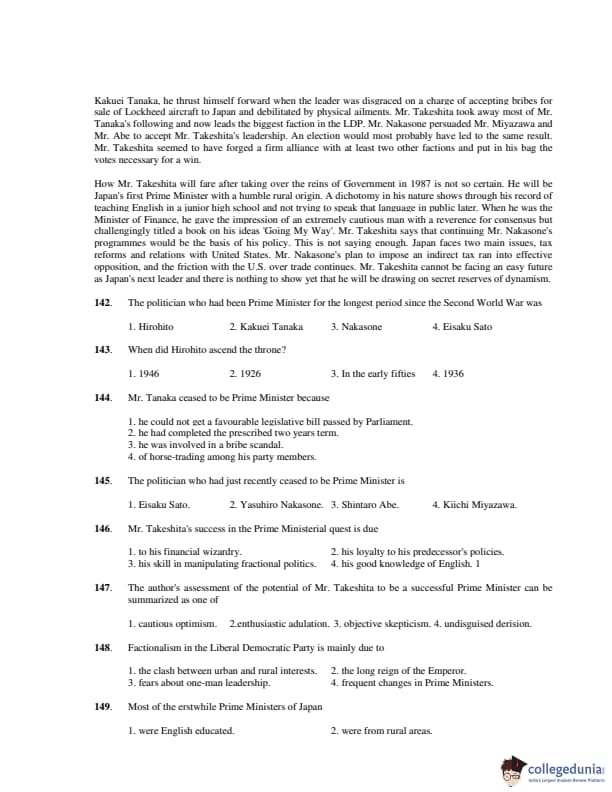
The politician who had been Prime Minister for the longest period since the Second World War was:
View Solution
When did Hirohito ascend the throne?
View Solution
Mr. Tanaka ceased to be Prime Minister because:
View Solution
The politician who had just recently ceased to be Prime Minister is:
View Solution
Mr. Takeshita’s success in the Prime Ministerial quest is due to:
View Solution
The author’s assessment of the potential of Mr. Takeshita to be a successful Prime Minister can be summarised as one of:
View Solution
Factionalism in the Liberal Democratic Party is mainly due to:
View Solution
Most of the erstwhile Prime Ministers of Japan:
View Solution
The number of erstwhile Prime Ministers mentioned by name in the passage is:
View Solution
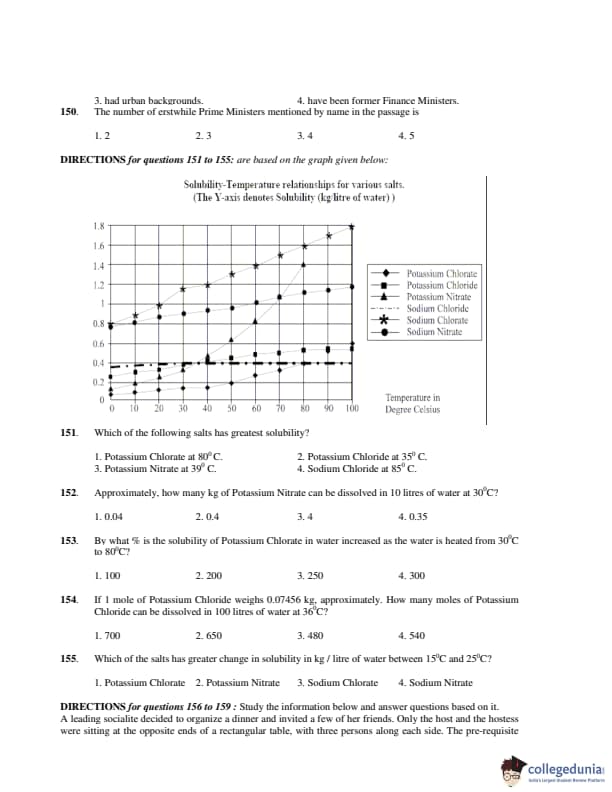
Which of the following salts has greatest solubility?
View Solution
Approximately, how many kg of Potassium Nitrate can be dissolved in 10 litres of water at 30\(^\circ\)C?
View Solution
By what percentage is the solubility of Potassium Chlorate in water increased as the water is heated from 30\(^\circ\)C to 80\(^\circ\)C?
View Solution
If 1 mole of Potassium Chloride weighs 0.07456 kg, approximately how many moles of Potassium Chloride can be dissolved in 100 litres of water at 36°C?
View Solution
Which of the salts has greater change in solubility in kg/litre of water between 15\(^\circ\)C and 25\(^\circ\)C?
View Solution
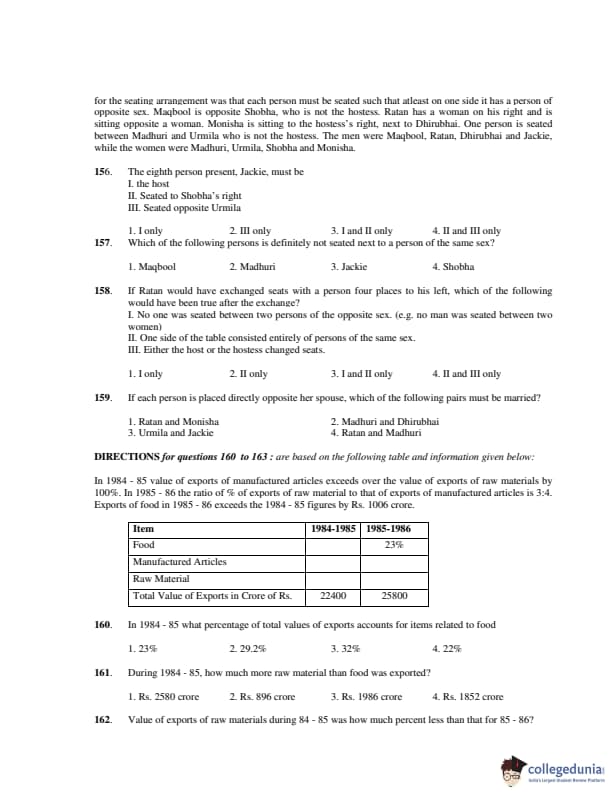
The eighth person present, Jackie, must be:
I. the host
II. Seated to Shobha’s right
III. Seated opposite Urmila
View Solution
Which of the following persons is definitely not seated next to a person of the same sex?
View Solution
If Ratan would have exchanged seats with a person four places to his left, which of the following would have been true after the exchange?
I. No one was seated between two persons of the opposite sex. (e.g., no man was seated between two women)
II. One side of the table consisted entirely of persons of the same sex.
III. Either the host or the hostess changed seats.
View Solution
If each person is placed directly opposite her spouse, which of the following pairs must be married?
View Solution
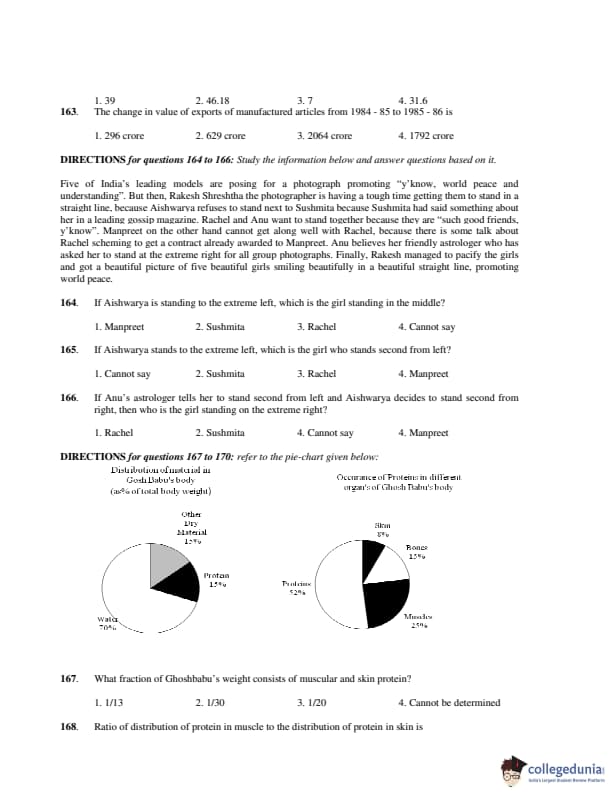
In 1984–85 what percentage of total value of exports accounts for items related to food?
View Solution
During 1984–85, how much more raw material than food was exported?
View Solution
Value of exports of raw materials during 1984–85 was how much percent less than that for 1985–86?
View Solution
The change in value of exports of manufactured articles from 1984–85 to 1985–86 is:
View Solution
If Aishwarya is standing to the extreme left, which is the girl standing in the middle?
View Solution
If Aishwarya stands to the extreme left, which is the girl who stands second from left?
View Solution
If Anu’s astrologer tells her to stand second from left and Aishwarya decides to stand second from right, then who is the girl standing on the extreme right?
View Solution
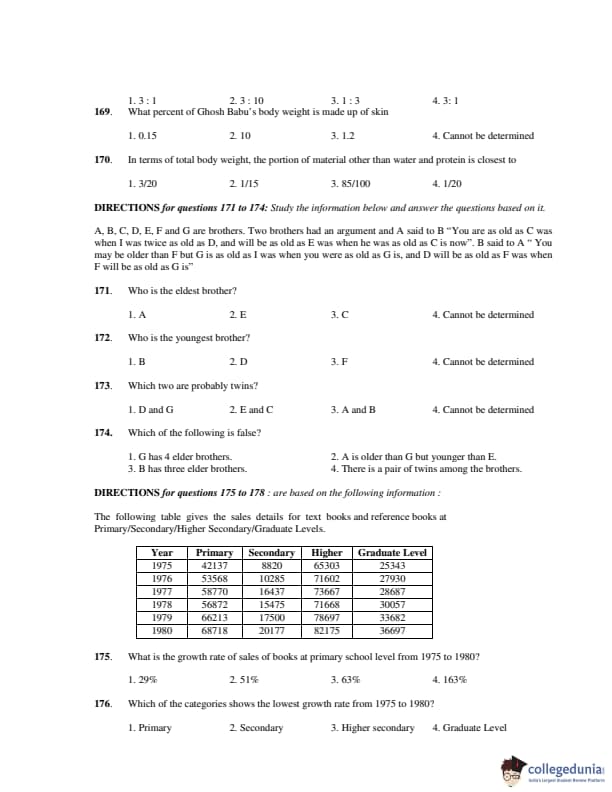
What fraction of Ghosh Babu's weight consists of muscular and skin protein?
View Solution
Ratio of distribution of protein in muscle to the distribution of protein in skin is:
View Solution
What percent of Ghosh Babu’s body weight is made up of skin?
View Solution
In terms of total body weight, the portion of material other than water and protein is closest to:
View Solution
Who is the eldest brother?
View Solution
Who is the youngest brother?
View Solution
Which two are probably twins?
View Solution
Which of the following is false?
View Solution
What is the growth rate of sales of books at primary school level from 1975 to 1980?
View Solution
Which of the categories shows the lowest growth rate from 1975 to 1980?
View Solution
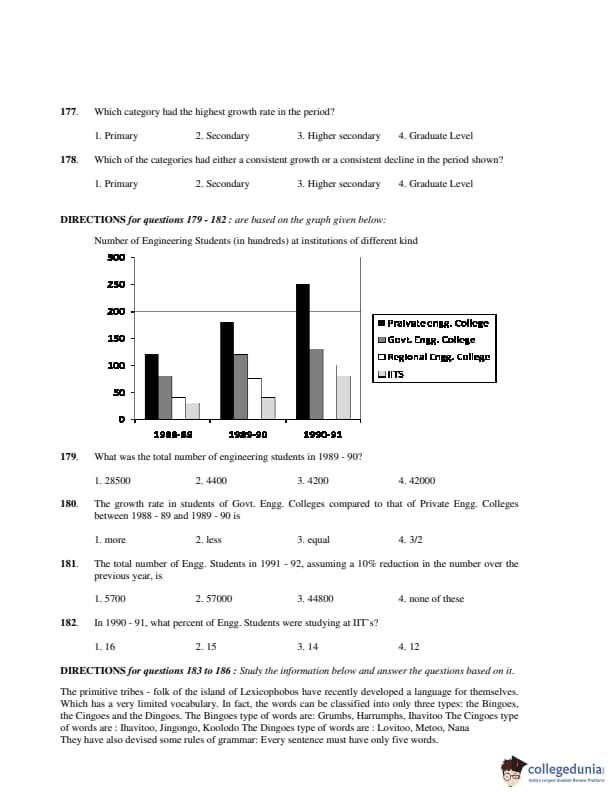
Which category had the highest growth rate in the period?
View Solution
Which of the categories had either a consistent growth or a consistent decline in the period shown?
View Solution
What was the total number of engineering students in 1989–90?
View Solution
The growth rate in students of Govt. Engg. Colleges compared to that of Private Engg. Colleges between 1988–89 and 1989–90 is:
View Solution
The total number of Engg. Students in 1991–92, assuming a 10% reduction over the previous year, is:
View Solution
In 1990–91, what percent of Engg. Students were studying at IITs?
View Solution
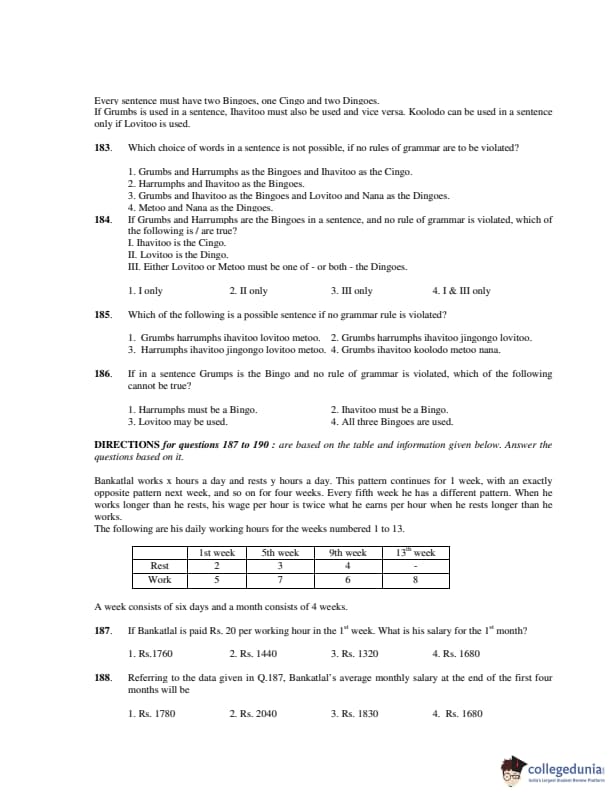
Which choice of words in a sentence is not possible, if no rules of grammar are to be violated?
View Solution
If Grumbs and Harrumphs are the Bingoes in a sentence, and no rule of grammar is violated, which of the following is / are true?
I. Ihavitoo is the Cingo.
II. Lovitoo is the Dingo.
III. Either Lovitoo or Metoo must be one of — or both — the Dingoes.
View Solution
Which of the following is a possible sentence if no grammar rule is violated?
View Solution
If in a sentence Grumbs is the Bingo and no rule of grammar is violated, which of the following cannot be true?
View Solution
If Bankatlala is paid Rs. 20 per working hour in the 1st week, what is his salary for the 1st month?
View Solution
Referring to the data given in Q.187, Bankatlala’s average monthly salary at the end of the first four months will be:
View Solution
The new manager Khushaldas stipulated that Rs.5 be deducted for every hour of rest and Rs.25 be paid per hour starting 9th week. What will be the change in Bankatlala’s salary for the 3rd month? (Hourly deductions are constant for all weeks starting 9th week)
View Solution
Using the data in the previous questions, what will be the total earning of Bankatlala at the end of sixteen weeks?
View Solution

CAT Previous Year Question Papers
Candidates preparing for CAT exam are recommended to solve CAT previous year question papers to improve their time management and problem-solving skills.
| CAT 2022 Question Papers | CAT 2021 Question Papers | CAT 2020 Question Papers |
| CAT 2019 Question Papers | CAT 2018 Question Papers | CAT 2017 Question Papers |



Comments