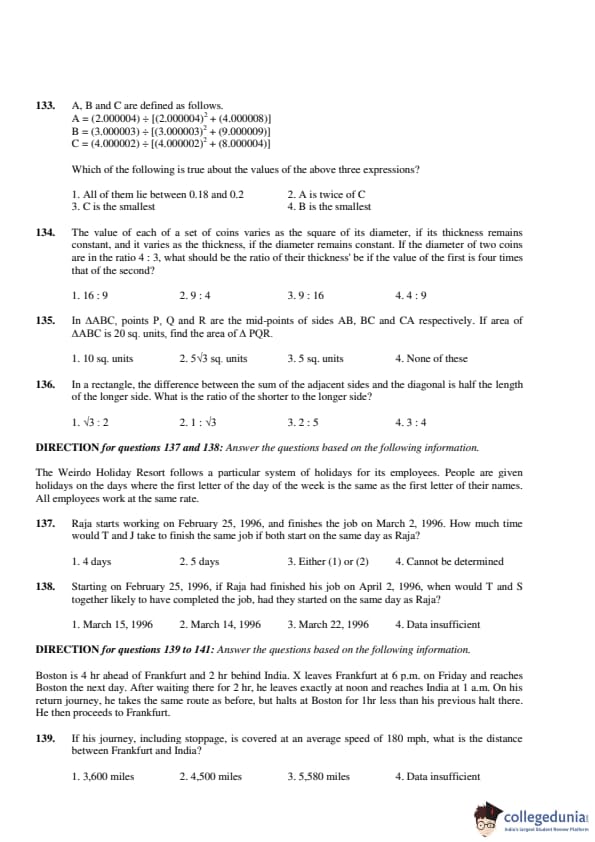
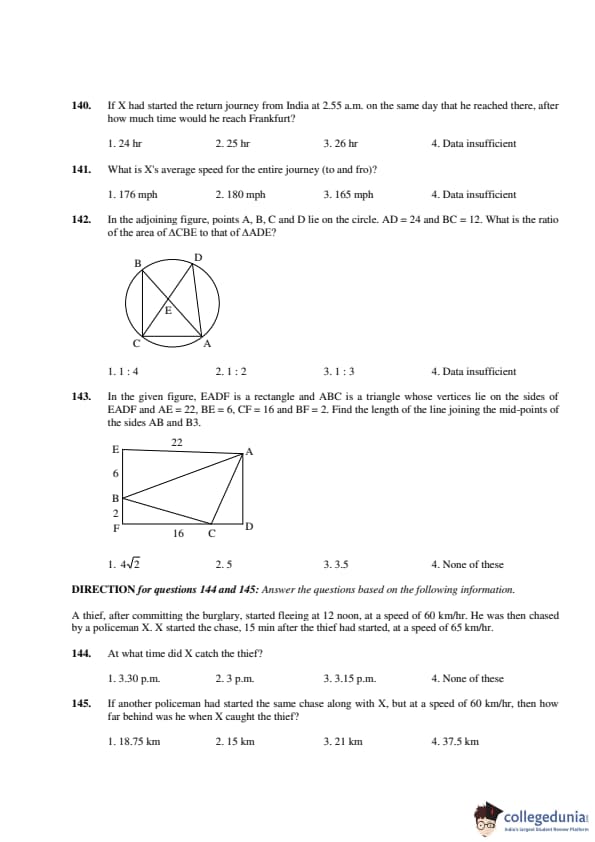
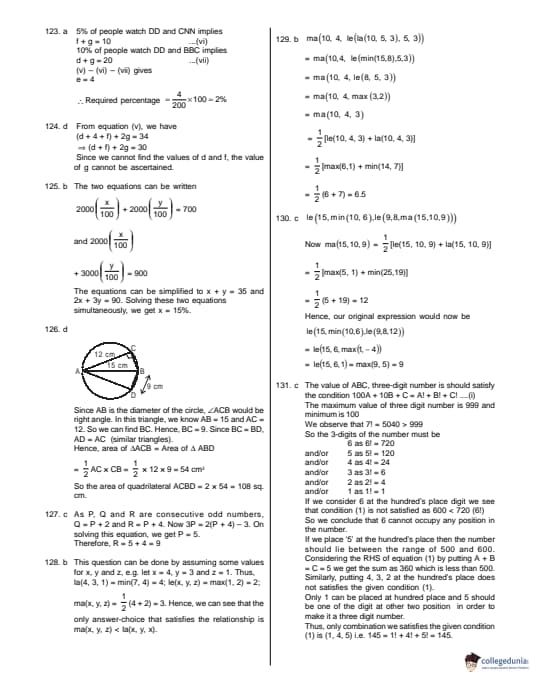
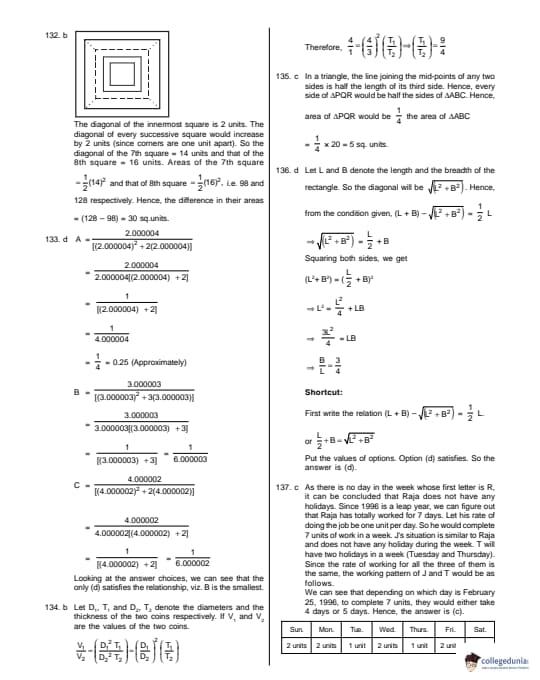
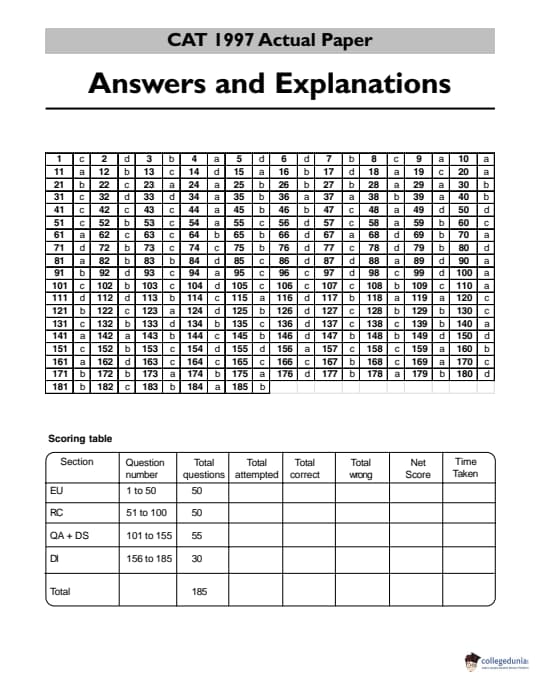
CAT 1997 Question Paper with Answer Key PDF is available for download. CAT 1997 Question Paper consisted of a total of 185 questions. The duration of the exam was 120 minutes. The conducting authority divided the 185 questions into 4 sections i.e. Verbal Ability, Reading Comprehension, Problem Solving/ Quant, and Data Interpretation. In CAT 1997 question paper, sectional time limit was not there and candidates were free to divide their time among the sections

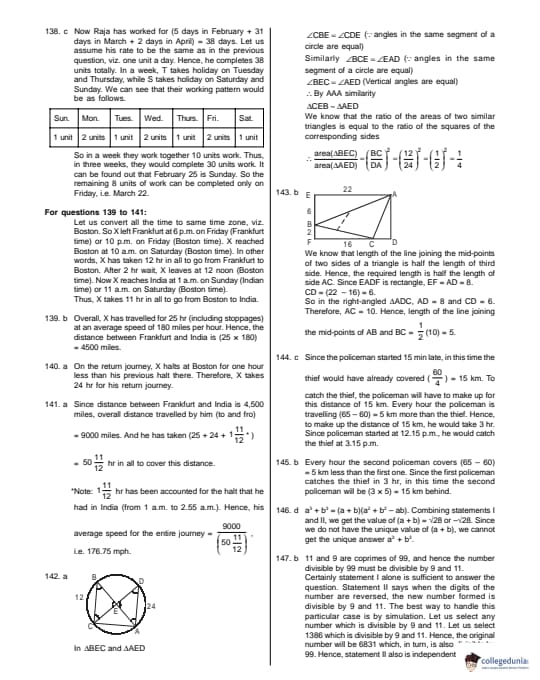
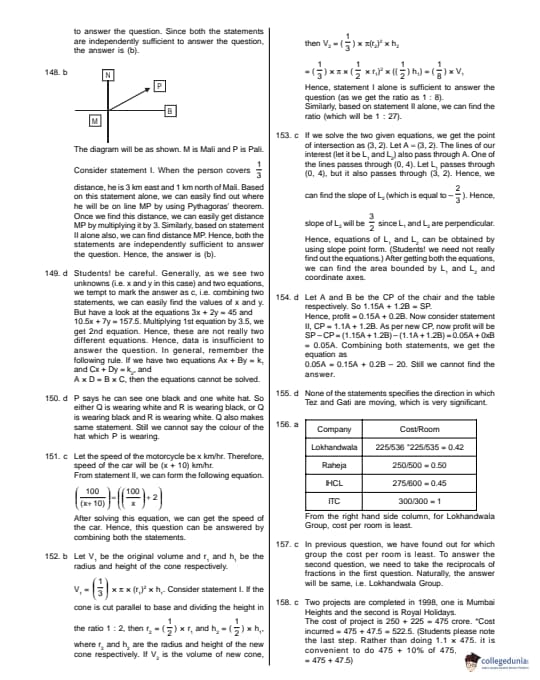
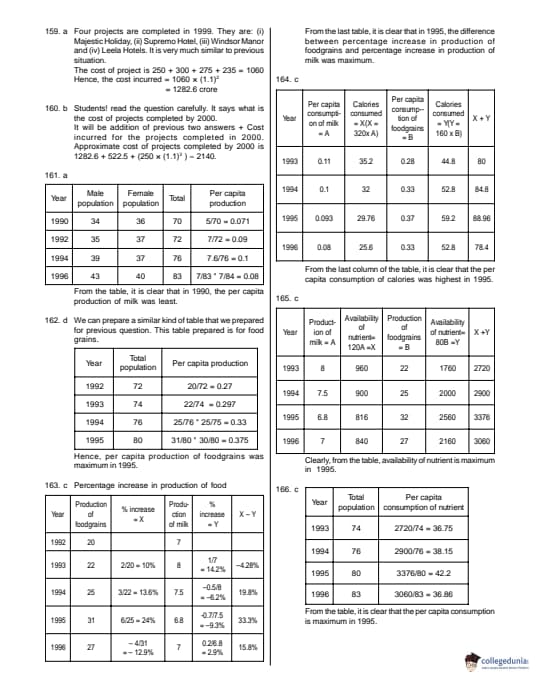
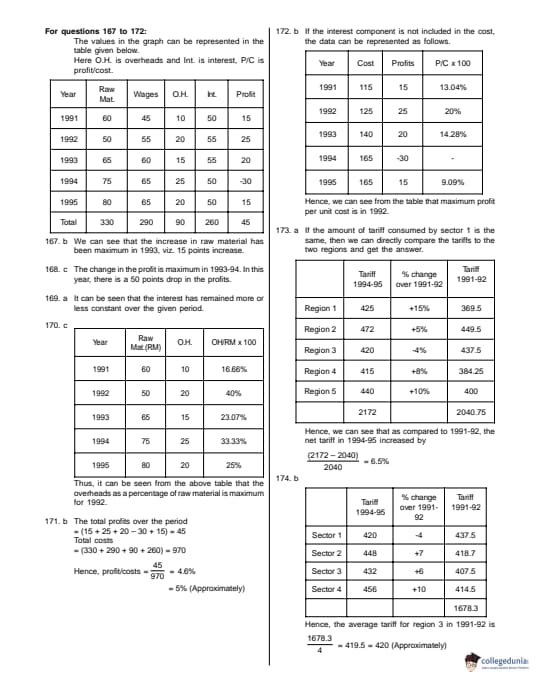
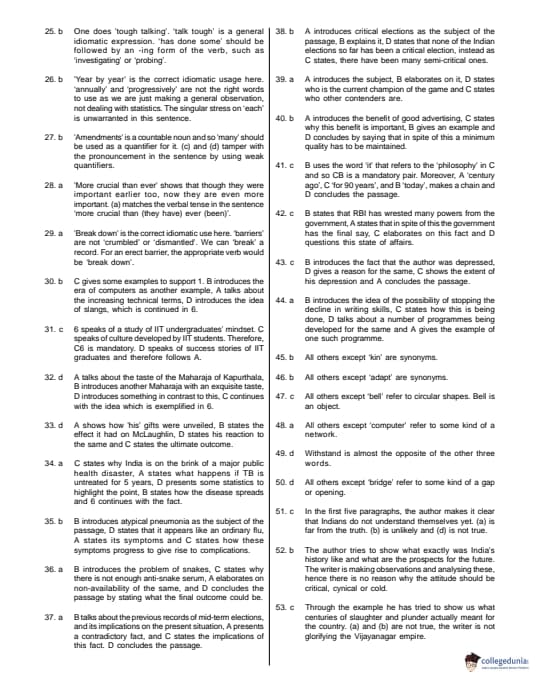
Candidates preparing for CAT 2025 can download the CAT 1997 question paper with the solution PDF to get a better idea about the type of questions asked in the paper and their difficulty level.

Also Check:

CAT 1997 Question Paper with Solution PDF

CAT 1997 Question Paper with Answer Key Download PDF Check Solutions

CAT 1997 question paper with solution pdf

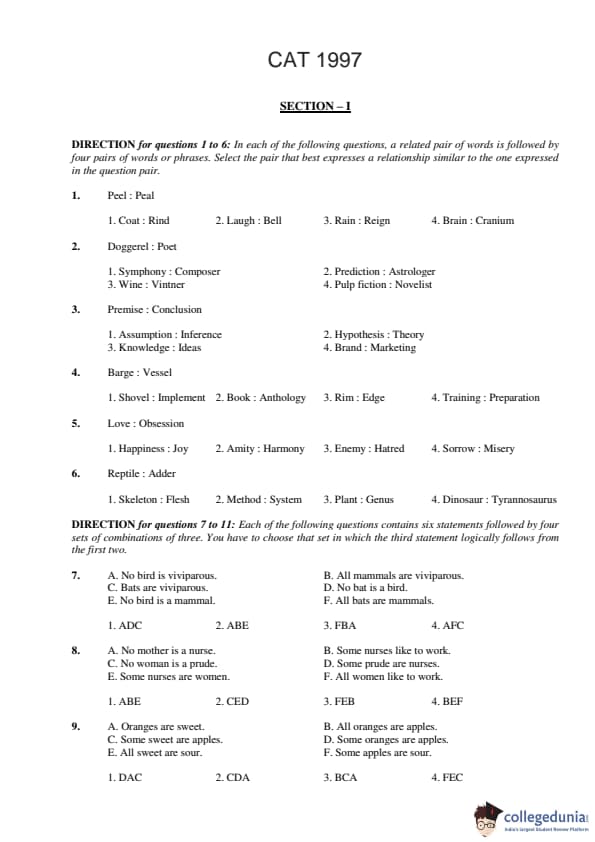
Question 1:

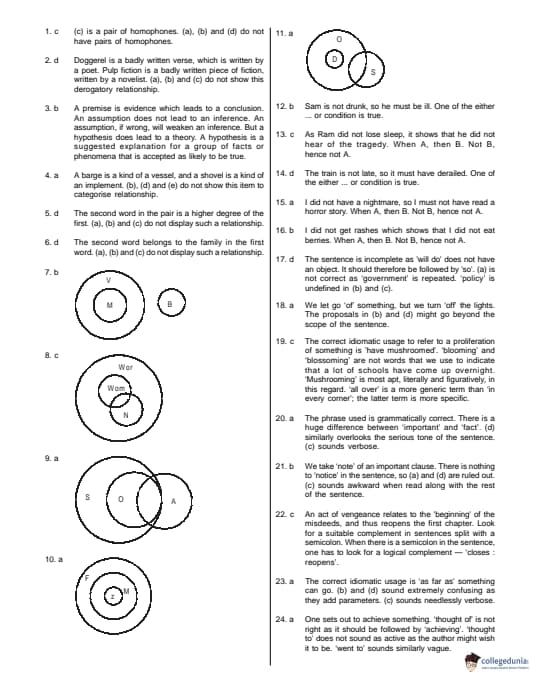
Peel : Peal

  • (a) Coat : Rind
  • (b) Laugh : Bell
  • (c) Rain : Reign
  • (d) Brain : Cranium
Correct Answer:(c) Rain : Reign View Solution

Question 2:

Doggerel : Poet

  • (a) Symphony : Composer
  • (b) Prediction : Astrologer
  • (c) Wine : Vintner
  • (d) Pulp fiction : Novelist
Correct Answer:(d) Pulp fiction : Novelist
View Solution

Question 3:

Premise : Conclusion

  • (a) Assumption : Inference
  • (b) Hypothesis : Theory
  • (c) Knowledge : Ideas
  • (d) Brand : Marketing
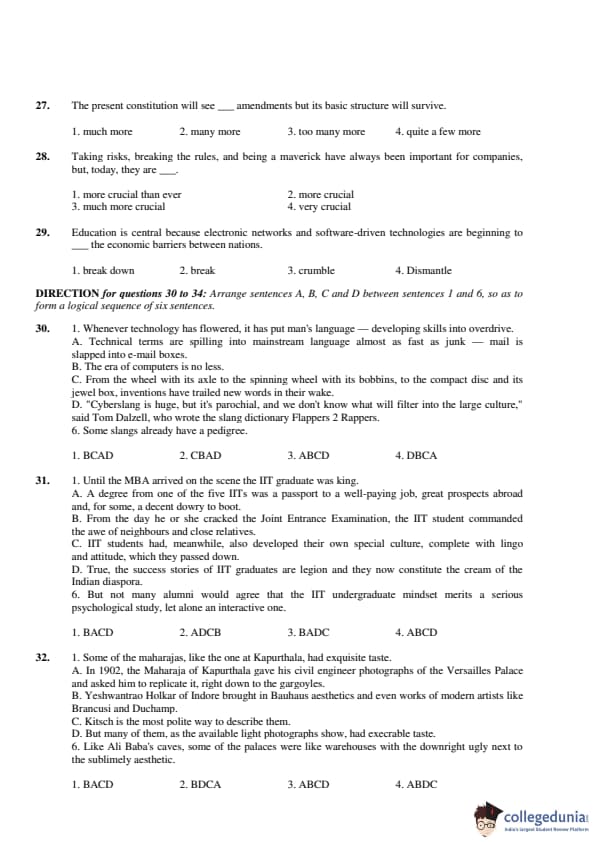
Correct Answer:(a) Assumption : Inference
View Solution

Question 4:

Barge : Vessel

  • (a) Shovel : Implement
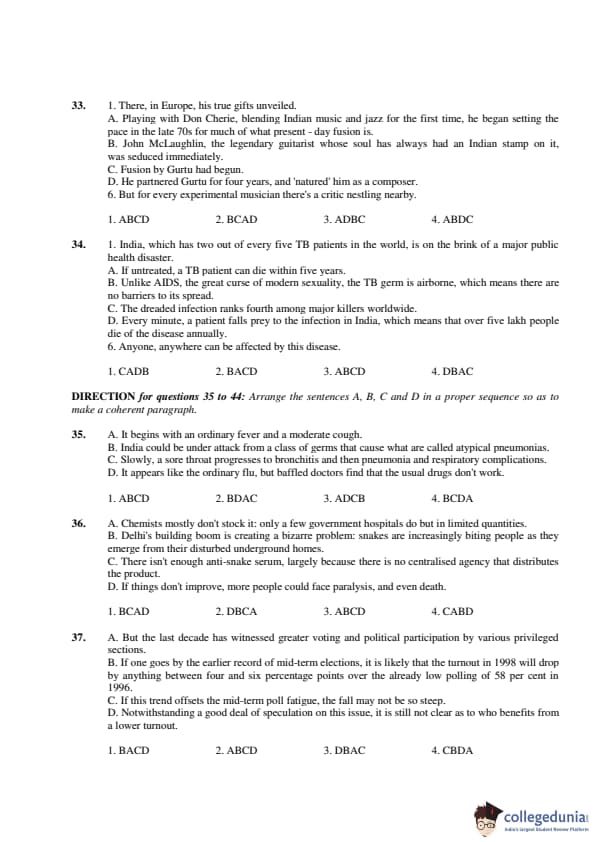
  • (b) Book : Anthology
  • (c) Rim : Edge
  • (d) Training : Preparation
Correct Answer:(a) Shovel : Implement
View Solution

Question 5:

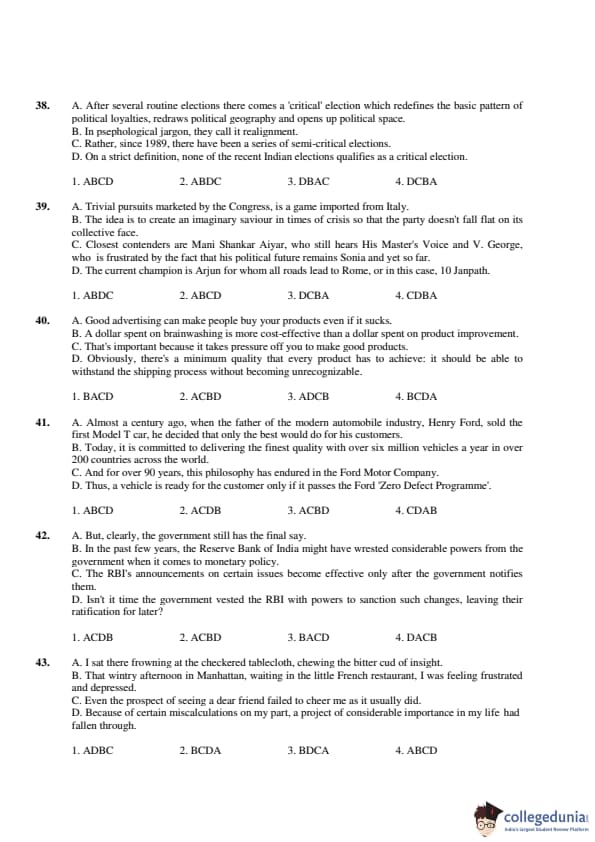
Love : Obsession

  • (a) Happiness : Joy
  • (b) Amity : Harmony
  • (c) Enemy : Hatred
  • (d) Sorrow : Misery
Correct Answer:(d) Sorrow : Misery
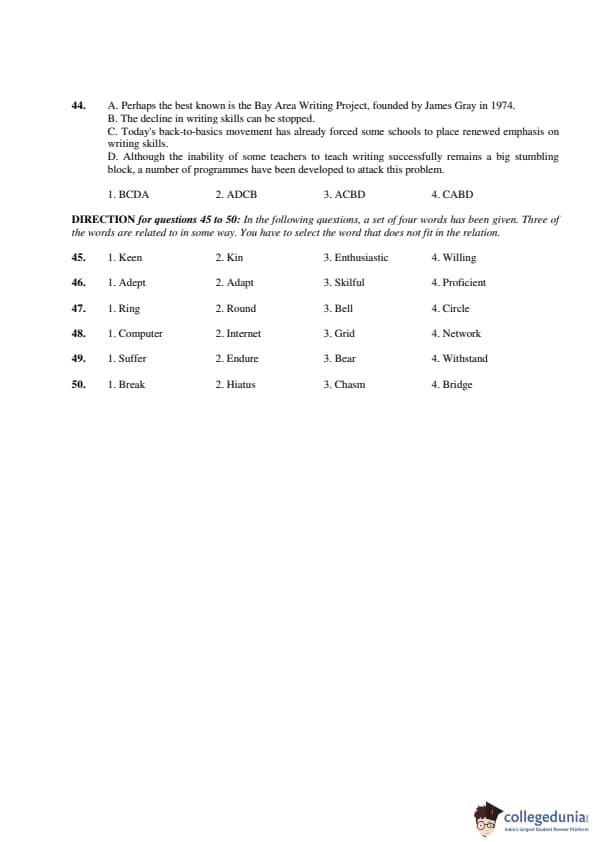
View Solution

Question 6:

Reptile : Adder

  • (a) Skeleton : Flesh
  • (b) Method : System
  • (c) Plant : Genus
  • (d) Dinosaur : Tyrannosaurus
Correct Answer:(d) Dinosaur : Tyrannosaurus
View Solution

Question 7:

A. No bird is viviparous.

B. All mammals are viviparous.

C. Bats are viviparous.

D. No bat is a bird.

E. No bird is a mammal.

F. All bats are mammals.

  • (a) ADC
  • (b) ABE
  • (c) FBA
  • (d) AFC
Correct Answer(b) ABE
View Solution

Question 8:

A. No mother is a nurse.

B. Some nurses like to work.

C. No woman is a prude.

D. Some prude are nurses.

E. Some nurses are women.

F. All women like to work.

  • (a) ABE
  • (b) CED
  • (c) FEB
  • (d) BEF 
Correct Answer:(c) FEB
View Solution

Question 9:

A. Oranges are sweet.

B. All oranges are apples.

C. Some sweet are apples.

D. Some oranges are apples.

E. All sweet are sour.

F. Some apples are sour.

  • (a) DAC
  • (b) CDA
  • (c) BCA
  • (d) FEC
Correct Answer:(a) DAC
View Solution

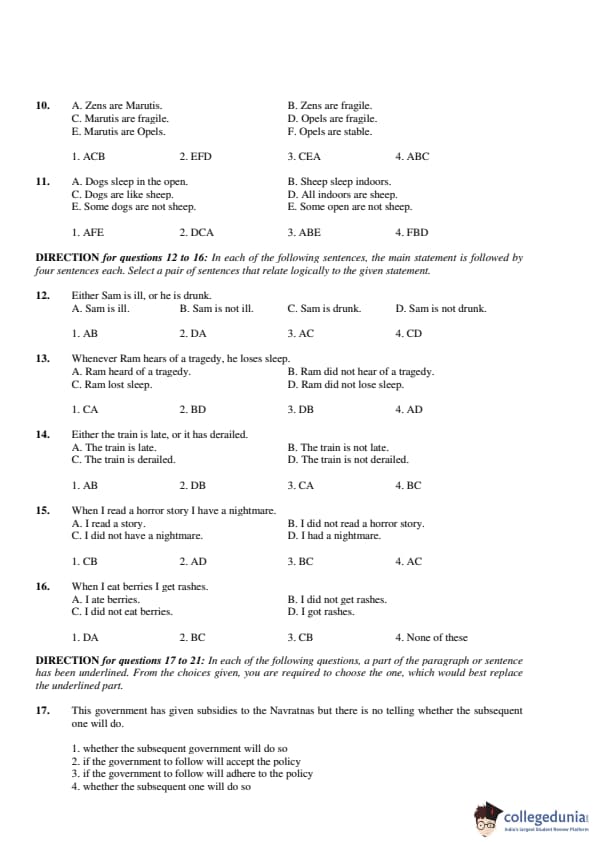
Question 10:

A. Zens are Marutis.

B. Zens are fragile.

C. Marutis are fragile.

D. Opels are fragile.

E. Marutis are Opels.

F. Opels are stable.

  • (a) ACB
  • (b) EFD
  • (c) CEA
  • (d) ABC
Correct Answer:(b) EFD
View Solution

Question 11:

A. Dogs sleep in the open.

B. Sheep sleep indoors.

C. Dogs are like sheep.

D. All indoors are sheep.

E. Some dogs are not sheep.

F. Some open are not sheep.

  • (a) AFE
  • (b) DCA
  • (c) ABE
  • (d) FBD
Correct Answer:(a) AFE
View Solution

Question 12:

Either Sam is ill, or he is drunk.


A. Sam is ill.

B. Sam is not ill.

C. Sam is drunk.

D. Sam is not drunk.

  • (a) AB
  • (b) DA
  • (c) AC
  • (d) CD
Correct Answer:(a) AB
View Solution

Question 13:

Whenever Ram hears of a tragedy, he loses sleep.


A. Ram heard of a tragedy.

B. Ram did not hear of a tragedy.

C. Ram lost sleep.

D. Ram did not lose sleep.

  • (a) AC
  • (b) BD
  • (c) DB
  • (d) AD
Correct Answer:(b) BD
View Solution

Question 14:

Either the train is late, or it has derailed.


A. The train is late.

B. The train is not late.

C. The train is derailed.

D. The train is not derailed.

  • (a) AB
  • (b) DB
  • (c) CA
  • (d) BC
Correct Answer:(c) CA
View Solution

Question 15:

When I read a horror story, I have a nightmare.


A. I read a story.

B. I did not read a horror story.

C. I did not have a nightmare.

D. I had a nightmare.

  • (a) CB
  • (b) AD
  • (c) BC
  • (d) AC
Correct Answer:

(c) BC
View Solution


Question 16:

When I eat berries, I get rashes.


A. I ate berries.

B. I did not get rashes.

C. I did not eat berries.

D. I got rashes.

  • (a) DA
  • (b) BC
  • (c) CB
  • (d) None of these
Correct Answer:
(c) CB
View Solution

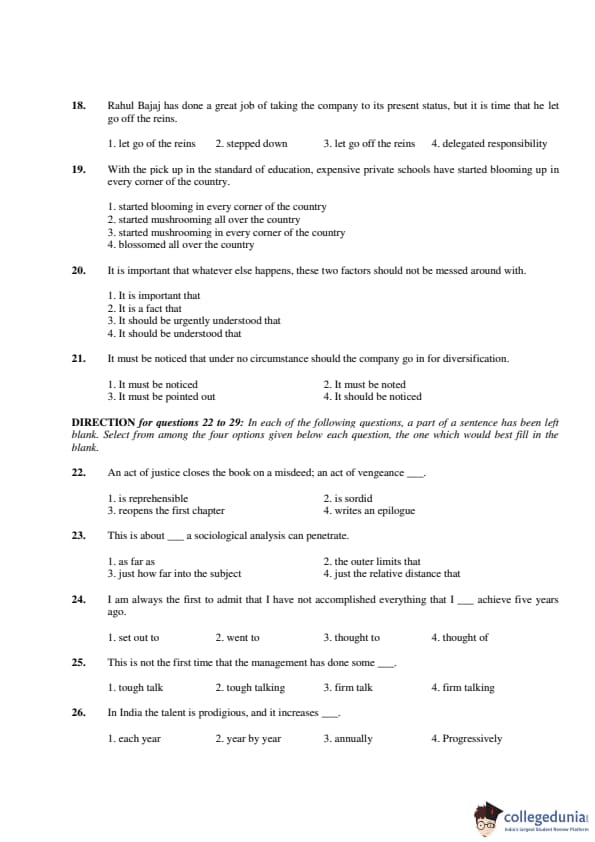
Question 17:

This government has given subsidies to the Navratnas but there is no telling \underline{whether the subsequent one will do.

  • (a) whether the subsequent government will do so
  • (b) if the government to follow will accept the policy
  • (c) if the government to follow will adhere to the policy
  • (d) whether the subsequent one will do so
Correct Answer:(d) whether the subsequent one will do so
View Solution

Question 18:

Rahul Bajaj has done a great job of taking the company to its present status, but it is time that he \underline{let go off the reins.

  • (a) let go of the reins
  • (b) stepped down
  • (c) let go off the reins
  • (d) delegated responsibility
Correct Answer:(a) let go of the reins
View Solution

Question 19:

With the pick up in the standard of education, expensive private schools have \underline{started blooming up in every corner of the country.

  • (a) started blooming in every corner of the country
  • (b) started mushrooming all over the country
  • (c) started mushrooming in every corner of the country
  • (d) blossomed all over the country
Correct Answer:(b) started mushrooming all over the country
View Solution

Question 20:

\underline{It is important that whatever else happens, these two factors should not be messed around with.

  • (a) It is important that
  • (b) It is a fact that
  • (c) It should be urgently understood that
  • (d) It should be understood that
Correct Answer:(d) It should be understood that
View Solution

Question 21:

\underline{It must be noticed that under no circumstance should the company go in for diversification.

  • (a) It must be noticed
  • (b) It must be noted
  • (c) It must be pointed out
  • (d) It should be noticed
Correct Answer:(b) It must be noted
View Solution

Question 22:

An act of justice closes the book on a misdeed; an act of vengeance \underline{\hspace{2cm.

  • (a) is reprehensible
  • (b) is sordid
  • (c) reopens the first chapter
  • (d) writes an epilogue
Correct Answer:(c) reopens the first chapter
View Solution

Question 23:

This is about \underline{\hspace{2cm a sociological analysis can penetrate.

  • (a) as far as
  • (b) the outer limits that
  • (c) just how far into the subject
  • (d) just the relative distance that
Correct Answer:(c) just how far into the subject
View Solution

Question 24:

I am always the first to admit that I have not accomplished everything that I \underline{\hspace{2cm achieve five years ago.

  • (a) set out to
  • (b) went to
  • (c) thought to
  • (d) thought of
Correct Answer:(a) set out to
View Solution

Question 25:

This is not the first time that the management has done some \underline{\hspace{2cm.

  • (a) tough talk
  • (b) tough talking
  • (c) firm talk
  • (d) firm talking
Correct Answer:(a) tough talk
View Solution

Question 26:

In India the talent is prodigious, and it increases \underline{\hspace{2cm.

  • (a) each year
  • (b) year by year
  • (c) annually
  • (d) progressively
Correct Answer:(b) year by year
View Solution

Question 27:

The present constitution will see \underline{\hspace{2cm amendments but its basic structure will survive.

  • (a) much more
  • (b) many more
  • (c) too many more
  • (d) quite a few more
Correct Answer:(b) many more
View Solution

Question 28:

Taking risks, breaking the rules, and being a maverick have always been important for companies, but, today, they are \underline{\hspace{2cm.

  • (a) more crucial than ever
  • (b) more crucial
  • (c) much more crucial
  • (d) very crucial
Correct Answer:(a) more crucial than ever
View Solution

Question 29:

Education is central because electronic networks and software-driven technologies are beginning to \underline{\hspace{2cm the economic barriers between nations.

  • (a) break down
  • (b) break
  • (c) crumble
  • (d) dismantle
Correct Answer:(a) break down
View Solution

Question 30:

Whenever technology has flowered, it has put man's language — developing skills into overdrive.

A. Technical terms are spilling into mainstream language almost as fast as junk — mail is slapped into e-mail boxes.

B. The era of computers is no less.

C. From the wheel with its axle to the spinning wheel with its bobbins, to the compact disc and its jewel box, inventions have trailed new words in their wake.

D. "Cyberslang is huge, but it's parochial, and we don't know what will filter into the large culture," said Tom Dalzell, who wrote the slang dictionary \textit{Flappers 2 Rappers.


6. Some slangs already have a pedigree.

  • (a) BCAD
  • (b) CBAD
  • (c) ABCD
  • (d) DBCA
Correct Answer: (a) BCAD
View Solution

Question 31:

Until the MBA arrived on the scene the IIT graduate was king.


A. A degree from one of the five IITs was a passport to a well-paying job, great prospects abroad and, for some, a decent dowry to boot.

B. From the day he or she cracked the Joint Entrance Examination, the IIT student commanded the awe of neighbours and close relatives.

C. IIT students had, meanwhile, also developed their own special culture, complete with lingo and attitude, which they passed down.

D. True, the success stories of IIT graduates are legion and they now constitute the cream of the Indian diaspora.


6. But not many alumni would agree that the IIT undergraduate mindset merits a serious psychological
study, let alone an interactive one.

  • (a) BACD
  • (b) ADCB
  • (c) BADC
  • (d) ABCD
Correct Answer: (c) BADC
View Solution

Question 32:

Some of the maharajas, like the one at Kapurthala, had exquisite taste.


A. In 1902, the Maharaja of Kapurthala gave his civil engineer photographs of the Versailles Palace and asked him to replicate it, right down to the gargoyles.

B. Yeshwantrao Holkar of Indore brought in Bauhaus aesthetics and even works of modern artists like Brancusi and Duchamp.

C. Kitsch is the most polite way to describe them.

D. But many of them, as the available light photographs show, had execrable taste.


6. Like Ali Baba's caves, some of the palaces were like warehouses with the downright ugly next to
the sublimely aesthetic.

  • (a) BACD
  • (b) BDCA
  • (c) ABCD
  • (d) ABDC
Correct Answer: (b) BDCA
View Solution

Question 33:

There, in Europe, his true gifts unveiled.


A. Playing with Don Cherie, blending Indian music and jazz for the first time, he began setting the pace in the late 70s for much of what present-day fusion is.

B. John McLaughlin, the legendary guitarist whose soul has always had an Indian stamp on it, was seduced immediately.

C. Fusion by Gurtu had begun.

D. He partnered Gurtu for four years, and ‘natured’ him as a composer.


6. But for every experimental musician there's a critic nestling nearby.

  • (a) ABCD
  • (b) BCAD
  • (c) ADBC
  • (d) ABDC
Correct Answer: (d) ABDC
View Solution

Question 34:

India, which has two out of every five TB patients in the world, is on the brink of a major public health disaster.


A. If untreated, a TB patient can die within five years.

B. Unlike AIDS, the great curse of modern sexuality, the TB germ is airborne, which means there are no barriers to its spread.

C. The dreaded infection ranks fourth among major killers worldwide.

D. Every minute, a patient falls prey to the infection in India, which means that over five lakh people die of the disease annually.


6. Anyone, anywhere can be affected by this disease.

  • (a) CABD
  • (b) BADC
  • (c) ABCD
  • (d) DBAC
Correct Answer: (a) CABD
View Solution

Question 35:

A. It begins with an ordinary fever and a moderate cough.

B. India could be under attack from a class of germs that cause what are called atypical pneumonias.

C. Slowly, a sore throat progresses to bronchitis and then pneumonia and respiratory complications.

D. It appears like the ordinary flu, but baffled doctors find that the usual drugs don't work.

  • (a) ABCD
  • (b) BDAC
  • (c) ADCB
  • (d) BCDA
Correct Answer: (b) BDAC
View Solution

Question 36:

A. Chemists mostly don't stock it: only a few government hospitals do but in limited quantities.

B. Delhi’s building boom is creating a bizarre problem: snakes are increasingly biting people as they emerge from their disturbed underground homes.

C. There isn't enough anti-snake serum, largely because there is no centralised agency that distributes the product.

D. If things don’t improve, more people could face paralysis, and even death.

  • (a) BCAD
  • (b) DBCA
  • (c) ABCD
  • (d) CABD
Correct Answer: (a) BCAD
View Solution

Question 37:

A. But the last decade has witnessed greater voting and political participation by various privileged sections.

B. If one goes by the earlier record of mid-term elections, it is likely that the turnout in 1998 will drop by anything between four and six percentage points over the already low polling of 58 per cent in 1996.

C. If this trend offsets the mid-term poll fatigue, the fall may not be so steep.

D. Notwithstanding a good deal of speculation on this issue, it is still not clear as to who benefits from a lower turnout.

  • (a) BACD
  • (b) ABCD
  • (c) DBAC
  • (d) CBDA
Correct Answer: (a) BACD
View Solution

Question 38:

A. After several routine elections there comes a 'critical' election which redefines the basic pattern of political loyalties, redraws political geography and opens up political space.

B. In psephological jargon, they call it realignment.

C. Rather, since 1989, there have been a series of semi-critical elections.

D. On each definition, only the realignment of recent elections qualifies as a critical election.

  • (a) ABCD
  • (b) DBCA
  • (c) CABD
  • (d) CBAD
Correct Answer: (a) ABCD
View Solution

Question 39:

A. Trivial pursuits marketed by the Congress, is a game imported from Italy.

B. The idea is to create an imaginary saviour in times of crisis so that the party doesn’t fall flat on its collective face.

C. Closest contenders are Mani Shankar Aiyar, who still hears His Master’s Voice and V. George, who is frustrated by the fact that his political future remains Sonia and yet so far.

D. The current champion is Arjun for whom all roads lead to Rome, or in this case, 10 Janpath.

  • (a) ABDC
  • (b) ABCD
  • (c) DCBA
  • (d) CDBA
Correct Answer: (a) ABDC
View Solution

Question 40:

A. Good advertising can make people buy your products even if it sucks.

B. A dollar spent on brainwashing is more cost-effective than a dollar spent on product improvement.

C. That’s important because it takes pressure off you to make good products.

D. Obviously, there’s a minimum quality that every product has to achieve: it should be able to withstand the shipping process without becoming unrecognizable.

  • (a) BACD
  • (b) ACBD
  • (c) ADCB
  • (d) BCDA
Correct Answer: (b) ACBD
View Solution

Question 41:

A. Almost a century ago, when the father of the modern automobile industry, Henry Ford, sold the first Model T car, he decided that only the best would do for his customers.

B. Today, it is committed to delivering the finest quality with over six million vehicles a year in over 200 countries across the world.

C. And for over 90 years, this philosophy has endured in the Ford Motor Company.

D. Thus, a vehicle is ready for the customer only if it passes the Ford 'Zero Defect Programme'.

  • (a) ABCD
  • (b) ACDB
  • (c) ACBD
  • (d) CDAB
Correct Answer: (a) ABCD
View Solution

Question 42:

A. But, clearly, the government still has the final say.

B. In the past few years, the Reserve Bank of India might have wrested considerable powers from the government when it comes to monetary policy.

C. The RBI’s announcements on certain issues become effective only after the government notifies them.

D. Isn’t it time the government vested the RBI with powers to sanction such changes, leaving their ratification for later?

  • (a) BACD
  • (b) ABCD
  • (c) BCAD
  • (d) DACB
Correct Answer: (c) BCAD
View Solution

Question 43:

A. I sat there frowning at the checkered tablecloth, chewing the bitter cud of insight.

B. That wintry afternoon in Manhattan, waiting in the little French restaurant, I was feeling frustrated and depressed.

C. Even the prospect of seeing a dear friend failed to cheer me as it usually did.

D. Because of certain miscalculations on my part, a project of considerable importance in my life had fallen through.

  • (a) ADBC
  • (b) BCDA
  • (c) BDCA
  • (d) ABCD
Correct Answer: (a) ADBC
View Solution

Question 44:

A. Perhaps the best known is the Bay Area Writing Project, founded by James Gray in 1974.

B. The decline in writing skills can be stopped.

C. Today’s back-to-basics movement has already forced some schools to place renewed emphasis on writing skills.

D. Although the inability of some teachers to teach writing successfully remains a big stumbling block, a number of programmes have been developed to attack this problem.

  • (a) BCDA
  • (b) ADCB
  • (c) ACBD
  • (d) CABD
Correct Answer: (a) BCDA
View Solution

Question 45:

Keen : Kin : Enthusiastic : Willing

  • (a) Keen
  • (b) Kin
  • (c) Enthusiastic
  • (d) Willing
Correct Answer:
 (b) Kin
View Solution

Question 46:

Adept : Adapt : Skilful : Proficient

  • (a) Adept
  • (b) Adapt
  • (c) Skilful
  • (d) Proficient
Correct Answer:
(b) Adapt
View Solution

Question 47:

Ring : Round : Bell : Circle

  • (a) Ring
  • (b) Round
  • (c) Bell
  • (d) Circle
Correct Answer:(c) Bell
View Solution

Question 48:

Computer : Internet : Grid : Network

  • (a) Computer
  • (b) Internet
  • (c) Grid
  • (d) Network
Correct Answer:
(a) Computer
View Solution

Question 49:

Suffer : Endure : Bear : Withstand

  • (a) Suffer
  • (b) Endure
  • (c) Bear
  • (d) Withstand
Correct Answer:
 (a) Suffer
View Solution

Question 50:

Break : Hiatus : Chasm : Bridge

  • (a) Break
  • (b) Hiatus
  • (c) Chasm
  • (d) Bridge
Correct Answer:
 (d) Bridge
View Solution

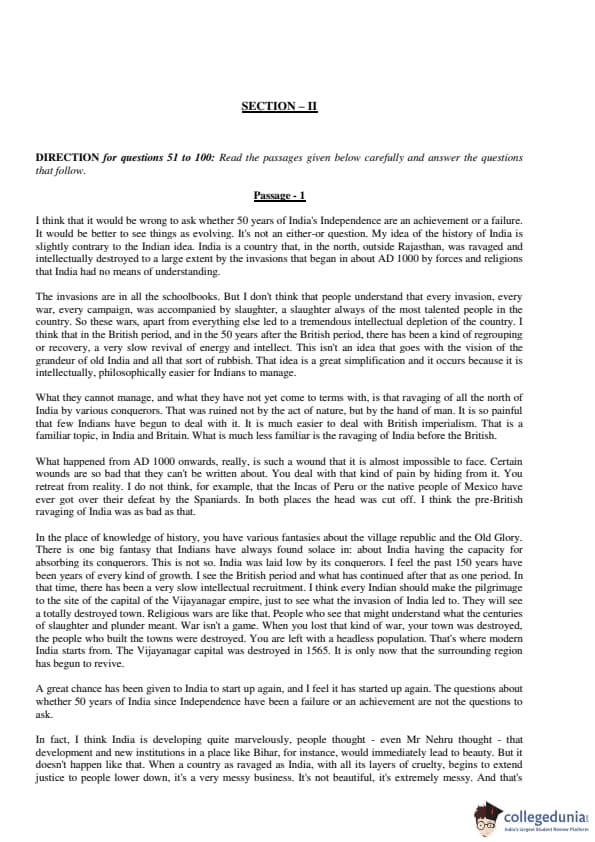
Question 51:

The central thrust of the passage is that

  • (a) India is gearing up for a new awakening.
  • (b) India is going back to its past status.
  • (c) India is yet to understand itself.
  • (d) India’s glorious past is a figment of the imagination.
Correct Answer:
 (a)
View Solution

Question 52:

The writer’s attitude is

  • (a) excessively critical of India.
  • (b) insightful.
  • (c) cynical.
  • (d) cold.
Correct Answer:
(b)

View Solution

Question 53:

The writer has given the example of the Vijayanagar kingdom in order to drive home the point that

  • (a) Indians should know their historical sites.
  • (b) Indians should be aware of the existence of such a historic past.
  • (c) it is time that India came to terms with the past.
  • (d) All of these
Correct Answer:

(d)
View Solution


Question 54:

The writer is against

  • (a) the child’s view of history.
  • (b) taking a critical stand on history.
  • (c) indulging in the details of the past.
  • (d) None of these

Correct Answer:(a)
View Solution


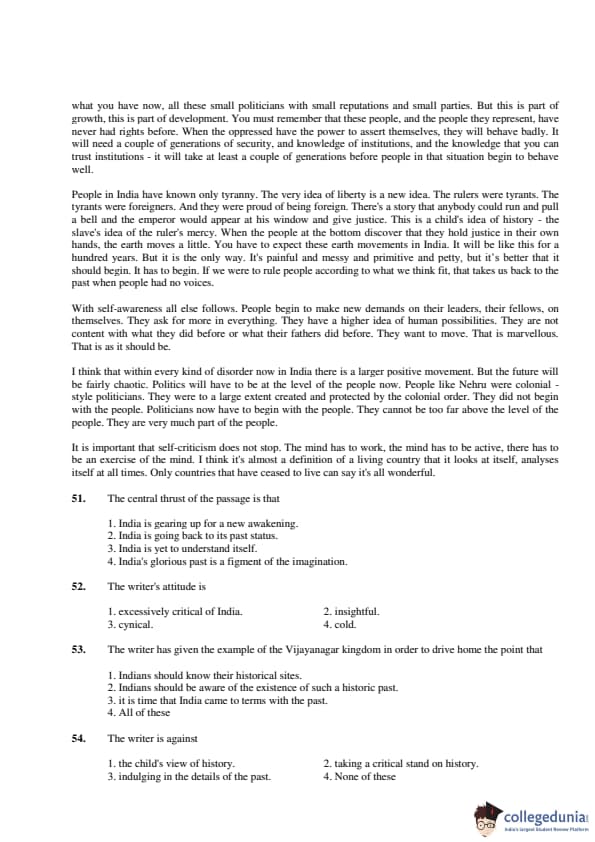
Question 55:

According to the writer, India’s regeneration and revival took place

  • (a) in the British period.
  • (b) after the British period.
  • (c) during and after the British period.
  • (d) a long time after the British left.
Correct Answer:
(c)
View Solution

Question 56:

According to the passage, self-awareness is followed by

  • (a) self-righteousness.
  • (b) a higher idea of human possibilities.
  • (c) a desire for more in everything.
  • (d) Both (b) and (c)
Correct Answer:
(d)
View Solution

Question 57:

According to the passage, India’s current situation is

  • (a) bleak.
  • (b) horrific.
  • (c) primitive and messy.
  • (d) None of these
Correct Answer:
(c)
View Solution

Question 58:

For a country to be alive and progressive, it is important that

  • (a) self-criticism does not stop.
  • (b) self-criticism does not exceed a certain limit.
  • (c) it feels that all is right with itself.
  • (d) None of these
Correct Answer:
(a)
View Solution

Question 59:

The writer’s prognosis for India’s future is that

  • (a) it will be stable.
  • (b) it will be chaotic.
  • (c) it will reflect the manipulations of the present.
  • (d) it will be subject to self-criticism.
Correct Answer:
(b)
View Solution

Question 60:

One of the main features of the tyranny of foreign rulers was

  • (a) the decimation of the country’s artists.
  • (b) the decimation of its people.
  • (c) the decimation of its intellect.
  • (d) the decimation of the country’s rulers.
Correct Answer:
(c)
View Solution

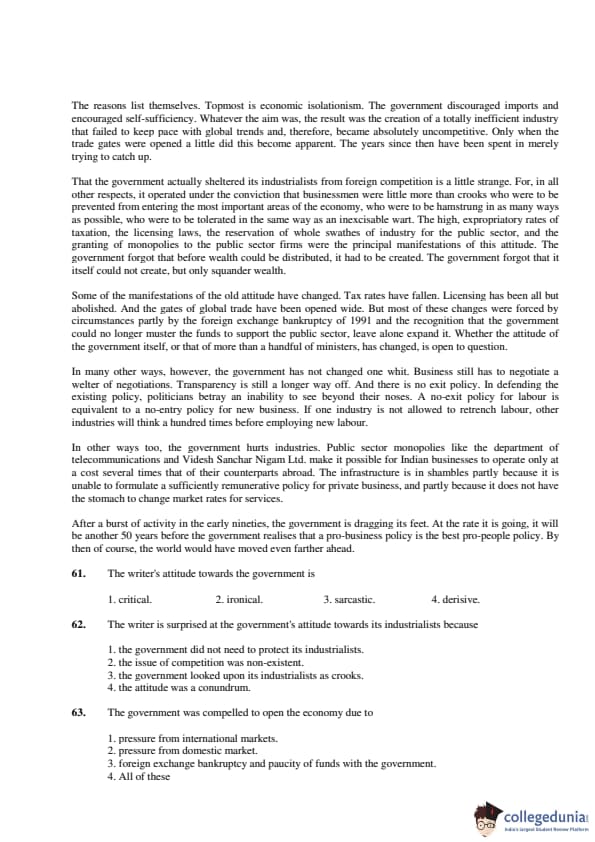
Question 61:

The writer’s attitude towards the government is

  • (a) critical.
  • (b) ironical.
  • (c) sarcastic.
  • (d) derisive.
Correct Answer:
(a)
View Solution

Question 62:

The writer is surprised at the government’s attitude towards its industrialists because

  • (a) the government did not need to protect its industrialists.
  • (b) the issue of competition was non-existent.
  • (c) the government looked upon its industrialists as crooks.
  • (d) the attitude was a conundrum.

Correct Answer:(c)


View Solution  


Question 63:

The government was compelled to open the economy due to

  • (a) pressure from international markets.
  • (b) pressure from domestic market.
  • (c) foreign exchange bankruptcy and paucity of funds with the government.
  • (d) All of these
Correct Answer:
(d)
View Solution

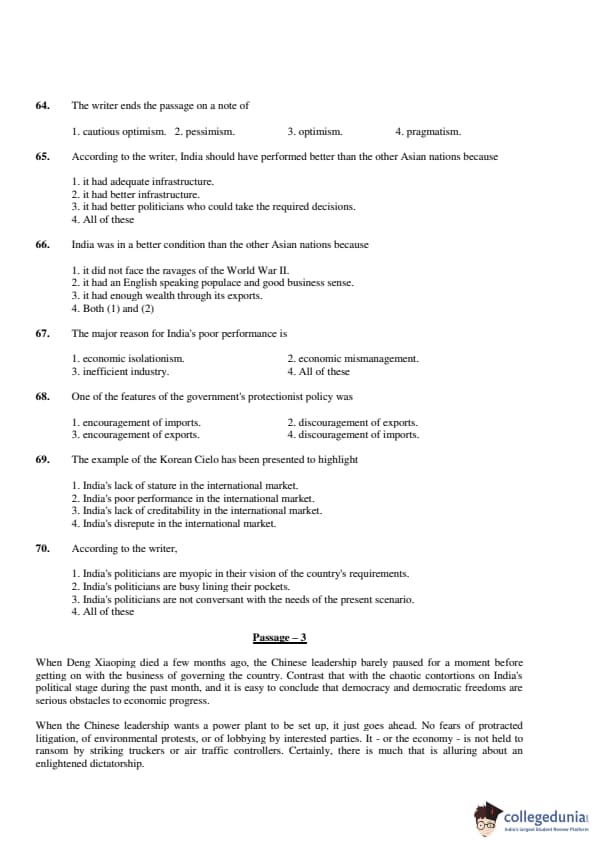
Question 64:

The writer ends the passage on a note of

  • (a) cautious optimism.
  • (b) pessimism.
  • (c) optimism.
  • (d) pragmatism.
Correct Answer:
(a)
View Solution

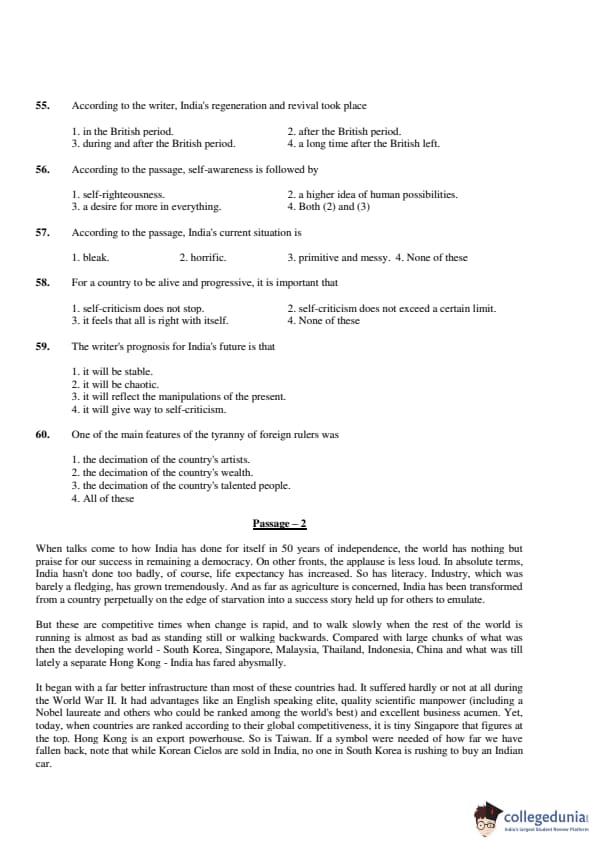
Question 65:

According to the writer, India should have performed better than the other Asian nations because

  • (a) it had adequate infrastructure.
  • (b) it had better infrastructure.
  • (c) it had better politicians who could take the required decisions.
  • (d) All of these
Correct Answer:
(d)
View Solution

Question 66:

India was in a better condition than the other Asian nations because

  • (a) it did not face the ravages of the World War II.
  • (b) it had an English speaking populace and good business sense.
  • (c) it had enough wealth through its exports.
  • (d) Both (a) and (b)
Correct Answer:
(d)
View Solution

Question 67:

The major reason for India's poor performance is

  • (a) economic isolationism.
  • (b) economic mismanagement.
  • (c) inefficient industry.
  • (d) All of these
Correct Answer:
(d)
View Solution

Question 68:

One of the features of the government’s protectionist policy was

  • (a) encouragement of imports.
  • (b) discouragement of exports.
  • (c) encouragement of exports.
  • (d) discouragement of imports.
Correct Answer:

(d)

View Solution


Question 69:

The example of the Korean Cielo has been presented to highlight

  • (a) India's lack of stature in the international market.
  • (b) India's poor performance in the international market.
  • (c) India's lack of creditability in the international market.
  • (d) India's disrepute in the international market.
Correct Answer:
(b)
View Solution

Question 70:

According to the writer,

  • (a) India’s politicians are myopic in their vision of the country’s requirements.
  • (b) India’s politicians are busy lining their pockets.
  • (c) India’s politicians are not conversant with the needs of the present scenario.
  • (d) All of these
Correct Answer:
(d)
View Solution

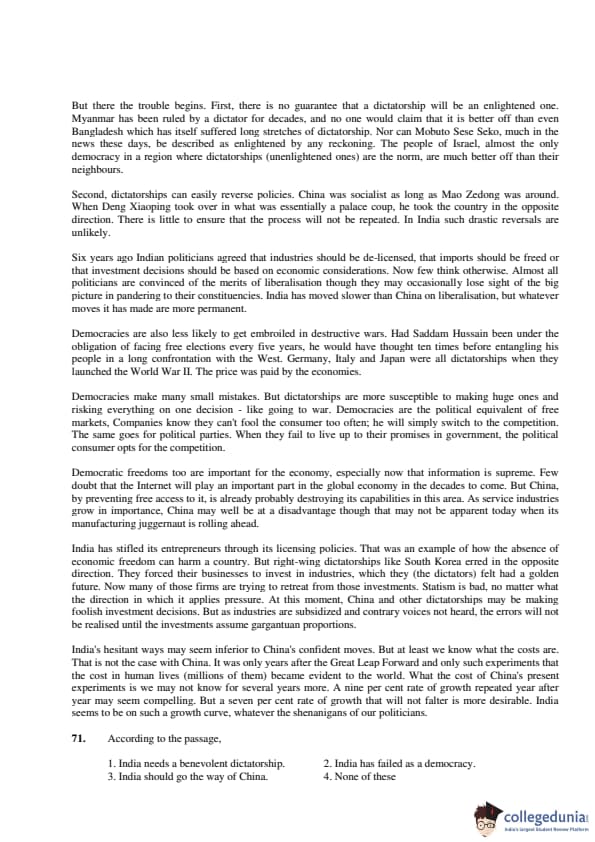
Question 71:

According to the passage,

  • (a) India needs a benevolent dictatorship.
  • (b) India has failed as a democracy.
  • (c) India should go the way of China.
  • (d) None of these
Correct Answer:
(d)
View Solution

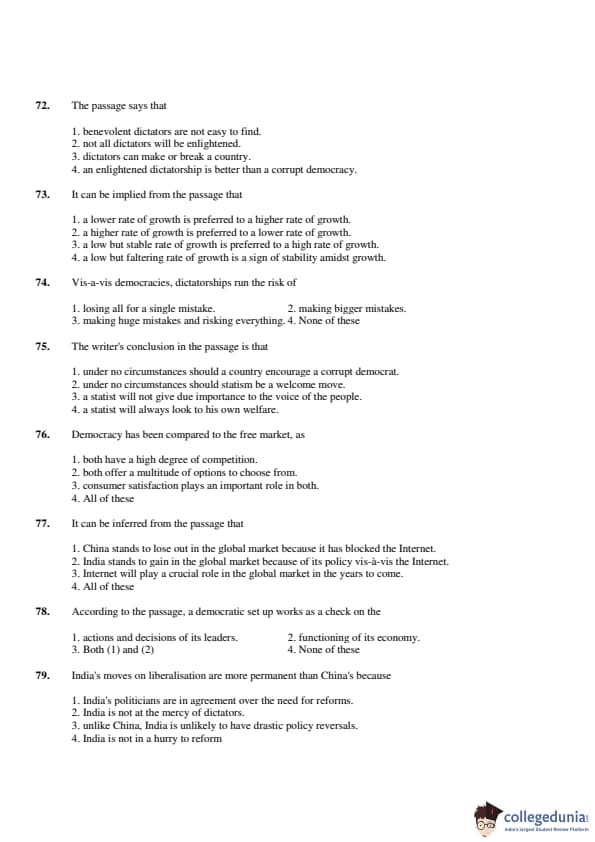
Question 72:

The passage says that

  • (a) benevolent dictators are not easy to find.
  • (b) not all dictators will be enlightened.
  • (c) dictators can make or break a country.
  • (d) an enlightened dictatorship is better than a corrupt democracy.
Correct Answer:
(b)
View Solution

Question 73:

It can be implied from the passage that

  • (a) a lower rate of growth is preferred to a higher rate of growth.
  • (b) a higher rate of growth is preferred to a lower rate of growth.
  • (c) a low but stable rate of growth is preferred to a high rate of growth.
  • (d) a low but faltering rate of growth is a sign of stability amidst growth.
Correct Answer:
(c)
View Solution

Question 74:

Vis-a-vis democracies, dictatorships run the risk of

  • (a) losing all for a single mistake.
  • (b) making bigger mistakes.
  • (c) making huge mistakes and risking everything.
  • (d) None of these
Correct Answer:
(c)
View Solution

Question 75:

The writer's conclusion in the passage is that

  • (a) under no circumstances should a country encourage a corrupt democracy.
  • (b) under no circumstances should statism be a welcome move.
  • (c) a statist will not give due importance to the voice of the people.
  • (d) a statist will always look to his own welfare.
Correct Answer:
(b)
View Solution

Question 76:

Democracy has been compared to the free market, as

  • (a) both have a high degree of competition.
  • (b) both offer a multitude of options to choose from.
  • (c) consumer satisfaction plays an important role in both.
  • (d) All of these
Correct Answer:
(d)
View Solution

Question 77:

It can be inferred from the passage that

  • (a) China stands to lose out in the global market because it has blocked the Internet.
  • (b) India stands to gain in the global market because of its policy vis-à-vis the Internet.
  • (c) Internet will play a crucial role in the global market in the years to come.
  • (d) All of these
Correct Answer:
(d)
View Solution

Question 78:

According to the passage, a democratic set up works as a check on the

  • (a) actions and decisions of its leaders.
  • (b) functioning of its economy.
  • (c) Both (a) and (b)
  • (d) None of these
Correct Answer:
(c)
View Solution

Question 79:

India's moves on liberalisation are more permanent than China’s because

  • (a) India’s politicians are in agreement over the need for reforms.
  • (b) India is not at the mercy of dictators.
  • (c) unlike China, India is unlikely to have drastic policy reversals.
  • (d) India is not in a hurry to reform
Correct Answer:
(c)
View Solution

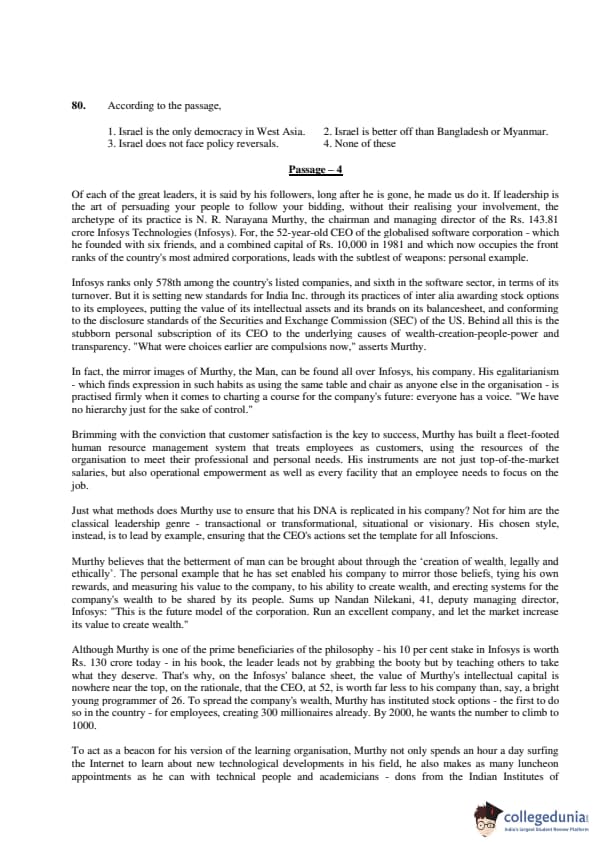
Question 80:

According to the passage,

  • (a) Israel is the only democracy in West Asia.
  • (b) Israel is better off than Bangladesh or Myanmar.
  • (c) Israel does not face policy reversals.
  • (d) None of these
Correct Answer:
(a)
View Solution

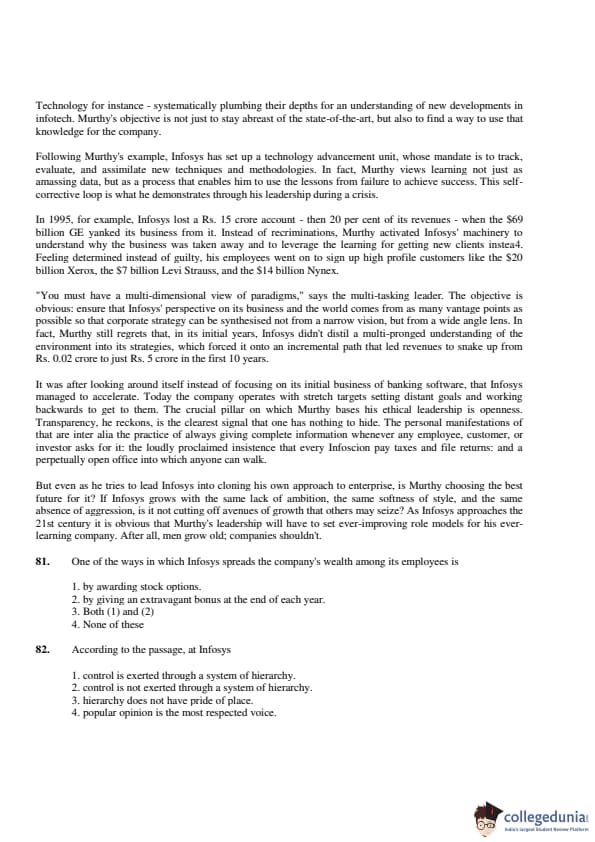
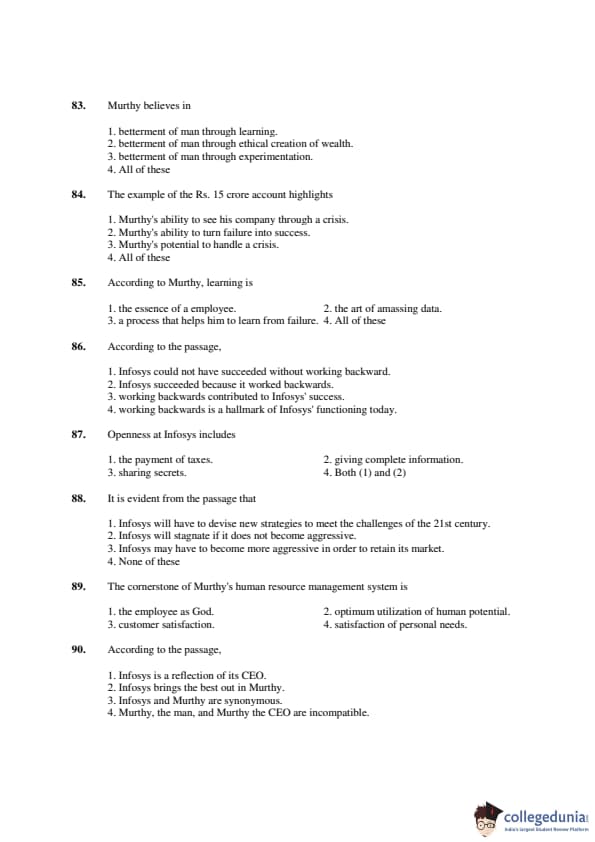
Question 81:

One of the ways in which Infosys spreads the company’s wealth among its employees is

  • (a) by awarding stock options.
  • (b) by giving an extravagant bonus at the end of each year.
  • (c) Both (a) and (b)
  • (d) None of these
Correct Answer:

(a)


View Solution

Question 82:

According to the passage, at Infosys

  • (a) control is exerted through a system of hierarchy.
  • (b) control is not exerted through a system of hierarchy.
  • (c) hierarchy does not have pride of place.
  • (d) popular opinion is the most respected voice.
    (b)
Correct Answer:
View Solution

Question 83:

Murthy believes in

  • (a) betterment of man through learning.
  • (b) betterment of man through ethical creation of wealth.
  • (c) betterment of man through experimentation.
  • (d) All of these
    (d)
Correct Answer:
View Solution

Question 84:

The example of the Rs. 15 crore account highlights

  • (a) Murthy’s ability to see his company through a crisis.
  • (b) Murthy’s ability to turn failure into success.
  • (c) Murthy’s potential to handle a crisis.
  • (d) All of these
    (d)
Correct Answer:
View Solution

Question 85:

According to Murthy, learning is

  • (a) the essence of a employee.
  • (b) the art of amassing data.
  • (c) a process that helps him to learn from failure.
  • (d) All of these
    (c)
Correct Answer:
View Solution

Question 86:

According to the passage,

  • (a) Infosys could not have succeeded without working backward.
  • (b) Infosys succeeded because it worked backwards.
  • (c) working backwards contributed to Infosys' success.
  • (d) working backwards is a hallmark of Infosys' functioning today.
    (c)
Correct Answer:
View Solution

Question 87:

Openness at Infosys includes

  • (a) the payment of taxes.
  • (b) giving complete information.
  • (c) sharing secrets.
  • (d) Both (a) and (b)
    (d)
Correct Answer:
View Solution

Question 88:

It is evident from the passage that

  • (a) Infosys will have to devise new strategies to meet the challenges of the 21st century.
  • (b) Infosys will stagnate if it does not become aggressive.
  • (c) Infosys may have to become more aggressive in order to retain its market.
  • (d) None of these
    (c)
Correct Answer:
View Solution

Question 89:

The cornerstone of Murthy’s human resource management system is

  • (a) the employee as God.
  • (b) optimum utilization of human potential.
  • (c) customer satisfaction.
  • (d) satisfaction of personal needs.
    (c)
Correct Answer:
View Solution

Question 90:

According to the passage,

  • (a) Infosys is a reflection of its CEO.
  • (b) Infosys brings the best out in Murthy.
  • (c) Infosys and Murthy are synonymous.
  • (d) Murthy, the man, and Murthy the CEO are incompatible.
    (a)
Correct Answer:
View Solution

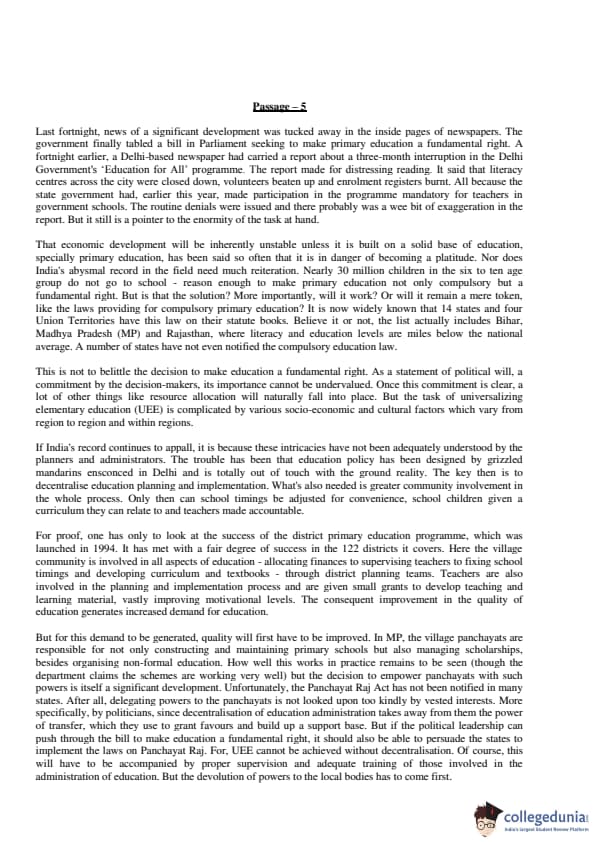
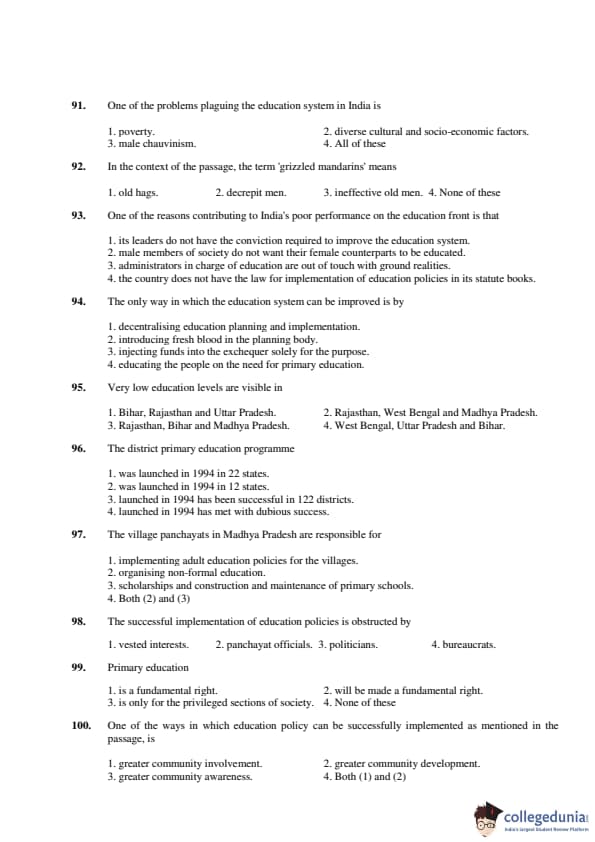
Question 91:

One of the problems plaguing the education system in India is

  • (a) poverty.
  • (b) diverse cultural and socio-economic factors.
  • (c) male chauvinism.
  • (d) All of these
    (d)
Correct Answer:
View Solution

Question 92:

In the context of the passage, the term ‘grizzled mandarins’ means

  • (a) old hags.
  • (b) decrepit men.
  • (c) ineffective old men.
  • (d) None of these
    (c)
Correct Answer:
View Solution

Question 93:

One of the reasons contributing to India’s poor performance on the education front is that

  • (a) its leaders do not have the conviction required to improve the education system.
  • (b) male members of society do not want their female counterparts to be educated.
  • (c) administrators in charge of education are out of touch with ground realities.
  • (d) the country does not have the law for implementation of education policies in its statute books.
    (c)
Correct Answer:
View Solution

Question 94:

The only way in which the education system can be improved is by

  • (a) decentralising education planning and implementation.
  • (b) introducing fresh blood in the planning body.
  • (c) injecting funds into the exchequer solely for the purpose.
  • (d) educating the people on the need for primary education.
    (a)
Correct Answer:
View Solution

Question 95:

Very low education levels are visible in

  • (a) Bihar, Rajasthan and Uttar Pradesh.
  • (b) Rajasthan, West Bengal and Madhya Pradesh.
  • (c) Rajasthan, Bihar and Madhya Pradesh.
  • (d) West Bengal, Uttar Pradesh and Bihar.
    (c)
Correct Answer:
View Solution

Question 96:

The district primary education programme

  • (a) was launched in 1994 in 22 states.
  • (b) was launched in 1994 in 12 states.
  • (c) launched in 1994 has been successful in 122 districts.
  • (d) launched in 1994 has met with dubious success.
    (c)
Correct Answer:
View Solution

Question 97:

The village panchayats in Madhya Pradesh are responsible for

  • (a) implementing adult education policies for the villages.
  • (b) organising non-formal education.
  • (c) scholarships and construction and maintenance of primary schools.
  • (d) Both (b) and (c)
    (d)
Correct Answer:
View Solution

Question 98:

The successful implementation of education policies is obstructed by

  • (a) vested interests.
  • (b) panchayat officials.
  • (c) politicians.
  • (d) bureaucrats.
    (c)
Correct Answer:
View Solution

Question 99:

Primary education

  • (a) is a fundamental right.
  • (b) will be made a fundamental right.
  • (c) is only for the privileged sections of society.
  • (d) None of these
    (b)
Correct Answer:
View Solution

Question 100:

One of the ways in which education policy can be successfully implemented as mentioned in the passage, is

  • (a) greater community involvement.
  • (b) greater community development.
  • (c) greater community awareness.
  • (d) Both (a) and (b)
    (a)
Correct Answer:
View Solution

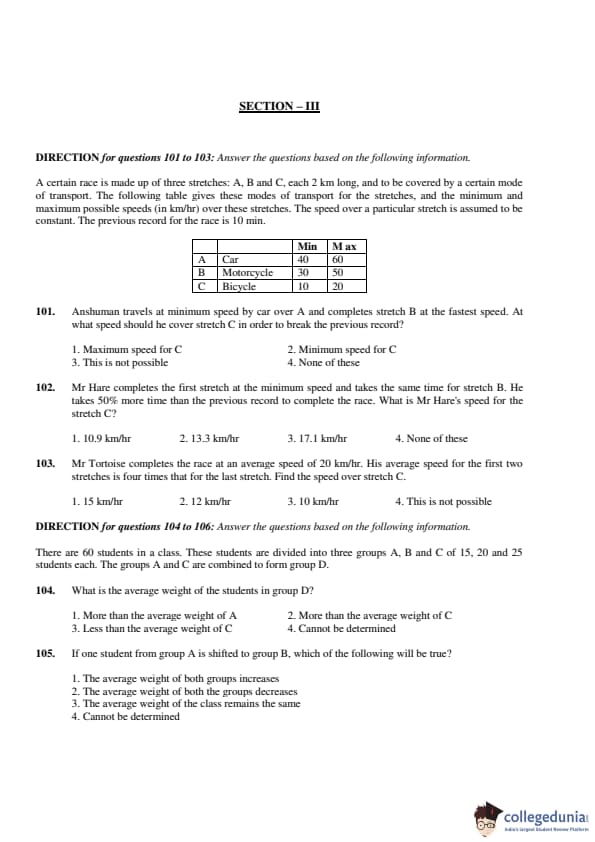
Question 101:

Anshuman travels at minimum speed by car over A and completes stretch B at the fastest speed. At what speed should he cover stretch C in order to break the previous record?

  • (a) Maximum speed for C
  • (b) Minimum speed for C
  • (c) This is not possible
  • (d) None of these
    (a)
Correct Answer:
View Solution

Question 102:

Mr Hare completes the first stretch at the minimum speed and takes the same time for stretch B. He takes 50% more time than the previous record to complete the race. What is Mr Hare’s speed for the stretch C?

  • (a) 10.9 km/hr
  • (b) 13.3 km/hr
  • (c) 17.1 km/hr
  • (d) None of these
    (b)
Correct Answer:
View Solution

Question 103:

Mr Tortoise completes the race at an average speed of 20 km/hr. His average speed for the first two stretches is four times that for the last stretch. Find the speed over stretch C.

  • (a) 15 km/hr
  • (b) 12 km/hr
  • (c) 10 km/hr
  • (d) This is not possible
    (b)
Correct Answer:
View Solution

Question 104:

What is the average weight of the students in group D?

  • (a) More than the average weight of A
  • (b) More than the average weight of C
  • (c) Less than the average weight of C
  • (d) Cannot be determined
    (d)
Correct Answer:
View Solution

Question 105:

If one student from group A is shifted to group B, which of the following will be true?

  • (a) The average weight of both groups increases
  • (b) The average weight of both the groups decreases
  • (c) The average weight of the class remains the same
  • (d) Cannot be determined
    (c)
Correct Answer:
View Solution

Question 106:

If all the students of the class have the same weight, then which of the following is false?

  • (a) The average weight of all the four groups is the same
  • (b) The total weight of A and C is twice the total weight of B
  • (c) The average weight of D is greater than the average weight of A
  • (d) The average weight of all the groups remains the same even if a number of students are shifted from one group to another
    (c)
Correct Answer:
View Solution

Question 107:

A student gets an aggregate of 60% marks in five subjects in the ratio 10 : 9 : 8 : 7 : 6. If the passing marks are 50% of the maximum marks and each subject has the same maximum marks, in how many subjects did he pass the examination?

  • (a) 2
  • (b) 3
  • (c) 4
  • (d) 5
    (c)
Correct Answer:
View Solution

Question 108:

In how many ways can eight directors, the vice chairman and chairman of a firm be seated at a round table, if the chairman has to sit between the vice chairman and a director?

  • (a) \(9! \times 2\)
  • (b) \(2 \times 8!\)
  • (c) \(2 \times 7!\)
  • (d) None of these
    (b)
Correct Answer:
View Solution

Question 109:

If \(\log_{2} \left[ \log_{3} \left( x^{2} - x + 37 \right) \right] = 1\), then what could be the value of \(x\)?

  • (a) 3
  • (b) 5
  • (c) 4
  • (d) None of these
    (a)
Correct Answer:
View Solution

Question 110:

After allowing a discount of 11.11%, a trader still makes a gain of 14.28%. At how many percentage above the cost price does he mark his goods?

  • (a) 28.56%
  • (b) 35%
  • (c) 22.22%
  • (d) None of these
    (b)
Correct Answer:
View Solution

Question 111:

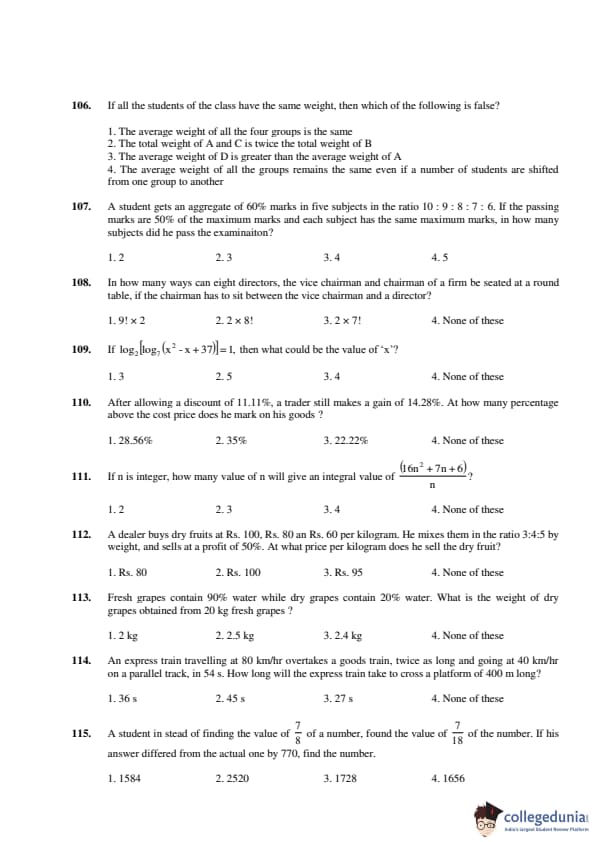
If \(n\) is an integer, how many values of \(n\) will give an integral value of \(\frac{16n^{2} + 7n + 6}{n}\)?

  • (a) 2
  • (b) 3
  • (c) 4
  • (d) None of these
    (c)
Correct Answer:
View Solution

Question 112:

A dealer buys dry fruits at Rs. 100, Rs. 80 and Rs. 60 per kilogram. He mixes them in the ratio 3 : 4 : 5 by weight, and sells at a profit of 50%. At what price per kilogram does he sell the dry fruit?

  • (a) Rs. 80
  • (b) Rs. 100
  • (c) Rs. 95
  • (d) None of these
    (b)
Correct Answer:
View Solution

Question 113:

Fresh grapes contain 90% water while dry grapes contain 20% water. What is the weight of dry grapes obtained from 20 kg fresh grapes?

  • (a) 2 kg
  • (b) 2.5 kg
  • (c) 2.4 kg
  • (d) None of these
    (b)
Correct Answer:
View Solution

Question 114:

An express train travelling at 80 km/hr overtakes a goods train, twice as long and going at 40 km/hr on a parallel track, in 54 s. How long will the express train take to cross a platform of 400 m long?

  • (a) 36 s
  • (b) 45 s
  • (c) 27 s
  • (d) None of these
    (a)
Correct Answer:
View Solution

Question 115:

A student instead of finding the value of \(\frac{7}{8}\) of a number, found the value of \(\frac{7}{18}\) of the number. If his answer differed from the actual one by 770, find the number.

  • (a) 1584
  • (b) 2520
  • (c) 1728
  • (d) 1656
    (b)
Correct Answer:
View Solution

Question 116:

P and Q are two positive integers such that \(PQ = 64\). Which of the following cannot be the value of \(P + Q\)?

  • (a) 20
  • (b) 65
  • (c) 16
  • (d) 35
    (b)
Correct Answer:
View Solution

Question 117:

The average marks of a student in 10 papers are 80. If the highest and the lowest scores are not considered, the average is 81. If his highest score is 92, find the lowest.

  • (a) 55
  • (b) 60
  • (c) 62
  • (d) Cannot be determined
    (a)
Correct Answer:
View Solution

Question 118:

If the roots \(x_1\) and \(x_2\) of the quadratic equation \(x^2 - 2x + c = 0\) also satisfy the equation \(7x_2 - 4x_1 = 47\), then which of the following is true?

  • (a) \(c = -15\)
  • (b) \(x_1 = -5, x_2 = 3\)
  • (c) \(x_1 = 4.5, x_2 = -2.5\)
  • (d) None of these
    (a)
Correct Answer:
View Solution

Question 119:

The sum of the areas of two circles, which touch each other externally, is \(153\pi\). If the sum of their radii is 15, find the ratio of the larger to the smaller radius.

  • (a) 4
  • (b) 2
  • (c) 3
  • (d) None of these
    (c)
Correct Answer:
View Solution

Question 120:

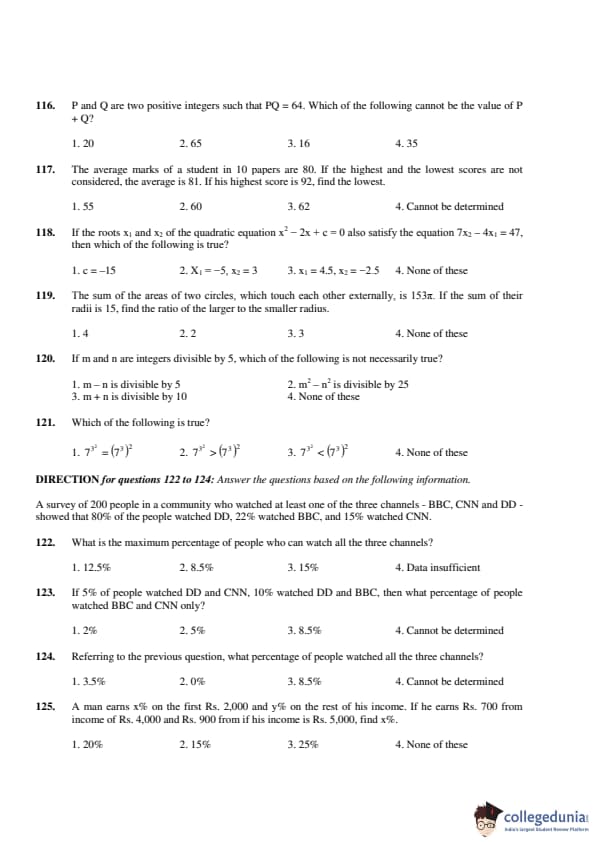
If m and n are integers divisible by 5, which of the following is not necessarily true?

  • (a) \(m - n\) is divisible by 5
  • (b) \(m^2 - n^2\) is divisible by 25
  • (c) \(m + n\) is divisible by 10
  • (d) None of these
    (c)
Correct Answer:
View Solution

Question 121:

Which of the following is true?

  • (a) \(7^{3} = (7^{3})^{2}\)
  • (b) \(7^{3} > (7^{3})^{2}\)
  • (c) \(7^{3} < (7^{3})^{2}\)
  • (d) None of these
    (c)
Correct Answer:
View Solution

Question 122:

What is the maximum percentage of people who can watch all the three channels?

  • (a) 12.5%
  • (b) 8.5%
  • (c) 15%
  • (d) Data insufficient
    (c)
Correct Answer:
View Solution

Question 123:

If 5% of people watched DD and CNN, 10% watched DD and BBC, then what percentage of people watched BBC and CNN only?

  • (a) 2%
  • (b) 5%
  • (c) 8.5%
  • (d) Cannot be determined
    (d)
Correct Answer:
View Solution

Question 124:

Referring to the previous question, what percentage of people watched all the three channels?

  • (a) 3.5%
  • (b) 0%
  • (c) 8.5%
  • (d) Cannot be determined
    (d)
Correct Answer:
View Solution

Question 125:

A man earns \(x%\) on the first Rs. 2{,000 and \(y%\) on the rest of his income. If he earns Rs. 700 from income of Rs. 4{,000 and Rs. 900 from Rs. 5{,000, find \(x%\).

  • (a) 20%
  • (b) 15%
  • (c) 25%
  • (d) None of these
    (a)
Correct Answer:
View Solution

Question 126:

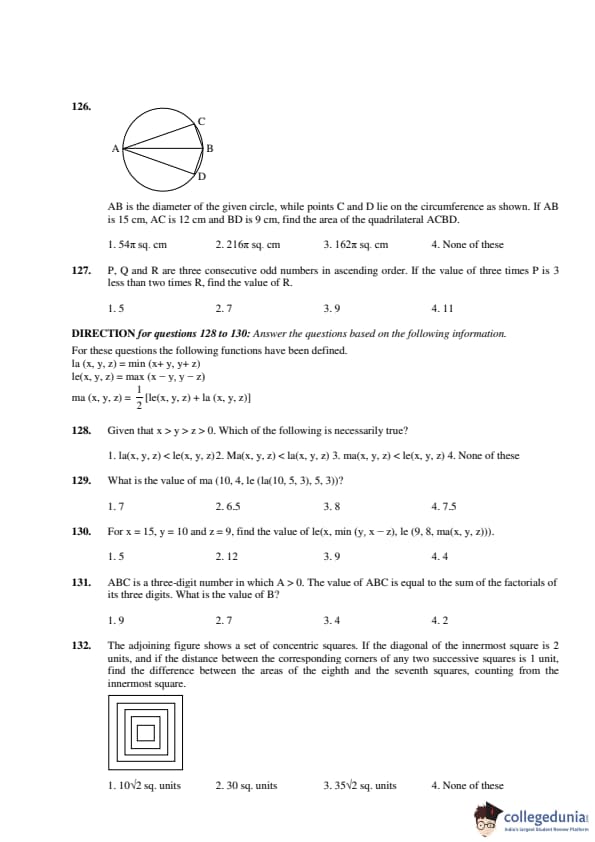
AB is the diameter of the given circle, while points C and D lie on the circumference as shown. If AB is 15 cm, AC is 12 cm and BD is 9 cm, find the area of the quadrilateral ACBD.


  • (a) \(54\pi\) sq. cm
  • (b) \(216\pi\) sq. cm
  • (c) \(162\pi\) sq. cm
  • (d) None of these
    (d)
Correct Answer:
View Solution

Question 127:

P, Q and R are three consecutive odd numbers in ascending order. If the value of three times P is 3 less than two times R, find the value of R.

  • (a) 5
  • (b) 7
  • (c) 9
  • (d) 11
    (c)
Correct Answer:
View Solution

Question 128:

Given that \(x > y > z > 0\). Which of the following is necessarily true?

  • (a) la\((x, y, z) <\) le\((x, y, z)\)
  • (b) ma\((x, y, z) <\) la\((x, y, z)\)
  • (c) ma\((x, y, z) <\) le\((x, y, z)\)
  • (d) None of these
    (c)
Correct Answer:
View Solution

Question 129:

What is the value of ma\((10, 4, le(la(10, 5, 3), 5, 3))\)?

  • (a) 7
  • (b) 6.5
  • (c) 8
  • (d) 7.5
    (b)
Correct Answer:
View Solution

Question 130:

For \(x = 15, y = 10, z = 9\), find the value of le\(\big(x, \min(y, x-z), \ le(9, 8, ma(x, y, z))\big)\).

  • (a) 5
  • (b) 12
  • (c) 9
  • (d) 4
    (a)
Correct Answer:
View Solution

Question 131:

ABC is a three-digit number in which A \(>\) 0. The value of ABC is equal to the sum of the factorials of its three digits. What is the value of B?

  • (a) 9
  • (b) 7
  • (c) 4
  • (d) 2
    (d)
Correct Answer:
View Solution

Question 132:

The adjoining figure shows a set of concentric squares. If the diagonal of the innermost square is 2 units, and if the distance between corresponding corners of any two successive squares is 1 unit, find the difference between the areas of the eighth and seventh squares, counting from the innermost square.


  • (a) \(10\sqrt{2}\) sq. units
  • (b) 30 sq. units
  • (c) \(35\sqrt{2}\) sq. units
  • (d) None of these
    (c)
Correct Answer:
View Solution

Question 133:

A, B and C are defined as follows: \(A = \frac{2.000004}{\sqrt{(2.000004)^2 + (4.000008)^2}}\)
\(B = \frac{3.000003}{\sqrt{(3.000003)^2 + (9.000009)^2}}\)
\(C = \frac{4.000002}{\sqrt{(4.000002)^2 + (8.000004)^2}}\)


Which of the following is true about the values of the above three expressions?

  • (a) All of them lie between 0.18 and 0.2
  • (b) A is twice of C
  • (c) C is the smallest
  • (d) B is the smallest
    (a)
Correct Answer:
View Solution

Question 134:

The value of each of a set of coins varies as the square of its diameter if its thickness remains constant, and it varies as the thickness if the diameter remains constant. If the diameter of two coins are in the ratio \(4 : 3\), what should be the ratio of their thickness if the value of the first is four times that of the second?

  • (a) 16 : 9
  • (b) 9 : 4
  • (c) 9 : 16
  • (d) 4 : 9
    (b)
Correct Answer:
View Solution

Question 135:

In \(\triangle ABC\), points P, Q and R are the mid-points of sides AB, BC and CA respectively. If area of \(\triangle ABC\) is 20 sq. units, find the area of \(\triangle PQR\).

  • (a) 10 sq. units
  • (b) \(5\sqrt{3}\) sq. units
  • (c) 5 sq. units
  • (d) None of these
    (c)
Correct Answer:
View Solution

Question 136:

In a rectangle, the difference between the sum of the adjacent sides and the diagonal is half the length of the longer side. What is the ratio of the shorter to the longer side?

  • (a) \(\sqrt{3} : 2\)
  • (b) \(1 : \sqrt{3}\)
  • (c) \(2 : 5\)
  • (d) \(3 : 4\)
    (a)
Correct Answer:
View Solution

Question 137:

Raja starts working on February 25, 1996, and finishes the job on March 2, 1996. How much time would T and J take to finish the same job if both start on the same day as Raja?

  • (a) 4 days
  • (b) 5 days
  • (c) Either (a) or (b)
  • (d) Cannot be determined
    (c)
Correct Answer:
View Solution

Question 138:

Starting on February 25, 1996, if Raja had finished his job on April 2, 1996, when would T and S together likely to have completed the job, had they started on the same day as Raja?

  • (a) March 15, 1996
  • (b) March 14, 1996
  • (c) March 22, 1996
  • (d) Data insufficient
    (b)
Correct Answer:
View Solution

Question 139:

If his journey, including stoppage, is covered at an average speed of 180 mph, what is the distance between Frankfurt and India?

  • (a) 3,600 miles
  • (b) 4,500 miles
  • (c) 5,580 miles
  • (d) Data insufficient
    (b)
Correct Answer:
View Solution

Question 140:

If X had started the return journey from India at 2.55 a.m. on the same day that he reached there, after how much time would he reach Frankfurt?

  • (a) 24 hr
  • (b) 25 hr
  • (c) 26 hr
  • (d) Data insufficient
    (b)
Correct Answer:
View Solution

Question 141:

What is X's average speed for the entire journey (to and fro)?

  • (a) 176 mph
  • (b) 180 mph
  • (c) 165 mph
  • (d) Data insufficient
    (a)
Correct Answer:
View Solution

Question 142:

In the adjoining figure, points A, B, C and D lie on the circle. \(AD = 24\) and \(BC = 12\). What is the ratio of the area of \(\triangle CBE\) to that of \(\triangle ADE\)?


  • (a) 1 : 4
  • (b) 1 : 2
  • (c) 1 : 3
  • (d) Data insufficient
    (a)
Correct Answer:
View Solution

Question 143:

In the given figure, EADF is a rectangle and ABC is a triangle whose vertices lie on the sides of EADF and AE = 22, BE = 6, CF = 16 and BF = 2. Find the length of the line joining the mid-points of the sides AB and BC.


  • (a) \(4\sqrt{2}\)
  • (b) 5
  • (c) 3.5
  • (d) None of these
    (a)
Correct Answer:
View Solution
Question 144:

A thief, after committing the burglary, started fleeing at 12 noon, at a speed of 60 km/hr. He was then chased by a policeman X. X started the chase, 15 min after the thief had started, at a speed of 65 km/hr. At what time did X catch the thief?

  • (a) 3.30 p.m.
  • (b) 3 p.m.
  • (c) 3.15 p.m.
  • (d) None of these
    (b)
Correct Answer:
View Solution
Question 145:

If another policeman had started the same chase along with X, but at a speed of 60 km/hr, then how far behind was he when X caught the thief?

  • (a) 18.75 km
  • (b) 15 km
  • (c) 21 km
  • (d) 37.5 km
    (a)
Correct Answer:
View Solution
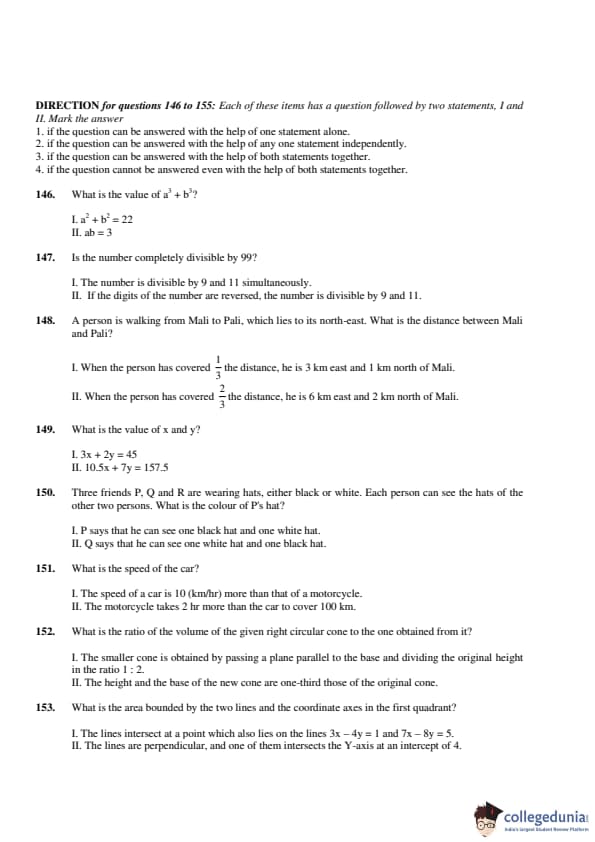
Question 146:

What is the value of \(a^3 + b^3\)?


I. \(a^2 + b^2 = 22\)

II. \(ab = 3\)

  • (a) if the question can be answered with the help of one statement alone.
  • (b) if the question can be answered with the help of any one statement independently.
  • (c) if the question can be answered with the help of both statements together.
  • (d) if the question cannot be answered even with the help of both statements together.
    (c)
Correct Answer:
View Solution
Question 147:

Is the number completely divisible by 99?


I. The number is divisible by 9 and 11 simultaneously.

II. If the digits of the number are reversed, the number is divisible by 9 and 11.

  • (a) if the question can be answered with the help of one statement alone.
  • (b) if the question can be answered with the help of any one statement independently.
  • (c) if the question can be answered with the help of both statements together.
  • (d) if the question cannot be answered even with the help of both statements together.
    (a)
Correct Answer:
View Solution
Question 148:

A person is walking from Mali to Pali, which lies to its north-east. What is the distance between Mali and Pali?


I. When the person has covered \(\frac{1}{3}\) the distance, he is 3 km east and 1 km north of Mali.

II. When the person has covered \(\frac{2}{3}\) the distance, he is 6 km east and 2 km north of Mali.

  • (a) if the question can be answered with the help of one statement alone.
  • (b) if the question can be answered with the help of any one statement independently.
  • (c) if the question can be answered with the help of both statements together.
  • (d) if the question cannot be answered even with the help of both statements together.
    (b)
Correct Answer:
View Solution
Question 149:

What is the value of \(x\) and \(y\)?


I. \(3x + 2y = 45\)

II. \(10.5x + 7y = 157.5\)

  • (a) if the question can be answered with the help of one statement alone.
  • (b) if the question can be answered with the help of any one statement independently.
  • (c) if the question can be answered with the help of both statements together.
  • (d) if the question cannot be answered even with the help of both statements together.
    (c)
Correct Answer:
View Solution
Question 150:

Three friends P, Q, R wear hats either black or white. Each sees the other two hats. What is the colour of P's hat?


I. P says he can see one black hat and one white hat.

II. Q says that he can see one white hat and one black hat.

  • (a) if the question can be answered with the help of one statement alone.
  • (b) if the question can be answered with the help of any one statement independently.
  • (c) if the question can be answered with the help of both statements together.
  • (d) if the question cannot be answered even with the help of both statements together.
    (d)
Correct Answer:
View Solution
Question 151:

What is the speed of the car?

I. The speed of a car is 10 km/hr more than that of a motorcycle.

II. The motorcycle takes 2 hr more than the car to cover 100 km.

  • (a) if the question can be answered with the help of one statement alone.
  • (b) if the question can be answered with the help of any one statement independently.
  • (c) if the question can be answered with the help of both statements together.
  • (d) if the question cannot be answered even with the help of both statements together.
    (c)
Correct Answer:
View Solution
Question 152:

What is the ratio of the volume of the given right circular cone to the one obtained from it?


I. The smaller cone is obtained by passing a plane parallel to the base and dividing the original height in the ratio 1:2.

II. The height and base of the new cone are one-third those of the original cone.

  • (a) if the question can be answered with the help of one statement alone.
  • (b) if the question can be answered with the help of any one statement independently.
  • (c) if the question can be answered with the help of both statements together.
  • (d) if the question cannot be answered even with the help of both statements together.
    (b)
Correct Answer:
View Solution
Question 153:
What is the area bounded by the two lines and the coordinate axes in the first quadrant?


I. The lines intersect at a point which also lies on \(3x - 4y = 1\) and \(7x - 8y = 5\).

II. The lines are perpendicular, and one of them intersects the Y-axis at an intercept of 4.

  • (a) if the question can be answered with the help of one statement alone.
  • (b) if the question can be answered with the help of any one statement independently.
  • (c) if the question can be answered with the help of both statements together.
  • (d) if the question cannot be answered even with the help of both statements together.
    (c)
Correct Answer:
View Solution

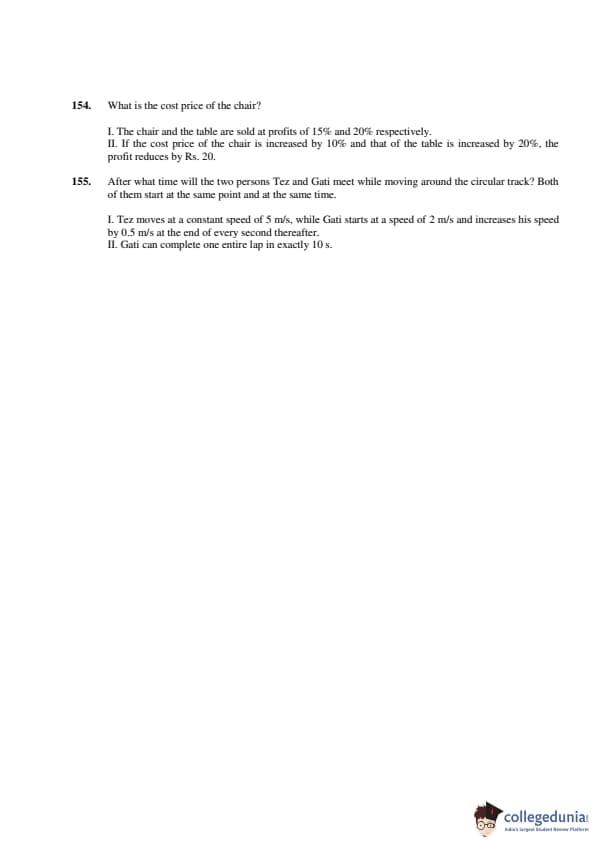
Question 154:

What is the cost price of the chair?


I. The chair and the table are sold at profits of 15% and 20% respectively.

II. If the cost price of the chair is increased by 10% and that of the table by 20%, the profit reduces by Rs.\ 20.

  • (a) if the question can be answered with the help of one statement alone.
  • (b) if the question can be answered with the help of any one statement independently.
  • (c) if the question can be answered with the help of both statements together.
  • (d) if the question cannot be answered even with the help of both statements together.
    (d)
Correct Answer:
View Solution

Question 155:

After what time will Tez and Gati meet while moving around the circular track? Both start at the same point and at the same time.


I. Tez moves at 5 m/s constant speed; Gati starts at 2 m/s and increases speed by 0.5 m/s every second thereafter.

II. Gati can complete one entire lap in exactly 10 s.

  • (a) if the question can be answered with the help of one statement alone.
  • (b) if the question can be answered with the help of any one statement independently.
  • (c) if the question can be answered with the help of both statements together.
  • (d) if the question cannot be answered even with the help of both statements together.
    (c)
Correct Answer:
View Solution

Question 156:

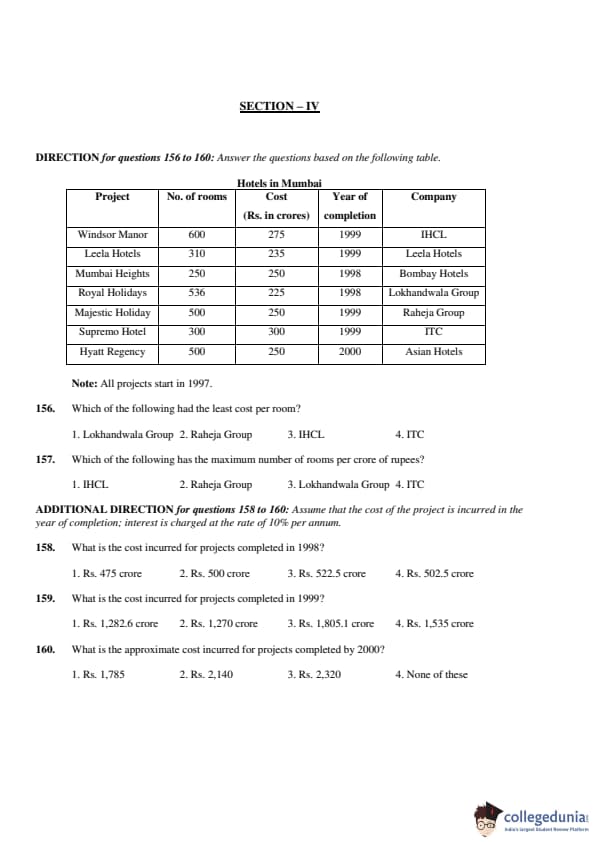
Which of the following had the least cost per room?

  • (a) Lokhandwala Group
  • (b) Raheja Group
  • (c) IHCL
  • (d) ITC
    (a) Lokhandwala Group
Correct Answer:
View Solution

Question 157:

Which of the following has the maximum number of rooms per crore of rupees?

  • (a) IHCL
  • (b) Raheja Group
  • (c) Lokhandwala Group
  • (d) ITC
    (c) Lokhandwala Group
Correct Answer:
View Solution

Question 158:

What is the cost incurred for projects completed in 1998?

  • (a) Rs. 475 crore
  • (b) Rs. 500 crore
  • (c) Rs. 522.5 crore
  • (d) Rs. 502.5 crore
    (c) Rs. 522.5 crore
Correct Answer:
View Solution

Question 159:

What is the cost incurred for projects completed in 1999?

  • (a) Rs. 1,282.6 crore
  • (b) Rs. 1,270 crore
  • (c) Rs. 1,805.1 crore
  • (d) Rs. 1,535 crore
    (a) Rs. 1,282.6 crore
Correct Answer:
View Solution

Question 160:

What is the approximate cost incurred for projects completed by 2000?

  • (a) Rs. 1,785
  • (b) Rs. 2,140
  • (c) Rs. 2,320
  • (d) None of these
    (b) Rs. 2,140
Correct Answer:
View Solution

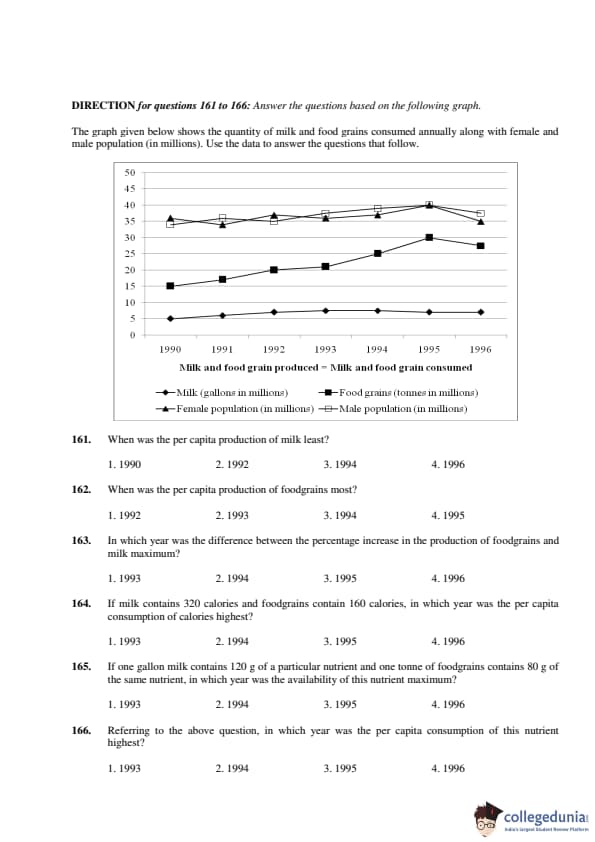
Question 161:

When was the per capita production of milk least?

  • (a) 1990
  • (b) 1992
  • (c) 1994
  • (d) 1996
    (b) 1992
Correct Answer:
View Solution

Question 162:

When was the per capita production of food grains most?

  • (a) 1992
  • (b) 1993
  • (c) 1994
  • (d) 1995
    (c) 1994
Correct Answer:
View Solution

Question 163:

In which year was the difference between the percentage increase in the production of food grains and milk maximum?

  • (a) 1993
  • (b) 1994
  • (c) 1995
  • (d) 1996
    (c) 1995
Correct Answer:
View Solution

Question 164:

If milk contains 320 calories and food grains contain 160 calories, in which year was the per capita consumption of calories highest?

  • (a) 1993
  • (b) 1994
  • (c) 1995
  • (d) 1996
    (b) 1994
Correct Answer:
View Solution

Question 165:

If one gallon milk contains 120 g nutrient and one tonne food grains contains 80 g nutrient, in which year was the availability of this nutrient maximum?

  • (a) 1993
  • (b) 1994
  • (c) 1995
  • (d) 1996
    (b) 1994
Correct Answer:
View Solution

Question 166:

Referring to the above question, in which year was the per capita consumption of this nutrient highest?

  • (a) 1993
  • (b) 1994
  • (c) 1995
  • (d) 1996
    (b) 1994
Correct Answer:
View Solution

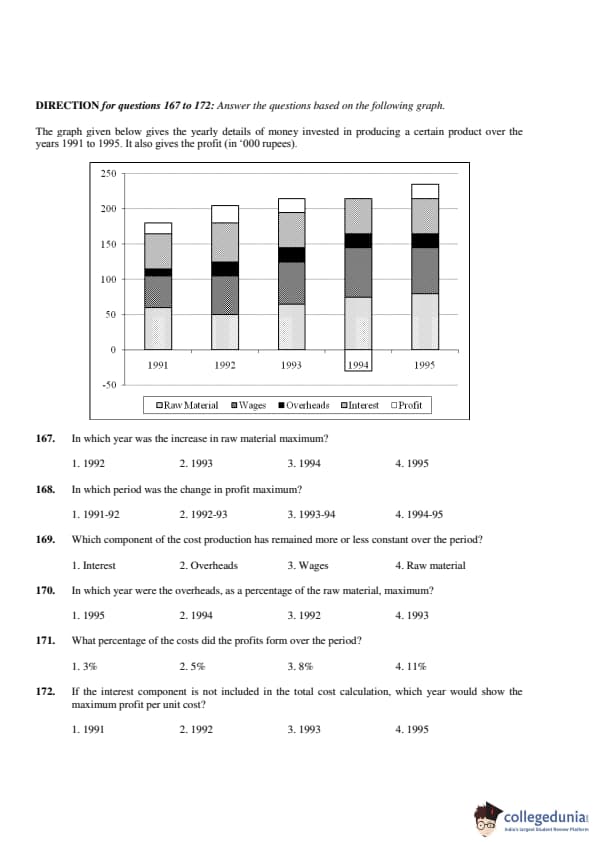
Question 167:

In which year was the increase in raw material maximum?

  • (a) 1992
  • (b) 1993
  • (c) 1994
  • (d) 1995
    (c) 1994
Correct Answer:
View Solution

Question 168:

In which period was the change in profit maximum?

  • (a) 1991-92
  • (b) 1992-93
  • (c) 1993-94
  • (d) 1994-95
    (c) 1993-94
Correct Answer:
View Solution

Question 169:

Which component of the cost production has remained more or less constant over the period?

  • (a) Interest
  • (b) Overheads
  • (c) Wages
  • (d) Raw material
    (a) Interest
Correct Answer:
View Solution

Question 170:

In which year were the overheads, as a percentage of the raw material, maximum?

  • (a) 1995
  • (b) 1994
  • (c) 1992
  • (d) 1993
    (c) 1992
Correct Answer:
View Solution

Question 171:

What percentage of the costs did the profits form over the period?

  • (a) 3%
  • (b) 5%
  • (c) 8%
  • (d) 11%
    (b) 5%
Correct Answer:
View Solution

Question 172:

If the interest component is not included in the total cost calculation, which year would show the maximum profit per unit cost?

  • (a) 1991
  • (b) 1992
  • (c) 1993
  • (d) 1995
    (d) 1995
Correct Answer:
View Solution

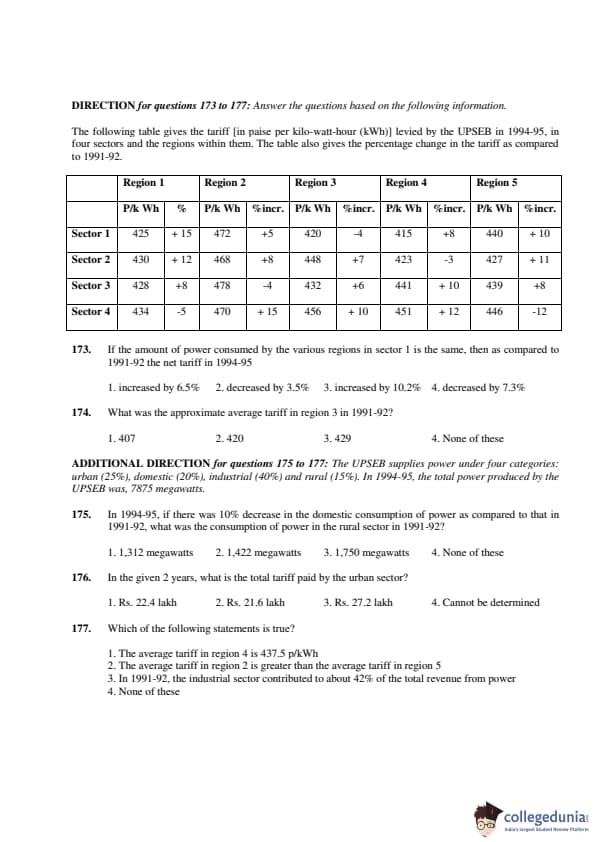
Question 173:

If the amount of power consumed by the various regions in sector 1 is the same, then as compared to 1991-92 the net tariff in 1994-95 was:

  • (a) increased by 6.5%
  • (b) decreased by 3.5%
  • (c) increased by 10.2%
  • (d) decreased by 7.3%
    (a)
Correct Answer:
View Solution

Question 174:

What was the approximate average tariff in region 3 in 1991-92?

  • (a) 407
  • (b) 420
  • (c) 429
  • (d) None of these
    (b)
Correct Answer:
View Solution

Question 175:

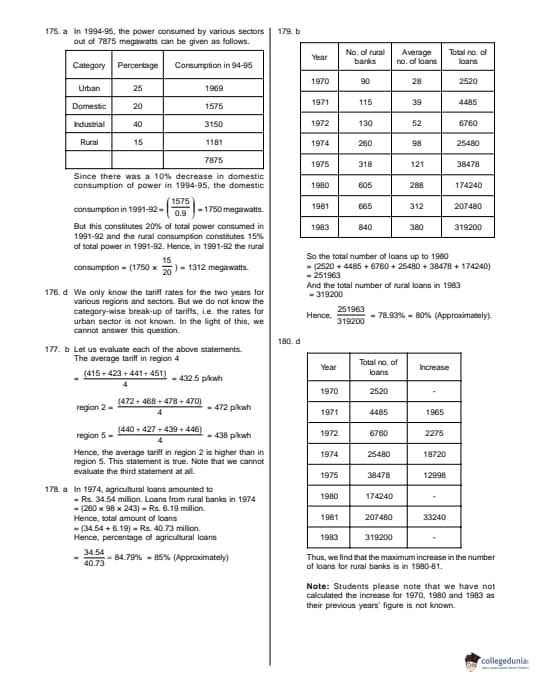
In 1994-95, if there was 10% decrease in the domestic consumption of power as compared to that in 1991-92, what was the consumption of power in the rural sector in 1991-92?

  • (a) 1,312 megawatts
  • (b) 1,422 megawatts
  • (c) 1,750 megawatts
  • (d) None of these
    (b)
Correct Answer:
View Solution

Question 176:

In the given two years, what is the total tariff paid by the urban sector?

  • (a) Rs. 22.4 lakh
  • (b) Rs. 21.6 lakh
  • (c) Rs. 27.2 lakh
  • (d) Cannot be determined
    (b)
Correct Answer:
View Solution

Question 177:

Which of the following statements is true?

  • (a) The average tariff in region 4 is 437.5 p/kWh
  • (b) The average tariff in region 2 is greater than the average tariff in region 5
  • (c) In 1991-92, the industrial sector contributed to about 42% of the total revenue from power
  • (d) None of these
    (c)
Correct Answer:
View Solution

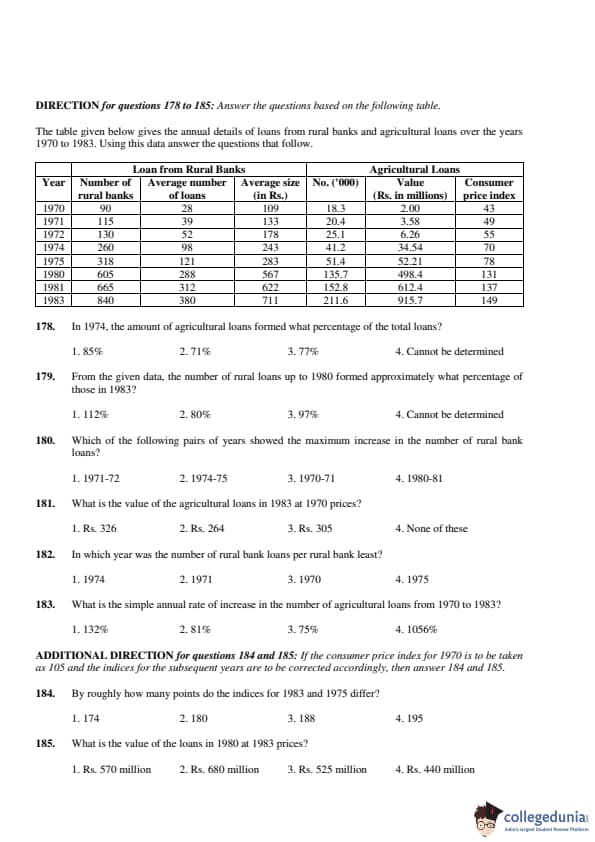
Question 178:

In 1974, the amount of agricultural loans formed what percentage of the total loans?

  • (a) 85%
  • (b) 71%
  • (c) 77%
  • (d) Cannot be determined
    (b)
Correct Answer:
View Solution

Question 179:

From the given data, the number of rural loans up to 1980 formed approximately what percentage of those in 1983?

  • (a) 112%
  • (b) 80%
  • (c) 97%
  • (d) Cannot be determined
    (b)
Correct Answer:
View Solution

Question 180:

Which of the following pairs of years showed the maximum increase in the number of rural bank loans?

  • (a) 1971-72
  • (b) 1974-75
  • (c) 1970-71
  • (d) 1980-81
    (d)
Correct Answer:
View Solution

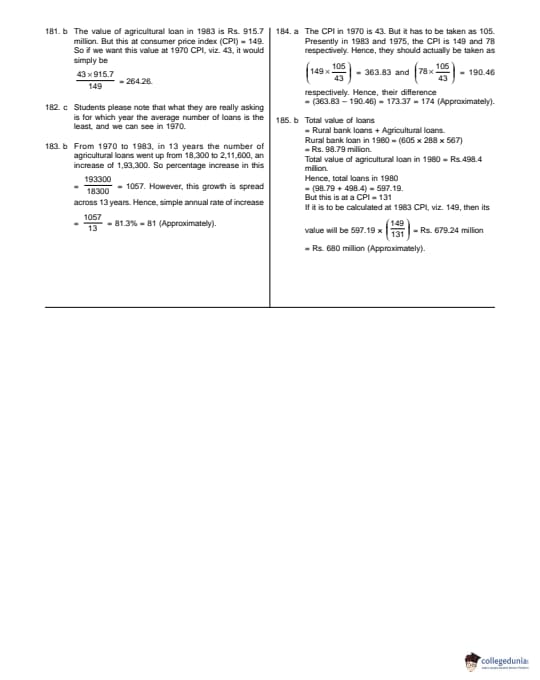
Question 181:

What is the value of the agricultural loans in 1983 at 1970 prices?

  • (a) Rs.\ 326
  • (b) Rs.\ 264
  • (c) Rs.\ 305
  • (d) None of these
    (b)
Correct Answer:
View Solution

Question 182:

In which year was the number of rural bank loans per rural bank least?

  • (a) 1974
  • (b) 1971
  • (c) 1970
  • (d) 1975
    (c)
Correct Answer:
View Solution

Question 183:

What is the simple annual rate of increase in the number of agricultural loans from 1970 to 1983?

  • (a) 132%
  • (b) 81%
  • (c) 75%
  • (d) 105%
    (b)
Correct Answer:
View Solution

Question 184:

By roughly how many points do the indices for 1983 and 1975 differ (CPI for 1970 taken as 105 and adjusted accordingly)?

  • (a) 174
  • (b) 180
  • (c) 188
  • (d) 195
    (c)
Correct Answer:
View Solution

Question 185:

What is the value of the loans in 1980 at 1983 prices?

  • (a) Rs.\ 570 million
  • (b) Rs.\ 680 million
  • (c) Rs.\ 525 million
  • (d) Rs.\ 440 million
    (b)
Correct Answer:
View Solution


Also Check:

CAT 1997 Paper Analysis

The below-mentioned table is showing the details of the question paper of CAT 1997

CAT 1997 Question Paper Pattern
Verbal Ability 50
Reading Comprehension 50
Problem Solving 45
Data Interpretation 40
Total 185

CAT Previous Year Question Papers

Candidates aspiring to appear for the upcoming CAT exam must solve CAT previous year question papers for enhanced preparation.

Other MBA Exam Question Papers