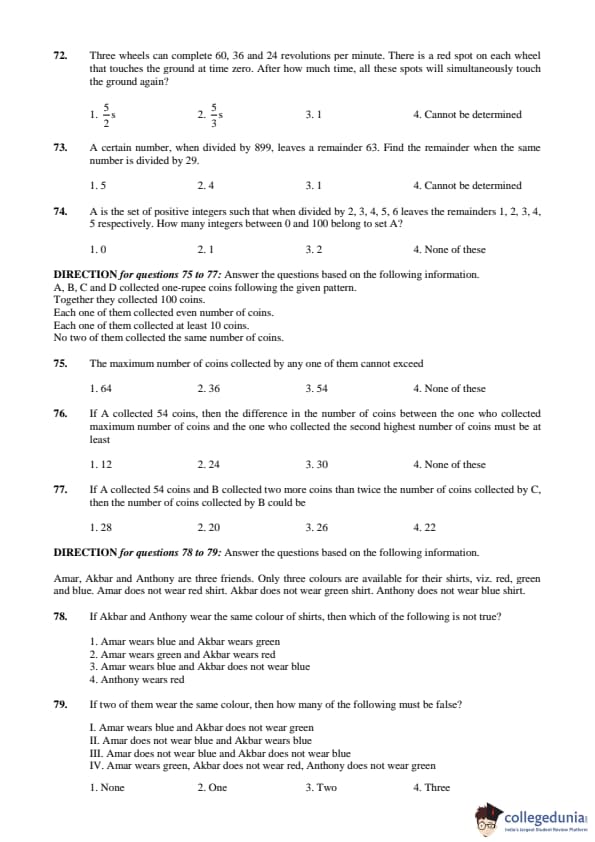
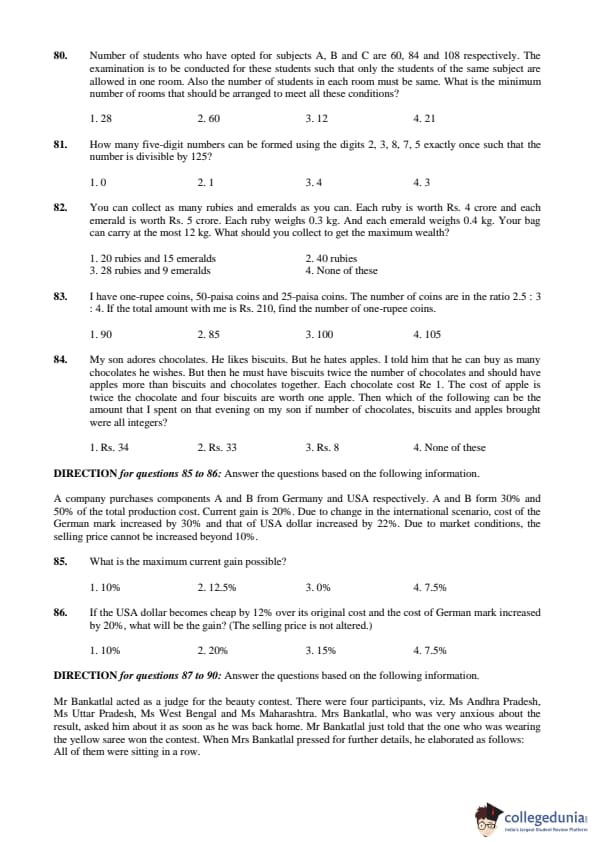
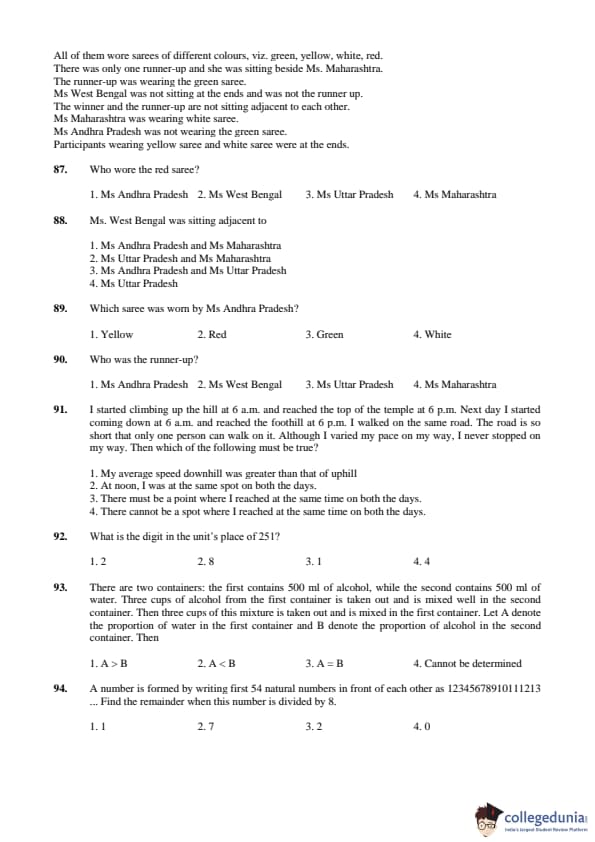
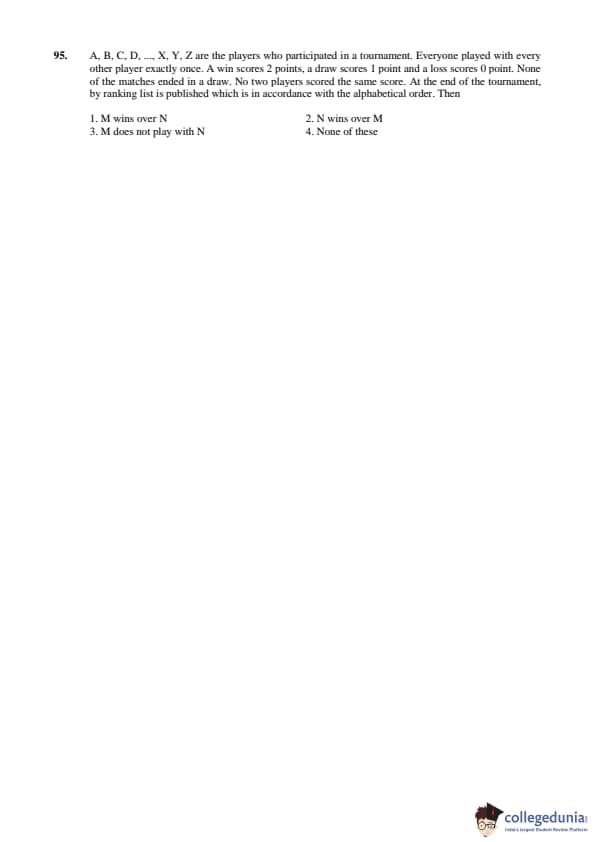
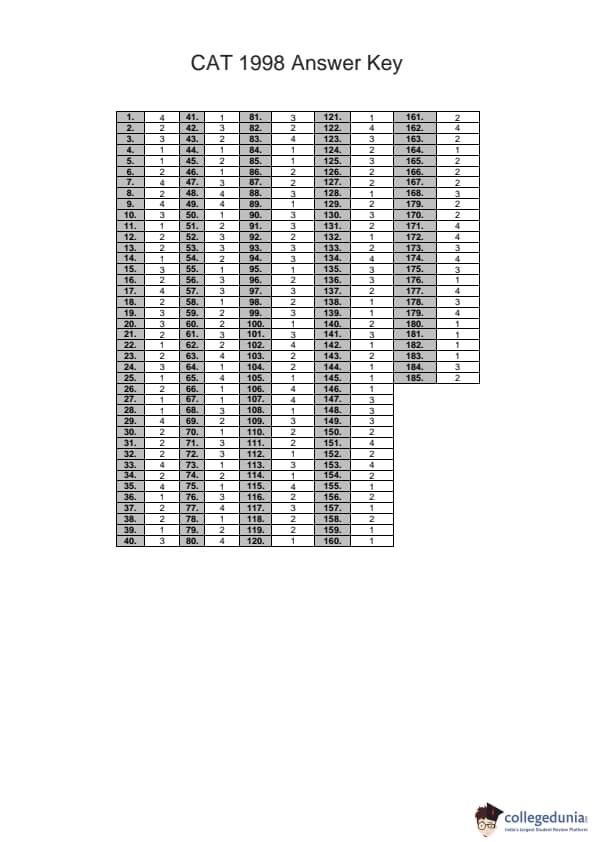
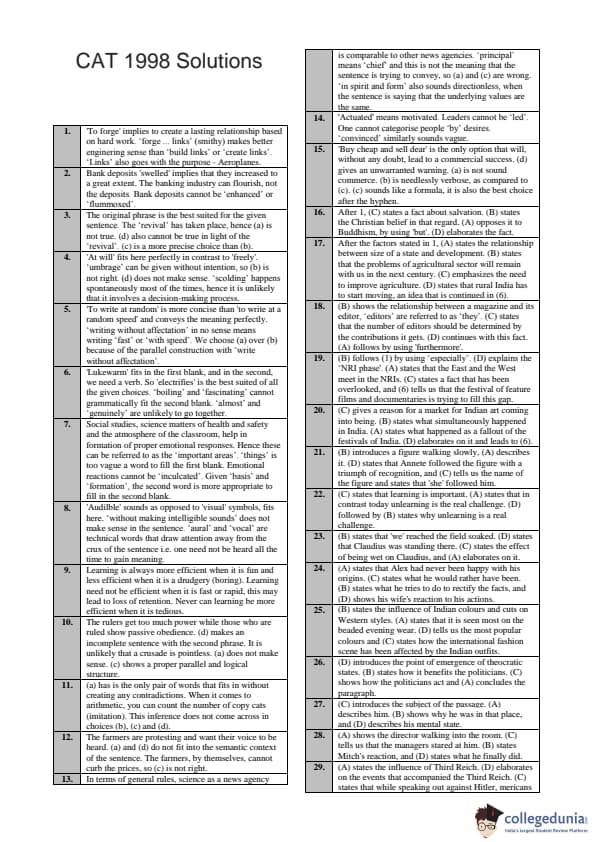
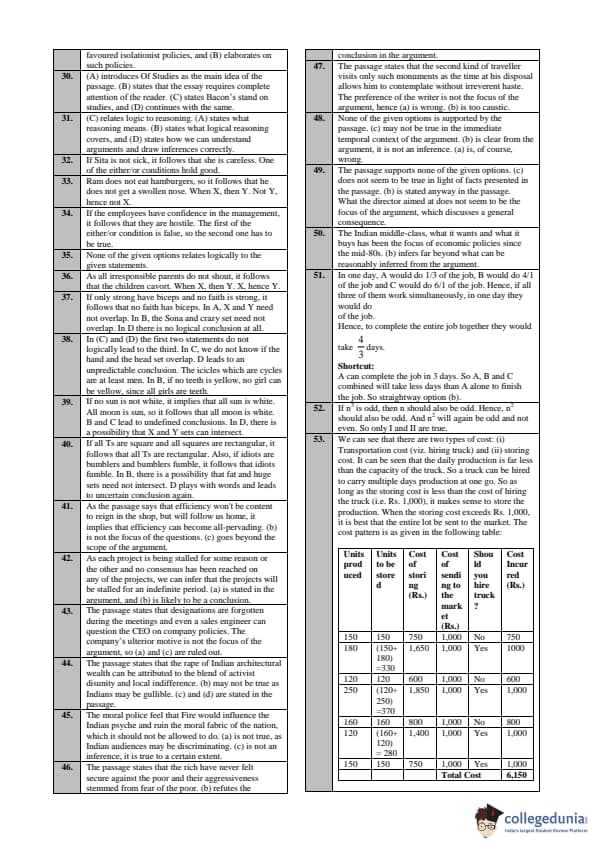
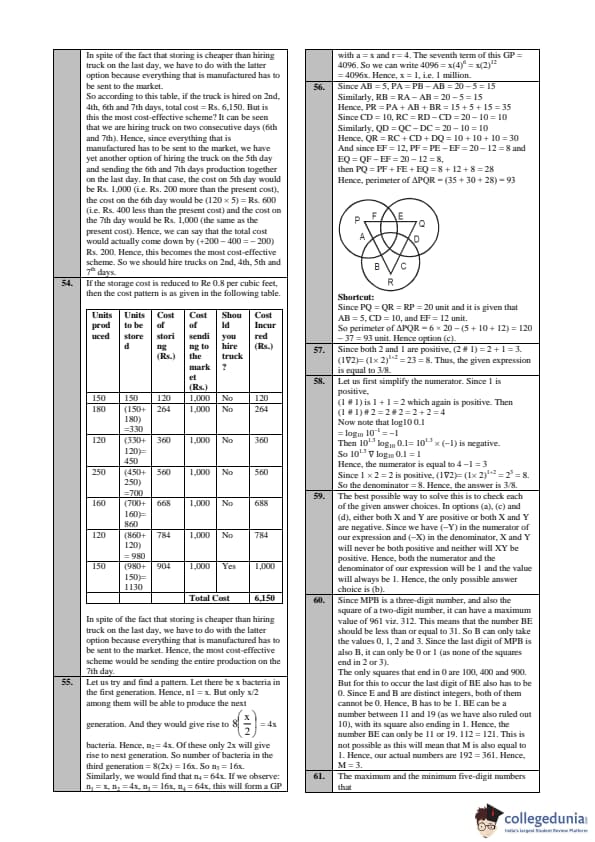
CAT 1998 Question Paper with Answer Key PDF is available for download. CAT 1998 Question Paper carried 185 questions in total. The overall exam pattern was the same as CAT 1997. The questions were divided into 4 sections- Verbal Ability, Reading Comprehension, Data Interpretation, and Problem Solving/Quantitative Ability. There was no sectional time limit in CAT 1998 question paper and a total of 120 minutes were allotted to solve the 185 questions.
 

Candidates preparing for CAT 2025 can download the CAT 1998 question paper with the solution PDF to get a better idea about the type of questions asked in the paper and their difficulty level

Also Check:

CAT 1998 Question Paper with Answer Key PDFs

CAT 1998 Question Paper with Answer Key Download PDF Check Solutions

CAT 1998 Question paper with solutions

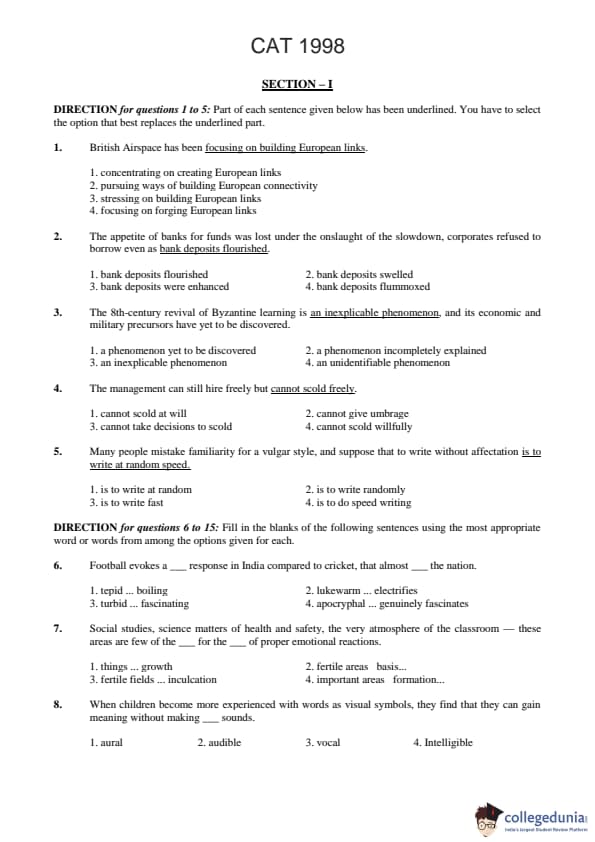
Question 1:

British Airspace has been focusing on building European links.

  • (A) concentrating on creating European links
  • (B) pursuing ways of building European connectivity
  • (C) stressing on building European links
  • (D) focusing on forging European links
Correct Answer: (D) focusing on forging European links
View Solution

Question 2:

The appetite of banks for funds was lost under the onslaught of the slowdown, corporates refused to borrow even as bank deposits flourished.

  • (A) bank deposits flourished
  • (B) bank deposits swelled
  • (C) bank deposits were enhanced
  • (D) bank deposits flummoxed
Correct Answer: (B) bank deposits swelled
View Solution

Question 3:

The 8th-century revival of Byzantine learning is an inexplicable phenomenon, and its economic and military precursors have yet to be discovered.

  • (A) a phenomenon yet to be discovered
  • (B) a phenomenon incompletely explained
  • (C) an inexplicable phenomenon
  • (D) an unidentifiable phenomenon
Correct Answer: (C) an inexplicable phenomenon
View Solution

Question 4:

The management can still hire freely but cannot scold freely.

  • (A) cannot scold at will
  • (B) cannot give umbrage
  • (C) cannot take decisions to scold
  • (D) cannot scold willfully
Correct Answer: (A) cannot scold at will
View Solution

Question 5:

Many people mistake familiarity for a vulgar style, and suppose that to write without affectation is to write at random speed.

  • (A) is to write at random
  • (B) is to write randomly
  • (C) is to write fast
  • (D) is to do speed writing
Correct Answer: (B) is to write randomly
View Solution

Question 6:

Football evokes a _______ response in India compared to cricket, that almost _______ the nation.

  • (A) tepid ... boiling
  • (B) lukewarm ... electrifies
  • (C) turbid ... fascinating
  • (D) apocryphal ... genuinely fascinates
Correct Answer: (B) lukewarm ... electrifies
View Solution

Question 7:

Social studies, science matters of health and safety, the very atmosphere of the classroom — these areas are few of the _______ for the _______ of proper emotional reactions.

  • (A) things ... growth
  • (B) fertile fields ... basis
  • (C) fertile areas ... inculcation
  • (D) important areas ... formation
Correct Answer: (B) fertile fields ... basis
View Solution

Question 8:

When children become more experienced with words as visual symbols, they find that they can gain meaning without making _______ sounds.

  • (A) aural
  • (B) audible
  • (C) vocal
  • (D) intelligible
Correct Answer: (B) audible
View Solution

Question 9:

Learning is more efficient when it is _______ . It is less efficient when it is _______ .

  • (A) fast ... slow
  • (B) rapid ... turtle-slow
  • (C) tedious ... like a joy ride
  • (D) fun ... drudgery
Correct Answer: (D) fun ... drudgery
View Solution

Question 10:

To a greater or lesser degree all the civilized countries of the world are made up of a small class of rulers _______ of a large class of subjects _______ .

  • (A) formed by a small minority ... who are uncivilized
  • (B) powerfully corrupt ... pointless crusaders
  • (C) corrupted by too much power ... corrupted by too much passive obedience
  • (D) who are ruled ... who ruled
Correct Answer: (C) corrupted by too much power ... corrupted by too much passive obedience
View Solution

Question 11:

Simple arithmetic tells us that there is more _______ than _______ .

  • (A) imitation ... innovation
  • (B) impracticality ... knowledge
  • (C) improvisation ... improvement
  • (D) improbability ... probability
Correct Answer: (A) imitation ... innovation
View Solution

Question 12:

As a step towards protesting against the spiralling prices, the farmers have decided to stage a picket in an effort to _______ .

  • (A) show their virility
  • (B) make themselves heard
  • (C) curb the prices
  • (D) topple the government
Correct Answer: (B) make themselves heard
View Solution

Question 13:

Science is a sort of news agency comparable _______ to other news agencies.

  • (A) principally
  • (B) in principle
  • (C) in principal
  • (D) in spirit and form
Correct Answer: (B) in principle
View Solution

Question 14:

Most political leaders acquire their position by causing a large number of people to believe that these leaders are _______ by altruistic desires.

  • (A) actuated
  • (B) convinced
  • (C) categorized
  • (D) led
Correct Answer: (A) actuated
View Solution

Question 15:

Everyone will admit that swindling one's fellow beings is a necessary practice; upon it is based the really sound commercial success formula — _______ .

  • (A) sell what you cannot buy back
  • (B) buy what you will sell to another at a higher price
  • (C) sell what you can, do not buy from a competitor
  • (D) buy cheap and sell dear
Correct Answer: (D) buy cheap and sell dear
View Solution

Question 16:

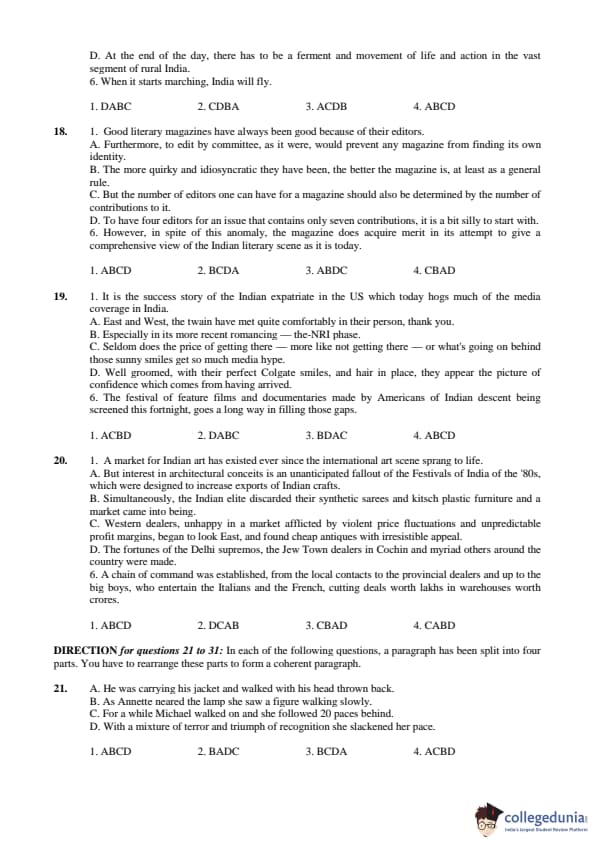
Arrange sentences A, B, C and D between sentences 1 and 6 to form a logical sequence of six sentences.

(1)Buddhism is a way to salvation.

(A) But Buddhism is more severely analytical.

(B) In the Christian tradition there is also a concern for the fate of human society conceived as a whole, rather than merely as a sum or network of individuals.

(C) Salvation is a property, or achievement of individuals.

(D) Not only does it dissolve society into individuals, the individual in turn is dissolved into component parts and instants, a stream of events.

(6) In modern terminology, Buddhist doctrine is reductionist.

  • (A) ABDC
  • (B) CBAD
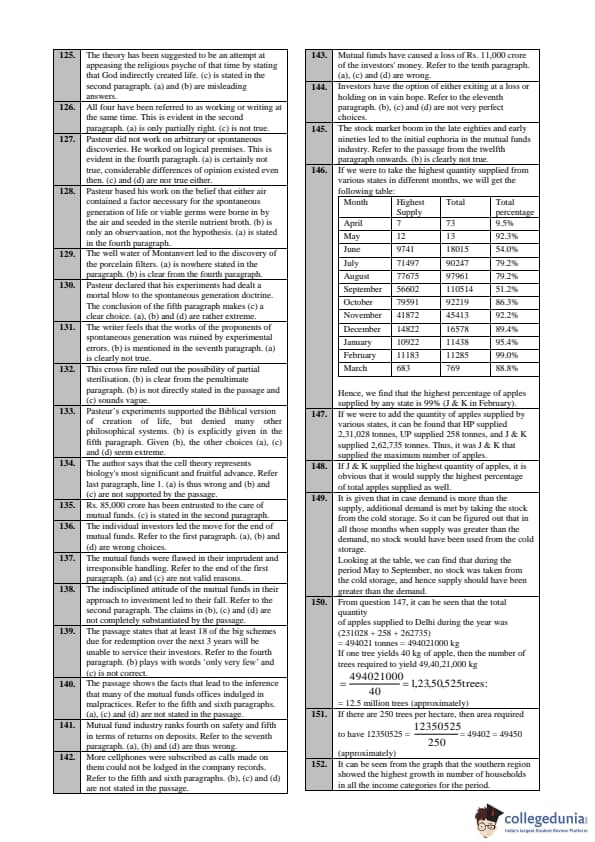
  • (C) BDAC
  • (D) ABCD
Correct Answer: (B) CBAD
View Solution

Question 17:

Arrange sentences A, B, C and D between sentences 1 and 6 to form a logical sequence of six sentences.


(A) It also appears that there is a direct relationship between the size of a state and development.

(B) The issues of Indian development, and the problem of India's agricultural sector, will remain with us long into the next century.

(C) Without improving Indian agriculture, no liberalisation and delicensing will be able to help India.

(D) At the end of the day, there has to be a ferment and movement of life and action in the vast segment of rural India.

(6) When it starts marching, India will fly.

  • (A) DABC
  • (B) CDBA
  • (C) ACDB
  • (D) ABCD
Correct Answer: (D) ABCD
View Solution

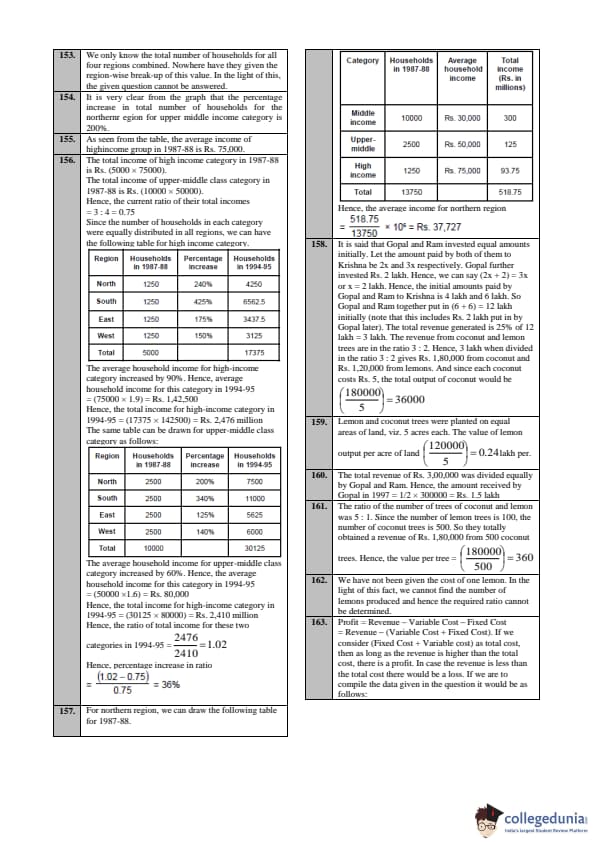
Question 18:

Arrange sentences A, B, C and D between sentences 1 and 6 to form a logical sequence of six sentences.


(1) Good literary magazines have always been good because of their editors.

(A) Furthermore, to edit by committee, as it were, would prevent any magazine from finding its own identity.

(B) The more quirky and idiosyncratic they have been, the better the magazine is, at least as a general rule.

(C) But the number of editors one can have for a magazine should also be determined by the number of contributions to it.

(D) To have four editors for an issue that contains only seven contributions, it is a bit silly to start with.

(6) However, in spite of this anomaly, the magazine does acquire merit in its attempt to give a comprehensive view of the Indian literary scene as it is today.

  • (A) ABCD
  • (B) BCDA
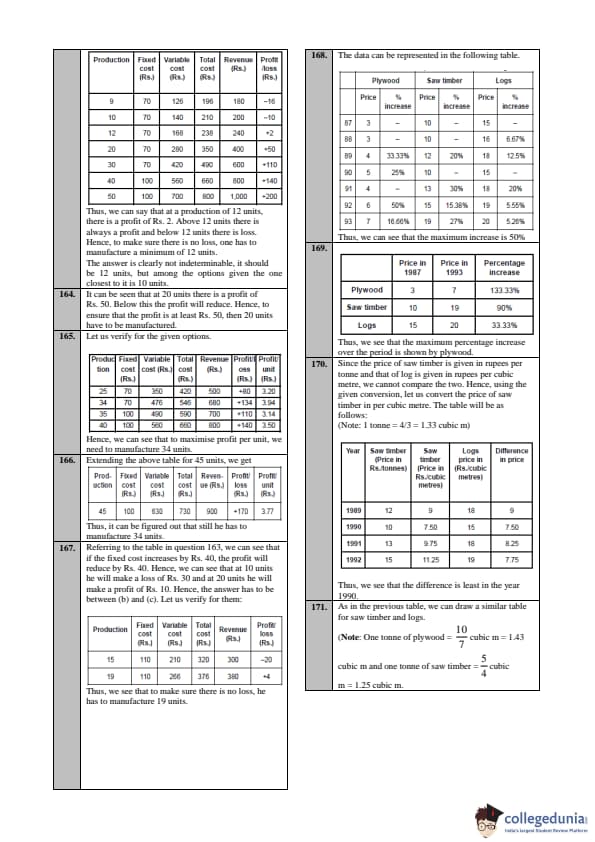
  • (C) ABCD
  • (D) CBAD
Correct Answer: (B) BCDA
View Solution

Question 19:

Arrange sentences A, B, C, and D between sentences 1 and 6 to form a logical sequence of six sentences.


(1) It is the success story of the Indian expatriate in the US which today hogs much of the media coverage in India.

(A) East and West, the twain have met quite comfortably in their person, thank you.

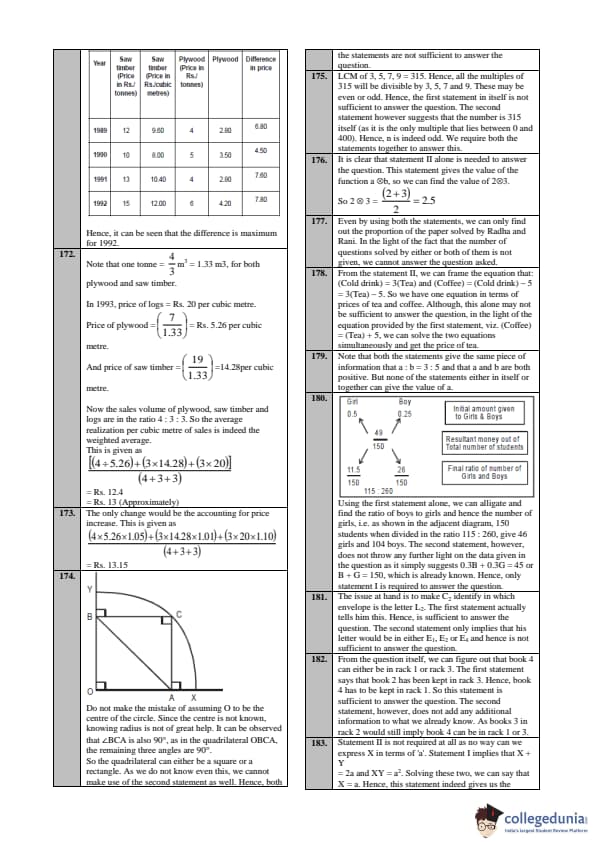
(B) Especially in its more recent romancing — the NRI phase.

(C) Seldom does the price of getting there — more like not getting there — or what’s going on behind those sunny smiles get so much media hype.

(D) Well groomed, with their perfect Colgate smiles, and hair in place, they appear the picture of confidence which comes from having arrived.

(6) The festival of feature films and documentaries made by Americans of Indian descent being screened this fortnight, goes a long way in filling those gaps.

  • (A) ACBD
  • (B) DABC
  • (C) BDAC
  • (D) ABCD
Correct Answer: (C) BDAC
View Solution

Question 20:

Arrange sentences A, B, C, and D between sentences 1 and 6 to form a logical sequence of six sentences.


(1) A market for Indian art has existed ever since the international art scene sprang to life.

(A) But interest in architectural conceits is an unanticipated fallout of the Festivals of India of the '80s, which were designed to increase exports of Indian crafts.

(B) Simultaneously, the Indian elite discarded their synthetic sarees and kitsch plastic furniture and a market came into being.

(C) Western dealers, unhappy in a market afflicted by violent price fluctuations and unpredictable profit margins, began to look East, and found cheap antiques with irresistible appeal.

(D) The fortunes of the Delhi supremos, the Jew Town dealers in Cochin and myriad others around the country were made.

(6) A chain of command was established, from the local contacts to the provincial dealers and up to the big boys, who entertain the Italians and the French, cutting deals worth lakhs in warehouses worth crores.

  • (A) ABCD
  • (B) DCAB
  • (C) CBAD
  • (D) CABD
Correct Answer: (C) CBAD
View Solution

Question 21:

In the following question, a paragraph has been split into four parts. Rearrange these parts to form a coherent paragraph.


(A) He was carrying his jacket and walked with his head thrown back.

(B) As Annette neared the lamp she saw a figure walking slowly.

(C) For a while Michael walked on and she followed 20 paces behind.

(D) With a mixture of terror and triumph of recognition she slackened her pace.

  • (A) ABCD
  • (B) BADC
  • (C) BCDA
  • (D) ACBD
Correct Answer: () BADC
View Solution

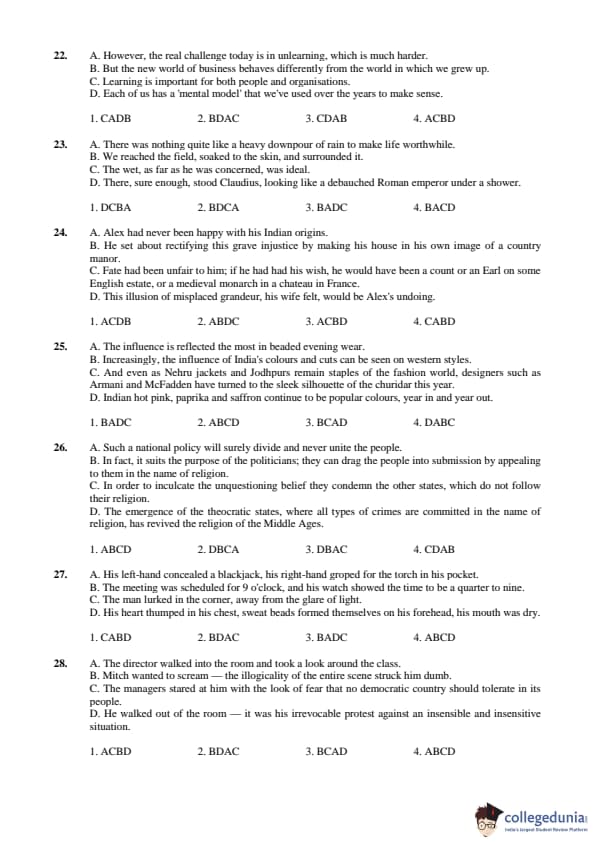
Question 22:

Arrange sentences A, B, C, and D to form a coherent paragraph.


(1) However, the real challenge today is in unlearning, which is much harder.

(A) But the new world of business behaves differently from the world in which we grew up.

(B) Learning is important for both people and organisations.

(C) Each of us has a 'mental model' that we've used over the years to make sense.

(6) In modern terminology, Buddhist doctrine is reductionist.

  • (A) CADB
  • (B) BDAC
  • (C) CDAB
  • (D) ACBD
Correct Answer: (A) CADB
View Solution

Question 23:

Arrange sentences A, B, C, and D to form a coherent paragraph.


(1) There was nothing quite like a heavy downpour of rain to make life worthwhile.

(A) We reached the field, soaked to the skin, and surrounded it.

(B) The wet, as far as he was concerned, was ideal.

(C) For a while Michael walked on and she followed 20 paces behind.

(6) There, sure enough, stood Claudius, looking like a debauched Roman emperor under a shower.

  • (A) DCBA
  • (B) BDCA
  • (C) BCDA
  • (D) ACBD
Correct Answer: (B) DCBA
View Solution

Question 24:

Arrange sentences A, B, C, and D to form a coherent paragraph.


(1) Alex had never been happy with his Indian origins.

(A) He set about rectifying this grave injustice by making his house in his own image of a country manor.

(B) Fate had been unfair to him; if he had had his wish, he would have been a count or an Earl on some English estate, or a medieval monarch in a chateau in France.

(C) This illusion of misplaced grandeur, his wife felt, would be Alex's undoing.

(6) Alex thought of himself as a lord, living in his grand home, untouched by the world.

  • (A) ACDB
  • (B) ABDC
  • (C) ACBD
  • (D) CABD
Correct Answer: (C) ACBD
View Solution

Question 25:

Arrange sentences A, B, C, and D to form a coherent paragraph.


(1) The influence is reflected the most in beaded evening wear.

(A) Increasingly, the influence of India's colours and cuts can be seen on western styles.

(B) And even as Nehru jackets and Jodhpurs remain staples of the fashion world, designers such as Armani and McFadden have turned to the sleek silhouette of the churidar this year.

(C) Indian hot pink, paprika and saffron continue to be popular colours, year in and year out.

  • (A) BADC
  • (B) ABCD
  • (C) BCAD
  • (D) DABC
Correct Answer: (A) BADC
View Solution

Question 26:

Arrange sentences A, B, C, and D to form a coherent paragraph.


(1) Such a national policy will surely divide and never unite the people.

(A) In fact, it suits the purpose of the politicians; they can drag the people into submission by appealing to them in the name of religion.

(B) In order to inculcate the unquestioning belief they condemn the other states, which do not follow their religion.

(C) The emergence of the theocratic states, where all types of crimes are committed in the name of religion, has revived the religion of the Middle Ages.

  • (A) ABCD
  • (B) DBCA
  • (C) DBAC
  • (D) CDAB
Correct Answer: (B) DBCA
View Solution

Question 27:

Arrange sentences A, B, C, and D to form a coherent paragraph.


(1) His left hand concealed a blackjack, his right-hand groped for the torch in his pocket.

(A) The meeting was scheduled for 9 o'clock, and his watch showed the time to be a quarter to nine.

(B) The man lurked in the corner, away from the glare of light.

(C) His heart thumped in his chest, sweat beads formed themselves on his forehead, his mouth was dry.

  • (A) CABD
  • (B) BDAC
  • (C) BADC
  • (D) ABCD
Correct Answer: (A) CABD
View Solution

Question 28:

Arrange sentences A, B, C, and D to form a coherent paragraph.


(1) The director walked into the room and took a look around the class.

(A) Mitch wanted to scream — the illogicality of the entire scene struck him dumb.

(B) The managers stared at him with the look of fear that no democratic country should tolerate in its people.

(C) He walked out of the room — it was his irrevocable protest against an insensible and insensitive situation.

  • (A) ACBD
  • (B) BDAC
  • (C) BCAD
  • (D) ABCD
Correct Answer: (D) ABCD
View Solution

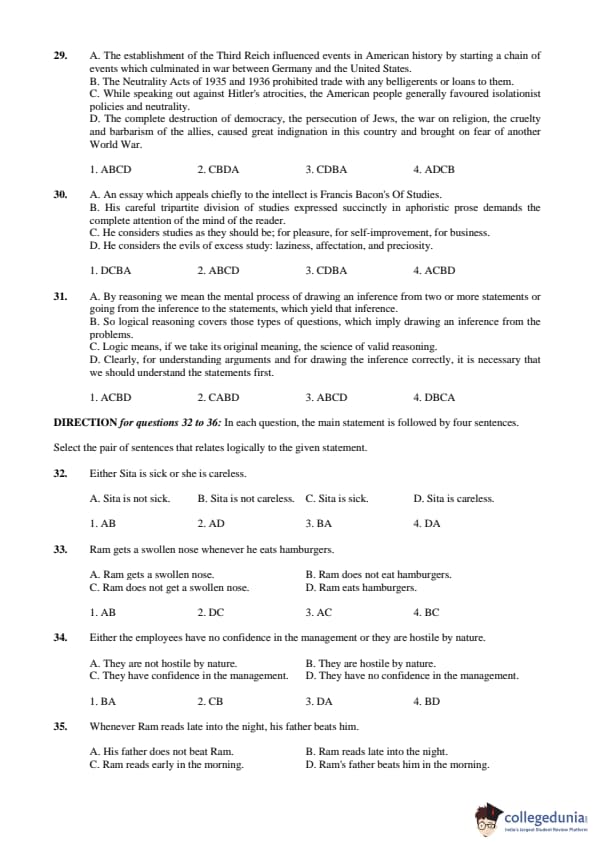
Question 29:

Arrange sentences A, B, C, and D to form a coherent paragraph.


(1) The establishment of the Third Reich influenced events in American history by starting a chain of events which culminated in war between Germany and the United States.

(A) The Neutrality Acts of 1935 and 1936 prohibited trade with any belligerents or loans to them.

(B) While speaking out against Hitler's atrocities, the American people generally favoured isolationist policies and neutrality.

(C) The complete destruction of democracy, the persecution of Jews, the war on religion, the cruelty and barbarism of the allies, caused great indignation in this country and brought on fear of another World War.

  • (A) ABCD
  • (B) CBDA
  • (C) CDBA
  • (D) ADCB
Correct Answer: (D) ADCB
View Solution

Question 30:

Arrange sentences A, B, C, and D to form a coherent paragraph.


(1) An essay which appeals chiefly to the intellect is Francis Bacon's Of Studies.

(A) His careful tripartite division of studies expressed succinctly in aphoristic prose demands the complete attention of the mind of the reader.

(B) He considers studies as they should be; for pleasure, for self-improvement, for business.

(C) He considers the evils of excess study: laziness, affectation, and preciosity.

  • (A) DCBA
  • (B) ABCD
  • (C) CDBA
  • (D) ACBD
Correct Answer: (B) ABCD
View Solution

Question 31:

Arrange sentences A, B, C, and D to form a coherent paragraph.


(1) By reasoning we mean the mental process of drawing an inference from two or more statements or going from the inference to the statements, which yield that inference.

(A) So logical reasoning covers those types of questions, which imply drawing an inference from the problems.

(B) Logic means, if we take its original meaning, the science of valid reasoning.

(C) Clearly, for understanding arguments and for drawing the inference correctly, it is necessary that we should understand the statements first.

  • (A) ACBD
  • (B) CABD
  • (C) ABCD
  • (D) DBCA
Correct Answer: (B) CABD
View Solution

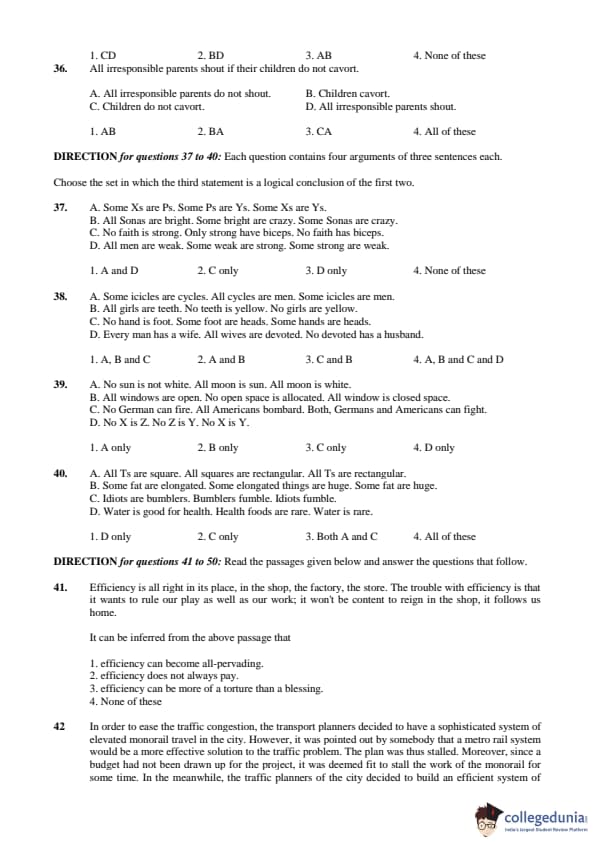
Question 32:

Either Sita is sick or she is careless.

  • (A) Sita is not sick.
  • (B) Sita is not careless.
  • (C) Sita is sick.
  • (D) Sita is careless.
Correct Answer: (B) AD
View Solution

Question 33:

Ram gets a swollen nose whenever he eats hamburgers.

  • (A) Ram gets a swollen nose.
  • (B) Ram does not eat hamburgers.
  • (C) Ram does not get a swollen nose.
  • (D) Ram eats hamburgers.
Correct Answer: (D) BC
View Solution

Question 34:

Either the employees have no confidence in the management or they are hostile by nature.

  • (A) They are not hostile by nature.
  • (B) They are hostile by nature.
  • (C) They have confidence in the management.
  • (D) They have no confidence in the management.
Correct Answer: (B) CB
View Solution

Question 35:

Whenever Ram reads late into the night, his father beats him.

  • (A) His father does not beat Ram.
  • (B) Ram reads late into the night.
  • (C) Ram reads early in the morning.
  • (D) Ram's father beats him in the morning.
Correct Answer: (D) CD
View Solution

Question 36:

All irresponsible parents shout if their children do not cavort.

  • (A) All irresponsible parents do not shout.
  • (B) Children do not cavort.
  • (C) Children cavort.
  • (D) All irresponsible parents shout.
Correct Answer: (A) AB
View Solution

Question 37:

Choose the set in which the third statement is a logical conclusion of the first two.

  • (A) Some Xs are Ps. Some Ps are Ys. Some Xs are Ys.
  • (B) All Sonas are bright. Some bright are crazy. Some Sonas are crazy.
  • (C) No faith is strong. Only strong have biceps. No faith has biceps.
  • (D) All men are weak. Some weak are strong. Some strong are weak.
Correct Answer: (2) C only
View Solution

Question 38:

Choose the set in which the third statement is a logical conclusion of the first two.


(A) Some Xs are Ps. Some Ps are Ys. Some Xs are Ys.

(B) All Sonas are bright. Some bright are crazy. Some Sonas are crazy.

(C) No faith is strong. Only strong have biceps. No faith has biceps.

(D) All men are weak. Some weak are strong. Some strong are weak.


(A) A and D

  • (B) C only
  • (C) D only
  • (D) None of these
Correct Answer: (B) C only
View Solution

Question 39:

Choose the set in which the third statement is a logical conclusion of the first two.


(A) Some icicles are cycles. All cycles are men. Some icicles are men.

(B) All girls are teeth. No teeth is yellow. No girls are yellow.

(C) No hand is foot. Some foot are heads. Some hands are heads.

(D) Every man has a wife. All wives are devoted. No devoted has a husband.

  • (A) A, B and C
  • (B) A and B
  • (C) C and B
  • (D) A, B, C and D
Correct Answer: (B) A and B
View Solution

Question 40:

Choose the set in which the third statement is a logical conclusion of the first two.


(A) No sun is not white. All moon is sun. All moon is white.

(B) All windows are open. No open space is allocated. All window is closed space.

(C) No German can fire. All Americans bombard. Both, Germans and Americans can fight.

(D) No X is Z. No Z is Y. No X is Y.

  • (A) A only
  • (B) B only
  • (C) C only
  • (D) D only
Correct Answer: (A) A only
View Solution

Question 41:

Choose the set in which the third statement is a logical conclusion of the first two.


(A) All Ts are square. All squares are rectangular. All Ts are rectangular.

(B) Some fat are elongated. Some elongated things are huge. Some fat are huge.

(C) Idiots are bumblers. Bumblers fumble. Idiots fumble.

(D) Water is good for health. Health foods are rare. Water is rare.

  • (A) D only
  • (B) C only
  • (C) Both A and C
  • (D) All of these
Correct Answer: (C) Both A and C
View Solution

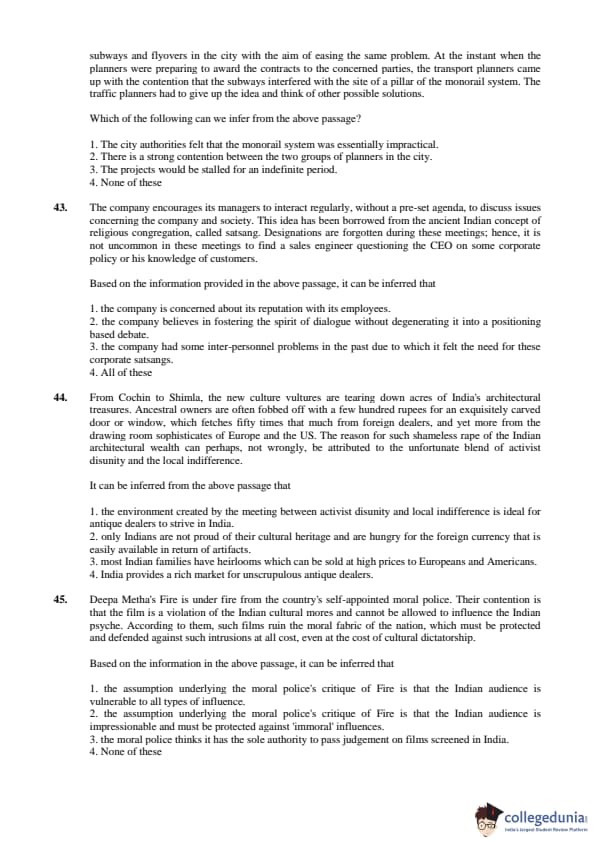
Question 42:

Efficiency is all right in its place, in the shop, the factory, the store. The trouble with efficiency is that it wants to rule our play as well as our work; it won't be content to reign in the shop, it follows us home.


It can be inferred from the above passage that

  • (A) Efficiency can become all-pervading.
  • (B) Efficiency does not always pay.
  • (C) Efficiency can be more of a torture than a blessing.
  • (D) None of these
Correct Answer: (A) Efficiency can become all-pervading.
View Solution

Question 43:

In order to ease the traffic congestion, the transport planners decided to have a sophisticated system of elevated monorail travel in the city. However, it was pointed out by somebody that a metro rail system would be a more effective solution to the traffic problem. The plan was thus stalled. Moreover, since a budget had not been drawn up for the project, it was deemed fit to stall the work of the monorail for some time. In the meanwhile, the traffic planners of the city decided to build an efficient system of subways and flyovers in the city with the aim of easing the same problem. At the instant when the planners were preparing to award the contracts to the concerned parties, the transport planners came up with the contention that the subways interfered with the site of a pillar of the monorail system. The traffic planners had to give up the idea and think of other possible solutions.


Which of the following can we infer from the above passage?

  • (A) The city authorities felt that the monorail system was essentially impractical.
  • (B) There is a strong contention between the two groups of planners in the city.
  • (C) The projects would be stalled for an indefinite period.
  • (D) None of these
Correct Answer: (C) The projects would be stalled for an indefinite period.
View Solution

Question 44:

The company encourages its managers to interact regularly, without a pre-set agenda, to discuss issues concerning the company and society. This idea has been borrowed from the ancient Indian concept of religious congregation, called satsang. Designations are forgotten during these meetings; hence, it is not uncommon in these meetings to find a sales engineer questioning the CEO on some corporate policy or his knowledge of customers.


Based on the information provided in the above passage, it can be inferred that

  • (A) The company is concerned about its reputation with its employees.
  • (B) The company believes in fostering the spirit of dialogue without degenerating it into a positioning based debate.
  • (C) The company had some inter-personnel problems in the past due to which it felt the need for these corporate satsangs.
  • (D) All of these
Correct Answer: (B) The company believes in fostering the spirit of dialogue without degenerating it into a positioning based debate.
View Solution

Question 45:

From Cochin to Shimla, the new culture vultures are tearing down acres of India's architectural treasures. Ancestral owners are often fobbed off with a few hundred rupees for an exquisitely carved door or window, which fetches fifty times that much from foreign dealers, and yet more from the drawing room sophisticates of Europe and the US. The reason for such shameless rape of the Indian architectural wealth can perhaps, not wrongly, be attributed to the unfortunate blend of activist disunity and the local indifference.


It can be inferred from the above passage that

  • (A) The environment created by the meeting between activist disunity and local indifference is ideal for antique dealers to strive in India.
  • (B) Only Indians are not proud of their cultural heritage and are hungry for the foreign currency that is easily available in return for artifacts.
  • (C) Most Indian families have heirlooms which can be sold at high prices to Europeans and Americans.
  • (D) India provides a rich market for unscrupulous antique dealers.
Correct Answer: (A) The environment created by the meeting between activist disunity and local indifference is ideal for antique dealers to strive in India.
View Solution

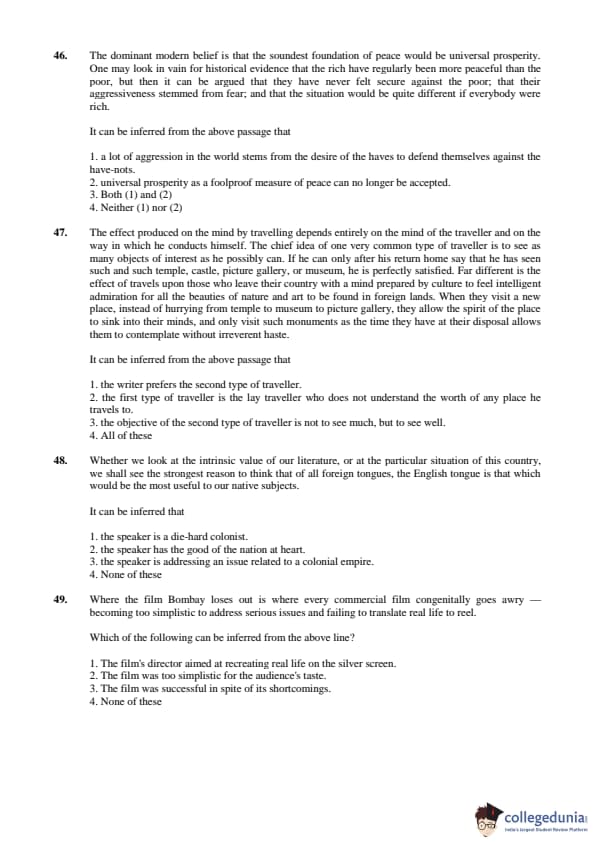
Question 46:

Deepa Mehta's Fire is under fire from the country's self-appointed moral police. Their contention is that the film is a violation of the Indian cultural mores and cannot be allowed to influence the Indian psyche. According to them, such films ruin the moral fabric of the nation, which must be protected and defended against such intrusions at all cost, even at the cost of cultural dictatorship.


Based on the information in the above passage, it can be inferred that

  • (A) The assumption underlying the moral police's critique of Fire is that the Indian audience is vulnerable to all types of influence.
  • (B) The assumption underlying the moral police's critique of Fire is that the Indian audience is impressionable and must be protected against 'immoral' influences.
  • (C) The moral police thinks it has the sole authority to pass judgement on films screened in India.
  • (D) None of these
Correct Answer: (B) The assumption underlying the moral police's critique of Fire is that the Indian audience is impressionable and must be protected against 'immoral' influences.
View Solution

Question 47:

The dominant modern belief is that the soundest foundation of peace would be universal prosperity. One may look in vain for historical evidence that the rich have regularly been more peaceful than the poor, but then it can be argued that they have never felt secure against the poor; that their aggressiveness stemmed from fear; and that the situation would be quite different if everybody were rich.


It can be inferred from the above passage that

  • (A) A lot of aggression in the world stems from the desire of the haves to defend themselves against the have-nots.
  • (B) Universal prosperity as a foolproof measure of peace can no longer be accepted.
  • (C) Both (A) and (B)
  • (D) Neither (A) nor (B)
Correct Answer: (A) A lot of aggression in the world stems from the desire of the haves to defend themselves against the have-nots.
View Solution

Question 48:

The effect produced on the mind by travelling depends entirely on the mind of the traveller and on the way in which he conducts himself. The chief idea of one very common type of traveller is to see as many objects of interest as he possibly can. If he can only after his return home say that he has seen such and such temple, castle, picture gallery, or museum, he is perfectly satisfied. Far different is the effect of travels upon those who leave their country with a mind prepared by culture to feel intelligent admiration for all the beauties of nature and art to be found in foreign lands. When they visit a new place, instead of hurrying from temple to museum to picture gallery, they allow the spirit of the place to sink into their minds, and only visit such monuments as the time they have at their disposal allows them to contemplate without irreverent haste.


It can be inferred from the above passage that

  • (A) the writer prefers the second type of traveller.
  • (B) the first type of traveller is the lay traveller who does not understand the worth of any place he travels to.
  • (C) the objective of the second type of traveller is not to see much, but to see well.
  • (D) All of these
Correct Answer: (D) All of these
View Solution

Question 49:

Whether we look at the intrinsic value of our literature, or at the particular situation of this country, we shall see the strongest reason to think that of all foreign tongues, the English tongue is that which would be the most useful to our native subjects.


It can be inferred that

  • (A) the speaker is a die-hard colonist.
  • (B) the speaker has the good of the nation at heart.
  • (C) the speaker is addressing an issue related to a colonial empire.
  • (D) None of these
Correct Answer: (D) None of these
View Solution

Question 50:

Where the film Bombay loses out is where every commercial film congenitally goes awry — becoming too simplistic to address serious issues and failing to translate real life to reel.


Which of the following can be inferred from the above line?

  • (A) The film's director aimed at recreating real life on the silver screen.
  • (B) The film was too simplistic for the audience's taste.
  • (C) The film was successful in spite of its shortcomings.
  • (D) None of these
Correct Answer: (D) None of these
View Solution

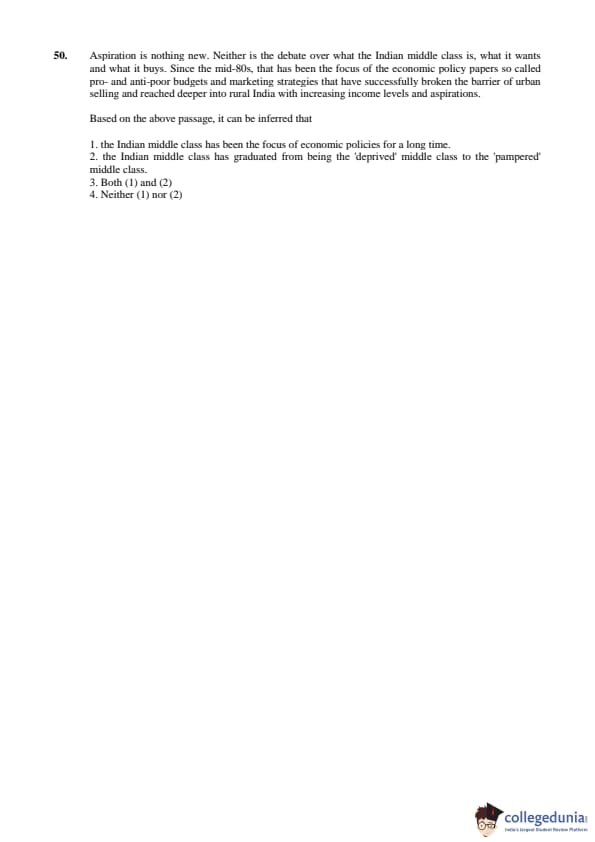
Question 51:

Aspiration is nothing new. Neither is the debate over what the Indian middle class is, what it wants and what it buys. Since the mid-80s, that has been the focus of the economic policy papers so called pro- and anti-poor budgets and marketing strategies that have successfully broken the barrier of urban selling and reached deeper into rural India with increasing income levels and aspirations.


Based on the above passage, it can be inferred that

  • (A) the Indian middle class has been the focus of economic policies for a long time.
  • (B) the Indian middle class has graduated from being the 'deprived' middle class to the 'pampered' middle class.
  • (C) Both (1) and (2)
  • (D) Neither (1) nor (2)
Correct Answer: (A) the Indian middle class has been the focus of economic policies for a long time.
View Solution

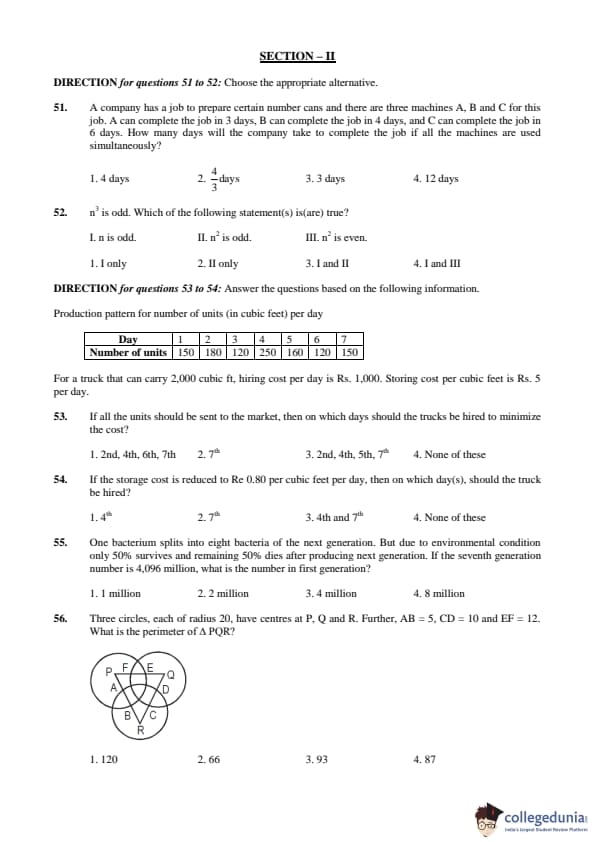
Question 52:

A company has a job to prepare certain number of cans and there are three machines A, B, and C for this job. A can complete the job in 3 days, B can complete the job in 4 days, and C can complete the job in 6 days. How many days will the company take to complete the job if all the machines are used simultaneously?

  • (A) 4 days
  • (B) \(\frac{4}{3}\) days
  • (C) 3 days
  • (C) 12 days
Correct Answer: (B) \(\frac{4}{3}\) days
View Solution

Question 53:

If \( n^3 \) is odd, which of the following statement(s) is(are) true?

I. \( n \) is odd.

II. \( n^2 \) is odd.

III. \( n^2 \) is even.

  • (A) I only
  • (B) II only
  • (C) I and II
  • (D) I and III
Correct Answer: (C)) I and II
View Solution

Question 54:

Production pattern for number of units (in cubic feet) per day


If all the units should be sent to the market, then on which days should the trucks be hired to minimize the cost?

  • (A) 2nd, 4th, 6th, 7th
  • (B) 7th
  • (C) 2nd, 4th, 5th, 7th
  • (D) None of these
Correct Answer: (A) 2nd, 4th, 5th, 7th
View Solution

Question 55:

If the storage cost is reduced to Rs. 0.80 per cubic feet per day, then on which day(s), should the truck be hired?

  • (A) 4th
  • (B) 7th
  • (C) 4th and 7th
  • (D) None of these
Correct Answer: (B) 7th
View Solution

Question 56:

One bacterium splits into eight bacteria of the next generation. But due to environmental condition only 50% survives and the remaining 50% dies after producing the next generation. If the seventh generation number is 4,096 million, what is the number in the first generation?

  • (A) 1 million
  • (B) 2 million
  • (C) 4 million
  • (D) 8 million
Correct Answer: (A) 1 million
View Solution

Question 57:

Three circles, each of radius 20, have centres at P, Q, and R. Further, AB = 5, CD = 10 and EF = 12. What is the perimeter of \( \triangle PQR \)?

  • (A) 120
  • (B) 66
  • (C) 93
  • (D) 87
Correct Answer: (C) 93
View Solution

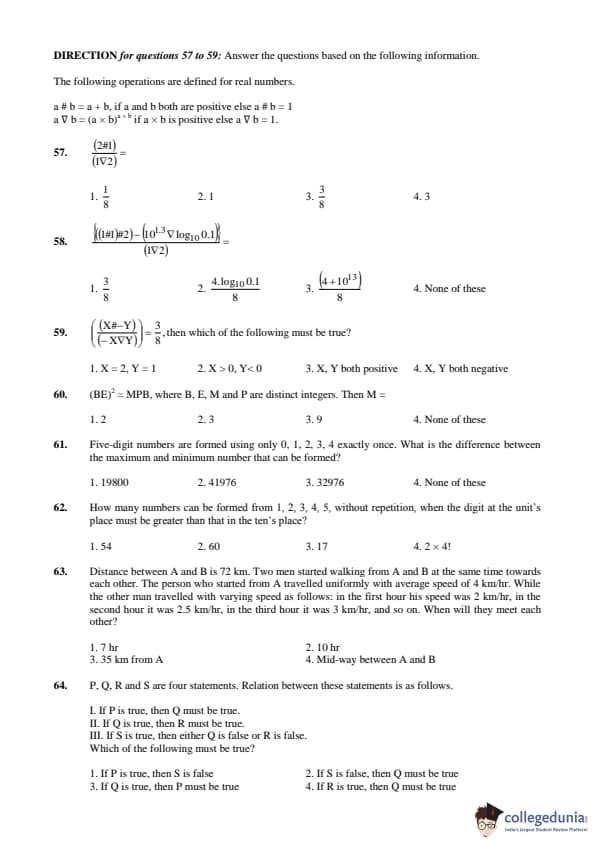
Question 58:

The following operations are defined for real numbers.
\[ a \ b = a + b, \, if \, a \, and \, b \, both are positive, else \, a \ b = 1 \] \[ a \vee b = (a \times b) + a + b, \, if \, a \times b \, is positive, else \, a \vee b = 1 \]

What is \[ \frac{(2 \ 1)}{(1 \vee 2)}? \]

  • (A) \( \frac{1}{8} \)
  • (B) 1
  • (C) \( \frac{3}{8} \)
  • (D) 3
Correct Answer: (C) \( \frac{3}{8} \)
View Solution

Question 59:

Evaluate the following expression: \[ \left( (|1| \ 2) - \left( 10^{1.3} \vee \log_{10} 0.1 \right) \right) \div (1 \vee 2) \]

  • (A) \( \frac{3}{8} \)
  • (B) \( \frac{4 \cdot \log_{10} 0.1}{8} \)
  • (C) \( \frac{4 + 10^{13}}{8} \)
  • (D) None of these
Correct Answer: (A) \( \frac{3}{8} \)
View Solution

Question 60:

Evaluate the following expression: \[ \left( \frac{X \ Y}{- X \times Y} \right) = \frac{3}{8}, \]
\text{then which of the following must be true?

  • (A) \( X = 2, Y = 1 \)
  • (B) \( X > 0, Y < 0 \)
  • (C) \( X, Y both positive \)
  • (D) \( X, Y both negative \)
Correct Answer: (B) \( X > 0, Y < 0 \)
View Solution

Question 61:

Given that \[ (BE)^2 = MPB, \, where B, E, M, and P are distinct integers. Then M = \]

  • (A) 2
  • (B) 3
  • (C) 9
  • (D) None of these
Correct Answer: (B) 3
View Solution

Question 62:

Five-digit numbers are formed using only 0, 1, 2, 3, 4 exactly once. What is the difference between the maximum and minimum number that can be formed?

  • (A) 19800
  • (B) 41976
  • (C) 32976
  • (D) None of these
Correct Answer: (C) 32976
View Solution

Question 63:

How many numbers can be formed from 1, 2, 3, 4, 5, without repetition, when the digit at the unit’s place must be greater than that in the ten’s place?

  • (A) 54
  • (B) 60
  • (C) 17
  • (D) \( 2 \times 4! \)
Correct Answer: (B) 60
View Solution

Question 64:

Distance between A and B is 72 km. Two men started walking from A and B at the same time towards each other. The person who started from A travelled uniformly with average speed of 4 km/hr. While the other man travelled with varying speed as follows: in the first hour his speed was 2 km/hr, in the second hour it was 2.5 km/hr, in the third hour it was 3 km/hr, and so on. When will they meet each other?

  • (A) 7 hr
  • (B) 10 hr
  • (C) Mid-way between A and B
  • (D) 35 km from A
Correct Answer: (C) Mid-way between A and B
View Solution

Question 65:

P, Q, R and S are four statements. Relation between these statements is as follows.

I. If P is true, then Q must be true.

II. If Q is true, then R must be true.

III. If S is true, then either Q is false or R is false.

Which of the following must be true?

  • (A) If P is true, then S is false.
  • (B) If S is false, then Q must be true.
  • (C) If Q is true, then P must be true.
  • (D) If R is true, then Q must be true.
Correct Answer: (A) If P is true, then S is false.
View Solution

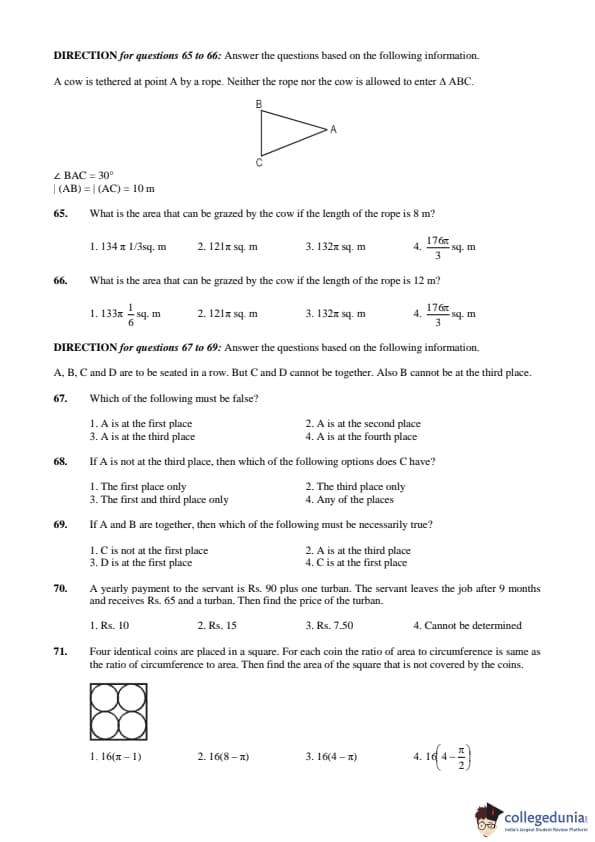
Question 66:

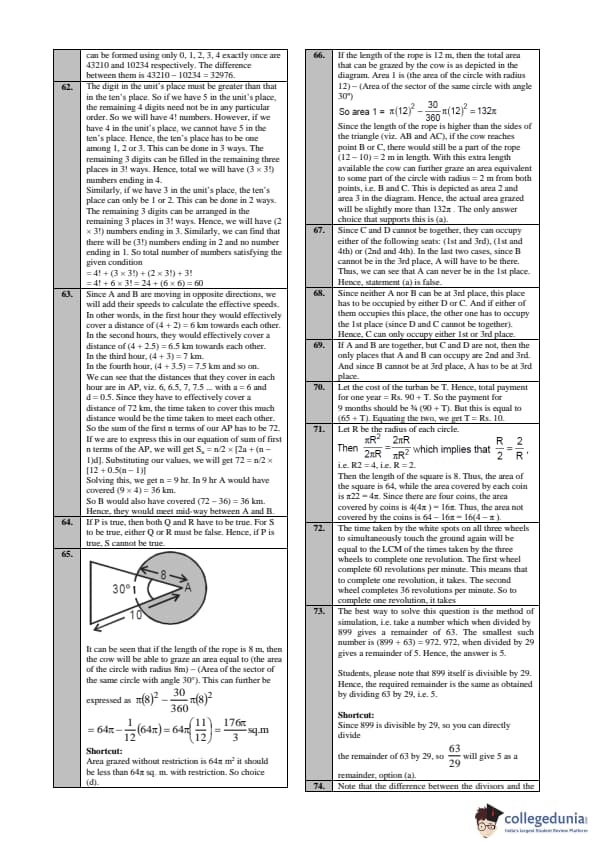
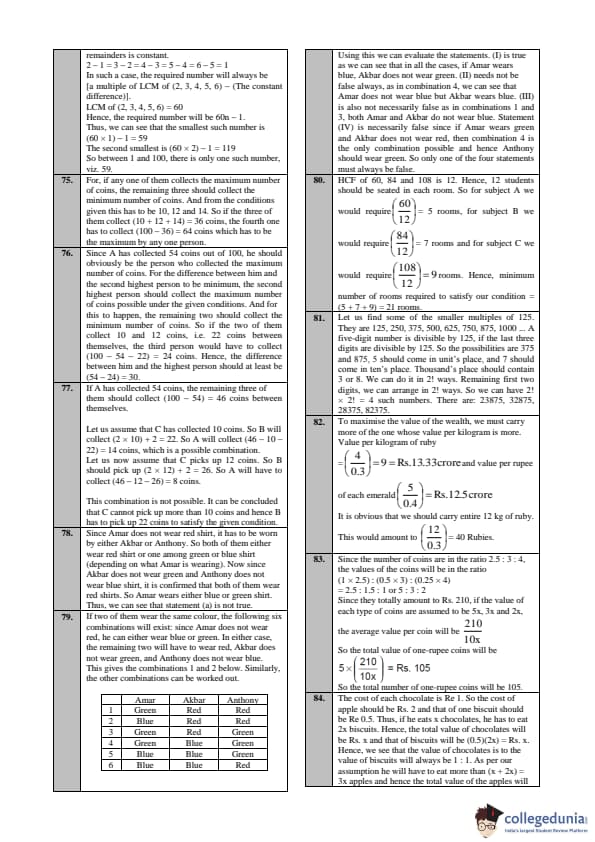
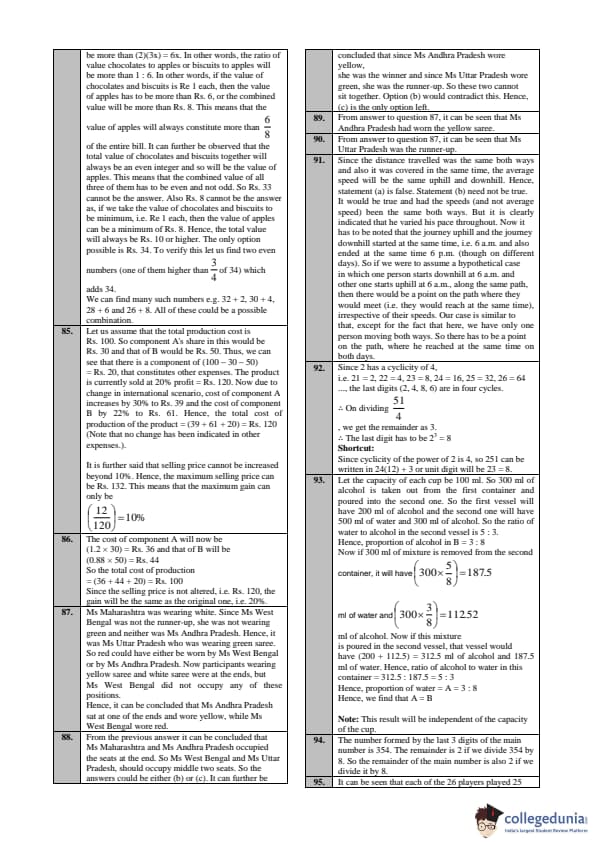
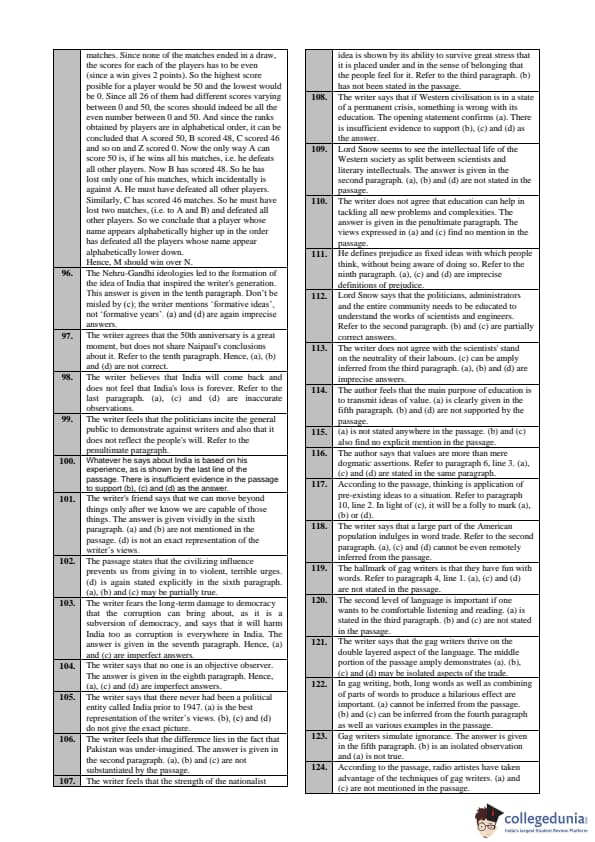
What is the area that can be grazed by the cow if the length of the rope is 8 m?

  • (A) \( 134 \pi \, \frac{1}{3} \, sq. m \)
  • (B) \( 121 \pi \, sq. m \)
  • (C) \( 132 \pi \, sq. m \)
  • (D) \( \frac{176 \pi}{3} \, sq. m \)
Correct Answer: (D) \( \frac{176 \pi}{3} \, \text{sq. m} \)
View Solution

Question 67:

What is the area that can be grazed by the cow if the length of the rope is 12 m?

  • (A) \( 133 \pi \, \frac{1}{6} \, sq. m \)
  • (B) \( 121 \pi \, sq. m \)
  • (C) \( 132 \pi \, sq. m \)
  • (D) \( \frac{176 \pi}{3} \, sq. m \)
Correct Answer: (A) \( 133 \pi \, \frac{1}{6} \, \text{sq. m} \)
View Solution

Question 68:

Which of the following must be false?

  • (A) A is at the first place
  • (B) A is at the second place
  • (C) A is at the third place
  • (D) A is at the fourth place
Correct Answer: (A) A is at the first place
View Solution

Question 69:

If A is not at the third place, then which of the following options does C have?

  • (A) The first place only
  • (B) The third place only
  • (C) The first and third place only
  • (D) Any of the places
Correct Answer: (C) The first and third place only
View Solution

Question 70:

If A and B are together, then which of the following must be necessarily true?

  • (A) C is not at the first place
  • (B) A is at the third place
  • (C) D is at the first place
  • (D) C is at the first place
Correct Answer: (B) A is at the third place
View Solution

Question 71:

A yearly payment to the servant is Rs. 90 plus one turban. The servant leaves the job after 9 months and receives Rs. 65 and a turban. Then find the price of the turban.

  • (A) Rs. 10
  • (B) Rs. 15
  • (C) Rs. 7.50
  • (D) Cannot be determined
Correct Answer: (A) Rs. 10
View Solution

Question 72:

Four identical coins are placed in a square. For each coin the ratio of area to circumference is the same as the ratio of circumference to area. Then find the area of the square that is not covered by the coins.

  • (A) \( 16(\pi - 1) \)
  • (B) \( 16(8 - \pi) \)
  • (C) \( 16(4 - \pi) \)
  • (D) \( 16 \left( 4 - \frac{\pi}{2} \right) \)
Correct Answer: (C) \( 16(4 - \pi) \)
View Solution

Question 73:

Three wheels can complete 60, 36, and 24 revolutions per minute. There is a red spot on each wheel that touches the ground at time zero. After how much time will all these spots will simultaneously touch the ground again?

  • (A) \( \frac{5}{2} \, s \)
  • (B) \( \frac{5}{3} \, s \)
  • (C) 3.1 s
  • (D) Cannot be determined
Correct Answer: (C) 3.1 s
View Solution

Question 74:

A certain number, when divided by 899, leaves a remainder 63. Find the remainder when the same number is divided by 29.

  • (A) 5
  • (B) 4
  • (C) 3
  • (D) Cannot be determined
Correct Answer: (A) 5
View Solution

Question 75:

A is the set of positive integers such that when divided by 2, 3, 4, 5, 6 leaves the remainders 1, 2, 3, 4, 5 respectively. How many integers between 0 and 100 belong to set A?

  • (A) 1
  • (B) 2
  • (C) 3
  • (D) None of these
Correct Answer: (B) 2
View Solution

Question 76:

The maximum number of coins collected by any one of them cannot exceed

  • (A) 64
  • (B) 36
  • (C) 54
  • (D) None of these
Correct Answer: (A) 64
View Solution

Question 77:

If A collected 54 coins, then the difference in the number of coins between the one who collected maximum number of coins and the one who collected the second highest number of coins must be at least

  • (A) 12
  • (B) 24
  • (C) 30
  • (D) None of these
Correct Answer: (C) 30
View Solution

Question 78:

If A collected 54 coins and B collected two more coins than twice the number of coins collected by C, then the number of coins collected by B could be

  • (A) 28
  • (B) 20
  • (C) 26
  • (D) 22
Correct Answer: (D) 22
View Solution

Question 79:

If Akbar and Anthony wear the same colour of shirts, then which of the following is not true?

  • (A) Amar wears blue and Akbar wears green
  • (B) Amar wears green and Akbar wears red
  • (C) Amar wears blue and Akbar does not wear blue
  • (D) Anthony wears red
Correct Answer: (A) Amar wears blue and Akbar wears green
View Solution

Question 80:

If two of them wear the same colour, then how many of the following must be false?

  • (A) None
  • (B) One
  • (C) Two
  • (D) Three
Correct Answer: (B) One
View Solution

Question 81:

Number of students who have opted for subjects A, B and C are 60, 84 and 108 respectively. The examination is to be conducted for these students such that only the students of the same subject are allowed in one room. Also the number of students in each room must be same. What is the minimum number of rooms that should be arranged to meet all these conditions?

  • (A) 28
  • (B) 60
  • (C) 12
  • (D) 21
Correct Answer: (D) 21
View Solution

Question 82:

How many five-digit numbers can be formed using the digits 2, 3, 8, 7, 5 exactly once such that the number is divisible by 125?

  • (A) 0
  • (B) 1
  • (C) 4
  • (D) 3
Correct Answer: (A) 0
View Solution

Question 83:

You can collect as many rubies and emeralds as you can. Each ruby is worth Rs. 4 crore and each emerald is worth Rs. 5 crore. Each ruby weighs 0.3 kg and each emerald weighs 0.4 kg. Your bag can carry at most 12 kg. What should you collect to get the maximum wealth?

  • (A) 20 rubies and 15 emeralds
  • (B) 40 rubies
  • (C) 28 rubies and 9 emeralds
  • (D) None of these
Correct Answer: (B) 40 rubies
View Solution

Question 84:

I have one-rupee coins, 50-paisa coins and 25-paisa coins. The number of coins are in the ratio 2.5 : 3 : 4. If the total amount with me is Rs. 210, find the number of one-rupee coins.

  • (A) 90
  • (B) 85
  • (C) 100
  • (D) 105
Correct Answer: (C) 100
View Solution

Question 85:

My son adores chocolates. He likes biscuits. But he hates apples. I told him that he can buy as many chocolates as he wishes. But then he must have biscuits twice the number of chocolates and should have apples more than biscuits and chocolates together. Each chocolate costs Rs. 1. The cost of an apple is twice the chocolate and four biscuits are worth one apple. Then which of the following can be the amount that I spent on that evening on my son if the number of chocolates, biscuits, and apples bought were all integers?

  • (A) Rs. 34
  • (B) Rs. 33
  • (C) Rs. 8
  • (D) None of these
Correct Answer: (A) Rs. 34
View Solution

Question 86:

What is the maximum current gain possible?

  • (A) 10%
  • (B) 12.5%
  • (C) 0%
  • (D) 7.5%
Correct Answer: (A) 10%
View Solution

Question 87:

If the USA dollar becomes cheap by 12% over its original cost and the cost of German mark increased by 20%, what will be the gain? (The selling price is not altered.)

  • (A) 10%
  • (B) 20%
  • (C) 15%
  • (D) 7.5%
Correct Answer: (B) 20%
View Solution

Question 88:

Who wore the red saree?

  • (A) Ms Andhra Pradesh
  • (B) Ms West Bengal
  • (C) Ms Uttar Pradesh
  • (D) Ms Maharashtra
Correct Answer: (B) Ms West Bengal
View Solution

Question 89:

Ms. West Bengal was sitting adjacent to

  • (A) Ms Andhra Pradesh and Ms Maharashtra
  • (B) Ms Uttar Pradesh and Ms Maharashtra
  • (C) Ms Andhra Pradesh and Ms Uttar Pradesh
  • (D) Ms Uttar Pradesh
Correct Answer: (C) Ms Andhra Pradesh and Ms Uttar Pradesh
View Solution

Question 90:

Which saree was worn by Ms Andhra Pradesh?

  • (A) Yellow
  • (B) Red
  • (C) Green
  • (D) White
Correct Answer: (A) Yellow
View Solution

Question 91:

Who was the runner-up?

  • (A) Ms Andhra Pradesh
  • (B) Ms West Bengal
  • (C) Ms Uttar Pradesh
  • (D) Ms Maharashtra
Correct Answer: (C) Ms Uttar Pradesh
View Solution

Question 92:

I started climbing up the hill at 6 a.m. and reached the top of the temple at 6 p.m. Next day I started coming down at 6 a.m. and reached the foothill at 6 p.m. I walked on the same road. The road is so short that only one person can walk on it. Although I varied my pace on my way, I never stopped on my way. Then which of the following must be true?

  • (A) My average speed downhill was greater than that uphill
  • (B) At noon, I was at the same spot on both the days.
  • (C) There must be a point where I reached at the same time on both the days.
  • (D) There cannot be a spot where I reached at the same time on both the days.
Correct Answer: (C) There must be a point where I reached at the same time on both the days.
View Solution

Question 93:

What is the digit in the unit’s place of 251?

  • (A) 2
  • (B) 8
  • (C) 3
  • (D) 1
Correct Answer: (D) 1
View Solution

Question 94:

There are two containers: the first contains 500 ml of alcohol, while the second contains 500 ml of water. Three cups of alcohol from the first container is taken out and is mixed well in the second container. Then three cups of this mixture is taken out and is mixed in the first container. Let A denote the proportion of water in the first container and B denote the proportion of alcohol in the second container. Then

  • (A) A > B
  • (B) A < B
  • (C) A = B
  • (D) Cannot be determined
Correct Answer: (C) A = B
View Solution

Question 95:

A number is formed by writing first 54 natural numbers in front of each other as 12345678910111213... Find the remainder when this number is divided by 8.

  • (A) 1
  • (B) 7
  • (C) 2
  • (D) 0
Correct Answer: (C) 2
View Solution

Question 96:

A, B, C, D, ..., X, Y, Z are the players who participated in a tournament. Everyone played with every other player exactly once. A win scores 2 points, a draw scores 1 point and a loss scores 0 point. None of the matches ended in a draw. No two players scored the same score. At the end of the tournament, a ranking list is published which is in accordance with the alphabetical order. Then

  • (A) M wins over N
  • (B) N wins over M
  • (C) M does not play with N
  • (D) None of these
Correct Answer: (A) M wins over N
View Solution

Question 97:

The idea of India that inspired the writer's generation was the one dominated or formed by

  • (A) the Nehru-Gandhi politics
  • (B) the Nehru-Gandhi ideology.
  • (C) the Nehru-Gandhi idea regarding India's formative years.
  • (D) the Nehruvian idea of socialism.
Correct Answer: (B) the Nehru-Gandhi ideology.
View Solution

Question 98:

The writer does not share

  • (A) Naipaul's stand that the 50th anniversary is a historical moment.
  • (B) Naipaul's stand that the 50th anniversary is not a historical moment.
  • (C) Naipaul's conclusion on the 50th anniversary being a historical moment.
  • (D) Naipaul's conclusion on the 50th anniversary not being a historical moment.
Correct Answer: (C) Naipaul's conclusion on the 50th anniversary being a historical moment.
View Solution

Question 99:

The writer shows faith in India's basic

  • (A) stability
  • (B) resilience
  • (C) fortitude
  • (D) democracy
Correct Answer: (B) resilience
View Solution

Question 100:

According to the writer,

  • (A) politicians incite the general public to demonstrate against writers.
  • (B) a politician’s demonstration does not reflect the people’s will.
  • (C) Both (1) and (2)
  • (D) Neither (1) nor (2)
Correct Answer: (C) Both (1) and (2)
View Solution

Question 101:

The writer's view of India is determined mainly by

  • (A) his experience.
  • (B) his fondness for the country.
  • (C) his love for the resilience of the Indian people.
  • (D) his love of writing about India
Correct Answer: (C) his love for the resilience of the Indian people
View Solution

Question 102:

According to the writer's friend,

  • (A) we should fight against communal pressure.
  • (B) the fact that communal conflagrations haven't occurred in India for half a century, is something to be proud of.
  • (C) we can move beyond things, only after we know we are capable of those things.
  • (D) we have to identify with the people who were involved in inciting communal passions.
Correct Answer: (C) we can move beyond things, only after we know we are capable of those things.
View Solution

Question 103:

What according to the passage prevents us from giving in to violent, terrible urges?

  • (A) Our education
  • (B) Our upbringing
  • (C) Our cultural influences
  • (D) The civilising influence
Correct Answer: (D) The civilising influence
View Solution

Question 104:

According to the writer, what disqualifies India from being called a democracy?

  • (A) Its communalism
  • (B) Its corruption
  • (C) Its anti-minority stance
  • (D) All of these
Correct Answer: (B) Its corruption
View Solution

Question 105:

The writer contradicts his assertion of being an 'objective observer' on the basis that

  • (A) no one can be an 'objective observer'.
  • (B) no one is an 'objective observer'.
  • (C) he is a subjective observer.
  • (D) everybody is a subjective observer.
Correct Answer: (B) no one is an 'objective observer'.
View Solution

Question 106:

In the first paragraph of the passage, the writer questions

  • (A) the existence of a political entity called India prior to independence.
  • (B) the contention that a political entity called India did not exist.
  • (C) the stand that India was an invention.
  • (D) the stand that India needs to think in terms of its being a nation-state.
Correct Answer: (A) the existence of a political entity called India prior to independence.
View Solution

Question 107:

According to the writer, the difference between India and Pakistan was that

  • (A) India survived as a nation-state, Pakistan did not.
  • (B) Indians were full of fantastic ideas in 1947.
  • (C) Pakistan was born out of another nation.
  • (D) the creation of Pakistan suffered from under-imaginativeness.
Correct Answer: (A) India survived as a nation-state, Pakistan did not.
View Solution

Question 108:

According to the passage, the secret of India’s survival lies in

  • (A) its ability to fight back in the face of tremendous stress and strains.
  • (B) the highly fertile imagination of the Indian people.
  • (C) a sense of belonging that people feel for it.
  • (D) Both (1) and (3)
Correct Answer: (D) Both (1) and (3)
View Solution

Question 109:

The writer's contention in the passage is that the crisis in Western civilization can be explained by

  • (A) the presence of some flaws in its education.
  • (B) some inherent lack of coordination among its various elements.
  • (C) some basic misunderstanding in its society.
  • (D) the energy it has devoted to education.
Correct Answer: (A) the presence of some flaws in its education.
View Solution

Question 110:

According to the writer, Lord Snow sees the intellectual life of Western society as split between

  • (A) the educated and the uneducated.
  • (B) the government servants and the plebeians.
  • (C) scientists and literary intellectuals.
  • (D) administrators and intellectuals.
Correct Answer: (C) scientists and literary intellectuals.
View Solution

Question 111:

The writer seems to criticise the belief that

  • (A) education gives rise to further complexities as civilization progresses.
  • (B) all new problems and complexities can be tackled and solved by more and better education.
  • (C) people need to learn more in order to earn more.
  • (D) None of these.
Correct Answer: (B) all new problems and complexities can be tackled and solved by more and better education.
View Solution

Question 112:

What, according to the author, would be the definition of 'prejudice'?

  • (A) Ideas that help people to identify with new situations.
  • (B) Fixed ideas with which people think without being aware of doing so.
  • (C) Ideas that people cull from experience in order to judge a situation.
  • (D) Fixed ideas that see a person through the trials and tribulations of life.
Correct Answer: (B) Fixed ideas with which people think without being aware of doing so.
View Solution

Question 113:

According to Lord Snow, which of the following groups needs to be educated enough to at least understand the works of scientists and engineers?

  • (A) Politicians, administrators, and the entire community
  • (B) Politicians and literary intellectuals
  • (C) Politicians and the layman
  • (D) All of these
Correct Answer: (A) Politicians, administrators, and the entire community
View Solution

Question 114:

In the passage, the writer questions

  • (A) the neutrality of science.
  • (B) scientists' stand on the neutrality of science.
  • (C) scientists' stand on the neutrality of their labours.
  • (D) Lord Snow's assertion regarding the potential of intellectuals in society.
Correct Answer: (B) scientists' stand on the neutrality of science.
View Solution

Question 115:

The author's assertion in the passage is that education's main responsibility is to

  • (A) transmit ideas of value.
  • (B) transmit technical knowledge.
  • (C) Both (1) and (2).
  • (D) transmit the values regarding human and societal norms.
Correct Answer: (C) Both (1) and (2).
View Solution

Question 116:

The author believes that

  • (A) the gulf between science and literature needs to be bridged.
  • (B) ideas should be maintained for a holistic view of society and its problems.
  • (C) words are not ideas.
  • (D) None of these.
Correct Answer: (D) None of these.
View Solution

Question 117:

Which of the following sentences is not true according to the author?

  • (A) Values must be part of one's psyche.
  • (B) Values are merely dogmatic assertions.
  • (C) One identifies with values.
  • (D) Values are the means to interpret and experience the world.
Correct Answer: (B) Values are merely dogmatic assertions.
View Solution

Question 118:

Thinking is

  • (A) being
  • (B) knowing
  • (C) application of pre-existing ideas to a situation
  • (D) application of fixed ideas to a situation
Correct Answer: (C) application of pre-existing ideas to a situation
View Solution

Question 119:

According to the writer, a larger part of the American population

  • (A) indulges in playing out the role of gag writers.
  • (B) indulges in the word trade.
  • (C) seeks employment in the gag trade for want of something better.
  • (D) looks down on gag writers.
Correct Answer: (B) indulges in the word trade.
View Solution

Question 120:

The hallmark of gag writers is that they

  • (A) ruin good, simple language.
  • (B) have fun with words.
  • (C) make better sense of words.
  • (D) play with words to suit the audience's requirements.
Correct Answer: (B) have fun with words.
View Solution

Question 121:

According to the passage, the second level of language is important if

  • (A) one wants to feel at home reading and listening today.
  • (B) one wants to be a gag writer.
  • (C) one wants to understand clean entertainment.
  • (D) All of these.
Correct Answer: (D) All of these.
View Solution

Question 122:

According to the writer, gag writers thrive on

  • (A) the double-layered aspect of language.
  • (B) audience craze for double entendres.
  • (C) commonplace jugglery with language.
  • (D) None of these.
Correct Answer: (A) the double-layered aspect of language.
View Solution

Question 123:

In gag writers' trade

  • (A) long words are abbreviated for effect.
  • (B) parts of words are combined to produce a hilarious portmanteau effect.
  • (C) long words play a major role.
  • (D) Both (2) and (3).
Correct Answer: (D) Both (2) and (3).
View Solution

Question 124:

When the writer says, "They don't get paid for ignorance, only for simulating it," he means to say

  • (A) the audience likes to think the gag writers are an ignorant lot.
  • (B) gag writers are terrific with insinuations.
  • (C) simulating ignorance is the trick that makes gag writers tick.
  • (D) None of these.
Correct Answer: (C) simulating ignorance is the trick that makes gag writers tick.
View Solution

Question 125:

Gag writers have influenced

  • (A) television artistes.
  • (B) radio writers.
  • (C) circus clowns.
  • (D) All of these.
Correct Answer: (D) All of these.
View Solution

Question 126:

Needham's theory that 'God did not create living things directly' was posited as

  • (A) an attempt to support his assertion by religious doctrine.
  • (B) an attempt to placate his religious peers.
  • (C) an attempt at propitiating a possibly offended God or the religious psyche of the time.
  • (D) All of these.
Correct Answer: (D) All of these.
View Solution

Question 127:

It can be inferred from the passage that

  • (A) Huxley, Buffon and Needham were contemporaries.
  • (B) Buffon, Needham, Voltaire and Huxley were contemporaries.
  • (C) Voltaire wrote a treatise on Needham's claim.
  • (D) None of these
Correct Answer: (B) Buffon, Needham, Voltaire and Huxley were contemporaries.
View Solution

Question 128:

According to the passage,

  • (A) Pasteur's precursors in the field worked on the basis of spontaneous generation.
  • (B) unlike his predecessors, Pasteur worked on logical premises rather than arbitrary and spontaneous discoveries.
  • (C) Pasteur stood to benefit largely from the work of his predecessors.
  • (D) Pasteur developed the ideas set forth by Voltaire and Needham.
Correct Answer: (B) unlike his predecessors, Pasteur worked on logical premises rather than arbitrary and spontaneous discoveries.
View Solution

Question 129:

Pasteur began his work on the basis of the contention that

  • (A) either air contained a factor necessary for the spontaneous generation of life or viable germs were borne in by the air and seeded in the sterile nutrient broth.
  • (B) after prolonged boiling, a broth would ferment only when air was admitted to it.
  • (C) Both (1) and (2).
  • (D) Neither (1) nor (2).
Correct Answer: (C) Both (1) and (2).
View Solution

Question 130:

The porcelain filters of the bacteriology laboratories owed their descent to

  • (A) Pasteur's homeland.
  • (B) the well water of Montanvert that had been rendered germ-free by slow filtration through sandy oil.
  • (C) Both (1) and (2).
  • (D) None of these.
Correct Answer: (B) the well water of Montanvert that had been rendered germ-free by slow filtration through sandy oil.
View Solution

Question 131:

What according to the passage was Pasteur's declaration to the world?

  • (A) Nobody could deny the work done by him.
  • (B) Science would forever be indebted to his experiments in bacteriology.
  • (C) The doctrine of spontaneous generation would never recover from the mortal blow dealt to it by his experiments.
  • (D) Those who refused to acknowledge his experiments would regret their scepticism.
Correct Answer: (C) The doctrine of spontaneous generation would never recover from the mortal blow dealt to it by his experiments.
View Solution

Question 132:

What according to the writer, was the problem with the proponents of spontaneous generation?

  • (A) Their work had no scientific basis.
  • (B) Their work was ruined by experimental errors.
  • (C) Both (1) and (2).
  • (D) Neither (1) nor (2).
Correct Answer: (C) Both (1) and (2).
View Solution

Question 133:

One of the results of the theoretical cross-fire regarding bacteriology was that

  • (A) partial sterilization as a possibility was ruled out.
  • (B) aseptic technique was introduced in surgery.
  • (C) the meaning of sterile was clear to all.
  • (D) All of these.
Correct Answer: (D) All of these.
View Solution

Question 134:

One of the reasons for the conflict caused by Pasteur's experiments was that

  • (A) they denied the existence of God as the creator.
  • (B) they seemed simultaneously to support the Biblical account of creation while denying a variety of other philosophical systems.
  • (C) academics and scientists refused to accept his theories.
  • (D) there were too many debates on the topic and this left the people confused.
Correct Answer: (B) they seemed simultaneously to support the Biblical account of creation while denying a variety of other philosophical systems.
View Solution

Question 135:

According to the author,

  • (A) it is an exaggeration to say that cell theory represents biology's most significant and fruitful advance.
  • (B) Pasteur could not hold his own against the contenders.
  • (C) cell theory rendered null and void all the other bacteriological theories of the time.
  • (D) the emergence of the cell theory represents biology's most significant and fruitful advance.
Correct Answer: (D) the emergence of the cell theory represents biology's most significant and fruitful advance.
View Solution

Question 136:

The amount of money entrusted to the care of the mutual funds was

  • (A) Rs. 75,000 crore.
  • (B) Rs. 80,000 crore.
  • (C) Rs. 85,000 crore.
  • (D) Rs. 82,000 crore.
Correct Answer: (C) Rs. 85,000 crore.
View Solution

Question 137:

The end of mutual funds was carried out at the hands of

  • (A) the government.
  • (B) non-banking finance companies.
  • (C) the individual investors.
  • (D) Banks.
Correct Answer: (C) the individual investors.
View Solution

Question 138:

According to the passage, the flaws of the mutual funds lay in their

  • (A) post-liberalisation syndrome.
  • (B) imprudent and irresponsible handling.
  • (C) stagnation.
  • (D) All of these.
Correct Answer: (B) imprudent and irresponsible handling.
View Solution

Question 139:

According to the passage, one of the reasons for the failure of the mutual funds was

  • (A) their indisciplined approach to investment.
  • (B) their devil-may-care approach to the world of finance.
  • (C) their ability to deceive investors.
  • (D) their inability to read the pulse of their investors.
Correct Answer: (A) their indisciplined approach to investment.
View Solution

Question 140:

According to the writer, one of the fallouts of the end of mutual funds is that

  • (A) at least some of the big schemes due for redemption over the next three years will be unable to service their investors.
  • (B) only very few of the big schemes due for redemption over the next three years will be unable to service their investors.
  • (C) none of the big schemes due for redemption over the next three years will be able to service their investors.
  • (D) None of these.
Correct Answer: (A) at least some of the big schemes due for redemption over the next three years will be unable to service their investors.
View Solution

Question 141:

It can be inferred from the passage that

  • (A) money was siphoned away outside the country by the mutual funds.
  • (B) many of the mutual fund offices indulged in malpractice.
  • (C) money invested in the mutual fund schemes was never returned to the investors.
  • (D) a sustained attack by the media exposed the anomalies in the mutual fund industry.
Correct Answer: (B) many of the mutual fund offices indulged in malpractice.
View Solution

Question 142:

The current rank of the mutual fund industry in terms of safety and returns on deposits respectively is

  • (A) third and fourth.
  • (B) tenth and twelfth.
  • (C) fourth and fifth.
  • (D) It is not ranked at all.
Correct Answer: (C) fourth and fifth.
View Solution

Question 143:

The increase in the number of cell phone subscriptions in the office of an asset management company was due to the fact that

  • (A) calls made by employees for personal deals couldn't be lodged in the company's records.
  • (B) employees found it easier to deal with investors without involving the company.
  • (C) the company was unscrupulous about maintaining correct records.
  • (D) the company was unscrupulous in granting personal deals to the employees.
Correct Answer: (A) calls made by employees for personal deals couldn't be lodged in the company's records.
View Solution

Question 144:

According to the passage, mutual funds caused a loss of

  • (A) Rs. 10,000 crore of the investors' money.
  • (B) Rs. 11,000 crore of the investors' money.
  • (C) Rs. 5,000 crore of the investors' money.
  • (D) Rs. 8,000 crore of the investors' money.
Correct Answer: (B) Rs. 11,000 crore of the investors' money.
View Solution

Question 145:

On the basis of the passage, it may be said that, in terms of retrieving their money, the investors

  • (A) are caught between the devil and the deep blue sea.
  • (B) have a no-exit route.
  • (C) have to make do with little or no gain.
  • (D) will trust the few bright stars in the mutual fund industry.
Correct Answer: (A) are caught between the devil and the deep blue sea.
View Solution

Question 146:

According to the passage, one of the reasons for the euphoria in the mutual fund industry can be attributed to

  • (A) the stock market boom in the late eighties and early nineties.
  • (B) failure of the primary market.
  • (C) Both (1) and (2).
  • (D) Neither (1) nor (2).
Correct Answer: (A) the stock market boom in the late eighties and early nineties.
View Solution

Question 147:

What was the maximum percentage of apples supplied by any state in any of the months?

  • (A) 99%
  • (B) 95%
  • (C) 88%
  • (D) 100%
Correct Answer: (A) 99%
View Solution

Question 148:

Which state supplied the maximum number of apples?

  • (A) UP
  • (B) HP
  • (C) J \& K
  • (D) Cold storage
Correct Answer: (C) J \& K
View Solution

Question 149:

Which state supplied the highest percentage of apples from the total apples supplied?

  • (A) HP
  • (B) UP
  • (C) J \& K
  • (D) Cannot be determined
Correct Answer: (B) UP
View Solution

Question 150:

In which of the following periods was the supply greater than the demand?

  • (A) August-March
  • (B) June-October
  • (C) May-September
  • (D) Cannot be determined
Correct Answer: (C) May-September
View Solution

Question 151:

If the yield per tree was 40 kg, then from how many trees were the apples supplied to New Delhi (in millions) during the year?

  • (A) 11.5
  • (B) 12.5
  • (C) 13.5
  • (D) Cannot be determined
Correct Answer: (B) 12.5
View Solution

Question 152:

Using the data in question 150, if there were 250 trees per hectare, then how many hectares of land was used?

  • (A) 9,400 hectares
  • (B) 49,900 hectares
  • (C) 50,000 hectares
  • (D) 49,450 hectares
Correct Answer: (D) 49,450 hectares
View Solution

Question 153:

Which region showed the highest growth in number of households in all the income categories for the period?

  • (A) North
  • (B) South
  • (C) West
  • (D) None of these
Correct Answer: (B) South
View Solution

Question 154:

What was the total household income in northern region for upper-middle class?

  • (A) Rs. 50 lakh
  • (B) Rs. 500 million
  • (C) Rs. 300 million
  • (D) Cannot be determined
Correct Answer: (B) Rs. 500 million
View Solution

Question 155:

What is the percentage increase in total number of households for the northern region (upper-middle) over the given period?

  • (A) 100%
  • (B) 200%
  • (C) 240%
  • (D) Cannot be determined
Correct Answer: (D) Cannot be determined
View Solution

Question 156:

What was the average income of the high-income group in 1987-88?

  • (A) Rs. 75,000
  • (B) Rs. 25,000
  • (C) Rs. 2,25,000
  • (D) Cannot be determined
Correct Answer: (A) Rs. 75,000
View Solution

Question 157:

The ratio of total income for the high-income category to the upper-middle class increased by how much percentage in the given period?

  • (A) 20%
  • (B) 36%
  • (C) 25%
  • (D) Cannot be determined
Correct Answer: (B) 36%
View Solution

Question 158:

What was the total output of coconuts?

  • (A) 24,000
  • (B) 36,000
  • (C) 18,000
  • (D) 48,000
Correct Answer: (B) 36,000
View Solution

Question 159:

What was the value of output per acre of lemon trees planted?

  • (A) 0.24 lakh per acre
  • (B) 2.4 lakh per acre
  • (C) 24 lakh per acre
  • (D) Cannot be determined
Correct Answer: (A) 0.24 lakh per acre
View Solution

Question 160:

What was the amount received by Gopal in 1997?

  • (A) Rs. 1.5 lakh
  • (B) Rs. 3 lakh
  • (C) Rs. 6 lakh
  • (D) None of these
Correct Answer: (A) Rs. 1.5 lakh
View Solution

Question 161:

What was the value of output per tree for coconuts?

  • (A) Rs. 36
  • (B) Rs. 360
  • (C) Rs. 3,600
  • (D) Rs. 240
Correct Answer: (B) Rs. 360
View Solution

Question 162:

What was the ratio of yields per acre of land for coconuts and lemons (in terms of number of lemons and coconuts)?

  • (A) 3 : 2
  • (B) 2 : 3
  • (C) 1 : 1
  • (D) Cannot be determined
Correct Answer: (D) Cannot be determined
View Solution

Question 163:

What is the minimum number of units that need to be produced to make sure that there was no loss?

  • (A) 5
  • (B) 10
  • (C) 20
  • (D) Indeterminable
Correct Answer: (B) 10
View Solution

Question 164:

How many units should be manufactured such that the profit was at least Rs. 50?

  • (A) 20
  • (B) 34
  • (C) 45
  • (D) 30
Correct Answer: (A) 20
View Solution

Question 165:

If at the most 40 units can be manufactured, then what is the number of units that can be manufactured to maximise profit per unit?

  • (A) 40
  • (B) 34
  • (C) 35
  • (D) 25
Correct Answer: (B) 34
View Solution

Question 166:

If the production cannot exceed 45 units, then what is the number of units that can maximise profit per unit?

  • (A) 40
  • (B) 34
  • (C) 45
  • (D) 35
Correct Answer: (B) 34
View Solution

Question 167:

If the fixed cost of production goes up by Rs. 40, then what is the minimum number of units that need to be manufactured to make sure that there is no loss?

  • (A) 10
  • (B) 19
  • (C) 15
  • (D) 20
Correct Answer: (B) 19
View Solution

Question 168:

What is the maximum percentage increase in price per cubic metre or per tonne over the previous year?

  • (A) 33.33%
  • (B) 85%
  • (C) 50%
  • (D) Cannot be determined
Correct Answer: (C) 50%
View Solution

Question 169:

Which product shows the maximum percentage increase in price over the period?

  • (A) Saw timber
  • (B) Plywood
  • (C) Logs
  • (D) Cannot be determined
Correct Answer: (B) Plywood
View Solution

Question 170:

If 1 m\(^3\) = 750 kg for saw timber, find in which year was the difference in prices of saw timber and logs the least?

  • (A) 1989
  • (B) 1990
  • (C) 1991
  • (D) 1992
Correct Answer: (B) 1990
View Solution

Question 171:

If one cubic metre = 700 kg for plywood and 800 kg for saw timber, find in which year was the difference in the prices of plywood and saw timber (per cubic metre) the maximum?

  • (A) 1989
  • (B) 1990
  • (C) 1991
  • (D) 1992
Correct Answer: (D) 1992
View Solution

Question 172:

If the volume sales of plywood, saw timber and logs were 40%, 30% and 30% respectively, then what was the average realisation in 1993 per cubic metre of sales?

  • (B) 15
  • (C) 16
  • (D) 13
Correct Answer: (D) 13
View Solution

Question 173:

If, in 1994, prices increased by 5%, 1% and 10% while the volume sales break-up was 40%, 30% and 30% for plywood, saw timber and logs respectively, then what was the average realisation?

  • (A) 18.95
  • (B) 16.45
  • (C) 13.15
  • (D) 10.25
Correct Answer: (C) 13.15
View Solution

Question 174:

Find the length of AB if \(\angle YBC = \angle CAX = \angle YOX = 90^\circ\).

[I.] Radius of the arc is given.
[II.] \( OA = 5 \)


  • (A) if the question can be answered with the help of any one statement alone but not by the other statement.
  • (B) if the question can be answered with the help of either of the statements taken individually.
  • (C) if the question can be answered with the help of both statements together.
  • (D) if the question cannot be answered even with the help of both statements together.
Correct Answer: (D) if the question cannot be answered even with the help of both statements together.
View Solution
Question 175:

Is \( n \) odd?

[I.] \( n \) is divisible by 3, 5, 7, and 9.
[II.] \( 0 < n < 400 \)

  • (A) if the question can be answered with the help of any one statement alone but not by the other statement.
  • (B) if the question can be answered with the help of either of the statements taken individually.
  • (C) if the question can be answered with the help of both statements together.
  • (D) if the question cannot be answered even with the help of both statements together.
Correct Answer: (C) if the question can be answered with the help of both statements together.
View Solution
Question 176:

Find \( 2 \otimes 3 \), where \( 2 \otimes 3 \) need not be equal to \( 3 \otimes 2 \)

[I.] \( 1 \otimes 2 = 3 \)
[II.] \( a \otimes b = \dfrac{a + b}{a} \), where \( a \) and \( b \) are positive.

  • (A) if the question can be answered with the help of any one statement alone but not by the other statement.
  • (B) if the question can be answered with the help of either of the statements taken individually.
  • (C) if the question can be answered with the help of both statements together.
  • (D) if the question cannot be answered even with the help of both statements together.
Correct Answer: (A) if the question can be answered with the help of any one statement alone but not by the other statement.
View Solution
Question 177:

Radha and Rani appeared in an examination. What was the total number of questions?

[I.] Radha and Rani together solved 20% of the paper.
[II.] Radha alone solved \( \dfrac{3}{5} \) of the paper solved by Rani.

  • (A) if the question can be answered with the help of any one statement alone but not by the other statement.
    % Optio (B) if the question can be answered with the help of either of the statements taken individually.
    % Optio (C) if the question can be answered with the help of both statements together.
    % Optio (D) if the question cannot be answered even with the help of both statements together.
Correct Answer: (D) if the question cannot be answered even with the help of both statements together.
View Solution
Question 178:

What is the price of tea?
[I.] Price of coffee is Rs. 5 more than that of tea.
[II.] Price of coffee is Rs. 5 less than the price of a cold drink which costs three times the price of tea.

  • (A) if the question can be answered with the help of any one statement alone but not by the other statement.
  • (B) if the question can be answered with the help of either of the statements taken individually.
  • (C) if the question can be answered with the help of both statements together.
  • (D) if the question cannot be answered even with the help of both statements together.
Correct Answer: (C) if the question can be answered with the help of both statements together.
View Solution
Question 179:

What is the value of ‘a’?

[I.] Ratio of \( a \) and \( b \) is 3 : 5, where \( b \) is positive.
[II.] Ratio of \( 2a \) and \( b \) is \( \dfrac{12}{10} \), where \( a \) is positive.

  • (A) if the question can be answered with the help of any one statement alone but not by the other statement.
  • (B) if the question can be answered with the help of either of the statements taken individually.
  • (C) if the question can be answered with the help of both statements together.
  • (D) if the question cannot be answered even with the help of both statements together.
Correct Answer: (D) if the question cannot be answered even with the help of both statements together.
View Solution
Question 180:

In a group of 150 students, find the number of girls.


[I.] Each girl was given 50 paise, while each boy was given 25 paise to purchase goods totaling Rs. 45.
[II.] Girls and boys were given 30 paise each to buy goods totaling Rs. 45.

  • (A) if the question can be answered with the help of any one statement alone but not by the other statement.
  • (B) if the question can be answered with the help of either of the statements taken individually.
  • (C) if the question can be answered with the help of both statements together.
  • (D) if the question cannot be answered even with the help of both statements together.
Correct Answer: (A) if the question can be answered with the help of any one statement alone but not by the other statement.
View Solution
Question 181:

There are four envelopes — E\textsubscript{1}, E\textsubscript{2}, E\textsubscript{3} and E\textsubscript{4} — in which one was supposed to put letters L\textsubscript{1}, L\textsubscript{2}, L\textsubscript{3} and L\textsubscript{4} meant for persons C\textsubscript{1}, C\textsubscript{2}, C\textsubscript{3} and C\textsubscript{4} respectively, but by mistake the letters got jumbled up and went in wrong envelopes. Now if C\textsubscript{2} is allowed to open an envelope at random, then how will he identify the envelope containing the letter for him?
[I.] L\textsubscript{2 has been put in E\textsubscript{1.
[II.] The letter belonging to C\textsubscript{3 has gone in the correct envelope.

  • (A) if the question can be answered with the help of any one statement alone but not by the other statement.
  • (B) if the question can be answered with the help of either of the statements taken individually.
  • (C) if the question can be answered with the help of both statements together.
  • (D) if the question cannot be answered even with the help of both statements together.
Correct Answer: (A) if the question can be answered with the help of any one statement alone but not by the other statement.
View Solution
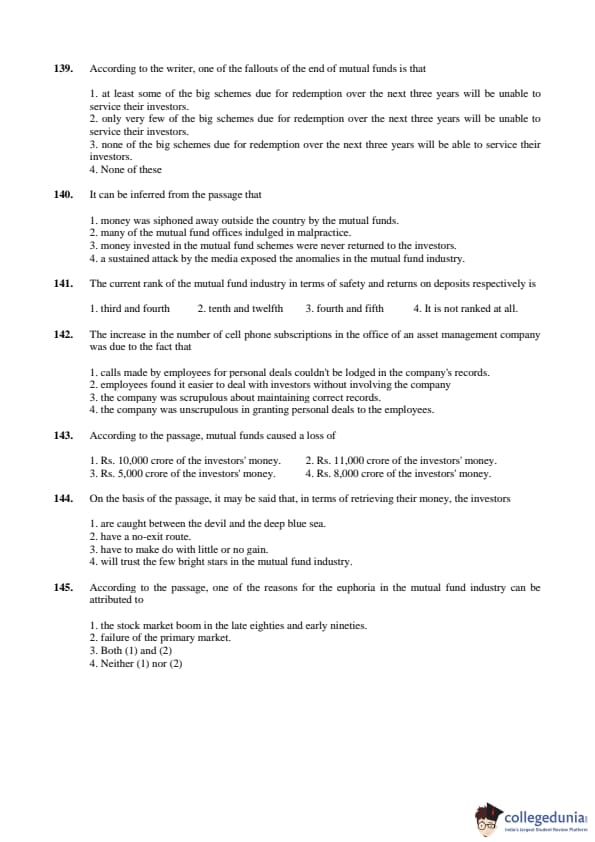
Question 182:

There are four racks numbered 1, 2, 3, 4 and four books numbered 1, 2, 3, 4. If an even rack has to contain an odd-numbered book and an odd rack contains an even-numbered book, then what is the position of book 4?

[I.] Second book has been put in third rack.
[II.] Third book has been put in second rack.

  • (A) if the question can be answered with the help of any one statement alone but not by the other statement.
  • (B) if the question can be answered with the help of either of the statements taken individually.
  • (C) if the question can be answered with the help of both statements together.
  • (D) if the question cannot be answered even with the help of both statements together.
Correct Answer: (A)
View Solution
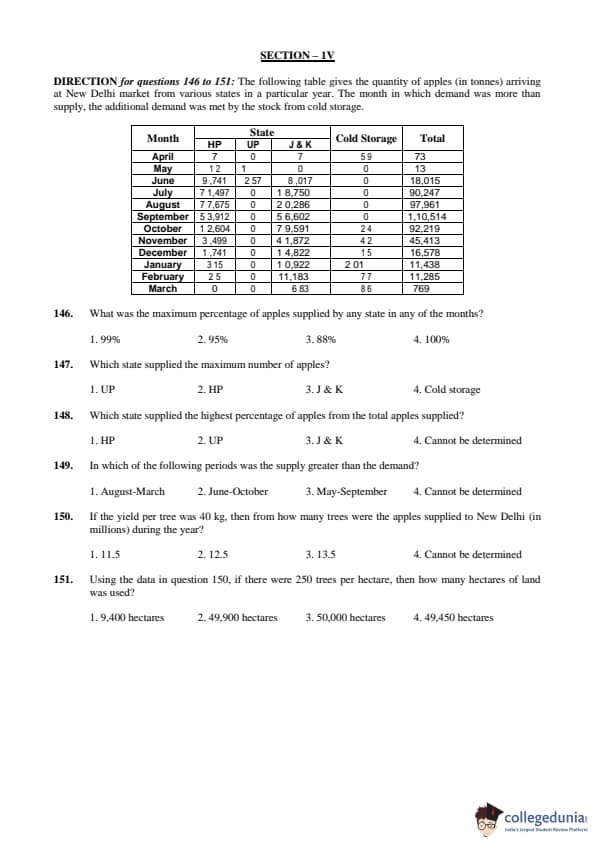
Question 183:

Find the value of X in terms of ‘a’.

[I.] Arithmetic mean of X and Y is ‘a’ while the geometric mean is also ‘a’.
[II.] \(\dfrac{X}{Y} = R\); \(X - Y = D\)

  • (A) if the question can be answered with the help of any one statement alone but not by the other statement.
  • (B) if the question can be answered with the help of either of the statements taken individually.
  • (C) if the question can be answered with the help of both statements together.
  • (D) if the question cannot be answered even with the help of both statements together.
Correct Answer: (A)
View Solution
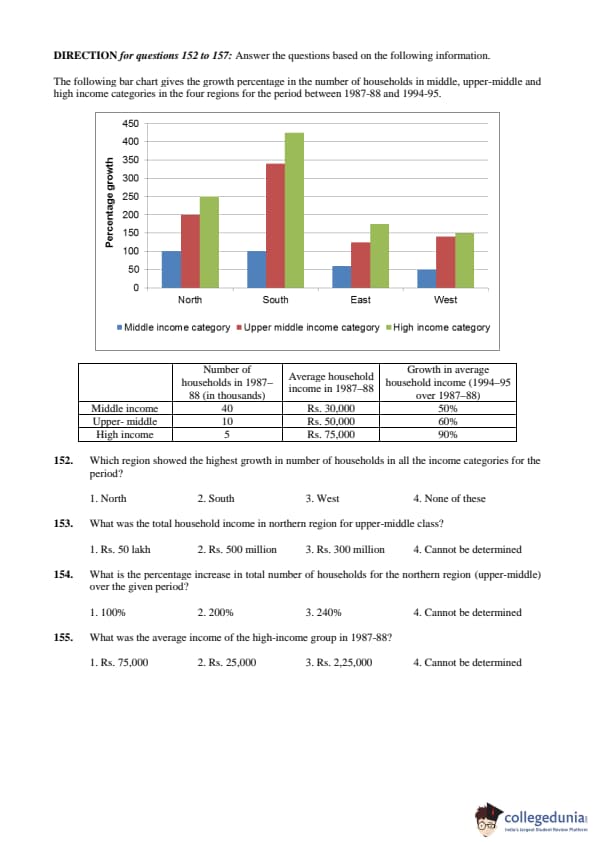
Question 184:

There are two concentric circles \( C_1 \) and \( C_2 \) with radii \( r_1 \) and \( r_2 \). The circles are such that \( C_1 \) fully encloses \( C_2 \). Then what is the radius of \( C_1 \)?

[I.] The difference of their circumference is \( k \) cm.
[II.] The difference of their areas is \( m \) sq. cm.

  • (A) if the question can be answered with the help of any one statement alone but not by the other statement.
  • (B) if the question can be answered with the help of either of the statements taken individually.
  • (C) if the question can be answered with the help of both statements together.
  • (D) if the question cannot be answered even with the help of both statements together.
Correct Answer: (C)
View Solution
Question 185:
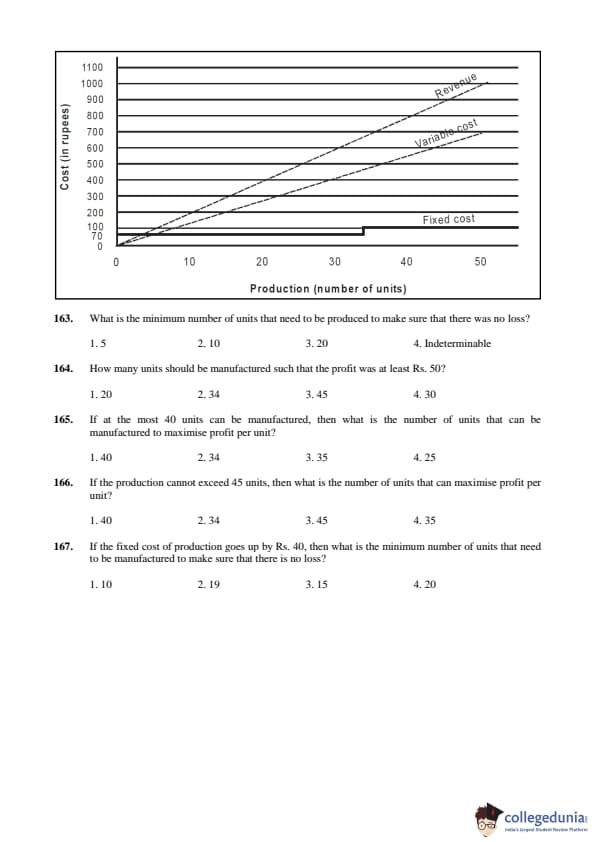
A circle circumscribes a square. What is the area of the square?
[I.] Radius of the circle is given.
[II.] Length of the tangent from a point 5 cm away from the centre of the circle is given.

  • (A) if the question can be answered with the help of any one statement alone but not by the other statement.
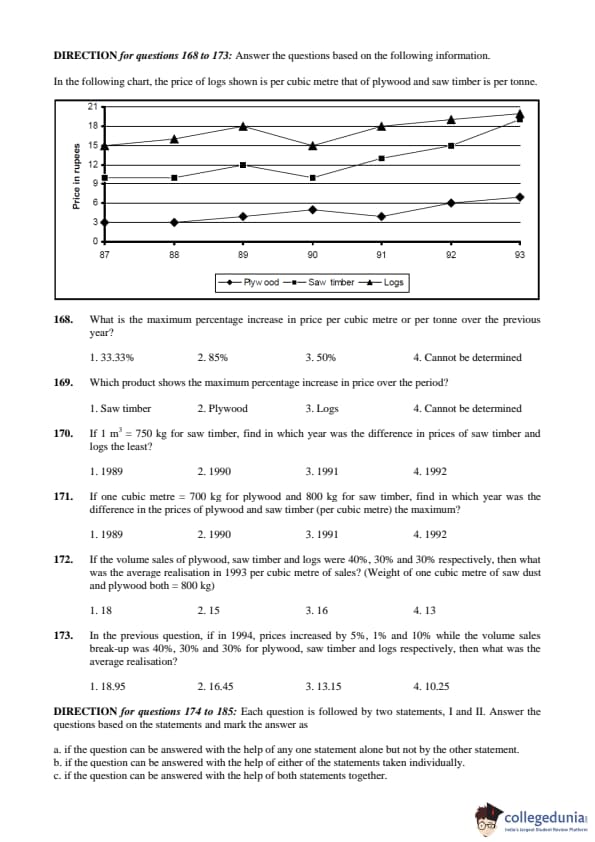
  • (B) if the question can be answered with the help of either of the statements taken individually.
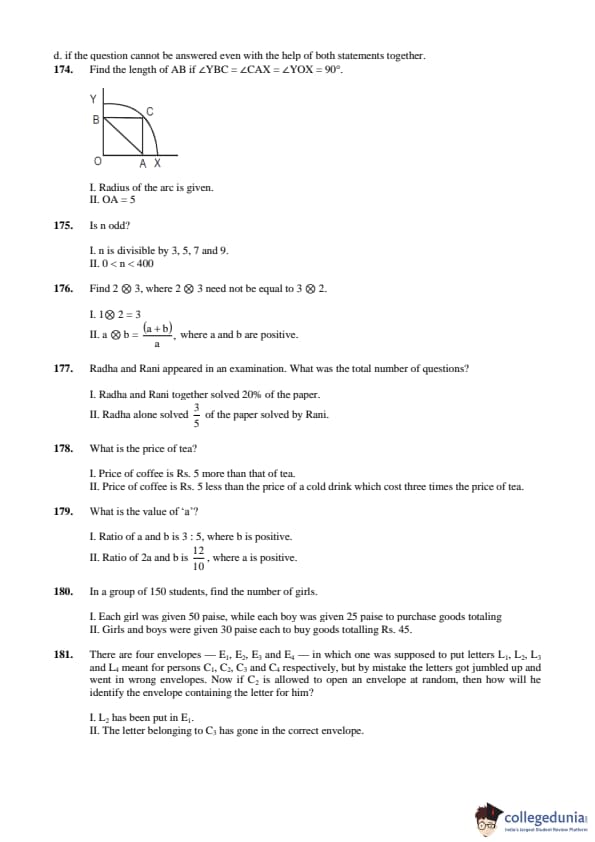
  • (C) if the question can be answered with the help of both statements together.
  • (D) if the question cannot be answered even with the help of both statements together.
Correct Answer: (B)
View Solution


Also Check:

CAT 1998 Paper Analysis

Go through the below-mentioned table displaying the number of questions asked in each of the 4 sections:

Topics Question Frequency
Verbal Ability 50
Reading Comprehension 50
Data Interpretation 40
Problem Solving/ Quantitative Ability 45
Total 185

CAT Previous Year Question Papers

Aspirants planning to clear the upcoming CAT exam are advised to solve CAT previous year question papers to prepare better.

Other MBA Exam Question Papers