




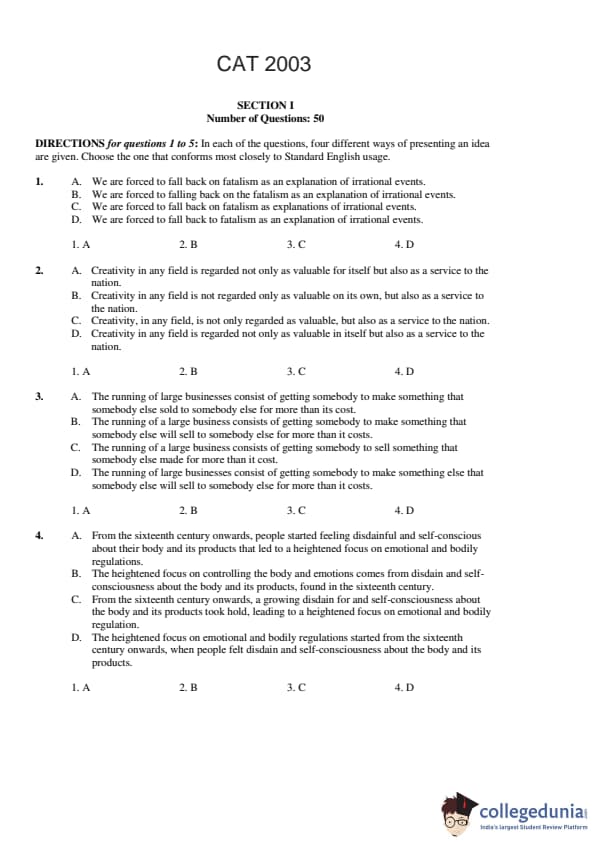
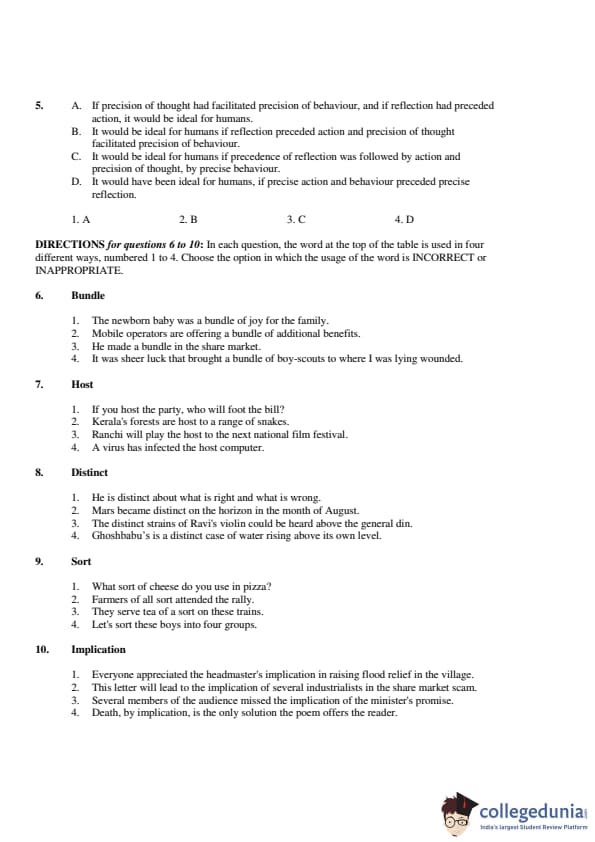
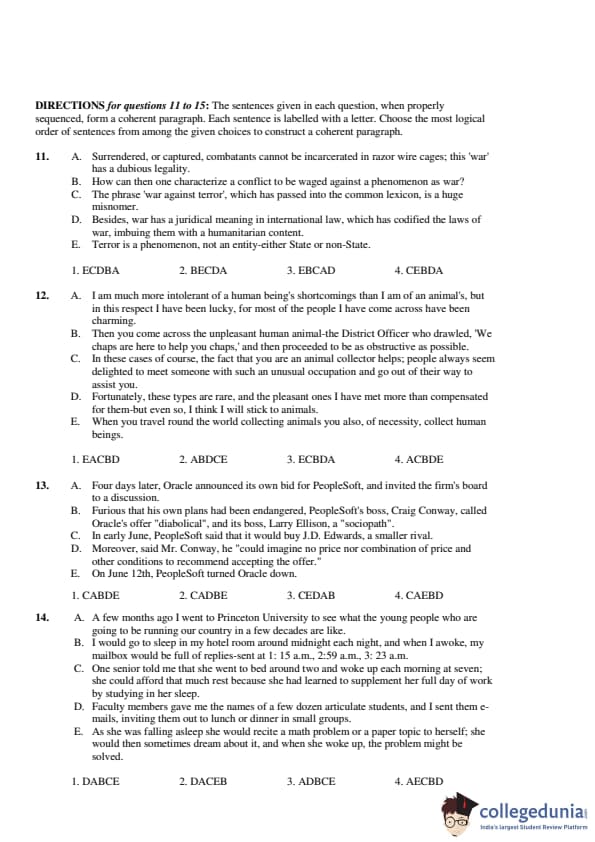
CAT 2003 Question Paper with Answer Key PDFs is available for download.The overall difficulty level of CAT 2003 exam was moderate to tough.CAT 2003 question paper carried 150 questions that were equally distributed in 3 sections- QA, VARC, and DILR. A total of 120 minutes were allotted for the exam. QA was rated the most difficult while the other 2 sections were rated moderate in the 2003 CAT exam.
Candidates preparing for CAT 2025 can download the CAT 2004 question paper with the solution PDF to get a better idea about the type of questions asked in the paper and their difficulty level.
Also Check:
CAT 2003 Question Paper with Answer Key PDFs
| CAT 2003 Question Paper with Answer Key | Download PDF | Check solutions |
Question 1:
questions. Choose the best answer to each question.
PASSAGE 1
The invention of the gas turbine by Frank Whittle in England and Hans von Ohain in
Germany in 1939 signalled the beginning of jet transport. Although the French engineer
Lorin had visualized the concept of jet propulsion more than 25 years earlier, it took
improved materials and the genius of Whittle and von Ohain to recognize the advantage that
a gas turbine offered over a piston engine, including speeds in excess of 350 miles per hour.
Read More
The progress from the first flights of liquid propellant rocket and jet-propelled aircraft in1939 to the first faster-than-sound (supersonic) manned airplane (the Bell X-1) in 1947
happened in less than a decade. This led very rapidly to a series of supersonic fighters and
bombers, the first of which became operational in the 1950s. World War II technology
foundations and emerging Cold War imperatives then led us into space with the launch of
Sputnik in 1957 and the placing of the first man on the moon only 12 years later — a mere
24 years after the end of World War II.
Now a hypersonic flight can take you anywhere in the planet in less than four hours. British
Royal Air Force and Royal Navy and the air forces of several other countries are going to use
a single-engine cousin to the F/A-22, called the F-35 Joint Strike Fighter. These planes
exhibit stealthy angles and coatings that make it difficult for radar to detect them, among
aviation’s most cutting-edge advances in design. The V-22, known as tilt-rotor, part
helicopter, part airplane, takes off vertically, then tilts its engine forward for winged flight. It
provides speed, three times the payload, five times the range of the helicopters it’s meant to
replace. The new fighter, F/A-22 Raptor, with more than a million parts, shows a perfect
assimilation of stealth, speed, avionics and agility.
It seems conventional forms, like the Predator and Global Hawk are pass´e, the stealthy
unmanned aerial vehicles (UAVs) are in. They are shaped like kites, bats and boomerangs,
all but invisible to the enemy radar and able to remain over hostile territory without any fear
of getting grilled if shot down. Will the UAVs take away pilots’ jobs permanently? Can a
computer-operated machine take a smarter and faster decision in a war-like situation? The
2
new free-flight concept will probably supplement the existing air traffic control system by
computers on each plane to map the altitude, route, weather and other planes; and a decade
from now, there will be no use of radar any more.
How much bigger can the airplanes get? In the ’50s they got speed, in the ’80s they became
stealthy. Now they are getting smarter thanks to computer automation. The change is quite
huge: from the four-seater to the A380 airplane. It seems we are now trading speed for size
as we build a new superjumbo jet, the 555 seater A380, which will fly at almost the same
speed of the Boeing 707, introduced half a century ago, but with an improved capacity,
range, greater fuel economy. A few years down the line will come the truly larger model, to
be known as 747X. In the beginning of 2005, the A380, the world’s first fully double-decked
superjumbo passenger jet, weighing 1.1 million pounds, may carry a load of about 840
passengers.
Barring the early phase, civil aviation has always lagged behind the military technologies (of
jet engines, lightweight composite materials, etc.). There are two fundamental factors behind
the decline in commercial aeronautics in comparison to military aeronautics. There is no
collective vision of our future such as the one that drove us in the past. There is also a need
for a more aggressive pool of airplane design talents to maintain an industry that continues to
find a multibillion dollar-a-year market for its product.
Can the history of aviation technology tell us something about the future of aeronautics?
Have we reached a final state in our evolution to a mature technology in aeronautics? Are the
challenges of coming out with the ‘better, cheaper, faster’ designs somehow inferior to those
that are suited for ‘faster, higher, further’? Safety should improve greatly as a result of the
forthcoming improvements in airframes, engines, and avionics. Sixty years from now,
aircraft will recover on their own if the pilot loses control. Satellites are the key not only to
GPS (global positioning system) navigation but also to in-flight communications, uplinked
weather, and even in-flight e-mail. Although there is some debate about what type of engines
will power future airplanes — lightweight turbines, turbocharged diesels, or both — there is
little debate about how these power plants will be controlled. Pilots of the future can look
forward to more and better on-board safety equipment.
Why might radars not be used a decade from now?
View Solution
According to the author, commercial aeronautics, in contrast to military aeronautics, has declined because, among other things:
View Solution
According to the first paragraph of the passage, which of the following statements is NOT false?
View Solution
What is the fourth paragraph of the passage, starting, "How much bigger . . .", about?
View Solution
What is the most noteworthy difference between V-22 and a standard airplane?
View Solution
Pure love of learning, of course, was a less compelling motive for those who became
educated for careers other than teaching. Students of law in particular had a reputation for
being materialistic careerists in an age when law was becoming known as the ‘lucrative
science’ and its successful practice the best means for rapid advancement in the government
of both church and state. Medicine too had its profit-making attractions.
Read More
Those who did not go on to law or medicine could, if they had been well trained in the arts, gain positions atroyal courts or rise in the clergy. Eloquent testimony to the profit motive behind much of
12th-century education was the lament of a student of Abelard around 1150: ”Christians
educate their sons . . . for gain, in order that the one brother, if he be a clerk, may help his
father and mother and his other brothers, saying that a clerk will have no heir and whatever
he has will be ours and the other brothers.” With the opening of positions in law, government
and the church, education became a means for advancement not only in income but also in
status. Most who were educated were wealthy, but in the 12th century, more often than
before, many were not and were able to rise through the ranks by means of their education.
The most familiar examples are Thomas Becket, who rose from a humble background to
become chancellor of England and then archbishop of Canterbury, and John of Salisbury,
who was born a ‘plebeian’ but because of his reputation for learning died as bishop of
Chartres.
The instances of Becket and John of Salisbury bring us to the most difficult question
concerning 12th-century education: To what degree was it still a clerical preserve? Despite
the fact that throughout the 12th century the clergy had a monopoly of instruction, one of the
outstanding medievalists of our day, R. W. Southern, refers with good reason to the
institutions staffed by the clergy as ‘secular schools’. How can we make sense out of the
paradox that 12th-century schools were clerical and yet ‘secular’?
Let us look at the clerical side first. Not only were all 12th-century teachers except
professionals and craftsmen in church order, but in northern Europe students in schools had
clerical status and looked like priests. Not that all really were priests, but by virtue of being
students all were awarded the legal privileges accorded to the clergy. Furthermore, the large
majority of 12th-century students, outside of the possible exception of Italy, if not already
priests became so after their studies were finished. For these reasons, the term ‘cleric’ was
often used to denote a man who was literate and the term ‘layman’ one who was illiterate.
The English word for cleric, clerk, continued for a long time to be a synonym for student or
for a man who could write, while the French word clerc even today has the connotation of
intellectual.
Despite all this, 12th-century education was taking on many secular qualities in its
environment, goals, and curriculum. Student life obviously became more secular when it
moved out from the monasteries into the bustling towns. Most students wandered from town
to town in search not only of good masters but also of worldly excitement, and as the 12th
century progressed they found the best of each in Paris. More important than environment
was the fact that most students, even though they entered the clergy, had secular goals.
Theology was recognized as the ‘queen of the sciences’, but very few went on to it. Instead
they used their study of the liberal arts as a preparation for law, medicine, government
service, or advancement in the ecclesiastical hierarchy.
This being so, the curriculum of the liberal arts became more sophisticated and more
divorced from religion. Teaching was still almost exclusively in Latin, and the first book
most often read was the Psalter, but further education was no longer similar to that of a choir
school. In particular, the discipline of rhetoric was transformed from a linguistic study into
instruction in how to compose letters and documents; there was a new stress on logic; and in
all the liberal arts and philosophy texts more advanced than those known in the early Middle
Ages were introduced.
Along with this new logic came the translation of Greek and Arabic philosophical and
scientific works. Most important was the translation of almost all the writings of Aristotle, as
well as his sophisticated Arabic commentators, which helped to bring about an intellectual
revolution based on Greek rationalism. On a more prosaic level, contact with Arabs resulted
in the introduction in the 12th century of the arithmetic system and the concept of zero.
Though most westerners first resisted this and made crude jokes about it, the material quickly
became widely accepted as useful. When it was understood, the system they used their study
of liberal arts as preparation for law, medicine, government service, or advancement in the
ecclesiastical hierarchy.
According to the passage, what led to the secularisation of the curriculum of the liberal arts in the 12th century?
View Solution
According to the author, in the 12th century, individuals were motivated to get higher education because it
View Solution
According to the passage, 12th-century schools were clerical and yet secular because
View Solution
What does the sentence 'Christians educate their sons . . . will be ours and the other brothers’ imply?
View Solution
According to which of the following is the most noteworthy trend in education in 12th-century Europe?
View Solution
as firmly entrenched in our system as is the older and higher layer comprising the Union
Government and the State. Like the democratic institutions at the higher level, those at the
panchayat level, the panchayati raj institutions (PRIs), are written into and protected by the
Constitution. All the essential features, which distinguish a unitary system from a federal
one, are as much enshrined at the lower as at the upper level of our federal system. But look
closely and you will discover a fatal flaw. The letter of the Constitution as well as the spirit
of the present polity have exposed the intra-State level of our federal system to a dilemma of
which the inter-State and Union-State layers are free.
Read More
The flaw has many causes. But all ofthem are rooted in an historical anomaly, that while the dynamics of federalism and
democracy have given added strength to the rights given to the States in the Constitution,
they have worked against the rights of panchayats.
At both levels of our federal system there is the same tussle between those who have certain
rights and those who try to encroach upon them if they believe they can. Thus, the Union
12
Government was able to encroach upon certain rights given to the States by the Constitution.
It got away with that because the single dominant party system, which characterised
Centre-State relations for close upon two decades, gave the party in power at the Union level
many extra-constitutional political leverages. Second, the Supreme Court had not yet begun
to extend the limits of its power. But all that has changed in recent times. The spurt given to
a multi-party democracy by the overthrow of the Emergency in 1977 became a long-term
trend later on because of the ways in which a vigorously democratic multi-party system
works in a political society which is as assertively pluralistic as Indian society is. It gives
political clout to all the various segments which constitute that society. Secondly, because of
the linguistic reorganisation of States in the 1950s, many of the most assertive segments have
found their most assertive expression as States. Thirdly, with single-party dominance
becoming a thing of the past at the Union level, governments can be formed at that level only
by multi-party coalitions in which State-level parties are major players. This has made it
impossible for the Union Government to do much about anything unless it also carries a
sufficient number of State-level parties with it. Indian federalism is now more real than it
used to be, but an unfortunate side-effect is that India’s panchayati raj system, inaugurated
with such fanfare in the early 1980s, has become less real.
By the time the PRIs came on the scene, most of the political space in our federal system had
been occupied by the Centre in the first 30 years of Independence, and most of what was still
left after that was occupied by the States in the next 20. PRIs might have hoped to wrest
some space from their immediate neighbour, the States, just as the States had wrested some
from the Centre. But having at last managed to checkmate the Centre’s encroachments on
their rights, the States were not about to allow the PRIs to do some encroaching of their own.
By the 1980’s and early 1990s, the only nationally left, the Congress, had gone deeper into a
siege mentality. Finding itself surrounded by State-level parties, it had built walls against
them in stead of winning them over. Next, the States retaliated by blocking Congress
proposals for panchayati raj in Parliament, suspecting that the Centre would try to use
panchayats to by-pass State Governments. The suspicion fed on the fact that the powers
proposed by the Congress for panchayats were very similar to many of the more lucrative
powers of State Governments. State-level leaders also feared, perhaps, that if panchayat-level
leaders captured some of the larger PRIs, such as district-level panchayats, they would exert
pressure on State-level leaders through intra-State multi-party federalism.
It soon became obvious to Congress leaders that there was no way the panchayati raj
amendments they wanted to write into the Constitution would pass muster unless State-level
parties were given their pound of flesh. The amendments were allowed only after it was
agreed that the powers of panchayats could be listed in the Constitution. Illustratively, they
would be defined and endowed on PRIs by the State Legislature acting at its discretion.
This left the door wide open for the States to exert the power of the new political fact that
while the Union and State Governments could afford to ignore panchayats as long as the
MLAs were happy, the Union Government had to be sensitive to the demands of State-level
parties. This has given State-level actors strong beachheads on the shores of both inter-State
and intra-State federalism. By using various administrative devices and non-elected parallel
structures, State Governments have subordinated their PRIs to the State administration and
given the upper hand to State Government officials against the elected heads of PRIs.
Panchayats have become local agencies for implementing schemes drawn up in distant State
capitals. And their own volition has been further circumscribed by a plethora of
‘centrally-sponsored schemes’. These are drawn up by even more distant Central authorities
but at the same time tie up local staff and resources on pain of the schemes being switched
off in the absence of matching local contribution. The ‘foreign aid’ syndrome can be clearly
seen at work behind this kind of ‘grass roots development’.
The central theme of the passage can be best summarized as
View Solution
The sentence in the last paragraph, "And their own volition has been further circumscribed . . ." refers to
View Solution
What is the ‘dilemma’ at the intra-State level mentioned in the first paragraph of the passage?
View Solution
Which of the following most closely describes the ‘fatal flaw’ that the passage refers to?
View Solution
Which of the following best captures the current state of Indian federalism as described in the passage?
View Solution
While I was in class at Columbia, struggling with the esoterica of jury, my father was on a
bricklayer’s scaffold not far up the street, working on a campus building. Once we met up on
the subway going home — he was with his tools, I with my books.
Read More
My father wasn’tinterested in Thucydides, and I wasn’t up on arches. My dad has built lots of places in New
York City he can’t get into: colleges, condos, coffee houses. He made his living on the
outside. Once the walls were up, a place took on a different feel for him, as though he wasn’t
welcome anymore. Related by blood, we’re separated by class, my father and I. Being the
white-collar child of a blue-collar parent means being the hinge on the door between two
ways of life. With one foot in the working class, the other in the middle class, people like me
are Straddlers, at home in neither world, living a limbo life.
What drove me to leave what I knew? Born blue-collar, I still never felt completely at home
among the tough guys and anti-intellectual crowd of my neighbourhood in deepest Brooklyn.
I never did completely fit in among the preppies and suburban royalty of Columbia, either.
It’s like that for Straddlers. It was not so smooth jumping from Italian old-world style to US
professional in a single generation. Others who were the first in their families to go to
college, will tell you the same thing: the academy can render you unrecognisable to the very
people who launched you into the world. The ideas and values absorbed in college challenge
the mom-and-pop orthodoxy that passed for truth for 18 years. Limbo kids may eschew
polyester blends for sea-isle cotton, prefer Brice to Kraft slices. They may wear clothes the
neighbourhood raises their eyebrows about. But they still live at home, speak the language of
the house and climb back there at the moment of reward.
But for the white-collar kids of blue-collar parents, the office is not necessarily a sanctuary.
In Corporate America, where the white-collar class is seen as foreign to working-class
people, a Straddler can get lost. Social class counts as the office, even though nobody likes to
admit it. Ultimately, corporate people learn as good middle-class adults, business types say,
how to work with those kids. They follow the way of getting along: diplomacy, nuance, and
politics to grab what they need. It’s also the reason they find following a set of rules laid out
in a manual that blue-collar families never have the chance to do.
People from both the middle class and the college degrees have lived lives filled with what
French sociologist Pierre Bourdieu calls ‘cultural capital’. Growing up in an educated
environment, they had access to Picasso and Mozart, sports and career behind. In a world
where actual French intellectuals are networked: Someone always has an aunt or golfing
buddy with the inside track for an internship or the right dinner-table talk would happen that
day from and with the family, the doctor’s office, the engine executive. Middle-class kids can
grow up with a sense of entitlement and can carry them through their lives. This
belongingness is not just related to having material means, it also has to do with learning and
possessing confidence in your place in the world. Such easy entitlement and direct exposure
to culture in the home is the more original, ‘legitimate’ means of appropriately cultural
capital, Bourdieu tells us. Those of us possessing ‘ill-gotten’ Culture’ can learn, but never as
well. Something is always a little off about us, like an engine with imprecise timing. There’s
a greater method between these class and the institutions in which the middle class works
and operates — universities or corporations. Children find the middle and upper classes have
been speaking about what life is for the culture.
According to the passage, which of the following statements about 'cultural capital' is NOT true?
View Solution
According to the passage, the patterns of socialization of working-class children make them most suited for jobs that require
View Solution
When Straddlers enter white collar jobs, they get lost because
View Solution
What does the author’s statement, "my father wasn’t interested in Thucydides, and I wasn’t up on arches," illustrate?
View Solution
Which of the following statements about Straddlers does the passage NOT support explicitly?
View Solution
The endless struggle between the flesh and the spirit found an end in Greek art. The Greek
artists were unaware of it. They were spiritual materialists, never denying the importance of
the body and ever seeing in the body a spiritual significance.
Read More
Mysticism on the whole was alien to the Greeks, thinkers as they were. Thought and mysticism never go well together andthere is little symbolism in Greek art. Athena was not a symbol of wisdom but an
embodiment of life and her statues were beautiful grave women, whose seriousness might
mark them as wise, but who were marked in no other way. The Apollo Belvedere is not a
22
symbol of the sun, nor the Versailles Artemis of the moon. There could be nothing less akin
to the ways of symbolism than their beautiful, normal humanity. Nor did decoration really
interest the Greeks. In all their art they were preoccupied with what they wanted to express,
not with ways of expressing it, and lovely expression, merely as lovely expression, did not
appeal to them at all.
Greek art is intellectual art, the art of men who were clear and lucid thinkers, and it is
therefore plain art. Artists than whom the world has never seen greater, men endowed with
the spirit’s best gift, found their natural method of expression in the simplicity and clarity
which are the endowment of the uncloaked soul. ”Nothing is excess; everything is regular,”
said the dictum of men who knew how to express. Structure belongs in an especial degree to
the province of the mind in art, and architecture resides here, as Greek architects would say,
“unmistakably.” These great men made a unified whole of the trilogy of Greek tragedy, by a
pure line, the surest, precise, decisive scheme of the Greek statue, from its finest conception
into expression in Greek architecture. The Greek temple is the clearest example, and it shows
courage and religious spirituality in architecture.
A Hindu temple is a complex expression of adornment. The lines of building are completely
hidden by the architectural sculptural figures and ornaments, visible to no one but the
temple-maker in thick masses, break it up into a bewildering series of irregular figures. It is
not a unity but a collection, rich, refined. It continues in unexpected forms as painters build
this way and that as the ornament required. The conclusion indefinitely is not planned but
built this way and that as the creator who has the mystical meaning to give. Greek
architecture was not particularly a means for the artist to inscribe the theory symbols of the
truth.
Again, the gigantic temples of Egypt, those massive immensities of granite which look as if
they power through the firmament were mighty enough to bring them into existence, are
something other than the creation of generous humanity based in beauty. The science and the
spirit are there, but what is there is a stiff, uncouth force, a form that becomes monumental,
overwhelming. It leads to nothingness at all that belongs to man. It is a great idea. The
Egyptian architects were possessed by the consciousness of the willful, irresistible
domination of the ways of nature; they had no thought to give the insignificant details that
would.
Greek architecture of the great age is the expression of men who were, first of all, intellectual
artists, kept firmly within the visible world by their mind, but, secondly to that, lovers of the
human world. The Greeks possessed the world of the pure intellect limited by the spirit. No
other great builders touched anything as simple as this simplicity in the Parthenon straight
columns rise to gain capitals, a gradient is sculptured in bold relief; there is nothing more.
And yet — here is the Greek machine — this absolute simplicity of structure is akin to
massive beauty and grand yet subtle mass. The architects and place would follow. Majestic
but modern, truly Greek. No superhuman force as in Egypt; no strange supernatural shapes
as in India; the Parthenon is the home of humanity at ease, calm, created of itself and high in
its eyes.
The Greek’s final challenge to nature lies in the fullness of their joyous strength. They set
their temples with such a small of all overlooking the whole sky, untied against the circle of
the sky. They would build where no war has happened, raise and ask any grander than all
these. It matters not at all if the temple is larger or small; one never thinks of the size. It
matters how much it is in ruins. A few will still need to recover for their individual work.
However, for Greeks, they would have let stand their stones for centuries for happiness.
"The Greeks flung a challenge to nature in the fullness of their joyous strength." Which of the following best captures the 'challenge' that is being referred to?
View Solution
Which of the following is NOT a characteristic of Greek architecture, according to the passage?
View Solution
From the passage, which of the following combinations can be inferred to be correct?
View Solution
According to the passage, what conception of man can be inferred from Egyptian architecture?
View Solution
According to the passage, which of the following best explains why there is little symbolism in Greek art?
View Solution
Directions for questions 26 to 33: The sentences given in each question, when properly
sequenced, form a coherent paragraph. Each sentence is labelled with a letter. Choose the
most logical order of sentences from among the given choices to construct a coherent
paragraph.
A. The wall does not simply divide Israel from a putative Palestinian state on the basis of the 1967
borders.
B. A chilling omission from the road map is the gigantic ‘separation wall’ now being built in the West
Bank by Israel.
C. It is surrounded by trenches, electric wire and moats; there are watchtowers at regular intervals.
D. It actually takes new tracts of Palestinian and, sometimes five or six kilometres at a stretch.
E. Almost a decade after the end of South African apartheid this ghastly racist wall is going up with
scarcely a peep from Israel’s American allies who are going to pay for most of it.
View Solution
A. Luckily the tide of battle moved elsewhere after the American victory at Midway and an Australian
victory over Japan at Milne Bay.
B. It could have been no more than a delaying tactic.
C. The Australian military, knowing the position was hopeless, planned to fall back to the south
east in the hope of defending the main cities.
D. They had captured most of the Solomon Islands and much of New Guinea, and seemed poised
for an invasion.
E. Not many people outside Australia realize how close the Japanese got.
View Solution
A. Call it the third wave sweeping the Indian media.
B. Now they are starring in a new role, as suave dealmakers who are in a hurry to strike alliances
and agreements.
C. Look around and you will find a host of deals that have been inked or are ready to be finalized.
D. Then the media barons wrested back control from their editors, and turned marketing warriors
with the brand as their missile.
E. The first came with those magnificent men in their mahogany chambers who took on the world
with their mighty fountain pens.
View Solution
A. The celebrations of economic recovery in Washington may be as premature as that ‘Mission
Accomplished’ banner hung on the USS Abraham Lincoln to hail the end of the Iraq war.
B. Meanwhile, in the real world, the struggles of families and communities continue unabated.
C. Washington responded to the favourable turn in economic news with enthusiasm.
D. The celebrations and high-fives up and down Pennsylvania Avenue are not to be found beyond
the Beltway.
E. When the third quarter GDP showed growth of 7.2% and the monthly unemployment rate dipped
to six per cent euphoria gripped the US capital.
View Solution
A. To much of the Labour movement, it symbolises the brutality of the upper classes.
B. And to everybody watching, the current mess over foxhunting symbolises the government’s
weakness.
C. To foxhunting’s supporters, Labour’s 1991 manifesto commitment to ban it symbolises the party’s
metropolitan roots and hostility to the countryside.
D. Small issues sometimes have large symbolic power.
E. To those who enjoy thundering across the countryside in red coats after foxes, foxhunting
symbolises the ancient roots of rural lives.
View Solution
A. In the case of King Merolchazzar’s courtship of the Princess of the Outer Isles, there occurs a
regrettable hitch.
B. She acknowledges the gifts, but no word of a meeting date follows.
C. The monarch, hearing good reports of a neighbouring princess, dispatches messengers with
gifts to her court, beseeching an interview.
D. The princess names a date, and a formal meeting takes place; after that everything buzzes
along pretty smoothly.
E. Royal love affairs in olden days were conducted on the correspondence method.
View Solution
A. Who can trace to its first beginnings the love of Damon for Pythias, of David for Jonathan, of
Swan for Edgar?
B. Similarly with men.
C. There is about great friendships between man and man a certain inevitability that can only be
compared with the age-old association of ham and eggs.
D. One simply feels that it is one of the things that must be so.
E. No one can say what was the mutual magnetism that brought the deathless partnership of these
wholesome and palatable foodstuffs about.
View Solution
A. Events intervened, and in the late 1930s and 1940s, Germany suffered from ‘over-branding’.
B. The British used to be fascinated by the home of Romanticism.
C. But reunification and the federal government’s move to Berlin have prompted Germany to think
again about its image.
D. The first foreign package holiday was a tour of Germany organized by Thomas Cook in 1855.
E. Since then Germany has been understandably nervous about promoting itself abroad.
View Solution
It is important for shipping companies to be clear about the objectives for maintenance and materials
management — as to whether the primary focus is on service level improvement or cost minimization.
Often when certain systems are set in place, the cost minimization objective and associated procedure
become more important than the flexibility required for service level improvement. The problem really
arises since cost minimization tends to focus on out of pocket costs which are visible, while the
opportunity costs, often greater in value, are lost sight of.
A. Shipping companies have to either minimize costs or maximize service quality. If they focus on
cost minimization, they will reduce quality. They should focus on service level improvement, or
else opportunity costs will be lost sight of.
B. Shipping companies should determine the primary focus of their maintenance and materials
management. Focus on cost minimization may reduce visible costs, but ignore greater invisible
costs and impair service quality.
C. Any cost minimization programme in shipping is bound to lower the quality of service. Therefore,
shipping companies must be clear about the primary focus of their maintenance and materials
management before embarking on cost minimization.
D. Shipping companies should focus on quality level improvement rather than cost cutting. Cost
cutting will lead to untold opportunity costs. Companies should have systems in place to make
the service level flexible.
View Solution
Try before you buy. We use this memorable saying to urge you to experience the consequences of an alternative before you choose it, whenever this is feasible. If you are considering buying a van after having always owned sedans, rent one for a week or borrow a friend’s. By experiencing the consequences first hand, they become more meaningful. In addition, you are likely to identify consequences you had not even thought of before. Maybe you will discover that it is difficult to park the van in your small parking space at work, but that, on the other hand, your elderly father has a much easier time getting in and out of it.
(A) If you are planning to buy a van after being used to sedans, borrow a van or rent it and try it before deciding to buy it. Then you may realize that parking a van is difficult while it is easier for your elderly father to get in and out of it.
(B) Before choosing an alternative, experience its consequences if feasible. If, for example, you want to change from sedans to a van, try one before buying it. You will discover aspects you may never have thought of.
(C) Always try before you buy anything. You are bound to discover many consequences. One of the consequences of going in for a van is that it is more difficult to park than sedans at the office car park.
(D) We urge you to try products such as vans before buying them. Then you can experience consequences you have not thought of such as parking problems. But your father may find vans more comfortable than cars.
View Solution
Physically, inertia is a feeling that you just can’t move; mentally, it is a sluggish mind. Even if you try to be sensitive, if your mind is sluggish, you just don’t feel anything intensely. You may even see a tragedy enacted in front of your eyes and not be able to respond meaningfully. You may see one person exploiting another, one group persecuting another, and not be able to get angry. Your energy is frozen. You are not deliberately refusing to act; you just don’t have the capacity.
Inertia is of two types — physical and mental. Physical inertia restricts bodily movements.
Mental inertia prevents mental response to events enacted in front of your eyes.
(A) Inertia makes your body and mind sluggish. They become insensitive to tragedies, exploitation, and persecution because it freezes your energy and decapitates it.
(B) When you have inertia you don’t act although you see one person exploiting another or one group persecuting another. You don’t get angry because you are incapable.
(C) Inertia is of two types — physical and mental. Physical inertia restricts bodily movements.
(D) Physical inertia stops your body from moving; mental inertia freezes your energy, and stops your mind from responding meaningfully to events, even tragedies, in front of you.
View Solution
Some decisions will be fairly obvious — 'no-brainers'. Your bank account is low, but you have a two-week vacation coming up and you want to get away to some place warm to relax with your family.
Will you accept your in-laws’ offer of free use of their Florida beachfront condo? Sure. You like your employer and feel ready to move forward in your career. Will you step in for your boss for three weeks while she attends a professional development course? Of course.
(A) Some decisions are obvious under certain circumstances. You may, for example, readily accept a relative’s offer of free holiday accommodation. Or step in for your boss when she is away.
(B) Some decisions are no-brainers. You need not think when making them. Examples are condo offers from in-law and job offers from bosses when your bank account is low or boss is away.
(C) Easy decisions are called 'no-brainers' because they do not require any cerebral activity. Examples such as accepting free holiday accommodation abound in our lives.
(D) Accepting an offer from in-laws when you are short on funds and want a holiday is a no-brainer. Another no-brainer is taking the boss’s job when she is away.
View Solution
Help
View Solution
Paper
View Solution
Service
View Solution
Reason
View Solution
Business
View Solution
The best punctuation is that of which the reader is least conscious; for when punctuation, or lack of it, ................. itself, it is usually because it .................
View Solution
The argument that the need for a looser fiscal policy to ............ demand outweighs the need to .............. budget deficits is persuasive.
View Solution
The Athenians on the whole were peaceful and prosperous; they had ............ to sit at home and think about the universe and dispute with Socrates, or to travel abroad and ............... the world.
View Solution
Their achievement in the field of literature is described as ...............; sometimes it is even called ...............
View Solution
From the time she had put her hair up, every man she had met had grovelled before her and she had acquired a mental attitude toward the other sex which was a blend of ............ and ................
View Solution
This simplified ............. to the decision-making process is a must read for anyone ............... important real estate, personal, or professional decisions.
View Solution
Physicians may soon have ............ to help paralysed people move their limbs by bypassing the ............... nerves that once controlled their muscles.
View Solution
The Internet is a medium where users have nearly .......... choices and ............. constraints about where to go and what to do.
View Solution
The value of the numeral MDCCLXXXVII is
View Solution
The value of the numeral MCMXCIX is
View Solution
Which of the following represent the numeral for 1995?
I. MCMLXXV
II. MCMXCV
III. MVD
IV. MVM
View Solution
Let the radius of each circular park be \(r\), and the distances to be traversed by the sprinters A, B, and C be \(a\), \(b\), and \(c\) respectively. Which of the following is true?
View Solution
Sprinter A traverses distances \( A_1 A_2 \), \( A_2 A_3 \), and \( A_3 A_4 \) at average speeds of 20, 30, and 15 respectively.
B traverses her entire path at a uniform speed of \( (10\sqrt{3} + 20) \).
C traverses distances \( C_1 C_2 \), \( C_2 C_3 \), and \( C_3 C_4 \), at average speeds of \( \frac{40}{3}(\sqrt{3} + 1) \), \( \frac{40}{3}(\sqrt{3} + 1) \), and 120 respectively. All speeds are in the same unit. Where would B and C be respectively when A finishes her sprint?
View Solution
Sprinters A, B, and C traverse their respective paths at uniform speeds of \( u \), \( v \), and \( w \) respectively. It is known that \( u^2:v^2:w^2 \) is equal to Area A: Area B: Area C, where Area A, Area B, and Area C are the areas of triangles \( A_1 A_2 A_3 \), \( B_1 B_2 B_3 \), and \( C_1 C_2 C_3 \) respectively. Where would A and C be when B reaches point \( B_3 \)?
View Solution
What is the vertical spacing between the two consecutive turns?
% Placeholder for the bar chart image

View Solution
The same string, when wound on the exterior four walls of a cube of side \( n \, cm \), starting at point C and ending at point D, can give exactly one turn (see figure, not drawn to scale). The length of the string is:
% Placeholder for the bar chart image

View Solution
In the set-up of the previous two questions, how is \( h \) related to \( n \)?
View Solution
There are 12 towns grouped into four zones with three towns per zone. It is intended to connect the towns with telephone lines such that every two towns are connected with three direct lines if they belong to the same zone, and with only one direct line otherwise. How many direct telephone lines are required?
View Solution
In the figure (not drawn to scale) given below, P is a point on AB such that \(AP : PB = 4 : 3\). PQ is parallel to AC and QD is parallel to CP. In \(\triangle ARC\), \(\angle ARC = 90^\circ\), and in \(\triangle PQS\), \(\angle PQS = 90^\circ\). The length of QS is 6 cm. What is the ratio of \(AP : PD\)?
% Placeholder for the bar chart image

View Solution
A car is being driven, in a straight line and at a uniform speed, towards the base of a vertical tower. The top of the tower is observed from the car and, in the process, it takes 10 min for the angle of elevation to change from \(45^\circ\) to \(60^\circ\). After how much more time will this car reach the base of the tower?
View Solution
In the figure (not drawn to scale) given below, if \(AD = CD = BC\) and \(\angle DBC = 96^\circ\), how much is the value of \(\angle DBC\)?
% Placeholder for the bar chart image

View Solution
If both a and b belong to the set \(\{1, 2, 3, 4\}\), then the number of equations of the form \(ax^2 + bx + 1 = 0\) having real roots is:
View Solution
If \(\log_x x - \log_10 \sqrt{x} = 2 \log_10 10\), then the possible value of \(x\) is given by:
View Solution
What is the sum of all two-digit numbers that give a remainder of 3 when they are divided by 7?
View Solution
An intelligence agency forms a code of two distinct digits selected from 0, 1, 2, ..., 9 such that the first digit of the code is non-zero. The code, handwritten on a slip, can however potentially create confusion when read upside down — for example, the code 91 may appear as 16. How many codes are there for which no such confusion can arise?
View Solution
Consider two different cloth-cutting processes. In the first one, \(n\) circular cloth pieces are cut from a square cloth piece of side \(a\) in the following steps: the original square of side \(a\) is divided into \(n\) smaller squares, not necessarily of the same size, then a circle of maximum possible area is cut from each of the smaller squares. In the second process, only one circle of maximum possible area is cut from the square of side \(a\) and the process ends there. The cloth pieces remaining after cutting the circles are scrapped in both the processes. The ratio of the total area of scrap cloth generated in the former to that in the latter is:
View Solution
In the figure below (not drawn to scale), rectangle ABCD is inscribed in the circle with center at O. The length of side AB is greater than side BC. The ratio of the area of the circle to the area of the rectangle ABCD is \(\pi : \sqrt{3}\). The line segment DE intersects AB at E such that \(\angle DOC = \angle ADE\). The ratio \(AE : AD\) is:
% Placeholder for the bar chart image

View Solution
If \(\frac{1}{3} \log N + 3 \log M = 1 + \log 1000\), then:
View Solution
Using only 2, 5, 10, 25, and 50 paisa coins, what will be the minimum number of coins required to pay exactly 78 paise, 69 paise and Rs. 1.01 to three different persons?
View Solution
The length of the circumference of a circle equals the perimeter of a triangle of equal sides, and also the perimeter of a square. The areas covered by the circle, triangle, and square are \(c\), \(t\), and \(s\), respectively. Then,
View Solution
What is the remainder when \(4^8\) is divided by 6?
View Solution
If \(x\) and \(y\) are integers, then the equation \(5x + 19y = 64\) has:
View Solution
What is the sum of \(n\) terms in the series \(\log m + \log \left( \frac{m^2}{n} \right) + \log \left( \frac{m^3}{n^2} \right) + \log \left( \frac{m^4}{n^3} \right) + \dots\)?
View Solution
Let \(S_1\) be a square of side \(a\). Another square \(S_2\) is formed by joining the mid-points of the sides of \(S_1\). The same process is applied to \(S_1\) to form yet another square \(S_3\), and so on. If \(A_1\), \(A_2\), \(A_3\), \dots are the areas and \(P_1\), \(P_2\), \(P_3\), \dots are the perimeters of \(S_1\), \(S_2\), \(S_3\), \dots, respectively, then the ratio \(\frac{P_1 + P_2 + P_3 + \dots}{A_1 + A_2 + A_3 + \dots}\) equals:
View Solution
If three positive real numbers \(x\), \(y\) and \(z\) satisfy \(y - x = z - y\) and \(x + y = 4\), then what is the minimum possible value of \(y\)?
View Solution
In the figure given below (not drawn to scale), A, B and C are three points on a circle with centre O. The chord BA is extended to a point T such that CT becomes a tangent to the circle at point C. If \(\angle \angle ATC = 30^\circ\) and \(\angle ACT = 50^\circ\), then the angle \(\angle ABOA\) is:
% Placeholder for the bar chart image

View Solution
The infinite sum \(1 + \frac{4}{7} + \frac{9}{72} + \frac{16}{73} + \frac{25}{74} + \dots\) equals:
View Solution
Consider the sets \(T_n = \{n, n+1, n+2, n+3, n+4\}\), where \(n = 1, 2, 3, \dots, 96\). How many of these sets contain 6 or any integral multiple thereof (i.e., any one of the numbers 6, 12, 18, ...)?
View Solution
Let ABCDEF be a regular hexagon. What is the ratio of the area of \(\triangle ACE\) to that of the hexagon ABCDEF?
View Solution
The number of roots common between the two equations \(x^3 + 3x^2 + 4x + 5 = 0\) and \(x^4 + 2x^3 + 7x + 3 = 0\) is:
View Solution
A real number \(x\) satisfying \(1 - \frac{1}{n} < x \leq 3 + \frac{1}{n}\), for every positive integer \(n\), is best described by:
View Solution
If \(n\) is such that \(36 \leq n \leq 72\), then \(x = \frac{n^2 + 2\sqrt{n(n+4)} + 16}{n + 4\sqrt{n + 4}}\) satisfies:
View Solution
If \(13x + 2z = 5y^2\), then:
View Solution
Let \(n(>1)\) be a composite integer such that \(\sqrt{n}\) is not an integer. Consider the following statements:
A: \(n\) has a perfect integer-valued divisor which is greater than 1 and less than \(\sqrt{n}\)
B: \(n\) has a perfect integer-valued divisor which is greater than \(\sqrt{n}\) but less than \(n\)
Then:
View Solution
If \(|b| \geq |a|\) and \(x = |a| - b\), then which one of the following is necessarily true?
View Solution
A piece of paper is in the shape of a right-angled triangle and is cut along a line that is parallel to the hypotenuse, leaving a smaller triangle. There was 35% reduction in the length of the hypotenuse of the triangle. If the area of the original triangle was 34 square inches before the cut, what is the area (in square inches) of the smaller triangle?
View Solution
Two straight roads R1 and R2 diverge from a point A at an angle of 120°. Ram starts walking from point A along R1 at a uniform speed of 3 km/hr. Shyam starts walking at the same time from A along R2 at a uniform speed of 2 km/hr. They continue walking for 4 hr along their respective roads and reach points B and C on R1 and R2 respectively. There is a straight line connecting B and C. Then Ram returns to point A after walking along the line segments BC and CA. Shyam also returns to A after walking along line segments BC and CA. Their speeds remain unchanged. The time interval (in hours) between Ram's and Shyam's return to the point A is:
View Solution
A square in sheet of side 12 inches is converted into a box with open top in the following steps. The sheet is placed horizontally. Then, equal-sized squares, each of side \(x\) inches, are cut from the four corners of the sheet. Finally, the four resulting sides are bent vertically upwards in the shape of a box. If \(x\) is an integer, then what value of \(x\) maximizes the volume of the box?
View Solution
If \(a\), \(a+2\) and \(a+4\) are prime numbers, then the number of possible solutions for \(a\) is:
View Solution
Let \(a\), \(b\), \(c\), and \(d\) be integers such that \(a = 6b\), \(a = 12c\), and \(2b = 9d = 12e\). Then which of the following pairs contains a number that is not an integer?
View Solution
In a coastal village, every year floods destroy exactly half of the huts. After the flood water recedes, the same number of huts destroyed are rebuilt. The floods occurred consecutively in the last three years — 2001, 2002 and 2003. If floods are expected again in 2004, the number of huts expected to be destroyed is:
View Solution
What is the smallest positive integer \(n\) such that \(g^n = e\)?
View Solution
Upon simplification, \(f \circ f \circ f \circ (f \circ (f \circ f))\) equals:
View Solution
Upon simplification, \(a^{10} \circ (f \circ (g \circ g)) \circ e^8\) equals:
View Solution
How many strings of letters can possibly be formed using the above rules?
View Solution
How many strings of letters can possibly be formed using the above rules such that the third letter of the string is e?
View Solution
Let \(x\) and \(y\) be positive integers such that \(x\) is prime and \(y\) is composite. Then,
View Solution
A survey on a sample of 25 new cars being sold at a local auto dealer was conducted to see which of the three popular options — air conditioning, radio and power windows were already installed. Following were the observation of the survey:
I. 15 had air conditioning
II. 2 had air conditioning and power windows but no radios
III. 12 had radio
IV. 6 had air conditioning and radio but no power windows
V. 11 had power windows
VI. 4 had radio and power windows
VII. 3 had all three options
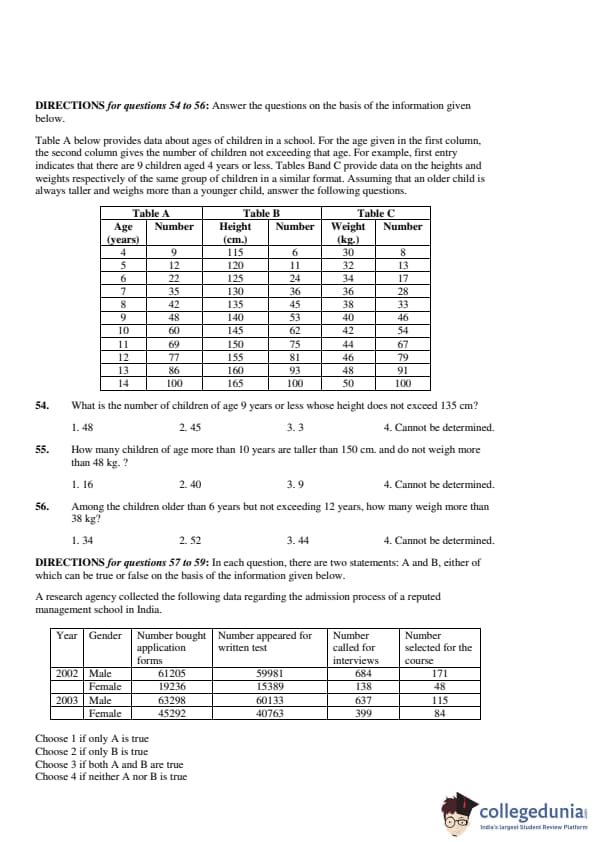
What is the number of cars that had none of the options?
View Solution
The athletes from FRG and USA decided to run a 4 × 100 m relay race for their respective countries with the country having three athletes borrowing the athlete from CZE. Assume that all the athletes run their stretch of the relay race at the same speed as in Decathlon event. How much more time did the FRG relay team take as compared to the USA team?
View Solution
What is the least that Daley Thompson must get in Score-2 that ensures him a bronze medal?
View Solution
At least how many competitors (excluding Daley Thompson) must Michael Smith have out-jumped in the long jump event?
View Solution
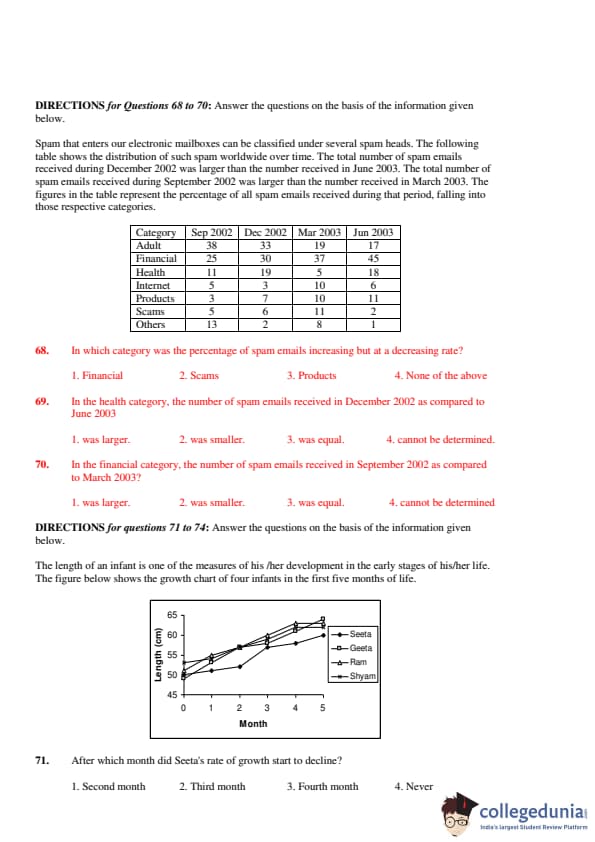
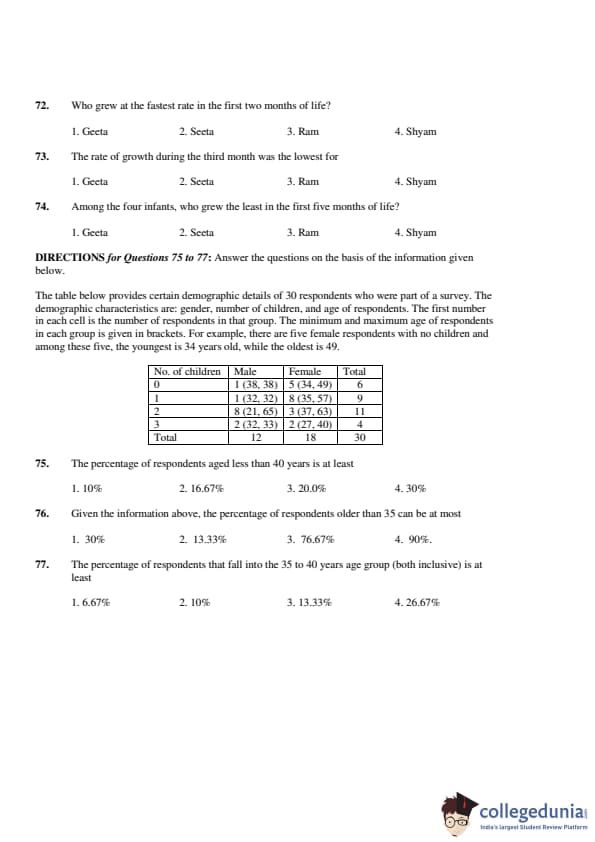
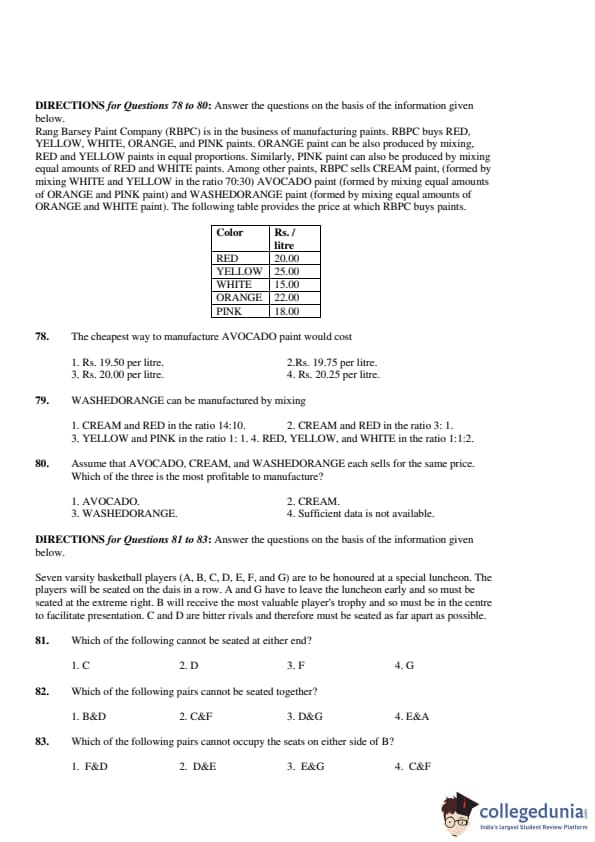
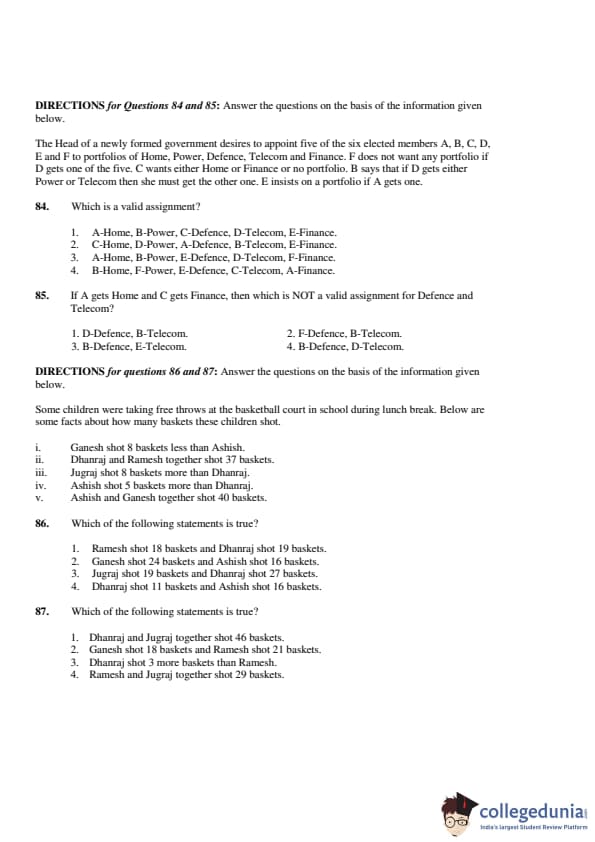
In which year during the period 1996-1999 was Chaidesh’s export of tea, as a proportion of tea produced, the highest?
View Solution
In which of the following years was the population of Chaidesh the lowest?
View Solution
The area under tea cultivation continuously decreased in all four years from 1996 to 1999, by 10%, 7%, 4%, and 1%, respectively. In which year was tea productivity (production per unit of area) the highest?
View Solution
Let us suppose that one bag of cement (50 kg) consumes 100 kg of limestone and 10 units of power. The only other cost item in producing cement is in the form of wages. During 1993-94, limestone, power and wages contributed, respectively, 20%, 25% and 15% to the cement price per bag. The average operating profit (per cent of price per cement bag) earned by a cement manufacturer during 2002-03 is closest to:
View Solution
Steel manufacturing requires the use of iron ore, power and manpower. The cost of iron ore has followed the All Items index. During 1993-94 power accounted for 30% of the selling price of steel, iron ore for 25%, and wages for 10% of the selling price of steel. Assuming the cost and price data for cement as given in the previous question, the operating profit (per cent of selling price) of an average steel manufacturer in 2002-03 is:
View Solution
Which item experienced continuous price rise during the ten-year period?
View Solution
Which item(s) experienced only one decline in price during the ten-year period?
View Solution
In the consolidated list, what would be the overall rank of the Philippines?
View Solution
In the consolidated list, how many countries would rank below Spain and above Taiwan?
View Solution
In the consolidated list, which country ranks 37th?
View Solution
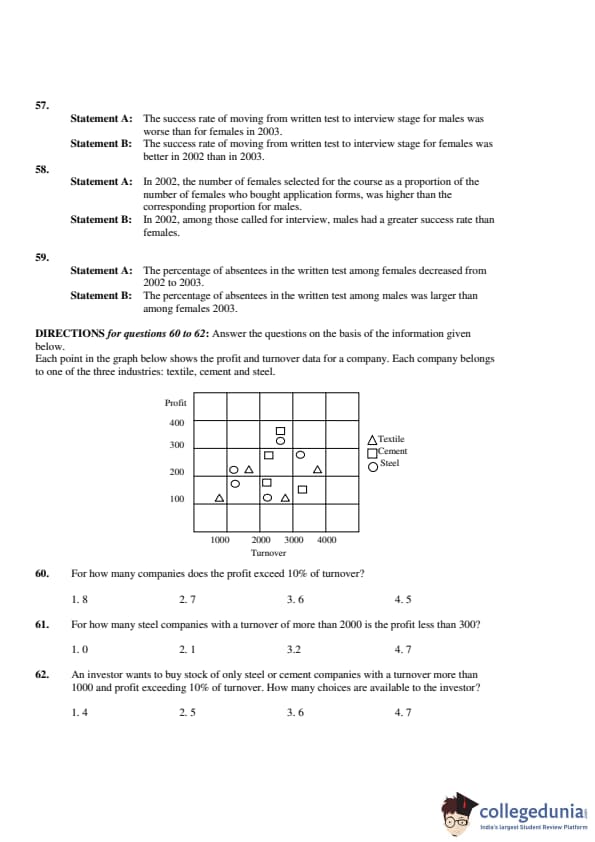
In the consolidated list, how many countries in Asia will rank lower than every country in South America, but higher than at least one country in Africa?
View Solution
Which of the following statements is correct?
View Solution
Locations 6 and 7 differ from all the rest because only in these two locations,
View Solution
During 1996-2002, the number of commodities that exhibited a net overall increase and net overall decrease, respectively were:
View Solution
The number of commodities that experienced a price decline for two or more consecutive years is:
View Solution
For which commodities did a price increase immediately follow a price decline only once in this period?
View Solution
Which of the following statements is NOT true?
View Solution
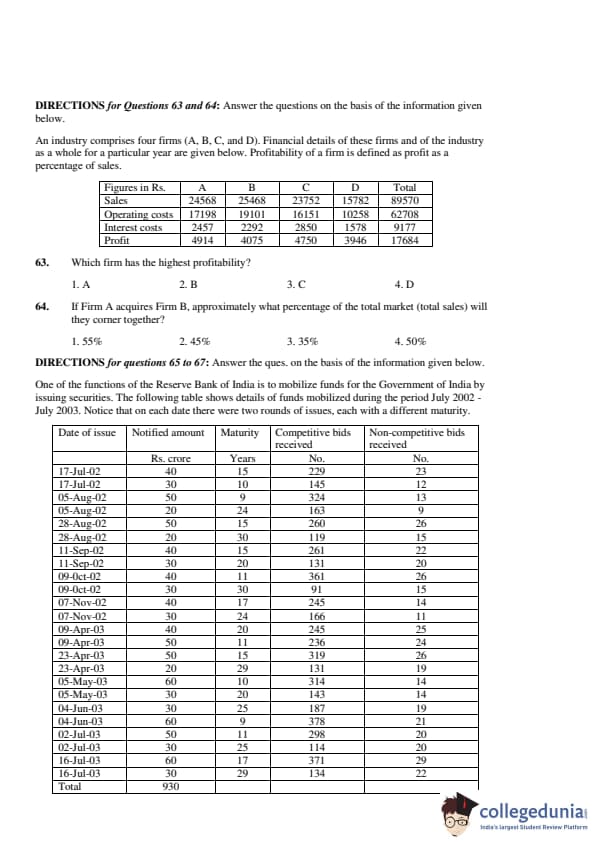
Which company recorded the highest operating profit in F.Y. 2002-03?
View Solution
What is the approximate average operating profit, in F.Y. 2001-02, of the two companies excluded from the third chart?
View Solution
The average operating profit in F.Y. 2002-03 of companies with profitability exceeding 10% in F.Y. 2002-03, is approximately:
View Solution
The two states which achieved the largest increases in sex ratio over the period 1901-2001 are:
View Solution
Among the states which have a sex ratio exceeding 1000 in 1901, the sharpest decline over the period 1901-2001 was registered in the state of:
View Solution
Each of the following statements pertains to the number of states with females outnumbering males in a given census year. Which of these statements is NOT correct?
View Solution
Congress procession can be allowed
View Solution
Which of the following is NOT true?
View Solution
In a cricket match, the ‘Man of the Match’ award is given to the player scoring the highest number of runs. In case of a tie, the player (out of those locked in the tie) who has taken the higher number of catches is chosen. Even thereafter if there is a tie, the player (out of those locked in the tie) who has dropped fewer catches is selected. Aakash, Biplab, and Chirag who were contenders for the award dropped at least one catch each. Biplab dropped two catches more than Aakash did, scored 50, and took two catches. Chirag got two chances to catch and dropped both. Who was the ‘Man of the Match’?
% Statement A
A. Chirag made 15 runs less than both Aakash and Biplab.
% Statement B
B. The catches dropped less by Biplab are 1 more than the catches taken by Aakash.
View Solution
Four friends — A, B, C, and D got the top four ranks in a competitive examination, but A did not get the first, B did not get the second, C did not get the third, and D did not get the fourth rank. Who secured which rank?
% Statement A
A. Neither A nor D were among the first 2.
% Statement B
B. Neither B nor C was third or fourth.
View Solution
The members of a local club contributed equally to pay Rs. 600 towards a donation. How much did each one pay?
% Statement A
A. If there had been five fewer members, each one would have paid an additional Rs. 10.
% Statement B
B. There were at least 20 members in the club, and each one paid not more than Rs. 30.
View Solution
A family has only one kid. The father says, “After ‘n’ years, my age will be 4 times the age of my kid.” The mother says, “After ‘n’ years, my age will be 3 times that of my kid.” What will be the combined ages of the parents after ‘n’ years?
% Statement A
A. The age difference between the parents is 10 years.
% Statement B
B. After ‘n’ years the kid is going to be twice as old as she is now.
View Solution
Which one among the following must have two sources?
View Solution
How many people (excluding the mastermind) needed to make answer-keys before C could make his answer-key?
View Solution
Both G and H were sources to:
View Solution
Which of the following statements is true?
View Solution
Which two groups of people had identical sources?
I. A, D and G
II. E and H
View Solution
Seventy percent of the employees in a multinational corporation have VCD players, 75% have microwave ovens, 80% have ACS and 85% have washing machines. At least what percentage of employees has all four gadgets?
View Solution
Who among the following arrived third?
View Solution
Name the correct pair of husband and wife.
View Solution
Of the following pairs, whose daughters go to the same school?
View Solution
Whose family is known to have more than one kid for certain?
View Solution
Based on the responses, which of the two, JP or DG, entered the lounge first?
View Solution
Who was sitting with JC when JP entered the lounge?
View Solution
How many of the seven members did VR meet on Friday in the lounge?
View Solution
Who were the last two faculty members to leave the lounge?
View Solution
If E sits in his office and faces the corridor, whose office is to his left?
View Solution
Whose office faces A's office?
View Solution
Who is/are F's neighbour(s)?
View Solution
D was heard telling someone to go further down the corridor to the last office on the right. To whose room was he trying to direct that person?
View Solution
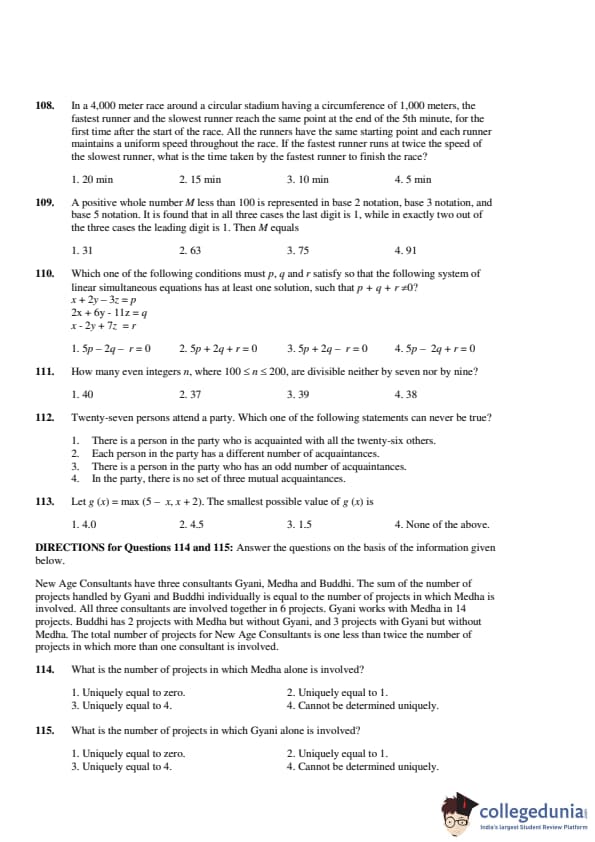
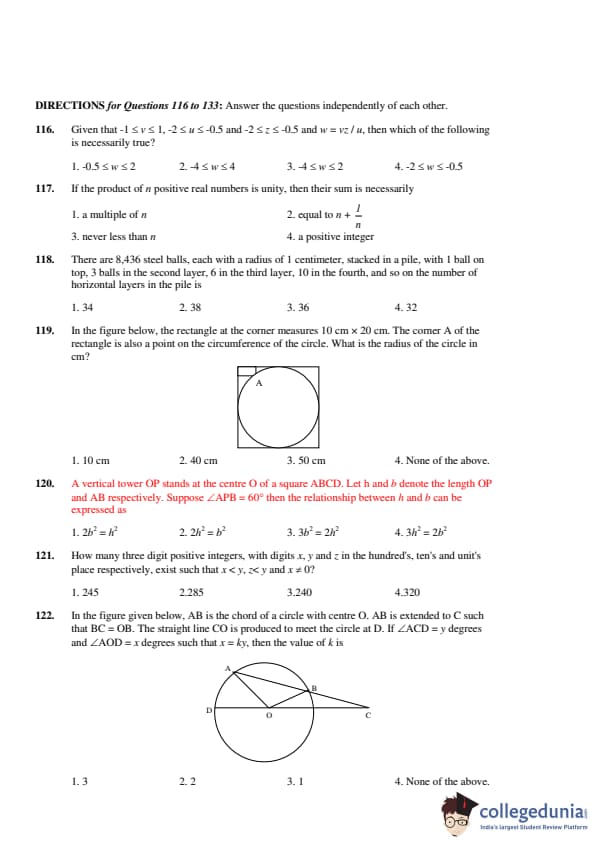
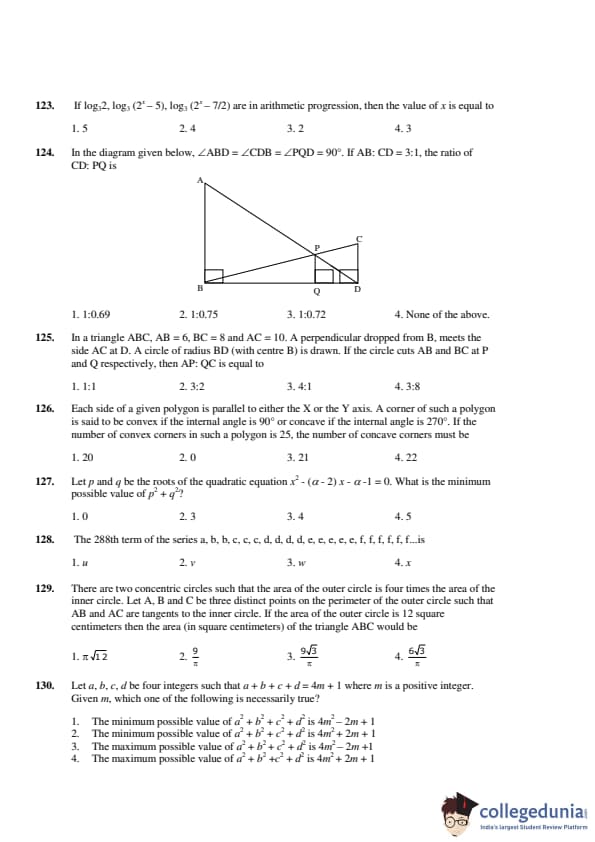
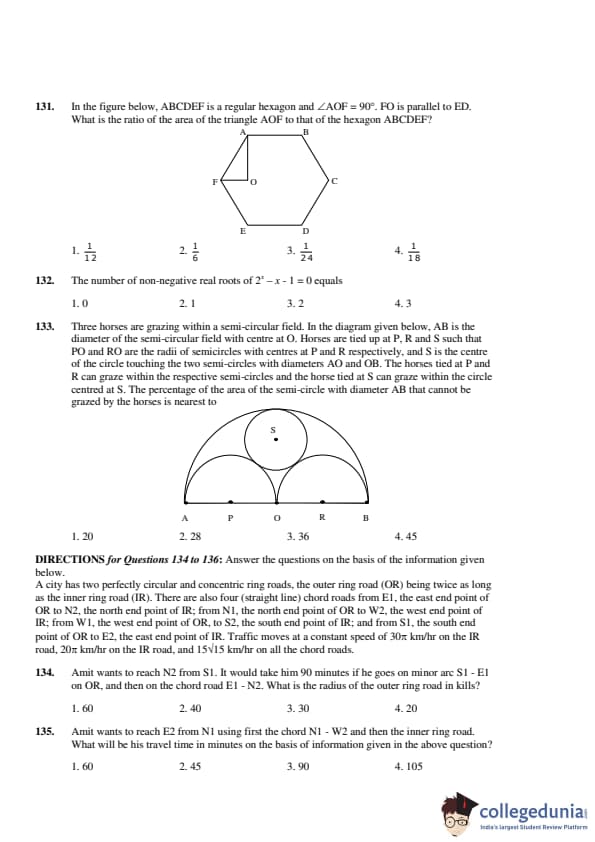
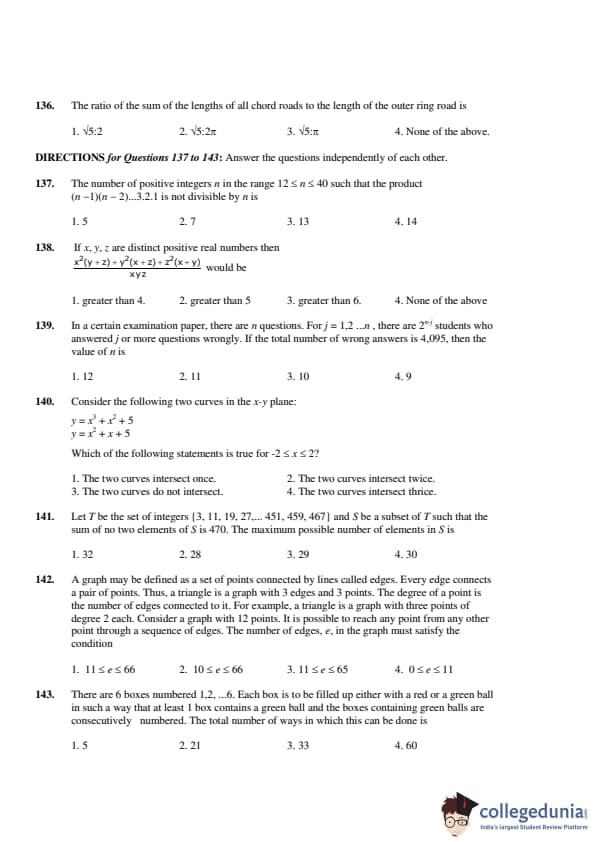
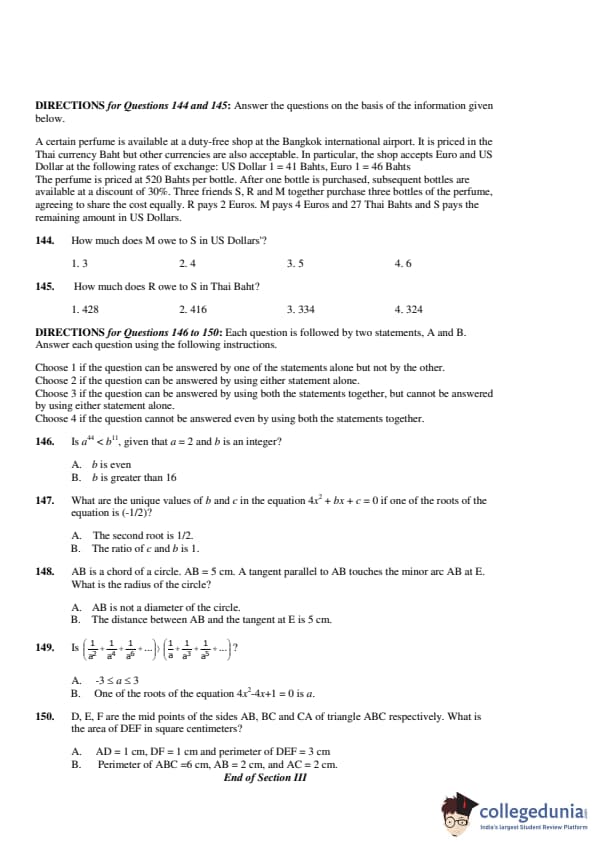
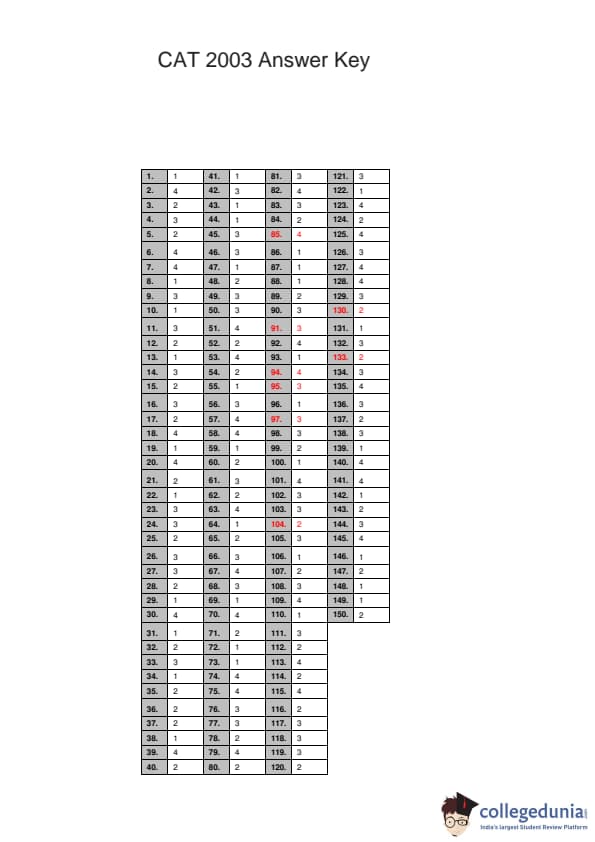
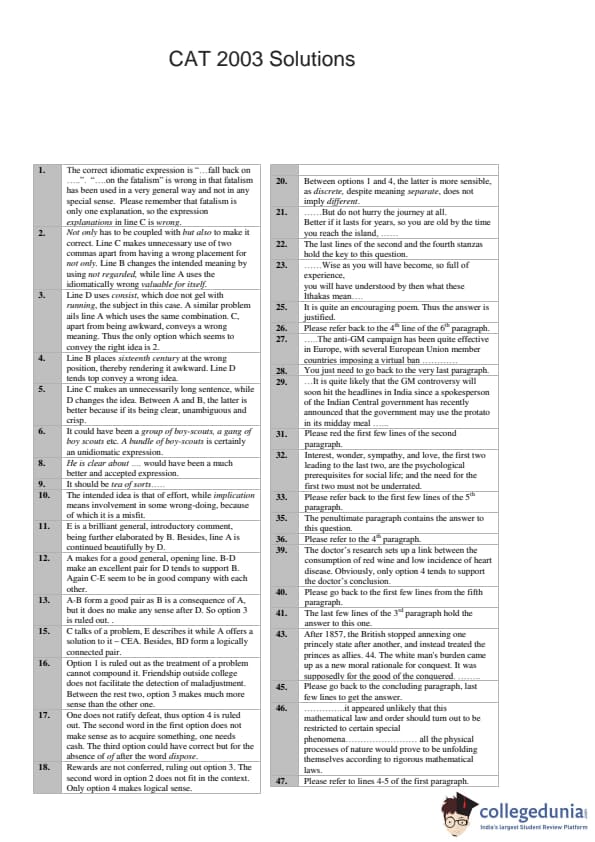
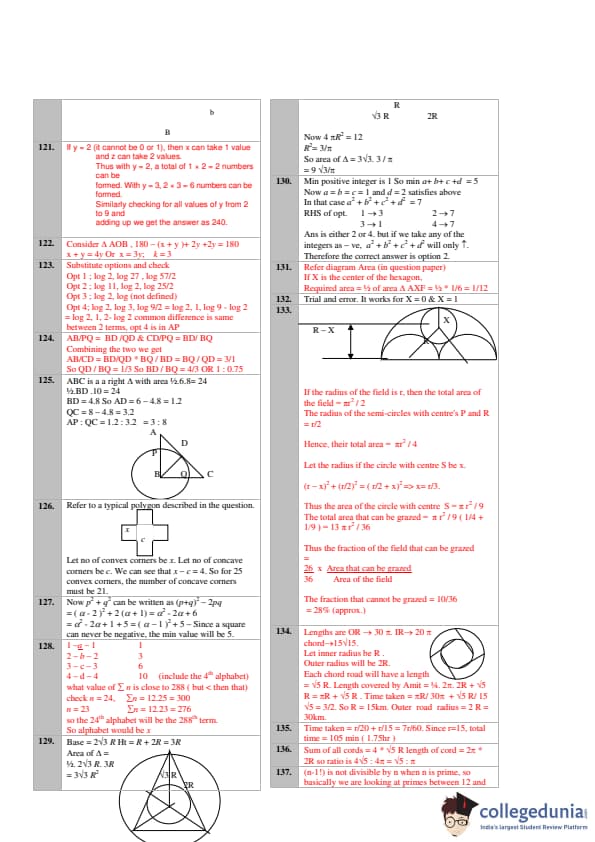
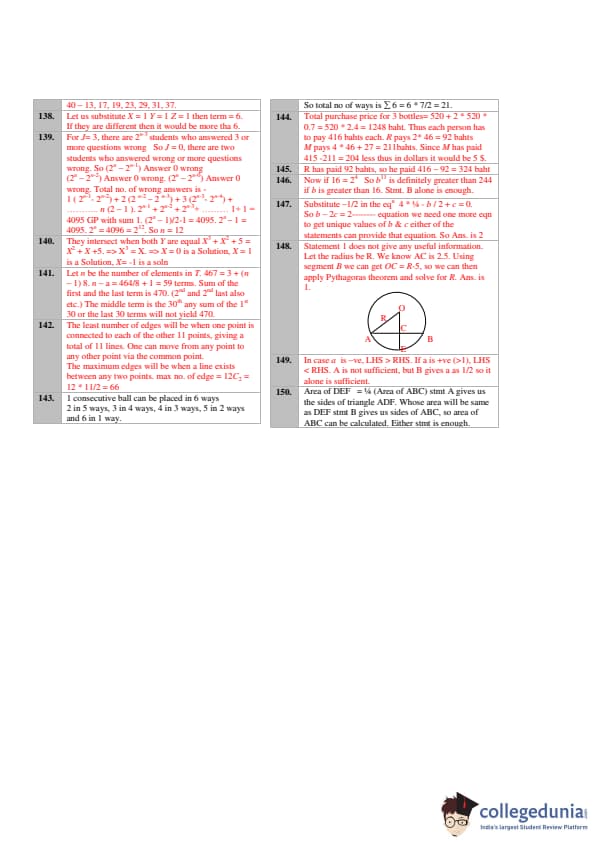
Also Check:
CAT 2003 Paper Analysis
The below-mentioned table displays the analysis of CAT question paper 2003:
| Section | Topics | No. Of Questions | Suggested Time | Possible Attempts | Possible Scores |
|---|---|---|---|---|---|
| 1 | QA | 50 | 40 min | 18-20 | 16-18 |
| 2 | VARC | 50 | 35-40 min | 28-32 | 22-24 |
| 3 | DILR | 50 | 40-45 min | 22-24 | 18-20 |
| Total | - | 150 | 120 min | 70-75 | 60-62 |
CAT 2003 QA Paper Analysis
Go through the below-mentioned table showing the details of QA section based on the number of questions asked-
- The Arithmetic section carried the maximum weightage in the QA section.
- Time, Speed, Distance, and Maxima/Minima carried the least weightage.
| Topics | No. Of Questions |
|---|---|
| Arithmetic | 15 |
| Number System | 11 |
| TDS/Time and Work | 1 |
| Percentages, SI, CI, and PLD | 2 |
| Ratio & Proportion, Pipes | 1 |
| Algebra | 13 |
| Equations and Inequalities | 7 |
| Progressions | 2 |
| Functions | 3 |
| Maxima/Minima | 1 |
CAT Question Papers of Other Years
| CAT 2024 Question Papers | CAT 2023 Question Papers |
| CAT 2022 Question Papers | CAT 2020 Question Papers |
| CAT 2019 Question Papers | CAT 2018 Question Papers |
| CAT 2017 Question Papers | CAT 2016 Question Papers |



Comments