




CAT 2008 Question Paper with Answer Key PDF is available for download. CAT 2008 paper was conducted on November 16, 2008. Around 250000 students registered for the exam that year. CAT 2008 question paper carried 90 questions and the weightage of the VARC section was the highest.
- The overall difficulty level of the VARC section in CAT exam was moderate while the difficulty level of the QA and DILR sections was higher than last year.
Candidates preparing for CAT 2025 can download the CAT QA question paper with the solution PDF to get a better idea about the type of questions asked in the paper and their difficulty level.
Also Check:
CAT 2008 QA Question Paper with Solution PDF
| CAT 2008 QA Question Paper with Answer Key | Download PDF | Check Solutions |
Question 1:
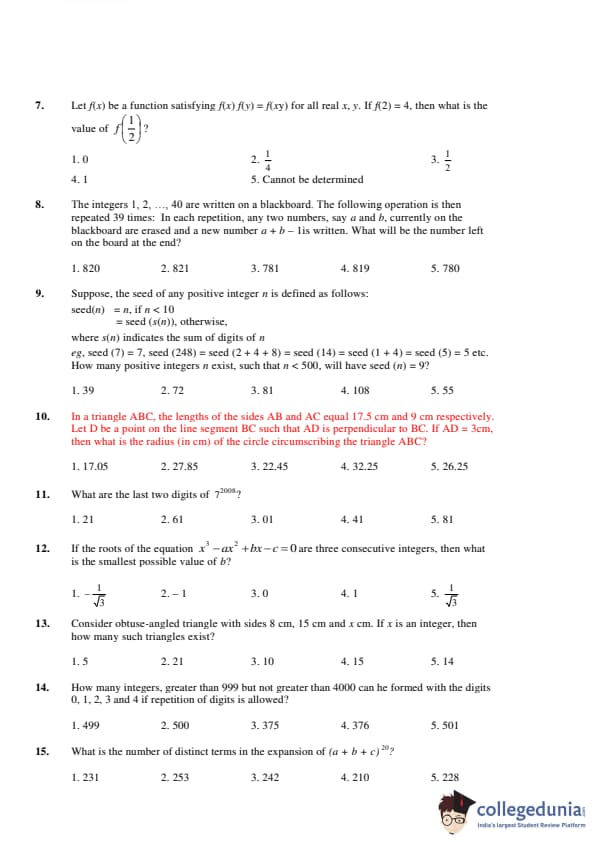
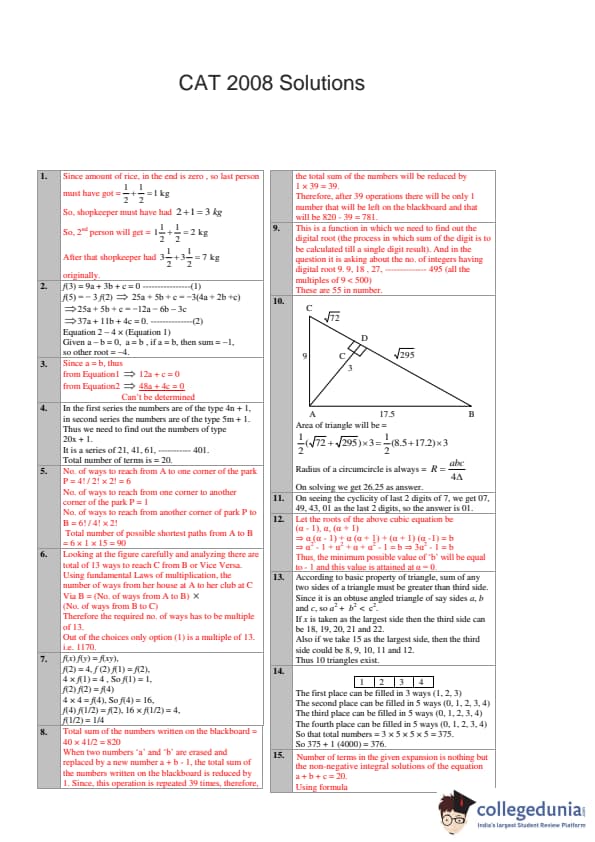
The integers \(1, 2, \ldots, 40\) are written on a blackboard. The following operation is then repeated 39 times: In each repetition, any two numbers, say \(a\) and \(b\), currently on the blackboard are erased and a new number \(a + b - 1\) is written. What will be the number left on the board at the end?
View Solution
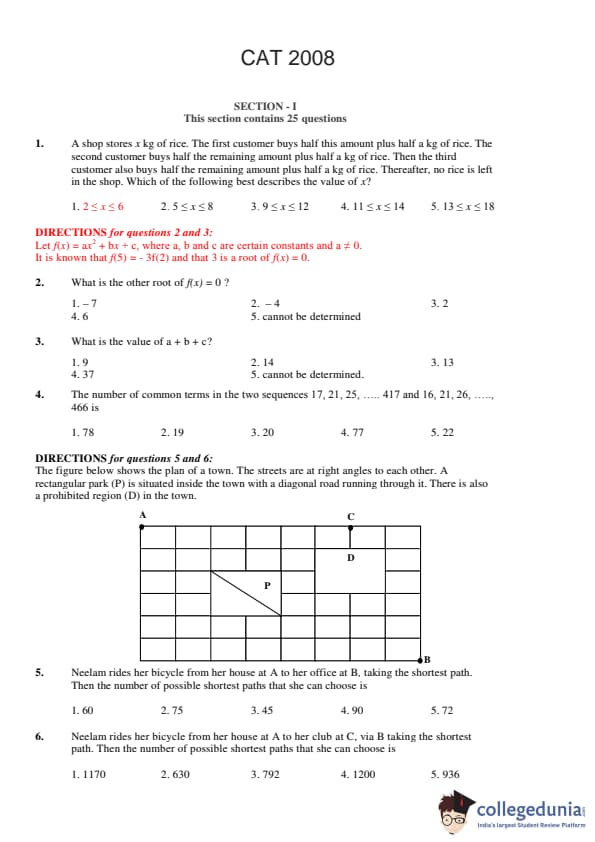
What are the last two digits of \(7^{2008}\)?
View Solution
If the roots of the equation \(x^3 - ax^2 + bx - c = 0\) are three consecutive integers, then what is the smallest possible value of \(b\)?
View Solution
A shop stores \(x\) kg of rice. The first customer buys half this amount plus half a kg of rice. The second customer buys half the remaining amount plus half a kg of rice. Then the third customer also buys half the remaining amount plus half a kg of rice. Thereafter, no rice is left in the shop. Which of the following best describes the value of \(x\)?
View Solution
What is the other root of \(f(x) = 0\)?
View Solution
What is the value of \(a + b + c\) given the above conditions?
View Solution
The number of common terms in the two sequences \(17, 21, 25, \ldots, 417\) and \(16, 21, 26, \ldots, 466\) is:
View Solution
How many integers, greater than \(999\) but not greater than \(4000\), can be formed with the digits \(0, 1, 2, 3, 4\), if repetition of digits is allowed?
View Solution
Neelam rides her bicycle from her house at \(A\) to her office at \(B\), taking the shortest path. The number of possible shortest paths that she can choose is:
View Solution
Neelam rides her bicycle from her house at \(A\) to her club at \(C\), via \(B\) taking the shortest path. The number of possible shortest paths that she can choose is:
View Solution
Let \(f(x)\) be a function satisfying \(f(x) f(y) = f(xy)\) for all real \(x, y\). If \(f(2) = 4\), then what is the value of \(f\left( \frac12 \right)\)?
View Solution
The seed of any positive integer \(n\) is defined as: \[ seed(n) = n, \ if n < 10 \] \[ seed(n) = seed(s(n)), \ otherwise \]
where \(s(n)\) is the sum of digits of \(n\). How many positive integers \(n\), such that \(n < 500\), will have \(seed(n) = 9\)?
View Solution
In \(\triangle ABC\), \(AB = 17.5\) cm, \(AC = 9\) cm. Let \(D\) be a point on \(BC\) such that \(AD \perp BC\) and \(AD = 3\) cm. What is the radius of the circumcircle of \(\triangle ABC\)?
View Solution
Consider obtuse-angled triangles with sides \(8\) cm, \(15\) cm, and \(x\) cm, where \(x\) is integer. How many such triangles exist?
View Solution
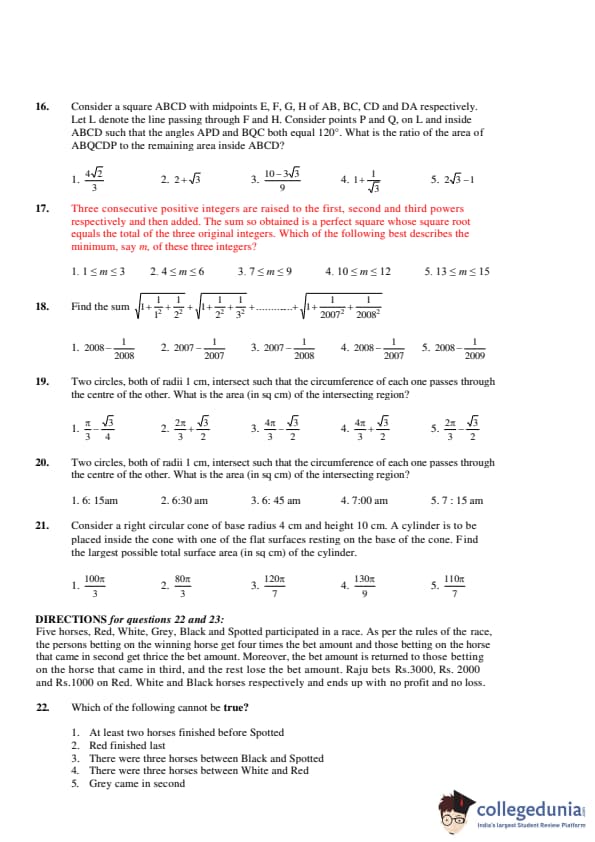
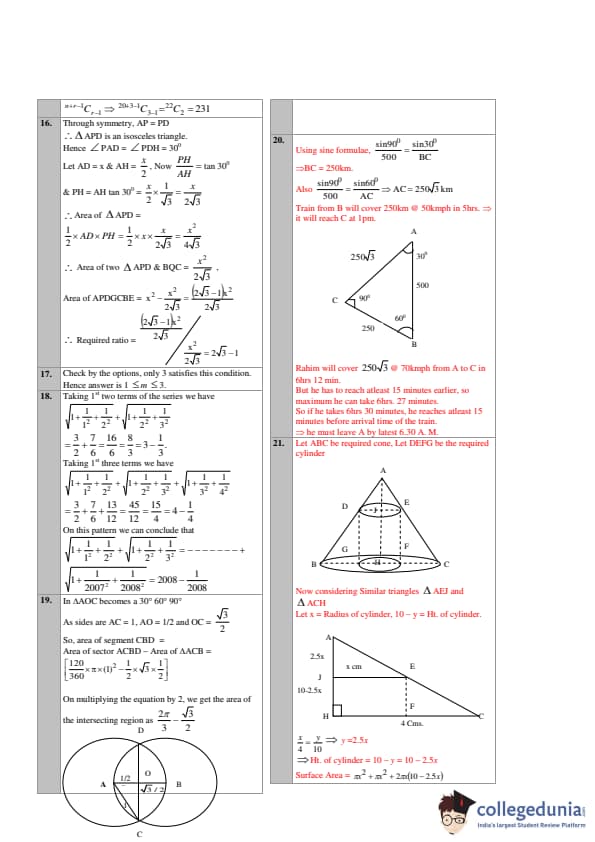
Square \(ABCD\) has midpoints \(E, F, G, H\) of sides \(AB, BC, CD, DA\) respectively. Let \(L\) be the line through \(F\) and \(H\). Points \(P, Q\) are on \(L\) inside \(ABCD\) such that \(\angle APD = \angle BQC = 120^\circ\). What is the ratio of area of \(ABQCDP\) to the remaining area?
View Solution
What is the number of distinct terms in the expansion of \((a + b + c)^{20}\)?
View Solution
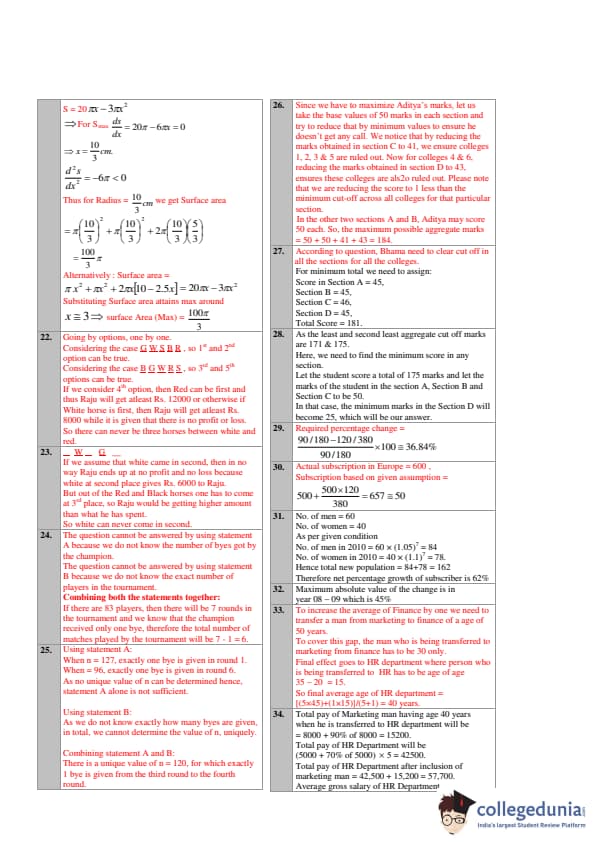
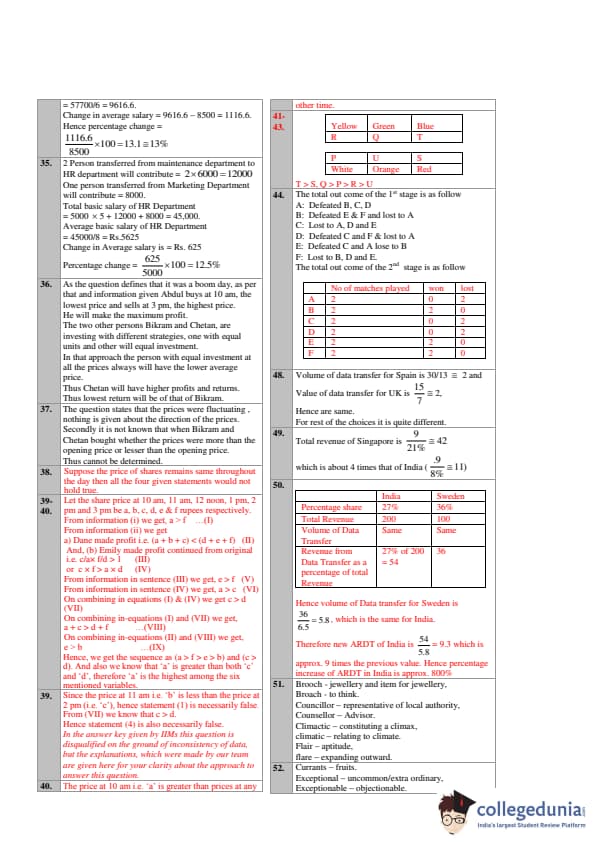
Which of the following cannot be true?
View Solution
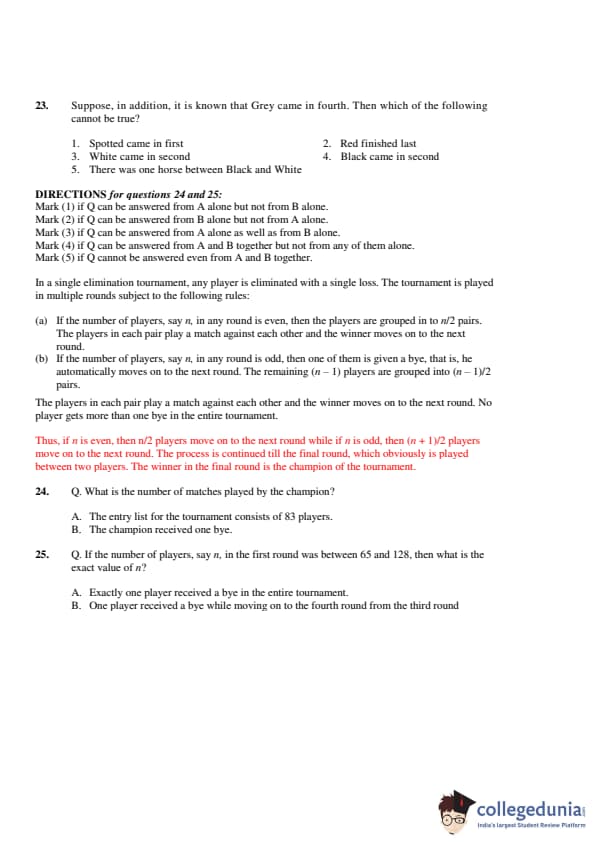
Suppose, in addition, it is known that Grey came in fourth. Then which of the following cannot be true?
View Solution
What is the number of matches played by the champion?
A. The entry list for the tournament consists of 83 players.
B. The champion received one bye.
View Solution
If the number of players in the first round was between 65 and 128, what is the exact value of \(n\)?
A. Exactly one player received a bye in the entire tournament.
B. One player received a bye while moving on to the fourth round from the third round.
View Solution
Two circles, both of radii \(1\) cm, intersect such that the circumference of each one passes through the centre of the other. What is the area (in sq. cm.) of the intersecting region?
View Solution
Rahim drives from city A to station C at \(70\) km/h. Train leaves city B (500 km south of A) at 8:00 am toward C at \(50\) km/h. C is located between S and SW of A with AC at \(30^\circ\) to AB. Rahim must reach C at least 15 minutes before train. Latest time to leave A?
View Solution
Three consecutive positive integers are raised to the first, second, and third powers respectively and added. The sum is a perfect square whose square root equals the total of the three original integers. Which range best describes the minimum integer \(m\) of these three?
View Solution
Find: \(\sum_{k=1}^{2007} \sqrt{1 + \frac{1}{k^2} + \frac{1}{(k+1)^2}}\)
View Solution
A right circular cone has base radius \(4\) cm and height \(10\) cm. A cylinder is to be placed inside the cone with one flat surface resting on the base of the cone. Find the largest possible total surface area (sq. cm) of the cylinder.
View Solution
Also Check:
CAT 2008 Paper Analysis
Out of the total 90 questions that appeared in CAT 2008, 40 came from the Verbal Ability section, while the QA and DILR section contributed 25 questions each. Have a look at the below-mentioned table in order to get detailed analysis of CAT 2008 question paper
| Sections | No. Of Questions | Difficulty Level | Good Attempts |
|---|---|---|---|
| Verbal Ability | 40 | Easy to moderate | 22 |
| Quantitative Ability | 25 | Easy to moderate | 13 |
| Data Interpretation and Logical Reasoning | 25 | Difficult | 14 |
| Total | 90 | - | 46 |
- CAT QA section carried more logical- based questions.
- DILR section was tougher than last year. Most of the questions in DILR section were tricky and time-consuming
- Questions from Reading Comprehension were easy to attempt.
CAT Question Papers of Other Years
| CAT 2024 Question Papers | CAT 2023 Question Papers |
| CAT 2022 Question Papers | CAT 2020 Question Papers |
| CAT 2019 Question Papers | CAT 2018 Question Papers |
| CAT 2017 Question Papers | CAT 2016 Question Papers |



Comments