CAT 2012 Question Paper was conducted for 21 days from October 11 to November 6, 2012. The question paper had 2 sections namely, Verbal Ability & Logical Reasoning and Quantitative Ability & Data Interpretation. Each section had 30 questions with a designated time slot of 70 minutes.
Candidates preparing for CAT 2025 can download the CAT VARC question paper with the solution PDF for the Slot 1 exam to get a better idea about the type of questions asked in the paper and their difficulty level.
Also Check:
CAT 2012 VARC Slot 1 Question Paper with solution PDF
Question 1:
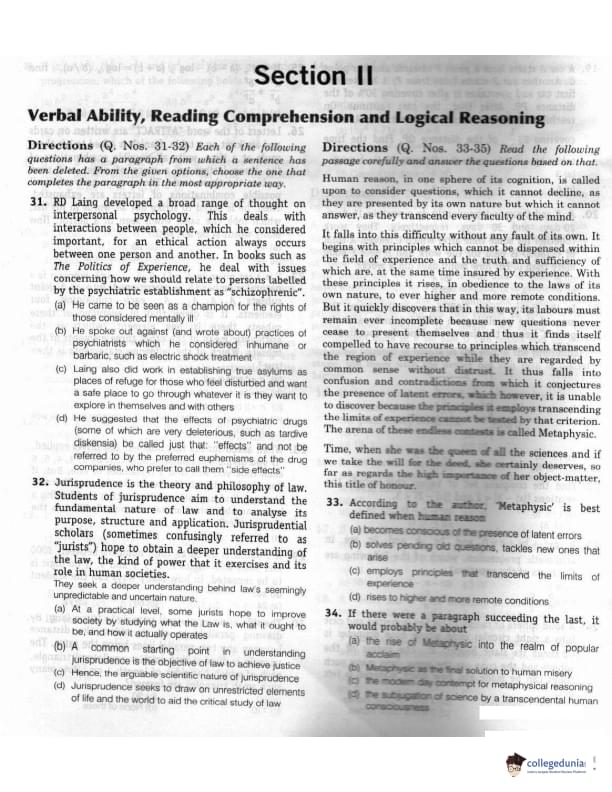
RD Laing developed a broad range of thought on interpersonal psychology. This deals with interactions between people, which he considered important, for an ethical action always occurs between one person and another. In books such as The Politics of Experience, he dealt with issues concerning how we should relate to persons labelled by the psychiatric establishment as “schizophrenic”.
- (A) He came to be seen as a champion for the rights of those considered mentally ill
- (B) He spoke out against (and wrote about) practices of psychiatrists which he considered inhumane or barbaric, such as electric shock treatment
- (C) Laing also did work in establishing true asylums as places of refuge for those who feel disturbed and want a safe place to go through whatever it is they want to explore in themselves and with others
- (D) He suggested that the effects of psychiatric drugs (some of which are very deleterious, such as tardive dyskinesia) be called just that: “effects”, and not be referred to by the preferred euphemisms of the drug companies, who prefer to call them “side effects”
Correct Answer: (B) He spoke out against (and wrote about) practices of psychiatrists which he considered inhumane or barbaric, such as electric shock treatment
View Solution
Question 2:
Jurisprudence is the theory and philosophy of law. Students of jurisprudence aim to understand the fundamental nature of law and to analyse its purpose, structure, and application. Jurisprudential scholars (sometimes confusingly referred to as “jurists”) hope to obtain a deeper understanding of the law, the kind of power that it exercises and its role in human societies.
- (A) At a practical level, some jurists hope to improve society by studying what the law is, what it ought to be, and how it actually operates
- (B) A common starting point in understanding jurisprudence is the objective of law to achieve justice
- (C) Hence, the arguable scientific nature of jurisprudence
- (D) Jurisprudence seeks to draw on unrestricted elements of life and the world to aid the critical study of law
Correct Answer: (A) At a practical level, some jurists hope to improve society by studying what the law is, what it ought to be, and how it actually operates
View Solution
Question 3:
According to the author, 'Metaphysic' is best defined when human reason:
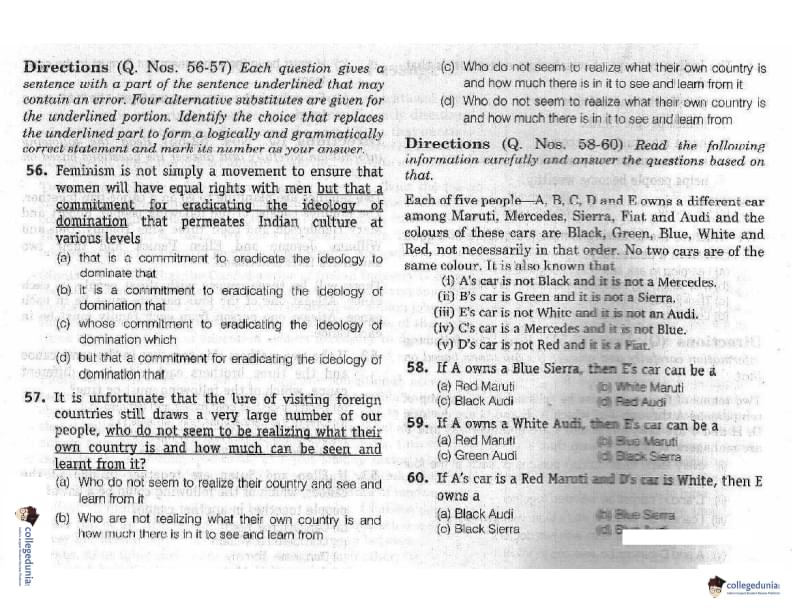
- (A) becomes conscious of the presence of latent errors
- (B) solves pending old questions, tackles new ones that arise
- (C) employs principles that transcend the limits of experience
- (D) rises to higher and more remote conditions
Correct Answer: (C) employs principles that transcend the limits of experience
View Solution
Question 4:
If there were a paragraph succeeding the last, it would probably be about:
- (A) the rise of Metaphysic into the realm of popular thought
- (B) Metaphysic as the final solution to human misery
- (C) the everyday contempt for metaphysical reasoning
- (D) the suitability of science by a transcendental human consciousness
Correct Answer: (A) the rise of Metaphysic into the realm of popular thought
View Solution
Question 5:
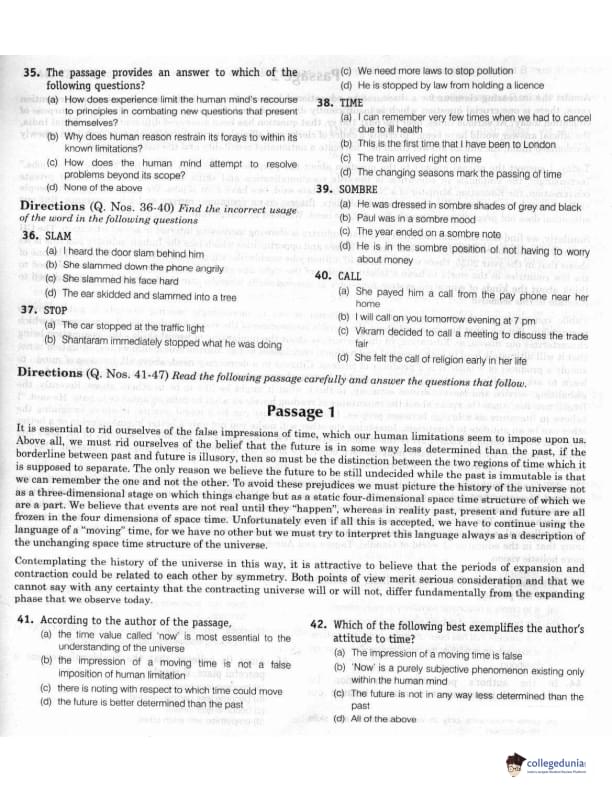
The passage provides an answer to which of the following questions?
- (A) How does experience limit the human mind’s recourse to principles in combating new questions that present themselves?
- (B) Why does human reason restrain its forays to within its known limitations?
- (C) How does the human mind attempt to resolve problems beyond its scope?
- (D) None of the above
Correct Answer: (C) How does the human mind attempt to resolve problems beyond its scope?
View Solution
Question 6:
Find the incorrect usage of the word “SLAM”.
- (A) I heard the door slam behind him
- (B) She slammed down the phone angrily
- (C) She slammed his face hard
- (D) The ear skidded and slammed into a tree
Correct Answer: (D) The ear skidded and slammed into a tree
View Solution
Question 7:
Find the incorrect usage of the word “STOP”.
- (A) The car stopped at the traffic light
- (B) Shantaram immediately stopped what he was doing
- (C) We need more laws to stop pollution
- (D) He is stopped by law from holding a licence
Correct Answer: (D) He is stopped by law from holding a licence
View Solution
Question 8:
Find the incorrect usage of the word “TIME”.
- (A) I can remember very few times when we had to cancel due to ill health
- (B) This is the first time that I have been to London
- (C) The train arrived right on time
- (D) The changing seasons mark the passing of time
Correct Answer: (A) I can remember very few times when we had to cancel due to ill health
View Solution
Question 9:
Find the incorrect usage of the word “SOMBRE”.
- (A) He was dressed in sombre shades of grey and black
- (B) Paul was in a sombre mood
- (C) The year ended on a sombre note
- (D) He is in the sombre position of not having to worry about money
Correct Answer: (D) He is in the sombre position of not having to worry about money
View Solution
Question 10:
Find the incorrect usage of the word “CALL”.
- (A) She payed him a call from the pay phone near her home
- (B) I will call on you tomorrow evening at 7 pm
- (C) Vikram decided to call a meeting to discuss the trade fair
- (D) She felt the call of religion early in her life
Correct Answer: (A) She payed him a call from the pay phone near her home
View Solution
Question 11:
According to the author of the passage,
- (A) the time value called ‘now’ is most essential to the understanding of the universe
- (B) the impression of a ‘moving time’ is not a false imposition of human limitation
- (C) there is nothing with respect to which time could move
- (D) the future is better determined than the past
Correct Answer: (C) there is nothing with respect to which time could move
View Solution
Question 12:
Which of the following best exemplifies the author's attitude to time?
- (A) The impression of a moving time is false
- (B) ‘Now’ is a purely subjective phenomenon existing only within the human mind
- (C) The future is not in any way less determined than the past
- (D) All of the above
Question 13:
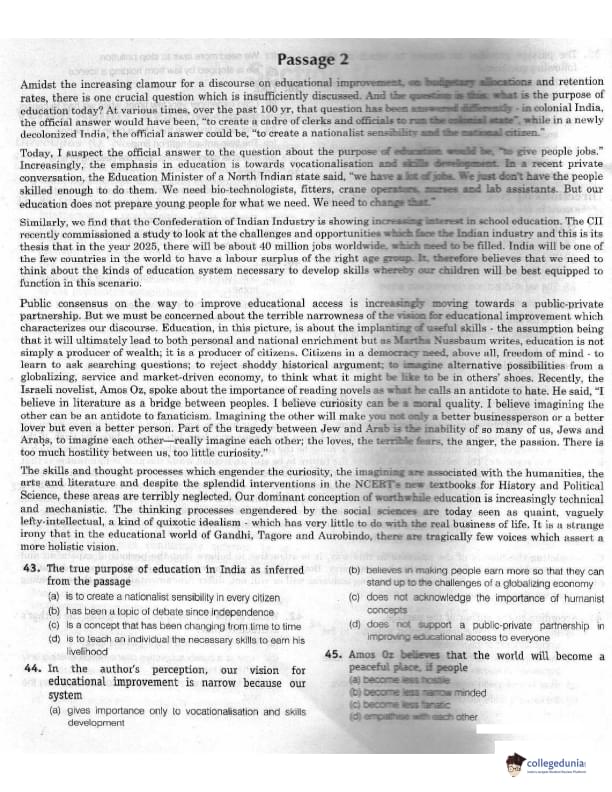
The true purpose of education in India as inferred from the passage
- (A) is to create a nationalist sensibility in every citizen
- (B) believes in making people earn more so that they can stand up to the challenges of a globalizing economy
- (C) has been a topic of debate since independence
- (D) is to teach an individual the necessary skills to earn his livelihood
Correct Answer: (A) is to create a nationalist sensibility in every citizen
View Solution
Question 14:
In the author's perception, our vision for educational improvement is narrow because our system
- (A) gives importance only to vocationalisation and skills development
- (B) believes in making people earn more so that they can stand up to the challenges of a globalizing economy
- (C) does not acknowledge the importance of humanist concepts
- (D) does not support a public-private partnership in improving educational access to everyone
Correct Answer: (A) gives importance only to vocationalisation and skills development
View Solution
Question 15:
Amos Oz believes that the world will become a peaceful place, if people
- (A) become less hostile
- (B) become less fanatic
- (C) become less narrow minded
- (D) imagine each other’s realities
Question 16:
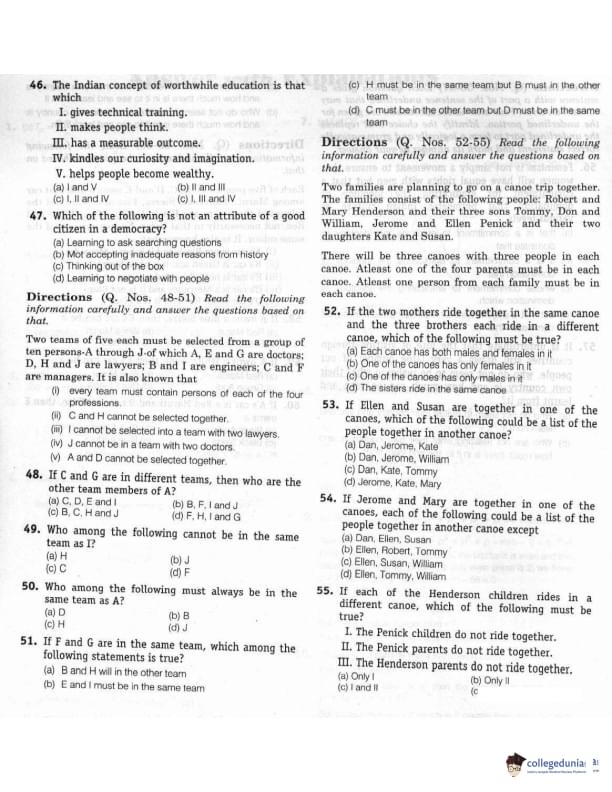
The Indian concept of worthwhile education is that which
- (A) I and V
- (B) II and III
- (C) I, III and IV
- (D) II, III and IV
Question 17:
Which of the following is not an attribute of a good citizen in a democracy?
- (A) Learning to ask searching questions
- (B) Not accepting inadequate reasons from history
- (C) Thinking out of the box
- (D) Learning to negotiate with people
Correct Answer: (D) Learning to negotiate with people
View Solution
Question 18:
If the two mothers ride together in the same canoe and the three brothers each ride in a different canoe, which of the following must be true?
- (A) Each canoe has both males and females in it
- (B) One of the canoes has only females in it
- (C) One of the canoes has only males in it
- (D) The sisters ride in the same canoe
Correct Answer: (B) One of the canoes has only females in it
View Solution
Question 19:
If Ellen and Susan are together in one of the canoes, which of the following could be a list of the people together in another canoe?
- (A) Dan, Jerome, Kate
- (B) Dan, Jerome, William
- (C) Dan, Kate, Tommy
- (D) Jerome, Kate, Mary
Question 20:
If Jerome and Mary are together in one of the canoes, each of the following could be a list of the people together in another canoe \textbf{except}:
- (A) Dan, Ellen, Susan
- (B) Ellen, Robert, Tommy
- (C) Ellen, Susan, William
- (D) Ellen, Tommy, William
Question 21:
If each of the Henderson children rides in a different canoe, which of the following must be true?
I. The Penick children do not ride together.
II. The Penick parents do not ride together.
III. The Henderson parents do not ride together.
- (a) Only I
- (b) Only II
- (c) I and II
Question 22:
Feminism is not simply a movement to ensure that women will have equal rights with men but that a commitment for eradicating the ideology of domination that permeates Indian culture at various levels.
- (A) that is a commitment to eradicate the ideology to dominate that
- (B) it is a commitment to eradicating the ideology of domination that
- (C) whose commitment to eradicating the ideology of domination which
- (D) but that a commitment for eradicating the ideology of domination that
Correct Answer: (B) it is a commitment to eradicating the ideology of domination that
View Solution
Question 23:
It is unfortunate that the lure of visiting foreign countries still draws a very large number of our people, who do not seem to be realizing what their own country is and how much can be seen and learnt from it.
- (A) Who do not seem to realize their country and see and learn from it
- (B) Who are not realizing what their own country is and how much there is in it to see and learn from
- (C) Who do not seem to realize what their own country is and how much there is in it to see and learn from it
- (D) Who do not seem to realize what their own country is and how much there is in it to see and learn from
Correct Answer: (C) Who do not seem to realize what their own country is and how much there is in it to see and learn from it
View Solution
Also Check:
CAT 2012 Question Paper Analysis
CAT 2012 Verbal Ability & Logical Reasoning Question Paper Analysis
The Verbal Ability & Logical Reasoning section of CAT 2012 Question Paper was rated moderate. The questions in Verbal Ability covered every topic of English Usage.
- The Reading Comprehension part of CAT 2012 Question Paper was manageable. There were 3 passages in which 1 was tough.
- The verbal Ability part had a good mix of questions from various areas.
- Family Trees, Propositions, Assumptions have got the highest weightage in Logical Reasoning.
Students should follow the below table for a better understanding of question distribution
| Topic |
Number of Questions |
Difficulty Level |
| Reading Comprehension |
10 |
Moderate |
| Sentence Correction |
2 |
Moderate |
| Para Jumble |
2 |
Moderate |
| Paragraph Summary |
2 |
Moderate |
| Fill in the Blanks |
1 |
Moderate |
| Word Usage |
2 |
Moderate |
| Para jumble (Odd sentence out) |
2 |
Moderate |
| Logical Puzzle |
3 |
Moderate |
| Arrangements |
6 |
Moderate |
CAT 2012 Quantitative Ability and Data Interpretation Question Paper Analysis
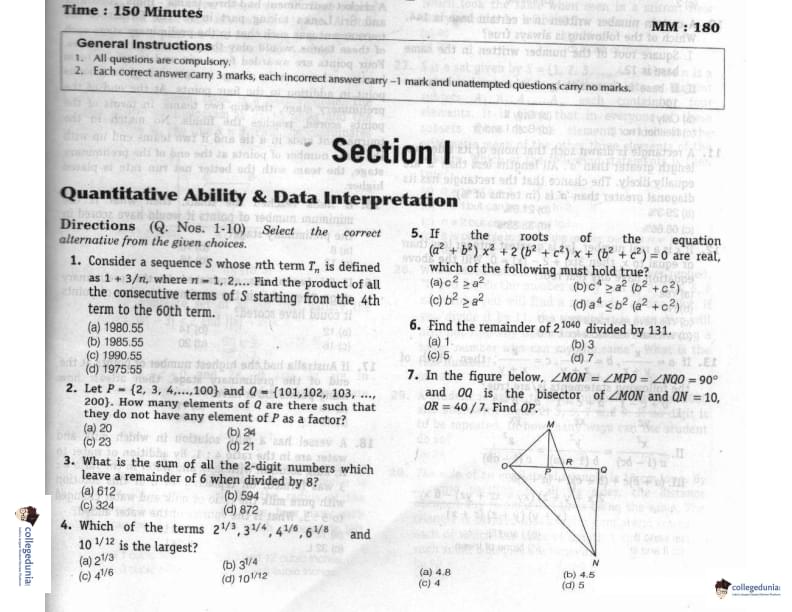
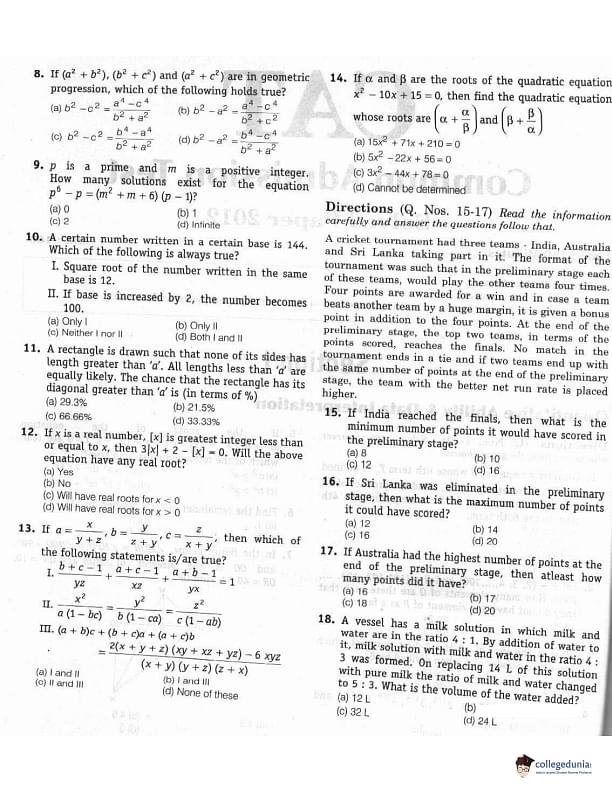
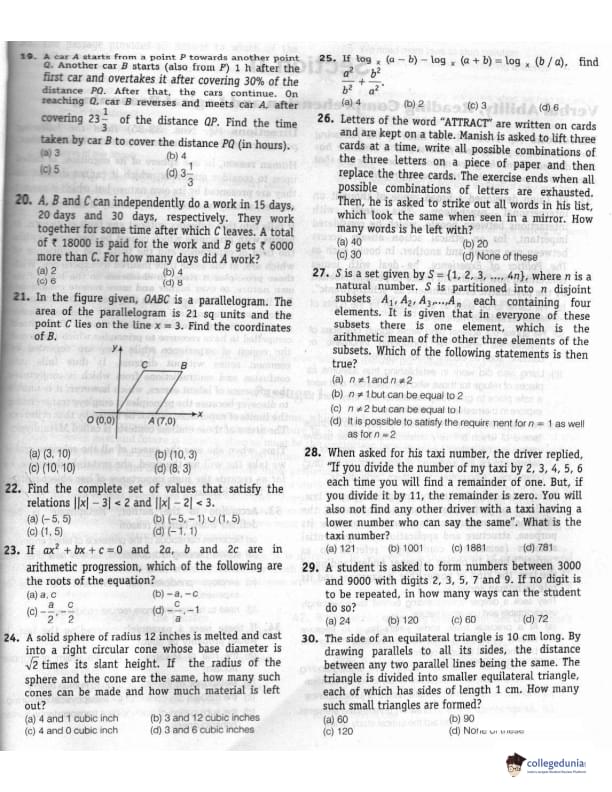
The Quantitative Ability and Data Interpretation section of the CAT 2012 Question Paper was based on various topics and difficult calculations.
- The question Paper had 21 questions from Quantitative Aptitude and 9 questions from Data Interpretation in both slots.
- This section was a little bit difficult compared to the other section.
- Questions from Quantitative Ability came from regular topics like Number System, Algebra, Geometry, Modern Math, and Arithmetic.
- Questions from Data Interpretation were not easy, it involved some tough calculations.
- The DI part of the question paper had questions in sets of 3.
Students should follow the below table for a better understanding of question distribution
| Topics |
Number of Questions |
Difficulty Level |
| Line Graph |
3 |
Difficult |
| Pie Chart |
3 |
Difficult |
| Tables |
3 |
Difficult |
| Number System |
2 |
Moderate |
| Algebra |
6 |
Moderate |
| Arithmetic |
4 |
Moderate |
| Modern Math |
3 |
Moderate |
| Geometry and Mensuration |
6 |
Moderate |
CAT Question Papers of Other Years
Other MBA Exam Question Papers








Comments