




CAT 2013 Question Paper had two sections- Verbal Ability & Logical Reasoning and Quantitative Ability & Data Interpretation. CAT 2013 was conducted by IIM Indore from October 16, 2013 to November 11, 2013. The question paper had 30 questions in each section and the candidates had 70 minutes for each section. An attempt of 35-40 questions was sufficient to score above 90%ile.
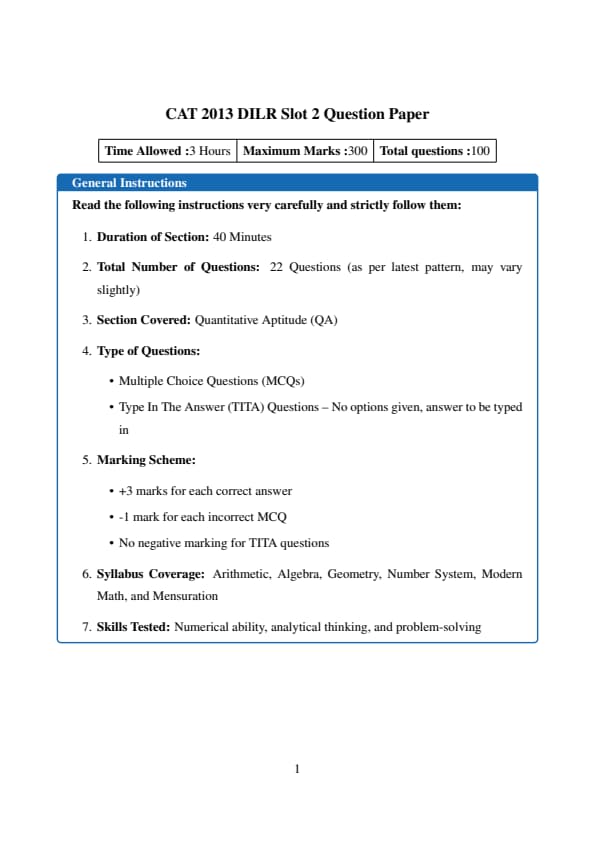
Candidates preparing for CAT 2025 can download the CAT DILR question paper with the solution PDF for the Slot 2 exam to get a better idea about the type of questions asked in the paper and their difficulty level.
Also Check:
CAT 2013 DILR Slot 2 Paper with Solution PDF
| CAT 2013 DILR Slot 2 Question Paper with Answer Key | Download PDF | Check Solutions |

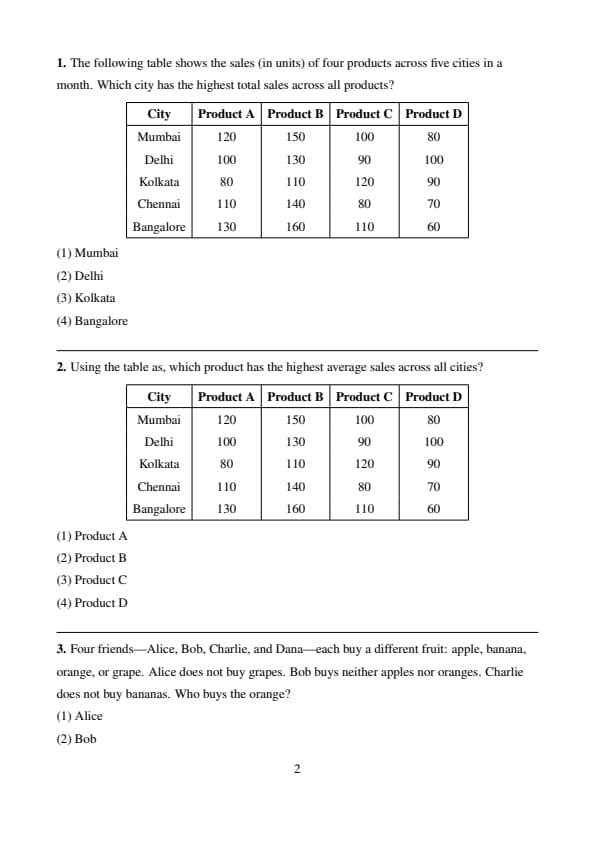
The following table shows the sales (in units) of four products across five cities in a month. Which city has the highest total sales across all products?

View Solution
Using the table as, which product has the highest average sales across all cities?

View Solution
Four friends—Alice, Bob, Charlie, and Dana—each buy a different fruit: apple, banana, orange, or grape. Alice does not buy grapes. Bob buys neither apples nor oranges. Charlie does not buy bananas. Who buys the orange?
View Solution
Four friends—Alice, Bob, Charlie, and Dana—each buy a different fruit: apple, banana, orange, or grape. Alice does not buy grapes. Bob buys neither apples nor oranges. Charlie does not buy bananas, who buys the grapes?
View Solution
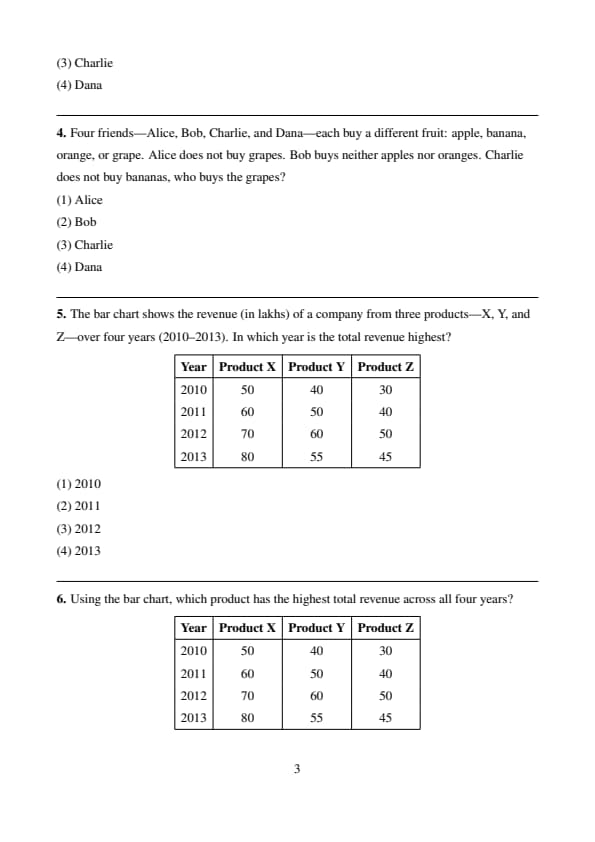
The bar chart shows the revenue (in lakhs) of a company from three products—X, Y, and Z—over four years (2010–2013). In which year is the total revenue highest?

View Solution
Using the bar chart, which product has the highest total revenue across all four years?

View Solution
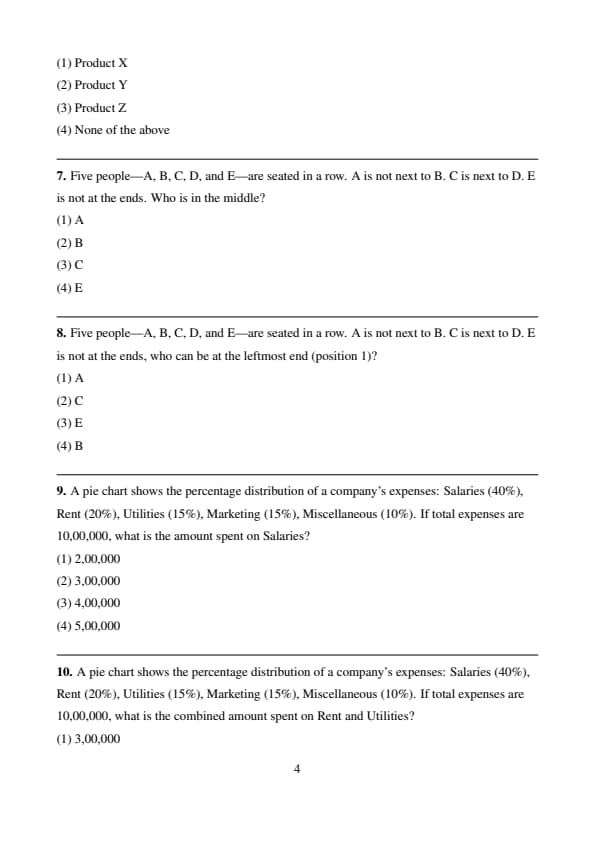
Five people—A, B, C, D, and E—are seated in a row. A is not next to B. C is next to D. E is not at the ends. Who is in the middle?
View Solution
Five people—A, B, C, D, and E—are seated in a row. A is not next to B. C is next to D. E is not at the ends, who can be at the leftmost end (position 1)?
View Solution
A pie chart shows the percentage distribution of a company’s expenses: Salaries (40%), Rent (20%), Utilities (15%), Marketing (15%), Miscellaneous (10%). If total expenses are ₹10,00,000, what is the amount spent on Salaries?
View Solution
A pie chart shows the percentage distribution of a company’s expenses: Salaries (40%), Rent (20%), Utilities (15%), Marketing (15%), Miscellaneous (10%). If total expenses are ₹10,00,000, what is the combined amount spent on Rent and Utilities?
View Solution
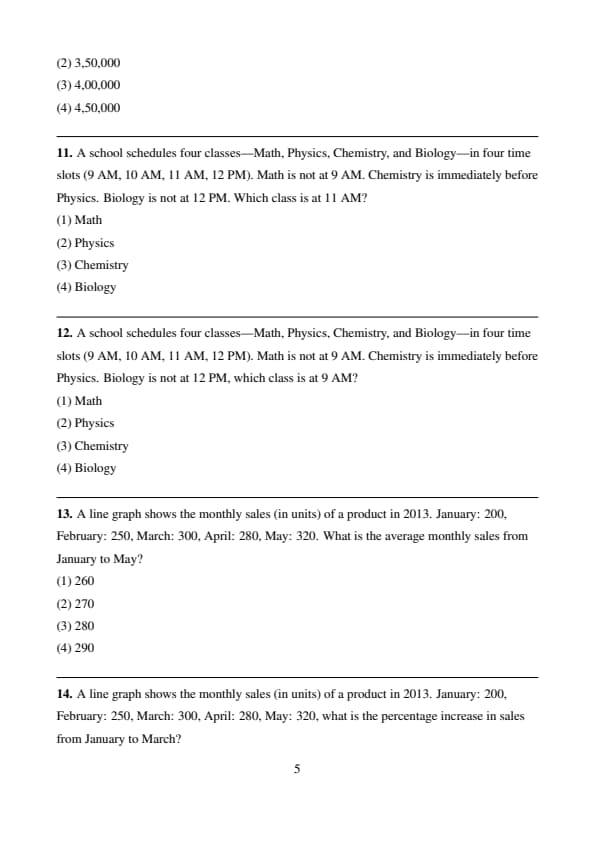
A school schedules four classes—Math, Physics, Chemistry, and Biology—in four time slots (9 AM, 10 AM, 11 AM, 12 PM). Math is not at 9 AM. Chemistry is immediately before Physics. Biology is not at 12 PM. Which class is at 11 AM?
View Solution
A school schedules four classes—Math, Physics, Chemistry, and Biology—in four time slots (9 AM, 10 AM, 11 AM, 12 PM). Math is not at 9 AM. Chemistry is immediately before Physics. Biology is not at 12 PM, which class is at 9 AM?
View Solution
A line graph shows the monthly sales (in units) of a product in 2013. January: 200, February: 250, March: 300, April: 280, May: 320. What is the average monthly sales from January to May?
View Solution
A line graph shows the monthly sales (in units) of a product in 2013. January: 200, February: 250, March: 300, April: 280, May: 320, what is the percentage increase in sales from January to March?
View Solution
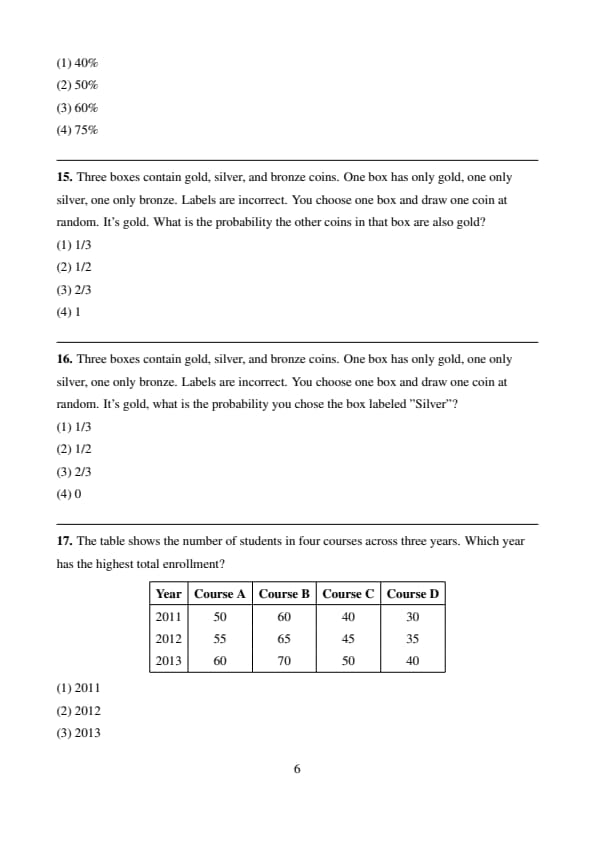
Three boxes contain gold, silver, and bronze coins. One box has only gold, one only silver, one only bronze. Labels are incorrect. You choose one box and draw one coin at random. It’s gold. What is the probability the other coins in that box are also gold?
View Solution
Three boxes contain gold, silver, and bronze coins. One box has only gold, one only silver, one only bronze. Labels are incorrect. You choose one box and draw one coin at random. It’s gold, what is the probability you chose the box labeled "Silver"?
View Solution
The table shows the number of students in four courses across three years. Which year has the highest total enrollment?

View Solution
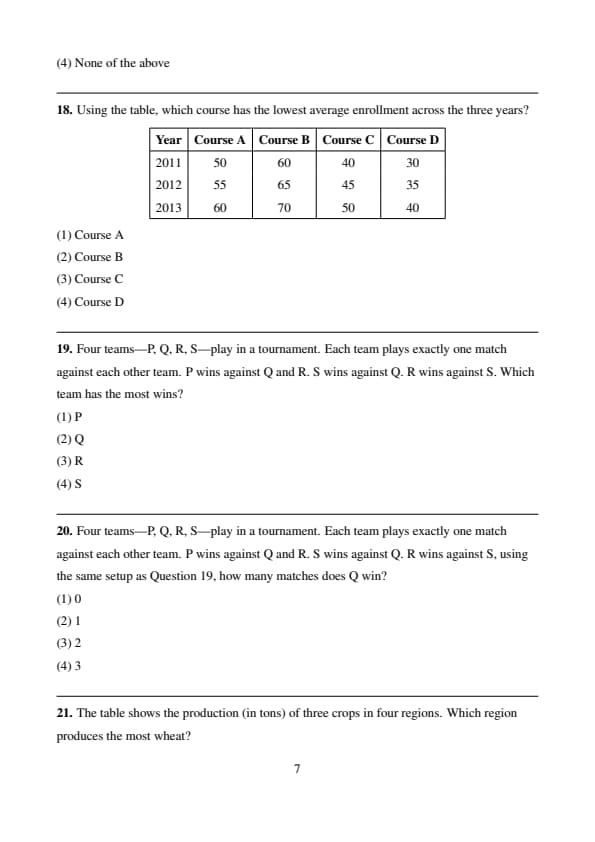
Using the table, which course has the lowest average enrollment across the three years?

View Solution
Four teams—P, Q, R, S—play in a tournament. Each team plays exactly one match against each other team. P wins against Q and R. S wins against Q. R wins against S. Which team has the most wins?
View Solution
Four teams—P, Q, R, S—play in a tournament. Each team plays exactly one match against each other team. P wins against Q and R. S wins against Q. R wins against S, using the same setup as Question 19, how many matches does Q win?
View Solution
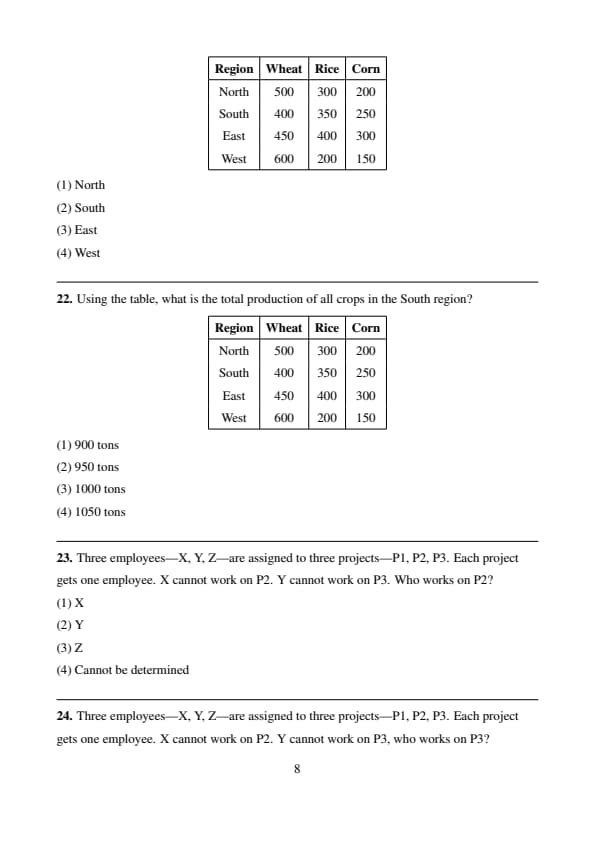
The table shows the production (in tons) of three crops in four regions. Which region produces the most wheat?

View Solution
Using the table, what is the total production of all crops in the South region?

(1) 900 tons
View Solution
Three employees—X, Y, Z—are assigned to three projects—P1, P2, P3. Each project gets one employee. X cannot work on P2. Y cannot work on P3. Who works on P2?
View Solution
Three employees—X, Y, Z—are assigned to three projects—P1, P2, P3. Each project gets one employee. X cannot work on P2. Y cannot work on P3, who works on P3?
View Solution
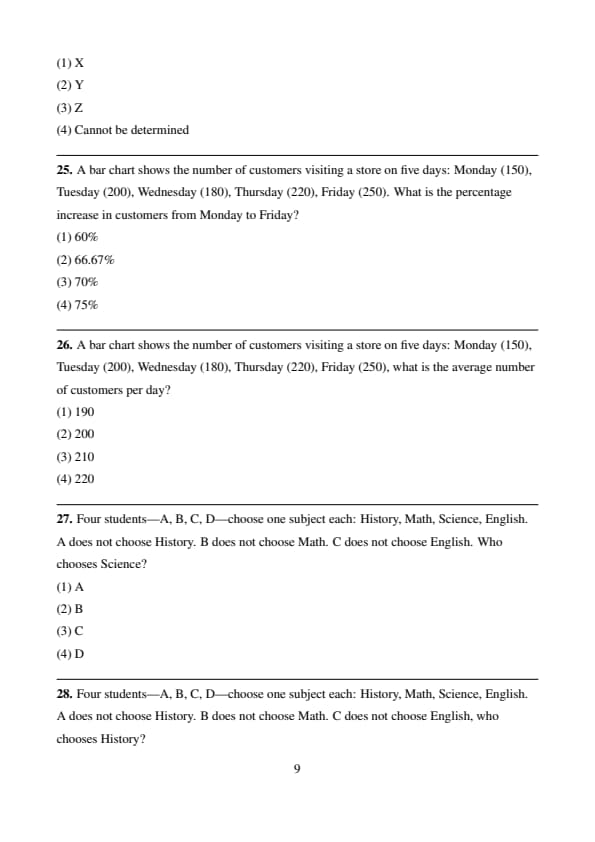
A bar chart shows the number of customers visiting a store on five days: Monday (150), Tuesday (200), Wednesday (180), Thursday (220), Friday (250). What is the percentage increase in customers from Monday to Friday?
View Solution
A bar chart shows the number of customers visiting a store on five days: Monday (150), Tuesday (200), Wednesday (180), Thursday (220), Friday (250), what is the average number of customers per day?
View Solution
Four students—A, B, C, D—choose one subject each: History, Math, Science, English. A does not choose History. B does not choose Math. C does not choose English. Who chooses Science?
View Solution
Four students—A, B, C, D—choose one subject each: History, Math, Science, English. A does not choose History. B does not choose Math. C does not choose English, who chooses History?
View Solution
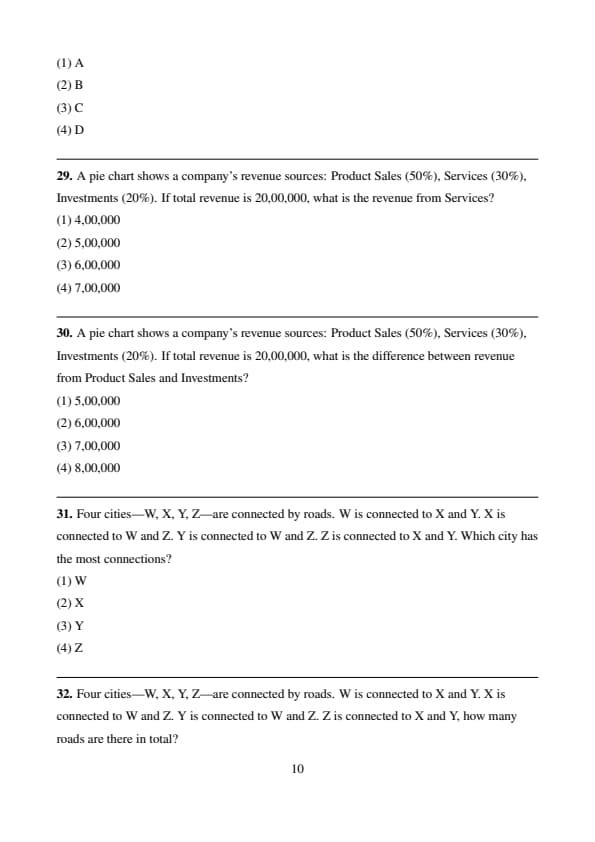
A pie chart shows a company’s revenue sources: Product Sales (50%), Services (30%), Investments (20%). If total revenue is ₹20,00,000, what is the revenue from Services?
View Solution
A pie chart shows a company’s revenue sources: Product Sales (50%), Services (30%), Investments (20%). If total revenue is ₹20,00,000, what is the difference between revenue from Product Sales and Investments?
View Solution
Four cities—W, X, Y, Z—are connected by roads. W is connected to X and Y. X is connected to W and Z. Y is connected to W and Z. Z is connected to X and Y. Which city has the most connections?
View Solution
Four cities—W, X, Y, Z—are connected by roads. W is connected to X and Y. X is connected to W and Z. Y is connected to W and Z. Z is connected to X and Y, how many roads are there in total?
View Solution

CAT 2013 Question Paper Analysis
In CAT 2013, the candidates were awarded 7.5 marks for each correct answer and 2.5 marks were deducted for each wrong answer.
CAT 2013 Verbal Ability and Logical Reasoning Paper Analysis
CAT 2013 Question Paper had 30 questions from the Verbal Ability and Logical Reasoning Section.
- This section of CAT 2013 Question Paper had 3 passages.
- The candidates were asked for sentence correction, para-jumble, para completion, fill in the blanks, word usage.
- The question paper had questions of Data Arrangement, Seating Arrangement, and logic-based.
CAT 2013 Quantitative Ability & Data Interpretation Paper Analysis
CAT 2013 Question Paper had 30 questions from the Quantitative Ability and Data Interpretation section.
- CAT 2013 question paper had questions from Number System, Arithmetic, Algebra, Geometry, Mensuration.
- The candidates had questions from Graphs, Pie charts, Table.
Candidates can find the marks distribution in CAT 2014 Question Paper from the below table:
| Topics | Number of Questions | Difficulty Level |
|---|---|---|
| Reading Comprehension | 10 (4+3+3) | Moderate |
| Verbal Ability | 11-14 | Moderate |
| Logical Reasoning | 6-9 | Moderate |
| Data interpretation | 6-10 | Moderate-Difficult |
| Quantitative Ability | 20-24 | Moderate |
CAT Question Papers of Other Years
| CAT 2024 Question Papers | CAT 2023 Question Papers |
| CAT 2022 Question Papers | CAT 2020 Question Papers |
| CAT 2019 Question Papers | CAT 2018 Question Papers |
| CAT 2017 Question Papers | CAT 2016 Question Papers |



Comments