




CAT 2016 Question Paper was rated difficult compared to the previous year. The paper included three sections: namely, Quantitative Aptitude, Data Interpretation & Logical Reasoning, and Verbal Ability & Reading Comprehension. These sections consisted of 34, 32, and 34 questions respectively. Candidates who attempted 72+ questions with 95% accuracy were able to get 99.5+ percentile.
Students preparing for CAT 2025 can download CAT 2016 Question Paper with Answer Key PDFs from below:
Also Check: CAT Question Paper With Solution Pdf
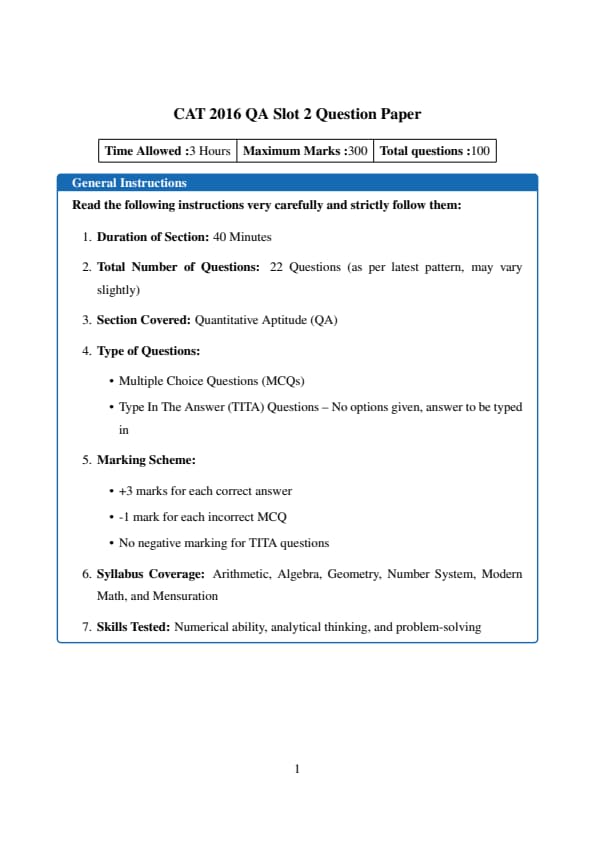
CAT 2016 Question Paper with Solution PDF – QA Slot 2
| CAT 2016 Question Paper With Answer Key – QA Slot 2 | Check Solutions |
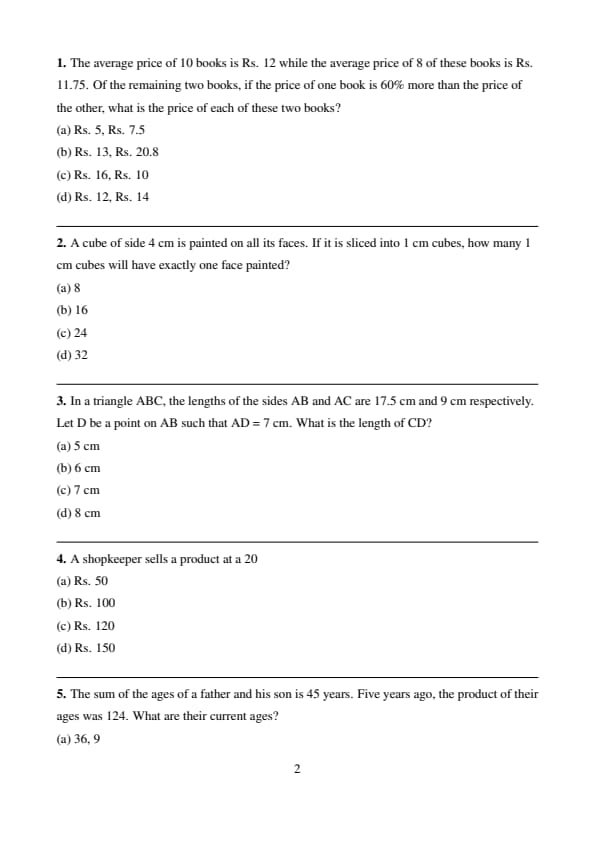
The average price of 10 books is Rs. 12 while the average price of 8 of these books is Rs. 11.75. Of the remaining two books, if the price of one book is 60% more than the price of the other, what is the price of each of these two books?
A cube of side 4 cm is painted on all its faces. If it is sliced into 1 cm cubes, how many 1 cm cubes will have exactly one face painted?
In a triangle ABC, the lengths of the sides AB and AC are 17.5 cm and 9 cm respectively. Let D be a point on AB such that AD = 7 cm. What is the length of CD?
A shopkeeper sells a product at a 20% profit. If he buys it at 20% less cost and sells it for Rs. 10 less, he earns a 25% profit. What is the original cost price?
The sum of the ages of a father and his son is 45 years. Five years ago, the product of their ages was 124. What are their current ages?
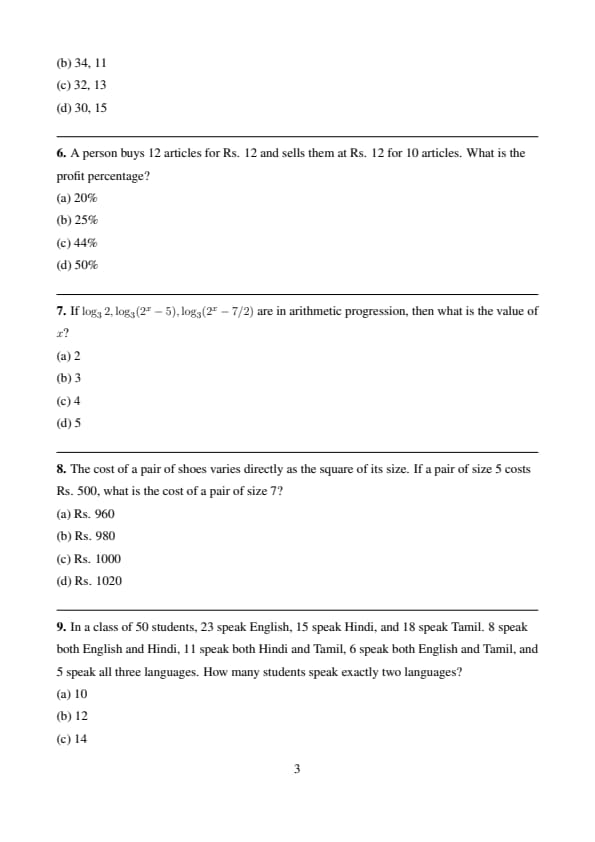
A person buys 12 articles for Rs. 12 and sells them at Rs. 12 for 10 articles. What is the profit percentage?
If \( \log_3 2, \log_3 (2^x - 5), \log_3 (2^x - 7/2) \) are in arithmetic progression, then what is the value of \( x \)?
The cost of a pair of shoes varies directly as the square of its size. If a pair of size 5 costs Rs. 500, what is the cost of a pair of size 7?
In a class of 50 students, 23 speak English, 15 speak Hindi, and 18 speak Tamil. 8 speak both English and Hindi, 11 speak both Hindi and Tamil, 6 speak both English and Tamil, and 5 speak all three languages. How many students speak exactly two languages?
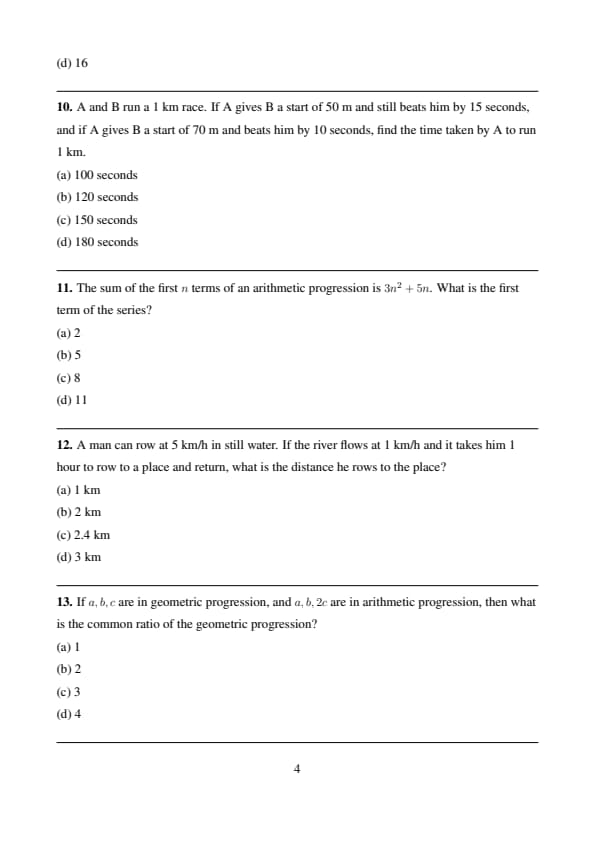
A and B run a 1 km race. If A gives B a start of 50 m and still beats him by 15 seconds, and if A gives B a start of 70 m and beats him by 10 seconds, find the time taken by A to run 1 km.
The sum of the first \( n \) terms of an arithmetic progression is \( 3n^2 + 5n \). What is the first term of the series?
A man can row at 5 km/h in still water. If the river flows at 1 km/h and it takes him 1 hour to row to a place and return, what is the distance he rows to the place?
If \( a, b, c \) are in geometric progression, and \( a, b, 2c \) are in arithmetic progression, then what is the common ratio of the geometric progression?
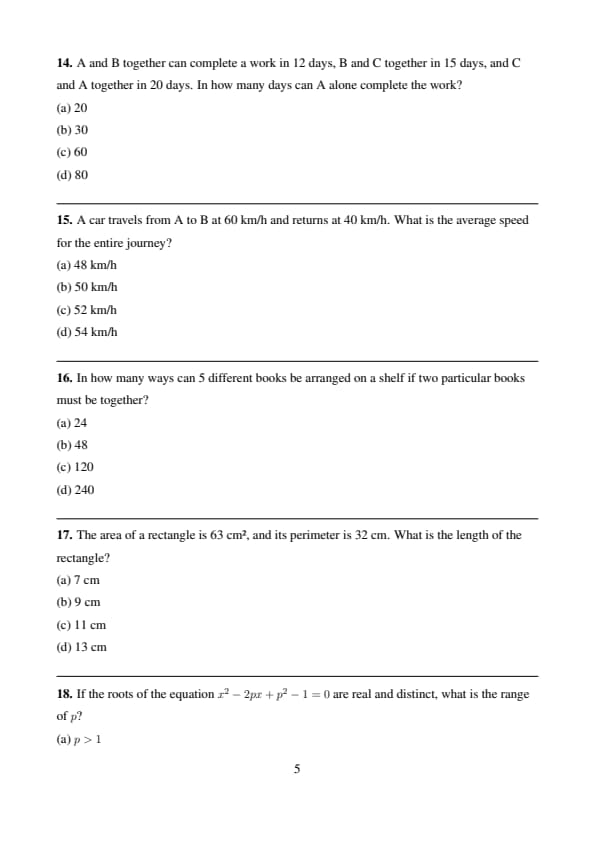
A and B together can complete a work in 12 days, B and C together in 15 days, and C and A together in 20 days. In how many days can A alone complete the work?
A car travels from A to B at 60 km/h and returns at 40 km/h. What is the average speed for the entire journey?
In how many ways can 5 different books be arranged on a shelf if two particular books must be together?
The area of a rectangle is 63 cm², and its perimeter is 32 cm. What is the length of the rectangle?
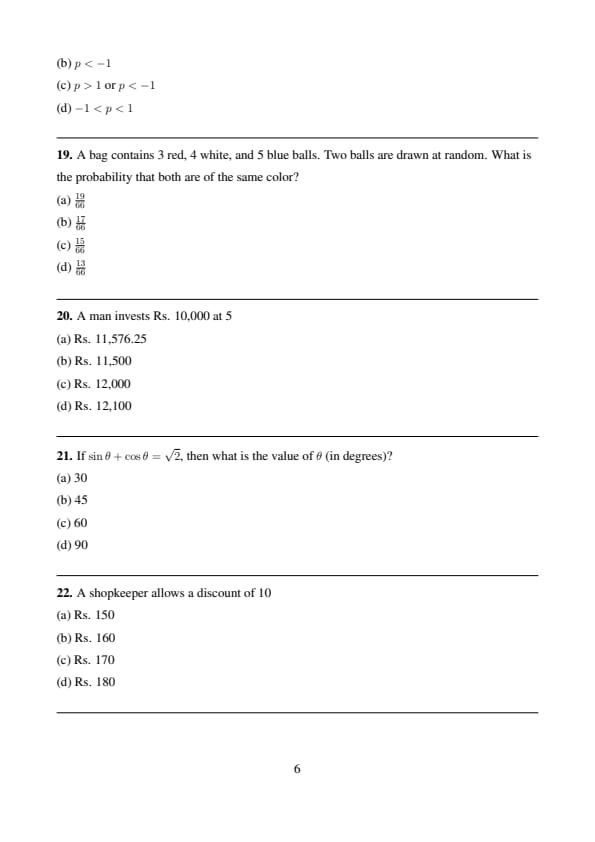
If the roots of the equation \( x^2 - 2px + p^2 - 1 = 0 \) are real and distinct, what is the range of \( p \)?
A bag contains 3 red, 4 white, and 5 blue balls. Two balls are drawn at random. What is the probability that both are of the same color?
A man invests Rs. 10,000 at 5% per annum compound interest for 3 years. What is the amount he receives at the end of 3 years?
If \( \sin \theta + \cos \theta = \sqrt{2} \), then what is the value of \( \theta \) (in degrees)?
A shopkeeper allows a discount of 10% on the marked price of an article and still makes a profit of 20%. If the marked price is Rs. 200, what is the cost price?
CAT 2016 Question Paper Analysis
CAT 2016 was conducted by IIM Bangalore on December 4, 2016. CAT 2015 exam pattern and CAT 2016 exam pattern were similar except for the weighted TITA questions.
CAT 2016 VARC Question Paper Analysis
The VARC section of CAT 2016 Question Paper was rated easy to moderate level. CAT 2016 Question Paper had 25 Non-MCQ questions and there was no negative marking for Non-MCQ questions.
The second slot of CAT 2016 was conducted from 2:30 PM and 5:30 PM. A good attempt of 66+ questions with 100% accuracy should suffice a good percentile.
Slot 1
- The question paper had reading comprehensions from areas like Environmental Studies, Economics, etc.
- The VARC section was lengthy but easier than other sections.
- Most of the questions of the VARC section came from the verbal logic part.
Slot 2
- One passage from the Reading Comprehension section was difficult and other passages were majorly factual.
- The easiest part of the question paper was the summary and the para jumble questions.
- There were inference-based questions in RC.
Students should follow the below table for a better understanding of question distribution
| Topic | Number of Questions |
|---|---|
| Reading Comprehension | 24 |
| Para-jumble | 4 |
| Summary | 3 |
| Para-jumble (Odd sentence out) | 2 |
CAT 2016 DILR Question Paper Analysis
Candidates should have practiced enough to do well in this section. They should have read the instructions before starting answering the questions.
Slot 1
- 1 set in this section was moderately difficult while 4 sets of this section were very easy.
- Most of the Data Interpretation questions were calculation-related.
- The slot 1 DILR question paper of CAT 2016 had no questions from the DS part.
Slot 2
- The question paper had three difficult DI sets but the other one was easier.
- This question paper had more than 17 doable questions.
Students should follow the below table for a better understanding of question distribution
| Topic | Number of Questions | Doable |
|---|---|---|
| Pass percentage - Moderate | 4 | 2-3 |
| Movies - Easy | 4 | 4 |
| Train - Difficult | 4 | 1-2 |
| Veg/Non-veg - Moderate/Difficult | 4 | 1-2 |
| Marks - Easy | 4 | 4 |
| Folders - Easy | 4 | 4 |
| T-shirt - Easy | 4 | 3 |
| Venn Diagram (Laptop/Smartphone/Tablet) - Moderate | 4 | 3 |
CAT 2016 QA Question Paper Analysis
The options in this section were very helpful to get the answer. Candidates should have known time management to get a good percentile in this section.
Slot 1
- CAT 2016 Question Paper had 7-8 MCQ questions from the QA section and the rest were Non-MCQs.
- The questions were easy and doable with the help of formulas.
- The question paper had around 10 questions from the Algebra part.
Slot 2
- The slot 2 QA section of CAT 2016 Question Paper was dominated by the questions from Geometry and Arithmetic.
- There were only 7 TITA questions in slot 2.
- A good attempt of 18-20 questions with 90% accuracy should suffice a good percentile.
Students should follow the below table for a better understanding of question distribution
| Topic | Number of Questions | Doable |
|---|---|---|
| Number System | 4 | 3 |
| Algebra | 10-11 | 8-10 |
| Arithmetic | 10 | 7-9 |
| Geometry and Mensuration | 7-8 | 4-5 |
| Modern Math | 2 | 1 |
CAT Question Papers of Previous Years
| CAT 2024 Question Papers | CAT 2023 Question Papers | CAT 2022 Question Papers | CAT 2021 Question Papers |
| CAT 2020 Question Papers | CAT 2019 Question Papers | CAT 2018 Question Papers | CAT 2017 Question Papers |



Comments