




CAT 2017 VARC Slot 2 question paper was a little bit easier than slot 1 VARC question paper. CAT 2017 VARC Slot 2 question paper was rated moderate.The summary questions were MCQ-based and carried negative marks. Since the passage was easy to read, the options were very close. Since the options were so identical, it became difficult and time-consuming to answer. The 5 passages came from areas like Economics, Biology, Current Trends, etc. The passage about typewriters had around 250 words. An attempt of 25-27 with around 90% accuracy was enough to get 99%ile.
Candidates preparing for CAT 2025 can download the CAT VARC question paper with the solution PDF for the Slot 2 exam conducted on November 26, 2017, to get a better idea about the type of questions asked in the paper and the difficulty level of questions.
Also Check:
CAT 2017 VARC Slot 2 Question Paper with Solution PDF
| CAT 2017 VARC Slot 2 Question Paper with Answer Key | Download PDF | Check Solutions |
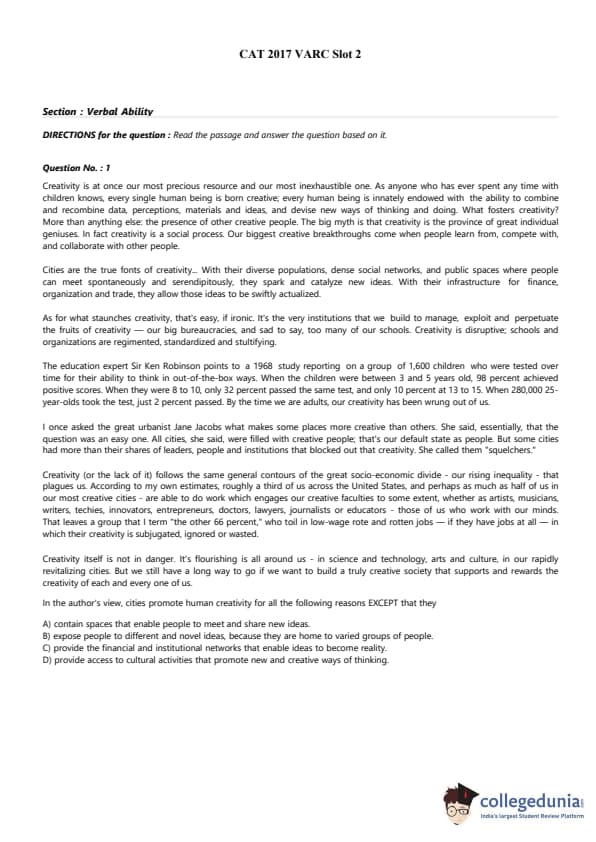
Question 1:
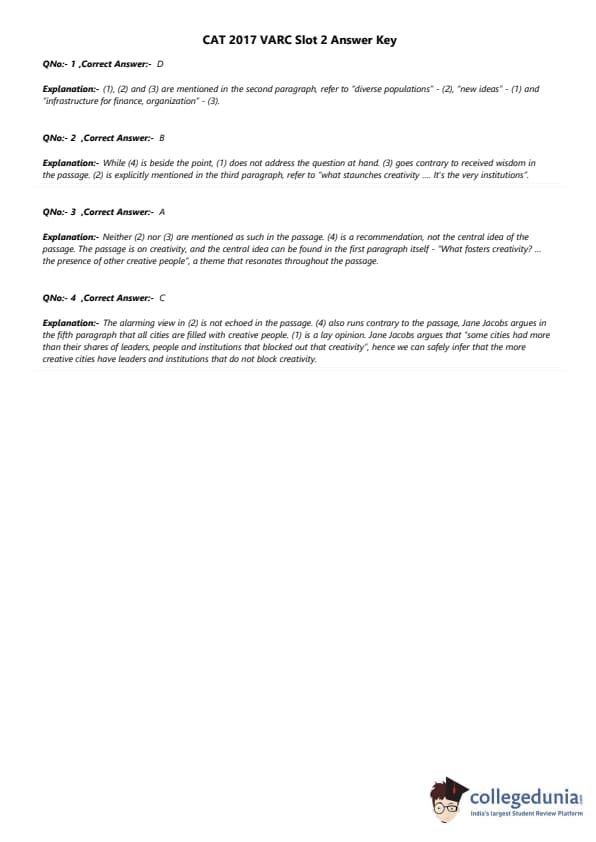
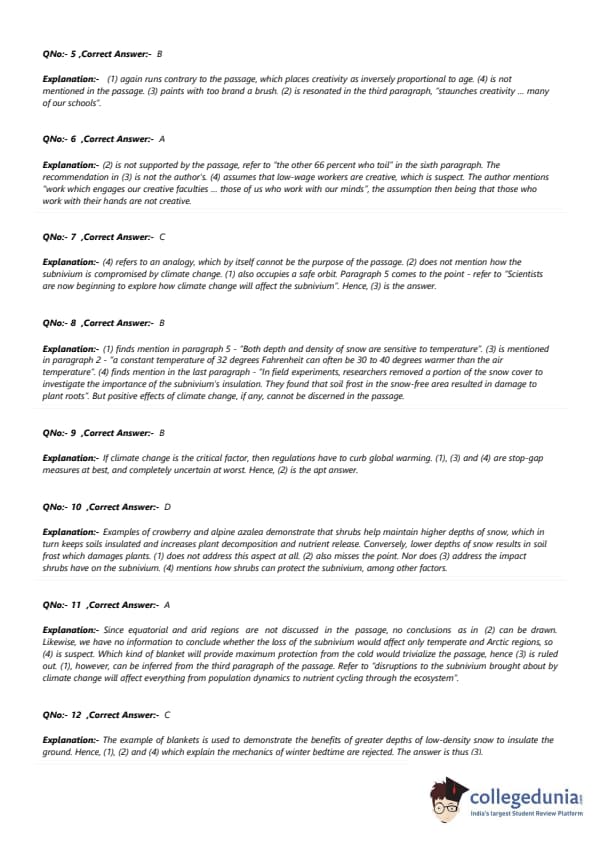
In the author's view, cities promote human creativity for all the following reasons EXCEPT that they
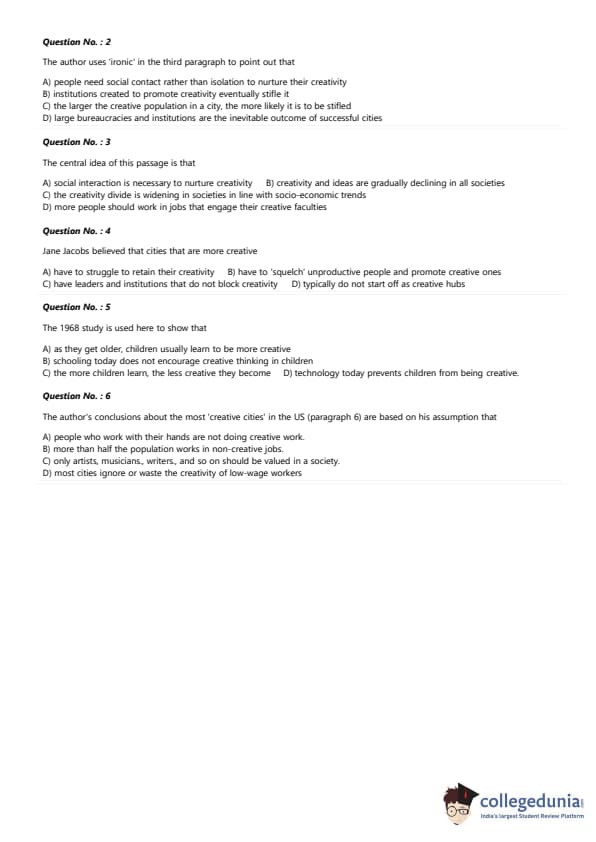
The author uses 'ironic' in the third paragraph to point out that
View Solution
The central idea of this passage is that
View Solution
Jane Jacobs believed that cities that are more creative
View Solution
The 1968 study is used here to show that
View Solution
The author's conclusions about the most 'creative cities' in the US (paragraph 6) are based on his assumption that
View Solution
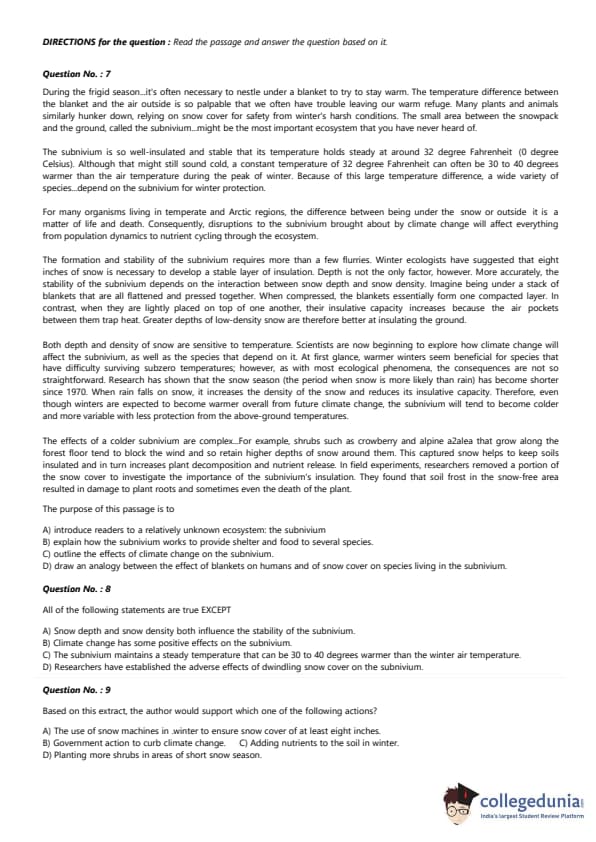
The purpose of this passage is to
View Solution
All of the following statements are true EXCEPT
View Solution
Based on this extract, the author would support which one of the following actions?
View Solution
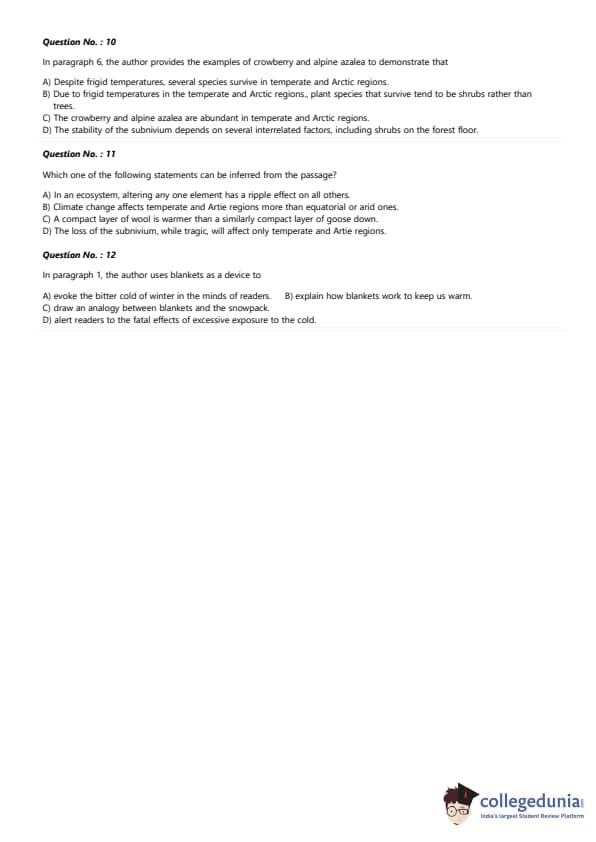
In paragraph 6, the author provides the examples of crowberry and alpine azalea to demonstrate that
View Solution
Which one of the following statements can be inferred from the passage?
View Solution
In paragraph 1, the author uses blankets as a device to
View Solution
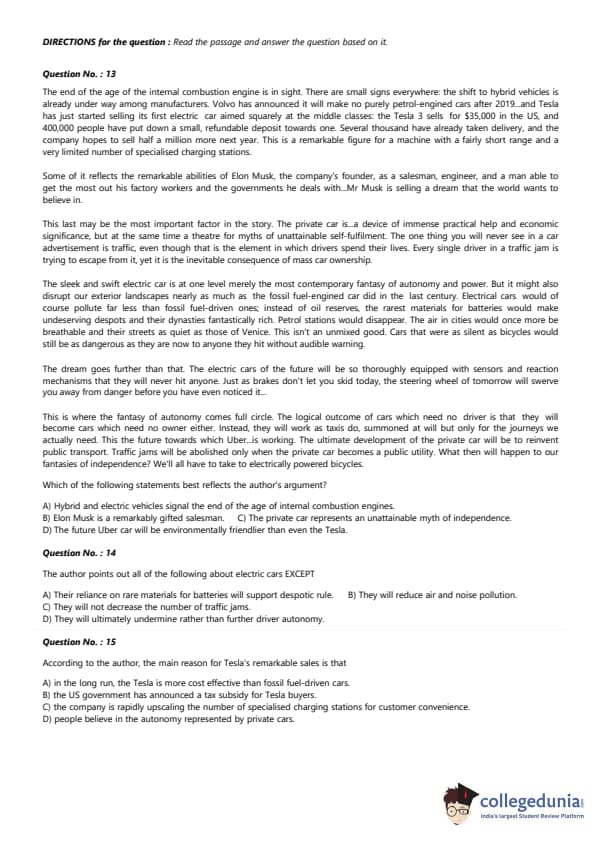
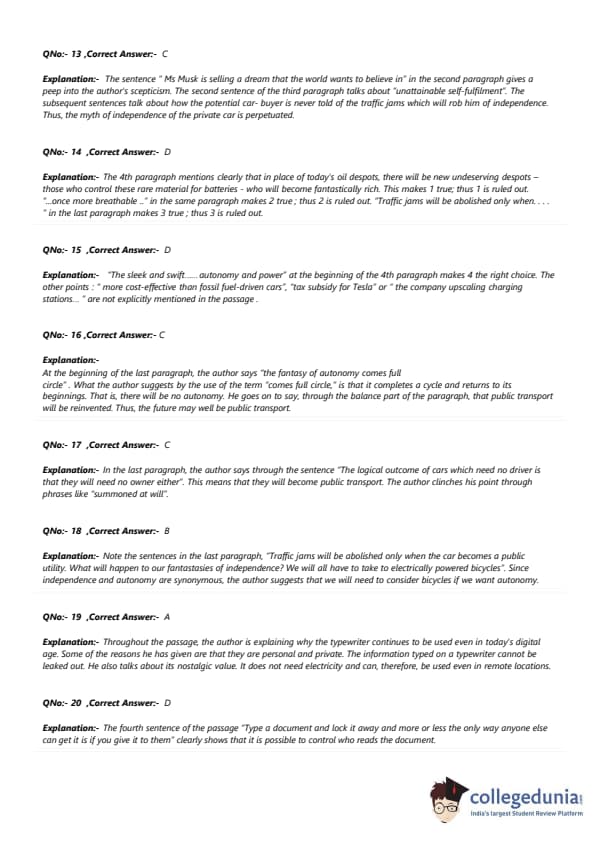
Which of the following statements best reflects the author's argument?
View Solution
The author points out all of the following about electric cars EXCEPT
View Solution
According to the author, the main reason for Tesla's remarkable sales is that
View Solution
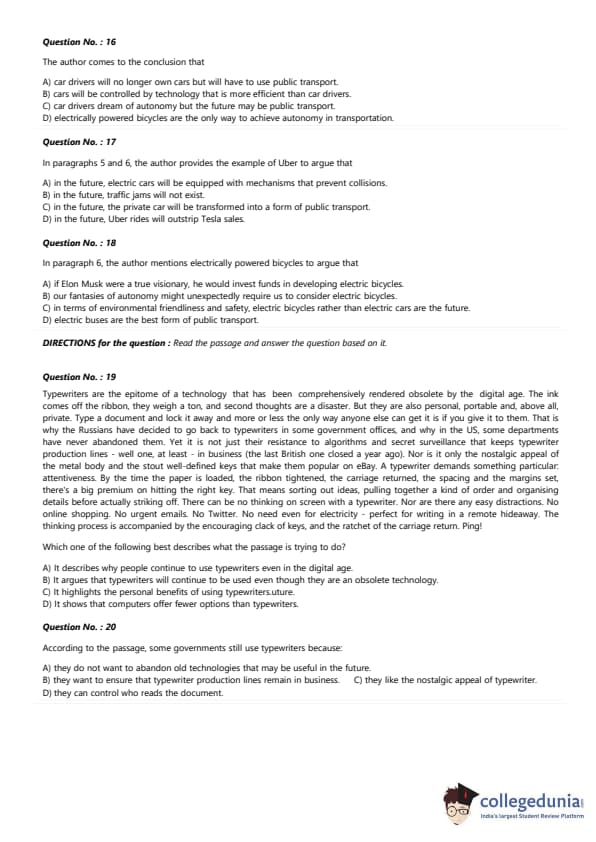
The author comes to the conclusion that
View Solution
In paragraphs 5 and 6, the author provides the example of Uber to argue that
View Solution
In paragraph 6, the author mentions electrically powered bicycles to argue that
View Solution
Which one of the following best describes what the passage is trying to do?
View Solution
According to the passage, some governments still use typewriters because:
View Solution
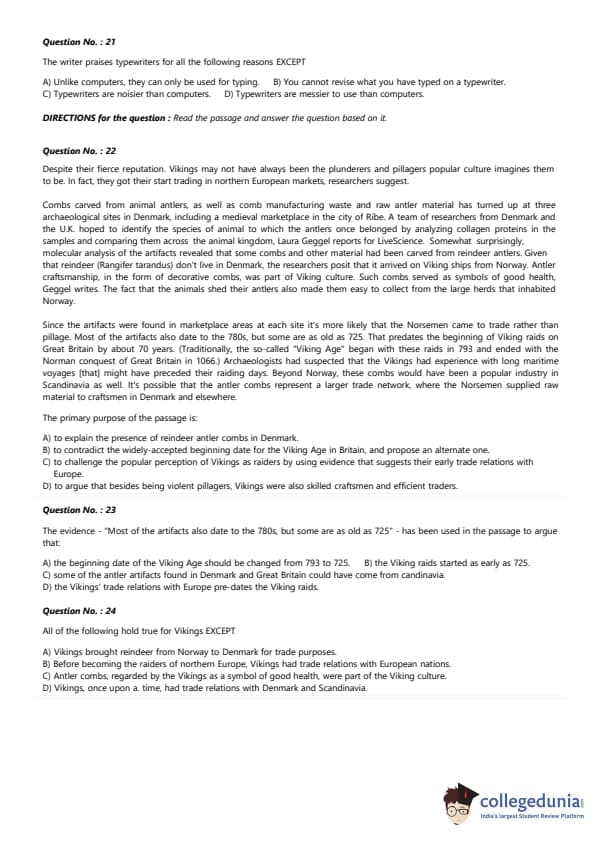
The writer praises typewriters for all the following reasons EXCEPT
View Solution
The primary purpose of the passage is:
View Solution
The evidence – "Most of the artifacts also date to the 780s, but some are as old as 725" – has been used in the passage to argue that:
View Solution
All of the following hold true for Vikings EXCEPT
View Solution
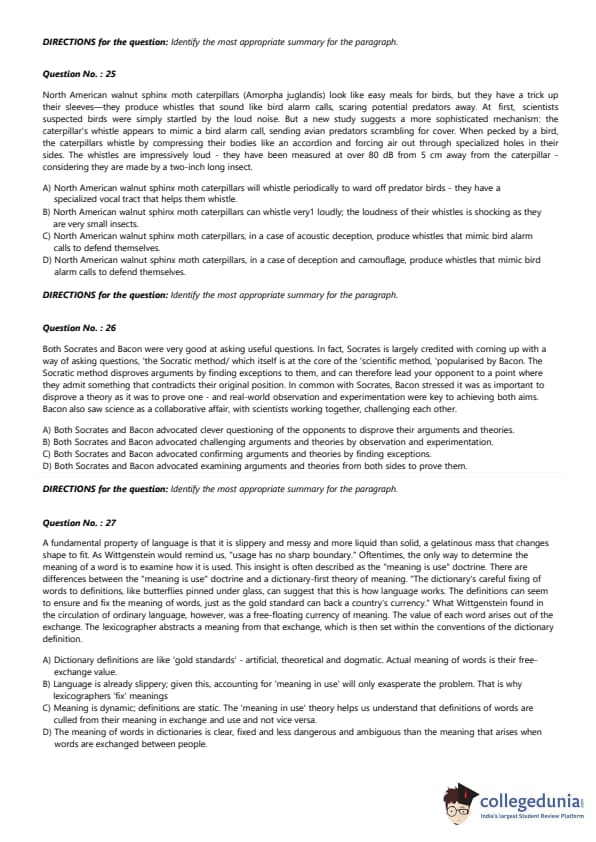
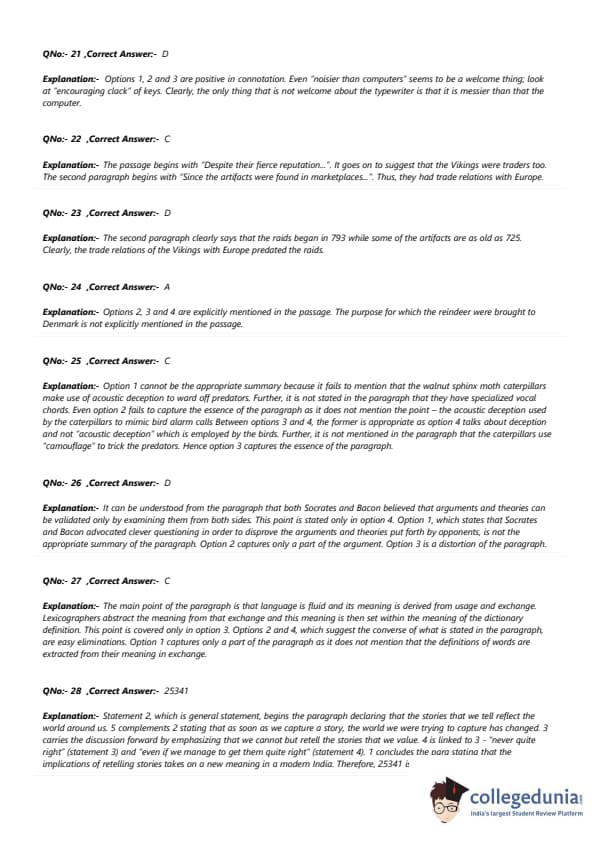
Identify the most appropriate summary for the paragraph.
\medskip
North American walnut sphinx moth caterpillars (Amorpha juglandis) look like easy meals for birds, but they have a trick up their sleeves—they produce whistles that sound like bird alarm calls, scaring potential predators away. At first, scientists suspected birds were simply startled by the loud noise. But a new study suggests a more sophisticated mechanism: the caterpillar’s whistle appears to mimic a bird alarm call, sending avian predators scrambling for cover. When pecked by a bird, the caterpillars whistle by compressing their bodies like an accordion and forcing air out through specialized holes in their sides. The whistles are impressively loud—they have been measured at over 80 dB from 5 cm away from the caterpillar—considering they are made by a two-inch long insect.
View Solution
Identify the most appropriate summary for the paragraph.
\medskip
Both Socrates and Bacon were very good at asking useful questions. In fact, Socrates is largely credited with coming up with a way of asking questions, 'the Socratic method,' which itself is at the core of the 'scientific method,' popularised by Bacon. The Socratic method disproves arguments by finding exceptions to them, and can therefore lead your opponent to a point where they admit something that contradicts their original position. In common with Socrates, Bacon stressed it was as important to disprove a theory as it was to prove one – and real-world observation and experimentation were key to achieving both aims. Bacon also saw science as a collaborative affair, with scientists working together, challenging each other.
View Solution
Identify the most appropriate summary for the paragraph.
\medskip
A fundamental property of language is that it is slippery and messy and more liquid than solid, a gelatinous mass that changes shape to fit. As Wittgenstein would remind us, "usage has no sharp boundary." Oftentimes, the only way to determine the meaning of a word is to examine how it is used. This insight is often described as the "meaning is use" doctrine. There are differences between the "meaning is use" doctrine and a dictionary-first theory of meaning. "The dictionary’s careful fixing of words to definitions, like butterflies pinned under glass, can suggest that this is how language works. The definitions can seem to ensure and fix the meaning of words, just as the gold standard can back a country’s currency." What Wittgenstein found in the circulation of ordinary language, however, was a free-floating currency of meaning. The value of each word arises out of the exchange. The lexicographer abstracts a meaning from that exchange, which is then set within the conventions of the dictionary definition.
View Solution
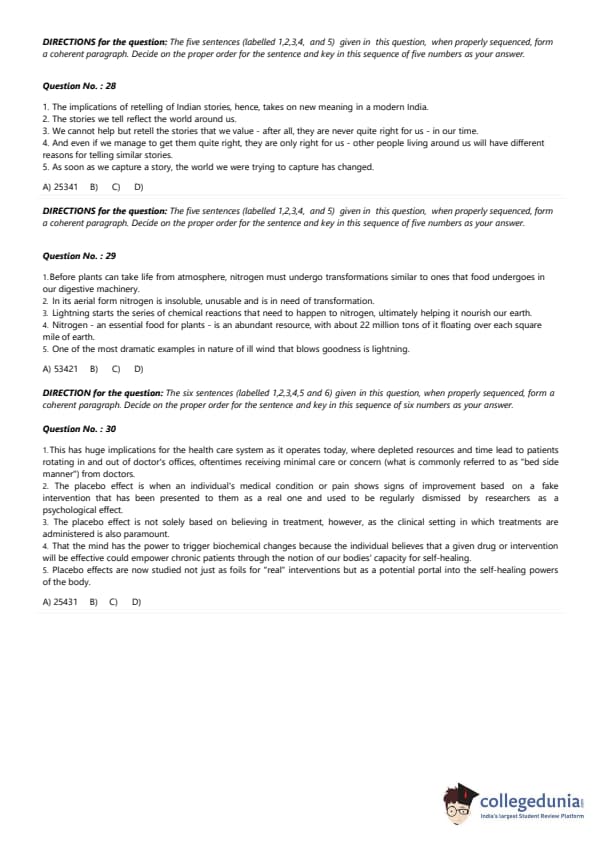
The five sentences (labelled 1, 2, 3, 4, and 5) given in this question, when properly sequenced, form a coherent paragraph. Decide on the proper order for the sentence and key in this sequence of five numbers as your answer.
1. The implications of retelling of Indian stories, hence, takes on new meaning in a modern India.
2. The stories we tell reflect the world around us.
3. We cannot help but retell the stories that we value – after all, they are never quite right for us – in our time.
4. And even if we manage to get them quite right, they are only right for us – other people living around us will have different reasons for telling similar stories.
5. As soon as we capture a story, the world we were trying to capture has changed.
View Solution
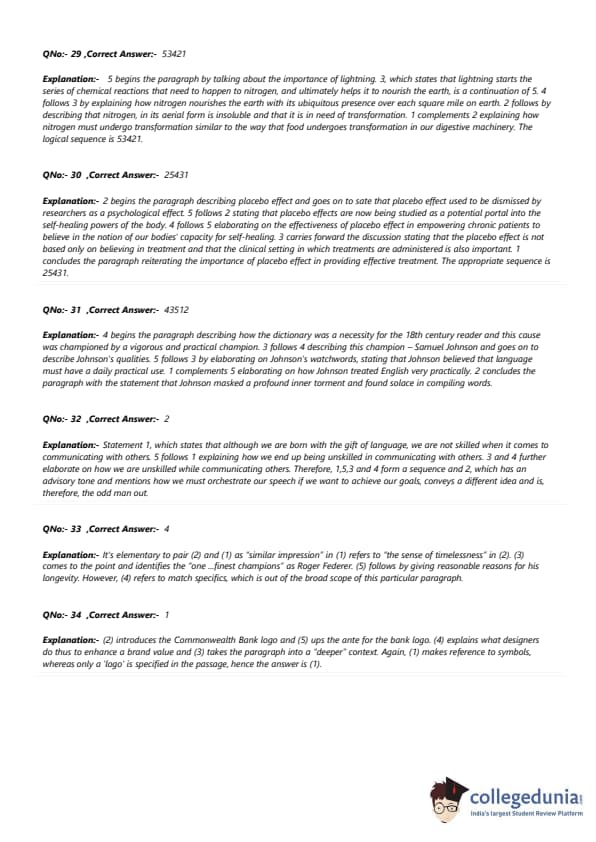
The five sentences (labelled 1, 2, 3, 4, and 5) given in this question, when properly sequenced, form a coherent paragraph. Decide on the proper order for the sentence and key in this sequence of five numbers as your answer.
1. Before plants can take life from atmosphere, nitrogen must undergo transformations similar to ones that food undergoes in our digestive machinery.
2. In its aerial form nitrogen is insoluble, unusable and is in need of transformation.
3. Lightning starts the series of chemical reactions that need to happen to nitrogen, ultimately helping it nourish our earth.
4. Nitrogen – an essential food for plants – is an abundant resource, with about 22 million tons of it floating over each square mile of earth.
5. One of the most dramatic examples in nature of ill wind that blows goodness is lightning.
View Solution
The six sentences (labelled 1,2,3,4,5 and 6) given in this question, when properly sequenced, form a coherent paragraph. Decide on the proper order for the sentence and key in this sequence of six numbers as your answer.
1. This has huge implications for the health care system as it operates today, where depleted resources and time lead to patients rotating in and out of doctor's offices, oftentimes receiving minimal care or concern (what is commonly referred to as "bed side manner") from doctors.
2. The placebo effect is when an individual's medical condition or pain shows signs of improvement based on a fake intervention that has been presented to them as a real one and used to be regularly dismissed by researchers as a psychological effect.
3. The placebo effect is not solely based on believing in treatment, however, as the clinical setting in which treatments are administered is also paramount.
4. That the mind has the power to trigger biochemical changes because the individual believes that a given drug or intervention will be effective could empower chronic patients through the notion of our bodies' capacity for self-healing.
5. Placebo effects are now studied not just as foils for "real" interventions but as a potential portal into the self-healing powers of the body.
6. [This sentence is missing from the original image and is therefore not considered in the given answer choice.]
View Solution
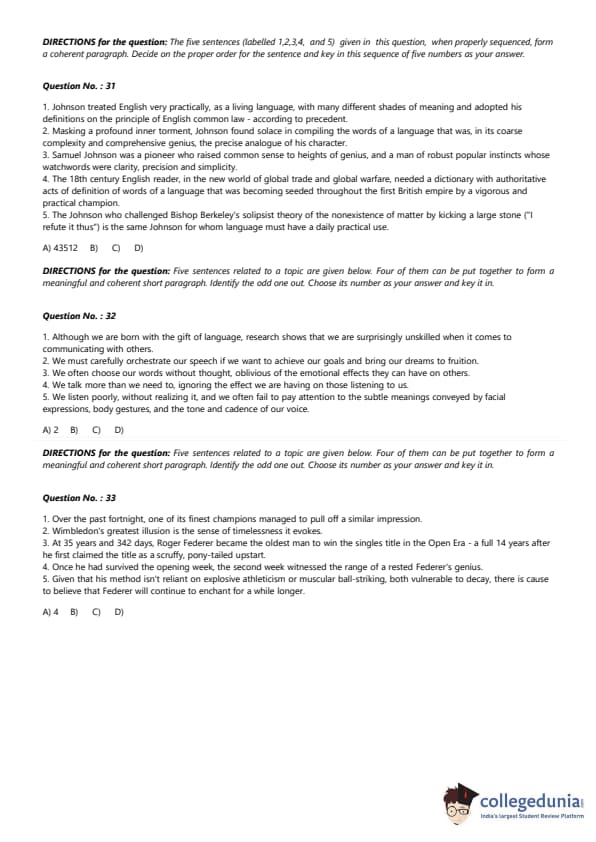
The five sentences (labelled 1,2,3,4, and 5) given in this question, when properly sequenced, form a coherent paragraph. Decide on the proper order for the sentence and key in this sequence of five numbers as your answer.
1. Johnson treated English very practically, as a living language, with many different shades of meaning and adopted his definitions on the principle of English common law – according to precedent.
2. Masking a profound inner torment, Johnson found solace in compiling the words of a language that was, in its coarse complexity and comprehensive genius, the precise analogue of his character.
3. Samuel Johnson was a pioneer who raised common sense to heights of genius, and a man of robust popular instincts whose watchwords were clarity, precision and simplicity.
4. The 18th century English reader, in the new world of global trade and global warfare, needed a dictionary with authoritative acts of definition of words of a language that was becoming seeded throughout the first British empire by a vigorous and practical champion.
5. The Johnson who challenged Bishop Berkeley’s solipsist theory of the nonexistence of matter by kicking a large stone (“I refute it thus”) is the same Johnson for whom language must have a daily practical use.
View Solution
Five sentences related to a topic are given below. Four of them can be put together to form a meaningful and coherent short paragraph. Identify the odd one out. Choose its number as your answer and key it in.
1. Although we are born with the gift of language, research shows that we are surprisingly unskilled when it comes to communicating with others.
2. We must carefully orchestrate our speech if we want to achieve our goals and bring our dreams to fruition.
3. We often choose our words without thought, oblivious of the emotional effects they can have on others.
4. We talk more than we need to, ignoring the effect we are having on those listening to us.
5. We listen poorly, without realizing it, and we often fail to pay attention to the subtle meanings conveyed by facial expressions, body gestures, and the tone and cadence of our voice.
View Solution
Five sentences related to a topic are given below. Four of them can be put together to form a meaningful and coherent short paragraph. Identify the odd one out. Choose its number as your answer and key it in.
1. Over the past fortnight, one of its finest champions managed to pull off a similar impression.
2. Wimbledon's greatest illusion is the sense of timelessness it evokes.
3. At 35 years and 342 days, Roger Federer became the oldest man to win the singles title in the Open Era – a full 14 years after he first claimed the title as a scruffy, pony-tailed upstart.
4. Once he had survived the opening week, the second week witnessed the range of a rested Federer's genius.
5. Given that his method isn't reliant on explosive athleticism or muscular ball-striking, both vulnerable to decay, there is cause to believe that Federer will continue to enchant for a while longer.
View Solution
Five sentences related to a topic are given below. Four of them can be put together to form a meaningful and coherent short paragraph. Identify the odd one out. Choose its number as your answer and key it in.
1. Those geometric symbols and aerodynamic swooshes are more than just skin deep.
2. The Commonwealth Bank logo – a yellow diamond, with a black chunk sliced out in one corner – is so recognisable that the bank doesn't even use its full name in its advertising.
3. It's not just logos with hidden shapes; sometimes brands will have meanings or stories within them that are deliberately vague or lost in time, urging you to delve deeper to solve the riddle.
4. Graphic designers embed cryptic references because it adds a story to the brand; they want people to spend more time with a brand and have that idea that they are an insider if they can understand the hidden message.
5. But the Comm Bank logo has more to it than meets the eye, as squirrelled away in that diamond is the Southern Cross constellation.
View Solution

Also Check:
CAT 2017 VARC Slot 2 Paper Analysis
CAT 2017 VARC Slot 2 was conducted by IIM Lucknow on 26 November 2017. The conducting time was 2:30 PM - 5:30 PM.
- A total of 5 idea-based passages were given from varied topics.
- CAT 2017 VARC Slot 2 question paper had 5 sentence type questions. One of them was tricky.
- A paragraph of 150 words was given with 4 options.
- 5 sentence paragraphs with short sentences were given.
Follow the table below to understand the complete CAT 2017 VARC Slot 2 Question Paper analysis- distribution of questions and good attempts.
| Topic | Number of Questions | Good Attempt |
|---|---|---|
| Reading Comprehension | 24 | 20-22 |
| Para-jumble | 4 | 2-3 |
| Summary | 3 | 2 |
| Para-jumble (Odd sentence out) | 3 | 2 |
CAT Question Papers of Other Years
| CAT 2024 Question Papers | CAT 2023 Question Papers |
| CAT 2022 Question Papers | CAT 2020 Question Papers |
| CAT 2019 Question Papers | CAT 2018 Question Papers |
| CAT 2017 Question Papers | CAT 2016 Question Papers |



Comments