CAT 2018 was conducted on November 25, 2018, in 2 slots. CAT 2018 VARC Slot 1 question paper was reported moderate to difficult in terms of overall difficulty level. CAT VARC was more or less along the lines of the previous year’s CAT question papers. There were 24 RC questions, 7 para jumbles, and 3 questions each from sentence elimination and para summary.

  • QA was significantly tougher than the previous year’s while DILR was relatively easier. 

​Candidates preparing for CAT 2025 can download the CAT VARC question paper with the solution pdf for the Slot 1 exam conducted on November 25, 2018, to get a better idea about the type of questions asked in the paper and the difficulty level of questions.

Also Check:

CAT 2018 VARC Slot 1 Question Paper with Solution PDF

CAT 2018 VARC Slot 1 Question Paper with Answer Key Download PDF Check Solutions
CAT 2018 VARC slot 1 Question PAper

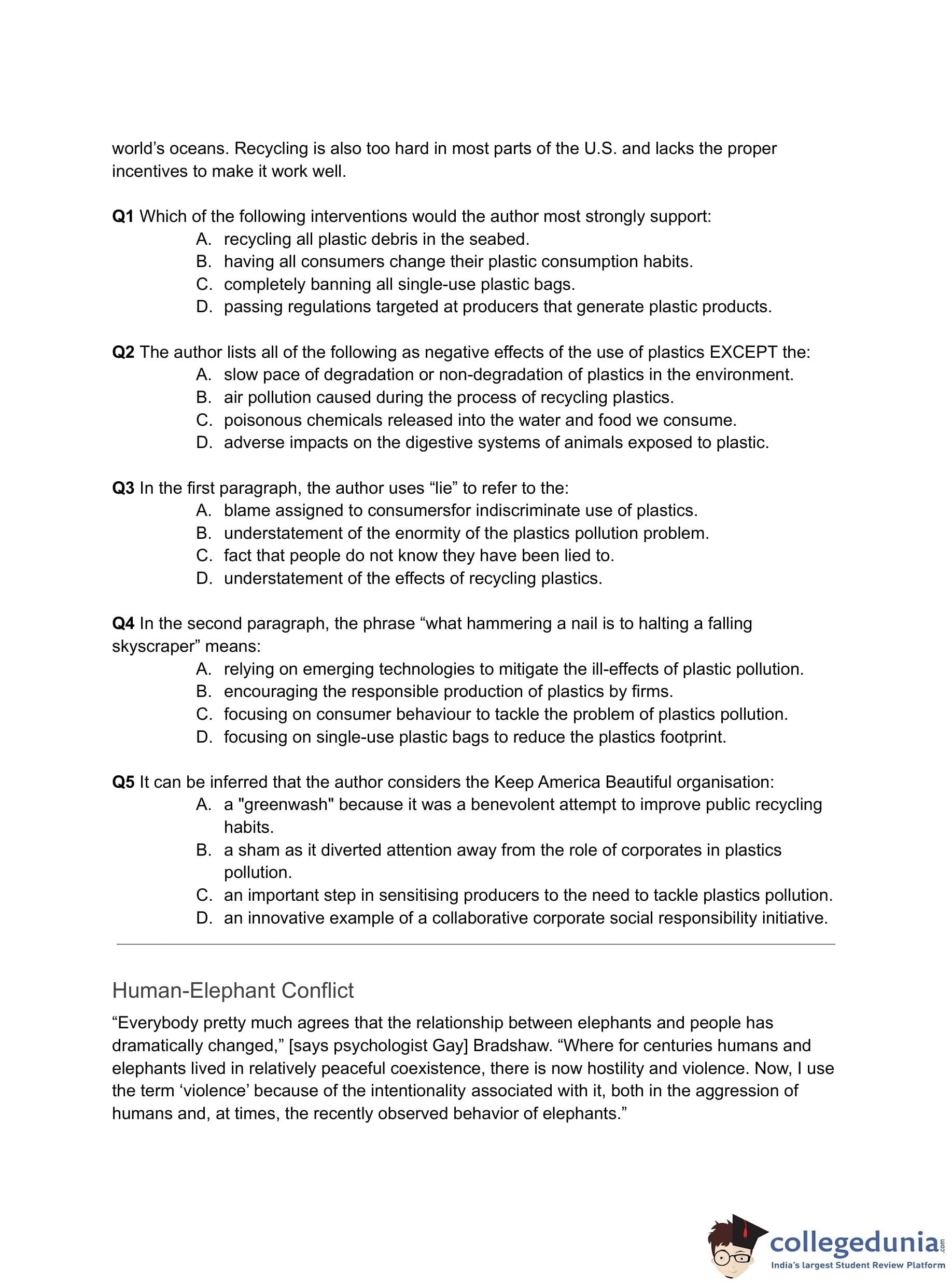
Question 1:

Which of the following interventions would the author most strongly support?

  • (A) recycling all plastic debris in the seabed.
  • (B) having all consumers change their plastic consumption habits.
  • (C) completely banning all single-use plastic bags.
  • (D) passing regulations targeted at producers that generate plastic products.
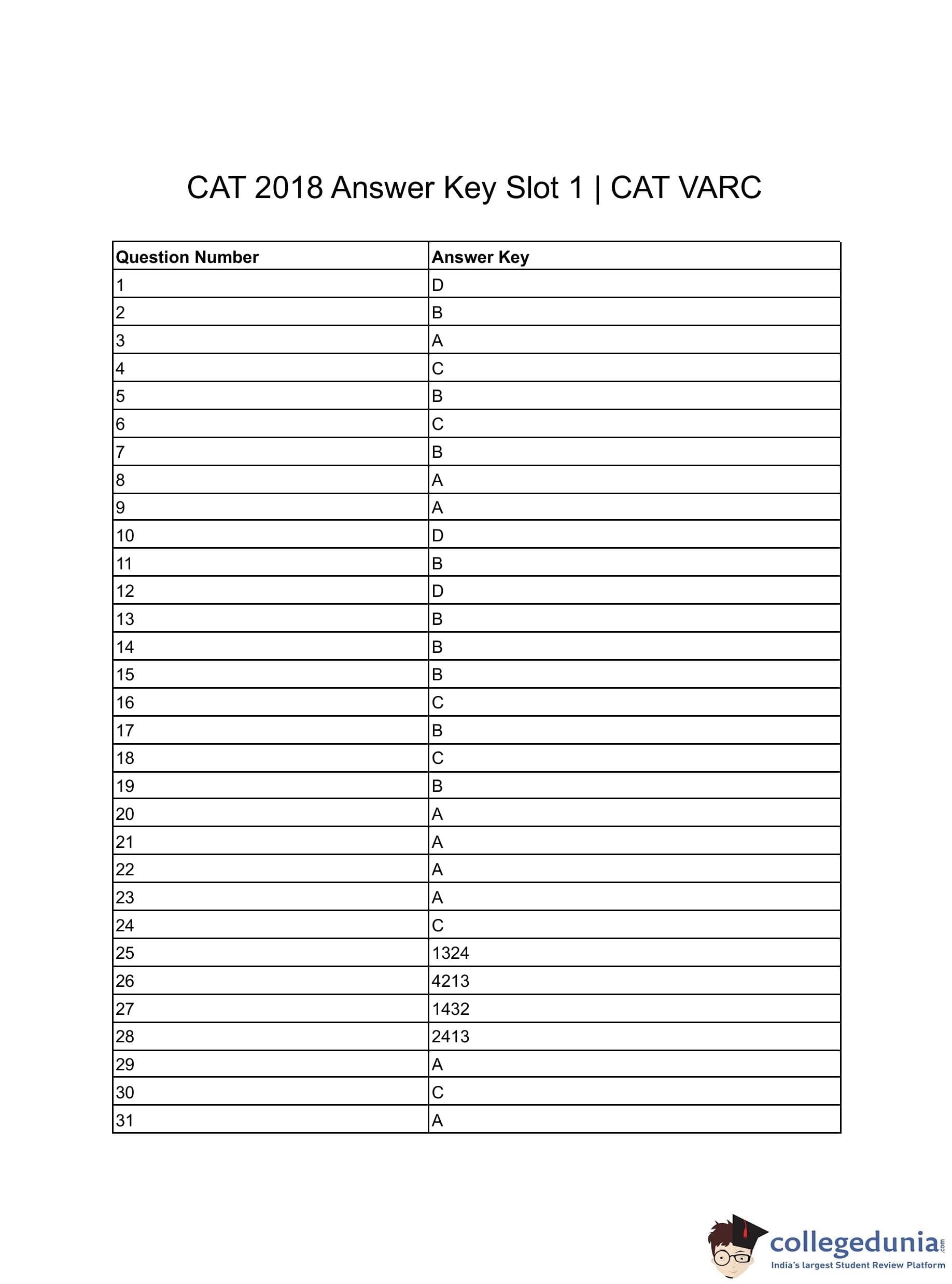
Correct Answer: (D) passing regulations targeted at producers that generate plastic products.
View Solution

Question 2:

The author lists all of the following as negative effects of the use of plastics EXCEPT the:

  • (A) slow pace of degradation or non-degradation of plastics in the environment.
  • (B) air pollution caused during the process of recycling plastics.
  • (C) poisonous chemicals released into the water and food we consume.
  • (D) adverse impacts on the digestive systems of animals exposed to plastic.
Correct Answer: (B) air pollution caused during the process of recycling plastics.
View Solution

Question 3:

In the first paragraph, the author uses "lie" to refer to the:

  • (A) blame assigned to consumers for indiscriminate use of plastics.
  • (B) understatement of the enormity of the plastics pollution problem.
  • (C) fact that people do not know they have been lied to.
  • (D) understatement of the effects of recycling plastics.
Correct Answer: (A) blame assigned to consumers for indiscriminate use of plastics.
View Solution

Question 4:

In the second paragraph, the phrase "what hammering a nail is to halting a falling skyscraper" means:

  • (A) relying on emerging technologies to mitigate the ill-effects of plastic pollution.
  • (B) encouraging the responsible production of plastics by firms.
  • (C) focusing on consumer behaviour to tackle the problem of plastics pollution.
  • (D) focusing on single-use plastic bags to reduce the plastics footprint.
Correct Answer: (C) focusing on consumer behaviour to tackle the problem of plastics pollution.
View Solution

Question 5:

It can be inferred that the author considers the Keep America Beautiful organisation:

  • (A) a "greenwash" because it was a benevolent attempt to improve public recycling habits.
  • (B) a sham as it diverted attention away from the role of corporations in plastics pollution.
  • (C) an important step in sensitising producers to the need to tackle plastics pollution.
  • (D) an innovative example of a collaborative corporate social responsibility initiative.
Correct Answer: (B) a sham as it diverted attention away from the role of corporations in plastics pollution.
View Solution

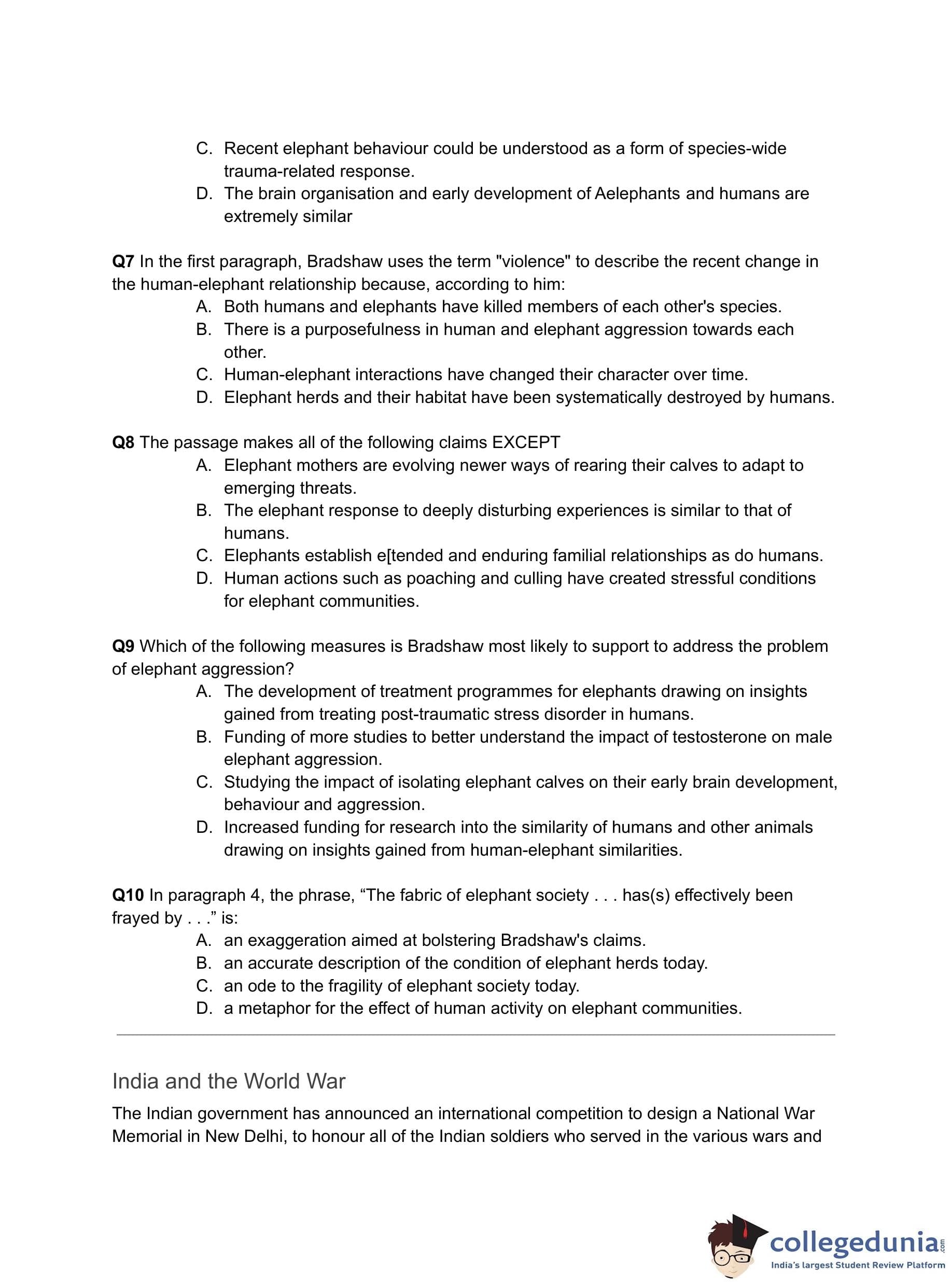
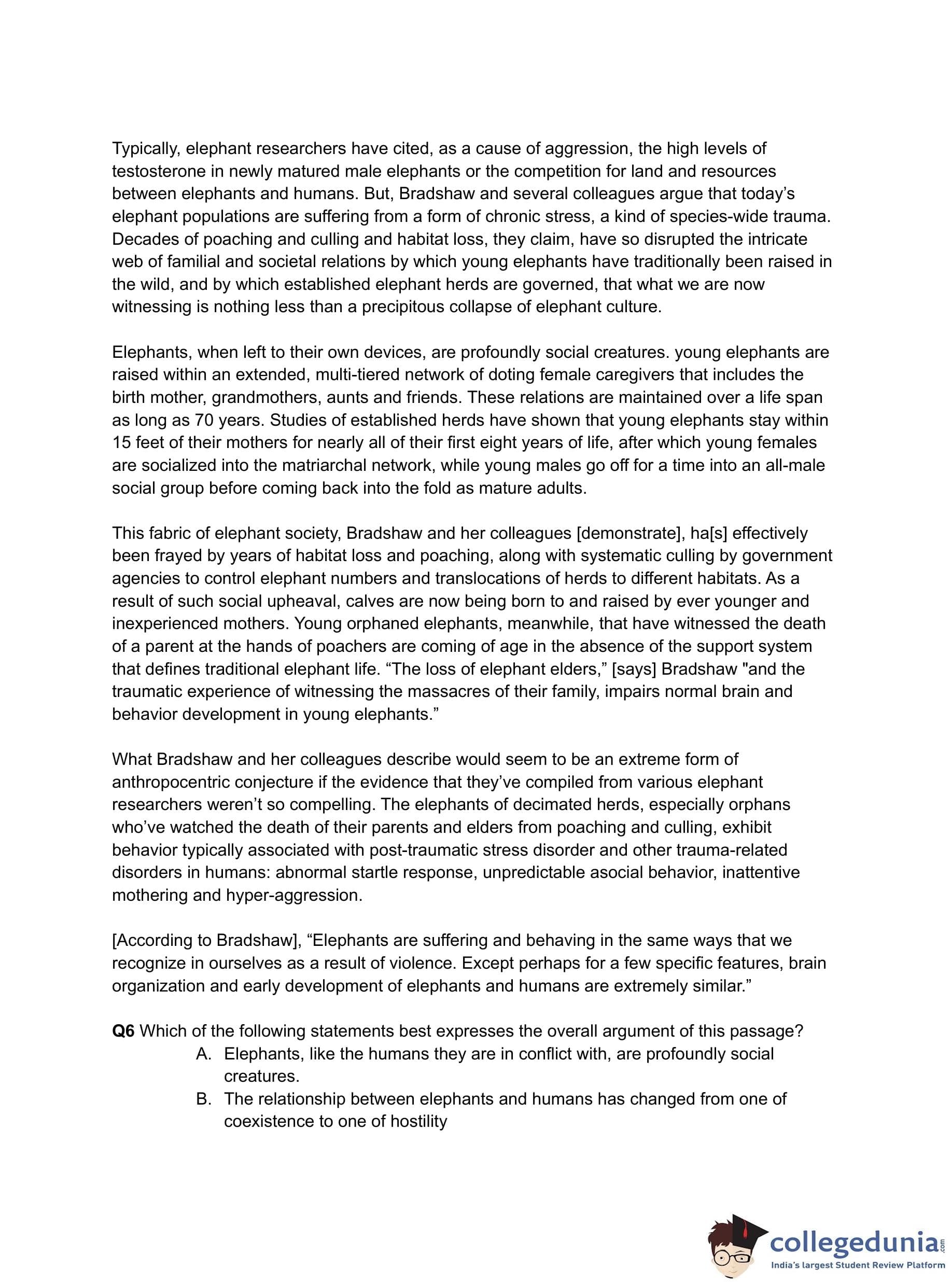
Question 6:

Which of the following statements best expresses the overall argument of this passage?

  • (A) Elephants, like the humans they are in conflict with, are profoundly social creatures.
  • (B) The relationship between elephants and humans has changed from one of coexistence to one of hostility.
  • (C) Recent elephant behaviour could be understood as a form of species-wide trauma-related response.
  • (D) The brain organisation and early development of elephants and humans are extremely similar.
Correct Answer: (B) The relationship between elephants and humans has changed from one of coexistence to one of hostility.
View Solution

Question 7:

In the first paragraph, Bradshaw uses the term "violence" to describe the recent change in the human-elephant relationship because, according to him:

  • (A) Both humans and elephants have killed members of each other's species.
  • (B) There is a purposefulness in human and elephant aggression towards each other.
  • (C) Human-elephant interactions have changed their character over time.
  • (D) Elephant herds and their habitat have been systematically destroyed by humans.
Correct Answer: (C) Human-elephant interactions have changed their character over time.
View Solution

Question 8:

The passage makes all of the following claims EXCEPT

  • (A) Elephant mothers are evolving newer ways of rearing their calves to adapt to emerging threats.
  • (B) The elephant response to deeply disturbing experiences is similar to that of humans.
  • (C) Elephants establish extended and enduring familial relationships as do humans.
  • (D) Human actions such as poaching and culling have created stressful conditions for elephant communities.
Correct Answer: (A) Elephant mothers are evolving newer ways of rearing their calves to adapt to emerging threats.
View Solution

Question 9:

Which of the following measures is Bradshaw most likely to support to address the problem of elephant aggression?

  • (A) The development of treatment programmes for elephants drawing on insights gained from treating post-traumatic stress disorder in humans.
  • (B) Funding of more studies to better understand the impact of testosterone on male elephant aggression.
  • (C) Studying the impact of isolating elephant calves on their early brain development, behaviour and aggression.
  • (D) Increased funding for research into the similarity of humans and other animals drawing on insights gained from human-elephant similarities.
Correct Answer: (A) The development of treatment programmes for elephants drawing on insights gained from treating post-traumatic stress disorder in humans.
View Solution

Question 10:

In paragraph 4, the phrase, “The fabric of elephant society . . . has(s) effectively been frayed by . . .” is:

  • (A) an exaggeration aimed at bolstering Bradshaw's claims.
  • (B) an accurate description of the condition of elephant herds today.
  • (C) an ode to the fragility of elephant society today.
  • (D) a metaphor for the effect of human activity on elephant communities.
Correct Answer: (D) a metaphor for the effect of human activity on elephant communities.
View Solution

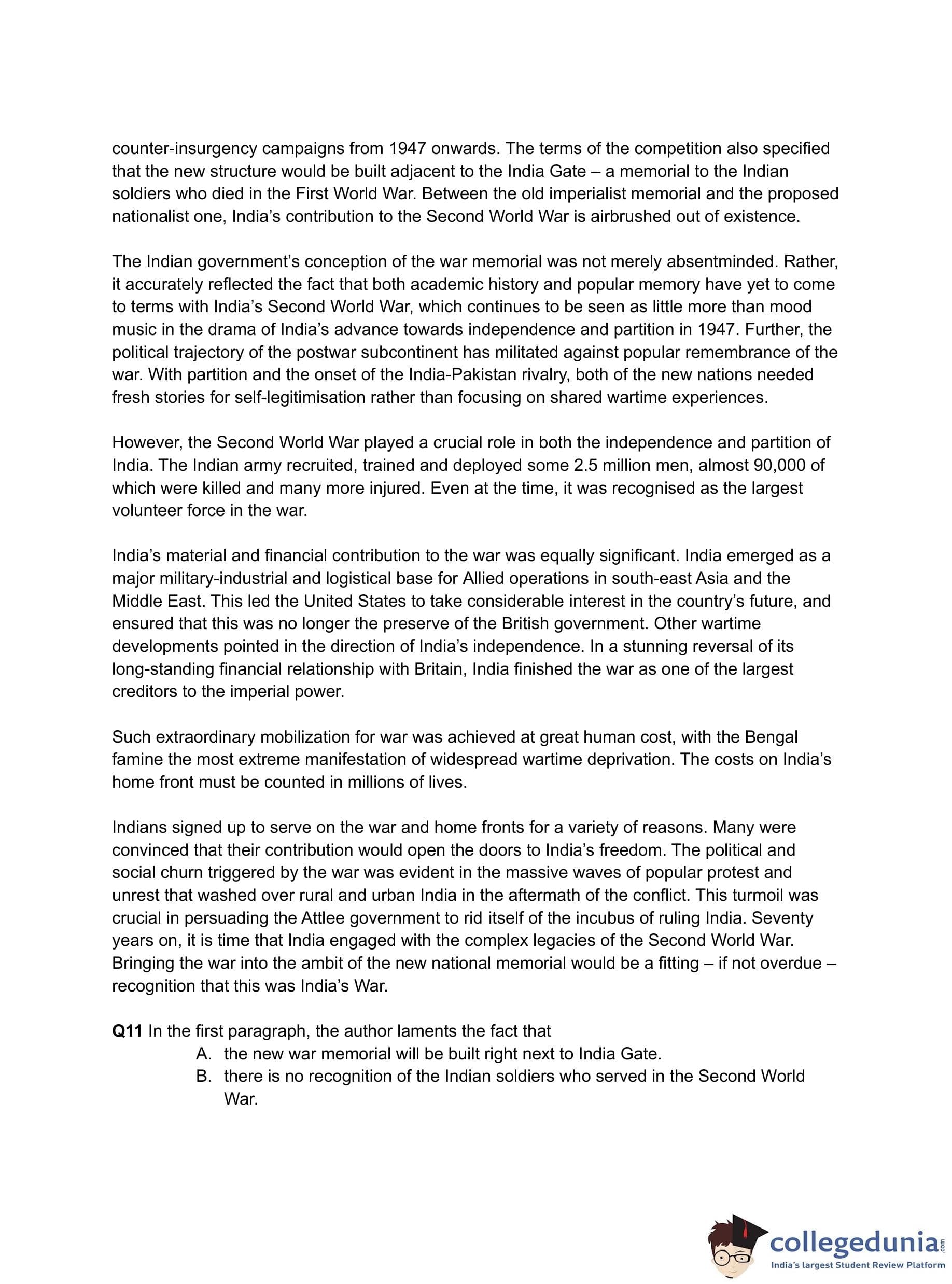
Question 11:

In the first paragraph, the author laments the fact that

  • (A) the new war memorial will be built right next to India Gate.
  • (B) there is no recognition of the Indian soldiers who served in the Second World War.
  • (C) funds will be wasted on another war memorial when we already have the India Gate memorial.
  • (D) India lost thousands of human lives during the Second World War.
Correct Answer: (B) there is no recognition of the Indian soldiers who served in the Second World War.
View Solution

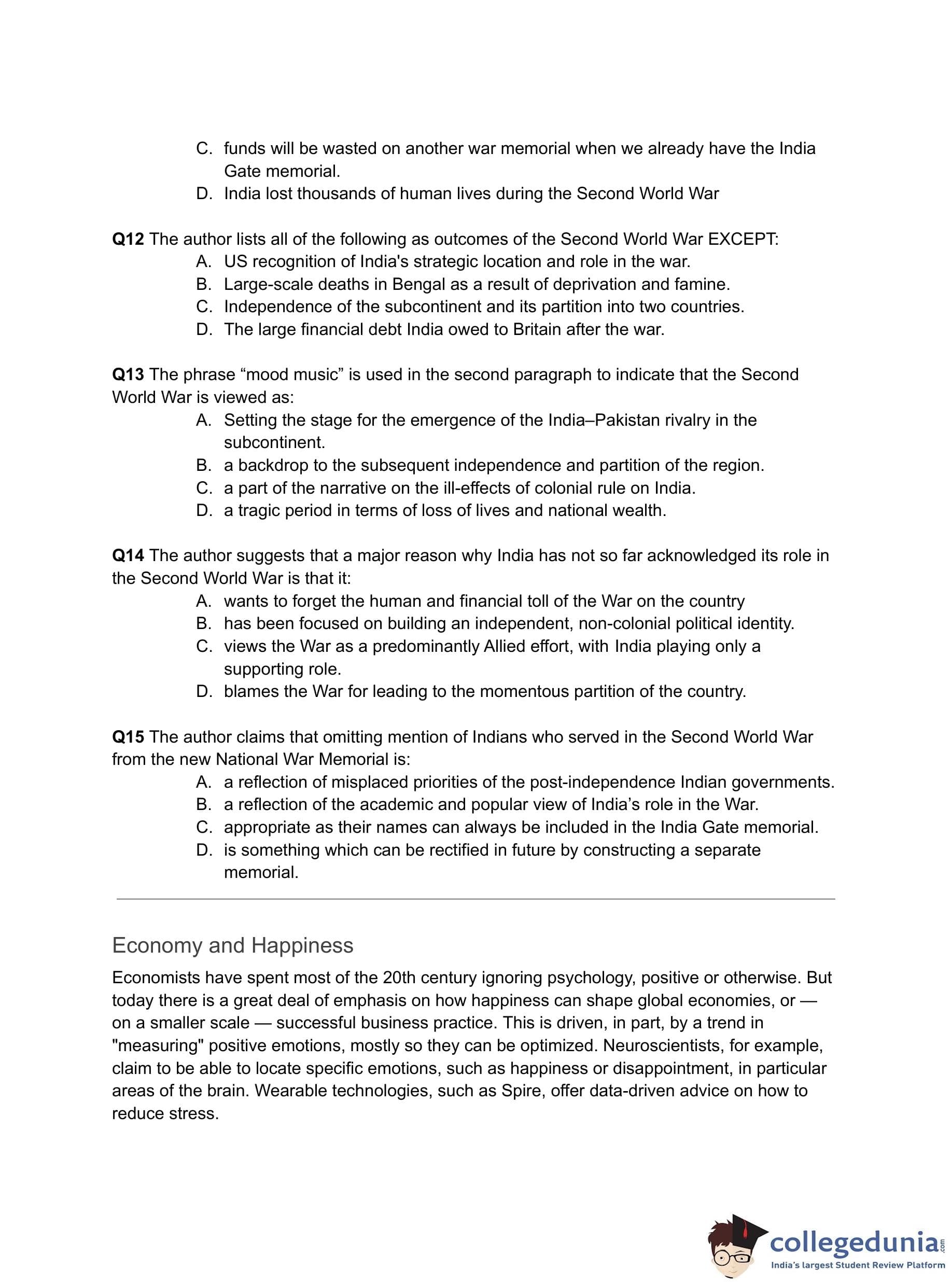
Question 12:

The author lists all of the following as outcomes of the Second World War EXCEPT:

  • (A) US recognition of India's strategic location and role in the war.
  • (B) Large-scale deaths in Bengal as a result of deprivation and famine.
  • (C) Independence of the subcontinent and its partition into two countries.
  • (D) The large financial debt India owed to Britain after the war.
Correct Answer: (D) The large financial debt India owed to Britain after the war.
View Solution

Question 13:

The phrase “mood music” is used in the second paragraph to indicate that the Second World War is viewed as:

  • (A) Setting the stage for the emergence of the India–Pakistan rivalry in the subcontinent.
  • (B) a backdrop to the subsequent independence and partition of the region.
  • (C) a part of the narrative on the ill-effects of colonial rule on India.
  • (D) a tragic period in terms of loss of lives and national wealth.
Correct Answer: (B) a backdrop to the subsequent independence and partition of the region.
View Solution

Question 14:

The author suggests that a major reason why India has not so far acknowledged its role in the Second World War is that:

  • (A) wants to forget the human and financial toll of the War on the country.
  • (B) has been focused on building an independent, non-colonial political identity.
  • (C) views the War as a predominantly Allied effort, with India playing only a supporting role.
  • (D) blames the War for leading to the momentous partition of the country.
Correct Answer: (B) has been focused on building an independent, non-colonial political identity.
View Solution

Question 15:

The author claims that omitting mention of Indians who served in the Second World War from the new National War Memorial is:

  • (A) a reflection of misplaced priorities of the post-independence Indian governments.
  • (B) a reflection of the academic and popular view of India’s role in the War.
  • (C) appropriate as their names can always be included in the India Gate memorial.
  • (D) something which can be rectified in future by constructing a separate memorial.
Correct Answer: (D) something which can be rectified in future by constructing a separate memorial.
View Solution

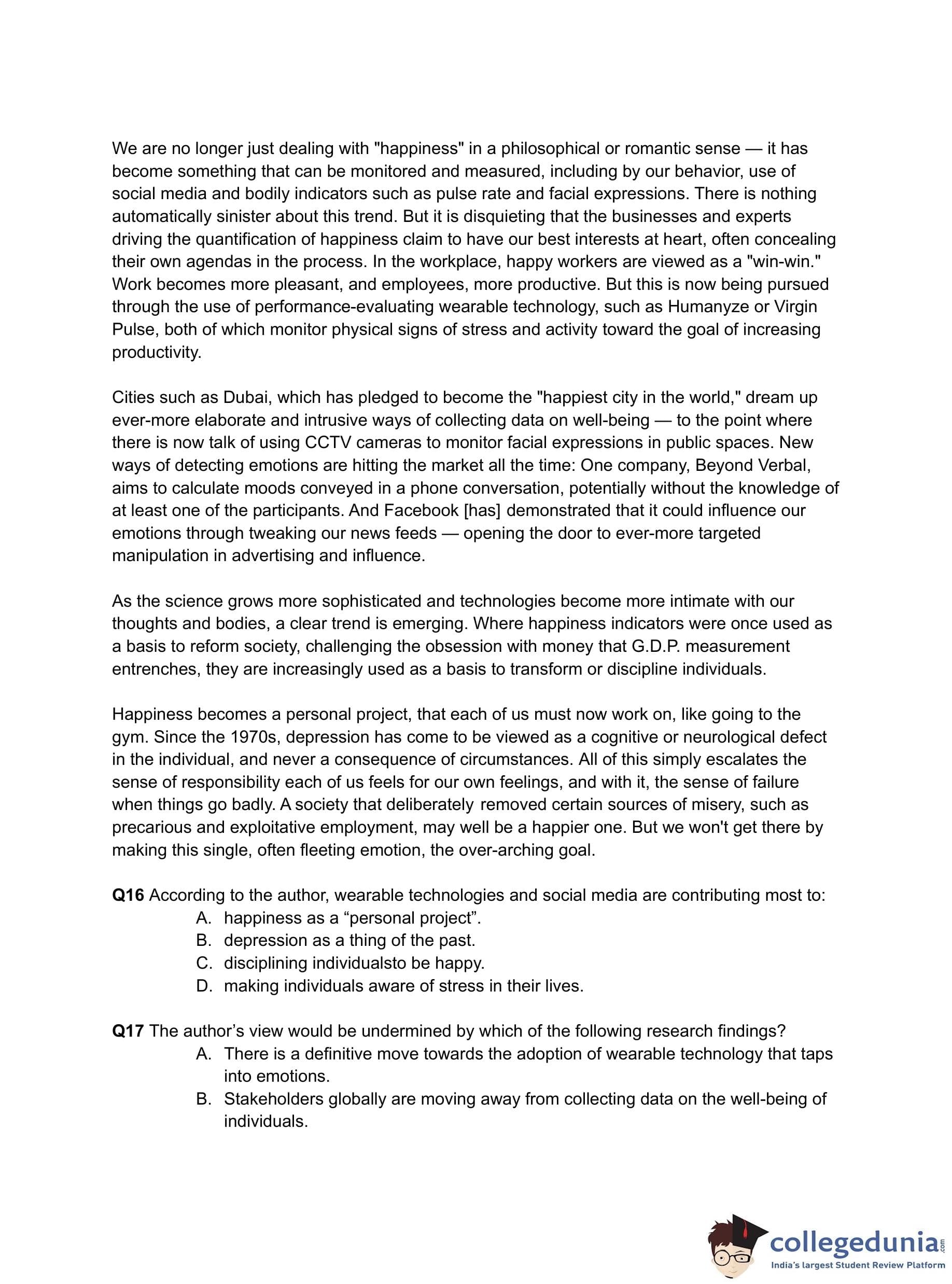
Question 16:

According to the author, wearable technologies and social media are contributing most to:

  • (A) happiness as a "personal project".
  • (B) depression as a thing of the past.
  • (C) disciplining individuals to be happy.
  • (D) making individuals aware of stress in their lives.
Correct Answer: (A) happiness as a "personal project".
View Solution

Question 17:

The author’s view would be undermined by which of the following research findings?

  • (A) There is a definitive move towards the adoption of wearable technology that taps into emotions.
  • (B) Stakeholders globally are moving away from collecting data on the well-being of individuals.
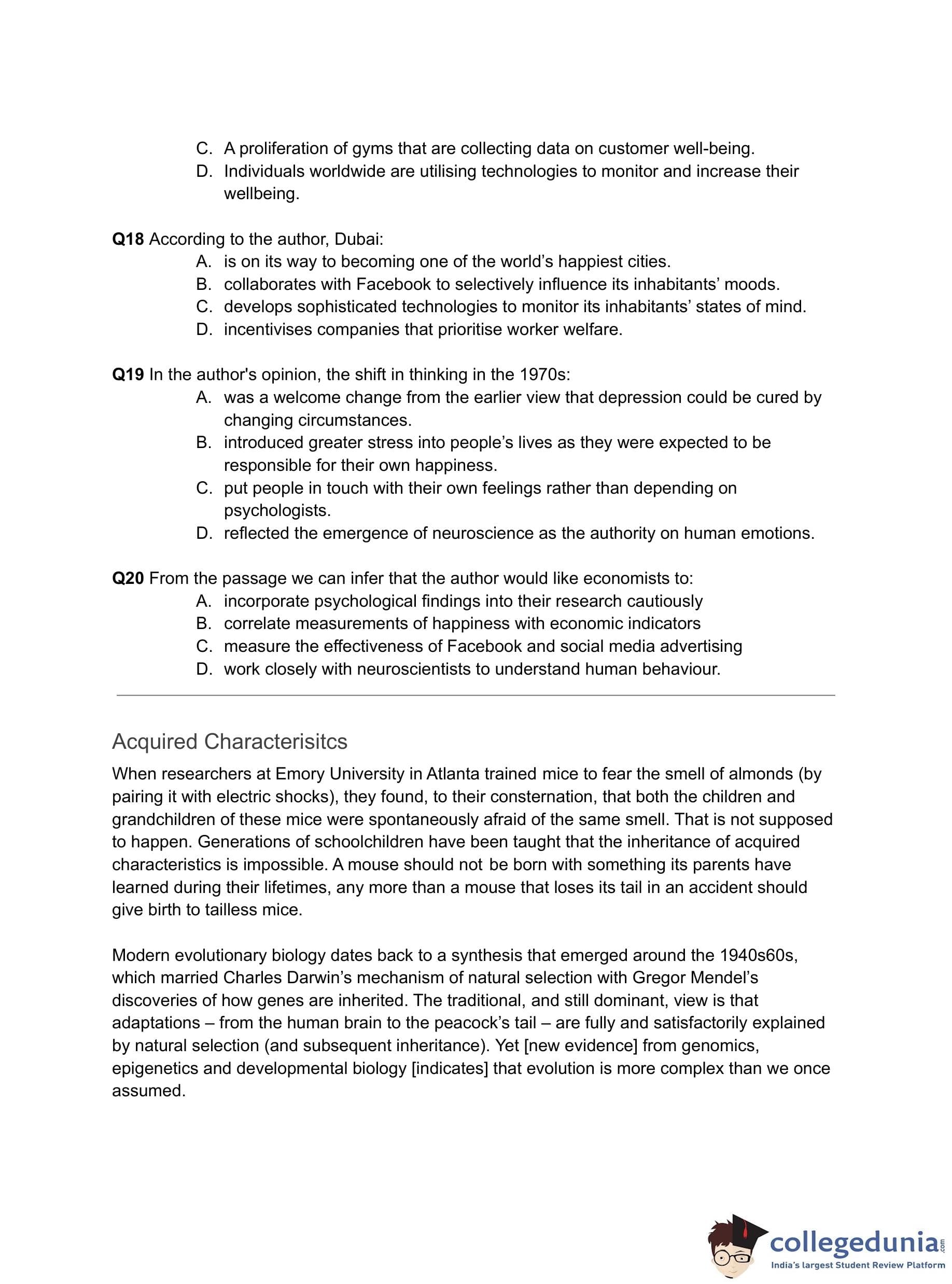
  • (C) A proliferation of gyms that are collecting data on customer well-being.
  • (D) Individuals worldwide are utilizing technologies to monitor and increase their wellbeing.
Correct Answer: (B) Stakeholders globally are moving away from collecting data on the well-being of individuals.
View Solution

Question 18:

According to the author, Dubai:

  • (A) is on its way to becoming one of the world’s happiest cities.
  • (B) collaborates with Facebook to selectively influence its inhabitants’ moods.
  • (C) develops sophisticated technologies to monitor its inhabitants’ states of mind.
  • (D) incentivizes companies that prioritize worker welfare.
Correct Answer: (A) is on its way to becoming one of the world’s happiest cities.
View Solution

Question 19:

In the author's opinion, the shift in thinking in the 1970s:

  • (A) was a welcome change from the earlier view that depression could be cured by changing circumstances.
  • (B) introduced greater stress into people’s lives as they were expected to be responsible for their own happiness.
  • (C) put people in touch with their own feelings rather than depending on psychologists.
  • (D) reflected the emergence of neuroscience as the authority on human emotions.
Correct Answer: (B) introduced greater stress into people’s lives as they were expected to be responsible for their own happiness.
View Solution

Question 20:

From the passage we can infer that the author would like economists to:

  • (A) incorporate psychological findings into their research cautiously.
  • (B) correlate measurements of happiness with economic indicators.
  • (C) measure the effectiveness of Facebook and social media advertising.
  • (D) work closely with neuroscientists to understand human behaviour.
Correct Answer: (D) work closely with neuroscientists to understand human behaviour.
View Solution

Question 21:

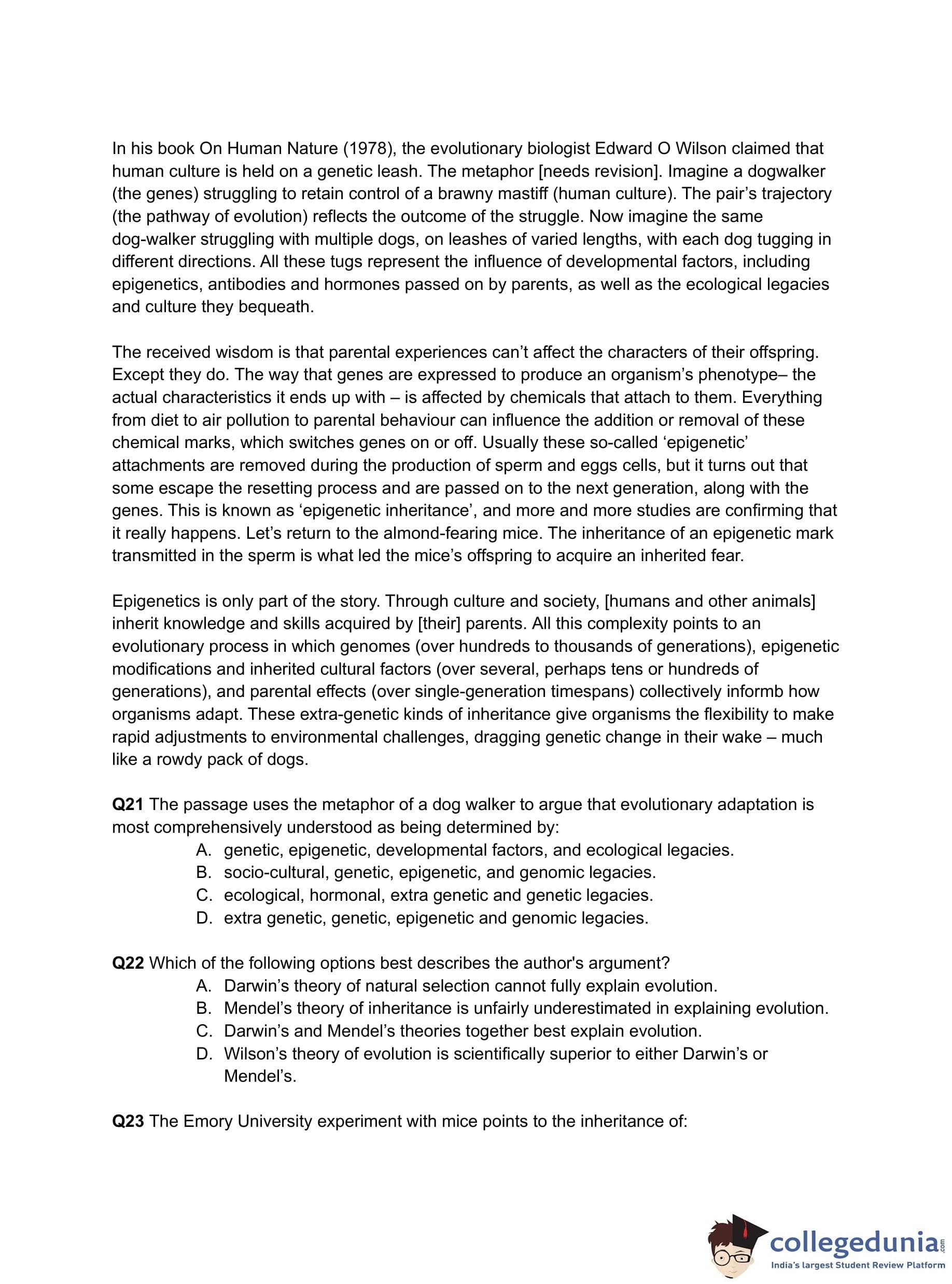
The passage uses the metaphor of a dog walker to argue that evolutionary adaptation is most comprehensively understood as being determined by:

  • (A) genetic, epigenetic, developmental factors, and ecological legacies.
  • (B) socio-cultural, genetic, epigenetic, and genomic legacies.
  • (C) ecological, hormonal, extra genetic and genetic legacies.
  • (D) extra genetic, genetic, epigenetic and genomic legacies.
Correct Answer: (D) extra genetic, genetic, epigenetic and genomic legacies.
View Solution

Question 22:

Which of the following options best describes the author's argument?

  • (A) Darwin’s theory of natural selection cannot fully explain evolution.
  • (B) Mendel’s theory of inheritance is unfairly underestimated in explaining evolution.
  • (C) Darwin’s and Mendel’s theories together best explain evolution.
  • (D) Wilson’s theory of evolution is scientifically superior to either Darwin’s or Mendel’s.
Correct Answer: (C) Darwin’s and Mendel’s theories together best explain evolution.
View Solution

Question 23:

The Emory University experiment with mice points to the inheritance of:

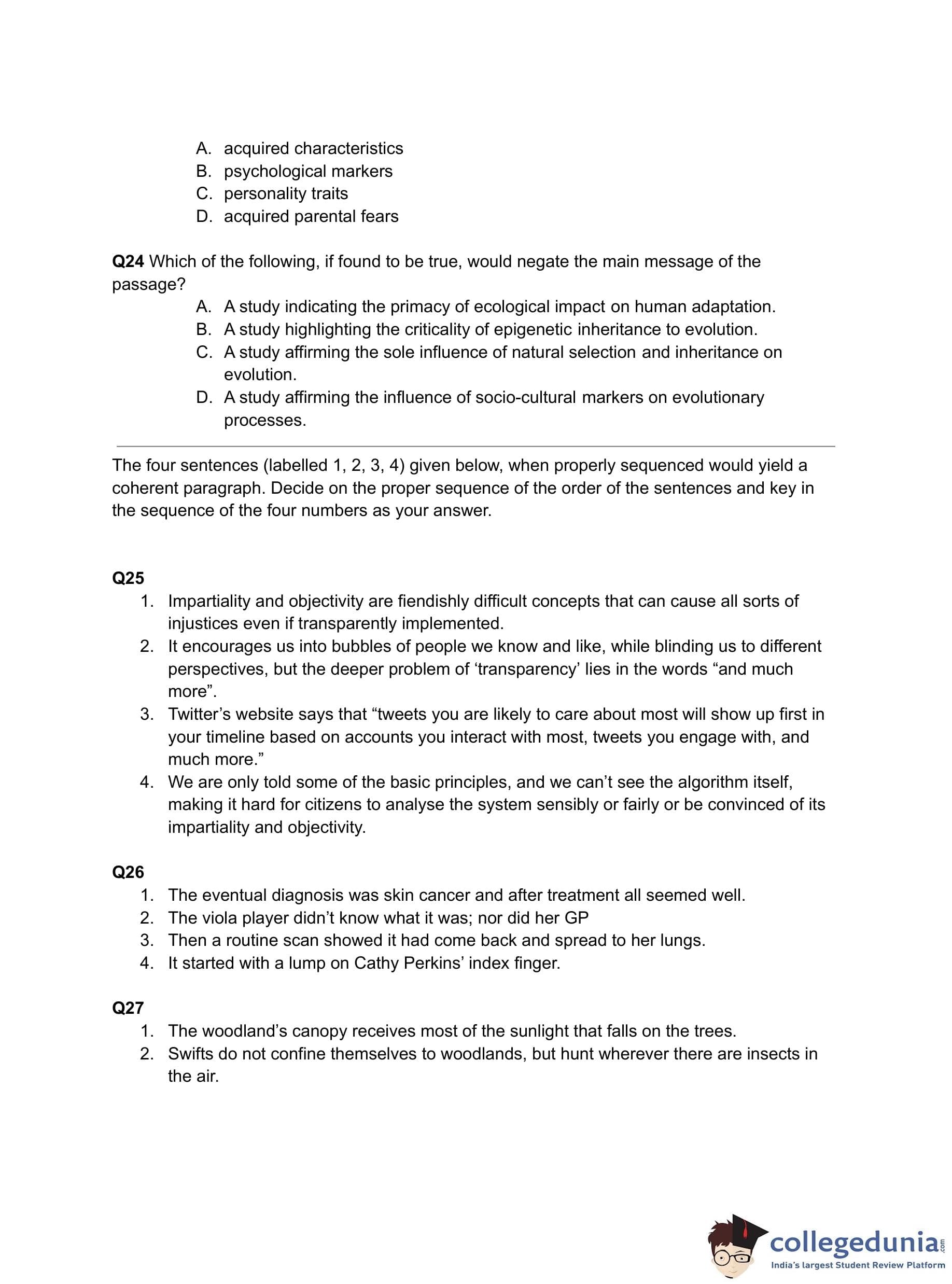
  • (A) acquired characteristics
  • (B) psychological markers
  • (C) personality traits
  • (D) acquired parental fears
Correct Answer: (D) acquired parental fears
View Solution

Question 24:

Which of the following, if found to be true, would negate the main message of the passage?

  • (A) A study indicating the primacy of ecological impact on human adaptation.
  • (B) A study highlighting the criticality of epigenetic inheritance to evolution.
  • (C) A study affirming the sole influence of natural selection and inheritance on evolution.
  • (D) A study affirming the influence of socio-cultural markers on evolutionary processes.
Correct Answer: (C) A study affirming the sole influence of natural selection and inheritance on evolution.
View Solution

Question 25:

The four sentences (labelled 1, 2, 3, 4) given below, when properly sequenced, would yield a coherent paragraph. Decide on the proper sequence of the order of the sentences and key in the sequence of the four numbers as your answer.
(1) Impartiality and objectivity are fiendishly difficult concepts that can cause all sorts of injustices even if transparently implemented.
(2) It encourages us into bubbles of people we know and like, while blinding us to different perspectives, but the deeper problem of ‘transparency’ lies in the words “and much more”.
(3) Twitter’s website says that “tweets you are likely to care about most will show up first in your timeline based on accounts you interact with most, tweets you engage with, and much more.”
(4) We are only told some of the basic principles, and we can’t see the algorithm itself, making it hard for citizens to analyse the system sensibly or fairly or be convinced of its impartiality and objectivity.

Correct Answer: 1 → 2 → 3 → 4
View Solution

Question 26:

The four sentences (labelled 1, 2, 3, 4) given below, when properly sequenced, would yield a coherent paragraph. Decide on the proper sequence of the order of the sentences and key in the sequence of the four numbers as your answer.

(1) The eventual diagnosis was skin cancer and after treatment all seemed well.
(2) The viola player didn’t know what it was; nor did her GP.
(3) Then a routine scan showed it had come back and spread to her lungs.
(4) It started with a lump on Cathy Perkins’ index finger.

Correct Answer: 4 → 2 → 3 → 1
View Solution

Question 27:

The four sentences (labelled 1, 2, 3, 4) given below, when properly sequenced, would yield a coherent paragraph. Decide on the proper sequence of the order of the sentences and key in the sequence of the four numbers as your answer.
(1) The woodland’s canopy receives most of the sunlight that falls on the trees.
(2) Swifts do not confine themselves to woodlands, but hunt wherever there are insects in the air.
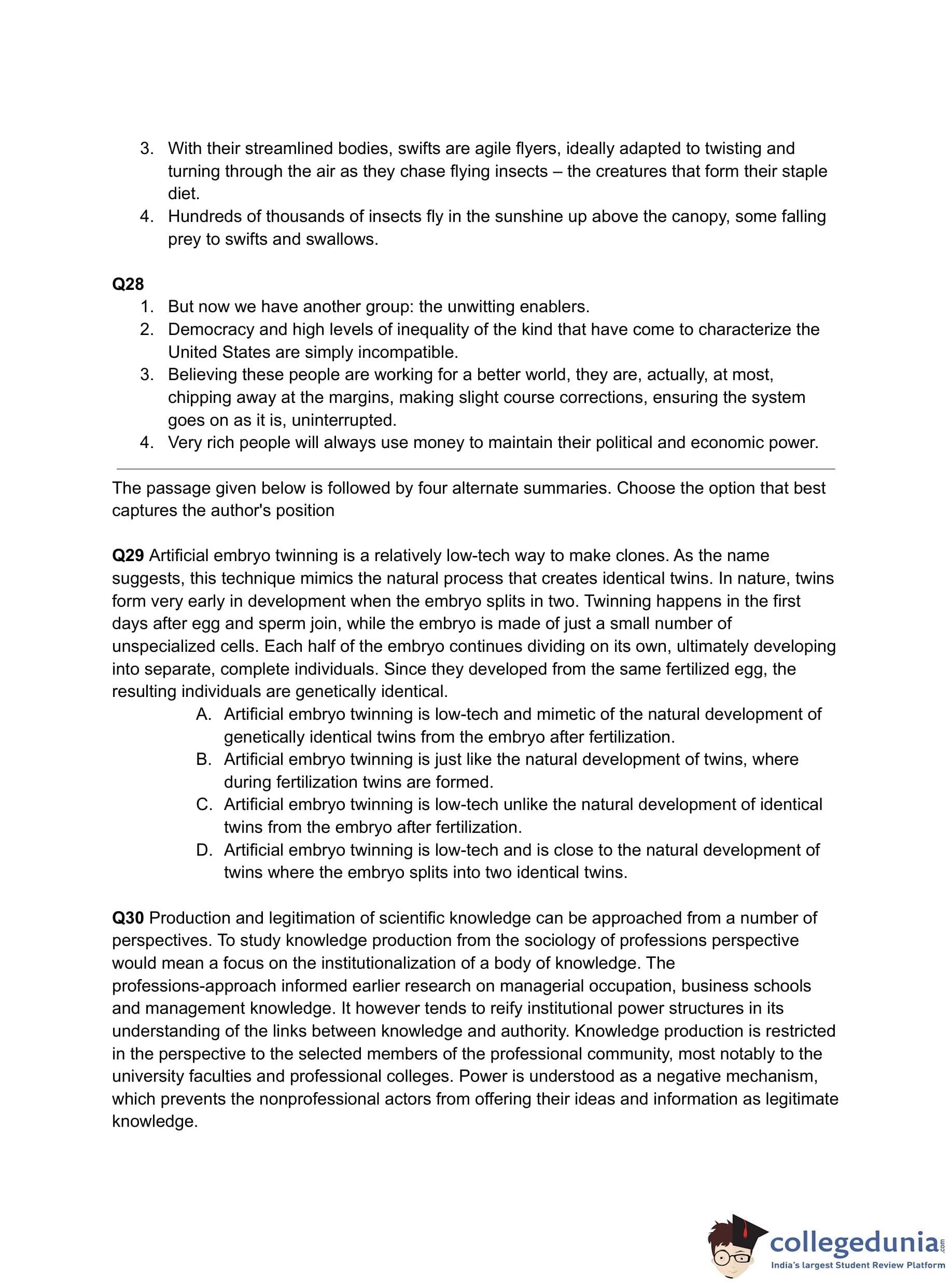
(3) With their streamlined bodies, swifts are agile flyers, ideally adapted to twisting and turning through the air as they chase flying insects – the creatures that form their staple diet.
(4) Hundreds of thousands of insects fly in the sunshine up above the canopy, some falling prey to swifts and swallows.

Correct Answer: 1 → 4 → 3 → 2
View Solution

Question 28:

The four sentences (labelled 1, 2, 3, 4) given below, when properly sequenced, would yield a coherent paragraph. Decide on the proper sequence of the order of the sentences and key in the sequence of the four numbers as your answer.
(1) But now we have another group: the unwitting enablers.
(2) Democracy and high levels of inequality of the kind that have come to characterize the United States are simply incompatible.
(3) Believing these people are working for a better world, they are, actually, at most, chipping away at the margins, making slight course corrections, ensuring the system goes on as it is, uninterrupted.
(4) Very rich people will always use money to maintain their political and economic power.

Correct Answer: 2 → 4 → 3 → 1
View Solution

Question 29:

Artificial embryo twinning is a relatively low-tech way to make clones. As the name suggests, this technique mimics the natural process that creates identical twins. In nature, twins form very early in development when the embryo splits in two. Twinning happens in the first days after egg and sperm join, while the embryo is made of just a small number of unspecialized cells. Each half of the embryo continues dividing on its own, ultimately developing into separate, complete individuals. Since they developed from the same fertilized egg, the resulting individuals are genetically identical.

  • (A) Artificial embryo twinning is low-tech and mimetic of the natural development of genetically identical twins from the embryo after fertilization.
  • (B) Artificial embryo twinning is just like the natural development of twins, where during fertilization twins are formed.
  • (C) Artificial embryo twinning is low-tech unlike the natural development of identical twins from the embryo after fertilization.
  • (D) Artificial embryo twinning is low-tech and is close to the natural development of twins where the embryo splits into two identical twins.
Correct Answer: (A) Artificial embryo twinning is low-tech and mimetic of the natural development of genetically identical twins from the embryo after fertilization.
View Solution

Question 30:

Production and legitimation of scientific knowledge can be approached from a number of perspectives. To study knowledge production from the sociology of professions perspective would mean a focus on the institutionalization of a body of knowledge. The professions-approach informed earlier research on managerial occupation, business schools and management knowledge. It however tends to reify institutional power structures in its understanding of the links between knowledge and authority. Knowledge production is restricted in the perspective to the selected members of the professional community, most notably to the university faculties and professional colleges. Power is understood as a negative mechanism, which prevents the nonprofessional actors from offering their ideas and information as legitimate knowledge.

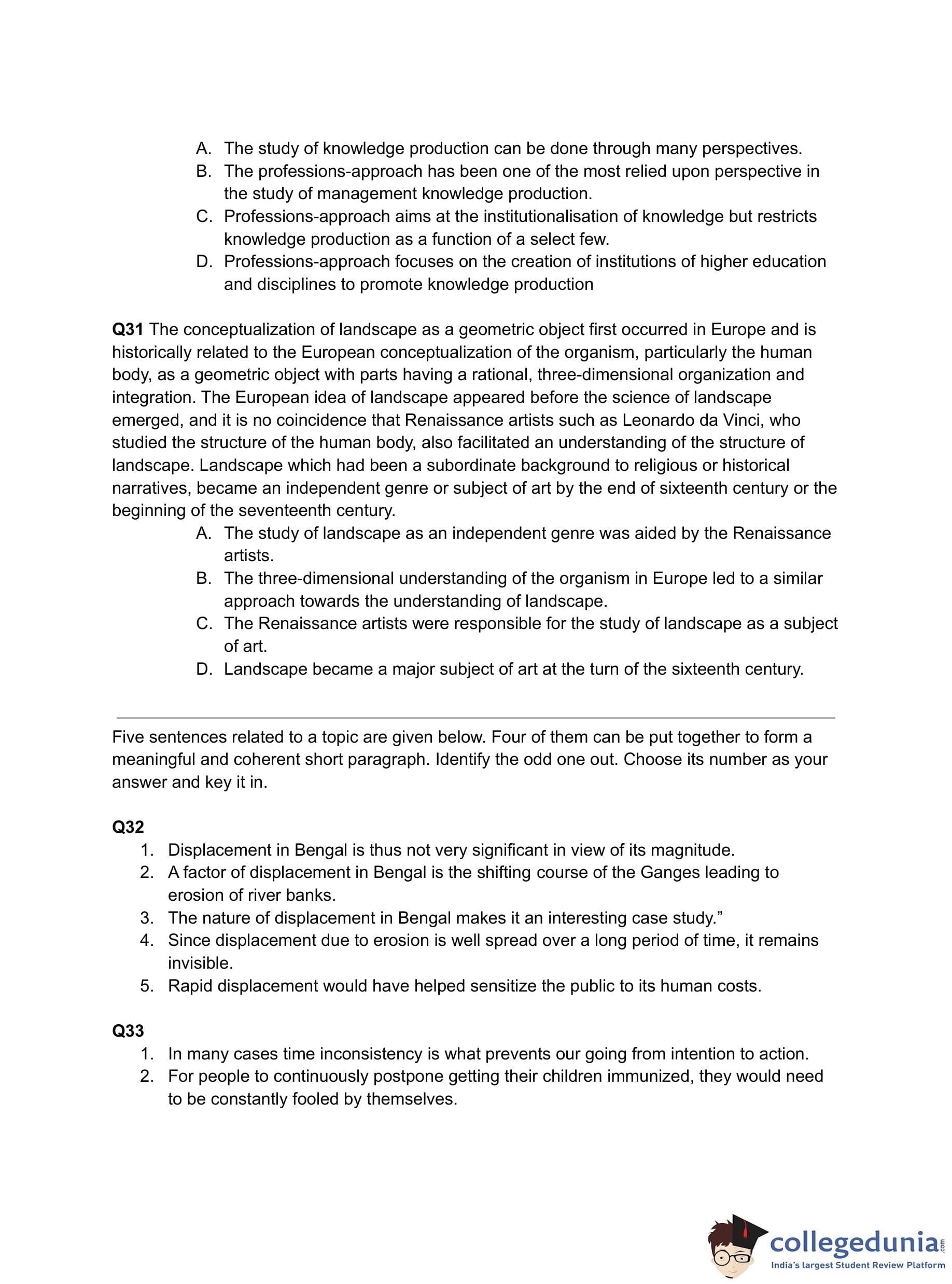
  • (A) The study of knowledge production can be done through many perspectives.
  • (B) The professions-approach has been one of the most relied upon perspectives in the study of management knowledge production.
  • (C) Professions-approach aims at the institutionalisation of knowledge but restricts knowledge production as a function of a select few.
  • (D) Professions-approach focuses on the creation of institutions of higher education and disciplines to promote knowledge production.
Correct Answer: (C) Professions-approach aims at the institutionalisation of knowledge but restricts knowledge production as a function of a select few.
View Solution

Question 31:

The conceptualization of landscape as a geometric object first occurred in Europe and is historically related to the European conceptualization of the organism, particularly the human body, as a geometric object with parts having a rational, three-dimensional organization and integration. The European idea of landscape appeared before the science of landscape emerged, and it is no coincidence that Renaissance artists such as Leonardo da Vinci, who studied the structure of the human body, also facilitated an understanding of the structure of landscape. Landscape, which had been a subordinate background to religious or historical narratives, became an independent genre or subject of art by the end of the sixteenth century or the beginning of the seventeenth century.

  • (A) The study of landscape as an independent genre was aided by the Renaissance artists.
  • (B) The three-dimensional understanding of the organism in Europe led to a similar approach towards the understanding of landscape.
  • (C) The Renaissance artists were responsible for the study of landscape as a subject of art.
  • (D) Landscape became a major subject of art at the turn of the sixteenth century.
Correct Answer: (B) The three-dimensional understanding of the organism in Europe led to a similar approach towards the understanding of landscape.
View Solution

Question 32:

Five sentences related to a topic are given below. Four of them can be put together to form a meaningful and coherent short paragraph. Identify the odd one out. Choose its number as your answer and key it in.
(1) Displacement in Bengal is thus not very significant in view of its magnitude.
(2) A factor of displacement in Bengal is the shifting course of the Ganges leading to erosion of river banks.
(3) The nature of displacement in Bengal makes it an interesting case study.
(4) Since displacement due to erosion is well spread over a long period of time, it remains invisible.
(5) Rapid displacement would have helped sensitize the public to its human costs.

Correct Answer: (1) Displacement in Bengal is thus not very significant in view of its magnitude.
View Solution

Question 33:

Five sentences related to a topic are given below. Four of them can be put together to form a meaningful and coherent short paragraph. Identify the odd one out. Choose its number as your answer and key it in.
(1) In many cases, time inconsistency is what prevents our going from intention to action.
(2) For people to continuously postpone getting their children immunized, they would need to be constantly fooled by themselves.
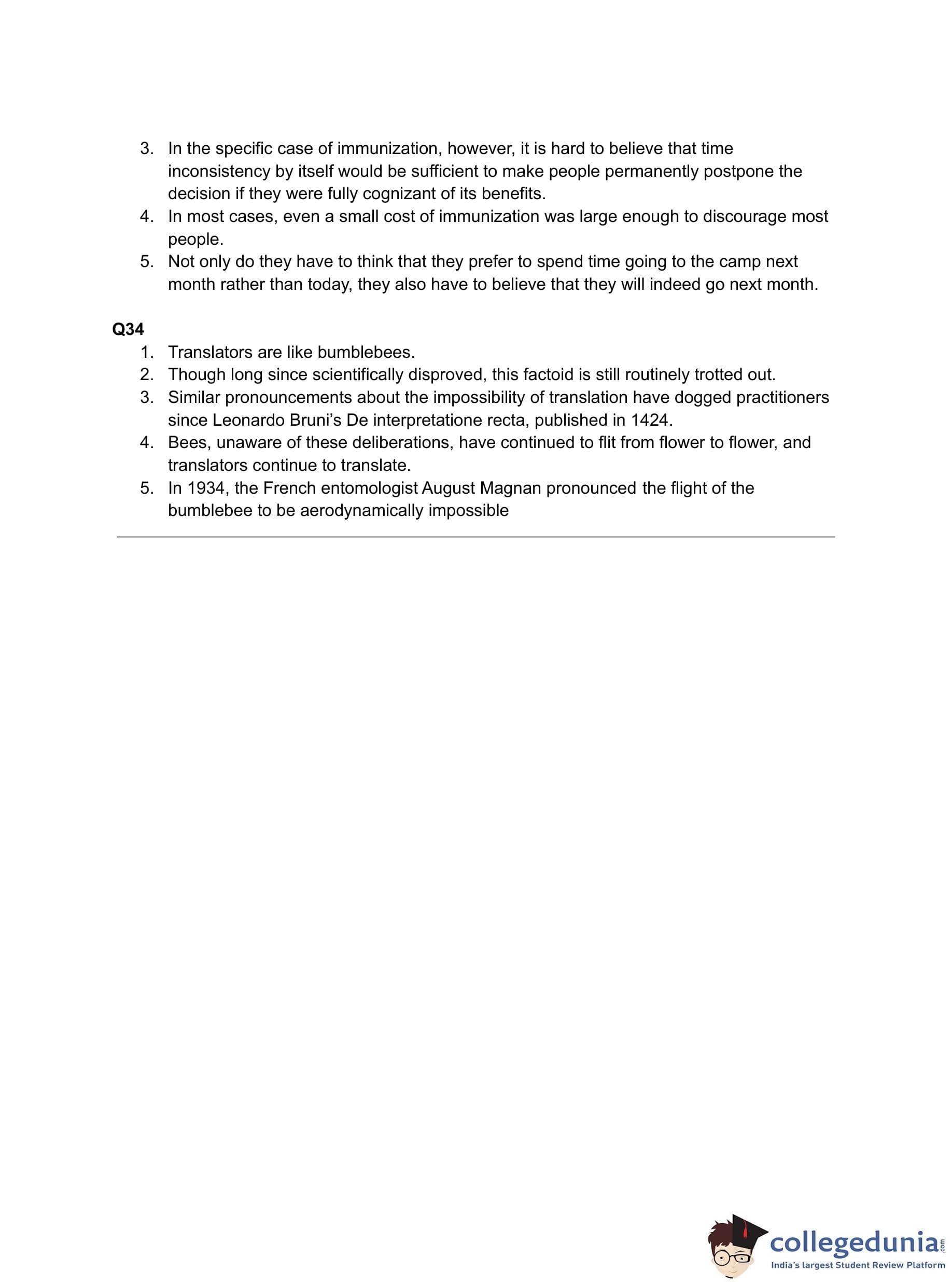
(3) In the specific case of immunization, however, it is hard to believe that time inconsistency by itself would be sufficient to make people permanently postpone the decision if they were fully cognizant of its benefits.
(4) In most cases, even a small cost of immunization was large enough to discourage most people.
(5) Not only do they have to think that they prefer to spend time going to the camp next month rather than today, they also have to believe that they will indeed go next month.

Correct Answer: (4) In most cases, even a small cost of immunization was large enough to discourage most people.
View Solution

Question 34:

Five sentences related to a topic are given below. Four of them can be put together to form a meaningful and coherent short paragraph. Identify the odd one out. Choose its number as your answer and key it in.
(1) Translators are like bumblebees.
(2) Though long since scientifically disproved, this factoid is still routinely trotted out.
(3) Similar pronouncements about the impossibility of translation have dogged practitioners since Leonardo Bruni's De interpretatione recta, published in 1424.
(4) Bees, unaware of these deliberations, have continued to flit from flower to flower, and translators continue to translate.
(5) In 1934, the French entomologist August Magnan pronounced the flight of the bumblebee to be aerodynamically impossible.

Correct Answer: (5) In 1934, the French entomologist August Magnan pronounced the flight of the bumblebee to be aerodynamically impossible.
View Solution
Also Check:

CAT 2018 Question Paper Slot 1 November 25: Sectional Analysis

CAT 2018 Slot 1 was conducted between 9.00 am to 12:00 pm. The overall difficulty level of this slot was reported to be moderate to difficult. CAT 2018 VARC Sectional Analysis is as follows:

  • VARC section comprised 5 RC passages. While one RC passage had 4 questions, the rest of them had 5 questions each.
  • Options in the VARC section were very distinct and this made the section easier to attempt.
  • Out of the 7 para jumbles, 4 were easier to attempt.
  • The section consisted of three summary questions which were a bit difficult to attempt.
  • Odd questions were pretty easy to attempt. Hence, the entire VARC section was quite doable.

Quick Links:

CAT Question Papers of Other Years

Other MBA Exam Question Papers