CAT 2019 VARC Question Paper for November 24 Slot 2 was rated moderate to difficult by the test-takers and experts alike. In CAT 2019 Slot 2 VARC paper, there were 5 RCs out of which 2 were more difficult to comprehend. 99 percentile in the section could be achieveAspirants of CAT can download CAT 2019 VARC Slot 2 Question Paper with Solution PDFs from the links below.d by scoring around 60 to 62 marks.
- CAT VARC section was considered to be the trickiest section of the exam.DILR was easier compared to the previous year. CAT QA section was easy to moderate.
Candidates preparing for CAT 2025 can download the CAT VARC question paper with the solution pdf for the Slot 2 exam conducted on November 24, 2019, to get a better idea about the type of questions asked in the paper and the difficulty level of questions.
Also Check:
CAT 2019 VARC Slot 2 Question Paper with Solution PDF
Question 1:
According to the passage, colonial powers located their capitals:
- (A) to showcase their power and prestige.
- (B) where they had the densest populations.
- (C) based on political expediency.
- (D) to promote their trading interests.
Question 2:
The “dilemma” mentioned in the passage refers to:
- (A) keeping government agencies in the largest city with good infrastructure or moving them to a remote area with few amenities.
- (B) concentrating on decongesting large cities or focusing on boosting employment in relatively larger cities.
- (C) encouraging private enterprises to relocate to smaller towns or not incentivising them in order to keep government costs in those towns low.
- (D) relocating government agencies to boost growth in remote areas with poor amenities or to relatively larger cities with good amenities.
Correct Answer: (D) relocating government agencies to boost growth in remote areas with poor amenities or to relatively larger cities with good amenities.
View Solution
Question 3:
People who support decentralising central government functions are LEAST likely to cite which of the following reasons for their view?
- (A) More independence could be enjoyed by regulatory bodies located away from political centres.
- (B) Policy makers may benefit from fresh thinking in a new environment.
- (C) It reduces expenses as infrastructure costs and salaries are lower in smaller cities.
- (D) It could weaken the nexus between bureaucrats and media in the capital.
Correct Answer: (C) It reduces expenses as infrastructure costs and salaries are lower in smaller cities.
View Solution
Question 4:
The “long pedigree” of the aim to shift civil servants to improve their living standards implies that this move:
- (A) is not a new idea and has been tried in the past.
- (B) has become common practice in several countries worldwide.
- (C) is supported by politicians and the ruling elites.
- (D) takes a long time to achieve its intended outcomes.
Correct Answer: (A) is not a new idea and has been tried in the past.
View Solution
Question 5:
According to the author, relocating government agencies has not always been a success for all of the following reasons EXCEPT:
- (A) a rise in pollution levels and congestion in the new locations.
- (B) the difficulty of attracting talented, well-skilled people in more remote areas.
- (C) increased avenues of corruption away from the capital city.
- (D) high staff losses, as people may not be prepared to move to smaller towns.
Correct Answer: (A) a rise in pollution levels and congestion in the new locations.
View Solution
Question 6:
Based on his views mentioned in the passage, one could best characterise Dr. Watrall as being:
- (A) opposed to the use of digital technology in archaeological and cultural sites in developing countries.
- (B) dismissive of laypeople's access to specialist images of archaeological and cultural sites.
- (C) uneasy about the marketing of archaeological images for commercial use by firms such as Google and CyArk.
- (D) critical about the links between a non-profit and a commercial tech platform for distributing archaeological images.
Correct Answer: (C) uneasy about the marketing of archaeological images for commercial use by firms such as Google and CyArk.
View Solution
Question 7:
By "digital colonialism", critics of the CyArk-Google project are referring to the fact that:
- (A) CyArk and Google have been scanning images without copyright permission from host countries.
- (B) the scanning process can damage delicate frescos and statues at the sites.
- (C) countries where the scanned sites are located do not own the scan copyrights.
- (D) CyArk and Google have not shared the details of digitisation with the host countries.
Correct Answer: (C) countries where the scanned sites are located do not own the scan copyrights.
View Solution
Question 8:
Which of the following, if true, would most strongly invalidate Dr. Watrall's objections?
- (A) Google takes down advertisements on its website hosting CyArk's scanned images.
- (B) There is a ban on CyArk scanning archaeological sites located in other countries.
- (C) CyArk does not own the copyright on scanned images of archaeological sites.
- (D) CyArk uploads its scanned images of archaeological sites onto museum websites only.
Correct Answer: (A) Google takes down advertisements on its website hosting CyArk's scanned images.
View Solution
Question 9:
In Dr. Thompson's view, CyArk owning the copyright of its digital scans of archaeological sites is akin to:
- (A) tourists uploading photos of monuments onto social media.
- (B) the seizing of ancient Egyptian artefacts by a Western museum.
- (C) the illegal downloading of content from the internet.
- (D) digital platforms capturing users' data for market research.
Correct Answer: (B) the seizing of ancient Egyptian artefacts by a Western museum.
View Solution
Question 10:
Of the following arguments, which one is LEAST likely to be used by the companies that digitally scan cultural sites?
- (A) It enables people who cannot physically visit these sites to experience them.
- (B) It helps preserve precious images in case the sites are damaged or destroyed.
- (C) It allows a large corporation to project itself as a protector of culture.
- (D) It provides images free of cost to all users.
Correct Answer: (C) It allows a large corporation to project itself as a protector of culture.
View Solution
Question 11:
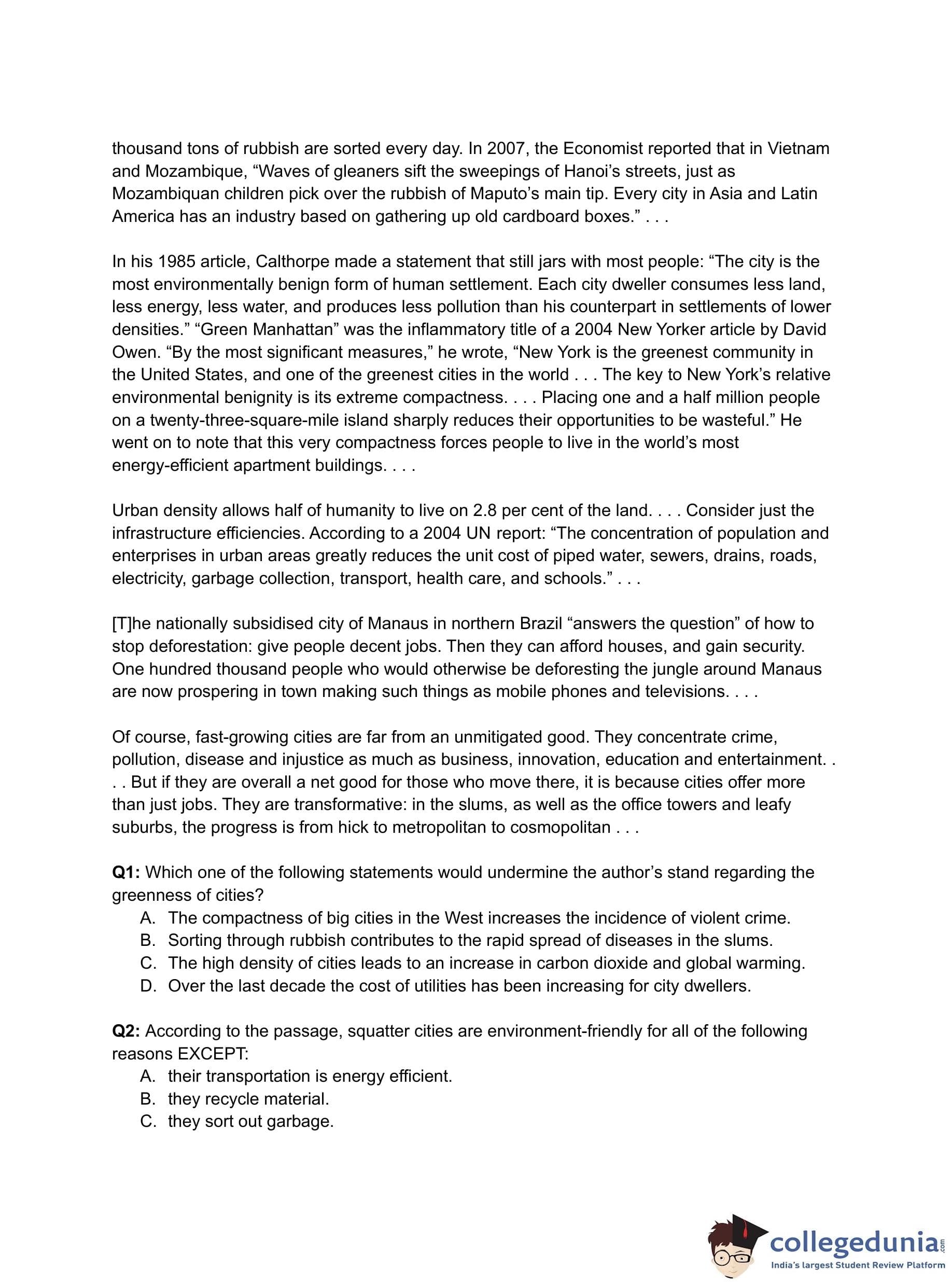
Which one of the following statements would undermine the author's stand regarding the greenness of cities?
- (A) The compactness of big cities in the West increases the incidence of violent crime.
- (B) Sorting through rubbish contributes to the rapid spread of diseases in the slums.
- (C) The high density of cities leads to an increase in carbon dioxide and global warming.
- (D) Over the last decade the cost of utilities has been increasing for city dwellers.
Correct Answer: (C) The high density of cities leads to an increase in carbon dioxide and global warming.
View Solution
Question 12:
According to the passage, squatter cities are environment-friendly for all of the following reasons EXCEPT:
- (A) their transportation is energy efficient.
- (B) they recycle material.
- (C) they sort out garbage.
- (D) their streets are kept clean.
Question 13:
We can infer that Calthorpe's statement "still jars" with most people because most people:
- (A) regard cities as places of disease and crime.
- (B) do not consider cities to be eco-friendly places.
- (C) do not regard cities as good places to live in.
- (D) consider cities to be very crowded and polluted.
Correct Answer: (B) do not consider cities to be eco-friendly places.
View Solution
Question 14:
In the context of the passage, the author refers to Manaus in order to:
- (A) explain how urban areas help the environment.
- (B) describe the infrastructure efficiencies of living in a city.
- (C) explain where cities source their labour for factories.
- (D) promote cities as employment hubs for people.
Correct Answer: (A) explain how urban areas help the environment.
View Solution
Question 15:
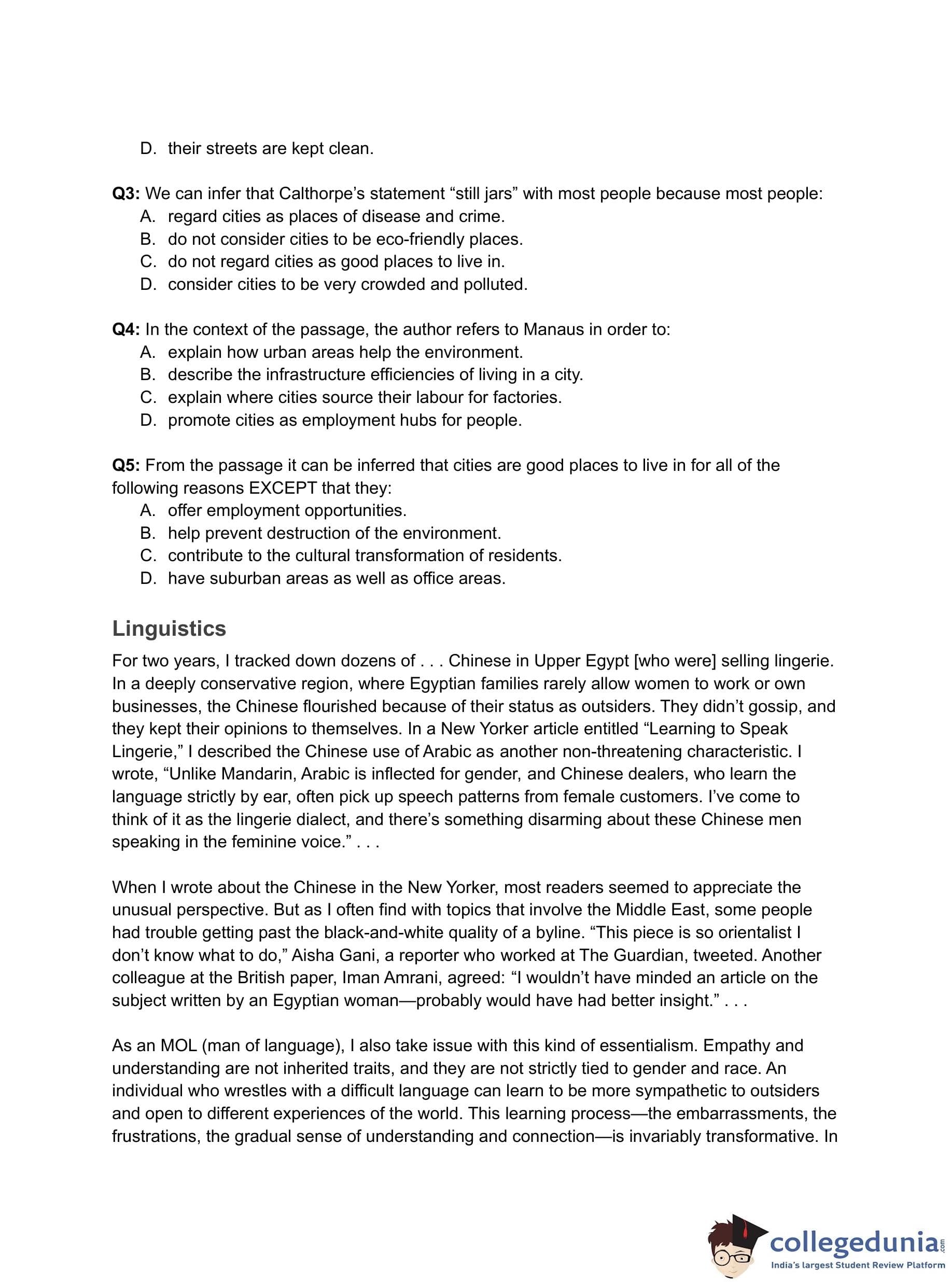
From the passage it can be inferred that cities are good places to live in for all of the following reasons EXCEPT that they:
- (A) offer employment opportunities.
- (B) help prevent destruction of the environment.
- (C) contribute to the cultural transformation of residents.
- (D) have suburban areas as well as office areas.
Correct Answer: (D) have suburban areas as well as office areas.
View Solution
Question 16:
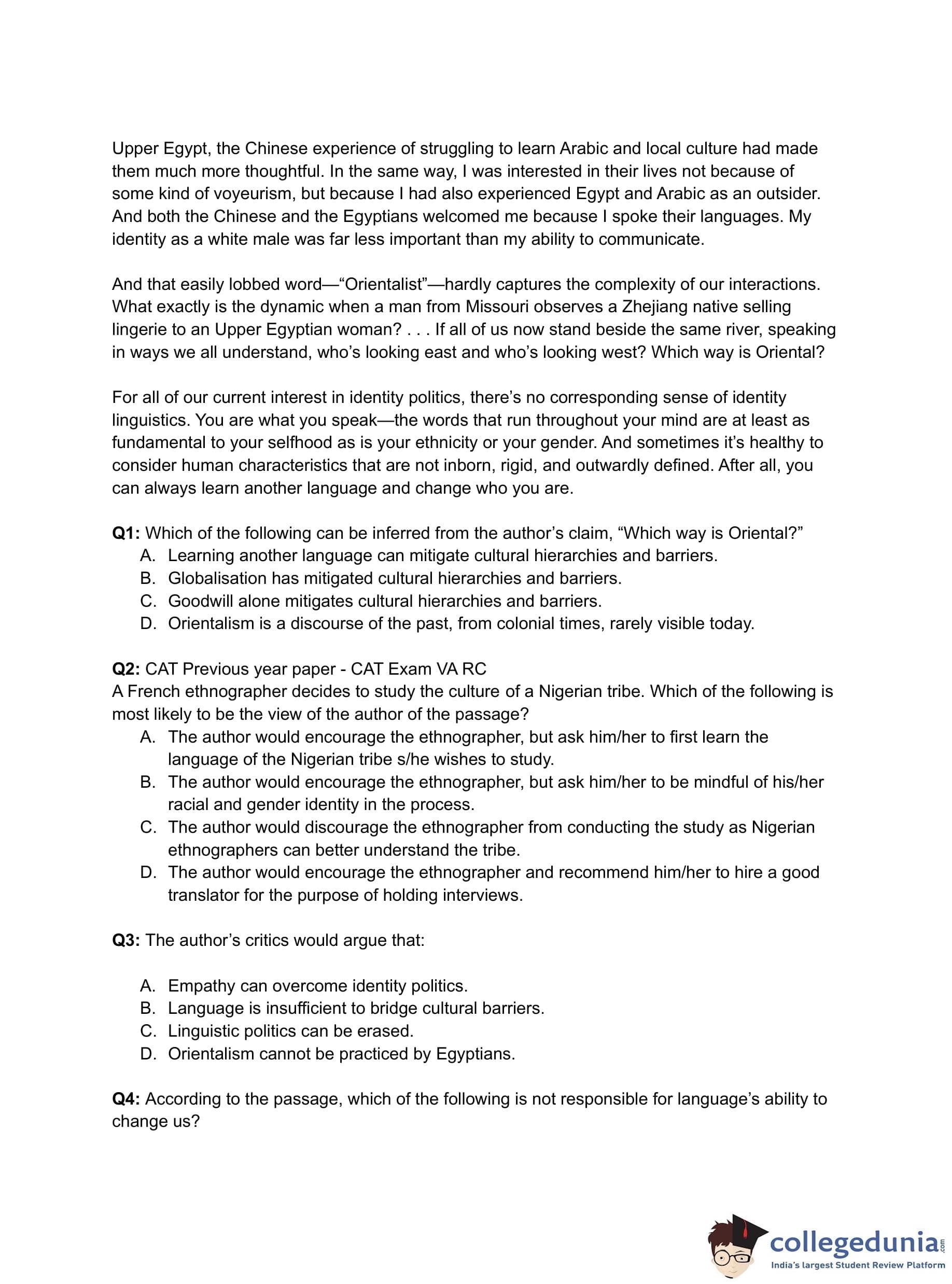
Which of the following can be inferred from the author's claim, "Which way is Oriental?"
- (A) Learning another language can mitigate cultural hierarchies and barriers.
- (B) Globalisation has mitigated cultural hierarchies and barriers.
- (C) Goodwill alone mitigates cultural hierarchies and barriers.
- (D) Orientalism is a discourse of the past, from colonial times, rarely visible today.
Correct Answer: (A) Learning another language can mitigate cultural hierarchies and barriers.
View Solution
Question 17:
A French ethnographer decides to study the culture of a Nigerian tribe. Which of the following is most likely to be the view of the author of the passage?
- (A) The author would encourage the ethnographer, but ask him/her to first learn the language of the Nigerian tribe s/he wishes to study.
- (B) The author would encourage the ethnographer, but ask him/her to be mindful of his/her racial and gender identity in the process.
- (C) The author would discourage the ethnographer from conducting the study as Nigerian ethnographers can better understand the tribe.
- (D) The author would encourage the ethnographer and recommend him/her to hire a good translator for the purpose of holding interviews.
Correct Answer: (A) The author would encourage the ethnographer, but ask him/her to first learn the language of the Nigerian tribe s/he wishes to study.
View Solution
Question 18:
The author's critics would argue that:
- (A) Empathy can overcome identity politics.
- (B) Language is insufficient to bridge cultural barriers.
- (C) Linguistic politics can be erased.
- (D) Orientalism cannot be practiced by Egyptians.
Correct Answer: (B) Language is insufficient to bridge cultural barriers.
View Solution
Question 19:
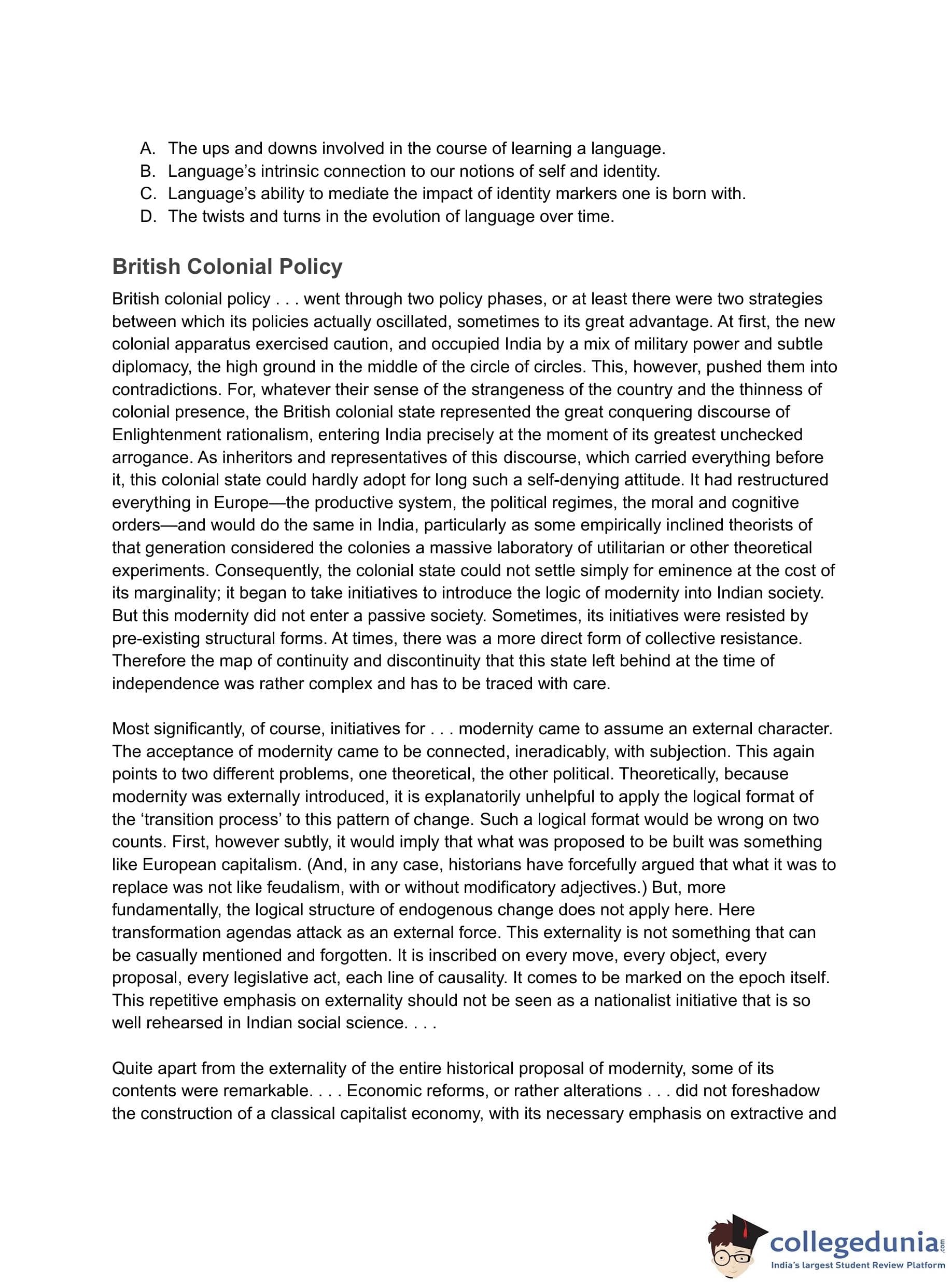
According to the passage, which of the following is not responsible for language's ability to change us?
- (A) The ups and downs involved in the course of learning a language.
- (B) Language's intrinsic connection to our notions of self and identity.
- (C) Language's ability to mediate the impact of identity markers one is born with.
- (D) The twists and turns in the evolution of language over time.
Correct Answer: (D) The twists and turns in the evolution of language over time.
View Solution
Question 20:
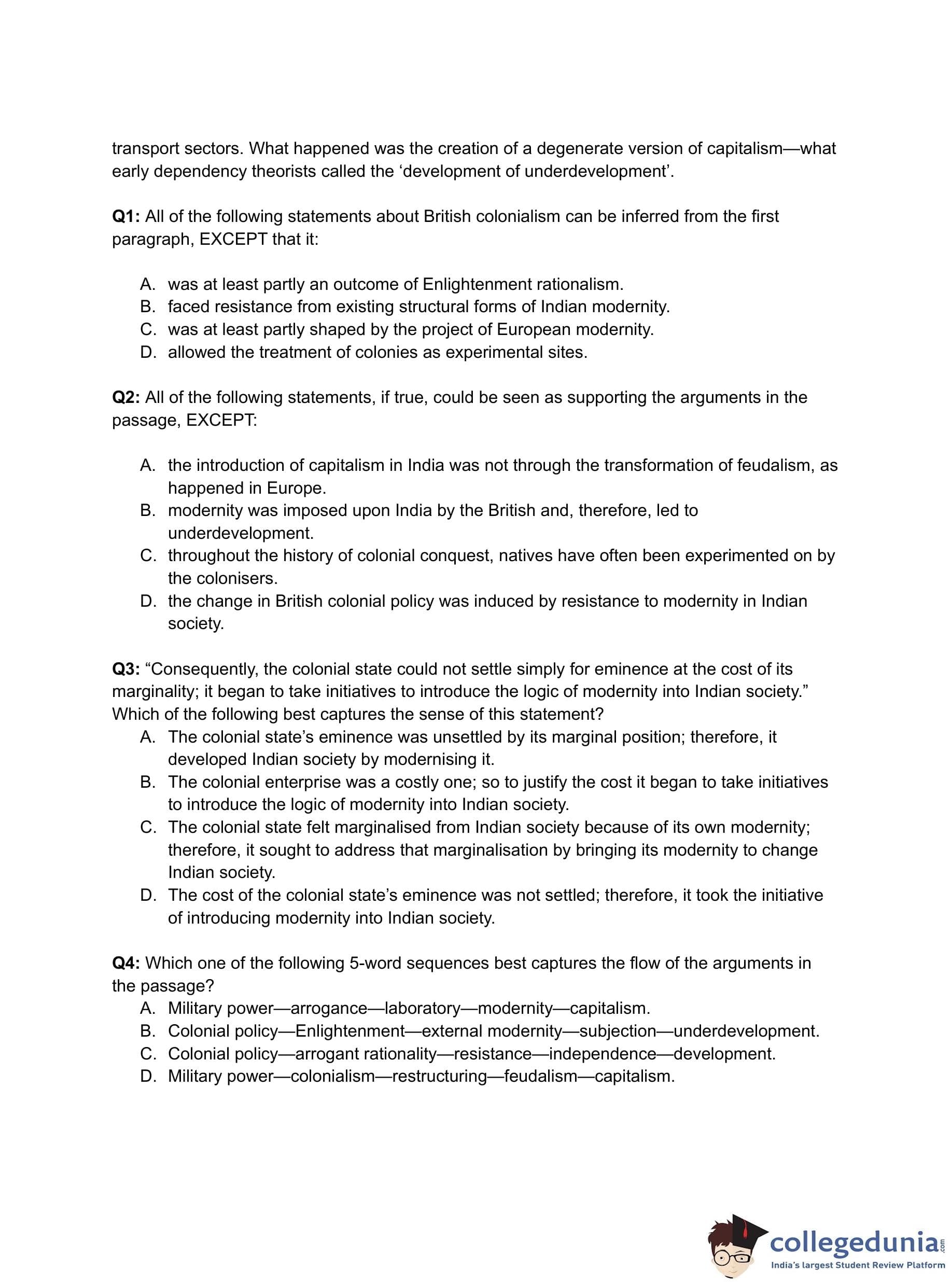
All of the following statements about British colonialism can be inferred from the first paragraph, EXCEPT that it:
- (A) was at least partly an outcome of Enlightenment rationalism.
- (B) faced resistance from existing structural forms of Indian modernity.
- (C) was at least partly shaped by the project of European modernity.
- (D) allowed the treatment of colonies as experimental sites.
Correct Answer: (B) faced resistance from existing structural forms of Indian modernity.
View Solution
Question 21:
All of the following statements, if true, could be seen as supporting the arguments in the passage, EXCEPT:
- (A) the introduction of capitalism in India was not through the transformation of feudalism, as happened in Europe.
- (B) modernity was imposed upon India by the British and, therefore, led to underdevelopment.
- (C) throughout the history of colonial conquest, natives have often been experimented on by the colonisers.
- (D) the change in British colonial policy was induced by resistance to modernity in Indian society.
Correct Answer: (D) the change in British colonial policy was induced by resistance to modernity in Indian society.
View Solution
Question 22:
"Consequently, the colonial state could not settle simply for eminence at the cost of its marginality; it began to take initiatives to introduce the logic of modernity into Indian society."
Which of the following best captures the sense of this statement?
- (A) The colonial state's eminence was unsettled by its marginal position; therefore, it developed Indian society by modernising it.
- (B) The colonial enterprise was a costly one; so to justify the cost it began to take initiatives to introduce the logic of modernity into Indian society.
- (C) The colonial state felt marginalised from Indian society because of its own modernity; therefore, it sought to address that marginalisation by bringing its modernity to change Indian society.
- (D) The cost of the colonial state's eminence was not settled; therefore, it took the initiative of introducing modernity into Indian society.
Correct Answer: (C) The colonial state felt marginalised from Indian society because of its own modernity; therefore, it sought to address that marginalisation by bringing its modernity to change Indian society.
View Solution
Question 23:
Which one of the following 5-word sequences best captures the flow of the arguments in the passage?
- (A) Military power-arrogance-laboratory-modernity-capitalism.
- (B) Colonial policy-Enlightenment-external modernity-subjection-underdevelopment.
- (C) Colonial policy-arrogant rationality-resistance-independence-development.
- (D) Military power-colonialism-restructuring-feudalism-capitalism.
Correct Answer: (B) Colonial policy-Enlightenment-external modernity-subjection-underdevelopment.
View Solution
Question 24:
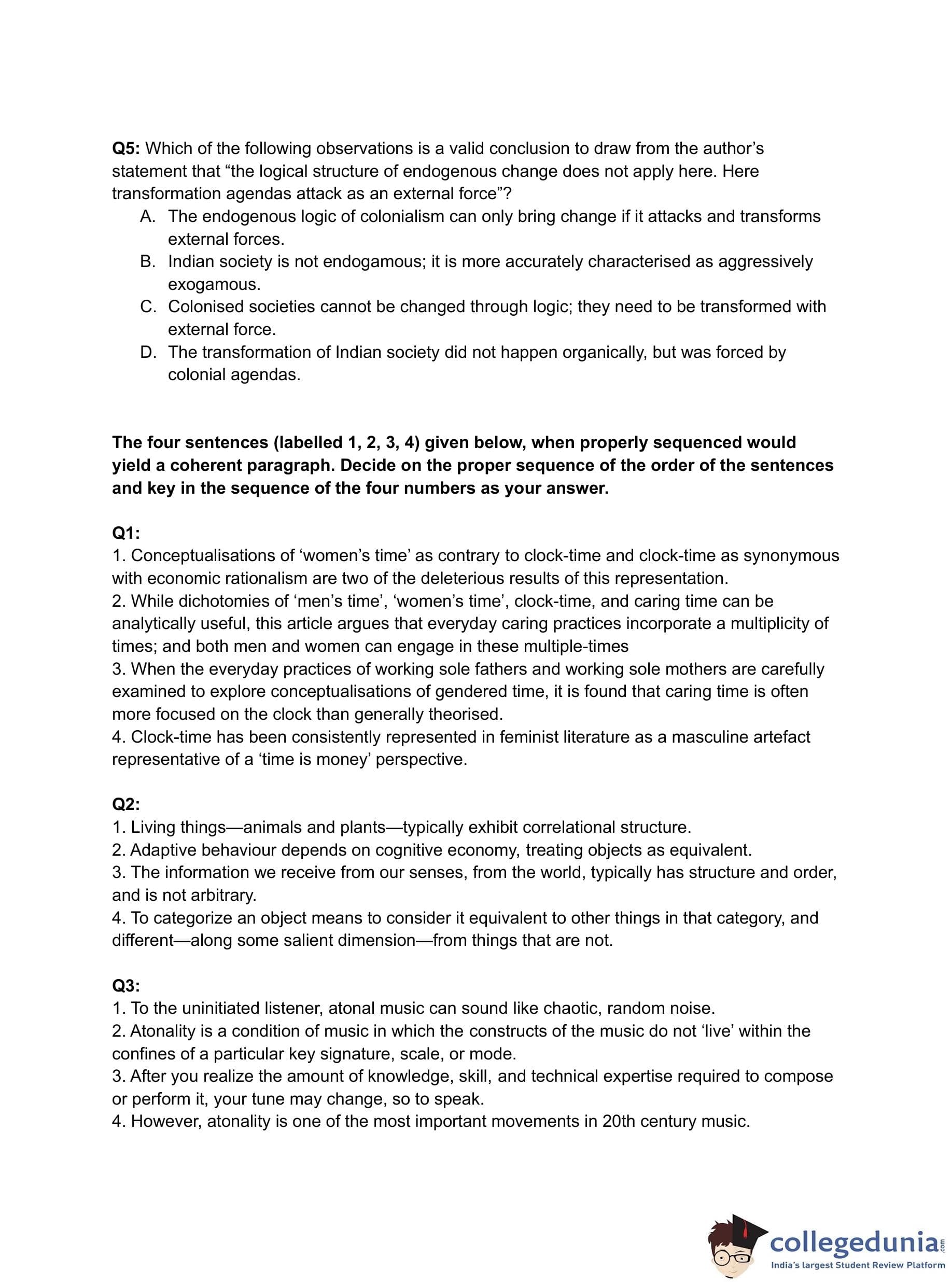
Which of the following observations is a valid conclusion to draw from the author's statement that "the logical structure of endogenous change does not apply here. Here transformation agendas attack as an external force"?
- (A) The endogenous logic of colonialism can only bring change if it attacks and transforms external forces.
- (B) Indian society is not endogamous; it is more accurately characterised as aggressively exogamous.
- (C) Colonised societies cannot be changed through logic; they need to be transformed with external force.
- (D) The transformation of Indian society did not happen organically, but was forced by colonial agendas.
Correct Answer: (D) The transformation of Indian society did not happen organically, but was forced by colonial agendas.
View Solution
Question 25:
(i) Conceptualisations of 'women's time' as contrary to clock-time and clock-time as synonymous with economic rationalism are two of the deleterious results of this representation.
(ii) While dichotomies of 'men's time', 'women's time', clock-time, and caring time can be analytically useful, this article argues that everyday caring practices incorporate a multiplicity of times; and both men and women can engage in these multiple-times.
(iii) When the everyday practices of working sole fathers and working sole mothers are carefully examined to explore conceptualisations of gendered time, it is found that caring time is often more focused on the clock than generally theorised.
(iv) Clock-time has been consistently represented in feminist literature as a masculine artefact representative of a 'time is money' perspective.
Question 26:
(i) Living things—animals and plants—typically exhibit correlational structure.
(ii) Adaptive behaviour depends on cognitive economy, treating objects as equivalent.
(iii) The information we receive from our senses, from the world, typically has structure and order, and is not arbitrary.
(iv) To categorize an object means to consider it equivalent to other things in that category, and different along some salient dimension from things that are not.
Question 27:
(i) To the uninitiated listener, atonal music can sound like chaotic, random noise.
(ii) Atonality is a condition of music in which the constructs of the music do not 'live' within the confines of a particular key signature, scale, or mode.
(iii) After you realize the amount of knowledge, skill, and technical expertise required to compose or perform it, your tune may change, so to speak.
(iv) However, atonality is one of the most important movements in 20th century music.
Question 28:
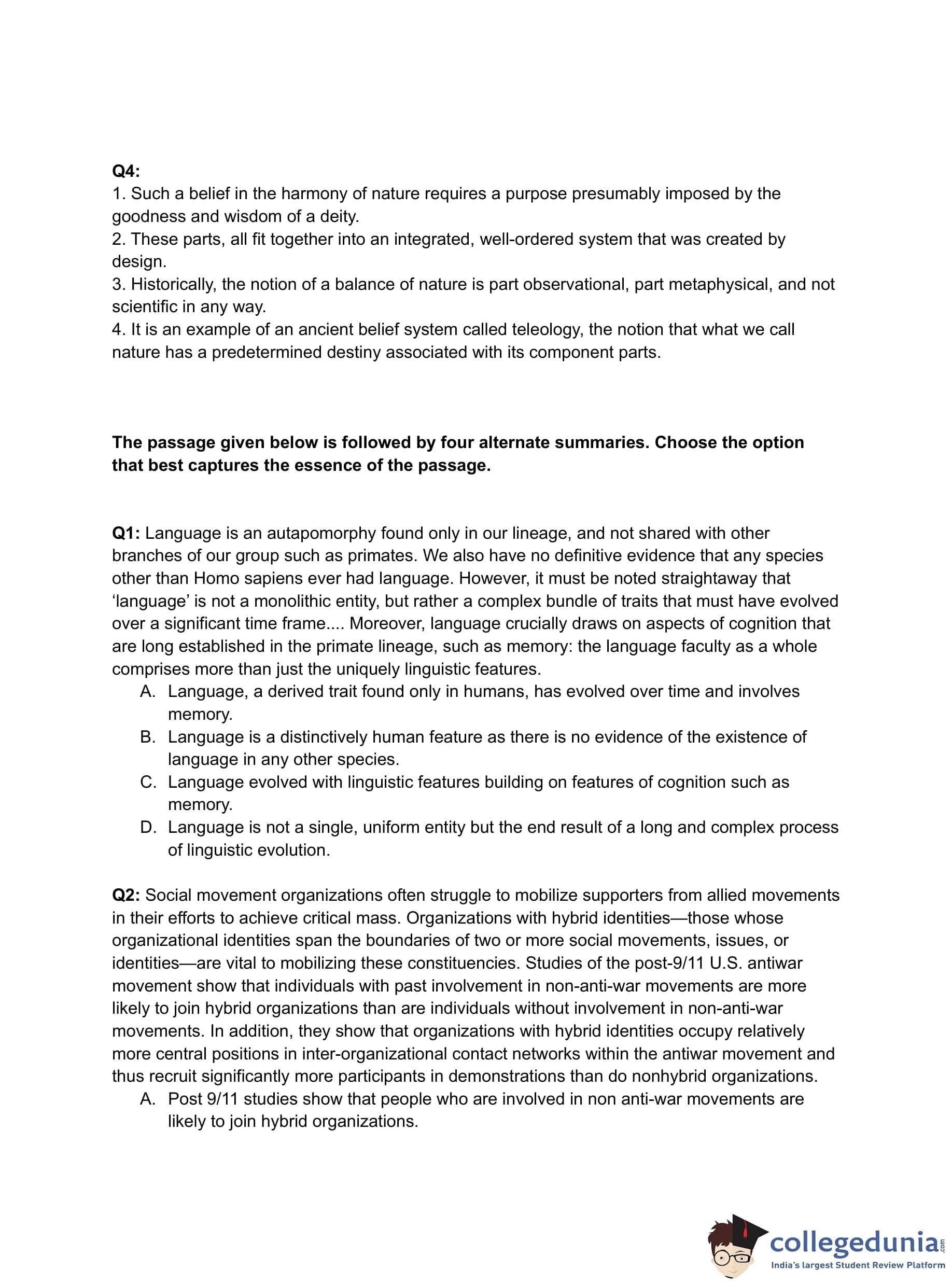
(i) Such a belief in the harmony of nature requires a purpose presumably imposed by the goodness and wisdom of a deity.
(ii) These parts, all fit together into an integrated, well-ordered system that was created by design.
(iii) Historically, the notion of a balance of nature is part observational, part metaphysical, and not scientific in any way.
(iv) It is an example of an ancient belief system called teleology, the notion that what we call nature has a predetermined destiny associated with its component parts.
Question 29:
Language is an autapomorphy found only in our lineage, and not shared with other branches of our group such as primates. We also have no definitive evidence that any species other than Homo sapiens ever had language. However, it must be noted straightaway that 'language' is not a monolithic entity, but rather a complex bundle of traits that must have evolved over a significant time frame .... Moreover, language crucially draws on aspects of cognition that are long established in the primate lineage, such as memory: the language faculty as a whole comprises more than just the uniquely linguistic features.
- (A) Language, a derived trait found only in humans, has evolved over time and involves memory.
- (B) Language is a distinctively human feature as there is no evidence of the existence of language in any other species.
- (C) Language evolved with linguistic features building on features of cognition such as memory.
- (D) Language is not a single, uniform entity but the end result of a long and complex process of linguistic evolution.
Correct Answer: (C) Language evolved with linguistic features building on features of cognition such as memory.
View Solution
Question 30:
Social movement organizations often struggle to mobilize supporters from allied movements in their efforts to achieve critical mass. Organizations with hybrid identities-those whose organizational identities span the boundaries of two or more social movements, issues, or identities-are vital to mobilizing these constituencies. Studies of the post-9/11 U.S. antiwar movement show that individuals with past involvement in non-anti-war movements are more likely to join hybrid organizations than are individuals without involvement in non-anti-war movements. In addition, they show that organizations with hybrid identities occupy relatively more central positions in inter-organizational contact networks within the antiwar movement and thus recruit significantly more participants in demonstrations than do nonhybrid organizations.
- (A) Post 9/11 studies show that people who are involved in non anti-war movements are likely to join hybrid organizations.
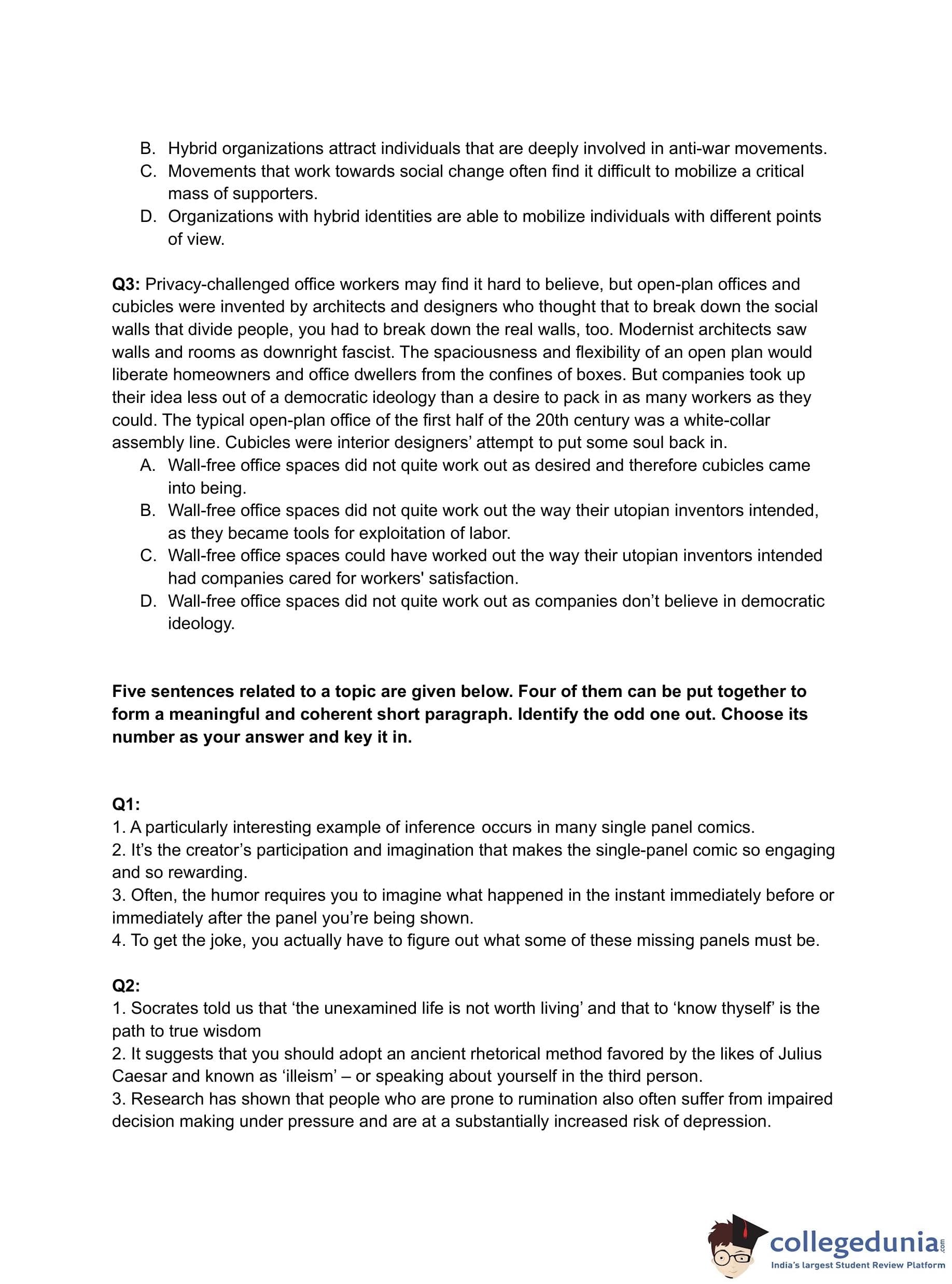
- (B) Hybrid organizations attract individuals that are deeply involved in anti-war movements.
- (C) Movements that work towards social change often find it difficult to mobilize a critical mass of supporters.
- (D) Organizations with hybrid identities are able to mobilize individuals with different points of view.
Correct Answer: (A) Post 9/11 studies show that people who are involved in non anti-war movements are likely to join hybrid organizations.
View Solution
Question 31:
Privacy-challenged office workers may find it hard to believe, but open-plan offices and cubicles were invented by architects and designers who thought that to break down the social walls that divide people, you had to break down the real walls, too. Modernist architects saw walls and rooms as downright fascist. The spaciousness and flexibility of an open plan would liberate homeowners and office dwellers from the confines of boxes. But companies took up their idea less out of a democratic ideology than a desire to pack in as many workers as they could. The typical open-plan office of the first half of the 20th century was a white-collar assembly line. Cubicles were interior designers' attempt to put some soul back in.
- (A) Wall-free office spaces did not quite work out as desired and therefore cubicles came into being.
- (B) Wall-free office spaces did not quite work out the way their utopian inventors intended, as they became tools for exploitation of labor.
- (C) Wall-free office spaces could have worked out the way their utopian inventors intended had companies cared for workers' satisfaction.
- (D) Wall-free office spaces did not quite work out as companies don't believe in democratic ideology.
Correct Answer: (B) Wall-free office spaces did not quite work out the way their utopian inventors intended, as they became tools for exploitation of labor.
View Solution
Question 32:
1. A particularly interesting example of inference occurs in many single-panel comics.
2. It's the creator's participation and imagination that makes the single-panel comic so engaging and so rewarding.
3. Often, the humor requires you to imagine what happened in the instant immediately before or immediately after the panel you're being shown.
4. To get the joke, you actually have to figure out what some of these missing panels must be.
Correct Answer: (A) Inference in single-panel comics often requires you to imagine the sequence of events before or after the panel.
View Solution
N/A Quick Tip: Focus on what the passage explicitly says about the need to imagine events outside the single-panel to understand the humor.
Question 33:
1. Socrates told us that 'the unexamined life is not worth living' and that to 'know thyself' is the path to true wisdom.
2. It suggests that you should adopt an ancient rhetorical method favored by the likes of Julius Caesar and known as 'illeism' - or speaking about yourself in the third person.
3. Research has shown that people who are prone to rumination also often suffer from impaired decision making under pressure and are at a substantially increased risk of depression.
4. Simple rumination - the process of churning your concerns around in your head - is not the way to achieve self-realization.
5. The idea is that this small change in perspective can clear your emotional fog, allowing you to see past your biases.
5. It is as though the cartoonist devised a series of panels to tell the story and has chosen to show you only one - and typically not even the funniest.
Correct Answer: (A) Rhetorical methods like illeism can help you better understand yourself by shifting perspective.
View Solution
Question 34:
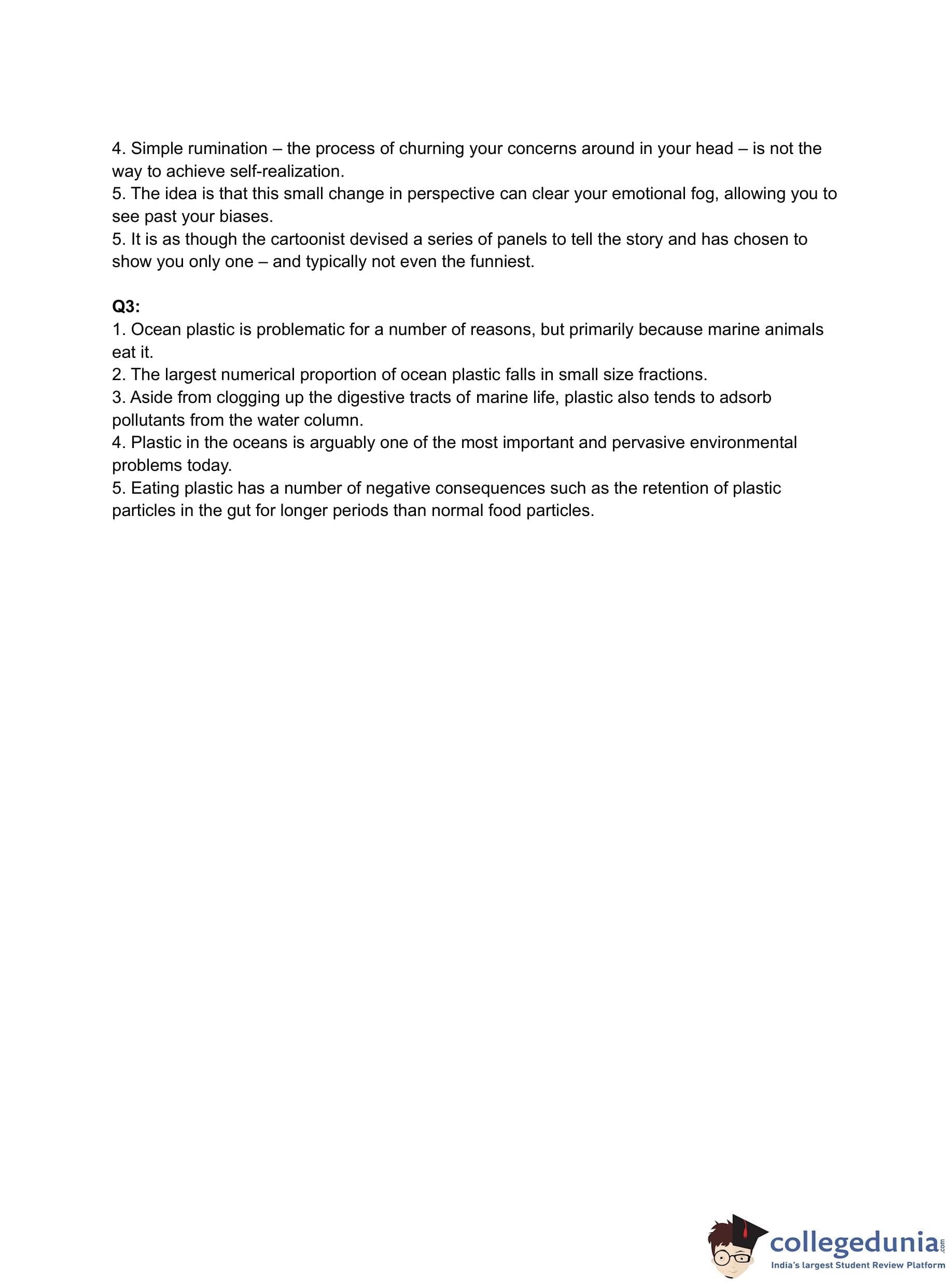
1. Ocean plastic is problematic for a number of reasons, but primarily because marine animals eat it.
2. The largest numerical proportion of ocean plastic falls in small size fractions.
3. Aside from clogging up the digestive tracts of marine life, plastic also tends to adsorb pollutants from the water column.
4. Plastic in the oceans is arguably one of the most important and pervasive environmental problems today.
5. Eating plastic has a number of negative consequences such as the retention of plastic particles in the gut for longer periods than normal food particles.
Correct Answer: (A) Ocean plastic is harmful to marine life because it clogs digestive tracts and adsorbs pollutants.
View Solution
N/A Quick Tip: Look for direct explanations in the passage about how the problem is caused or worsened.
CAT 2019 Question Paper Slot 2 November 24: Sectional Analysis
CAT 2019 Slot 2 was conducted between 2.30 pm to 5:30 pm. The overall difficulty level of this slot was reported to be moderate to difficult. CAT 2019 VARC Sectional Analysis is as follows:
- VARC contained 5 RCs- 4 RCs had 5 questions each and 1 RC had 4 questions.
- Two of the RCs were difficult in terms of language and vocabulary, while the other 3 were easier to understand.
- There were three questions each from the para summary and odd sentence. Their overall difficulty level was easy to moderate.
- The paper had 4 para jumble questions. Out of these, only 1 question was difficult.
CAT Question Papers of Other Years
Other MBA Exam Question Papers









Comments