




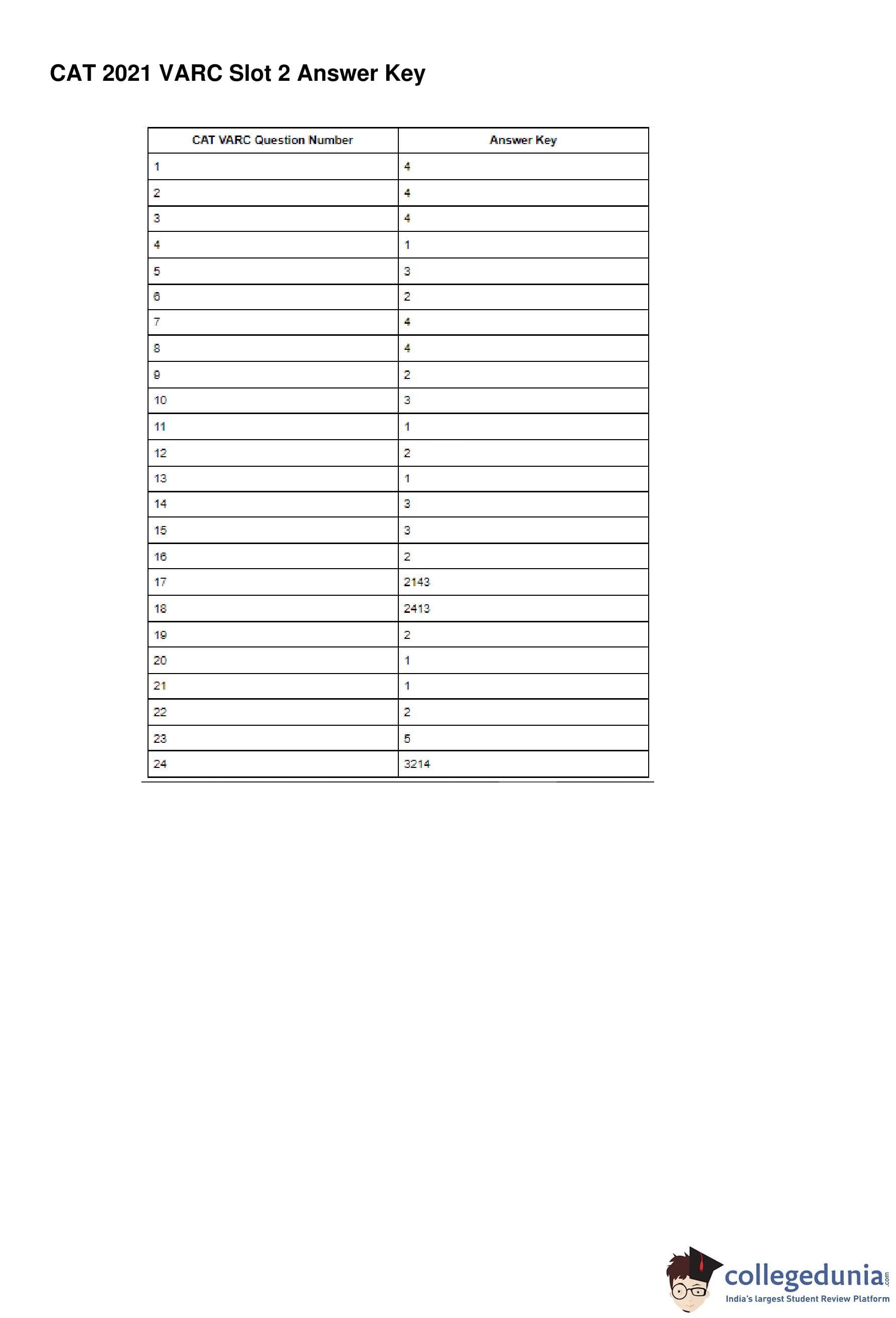
CAT 2021 VARC Slot 2 Question Paper with Answer Key is available.CAT 2021 Question paper had a total of 66 questions carrying 198 marks. Out of the 66 questions, CAT VARC comprised 24 questions. 66.66% of the total weightage in the VARC section was carried by RC (Reading Comprehension) questions.The overall difficulty level of CAT 2021 VARC slot 2 was moderate to tough.
For scoring more than 99%ile in CAT 2025 , students were required to score somewhere between 30-32. Aspirants aiming for CAT are strongly recommended to download CAT 2021 VARC Slot 2 question paper with answer key PDFs to check their preparation level.
Also Check:
CAT 2021 VARC Slot 2 Question Paper with Solution PDF
| CAT 2021 VARC Question Paper with Answer Key | Download PDF | Check solutions |

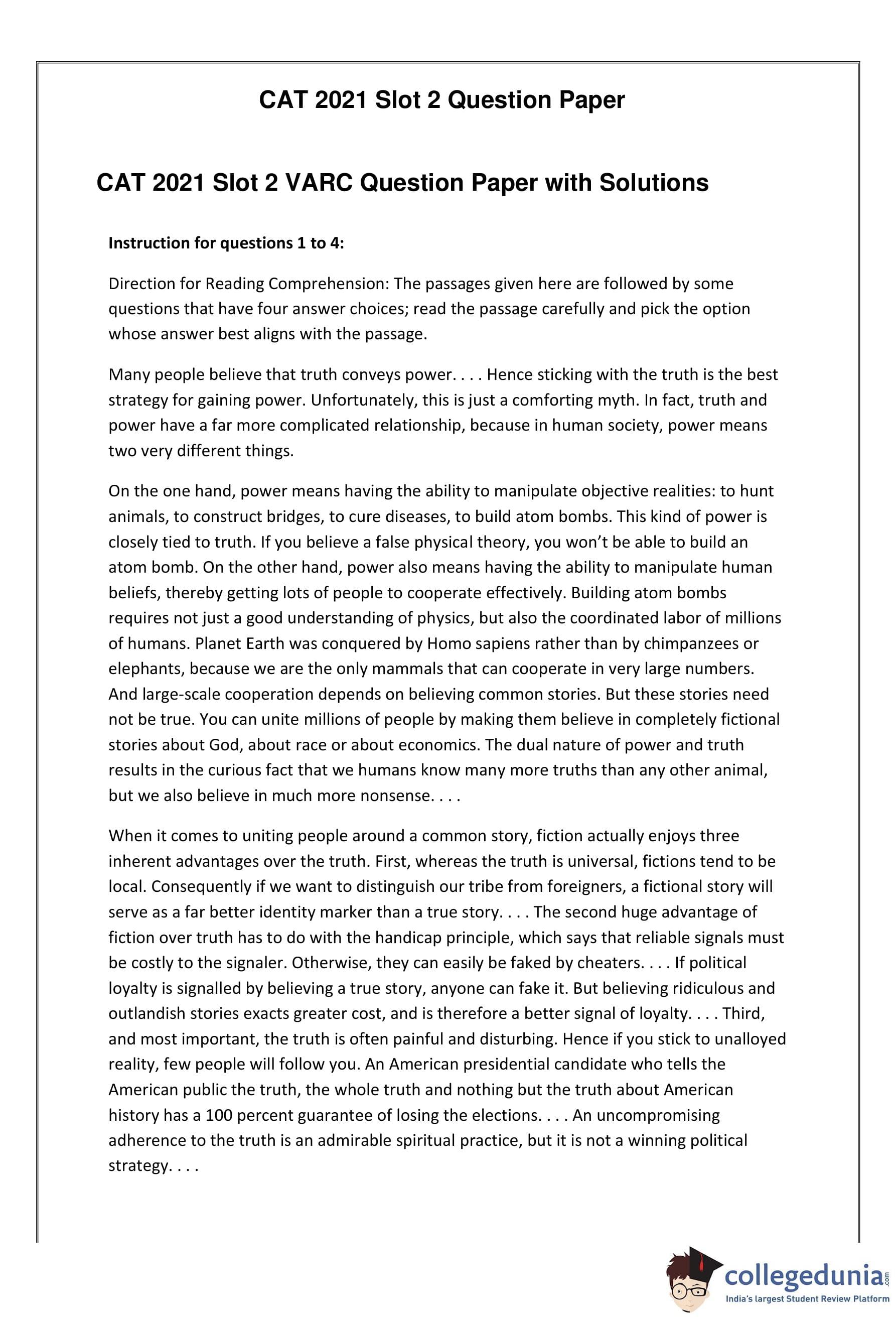
he passages given here are followed by some questions that have four answer choices; read the passage carefully and pick the option whose answer best aligns with the passage. Many people believe that truth conveys power. . . . Hence sticking with the truth is the best strategy for gaining power. Unfortunately, this is just a comforting myth. In fact, truth and power have a far more complicated relationship, because in human society, power means two very different things.
The central theme of the passage is about the choice between:
Regarding which one of the following quotes could we argue that the author overemphasises the importance of fiction?
View Solution
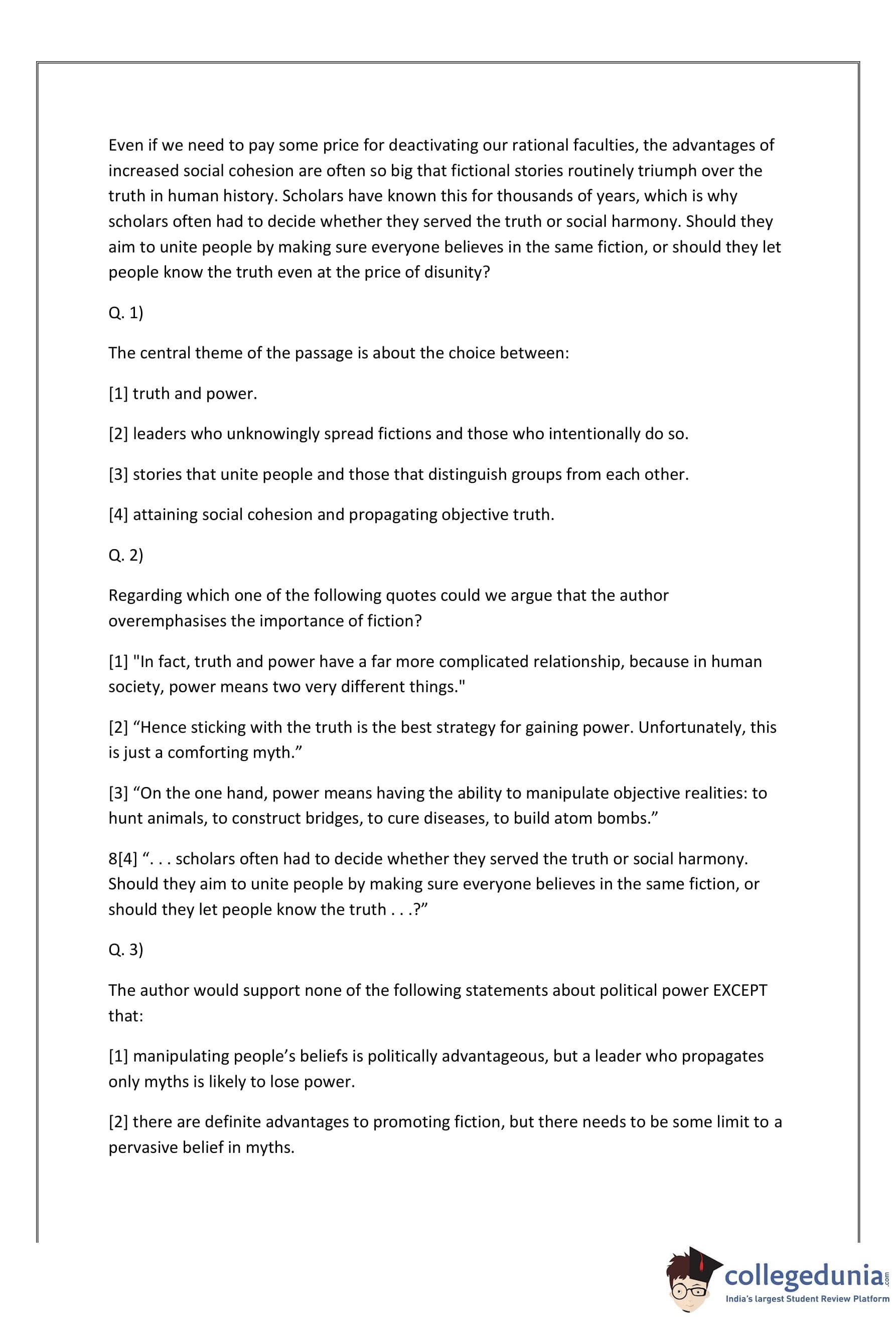
The author would support none of the following statements about political power EXCEPT that:
View Solution
The author implies that, like scholars, successful leaders:
View Solution
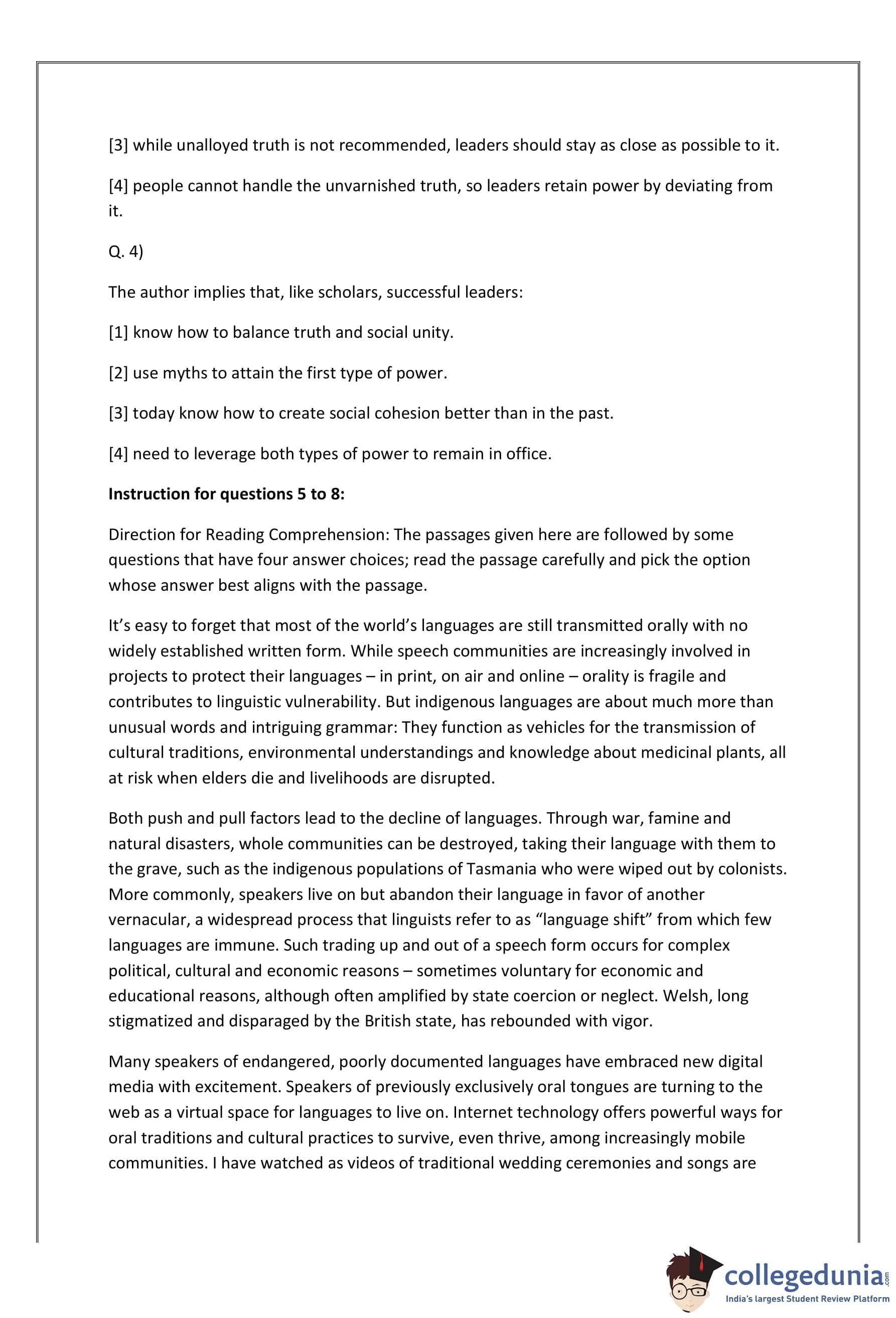
The passages given here are followed by some 5 questions that have four answer choices; read the passage carefully and pick the option whose answer best aligns with the passage. It’s easy to forget that most of the world’s languages are still transmitted orally with no widely established written form. While speech communities are increasingly involved in projects to protect their languages - in print, on air and online - orality is fragile and contributes to linguistic vulnerability. But indigenous languages are about much more than unusual words and intriguing grammar:
Read More
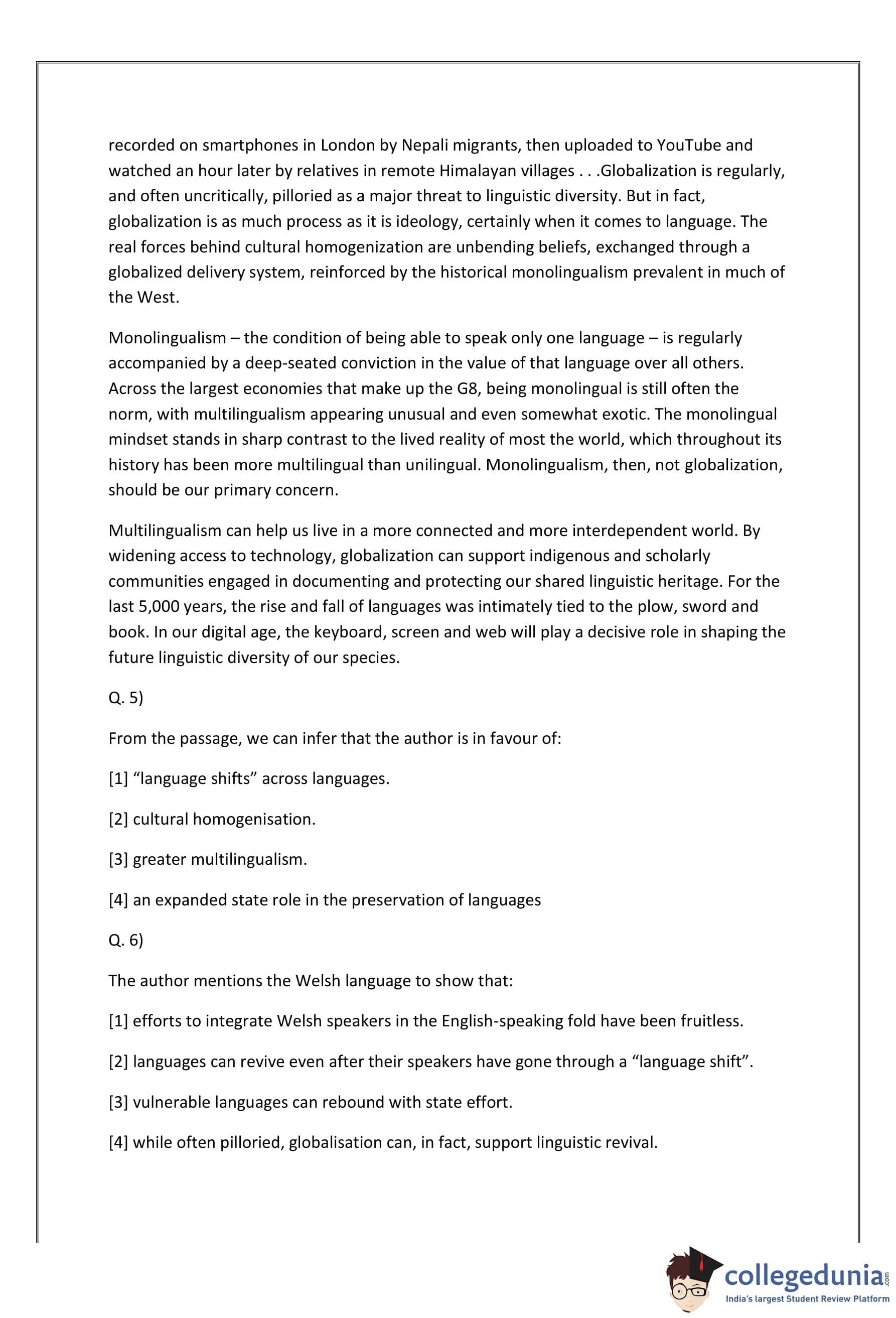
They function as vehicles for the transmission of cultural traditions, environmental understandings and knowledge about medicinal plants, all at risk when elders die and livelihoods are disrupted. Both push and pull factors lead to the decline of languages. Through war, famine and natural disasters, whole communities can be destroyed, taking their language with them to the grave, such as the indigenous populations of Tasmania who were wiped out by colonists. More commonly, speakers live on but abandon their language in favor of another vernacular, a widespread process that linguists refer to as ”language shift” from which few languages are immune. Such trading up and out of a speech form occurs for complex political, cultural and economic reasons - sometimes voluntary for economic and educational reasons, although often amplified by state coercion or neglect. Welsh, long stigmatized and disparaged by the British state, has rebounded with vigor. Many speakers of endangered, poorly documented languages have embraced new digital media with excitement. Speakers of previously exclusively oral tongues are turning to the web as a virtual space for languages to live on. Internet technology offers powerful ways for oral traditions and cultural practices to survive, even thrive, among increasingly mobile com- munities. I have watched as videos of traditional wedding ceremonies and songs are recorded on smartphones in London by Nepali migrants, then uploaded to YouTube and watched an hour later by relatives in remote Himalayan villages . . . Globalization is regularly, and often uncritically, pilloried as a major threat to linguistic diversity. But in fact, globalization is as much process as it is ideology, certainly when it comes to language. The real forces behind cultural homogenization are unbending beliefs, exchanged through a globalized delivery sys- tem, reinforced by the historical monolingualism prevalent in much of the West. Monolingualism - the condition of being able to speak only one language - is regularly accompanied by a deep-seated conviction in the value of that language over all others. Across the largest economies that make up the G8, being monolingual is still often the norm, with multilingualism appearing unusual and even somewhat exotic. The monolingual mindset stands in sharp contrast to the lived reality of most the world, which throughout its history has been more multilingual than unilingual. Monolingualism, then, not globalization, should be our primary concern. Multilingualism can help us live in a more connected and more interdependent world. By widening access to technology, globalization can support indigenous and scholarly communi- ties engaged in documenting and protecting our shared linguistic heritage. For the last 5,000 years, the rise and fall of languages was intimately tied to the plow, sword and book. In our digital age, the keyboard, screen and web will play a decisive role in shaping the future lin- guistic diversity of our species.From the passage, we can infer that the author is in favour of:
View Solution
The author emphasizes the value of multilingualism and its benefits, contrasting it with monolingualism and the risks posed by cultural homogenization. The passage advocates for a more connected and interdependent world through multilingualism, which is supported by globalization. Therefore, the author supports greater multilingualism.
Thus, the correct option is: \[ \boxed{(3) greater multilingualism.} \] Quick Tip: Look for the emphasis in the passage on the advantages of multilingualism and its connection to globalization.
The author mentions the Welsh language to show that:
View Solution
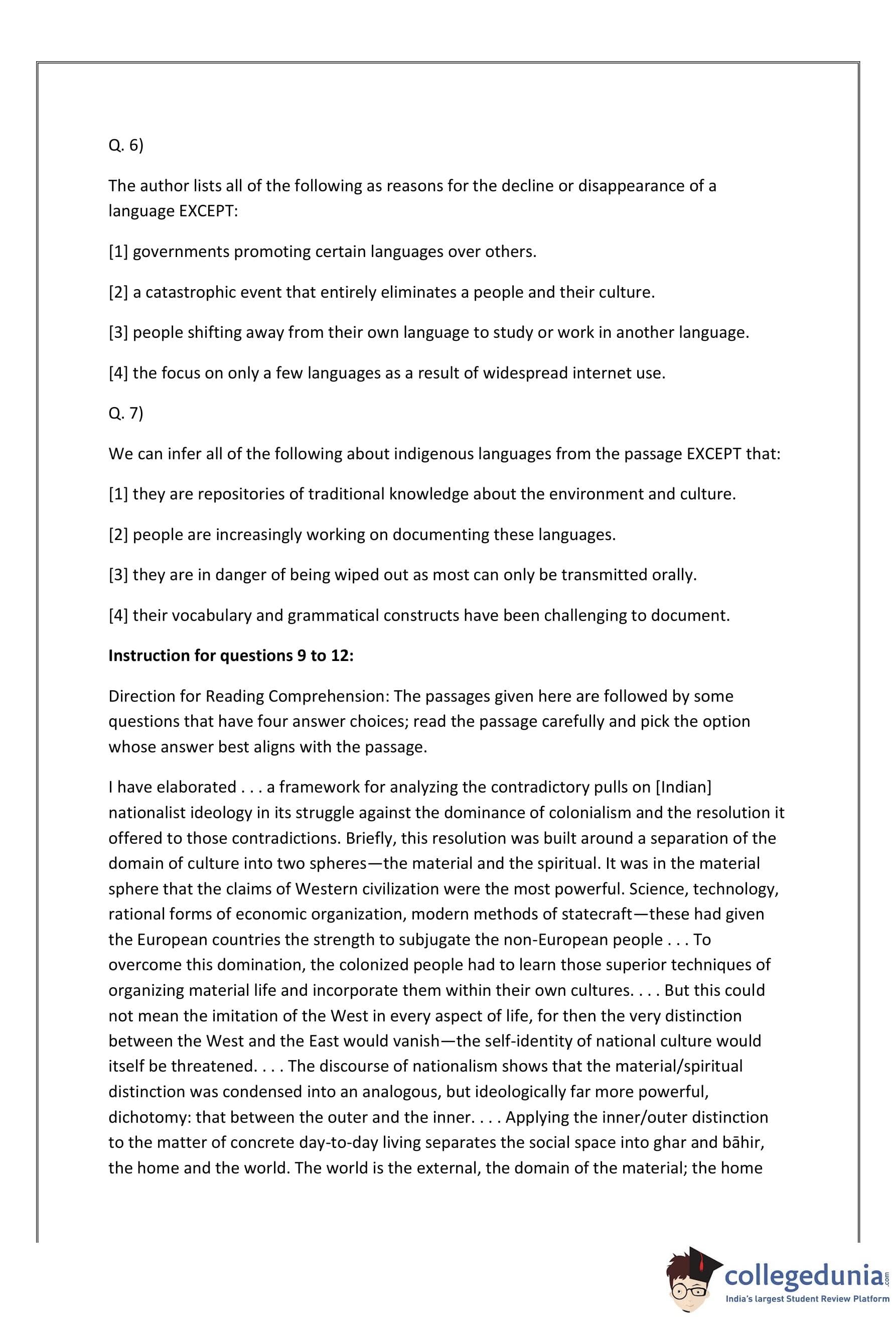
The author lists all of the following as reasons for the decline or disappearance of a language EXCEPT:
View Solution
We can infer all of the following about indigenous languages from the passage EXCEPT that:
View Solution
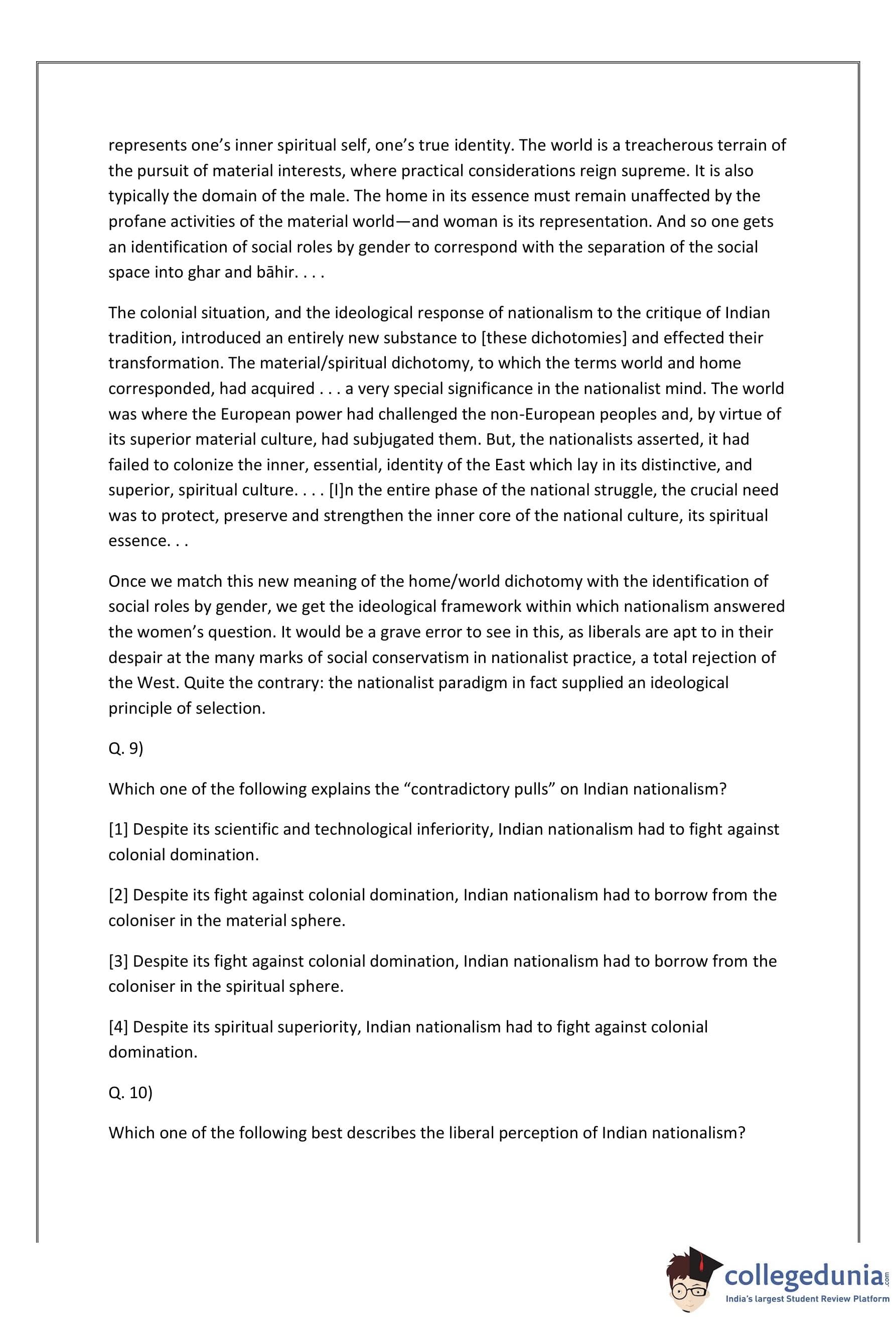
The passages given here are followed by some questions that have four answer choices; read the passage carefully and pick the option whose answer best aligns with the passage. I have elaborated . . . a framework for analyzing the contradictory pulls on [Indian] nation- alist ideology in its struggle against the dominance of colonialism and the resolution it offered to those contradictions. Briefly, this resolution was built around a separation of the domain of culture into two spheres-the material and the spiritual.
Read More
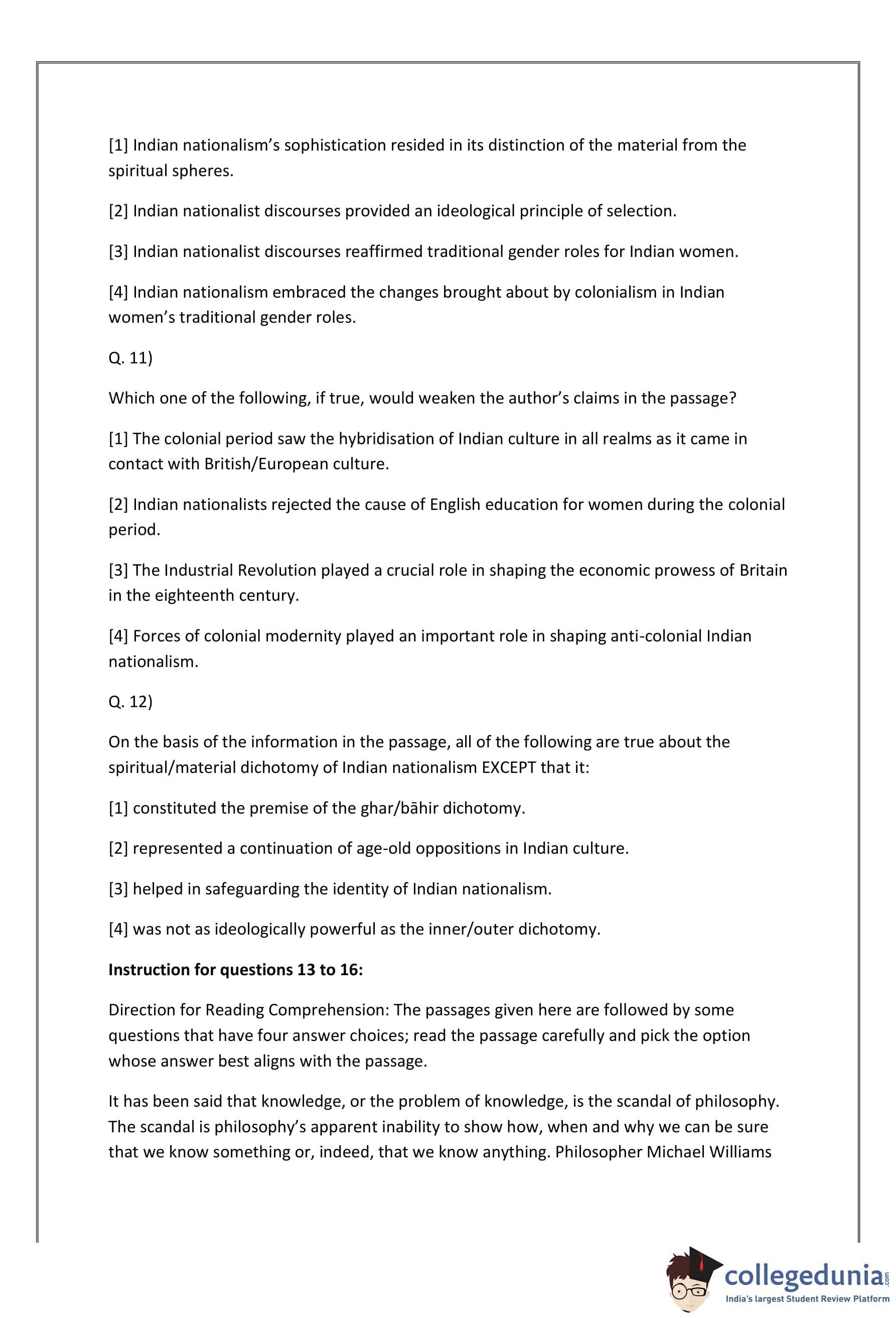
It was in the material sphere that the claims of Western civilization were the most powerful. Science, technology, rational forms of economic organization, modern methods of statecraft-these had given the European coun- tries the strength to subjugate the non-European people . . . To overcome this domination, the colonized people had to learn those superior techniques of organizing material life and 10 incorporate them within their own cultures. . . . But this could not mean the imitation of the West in every aspect of life, for then the very distinction between the West and the East would vanish-the self-identity of national culture would itself be threatened. . . . The discourse of nationalism shows that the material/spiritual distinction was condensed into an analogous, but ideologically far more powerful, dichotomy: that between the outer and the inner. . . . Apply- ing the inner/outer distinction to the matter of concrete day-to-day living separates the social space into ghar and bahir, the home and the world. The world is the external, the domain of the material; the home represents one’s inner spiritual self, one’s true identity. The world is a treacherous terrain of the pursuit of material interests, where practical considerations reign supreme. It is also typically the domain of the male. The home in its essence must remain unaffected by the profane activities of the material world-and woman is its representation. And so one gets an identification of social roles by gender to correspond with the separation of the social space into ghar and b¯ahir .. . . The colonial situation, and the ideological response of nationalism to the critique of In- dian tradition, introduced an entirely new substance to [these dichotomies] and effected their transformation. The material/spiritual dichotomy, to which the terms world and home corre- sponded, had acquired . . . a very special significance in the nationalist mind. The world was where the European power had challenged the non-European peoples and, by virtue of its superior material culture, had subjugated them. But, the nationalists asserted, it had failed to colonize the inner, essential, identity of the East which lay in its distinctive, and superior, spiritual culture. . .. [I]n the entire phase of the national struggle, the crucial need was to protect, preserve and strengthen the inner core of the national culture, its spiritual essence .. . Once we match this new meaning of the home/world dichotomy with the identification of social roles by gender, we get the ideological framework within which nationalism answered the women’s question. It would be a grave error to see in this, as liberals are apt to in their despair at the many marks of social conservatism in nationalist practice, a total rejection of the West. Quite the contrary: the nationalist paradigm in fact supplied an ideological principle of selection.The passages given here are followed by some questions that have four answer choices; read the passage carefully and pick the option whose answer best aligns with the passage. I have elaborated . . . a framework for analyzing the contradictory pulls on [Indian] nation- alist ideology in its struggle against the dominance of colonialism and the resolution it offered to those contradictions. Briefly, this resolution was built around a separation of the domain of culture into two spheres-the material and the spiritual. It was in the material sphere that the claims of Western civilization were the most powerful. Science, technology, rational forms of economic organization, modern methods of statecraft-these had given the European coun- tries the strength to subjugate the non-European people . . . To overcome this domination, the colonized people had to learn those superior techniques of organizing material life and 10 incorporate them within their own cultures. . . . But this could not mean the imitation of the West in every aspect of life, for then the very distinction between the West and the East would vanish-the self-identity of national culture would itself be threatened. . . . The discourse of nationalism shows that the material/spiritual distinction was condensed into an analogous, but ideologically far more powerful, dichotomy: that between the outer and the inner. . . . Apply- ing the inner/outer distinction to the matter of concrete day-to-day living separates the social space into ghar and bahir, the home and the world. The world is the external, the domain of the material; the home represents one’s inner spiritual self, one’s true identity. The world is a treacherous terrain of the pursuit of material interests, where practical considerations reign supreme. It is also typically the domain of the male. The home in its essence must remain unaffected by the profane activities of the material world-and woman is its representation. And so one gets an identification of social roles by gender to correspond with the separation of the social space into ghar and b¯ahir .. . . The colonial situation, and the ideological response of nationalism to the critique of In- dian tradition, introduced an entirely new substance to [these dichotomies] and effected their transformation. The material/spiritual dichotomy, to which the terms world and home corre- sponded, had acquired . . . a very special significance in the nationalist mind. The world was where the European power had challenged the non-European peoples and, by virtue of its superior material culture, had subjugated them. But, the nationalists asserted, it had failed to colonize the inner, essential, identity of the East which lay in its distinctive, and superior, spiritual culture. . .. [I]n the entire phase of the national struggle, the crucial need was to protect, preserve and strengthen the inner core of the national culture, its spiritual essence .. . Once we match this new meaning of the home/world dichotomy with the identification of social roles by gender, we get the ideological framework within which nationalism answered the women’s question. It would be a grave error to see in this, as liberals are apt to in their despair at the many marks of social conservatism in nationalist practice, a total rejection of the West. Quite the contrary: the nationalist paradigm in fact supplied an ideological principle of selection. It was in the material sphere that the claims of Western civilization were the most powerful. Science, technology, rational forms of economic organization, modern methods of statecraft-these had given the European coun- tries the strength to subjugate the non-European people . . . To overcome this domination, the colonized people had to learn those superior techniques of organizing material life and 10 incorporate them within their own cultures. . . . But this could not mean the imitation of the West in every aspect of life, for then the very distinction between the West and the East would vanish-the self-identity of national culture would itself be threatened. . . . The discourse of nationalism shows that the material/spiritual distinction was condensed into an analogous, but ideologically far more powerful, dichotomy: that between the outer and the inner. . . . Apply- ing the inner/outer distinction to the matter of concrete day-to-day living separates the social space into ghar and bahir, the home and the world. The world is the external, the domain of the material; the home represents one’s inner spiritual self, one’s true identity. The world is a treacherous terrain of the pursuit of material interests, where practical considerations reign supreme. It is also typically the domain of the male. The home in its essence must remain unaffected by the profane activities of the material world-and woman is its representation. And so one gets an identification of social roles by gender to correspond with the separation of the social space into ghar and b¯ahir .. . . The colonial situation, and the ideological response of nationalism to the critique of In- dian tradition, introduced an entirely new substance to [these dichotomies] and effected their transformation. The material/spiritual dichotomy, to which the terms world and home corre- sponded, had acquired . . . a very special significance in the nationalist mind. The world was where the European power had challenged the non-European peoples and, by virtue of its superior material culture, had subjugated them. But, the nationalists asserted, it had failed to colonize the inner, essential, identity of the East which lay in its distinctive, and superior, spiritual culture. . .. [I]n the entire phase of the national struggle, the crucial need was to protect, preserve and strengthen the inner core of the national culture, its spiritual essence .. . Once we match this new meaning of the home/world dichotomy with the identification of social roles by gender, we get the ideological framework within which nationalism answered the women’s question. It would be a grave error to see in this, as liberals are apt to in their despair at the many marks of social conservatism in nationalist practice, a total rejection of the West. Quite the contrary: the nationalist paradigm in fact supplied an ideological principle of selection.Which one of the following explains the "contradictory pulls" on Indian nationalism?
View Solution
The passage explains that Indian nationalism had to learn the techniques of organizing material life from the colonizers in order to overcome colonial domination. However, it could not imitate the West completely, as that would erase the distinction between the West and the East. Therefore, Indian nationalism had to selectively borrow from the colonizer, especially in the material sphere.
Thus, the correct option is: \[ \boxed{(2) Despite its fight against colonial domination, Indian nationalism had to borrow from the coloniser in the material sphere.} \] Quick Tip: Focus on the contradiction where Indian nationalism had to incorporate Western techniques in the material sphere while maintaining its spiritual distinctiveness.
Which one of the following best describes the liberal perception of Indian nationalism?
View Solution
Which one of the following, if true, would weaken the author's claims in the passage?
View Solution
On the basis of the information in the passage, all of the following are true about the spiritual/material dichotomy of Indian nationalism EXCEPT that it:
View Solution
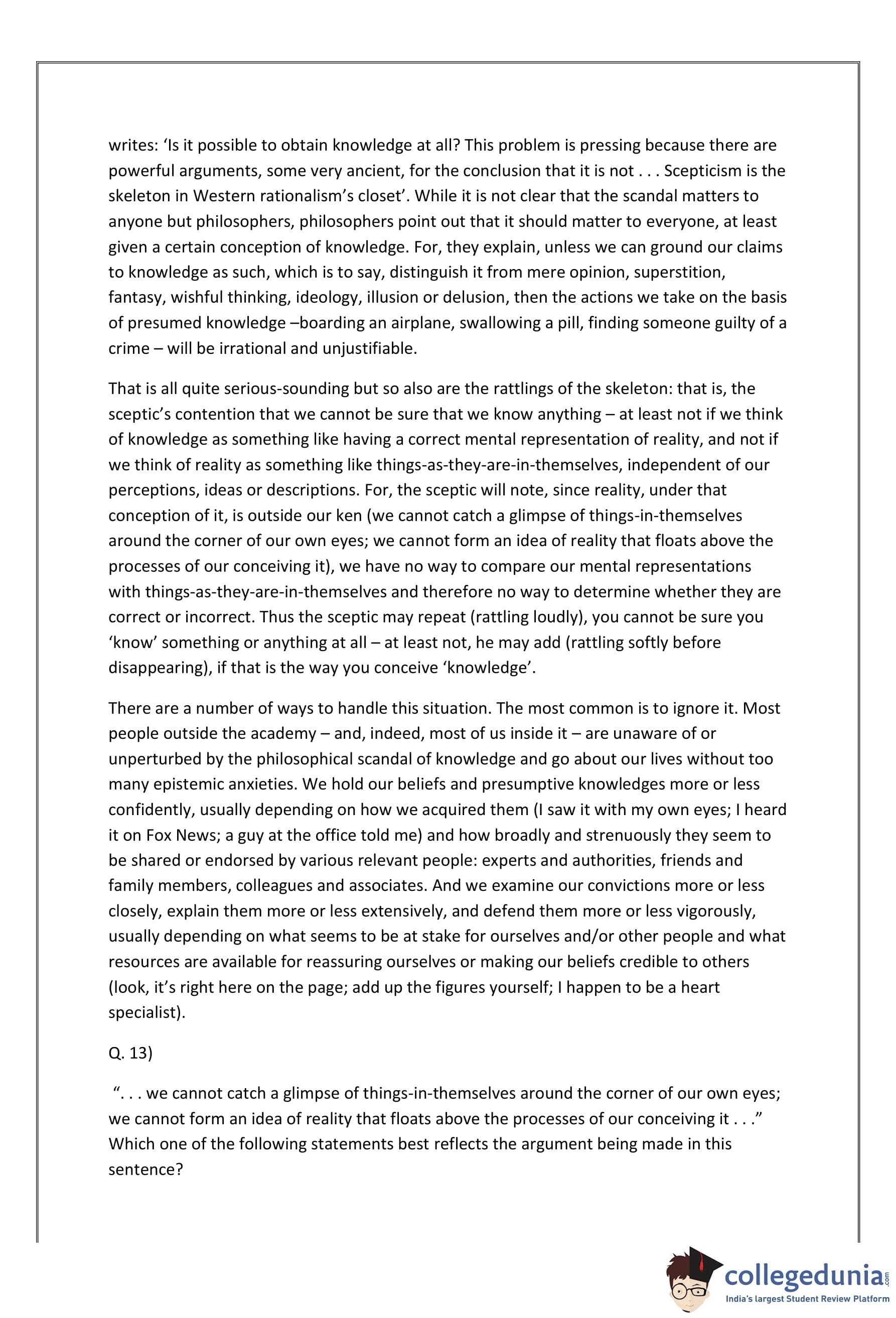
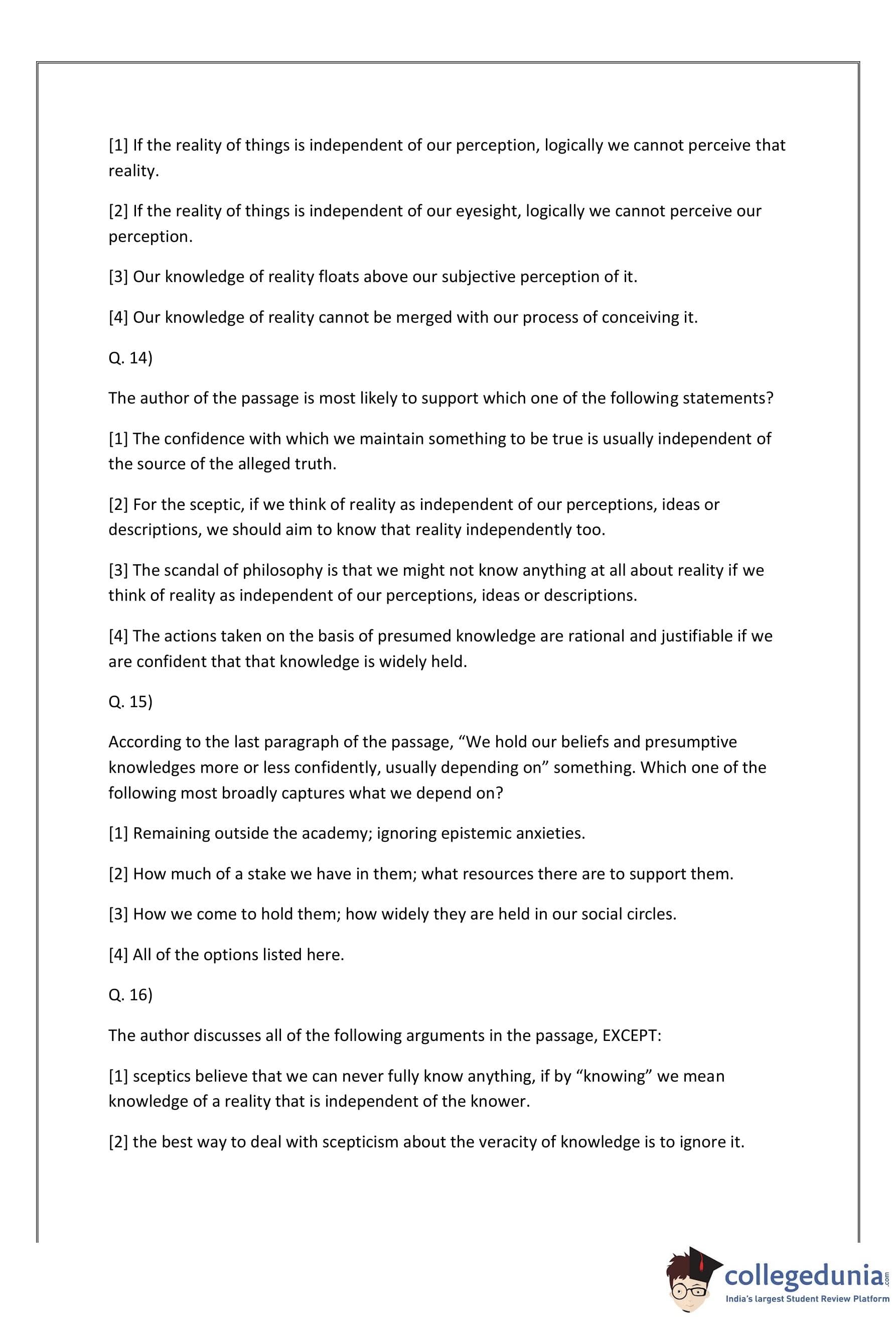
The passages given here are followed by some questions that have four answer choices; read the passage carefully and pick the option whose answer best aligns with the passage. It has been said that knowledge, or the problem of knowledge, is the scandal of philosophy. The scandal is philosophy’s apparent inability to show how, when and why we can be sure that we know something or, indeed, that we know anything.
Read More
Philosopher Michael Williams writes:’Is it possible to obtain knowledge at all? This problem is pressing because there are powerful arguments, some very ancient, for the conclusion that it is not . . . Scepticism is the skeleton in Western rationalism’s closet’. While it is not clear that the scandal matters to anyone but philosophers, philosophers point out that it should matter to everyone, at least given a certain conception of knowledge. For, they explain, unless we can ground our claims to knowledge as such, which is to say, distinguish it from mere opinion, superstition, fantasy, wishful thinking, ideology, illusion or delusion, then the actions we take on the basis of presumed knowledge -boarding an airplane, swallowing a pill, finding someone guilty of a crime - will be irrational and unjustifiable. That is all quite serious-sounding but so also are the rattlings of the skeleton: that is, the 15 sceptic’s contention that we cannot be sure that we know anything - at least not if we think of knowledge as something like having a correct mental representation of reality, and not if we think of reality as something like things-as-they-are-in-themselves, independent of our per- ceptions, ideas or descriptions. For, the sceptic will note, since reality, under that conception of it, is outside our ken (we cannot catch a glimpse of things-in-themselves around the cor- ner of our own eyes; we cannot form an idea of reality that floats above the processes of our conceiving it), we have no way to compare our mental representations with things-as-they- are-in-themselves and therefore no way to determine whether they are correct or incorrect. Thus the sceptic may repeat (rattling loudly), you cannot be sure you ’know’ something or anything at all - at least not, he may add (rattling softly before disappearing), if that is the way you conceive ’knowledge’. There are a number of ways to handle this situation. The most common is to ignore it. Most people outside the academy - and, indeed, most of us inside it - are unaware of or unperturbed by the philosophical scandal of knowledge and go about our lives without too many epistemic anxieties. We hold our beliefs and presumptive knowledges more or less confidently, usually depending on how we acquired them (I saw it with my own eyes; I heard it on Fox News; a guy at the office told me) and how broadly and strenuously they seem to be shared or endorsed by various relevant people: experts and authorities, friends and family members, colleagues and associates. And we examine our convictions more or less closely, explain them more or less extensively, and defend them more or less vigorously, usually depending on what seems to be at stake for ourselves and/or other people and what resources are available for reassuring ourselves or making our beliefs credible to others (look, it’s right here on the page; add up the figures yourself; I happen to be a heart specialist)View Solution
The sentence suggests that if reality exists independently of our perceptions, it would be impossible for us to directly access or know this reality. The argument is that we cannot "catch a glimpse" of a reality outside of our perception, which implies that knowledge of such a reality is impossible. Therefore, the best option is (1).
Thus, the correct option is: \[ \boxed{(1) If the reality of things is independent of our perception, logically we cannot perceive that reality.} \] Quick Tip: Pay attention to the relationship between perception and knowledge as discussed in the passage. If reality is outside our perception, we can't access it.
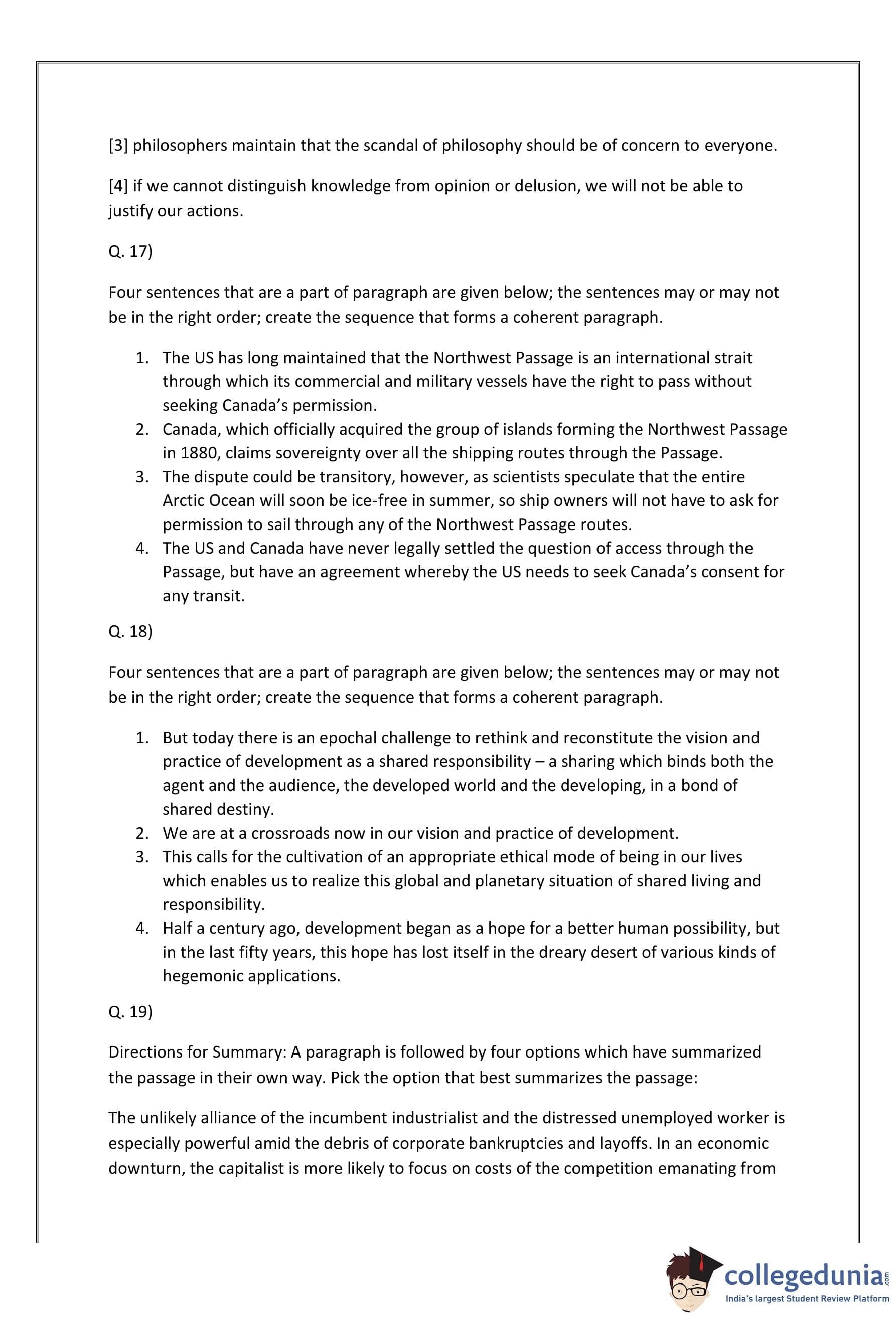
The author of the passage is most likely to support which one of the following statements?
View Solution
According to the last paragraph of the passage, "We hold our beliefs and presumptive knowledges more or less confidently, usually depending on" something. Which one of the following most broadly captures what we depend on?
View Solution
The author discusses all of the following arguments in the passage, EXCEPT:
View Solution
Four sentences that are a part of the paragraph are given below; the sentences may or may not be in the right order; create the sequence that forms a coherent paragraph.
1. The US has long maintained that the Northwest Passage is an international strait through which its commercial and military vessels have the right to pass without seeking Canada's permission.
2. Canada, which officially acquired the group of islands forming the Northwest Passage in 1880, claims sovereignty over all the shipping routes through the Passage.
3. The dispute could be transitory, however, as scientists speculate that the entire Arctic Ocean will soon be ice-free in summer, so ship owners will not have to ask for permission to sail through any of the Northwest Passage routes.
4. The US and Canada have never legally settled the question of access through the Passage, but have an agreement whereby the US needs to seek Canada's consent for any transit.
View Solution
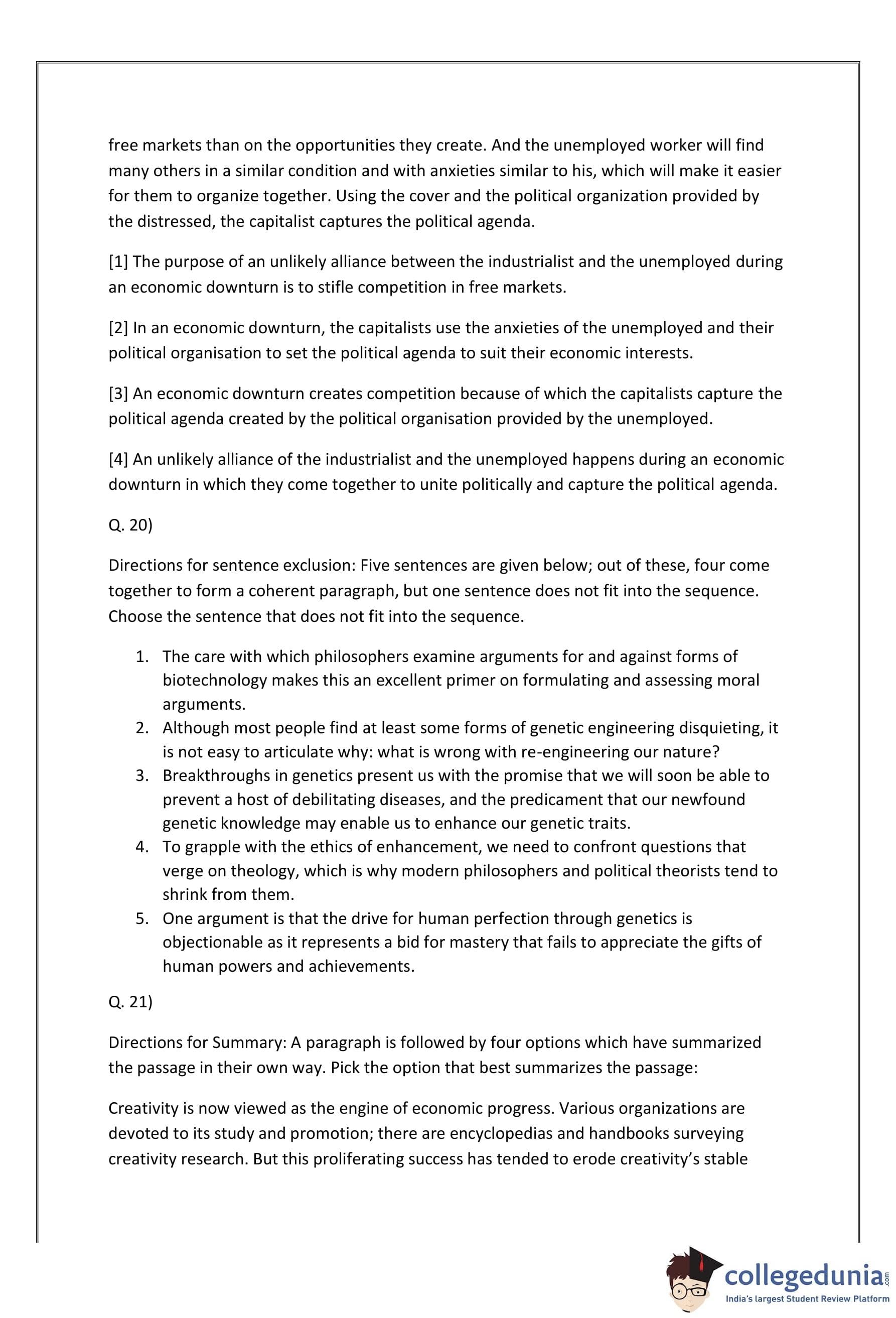
Four sentences that are a part of the paragraph are given below; the sentences may or may not be in the right order; create the sequence that forms a coherent paragraph.
1. But today there is an epochal challenge to rethink and reconstitute the vision and practice of development as a shared responsibility - a sharing which binds both the agent and the audience, the developed world and the developing, in a bond of shared destiny.
2. We are at a crossroads now in our vision and practice of development.
3. This calls for the cultivation of an appropriate ethical mode of being in our lives which enables us to realize this global and planetary situation of shared living and responsibility.
4. Half a century ago, development began as a hope for a better human possibility, but in the last fifty years, this hope has lost itself in the dreary desert of various kinds of hegemonic applications.
View Solution
Directions for Summary: A paragraph is followed by four options which have summarized the passage in their own way. Pick the option that best summarizes the passage:
The unlikely alliance of the incumbent industrialist and the distressed unemployed worker is especially powerful amid the debris of corporate bankruptcies and layoffs. In an economic downturn, the capitalist is more likely to focus on costs of the competition emanating from free markets than on the opportunities they create. And the unemployed worker will find many others in a similar condition and with anxieties similar to his, which will make it easier for them to organize together. Using the cover and the political organization provided by the distressed, the capitalist captures the political agenda.
View Solution
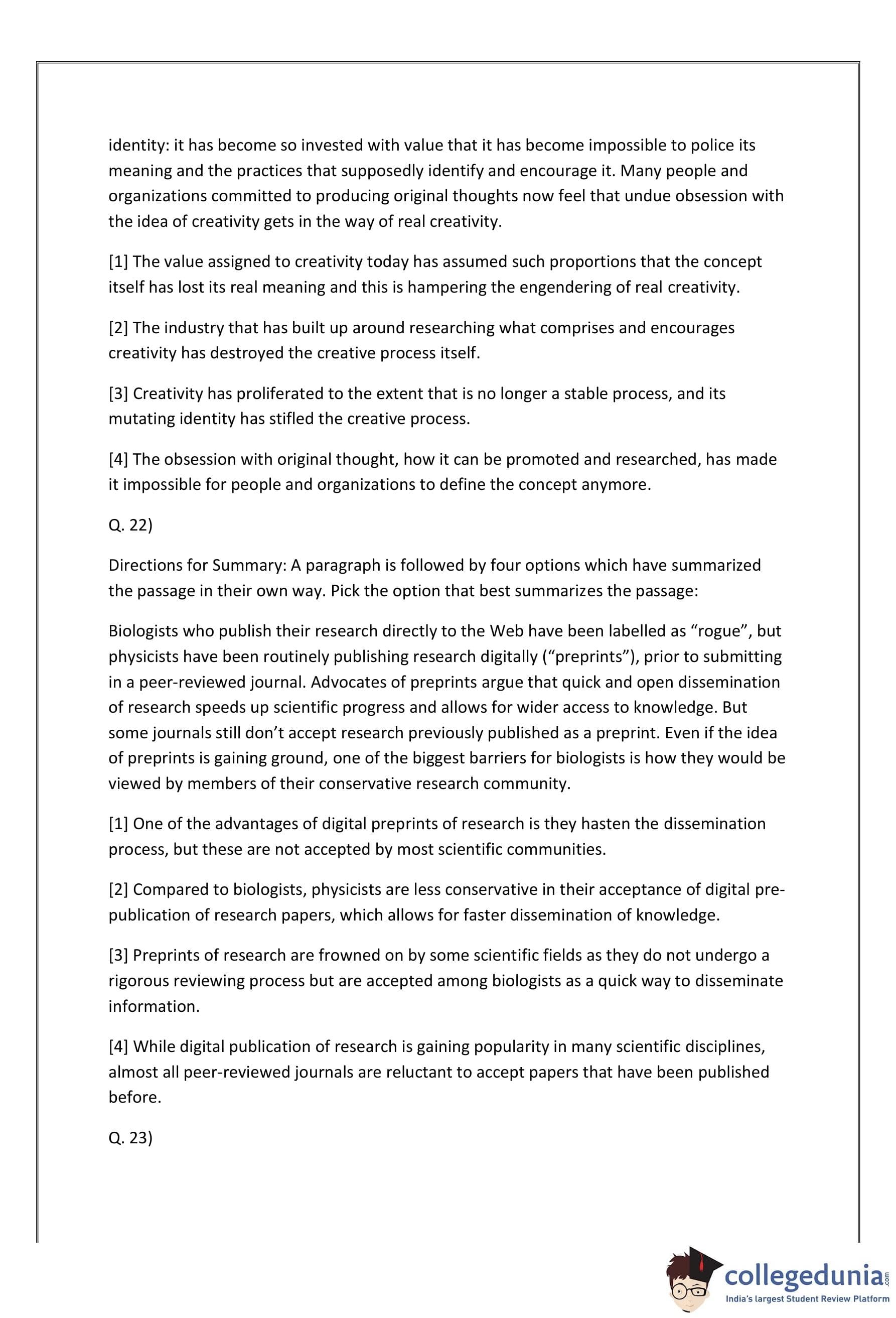
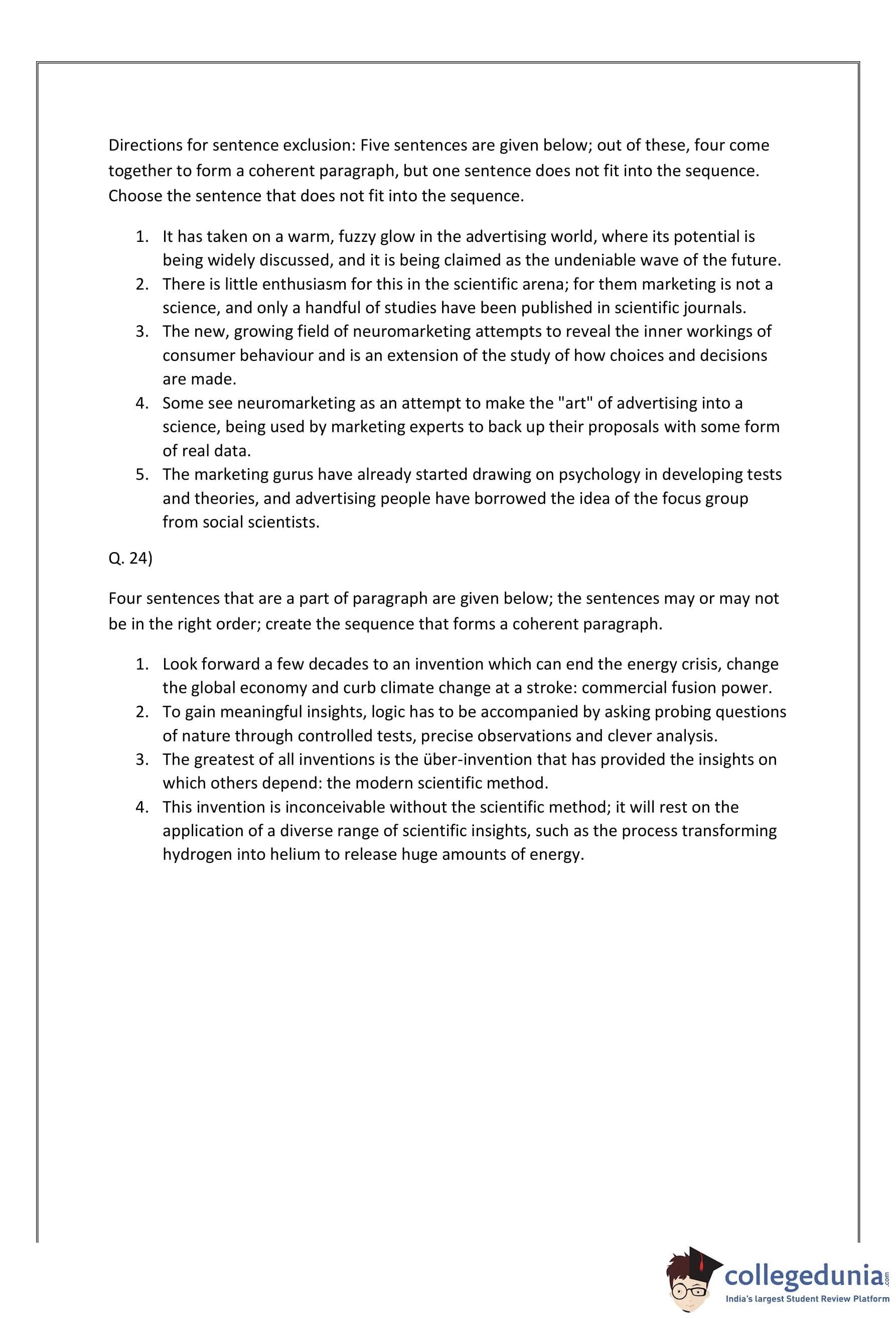
Directions for sentence exclusion: Five sentences are given below; out of these, four come together to form a coherent paragraph, but one sentence does not fit into the sequence. Choose the sentence that does not fit into the sequence.
1. The care with which philosophers examine arguments for and against forms of biotechnology makes this an excellent primer on formulating and assessing moral arguments.
2. Although most people find at least some forms of genetic engineering disquieting, it is not easy to articulate why: what is wrong with re-engineering our nature?
3. Breakthroughs in genetics present us with the promise that we will soon be able to prevent a host of debilitating diseases, and the predicament that our newfound genetic knowledge may enable us to enhance our genetic traits.
4. To grapple with the ethics of enhancement, we need to confront questions that verge on theology, which is why modern philosophers and political theorists tend to shrink from them.
5. One argument is that the drive for human perfection through genetics is objectionable as it represents a bid for mastery that fails to appreciate the gifts of human powers and achievements.
View Solution
Directions for Summary: A paragraph is followed by four options which have summarized the passage in their own way. Pick the option that best summarizes the passage:
Creativity is now viewed as the engine of economic progress. Various organizations are devoted to its study and promotion; there are encyclopedias and handbooks surveying creativity research. But this proliferating success has tended to erode creativity's stable identity: it has become so invested with value that it has become impossible to police its meaning and the practices that supposedly identify and encourage it. Many people and organizations committed to producing original thoughts now feel that undue obsession with the idea of creativity gets in the way of real creativity.
View Solution
Directions for Summary: A paragraph is followed by four options which have summarized the passage in their own way. Pick the option that best summarizes the passage:
Biologists who publish their research directly to the Web have been labelled as "rogue", but physicists have been routinely publishing research digitally ("preprints"), prior to submitting in a peer-reviewed journal. Advocates of preprints argue that quick and open dissemination of research speeds up scientific progress and allows for wider access to knowledge. But some journals still don't accept research previously published as a preprint. Even if the idea of preprints is gaining ground, one of the biggest barriers for biologists is how they would be viewed by members of their conservative research community.
View Solution
Directions for sentence exclusion: Five sentences are given below; out of these, four come together to form a coherent paragraph, but one sentence does not fit into the sequence. Choose the sentence that does not fit into the sequence:
1. It has taken on a warm, fuzzy glow in the advertising world, where its potential is being widely discussed, and it is being claimed as the undeniable wave of the future.
2. There is little enthusiasm for this in the scientific arena; for them marketing is not a science, and only a handful of studies have been published in scientific journals.
3. The new, growing field of neuromarketing attempts to reveal the inner workings of consumer behaviour and is an extension of the study of how choices and decisions are made.
4. Some see neuromarketing as an attempt to make the "art" of advertising into a science, being used by marketing experts to back up their proposals with some form of real data.
5. The marketing gurus have already started drawing on psychology in developing tests and theories, and advertising people have borrowed the idea of the focus group from social scientists.
View Solution
Four sentences that are a part of paragraph are given below; the sentences may or may not be in the right order; create the sequence that forms a coherent paragraph:
1. Look forward a few decades to an invention which can end the energy crisis, change the global economy and curb climate change at a stroke: commercial fusion power.
2. To gain meaningful insights, logic has to be accompanied by asking probing questions of nature through controlled tests, precise observations and clever analysis.
3. The greatest of all inventions is the über-invention that has provided the insights on which others depend: the modern scientific method.
4. This invention is inconceivable without the scientific method; it will rest on the application of a diverse range of scientific insights, such as the process transforming hydrogen into helium to release huge amounts of energy.
CAT 2021 Question Paper VARC Slot 2: Sectional Analysis
CAT 2021 question paper for VARC slot 2 was difficult compared to the slot 1 paper. The questions were more time-consuming and lengthy.
- The RC section accounted for 66% of questions in VARC.
- In CAT 2021 VARC slot 2, RC passages were related to Nationalism, Philosophy, Knowledge, and Language. The word count of each passage was nearly 500.
- The summary-based and odd-one out questions were easy to attempt
Tabulated below is the distribution of questions as per the sections in CAT 2021 VARC slot 2:
| Sections | Number of MCQs and Non-MCQs | Difficulty Level |
|---|---|---|
| Reading Comprehension | 16 | Moderate |
| Para Jumbles | 3 | Easy |
| Summary | 3 | Easy |
| Odd Sentence Out | 2 | Easy |
Quick Links:
CAT Question Papers of Other Years
| CAT 2024 Question Papers | CAT 2023 Question Papers |
| CAT 2022 Question Papers | CAT 2020 Question Papers |
| CAT 2019 Question Papers | CAT 2018 Question Papers |
| CAT 2017 Question Papers | CAT 2016 Question Papers |



Comments