




CAT 2022 Slot 1 VARC Question Paper with Solutions PDF is available for download. CAT 2022 VARC slot 1 was rated easy to moderate with 4 RC passages carrying 4 questions each. CAT 2022 slot 1 question paper for VARC carried 21 MCQs and 3 TITA questions. Download CAT 2022 Slot 1 Question Paper with Answer Key PDF for VARC from the links provided below.
Candidates preparing for CAT 2025 can download the CAT VARC question paper with the answer key PDF for the Slot 1 exam conducted on November 28, 2022, to get a better idea about the type of questions asked in the paper and the difficulty level of questions.
Also Check:
CAT 2022 VARC slot 1 Question Paper with Solutions PDF
| CAT 2022 VARC Slot 1 Question Paper with Answer Key | Download PDF | Check Solutions |
Comprehension: The passage below is accompanied by a set of questions. Choose the best answer to each question. The Chinese have two different concepts of a copy. Fangzhipin. . . are imitations where the difference from the original is obvious. These are small models or copies that can be purchased in a museum shop, for example.
Read More
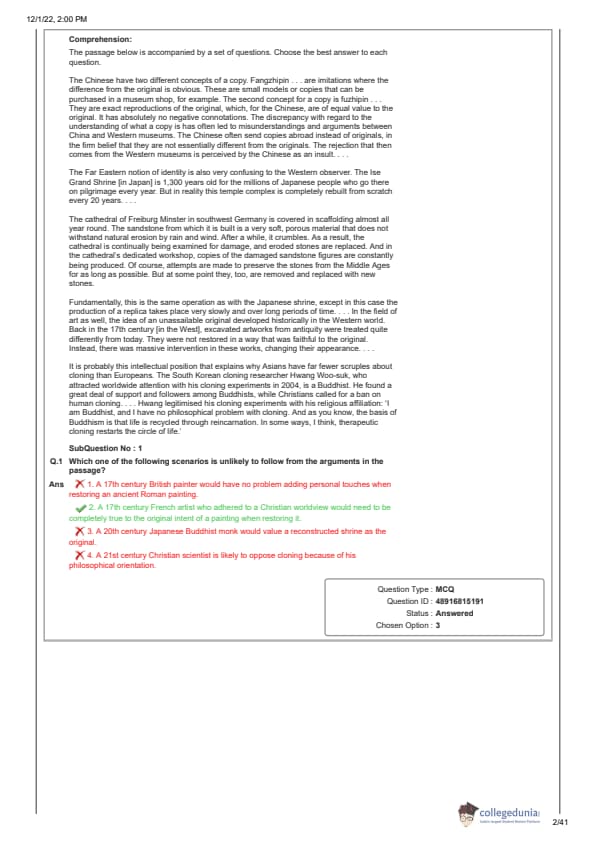
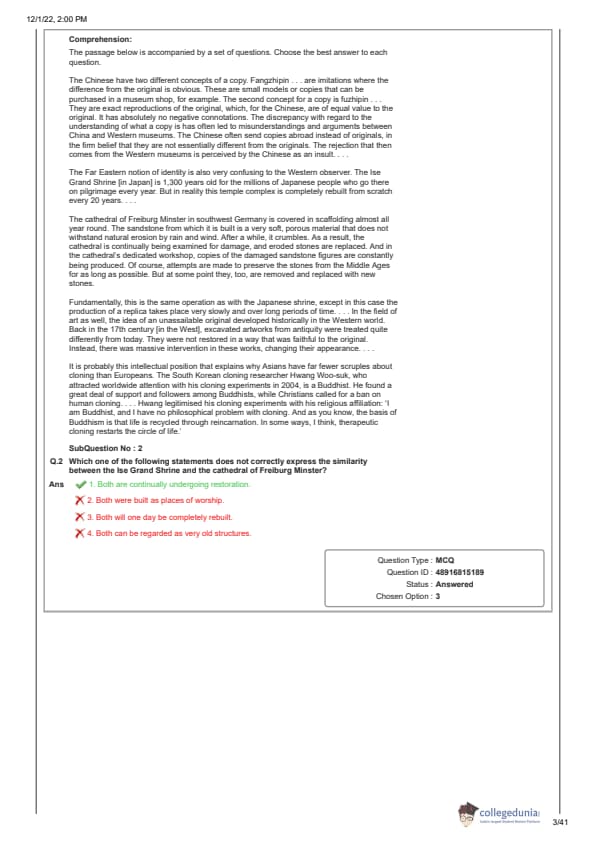
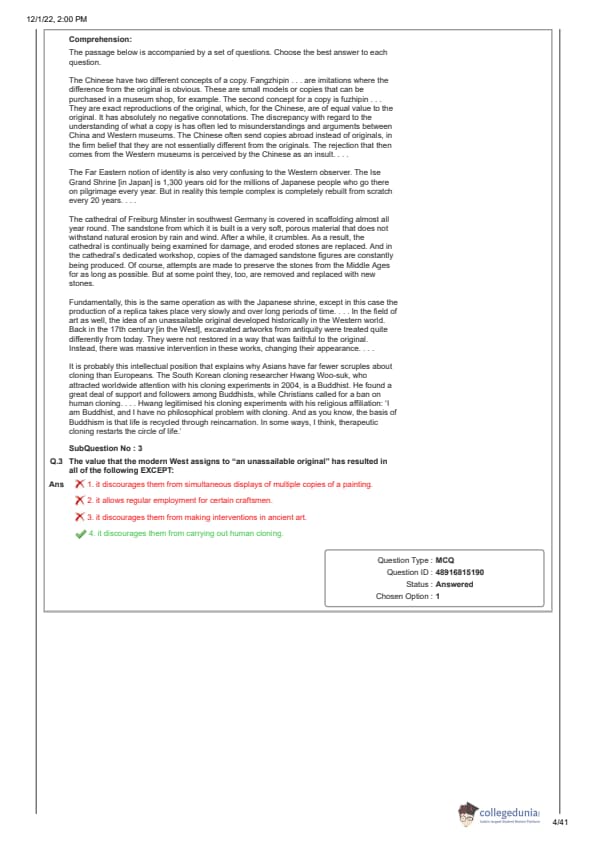
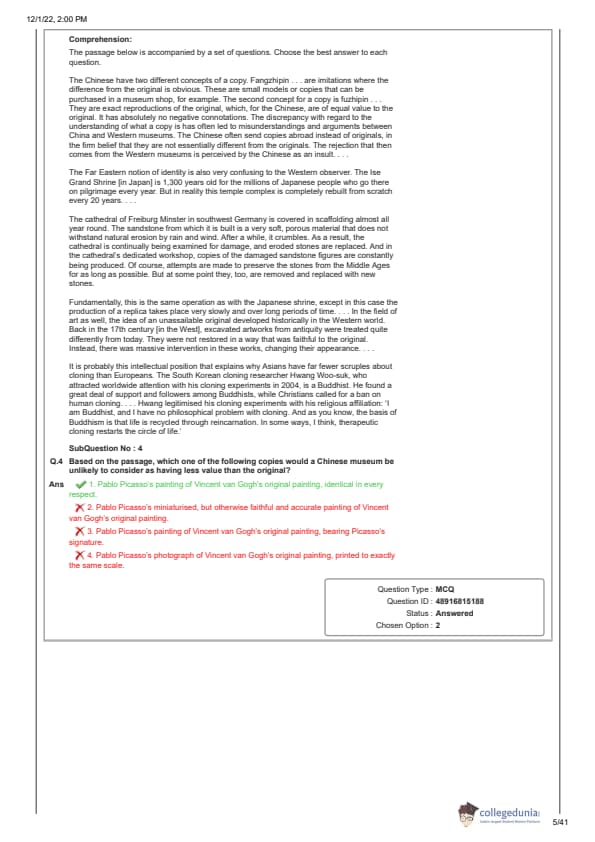
The second concept for a copy is fuzhipin. . . They are exact reproductions of the original, which, for the Chinese, are of equal value to the original. It has absolutely no negative connotations. The discrepancy with regard to the understanding of what a copy is has often led to misunderstandings and arguments between China and Western museums. The Chinese often send copies abroad instead of originals, in the firm belief that they are not essentially different from the originals. The rejection that then comes from the Western museums is perceived by the Chinese as an insult. . . The Far Eastern notion of identity is also very confusing to the Western observer. The Ise Grand Shrine [in Japan] is 1,300 years old for the millions of Japanese people who go there on pilgrimage every year. But in reality this temple complex is completely rebuilt from scratch every 20 years. . . The cathedral of Freiburg Minster in southwest Germany is covered in scaffolding almost all year round. The sandstone from which it is built is a very soft, porous material that does not withstand natural erosion by rain and wind. After a while, it crumbles. As a result, the cathedral is continually being examined for damage, and eroded stones are replaced. And in the cathedral’s dedicated workshop, copies of the damaged sandstone figures are constantly being produced. Of course, attempts are made to preserve the stones from the Middle Ages for as long as possible. But at some point, they too, are removed and replaced with new stones. Fundamentally, this is the same operation as with the Japanese shrine, except in this case the production of a replica takes place very slowly and over long periods of time. . . In the field of art as well, the idea of an unassailable original developed historically in the Western world. Back in the 17th century [in the West], excavated artworks from antiquity were treated quite differently from today. They were not restored in a way that was faithful to the original. Instead, there was massive intervention in these works, changing their appearance. . . It is probably this intellectual position that explains why Asians have far fewer scruples 2 about cloning than Europeans. The South Korean cloning researcher Hwang Woo-suk, who attracted worldwide attention with his cloning experiments in 2004, is a Buddhist. He found a great deal of support and followers among Buddhists, while Christians called for a ban on human cloning. . . Hwang legitimised his cloning experiments with his religious affiliation: “I am Buddhist, and I have no philosophical problem with cloning. And as you know, the basis of Buddhism is that life is recycled through reincarnation. In some ways, I think, therapeutic cloning restarts the circle of life.”Question 1:
Which one of the following scenarios is unlikely to follow from the arguments in the passage?
(1) A 17th century British painter would have no problem adding personal touches when
restoring an ancient Roman painting.
(2) A 17th century French artist who adhered to a Christian worldview would need to be
completely true to the original intent of a painting when restoring it.
(3) A 20th century Japanese Buddhist monk would value a reconstructed shrine as the
original.
(4) A 21st century Christian scientist is likely to oppose cloning because of his philosophical
orientation.
View Solution
Which one of the following statements does not correctly express the similarity between the Ise Grand Shrine and the cathedral of Freiburg Minster?
(1) Both are continually undergoing restoration.
(2) Both were built as places of worship.
(3) Both will one day be completely rebuilt.
(4) Both can be regarded as very old structures.
View Solution
The value that the modern West assigns to “an unassailable original” has resulted in all of the following EXCEPT:
(1) it discourages them from simultaneous displays of multiple copies of a painting.
(2) it allows regular employment for certain craftsmen.
(3) it discourages them from making interventions in ancient art.
(4) it discourages them from carrying out human cloning.
View Solution
Based on the passage, which one of the following copies would a Chinese museum be unlikely to consider as having less value than the original?
(1) Pablo Picasso’s painting of Vincent van Gogh’s original painting, identical in every
respect.
(2) Pablo Picasso’s miniaturised, but otherwise faithful and accurate painting of Vincent van
Gogh’s original painting.
(3) Pablo Picasso’s painting of Vincent van Gogh’s original painting, bearing Picasso’s
signature.
(4) Pablo Picasso’s photograph of Vincent van Gogh’s original painting, printed to exactly the
same scale.
View Solution
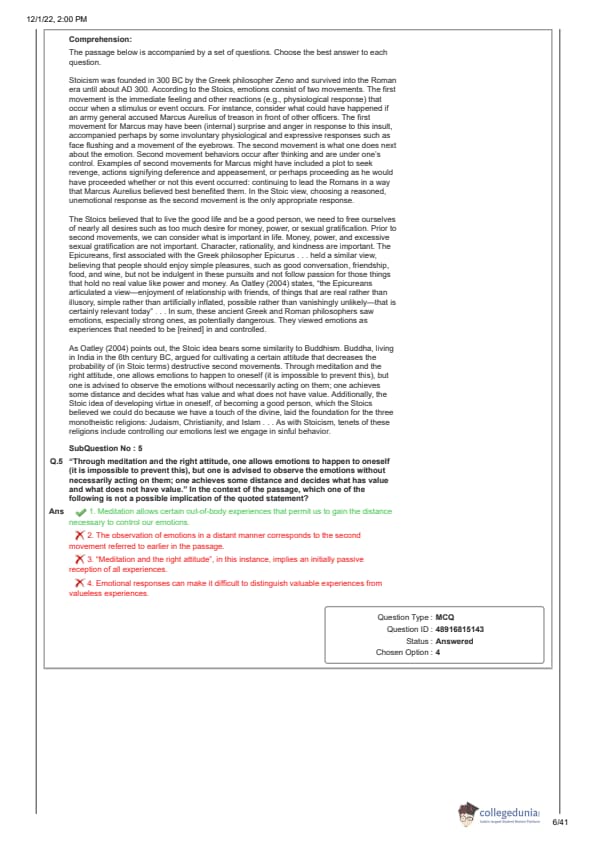
(1) Meditation allows certain out-of-body experiences that permit us to gain the distance
necessary to control our emotions.
(2) The observation of emotions in a distant manner corresponds to the second movement
referred to earlier in the passage.
(3) “Meditation and the right attitude”, in this instance, implies an initially passive reception
of all experiences.
(4) Emotional responses can make it difficult to distinguish valuable experiences from
valueless experiences.
View Solution
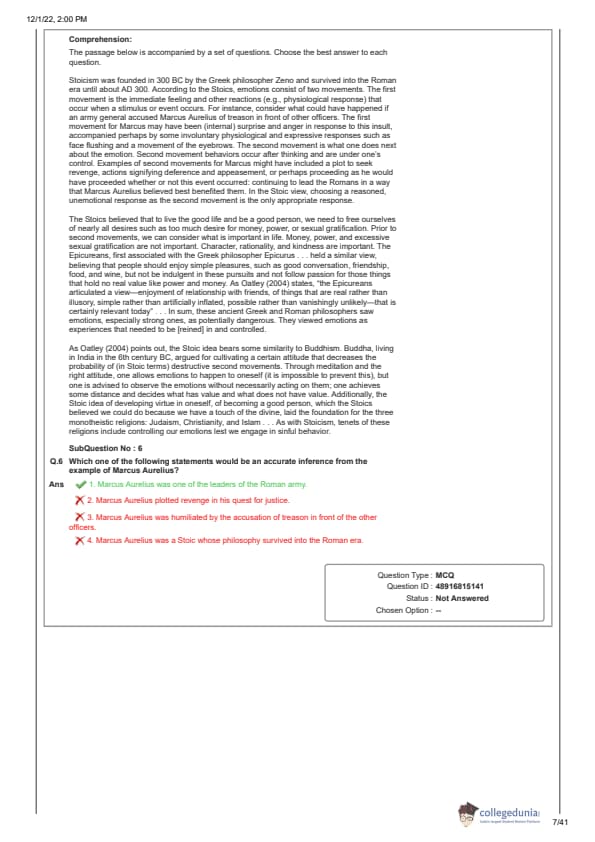
Which one of the following statements would be an accurate inference from the example of Marcus Aurelius?
(1) Marcus Aurelius was one of the leaders of the Roman army.
(2) Marcus Aurelius plotted revenge in his quest for justice.
(3) Marcus Aurelius was humiliated by the accusation of treason in front of the other officers.
(4) Marcus Aurelius was a Stoic whose philosophy survived into the Roman era.
View Solution
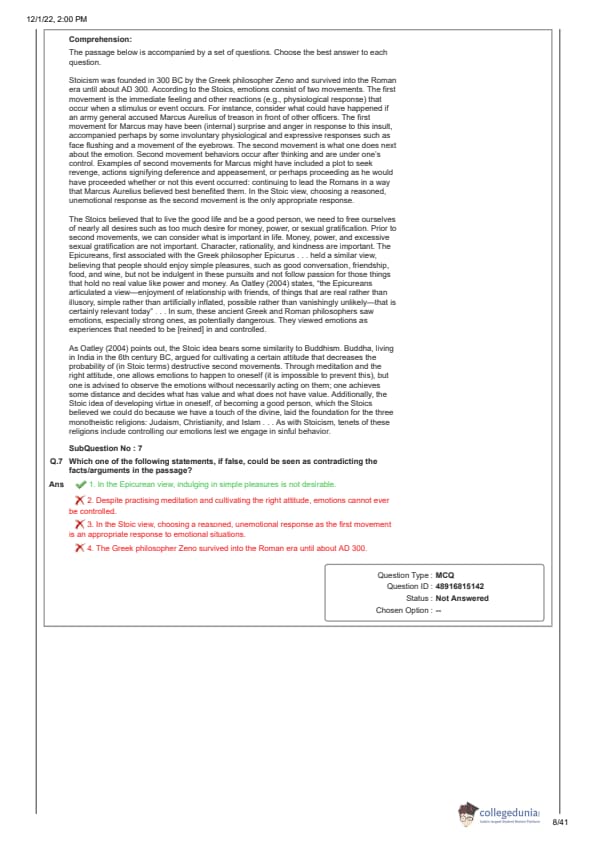
Which one of the following statements, if false, could be seen as contradicting the facts/arguments in the passage?
(1) In the Epicurean view, indulging in simple pleasures is not desirable.
(2) Despite practicing meditation and cultivating the right attitude, emotions cannot ever be
controlled.
(3) In the Stoic view, choosing a reasoned, unemotional response as the first movement is an
appropriate response to emotional situations.
(4) The Greek philosopher Zeno survived into the Roman era until about AD 300.
View Solution
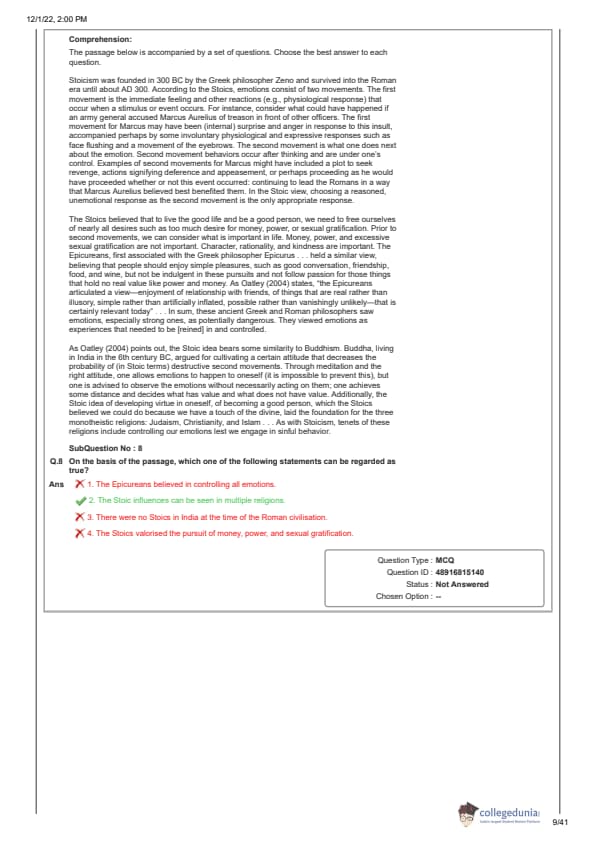
On the basis of the passage, which one of the following statements can be regarded as true?
(1) The Epicureans believed in controlling all emotions.
(2) The Stoic influences can be seen in multiple religions.
(3) There were no Stoics in India at the time of the Roman civilisation.
(4) The Stoics valorised the pursuit of money, power, and sexual gratification.
View Solution
Read More
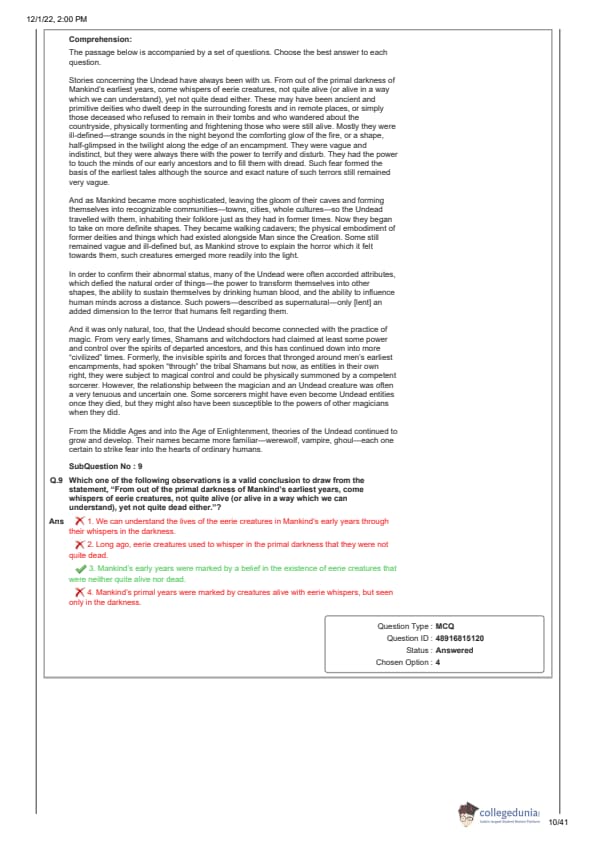
These may have been ancient and primitive deities who dwelt deep in the surrounding forests and in remote places, or simply those deceased who refused to remain in their tombs and who wandered about the countryside, physically tormenting and frightening those who were still alive. Mostly they were ill-defined—strange sounds in the night beyond the comforting glow of the fire, or a shape, half-glimpsed in the twilight along the edge of an encampment. They were vague and indistinct, but they were always there with the power to terrify and disturb. They had the power to touch the minds of our early ancestors and to fill them with dread. Such fear formed the basis of the earliest tales although the source and exact nature of such terrors still remained very vague. And as Mankind became more sophisticated, leaving the gloom of their caves and forming themselves into recognizable communities—towns, cities, whole cultures—so the Undead travelled with them, inhabiting their folklore just as they had in former times. Now they began to take on more definite shapes. They became walking cadavers; the physical embodiment of former deities and things which had existed alongside Man since the Creation. Some still remained vague and ill-defined but, as Mankind strove to explain the horror which it felt towards them, such creatures emerged more readily into the light. In order to confirm their abnormal status, many of the Undead were often accorded attributes, which defied the natural order of things—the power to transform themselves into other shapes, the ability to sustain themselves by drinking human blood, and the ability to influence human minds across a distance. Such powers—described as supernatural—only [lent] an added dimension to the terror that humans felt regarding them. And it was only natural, too, that the Undead should become connected with the practice of magic. From very early times, Shamans and witchdoctors had claimed at least some power and control over the spirits of departed ancestors, and this has continued down to more “civilized” times. Formerly, the invisible spirits and forces that thronged around men’s earliest encampments, had spoken “through” the tribal Shamans but now, as entities in their own right, they were subject to magical control and could be physically summoned by a competent sorcerer. However, the relationship between the magician and an Undead creature was often a very tenuous and uncertain one. Some sorcerers might have even become Undead entities once they died, but they might also have been susceptible to the powers of other magicians when they did. From the Middle Ages and into the Age of Enlightenment, theories of the Undead continued to grow and develop. Their names become more familiar—werewolf, vampire, ghoul—each one certain to strike fear into the hearts of ordinary humansWhich one of the following observations is a valid conclusion to draw from the statement, ``From out of the primal darkness of Mankind's earliest years, come whispers of eerie creatures, not quite alive (or alive in a way which we can understand), yet not quite dead either.''?
1. We can understand the lives of the eerie creatures in Mankind’s early years through their
whispers in the darkness.
2. Long ago, eerie creatures used to whisper in the primal darkness that they were not quite
dead.
3. Mankind’s early years were marked by a belief in the existence of eerie creatures that
were neither quite alive nor dead.
4. Mankind’s primal years were marked by creatures alive with eerie whispers, but seen only
in the darkness.
View Solution
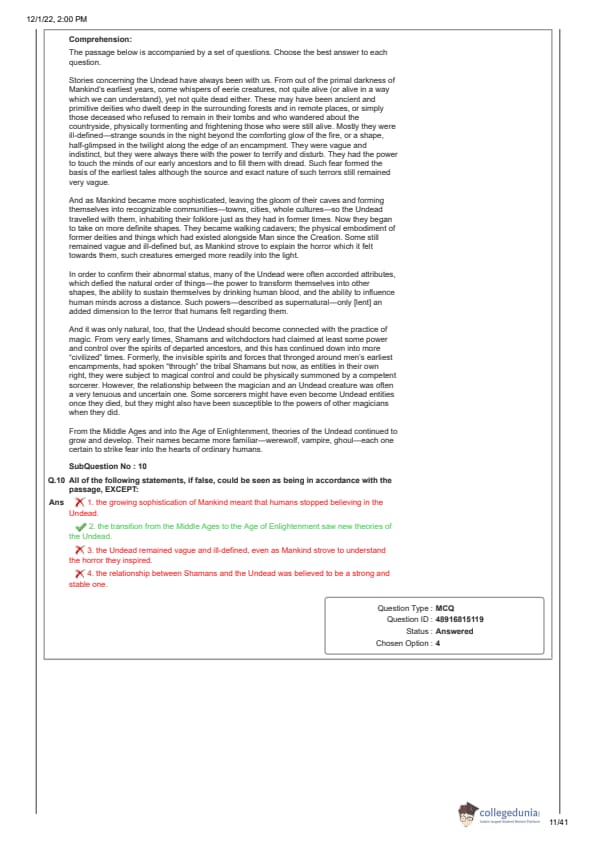
All of the following statements, if false, could be seen as being in accordance with the passage, EXCEPT:
1. The growing sophistication of Mankind meant that humans stopped believing in the
Undead.
2. The transition from the Middle Ages to the Age of Enlightenment saw new theories of the
Undead.
3. The Undead remained vague and ill-defined, even as Mankind strove to understand the
horror they inspired.
4. The relationship between Shamans and the Undead was believed to be a strong and stable
one.
View Solution
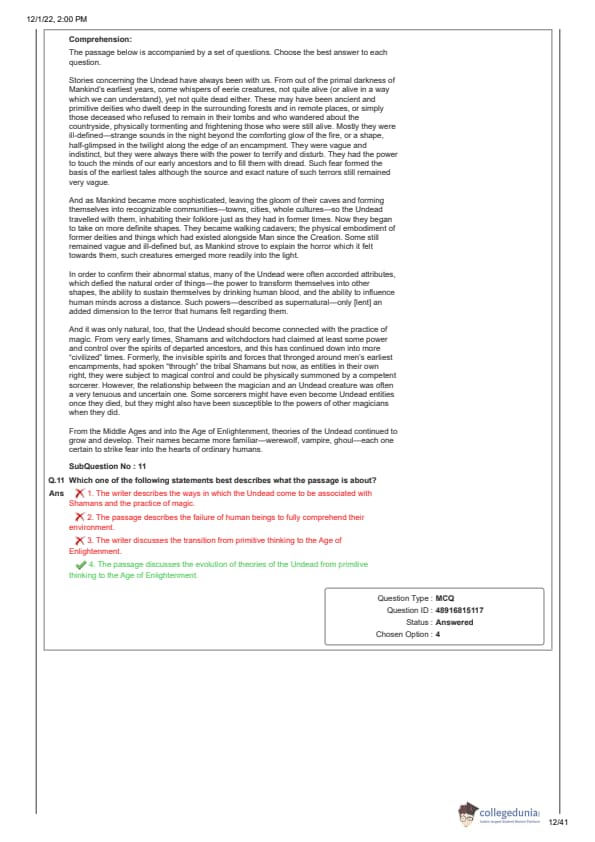
Which one of the following statements best describes what the passage is about?
1. The writer describes the ways in which the Undead come to be associated with Shamans
and the practice of magic.
2. The passage describes the failure of human beings to fully comprehend their environment.
3. The writer discusses the transition from primitive thinking to the Age of Enlightenment.
4. The passage discusses the evolution of theories of the Undead from primitive thinking to
the Age of Enlightenment.
View Solution
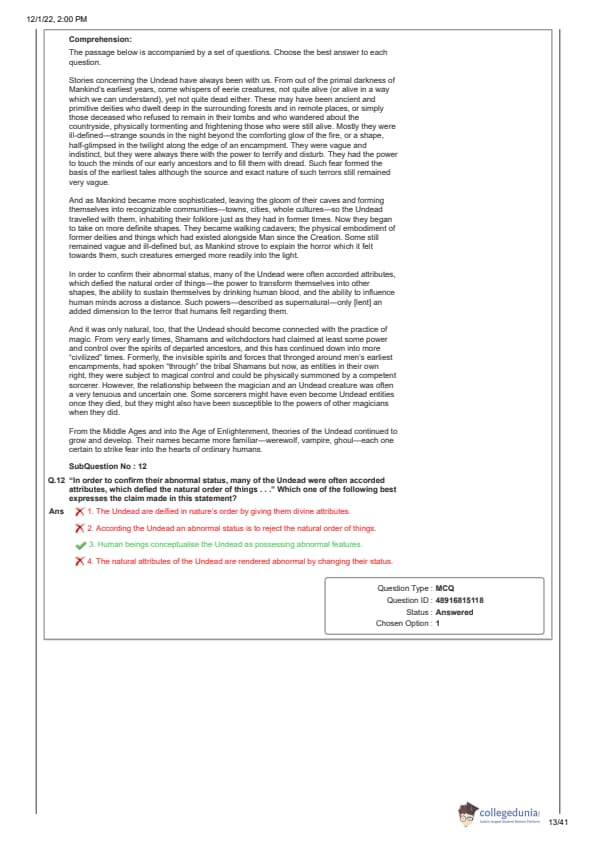
“In order to confirm their abnormal status, many of the Undead were often accorded attributes, which defied the natural order of things . . .” Which one of the following best expresses the claim made in this statement?
1. The Undead are deified in nature’s order by giving them divine attributes.
2. According the Undead an abnormal status is to reject the natural order of things.
3. Human beings conceptualise the Undead as possessing abnormal features.
4. The natural attributes of the Undead are rendered abnormal by changing their status.
View Solution
Read More
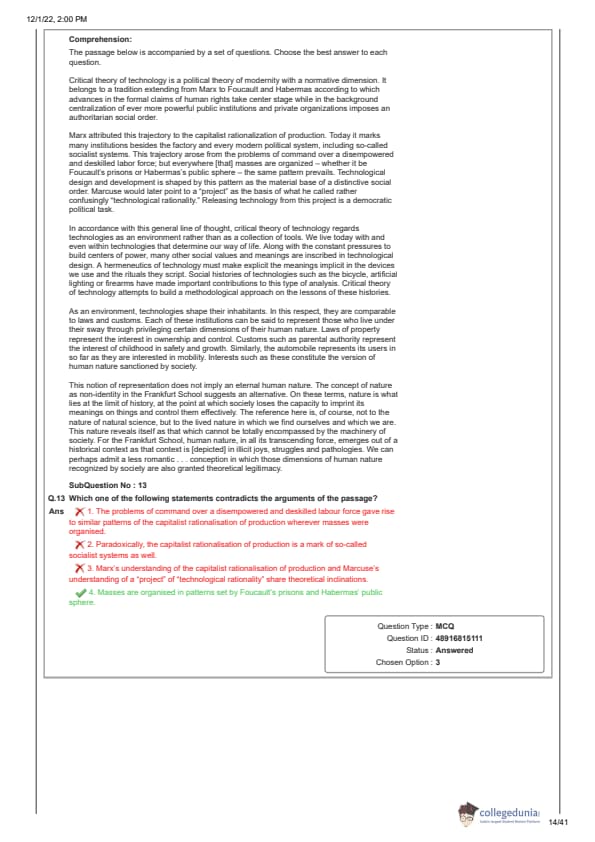
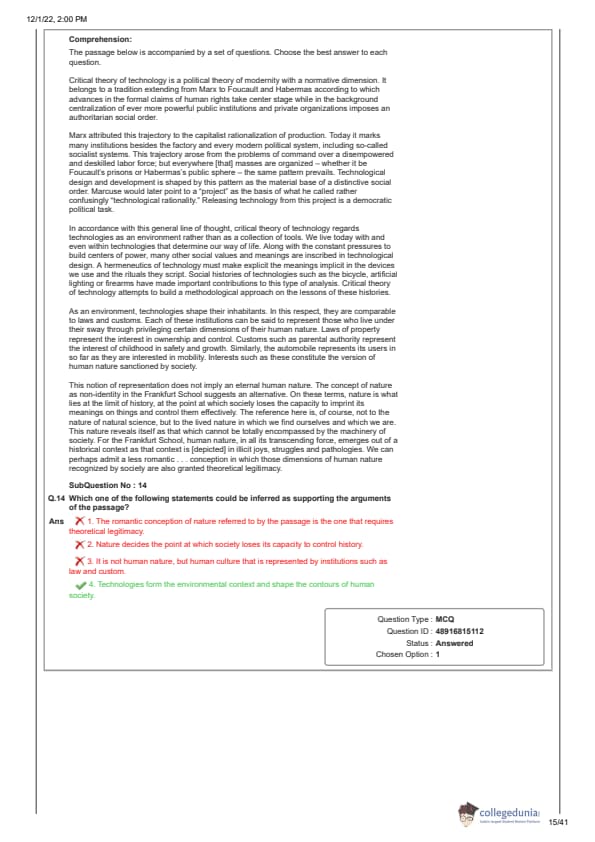
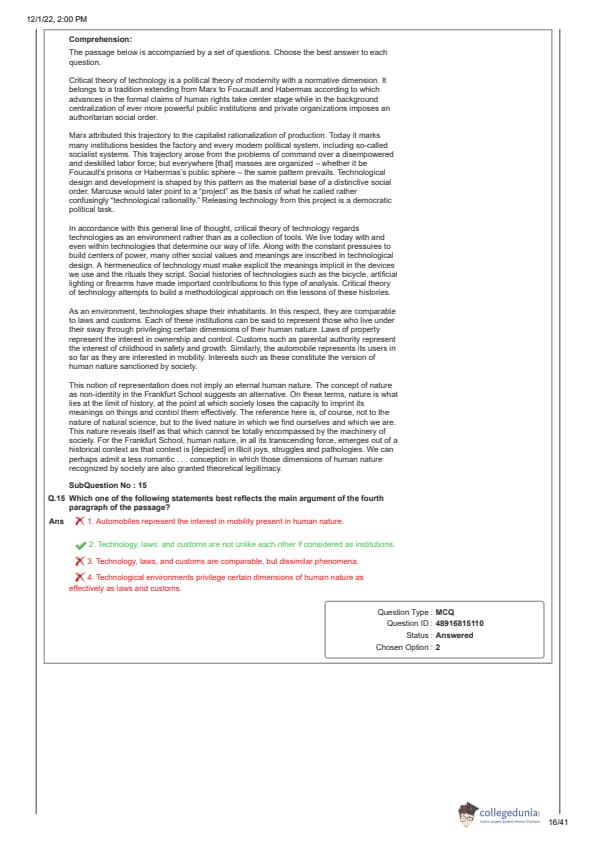
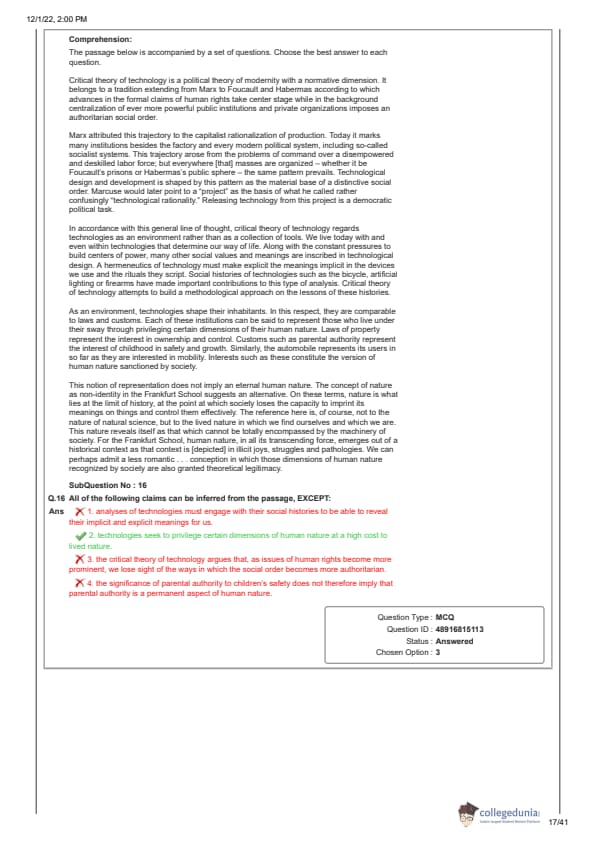
Marx attributed this trajectory to the capitalist rationalization of production. Today it marks many institutions besides the factory and every modern political system, including so-called socialist systems. This trajectory arose from the problems of command over a disempowered and deskilled labor force; but everywhere that masses are organized – whether it be Foucault’s prisons or Habermas’s public sphere – the same pattern prevails. Technological design and development is shaped by this pattern as the material base of a distinctive social order. Marcuse would later point to a “project” as the basis of what he called rather confusingly “technological rationality.” Releasing technology from this project is a democratic political task. In accordance with this general line of thought, critical theory of technology regards technologies as an environment rather than as a collection of tools. We live today with and even within technologies that determine our way of life. Along with the constant pressures to build centers of power, many other social values and meanings are inscribed in technological design. A hermeneutics of technology must make explicit the meanings implicit in the devices we use and the rituals they script. Social histories of technologies such as the bicycle, artificial lighting or firearms have made important contributions to this type of analysis. Critical theory of technology attempts to build a methodological approach on the lessons of these histories. As an environment, technologies shape their inhabitants. In this respect, they are comparable to laws and customs. Each of these institutions can be said to represent those who live under their sway through privileging certain dimensions of their human nature. Laws of property represent the interest in ownership and control. Customs such as parental authority represent the interest of childhood in safety and growth. Similarly, the automobile represents its users in so far as they are interested in mobility. Interests such as these constitute the version of human nature sanctioned by society. This notion of representation does not imply an eternal human nature. The concept of nature as non-identity in the Frankfurt School suggests an alternative. On these terms, nature is what lies at the limit of history, at the point at which society loses the capacity to imprint its meanings on things and control them effectively. The reference here is, of course, not to the nature of natural science, but to the lived nature in which we find ourselves and which we are. This nature reveals itself as that which cannot be totally encompassed by the machinery of society. For the Frankfurt School, human nature, in all its transcending force, emerges out 20 of a historical context that cannot be [depicted] in illicit joys, struggles and pathologies. We can perhaps admit a less romantic . . . conception in which those dimensions of human nature recognized by society are also granted theoretical legitimacy.Which one of the following statements contradicts the arguments of the passage?
1. The problems of command over a disempowered and deskilled labour force gave rise to
similar patterns of the capitalist rationalisation of production wherever masses were
organised.
2. Paradoxically, the capitalist rationalisation of production is a mark of so-called socialist
systems as well.
3. Marx’s understanding of the capitalist rationalisation of production and Marcuse’s
understanding of a “project” of “technological rationality” share theoretical inclinations.
4. Masses are organised in patterns set by Foucault’s prisons and Habermas’s public sphere.
View Solution
Which one of the following statements could be inferred as supporting the arguments of the passage?
1. The romantic conception of nature referred to by the passage is the one that requires
theoretical legitimacy.
2. Nature decides the point at which society loses its capacity to control history.
3. It is not human nature, but human culture that is represented by institutions such as law
and custom.
4. Technologies form the environmental context and shape the contours of human society.
View Solution
Which one of the following statements best reflects the main argument of the fourth paragraph of the passage?
1. Automobiles represent the interest in mobility present in human nature.
2. Technology, laws, and customs are not unlike each other if considered as institutions.
3. Technology, laws, and customs are comparable, but dissimilar phenomena.
4. Technological environments privilege certain dimensions of human nature as effectively
as laws and customs
View Solution
All of the following claims can be inferred from the passage, EXCEPT:
1. Analyses of technologies must engage with their social histories to be able to reveal their
implicit and explicit meanings for us.
2. Technologies seek to privilege certain dimensions of human nature at a high cost to lived
nature.
3. The critical theory of technology argues that, as issues of human rights become more
prominent, we lose sight of the ways in which the social order becomes more authoritarian.
4. The significance of parental authority to children’s safety does not therefore imply that
parental authority is a permanent aspect of human nature.
View Solution
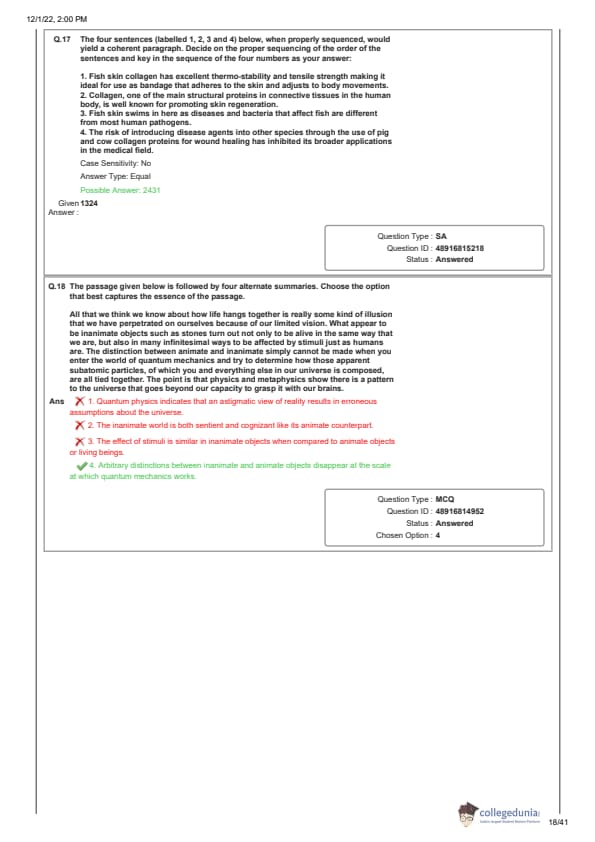
The four sentences (labelled 1, 2, 3 and 4) below, when properly sequenced, would yield a coherent paragraph. Decide on the proper sequencing of the order of the sentences and key in the sequence of the four numbers as your answer:
1. Fish skin collagen has excellent thermo-stability and tensile strength making it ideal for
use as bandage that adheres to the skin and adjusts to body movements.
2. Collagen, one of the main structural proteins in connective tissues in the human body, is
well known for promoting skin regeneration.
3. Fish skin swims in here as diseases and bacteria that affect fish are different from most
human pathogens.
4. The risk of introducing disease agents into other species through the use of pig and cow
collagen proteins for wound healing has inhibited its broader applications in the medical
field.
View Solution
The passage given below is followed by four alternate summaries. Choose the option that best captures the essence of the passage.
All that we think we know about how life hangs together is really some kind of illusion that we have perpetrated on ourselves because of our limited vision. What appear to be inanimate objects such as stones turn out not only to be alive in the same way that we are, but also in many infinitesimal ways to be affected by stimuli just as humans are. The distinction between animate and inanimate simply cannot be made when you enter the world of quantum mechanics and try to determine how those apparent subatomic particles, of which you and everything else in our universe is composed, are all tied together. The point is that physics and metaphysics show there is a pattern to the universe that goes beyond our capacity to grasp it with our brains.
1. Quantum physics indicates that an astigmatic view of reality results in erroneous
assumptions about the universe.
2. The inanimate world is both sentient and cognizant like its animate counterpart.
3. The effect of stimuli is similar in inanimate objects when compared to animate objects or
living beings.
4. Arbitrary distinctions between inanimate and animate objects disappear at the scale at
which quantum mechanics works.
View Solution
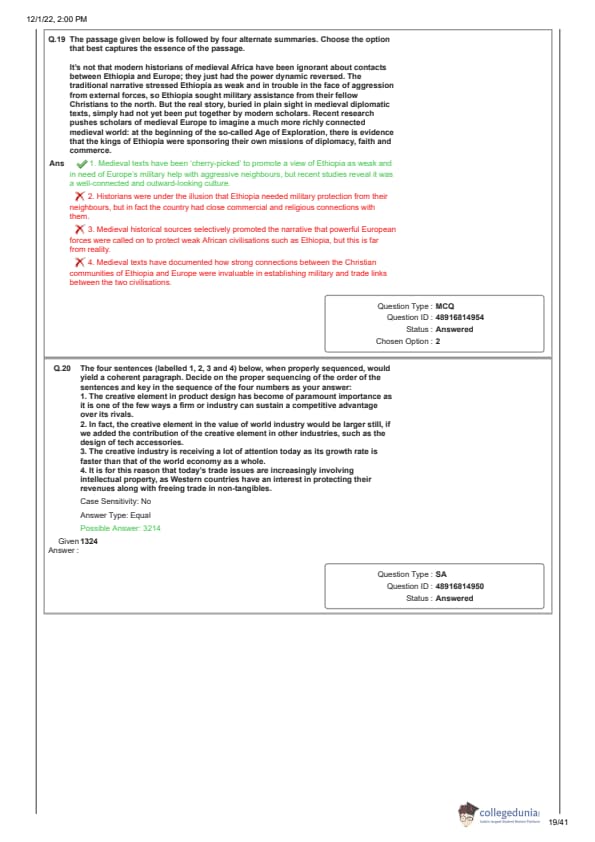
The passage given below is followed by four alternate summaries. Choose the option that best captures the essence of the passage.
It’s not that modern historians of medieval Africa have been ignorant about contacts between Ethiopia and Europe; they just had the power dynamic reversed. The traditional narrative stressed Ethiopia as weak and in trouble in the face of aggression from external forces, so Ethiopia sought military assistance from their fellow Christians to the north. But the real story, buried in plain sight in medieval diplomatic texts, simply had not yet been put together by modern scholars. Recent research pushes scholars of medieval Europe to imagine a much more richly connected medieval world: at the beginning of the so-called Age of Exploration, there is evidence that the kings of Ethiopia were sponsoring their own missions of diplomacy, faith and commerce.
1. Medieval texts have been ‘cherry-picked’ to promote a view of Ethiopia as weak and in
need of Europe’s military help with aggressive neighbours, but recent studies reveal it was a
well-connected and outward-looking culture.
2. Historians were under the illusion that Ethiopia needed military protection from their
neighbours, but in fact the country had close commercial and religious connections with
Europe.
3. Medieval historical sources selectively promoted the narrative that powerful European
forces were called on to protect weak African civilisations such as Ethiopia, but this is far
from reality.
4. Medieval texts have documented how strong connections between the Christian
communities of Ethiopia and Europe were invaluable in establishing military and trade links
between the two civilisations
View Solution
The four sentences (labelled 1, 2, 3 and 4) below, when properly sequenced, would yield a coherent paragraph. Decide on the proper sequencing of the order of the sentences and key in the sequence of the four numbers as your answer:
1. The creative element in product design has become of paramount importance as it is one
of the few ways a firm or industry can sustain a competitive advantage over its rivals.
2. In fact, the creative element in the value of world industry would be larger still, if we
added the contribution of the creative element in other industries, such as the design of tech
accessories.
3. The creative industry is receiving a lot of attention today as its growth rate is faster than
that of the world economy as a whole.
4. It is for this reason that today’s trade issues are increasingly involving intellectual
property, as Western countries have an interest in protecting their revenues along with freeing
trade in non-tangibles.
View Solution
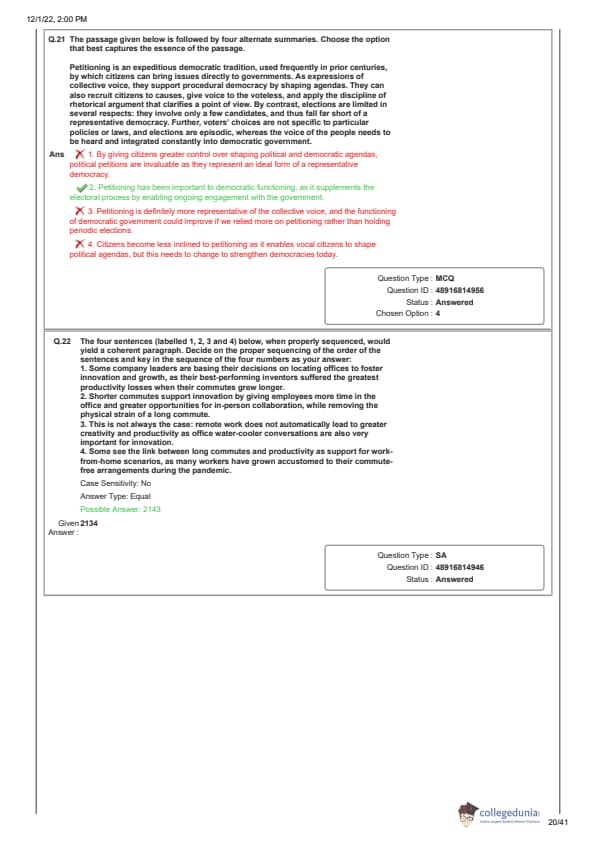
The passage given below is followed by four alternate summaries. Choose the option that best captures the essence of the passage.
Petitioning is an expeditious democratic tradition, used frequently in prior centuries, by which citizens can bring issues directly to governments. As expressions of collective voice, they support procedural democracy by shaping agendas. They can also recruit citizens to causes, give voice to the voiceless, and apply the discipline of rhetorical argument that clarifies a point of view. By contrast, elections are limited in several respects: they involve only a few candidates, and thus fall short of a representative democracy. Further, voters’ choices are not specific to particular policies or laws, and elections are episodic, whereas the voice of the people needs to be heard and integrated constantly into democratic government.
1. By giving citizens greater control over shaping political and democratic agendas, political
petitions are invaluable as they represent an ideal form of a representative democracy.
2. Petitioning has been important to democratic functioning, as it supplements the electoral
process by enabling ongoing engagement with the government.
3. Petitioning is definitely more representative of the collective voice, and the functioning of
democratic government could improve if we relied more on petitioning rather than holding
periodic elections.
4. Citizens become less inclined to petitioning as it enables vocal citizens to shape political
agendas, but this needs to change to strengthen democracies today.
View Solution
The four sentences (labelled 1, 2, 3 and 4) below, when properly sequenced, would yield a coherent paragraph. Decide on the proper sequencing of the order of the sentences and key in the sequence of the four numbers as your answer:
1. Some company leaders are basing their decisions on locating offices to foster innovation
and growth, as their best-performing inventors suffered the greatest productivity losses when
their commutes grew longer.
2. Shorter commutes support innovation by giving employees more time in the office and
greater opportunities for in-person collaboration, while removing the physical strain of a
long commute.
3. This is not always the case: remote work does not automatically lead to greater creativity
and productivity as office water-cooler conversations are also very important for innovation.
4. Some see the link between long commutes and productivity as support for
work-from-home scenarios, as many workers have grown accustomed to their commute-free
arrangements during the pandemic
View Solution
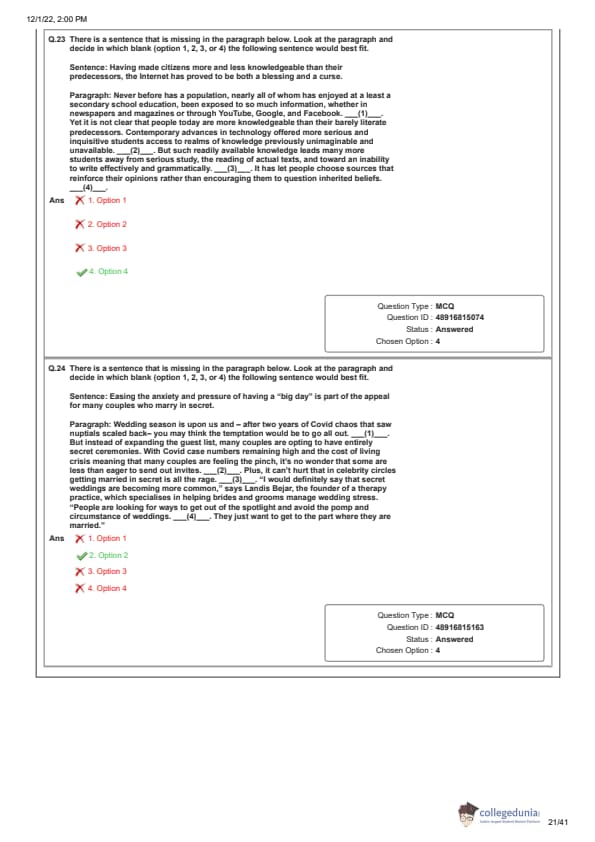
There is a sentence that is missing in the paragraph below. Look at the paragraph and
decide in which blank (option 1, 2, 3, or 4) the following sentence would best fit.
Sentence: Having made citizens more and less knowledgeable than their
predecessors, the Internet has proved to be both a blessing and a curse.
Paragraph: Never before has a population, nearly all of whom has enjoyed at a least a
secondary school education, been exposed to so much information, whether in
newspapers and magazines or through YouTube, Google, and Facebook. ...........(1)............
Yet it is not clear that people today are more knowledgeable than their barely literate
predecessors. Contemporary advances in technology offered more serious and
inquisitive students access to realms of knowledge previously unimaginable and
unavailable. ...........(2)............ But such readily available knowledge leads many more
students away from serious study, the reading of actual texts, and toward an inability
to write effectively and grammatically. ...........(3)............ It has let people choose sources that
reinforce their opinions rather than encouraging them to question inherited beliefs.
There is a sentence that is missing in the paragraph below. Look at the paragraph and
decide in which blank (option 1, 2, 3, or 4) the following sentence would best fit.
Sentence: Easing the anxiety and pressure of having a “big day” is part of the appeal
for many couples who marry in secret.
Paragraph: Wedding season is upon us and – after two years of Covid chaos that saw
nuptials scaled back– you may think the temptation would be to go all out. ...........(1)............
But instead of expanding the guest list, many couples are opting to have entirely
secret ceremonies. With Covid case numbers remaining high and the cost of living
crisis meaning that many couples are feeling the pinch, it’s no wonder that some are
less than eager to send out invites. ...........(2)............ Plus, it can’t hurt that in celebrity circles
getting married in secret is all the rage. ...........(3)............ “I would definitely say that secret
weddings are becoming more common,” says Landis Bejar, the founder of a therapy
practice, which specialises in helping brides and grooms manage wedding stress.
“People are looking for ways to get out of the spotlight and avoid the pomp and
circumstance of weddings. ...........(4)............ They just want to get to the part where they are


CAT Question Papers of Other Years
| CAT 2024 Question Papers | CAT 2023 Question Papers |
| CAT 2021 Question Papers | CAT 2020 Question Papers |
| CAT 2019 Question Papers | CAT 2018 Question Papers |
| CAT 2017 Question Papers | CAT 2016 Question Papers |



Comments