




CAT 2022 Slot 2 VARC Question Paper with Solutions PDF is now available for download. Out of the total 24 questions, CAT 2022 VARC slot 2 paper comprised 4 RC passages carrying 4 questions each and 3 questions each from Para Completion and Para Summary. Overall, CAT 2022 VARC slot 2 question paper was easier than last year. Check CAT 2022 Slot 2 VARC Question Paper with Solutions PDF given below.
Candidates preparing for CAT 2025 can download the CAT VARC question paper with the answer key PDF for the Slot 2 exam conducted on November 28, 2022, to get a better idea about the type of questions asked in the paper and the difficulty level of questions.
Also Check:
CAT 2022 VARC Slot 2 Question Paper with Solutions PDF
| CAT 2022 VARC Slot 2 Question Paper With Solution PDF | Download PDF | Check Solution |

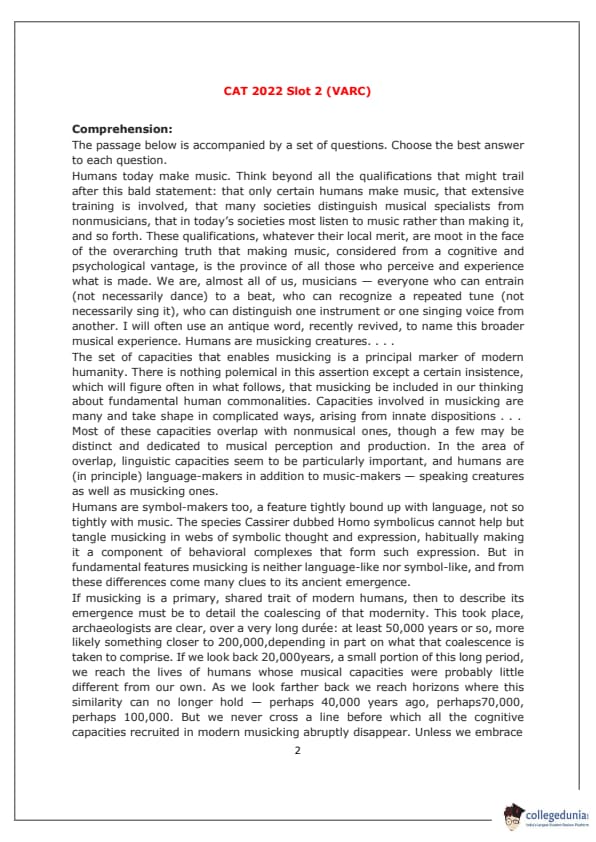
Humans today make music. Think beyond all the qualifications that might trail after this bald statement: that only certain humans make music, that extensive training is involved, that many societies distinguish musical specialists from nonmusicians, that in today’s societies most listen to music rather than making it, and so forth.
Read More
These qualifications, whatever their local merit, are moot in the face of the overarching truth that making music, considered from a cognitive and psychological vantage, is the province of all those who perceive and experience what is made. We are, almost all of us, musicians — everyone who can entrain (not necessarily dance) to a beat, who can recognize a repeated tune (not necessarily sing it), who can distinguish one instrument or one singing voice from another. I will often use an antique word, recently revived, to name this broader musical experience. Humans are musicking creatures. . . . The set of capacities that enables musicking is a principal marker of modern humanity. There is nothing polemical in this assertion except a certain insistence, which will figure often in what follows, that musicking be included in our thinking about fundamental human commonalities. Capacities involved in musicking are many and take shape in complicated ways, arising from innate dispositions. . . . Most of these capacities overlap with nonmusical ones, though a few may be distinct and dedicated to musical perception and production. In the area of overlap, linguistic capacities seem to be particularly important, and humans are (in principle) language-makers in addition to music-makers — speaking creatures as well as musicking ones. Humans are symbol-makers too, a feature tightly bound up with language, not so tightly with music. The species Cassirer dubbed Homo symbolicus cannot help but tangle musicking in webs of symbolic thought and expression, habitually making it a component of behavioral complexes that form such expression. But in fundamental features musicking is neither language-like nor symbol-like, and from these differences come many clues to its ancient emergence. If musicking is a primary, shared trait of modern humans, then to describe its emergence must be to detail the coalescing of that modernity. This took place, archaeologists are clear, over a very long dur´ee: at least 50,000 years or so, more likely something closer to 200,000, depending in part on what that coalescence is taken to comprise. If we look back 20,000 years, a small portion of this long period, we reach the lives of humans whose musical capacities were probably little different from our own. As we look farther back we reach horizons where this similarity can no longer hold — perhaps 40,000 years ago, perhaps 70,000, perhaps 100,000. But we never cross a line before which all the cognitive capacities recruited in modern musicking abruptly disappear. Unless we embrace the incredible notion that music sprang forth in full-blown glory, its emergence will have to be tracked in gradualist terms across a long period. This is one general feature of a history of music’s emergence. . . . The history was at once sociocultural and biological. . . . The capacities recruited in musicking are many, so describing its emergence involves following several or many separate strands.Which one of the following sets of terms best serves as keywords to the passage?
View Solution
Based on the passage, which one of the following statements is a valid argument about the emergence of music/musicking?
View Solution
“Think beyond all the qualifications that might trail after this bald statement...”. In the context of the passage, what is the author trying to communicate in this quoted extract?
View Solution
Which one of the following statements, if true, would weaken the author’s claim that humans are musicking creatures?
View Solution
Read More
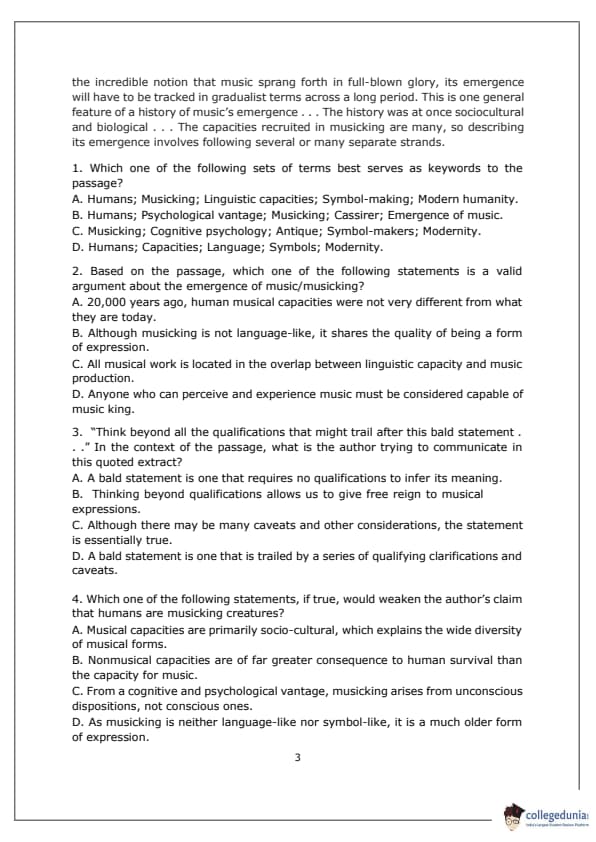
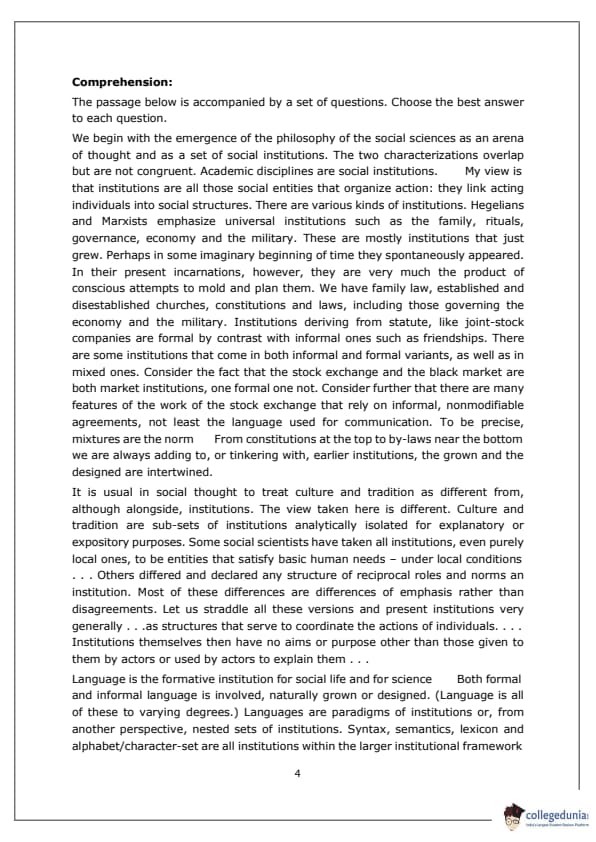
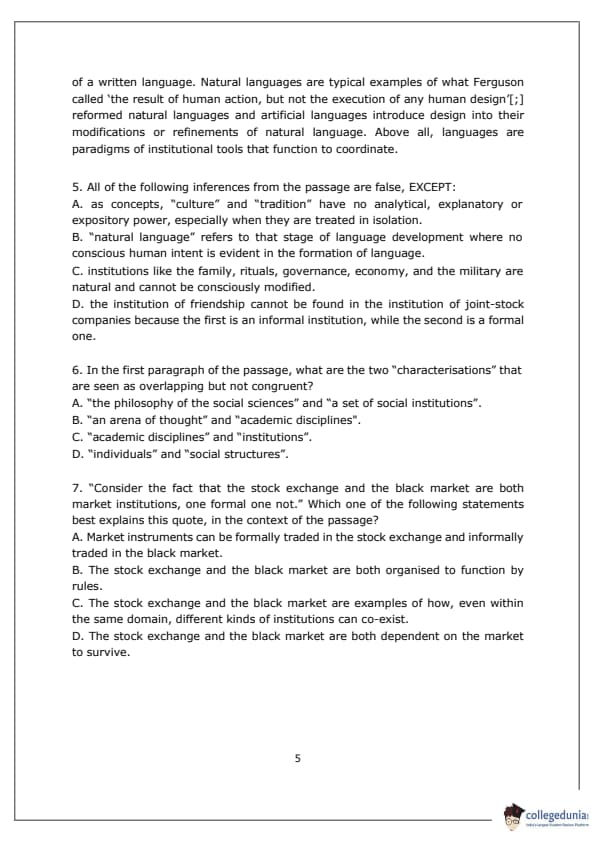
My view is that institutions are all those social entities that organize action: they link acting individuals into social structures. There are various kinds of institutions. Hegelians and Marxists emphasize universal institutions such as the family, rituals, governance, economy, and the military. These are mostly institutions that just grew. Perhaps in some imaginary beginning of time they spontaneously appeared. In their present incarnations, however, they are very much the product of conscious attempts to mold and plan them. We have family law, established and disestablished churches, constitutions and laws, including those governing the economy and the military. Institutions deriving from statute, like joint-stock companies, are formal by contrast with informal ones such as friendships. There are some institutions that come in both informal and formal variants, as well as in mixed ones. Consider the fact that the stock exchange and the black market are both market institutions, one formal one not. Consider further that there are many features of the work of the stock exchange that rely on informal, nonmodifiable agreements, not least the language used for communication. To be precise, mixtures are the norm. From constitutions at the top to by-laws near the bottom, we are always adding to, or tinkering with, earlier institutions, the grown and the designed are intertwined. It is usual in social thought to treat culture and tradition as different from, although alongside, institutions. The view taken here is different. Culture and tradition are sub-sets of institutions analytically isolated for explanatory or expository purposes. Some social scientists have taken all institutions, even purely local ones, to be entities that satisfy basic human needs – under local conditions. . . Others differed and declared any structure of reciprocal roles and norms an institution. Most of these differences are differences of emphasis rather than disagreements. Let us straddle all these versions and present institutions very generally . . . as structures that serve to coordinate the actions of individuals. . . . Institutions themselves then have no aims or purpose other than those given to them by actors or used by actors to explain them. . . . Language is the formative institution for social life and for science. Both formal and informal language is involved, naturally grown or designed. (Language is all of these to varying degrees.) Languages are paradigms of institutions or, from another perspective, nested sets of institutions. Syntax, semantics, lexicon, and alphabet/character-set are all institutions within the larger institutional framework of a written language. Natural languages are typical examples of what Ferguson called ‘the result of human action, but not the execution of any human design’; reformed natural languages and artificial languages introduce design into their modifications or refinements of natural language. Above all, languages are paradigms of institutional tools that function to coordinate.All of the following inferences from the passage are false, EXCEPT:
View Solution
In the first paragraph of the passage, what are the two “characterisations” that are seen as overlapping but not congruent?
View Solution
“Consider the fact that the stock exchange and the black market are both market institutions, one formal one not.” Which one of the following statements best explains this quote, in the context of the passage?
View Solution
Which of the following statements best represents the essence of the passage?
View Solution
Read More
But those technical ideals are at their core social and political choices determined by a dominant culture focused on economic growth for the most privileged segments of society. By choosing to downplay public welfare as a critical parameter for engineering design, we risk creating a culture of disengagement from societal concerns amongst engineers that is antithetical to the ethical code of engineering. In my field of medical devices, ignoring social dimensions has real consequences. . . . Most FDA-approved drugs are incorrectly dosed for people assigned female at birth, leading to unexpected adverse reactions. This is because they have been inadequately represented in clinical trials. Beyond physical failings, subjective beliefs treated as facts by those in decision-making roles can encode social inequities. For example, spirometers, routinely used devices that measure lung capacity, still have correction factors that automatically assume smaller lung capacity in Black and Asian individuals. These racially based adjustments are derived from research done by eugenicists who thought these racial differences were biologically determined and who considered nonwhite people as inferior. These machines ignore the influence of social and environmental factors on lung capacity. Many technologies for systemically marginalized people have not been built because they were not deemed important, such as better early diagnostics and treatment for diseases like endometriosis, a disease that afflicts 10 percent of people with uteruses. And we hardly question whether devices are built sustainably, which has led to a crisis of medical waste and health care accounting for 10 percent of U.S. greenhouse gas emissions. Social justice must be made core to the way engineers are trained. Some universities are working on this. . . . Engineers taught this way will be prepared to think critically about what problems we choose to solve, how we do so responsibly, and how we build teams that challenge our ways of thinking. Individual engineering professors are also working to embed societal needs in their pedagogy. Darshan Karwat at the University of Arizona developed activist engineering to challenge engineers to acknowledge their full moral and social responsibility through practical self-reflection. Khalid Kadir at the University of California, Berkeley, created the popular course Engineering, Environment, and Society that teaches engineers how to engage in place-based knowledge, an understanding of the people, context, and history, to design better technical approaches in collaboration with communities. When we design and build with equity and justice in mind, we craft better solutions that respond to the complexities of entrenched systemic problems.We can infer that the author would approve of a more evolved engineering pedagogy that includes all of the following EXCEPT:
View Solution
All of the following are examples of the negative outcomes of focusing on technical ideals in the medical sphere EXCEPT the:
View Solution
The author gives all of the following reasons for why marginalized people are systematically discriminated against in technology-related interventions EXCEPT:
View Solution
In this passage, the author is making the claim that:
View Solution
Read More
It makes sense for these molluscs to have added protection in the form of a higher cognition; they don’t have a shell covering them, and pretty much everything feeds on cephalopods, including humans. But how did cephalopods manage to secure their own invisibility cloak? Cephalopods fire from multiple cylinders to achieve this in varying degrees from species to species. There are four main catalysts – chromatophores, iridophores, papillae, and 17 leucophores. . . . Well, what about other colours? Cue the iridophores. Think of a second level of skin that has thin stacks of cells. These can reflect light back at different wavelengths. . . . It’s using the same properties that we’ve seen in hologram stickers, or rainbows on puddles of oil. You move your head and you see a different colour. The sticker isn’t doing anything but reflecting light – it’s your movement that’s changing the appearance of the colour. This property of holograms, oil, and other such surfaces is called “iridescence”. . . . Papillae are sections of the skin that can be deformed to make a texture bumpy. Even humans possess them (goosebumps) but cannot use them in the manner that cephalopods can. For instance, the use of these cells is how an octopus can wrap itself over a rock and appear jagged or how a squid or cuttlefish can imitate the look of a coral reef by growing miniature towers on its skin. It actually matches the texture of the substrate it chooses. Finally, the leucophores: According to a paper, published in Nature, cuttlefish and octopuses possess an additional type of reflector cell called a leucophore. They are cells that scatter full spectrum light so that they appear white in a similar way that a polar bear’s fur appears white. Leucophores will also reflect any filtered light shown on them . . . If the water appears blue at a certain depth, the octopuses and cuttlefish can appear blue; if the water appears green, they appear green, and so on and so forth.All of the following are reasons for octopuses being “misfits” EXCEPT that they:
View Solution
Which one of the following statements is not true about the camouflaging ability of Cephalopods?
View Solution
Based on the passage, we can infer that all of the following statements, if true, would weaken the camouflaging adeptness of Cephalopods EXCEPT:
View Solution
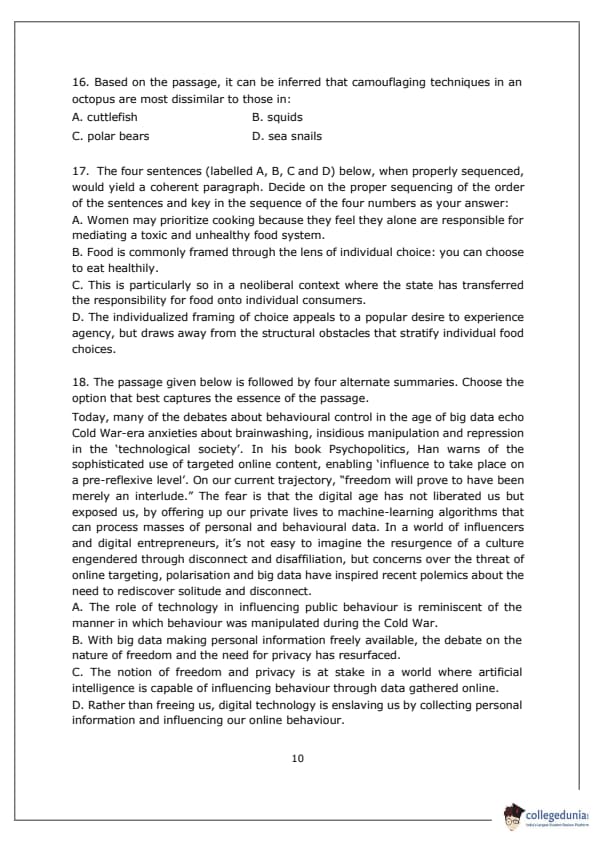
Based on the passage, it can be inferred that camouflaging techniques of octopuses are most dissimilar to those in:
View Solution
The four sentences (labeled A, B, C, and D) below, when properly sequenced, would yield a coherent paragraph. Decide on the proper sequencing of the order of the sentences and key in the sequence of the four numbers as your answer:
(A) Women may prioritize cooking because they feel they alone are responsible for mediating a toxic and unhealthy food system.
(B) Food is commonly framed through the lens of individual choice: you can choose to eat healthily.
(C) This is particularly so in a neoliberal context where the state has transferred the responsibility for food onto individual consumers.
(D) The individualized framing of choice appeals to a popular desire to experience agency, but draws away from the structural obstacles that stratify individual food choices.
View Solution
The passage given below is followed by four alternate summaries. Choose the option that best captures the essence of the passage:
Today, many of the debates about behavioral control in the age of big data echo Cold War-era anxieties about brainwashing, insidious manipulation and repression in the ‘technological society’. In his book Psychopolitics, Han warns of the sophisticated use of targeted online content, enabling ‘influence to take place one pre-reflexive level’. On our current trajectory, “freedom will prove to have been merely an interlude.” The fear is that the digital age has not liberated but exposed us, by offering up our private lives to machine-learning algorithms that can process masses of personal and behavioral data. In a world of influencers and digital entrepreneurs, it’s not easy to imagine the resurgence of culture engendered through disconnect and disaffiliation, but concerns over the threat of online targeting, polarization and big data have inspired recent polemics about the need to rediscover solitude and disconnect.
View Solution
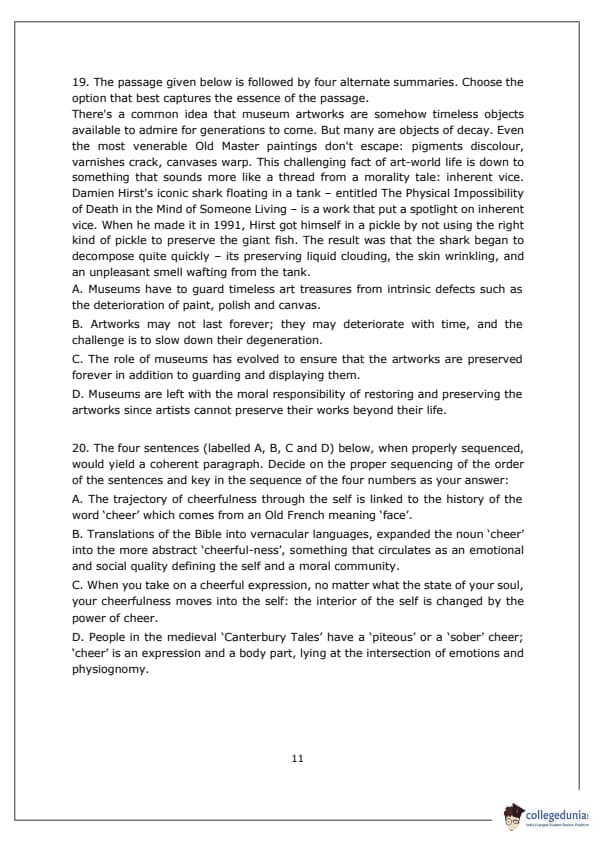
The passage given below is followed by four alternate summaries. Choose the option that best captures the essence of the passage:
There's a common idea that museum artworks are somehow timeless objects available to admire for generations to come. But many are objects of decay. Even the most venerable Old Master paintings don't escape: pigments discolor, varnishes crack, canvases warp. This challenging fact of art-world life is down to something that sounds more like a thread from a morality tale: inherent vice. Damien Hirst's iconic shark floating in a tank – entitled The Physical Impossibility Of Death in the Mind of Someone Living – is a work that put a spotlight on inherent vice. When he made it in 1991, Hirst got himself in a pickle by not using the right kind of pickle to preserve the giant fish. The result was that the shark began to decompose quite quickly – its preserving liquid clouding, the skin wrinkling, and an unpleasant smell wafting from the tank.
View Solution
The four sentences (labeled A, B, C, and D) below, when properly sequenced, would yield a coherent paragraph. Decide on the proper sequencing of the order of the sentences and key in the sequence of the four numbers as your answer:
(A) The trajectory of cheerfulness through the self is linked to the history of the word ‘cheer’ which comes from an Old French meaning ‘face’.
(B) Translations of the Bible into vernacular languages, expanded the noun ‘cheer’ into the more abstract ‘cheerfulness’, something that circulates as an emotional and social quality defining the self and a moral community.
(C) When you take on a cheerful expression, no matter what the state of your soul, your cheerfulness moves into the self: the interior of the self is changed by the power of cheer.
(D) People in the medieval ‘Canterbury Tales’ have a ‘piteous’ or a ‘sober’ cheer; ‘cheer’ is an expression and a body part, lying at the intersection of emotions and physiognomy.
View Solution
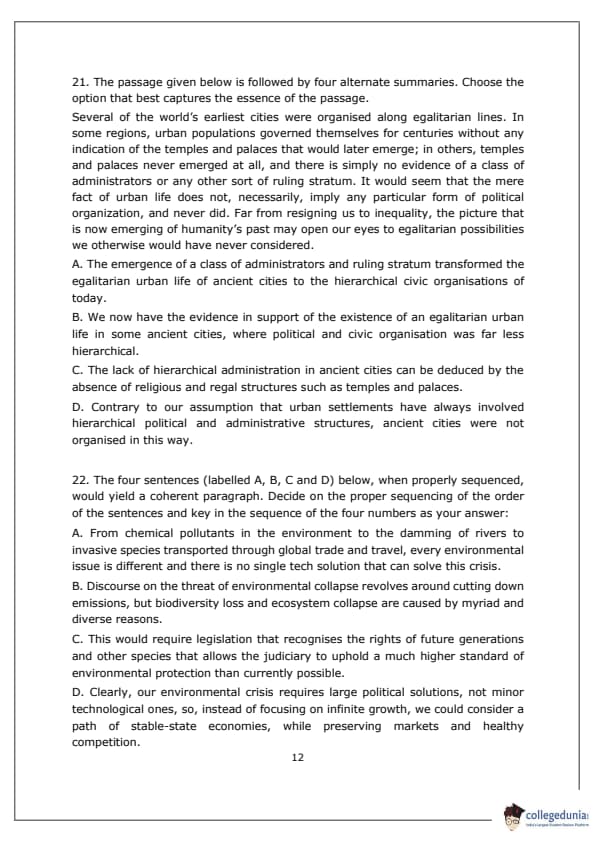
The passage given below is followed by four alternate summaries. Choose the option that best captures the essence of the passage:
Several of the world’s earliest cities were organized along egalitarian lines. In some regions, urban populations governed themselves for centuries without any indication of the temples and palaces that would later emerge; in others, temples and palaces never emerged at all, and there is simply no evidence of a class of administrators or any other sort of ruling stratum. It would seem that the fact of urban life does not, necessarily, imply any particular form of political organization, and never did. Far from resigning us to inequality, the picture that is now emerging of humanity’s past may open our eyes to egalitarian possibilities we otherwise would have never considered.
View Solution
The four sentences (labeled A, B, C and D) below, when properly sequenced, would yield a coherent paragraph. Decide on the proper sequencing of the order of the sentences and key in the sequence of the four numbers as your answer:
(A) From chemical pollutants in the environment to the damming of rivers to invasive species transported through global trade and travel, every environmental issue is different and there is no single tech solution that can solve this crisis.
(B) Discourse on the threat of environmental collapse revolves around cutting down emissions, but biodiversity loss and ecosystem collapse are caused by myriad and diverse reasons.
(C) This would require legislation that recognises the rights of future generations and other species that allows the judiciary to uphold a much higher standard of environmental protection than currently possible.
(D) Clearly, our environmental crisis requires large political solutions, not minor technological ones, so, instead of focusing on infinite growth, we could consider paths of stable-state economies, while preserving markets and healthy competition.
View Solution
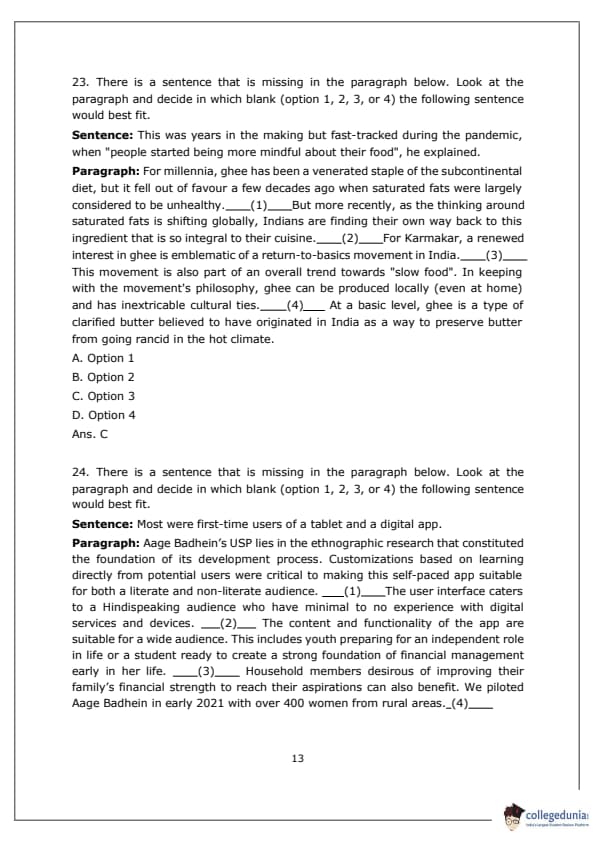
There is a sentence that is missing in the paragraph below. Look at the paragraph and decide in which blank (option 1, 2, 3, or 4) the following sentence would best fit.
Sentence: This was years in the making but fast-tracked during the pandemic, when "people started being more mindful about their food", he explained.
Paragraph:For millennia, ghee has been a venerated staple of the subcontinental diet, but it fell out of favour a few decades ago when saturated fats were largely considered to be unhealthy. ____(1)____ But more recently, as the thinking around saturated fats is shifting globally, Indians are finding their own way back to this ingredient that is so integral to their cuisine. ____(2)____ For Karmakar, a renewed interest in ghee is emblematic of a return-to-basics movement in India. ____(3)____ This movement is also part of an overall trend towards "slow food". In keeping with the movement's philosophy, ghee can be produced locally (even at home) and has inextricable cultural ties. ____(4)____ At a basic level, ghee is a type of clarified butter believed to have originated in India as a way to preserve butter from going rancid in the hot climate.
View Solution
There is a sentence that is missing in the paragraph below. Look at the paragraph and decide in which blank (option 1, 2, 3, or 4) the following sentence would best fit.
Sentence: Most were first-time users of a tablet and a digital app.
Paragraph: Aage Badhein’s USP lies in the ethnographic research that constituted the foundation of its development process. Customizations based on learning directly from potential users were critical to making this self-paced app suitable for both a literate and non-literate audience. ____(1)____ The user interface caters to a Hindi speaking audience who have minimal to no experience with digital services and devices. ____(2)____ The content and functionality of the app are suitable for a wide audience. This includes youth preparing for an independent role in life or a student ready to create a strong foundation of financial management early in her life. ____(3)____ Household members desirous of improving their family’s financial strength to reach their aspirations can also benefit. We piloted Aage Badhein in early 2021 with over 400 women from rural areas. ____(4)____ The digital solution generated a large amount of interest in the communities.
View Solution



CAT Question Papers of Other Years
| CAT 2024 Question Papers | CAT 2023 Question Papers |
| CAT 2021 Question Papers | CAT 2020 Question Papers |
| CAT 2019 Question Papers | CAT 2018 Question Papers |
| CAT 2017 Question Papers | CAT 2016 Question Papers |



Comments