




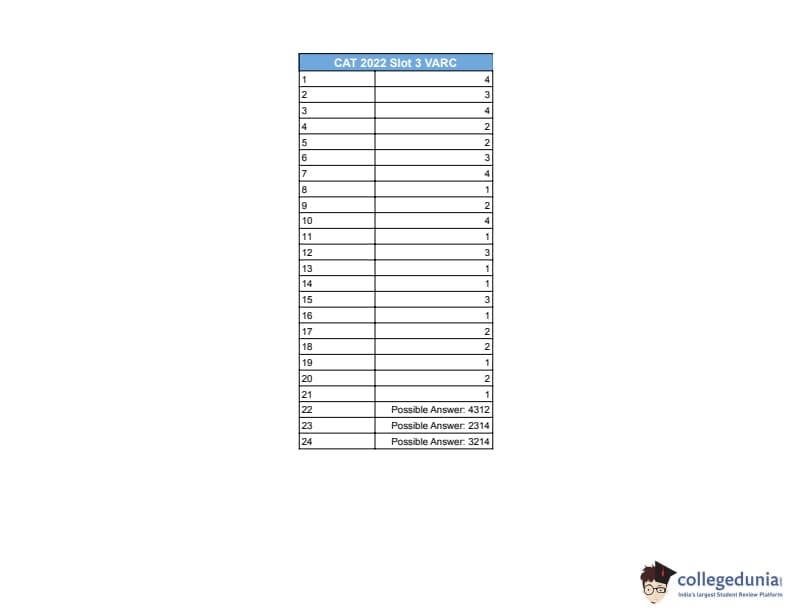
CAT 2022 Slot 3 VARC Question Paper with Solutions PDF is available here for download. CAT 2022 VARC section of slot 3 had 4 RC passages carrying 4 questions each and 3 questions each from Parajumbles and Para Summary. Surprisingly, CAT 2022 VARC question paper was comparatively easier than the last 2 years. Check CAT 2022 Slot 3 VARC Question Paper with Solutions PDF given below.
Candidates preparing for CAT 2025 can download the CAT VARC question paper with the answer key PDF for the Slot 3 exam conducted on November 28, 2022, to get a better idea about the type of questions asked in the paper and the difficulty level of questions.
Also Check:
CAT 2022 VARC Slot 3 Question Paper with Solutions PDF
| CAT 2022 VARC Slot 3 Question Paper with Answer Key | Download PDF | Check Solutions |

Read More
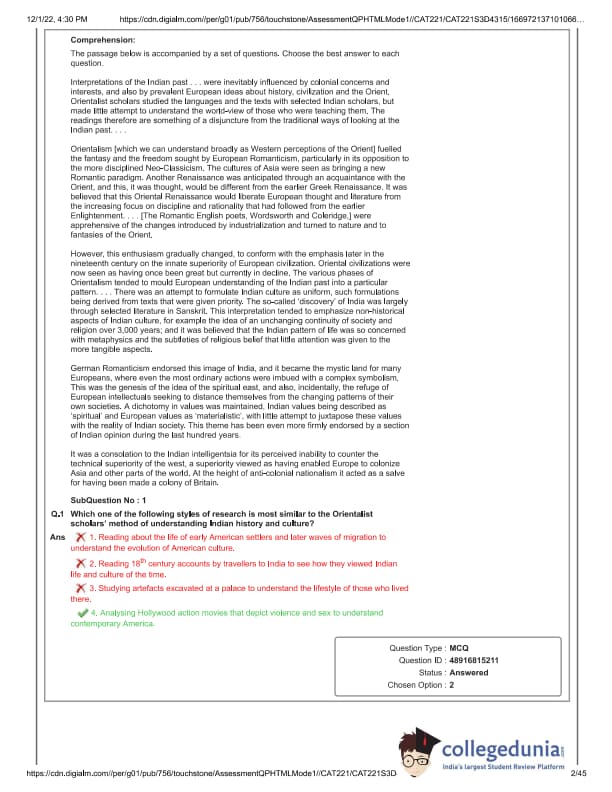
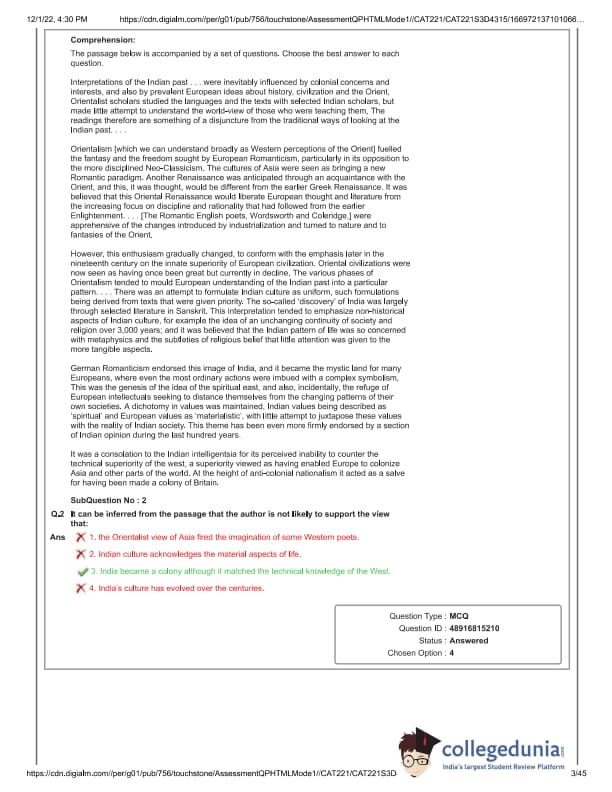
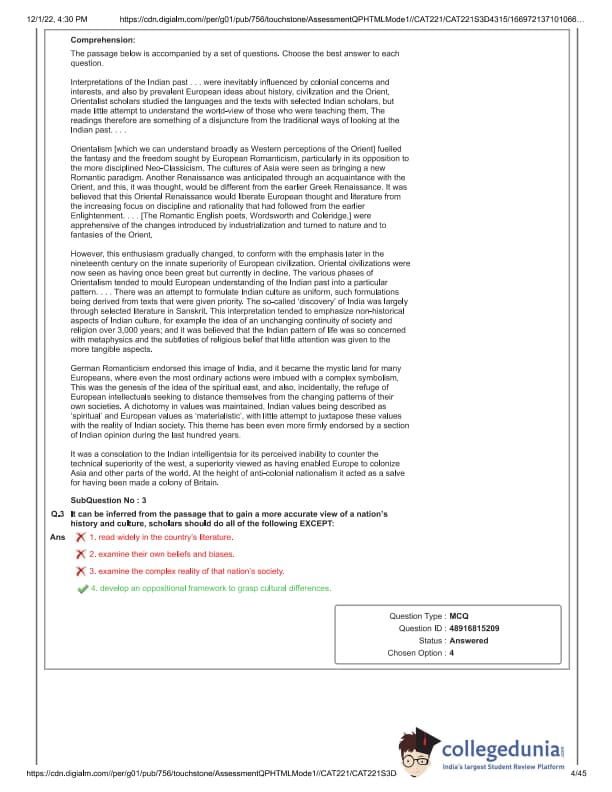
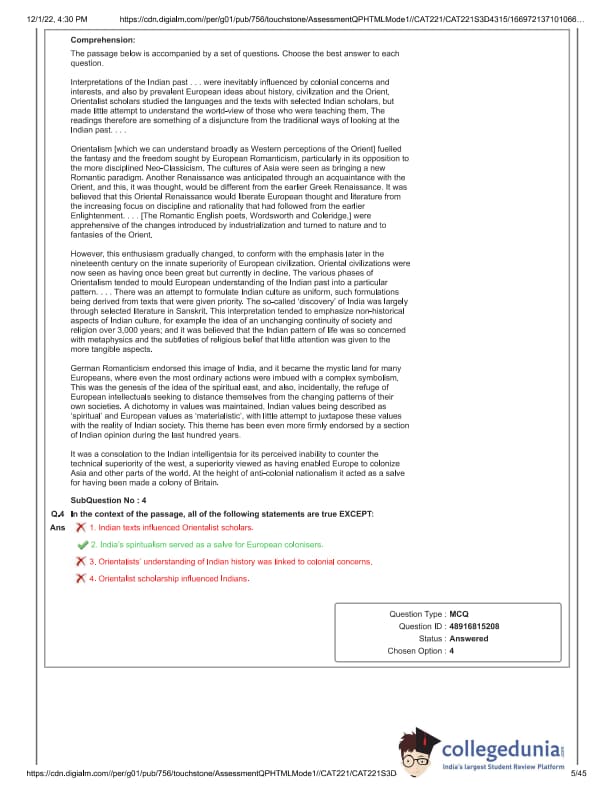
Orientalism [which we can understand broadly as Western perceptions of the Orient] fuelled the fantasy and the freedom sought by European Romanticism, particularly in its opposition to the more disciplined Neo-Classicism. The cultures of Asia were seen as bringing a new Romantic paradigm. Another Renaissance was anticipated through an acquaintance with the Orient, and this, it was thought, would be different from the earlier Greek Renaissance. It was believed that this Oriental Renaissance would liberate European thought and literature from the increasing focus on discipline and rationality that had followed from the earlier Enlightenment. .. . [The Romantic English poets, Wordsworth and Coleridge,] were apprehensive of the changes introduced by industrialization and turned to nature and to fantasies of the Orient. However, this enthusiasm gradually changed, to conform with the emphasis later in the nineteenth century on the innate superiority of European civilization. Oriental civilizations were now seen as having once been great but currently in decline. The various phases of Orientalism tended to mould European understanding of the Indian past into a particular pattern. ... There was an attempt to formulate Indian culture as uniform, such formulations being derived from texts that were given priority. The so-called ’discovery’ of India was largely through selected literature in Sanskrit. This interpretation tended to emphasize non-historical aspects of Indian culture, for example the idea of an unchanging continuity of society and religion over 3,000 years; and it was believed that the Indian pattern of life was so concerned with metaphysics and the subtleties of religious belief that little attention was given to the more tangible aspects. German Romanticism endorsed this image of India, and it became the mystic land for many Europeans, where even the most ordinary actions were imbued with a complex symbolism. This was the genesis of the idea of the spiritual east, and also, incidentally, the refuge of European intellectuals seeking to distance themselves from the changing patterns of their own societies. A dichotomy in values was maintained, Indian values being described as ’spiritual” and European values as ’materialistic’, with little attempt to juxtapose these values with the reality of Indian society. This theme has been even more firmly endorsed by a section of Indian opinion during the last hundred years. It was a consolation to the Indian intelligentsia for its perceived inability to counter the technical superiority of the west, a superiority viewed as having enabled Europe to colonize Asia and other parts of the world. At the height of anti-colonial nationalism it acted as a salve for having been made a colony of Britain.Which one of the following styles of research is most similar to the Orientalist scholars' method of understanding Indian history and culture?
View Solution
It can be inferred from the passage that the author is not likely to support the view that:
View Solution
It can be inferred from the passage that to gain a more accurate view of a nation's history and culture, scholars should do all of the following EXCEPT:
View Solution
In the context of the passage, all of the following statements are true EXCEPT:
View Solution
Read More
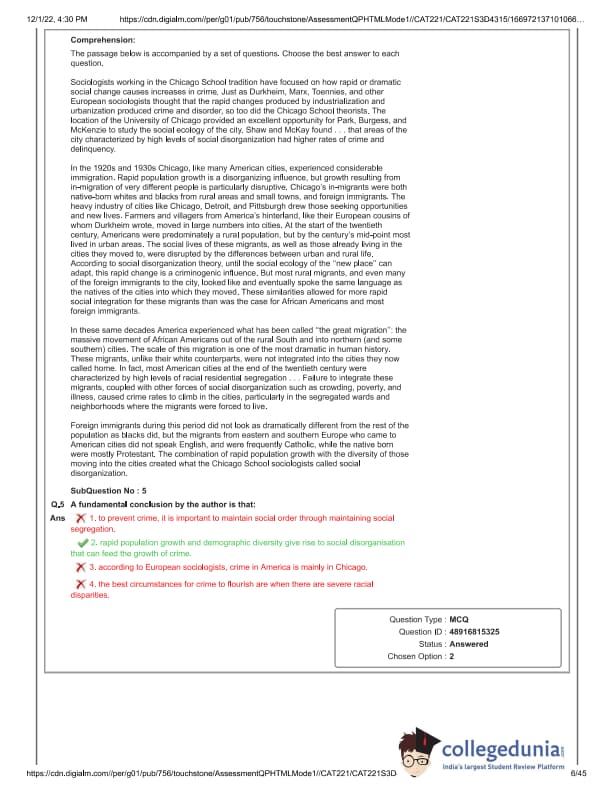
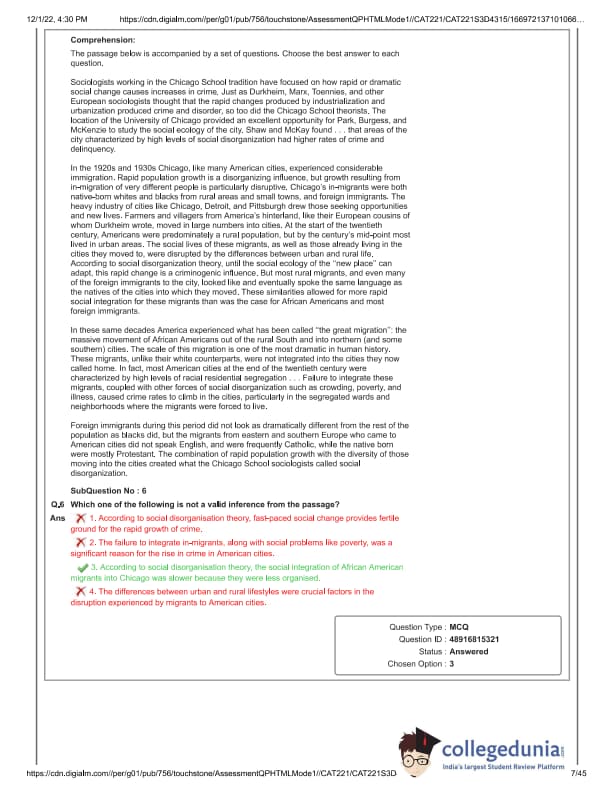
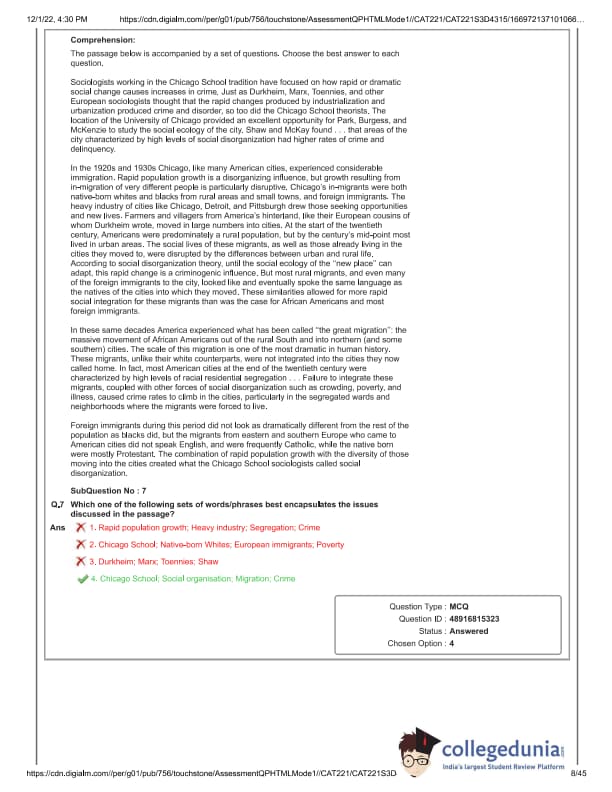
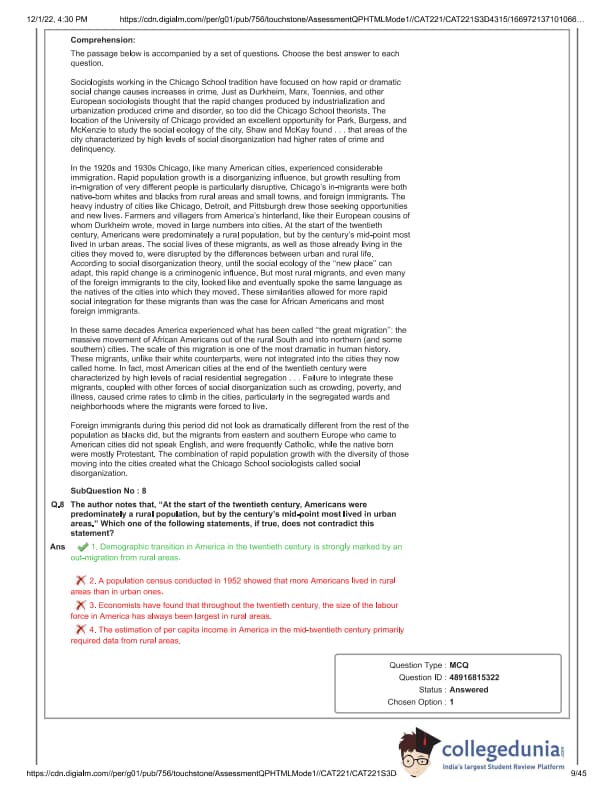
n the 1920s and 1930s Chicago, like many American cities, experienced considerable immigration. Rapid population growth is a disorganizing influence, but growth resulting from in-migration of very different people is particularly disruptive. Chicago’s in-migrants were both native-bom whites and blacks from rural areas and small towns, and foreign immigrants. The heavy industry of cities like Chicago, Detroit, and Pittsburgh drew those seeking opportunities and new lives. Farmers and villagers from America’s hinterland, like their European cousins of whom Durkheim wrote, moved in large numbers into cities. At the start of the twentieth century, Americans were predominately a rural population, but by the century’s mid-point most lived in urban areas. The social lives of these migrants, as well as those already living in the cities they moved to, were disrupted by the differences between urban and rural life. According to social disorganization theory, until the social ecology of the ”new place” can adapt, this rapid change is a criminogenic influence. But most rural migrants, and even many,of the foreign immigrants to the city, looked like and eventually spoke the same language as the natives of the cities into which they moved. These similarities allowed for more rapid social integration for these migrants than was the case for African Americans and most foreign immigrants. In these same decades America experienced what has been called ”the great migration”: the massive movement of African Americans out of the rural South and into northern (and some southern) cities. The scale of this migration is one of the most dramatic in human history. These migrants, unlike their white counterparts, were not integrated into the cities they now called home. In fact, most American cities at the end of the twentieth century were characterized by high levels of racial residential segregation . . . Failure to integrate these migrants, coupled with other forces of social disorganization such as crowding, poverty, and illness, caused crime rates to climb in the cities, particularly in the segregated wards and neighborhoods where the migrants were forced to live. Foreign immigrants during this period did not look as dramatically different from the rest of the population as blacks did, but the migrants from eastern and southern Europe who came to American cities did not speak English, and were frequently Catholic, while the native born were mostly Protestant. The combination of rapid population growth with the diversity of those moving into the cities created what the Chicago School sociologists called social disorganization.A fundamental conclusion by the author is that:
View Solution
Which one of the following is not a valid inference from the passage?
View Solution
Which one of the following sets of words/phrases best encapsulates the issues discussed in the passage?
View Solution
The author notes that, "At the start of the twentieth century, Americans were predominately a rural population, but by the century's mid-point most lived in urban areas." Which one of the following statements, if true, does not contradict this statement?
View Solution
Read More
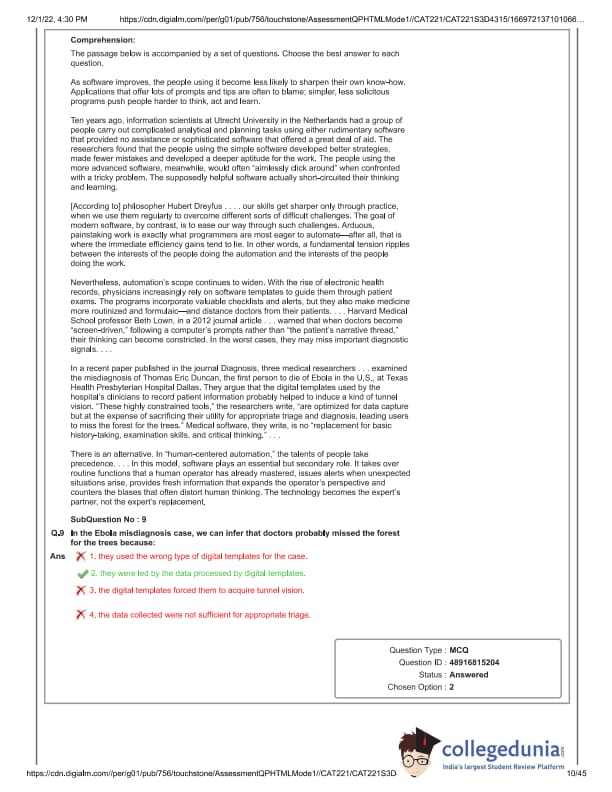
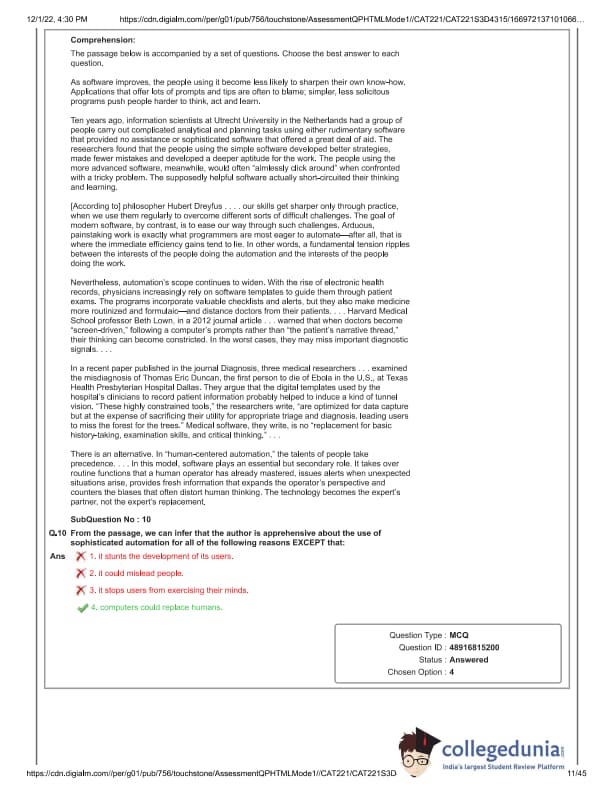
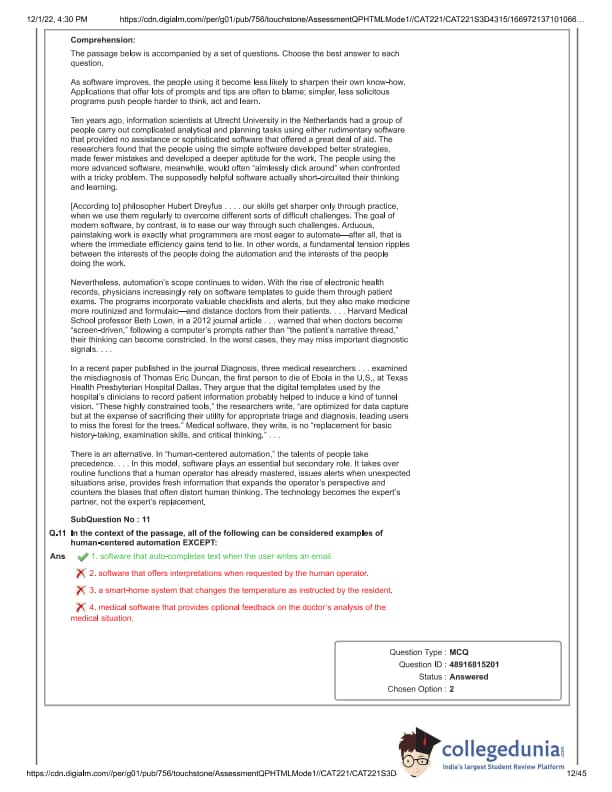
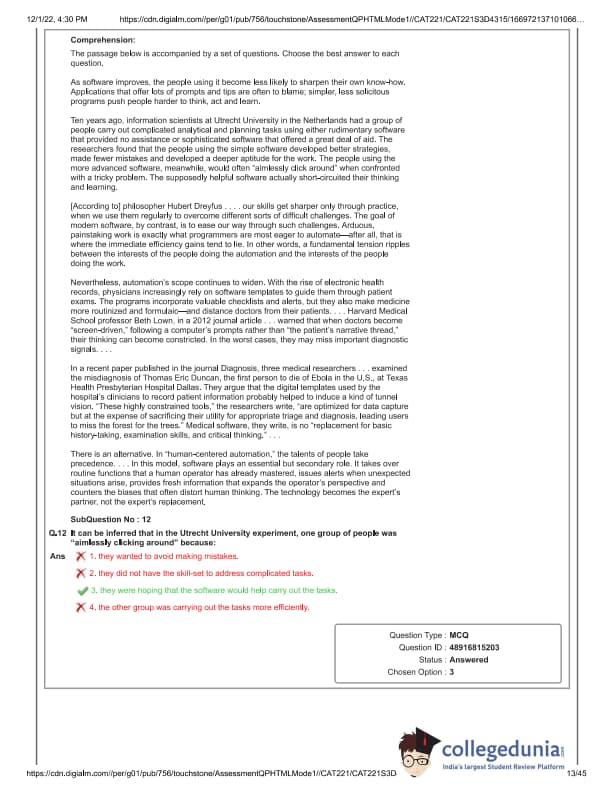
Ten years ago, information scientists at Utrecht University in the Netherlands had a group of people carry out complicated analytical and planning tasks using either rudimentary software that provided no assistance or sophisticated software that offered a great deal of aid. The researchers found that the people using the simple software developed better strategies, made fewer mistakes and developed a deeper aptitude for the work. The people using the more advanced software, meanwhile, would often ”aimlessly click around” when confronted with a tricky problem. The supposedly helpful software actually short-circuited their thinking and learning. [According to] philosopher Hubert Dreyfus . . . . our skills get sharper only through practice, when we use them regularly to overcome different sorts of difficult challenges. The goal of modern software, by contrast, is to ease our way through such challenges. Arduous, painstaking work is exactly what programmers are most eager to automate-after all, that is where the immediate efficiency gains tend to lie. In other words, a fundamental tension ripples between the interests of the people doing the automation and the interests of the people doing the work. Nevertheless, automation’s scope continues to widen. With the rise of electronic health records, physicians increasingly rely on software templates to guide them through patient exams. The programs incorporate valuable checklists and alerts, but they also make medicine more routinized and formulaio-and distance doctors from their patients. . . . Harvard Medical School professor Beth Lown, in a 2012 journal artide . . . wamed that when doctors become ”screen-driven,” following a computer’s prompts rather than ”the patient’s narrative thread,” their thinking can become constricted. In the worst cases, they may miss important diagnostic signals. . . . In a recent paper published in the journal Diagnosis, three medical researchers . . . examined the misdiagnosis of Thomas Eric Duncan, the first person to die of Ebola in the U.S., at Texas Health Presbyterian Hospital Dallas. They argue that the digital templates used by the hospital’s clinicians to record patient information probably helped to induce a kind of tunnel vision. ”These highly constrained tools,” the researchers write, ”are optimized for data capture but at the expense of sacrificing their utility for appropriate triage and diagnosis, leading users to miss the forest for the trees.” Medical software, they write, is no ”replacement for basic history-taking, examination skills, and critical thinking.” ... There is an alternative. In ”human-centered automation,” the talents of people take precedence. ... In this model, software plays an essential but secondary role. It takes over routine functions that a human operator has already mastered, issues alerts when unexpected situations arise, provides fresh information that expands the operator’s perspective and 10 counters the biases that often distort human thinking. The technology becomes the expert’s partner, not the expert’s replacement.In the Ebola misdiagnosis case, we can infer that doctors probably missed the forest for the trees because:
View Solution
From the passage, we can infer that the author is apprehensive about the use of sophisticated automation for all of the following reasons EXCEPT that:
View Solution
In the context of the passage, all of the following can be considered examples of human-centered automation EXCEPT:
View Solution
It can be inferred that in the Utrecht University experiment, one group of people was "aimlessly clicking around" because:
View Solution
Read More
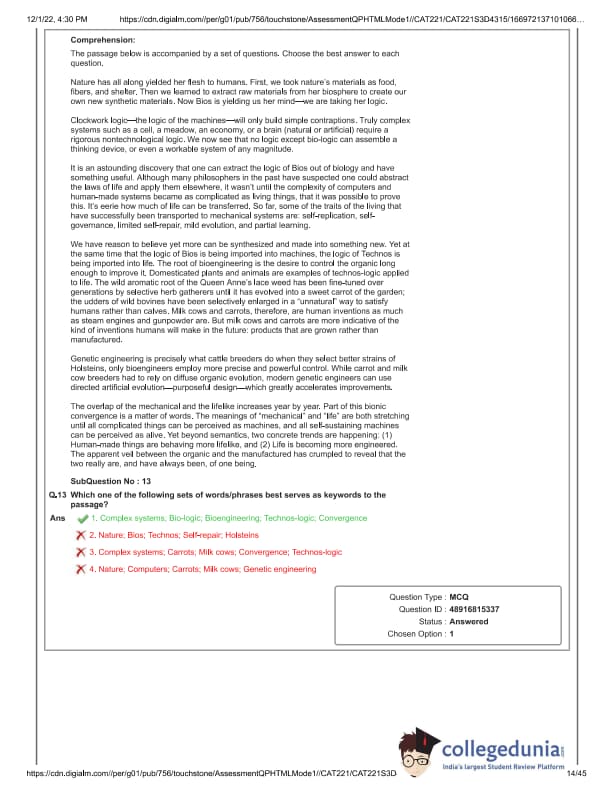
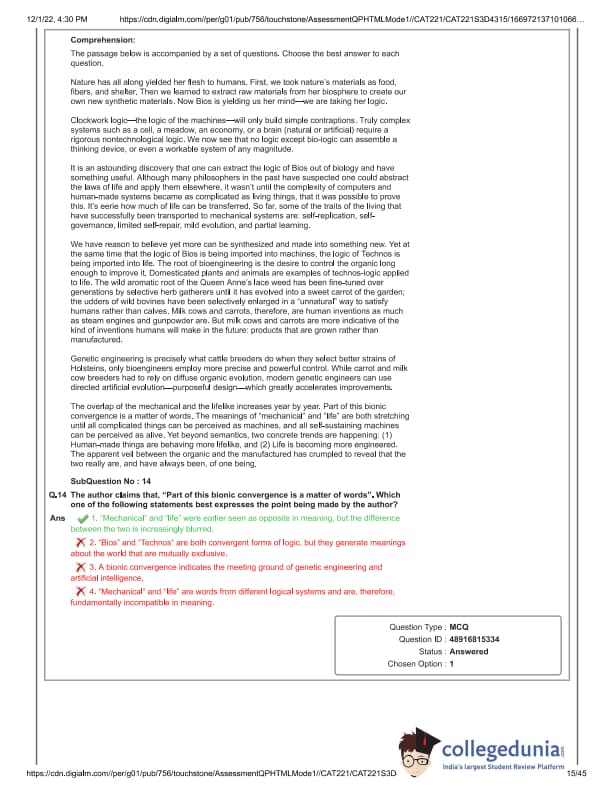
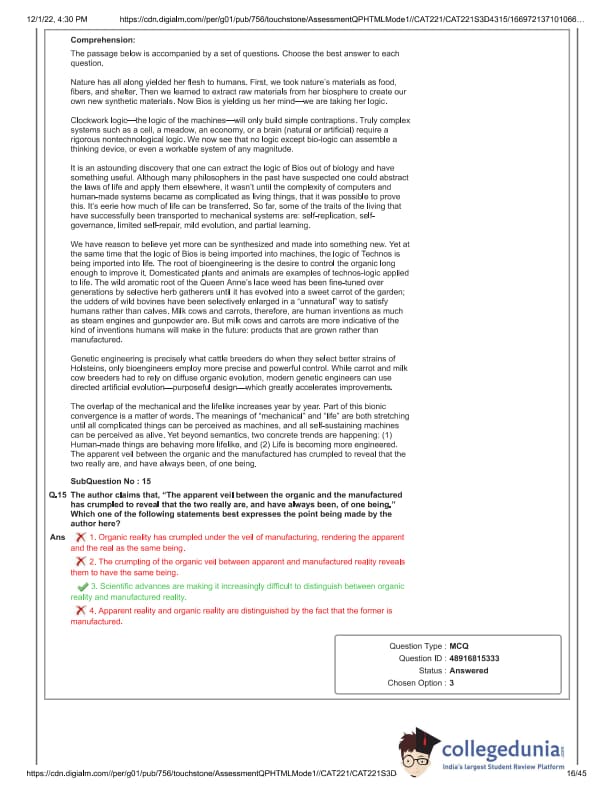
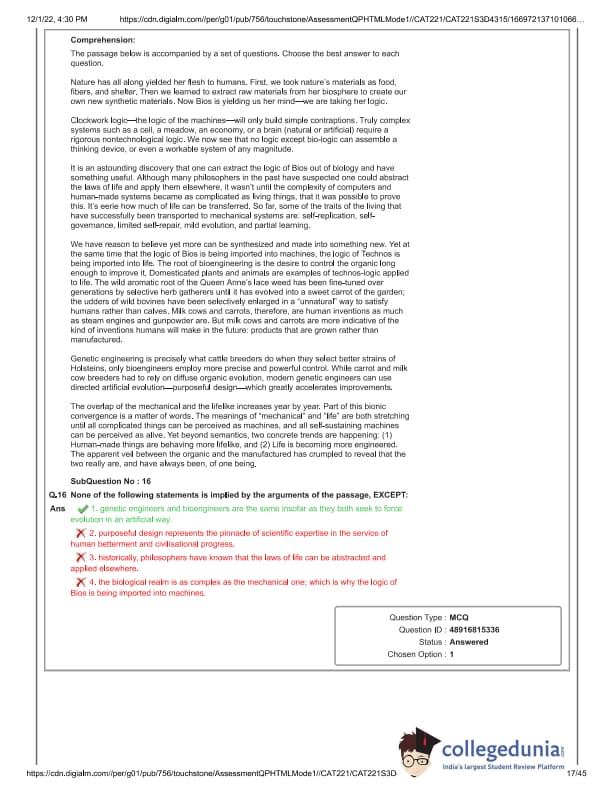
It is an astounding discovery that one can extract the logic of Bios out of biology and have something useful. Although many philosophers in the past have suspected one could abstract the laws of life and apply them elsewhere, it wasn’t until the complexity of computers and human-made systems became as complicated as living things, that it was possible to prove this. It’s eerie how much of life can be transferred. So far, some of the traits of the living that have successfully been transported to mechanical systems are: self-replication, self- governance, limited self-repair, mild evolution, and partial learning. We have reason to believe yet more can be synthesized and made into something new. Yet at the same time that the logic of Bios is being imported into machines, the logic of Technos is being imported into life. The root of bioengineering is the desire to control the organic long enough to improve it. Domesticated plants and animals are examples of technos-logic applied to life. The wild aromatic root of the Queen Anne’s lace weed has been fine-tuned over generations by selective herb gatherers until it has evolved into a sweet carrot of the garden; the udders of wild bovines have been selectively enlarged in a ”unnatural” way to satisfy humans rather than calves. Milk cows and carrots, therefore, are human inventions as much as steam engines and gunpowder are. But milk cows and carrots are more indicative of the kind of inventions humans will make in the future: products that are grown rather than manufactured. Genetic engineering is precisely what cattle breeders do when they select better strains of Holsteins, only bioengineers employ more precise and powerful control. While carrot and milk cow breeders had to rely on diffuse organic evolution, modern genetic engineers can use directed artificial evolution-purposeful design-which greatly accelerates improvements. The overlap of the mechanical and the lifelike increases year by year. Part of this bionic convergence is a matter of words. The meanings of ”mechanical” and ”life” are both stretching until all complicated things can be perceived as machines, and all self-sustaining machines can be perceived as alive. Yet beyond semantics, two concrete trends are happening: (1) Human-made things are behaving more lifelike, and (2) Life is becoming more engineered. The apparent veil between the organic and the manufactured has crumpled to reveal that the two really are, and have always been, of one being.Which one of the following sets of words/phrases best serves as keywords to the passage?
View Solution
The author claims that, "Part of this bionic convergence is a matter of words". Which one of the following statements best expresses the point being made by the author?
View Solution
The author claims that, "The apparent veil between the organic and the manufactured has crumpled to reveal that the two really are, and have always been, of one being." Which one of the following statements best expresses the point being made by the author here?
View Solution
None of the following statements is implied by the arguments of the passage, EXCEPT:
View Solution
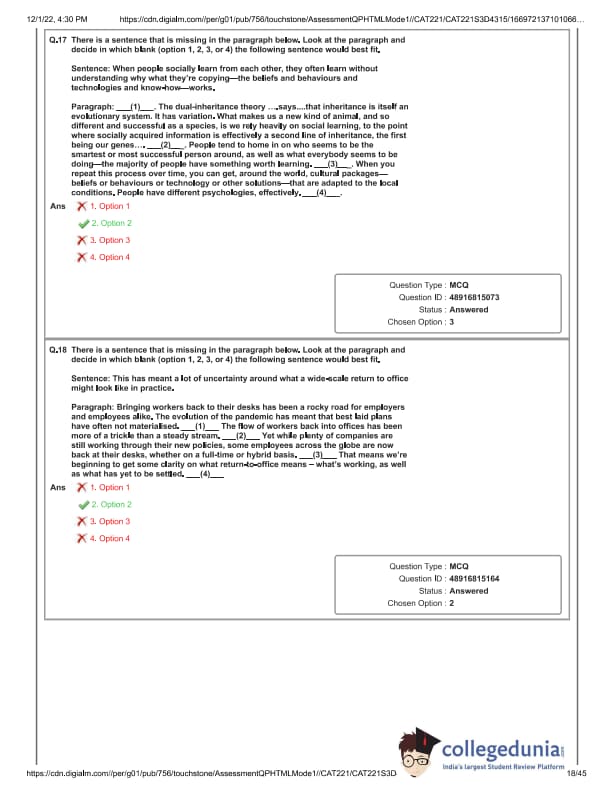
There is a sentence that is missing in the paragraph below. Look at the paragraph and decide in which blank (option 1, 2, 3, or 4) the following sentence would best fit.
Sentence: When people socially learn from each other, they often learn without understanding why what they're copying—the beliefs and behaviours and technologies and know-how—works.
Paragraph: _ (1) _. The dual-inheritance theory .... says .... that inheritance is itself an evolutionary system. It has variation. What makes us a new kind of animal, and so different and successful as a species, is we rely heavily on social learning, to the point where socially acquired information is effectively a second line of inheritance, the first being our genes .... _ (2) _. People tend to home in on who seems to be the smartest or most successful person around, as well as what everybody seems to be doing—the majority of people have something worth learning. _ (3) _. When you repeat this process over time, you can get, around the world, cultural packages—beliefs or behaviours or technology or other solutions—that are adapted to the local conditions. People have different psychologies, effectively. _ (4) _.
(1) Option 1
(2) Option 2
(3) Option 3
(4) Option 4
View Solution
There is a sentence that is missing in the paragraph below. Look at the paragraph and decide in which blank (option 1, 2, 3, or 4) the following sentence would best fit.
Sentence: This has meant a lot of uncertainty around what a wide-scale return to office might look like in practice.
Paragraph: Bringing workers back to their desks has been a rocky road for employers and employees alike. The evolution of the pandemic has meant that best laid plans have often not materialised. _ (1) _ The flow of workers back into offices has been more of a trickle than a steady stream. _ (2) _ Yet while plenty of companies are still working through their new policies, some employees across the globe are now back at their desks, whether on a full-time or hybrid basis. _ (3) _ That means we're beginning to get some clarity on what return-to-office means — what's working, as well as what has yet to be settled. _ (4) _
(1) Option 1
(2) Option 2
(3) Option 3
(4) Option 4
View Solution
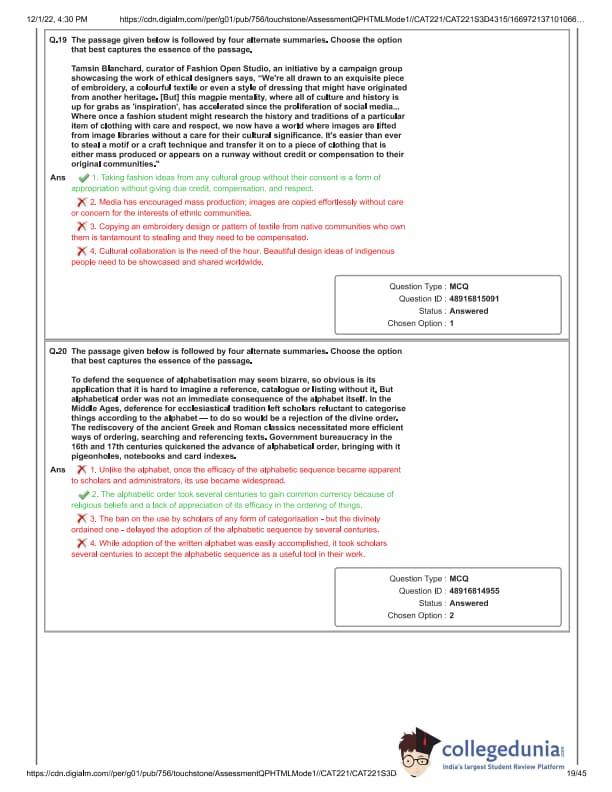
The passage given below is followed by four alternate summaries. Choose the option that best captures the essence of the passage.
Tamsin Blanchard, curator of Fashion Open Studio, an initiative by a campaign group showcasing the work of ethical designers says, "We're all drawn to an exquisite piece of embroidery, a colourful textile or even a style of dressing that might have originated from another heritage. [But] this magpie mentality, where all of culture and history is up for grabs as 'inspiration', has accelerated since the proliferation of social media ... Where once a fashion student might research the history and traditions of a particular item of clothing with care and respect, we now have a world where images are lifted from image libraries without a care for their cultural significance. It's easier than ever to steal a motif or a craft technique and transfer it on to a piece of clothing that is either mass produced or appears on a runway without credit or compensation to their original communities."
(1) Taking fashion ideas from any cultural group without their consent is a form of
appropriation without giving due credit, compensation, and respect.
(2) Media has encouraged mass production; images are copied effortlessly without care or
concern for the interests of ethnic communities.
(3) Copying an embroidery design or pattern of textile from native communities who own
them is tantamount to stealing and they need to be compensated.
(4) Cultural collaboration is the need of the hour. Beautiful design ideas of indigenous
people need to be showcased and shared worldwide.
View Solution
The passage given below is followed by four alternate summaries. Choose the option that best captures the essence of the passage.
To defend the sequence of alphabetisation may seem bizarre, so obvious is its application that it is hard to imagine a reference, catalogue or listing without it. But alphabetical order was not an immediate consequence of the alphabet itself. In the Middle Ages, deference for ecclesiastical tradition left scholars reluctant to categorise things according to the alphabet — to do so would be a rejection of the divine order. The rediscovery of the ancient Greek and Roman classics necessitated more efficient ways of ordering, searching and referencing texts. Government bureaucracy in the 16th and 17th centuries quickened the advance of alphabetical order, bringing with it pigeonholes, notebooks and card indexes.
(1) Unlike the alphabet, once the efficacy of the alphabetic sequence became apparent to
scholars and administrators, its use became widespread.
(2) The alphabetic order took several centuries to gain common currency because of
religious beliefs and a lack of appreciation of its efficacy in the ordering of things.
(3) The ban on the use by scholars of any form of categorisation — but the divinely ordained
one — delayed the adoption of the alphabetic sequence by several centuries.
(4) While adoption of the written alphabet was easily accomplished, it took scholars several
centuries to accept the alphabetic sequence as a useful tool in their work.
View Solution
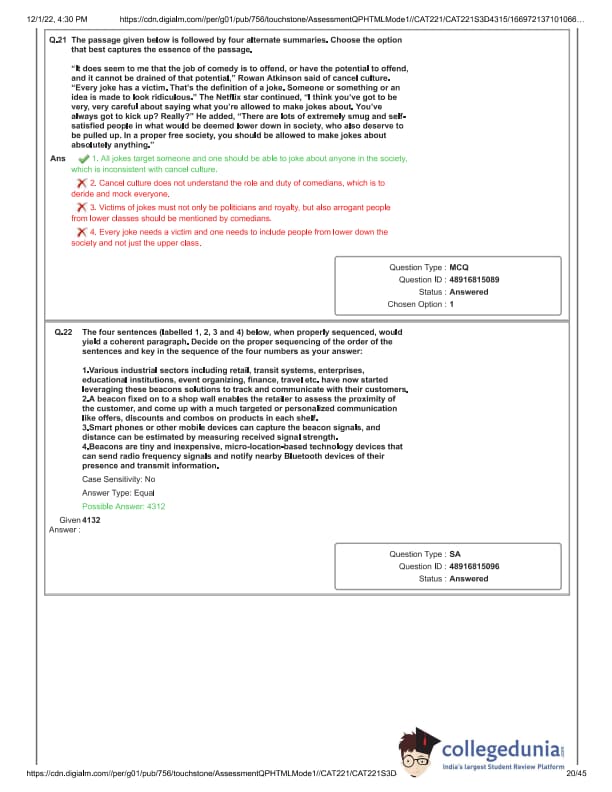
The passage given below is followed by four alternate summaries. Choose the option that best captures the essence of the passage.
"It does seem to me that the job of comedy is to offend, or have the potential to offend, and it cannot be drained of that potential," Rowan Atkinson said of cancel culture. "Every joke has a victim. That's the definition of a joke. Someone or something or an idea is made to look ridiculous." The Netflix star continued, "I think you've got to be very, very careful about saying what you're allowed to make jokes about. You've always got to kick up? Really?" He added, "There are lots of extremely smug and self-satisfied people in what would be deemed lower down in society, who also deserve to be pulled up. In a proper free society, you should be allowed to make jokes about absolutely anything."
(1) All jokes target someone and one should be able to joke about anyone in the society,
which is inconsistent with cancel culture.
(2) Cancel culture does not understand the role and duty of comedians, which is to deride
and mock everyone.
(3) Victims of jokes must not only be politicians and royalty, but also arrogant people from
lower classes should be mentioned by comedians.
(4) Every joke needs a victim and one needs to include people from lower down the society
and not just the upper class.
View Solution
The passage discusses Rowan Atkinson’s view that comedy inherently involves offense, as every joke has a "victim." He criticizes the idea promoted by cancel culture that certain groups should be off-limits in humor. He argues for equal-opportunity satire, even including those in lower social strata, provided it's done in a free society. Option (1) best captures this full sentiment — the essence of comedy, its clash with cancel culture, and the belief that no one should be exempt from satire.
Thus, the correct option is: \[ \boxed{(1) All jokes target someone and one should be able to joke about anyone in the society, which is inconsistent with cancel culture.} \] Quick Tip: In summary questions, choose the option that reflects both the central idea and tone. Here, focus on freedom, comedy, and criticism of censorship.
The four sentences (labelled 1, 2, 3 and 4) below, when properly sequenced, would yield a coherent paragraph. Decide on the proper sequencing of the order of the sentences and key in the sequence of the four numbers as your answer:
1. Various industrial sectors including retail, transit systems, enterprises, educational institutions, event organizing, finance, travel etc. have now started leveraging these beacons solutions to track and communicate with their customers.
2. A beacon fixed on to a shop wall enables the retailer to assess the proximity of the customer, and come up with a much targeted or personalized communication like offers, discounts and combos on products in each shelf.
3. Smart phones or other mobile devices can capture the beacon signals, and distance can be estimated by measuring received signal strength.
4. Beacons are tiny and inexpensive, micro-location-based technology devices that can send radio frequency signals and notify nearby Bluetooth devices of their presence and transmit information.
View Solution
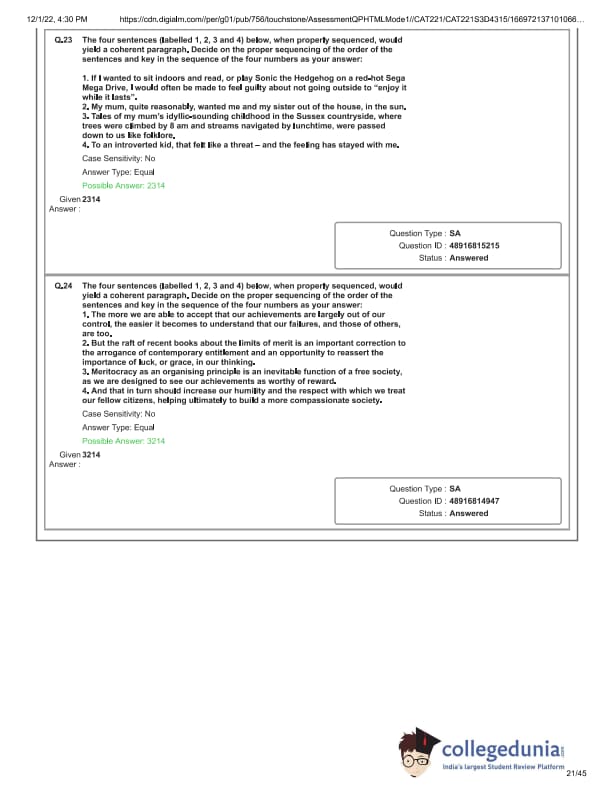
The four sentences (labelled 1, 2, 3 and 4) below, when properly sequenced, would yield a coherent paragraph. Decide on the proper sequencing of the order of the sentences and key in the sequence of the four numbers as your answer:
1. If I wanted to sit indoors and read, or play Sonic the Hedgehog on a red-hot Sega Mega Drive, I would often be made to feel guilty about not going outside to "enjoy it while it lasts".
2. My mum, quite reasonably, wanted me and my sister out of the house, in the sun.
3. Tales of my mum's idyllic-sounding childhood in the Sussex countryside, where trees were climbed by 8 am and streams navigated by lunchtime, were passed down to us like folklore.
4. To an introverted kid, that felt like a threat - and the feeling has stayed with me.
View Solution
The four sentences (labelled 1, 2, 3 and 4) below, when properly sequenced, would yield a coherent paragraph. Decide on the proper sequencing of the order of the sentences and key in the sequence of the four numbers as your answer:
1. The more we are able to accept that our achievements are largely out of our control, the easier it becomes to understand that our failures, and those of others, are too.
2. But the raft of recent books about the limits of merit is an important correction to the arrogance of contemporary entitlement and an opportunity to reassert the importance of luck, or grace, in our thinking.
3. Meritocracy as an organising principle is an inevitable function of a free society, as we are designed to see our achievements as worthy of reward.
4. And that in turn should increase our humility and the respect with which we treat our fellow citizens, helping ultimately to build a more compassionate society.
View Solution

CAT Question Papers of Other Years
| CAT 2024 Question Papers | CAT 2023 Question Papers |
| CAT 2021 Question Papers | CAT 2020 Question Papers |
| CAT 2019 Question Papers | CAT 2018 Question Papers |
| CAT 2017 Question Papers | CAT 2016 Question Papers |



Comments