




CAT 2023 Slot 2 QA Question Paper is available here for free download. CAT 2023 Slot 2 paper has been conducted on November 26 from 12.30 PM to 2.30 PM. CAT 2023 Slot 2 question paper QA comprises 22 questions to be attempted in 40 minutes. According to initial students reaction, CAT 2023 Slot 2 QA was moderate to difficult.
CAT 2023 Slot 2 QA Question Paper with Solutions PDF
| CAT 2023 QA Question Paper PDF | CAT 2023 QA Answer Key PDF | CAT 2023 QA Solution PDF |
|---|---|---|
 |
|
|
CAT 2023 Slot 2 QA Questions with Solution
| Q. No. | Question (with options) | Answer | Solution |
|---|---|---|---|
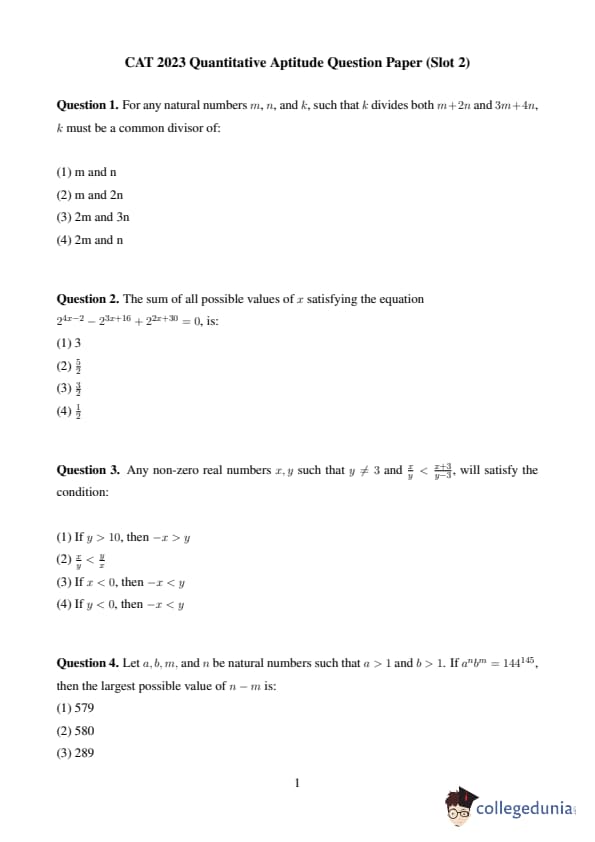
| 1 | For any natural numbers m, n, and k, such that k divides both m + 2n and 3m + 4n, k must be a common divisor of: 1. m and n 2. m and 2n 3. 2m and 3n 4. 2m and n |
Option 2 | Given k divides both expressions, we rewrite m + 2n = ka and 3m + 4n = kb. Subtracting these equations helps identify that k must divide both m and 2n to satisfy the condition. |
| 2 | The sum of all possible values of x satisfying 2^(4x−2) − 2^(3x+16) + 2^(2x+30) = 0 is: 1. 3 2. 5/2 3. 3/2 4. 1/2 |
Option 4 | We express all terms with the same base and rewrite the equation to isolate x. Solving the simplified equation reveals possible values for x, and summing them gives the final answer. |
| 3 | Any non-zero real numbers x, y such that y ≠ 3 and x/y < (x+3)/(y-3), satisfy the condition: 1. If y > 10, then −x > y 2. x/y < y/x 3. If x < 0, then −x < y 4. If y < 0, then −x < y |
Option 4 | By cross-multiplying and simplifying, we get −x < y as a necessary condition when y < 0, leading to the correct answer. |
| 4 | If a^n * b^m = 144145, then the largest possible value of n − m is: 1. 579 2. 580 3. 289 4. 290 |
Option 1 | Decomposing 144145 into prime factors as powers of 2 and 3, we assign values to n and m to maximize n - m, resulting in the answer 579. |
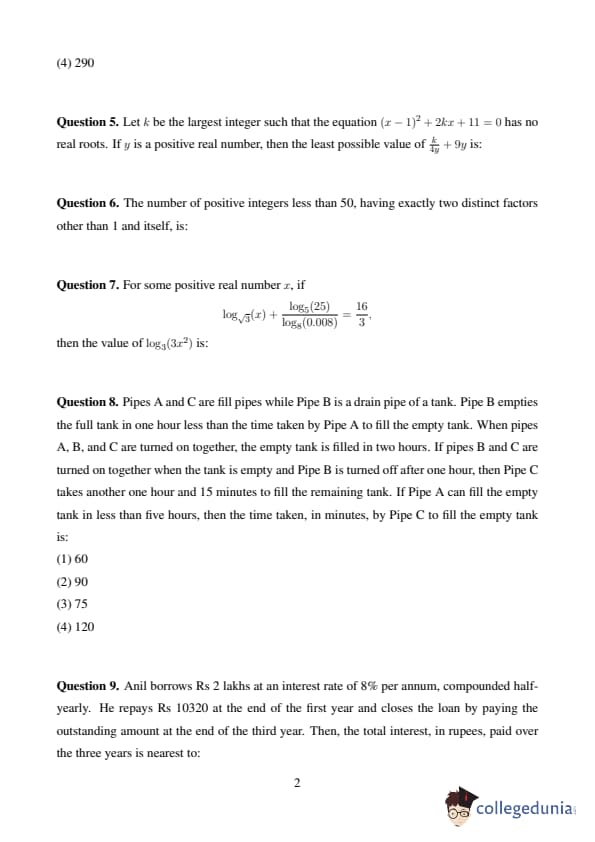
| 5 | Let k be the largest integer such that (x − 1)^2 + 2kx + 11 = 0 has no real roots. Then the least possible value of (k/4y + 9y) is: | 6 | To ensure no real roots, the discriminant must be less than zero. Solving the inequality for k, we find the largest integer satisfying this condition and use it to find the minimum of k/4y + 9y. |
| 6 | The number of positive integers less than 50, having exactly two distinct factors other than 1 and itself, is: | 15 | Since prime numbers have only two distinct factors, we count all prime numbers less than 50, yielding 15. |
| 7 | For some positive real number x, if log√3(x) + log5(25) / log8(0.008) = 16/3, then log3(3x^2) equals: | 7 | We simplify each term in the equation using logarithmic properties and solve for x. Substituting x in log3(3x^2) gives the result. |
| 8 | Pipes A and C are fill pipes while Pipe B is a drain pipe. If pipes B and C are turned on and Pipe B is closed after 1 hour, Pipe C fills the remaining tank in 1 hour 15 mins. Time taken by Pipe C to fill the empty tank: | 90 | We set up rate equations and calculate the time required for Pipe C to fill the tank based on the rates of inflow and outflow, resulting in 90 minutes. |
| 9 | Anil borrows Rs 2 lakhs at 8% p.a., compounded half-yearly. He repays Rs 10320 after one year and closes the loan at the end of the third year. Total interest paid over three years: | 51311 | Calculating compound interest for each period and adjusting for repayments, we determine the total interest paid by Anil. |
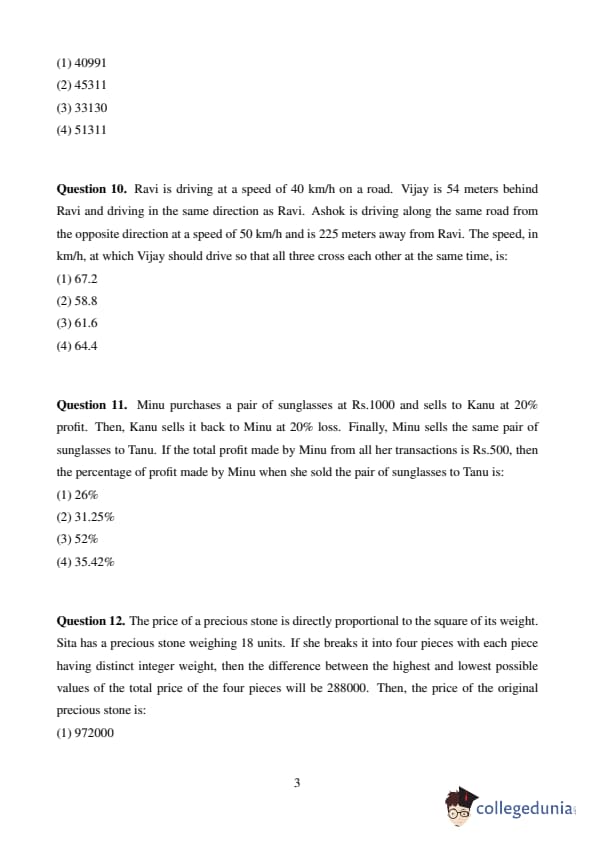
| 10 | Ravi drives at 40 km/h. Vijay, 54 meters behind, needs to drive at what speed to reach Ravi as Ashok approaches from the opposite direction at 50 km/h: | 61.6 | Setting up equations for relative speed, we solve for Vijay's required speed to ensure they all meet at the same time. |
| 11 | Minu buys sunglasses at Rs 1000, sells to Kanu at 20% profit, who sells back at 20% loss. Minu’s profit percentage after final sale: | 31.25% | Calculating each transaction step-by-step, we find that Minu's profit percentage on the final sale is 31.25%. |
| 12 | The price of a precious stone is proportional to the square of its weight. If Sita breaks an 18-unit stone into four pieces with integer weights, total price difference between max and min configurations: | 1296000 | Using proportional relationships, we calculate the price difference between various weight configurations, giving the answer. |
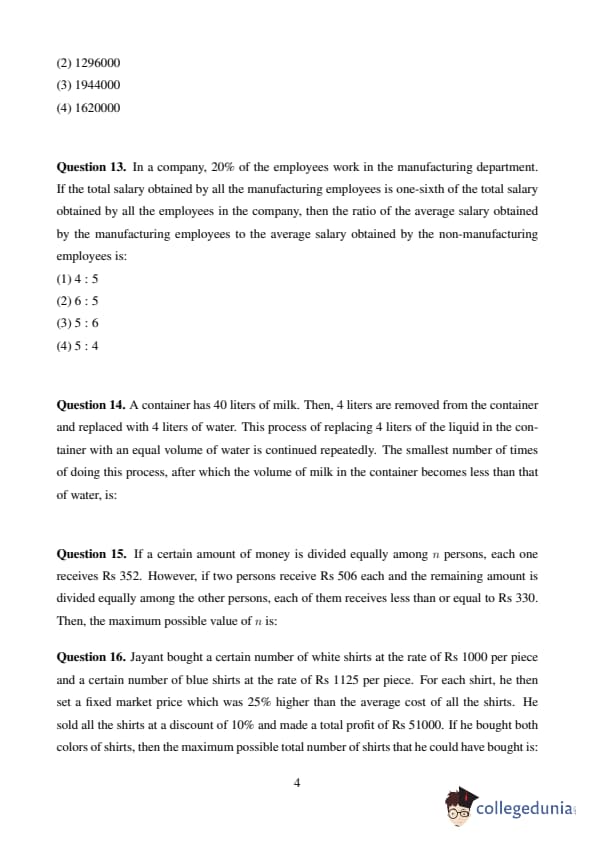
| 13 | In a company, 20% employees work in manufacturing. If manufacturing salary is 1/6 of total salary, the ratio of average salaries (manufacturing : non-manufacturing): | 4 : 5 | Setting up ratios and calculating each average salary, we find the required ratio to be 4:5. |
| 14 | A 40L milk container is reduced by 4L milk and replaced with water multiple times. Minimum repetitions for water volume to exceed milk: | 7 | Using a dilution formula, we calculate that after 7 replacements, the water volume exceeds milk volume in the container. |
| 15 | When a certain amount is divided among n people, each gets Rs 352. If two get Rs 506, and the rest Rs ≤ 330, maximum n: | 16 | Setting up inequalities based on the redistributed amounts, we solve for the maximum possible n. |
| 16 | Jayant buys white shirts at Rs 1000 each and blue shirts at Rs 1125. After selling all shirts with set profit, maximum total shirts bought: | 407 | Setting up profit equations, we determine the maximum number of shirts Jayant could buy to achieve his profit target. |
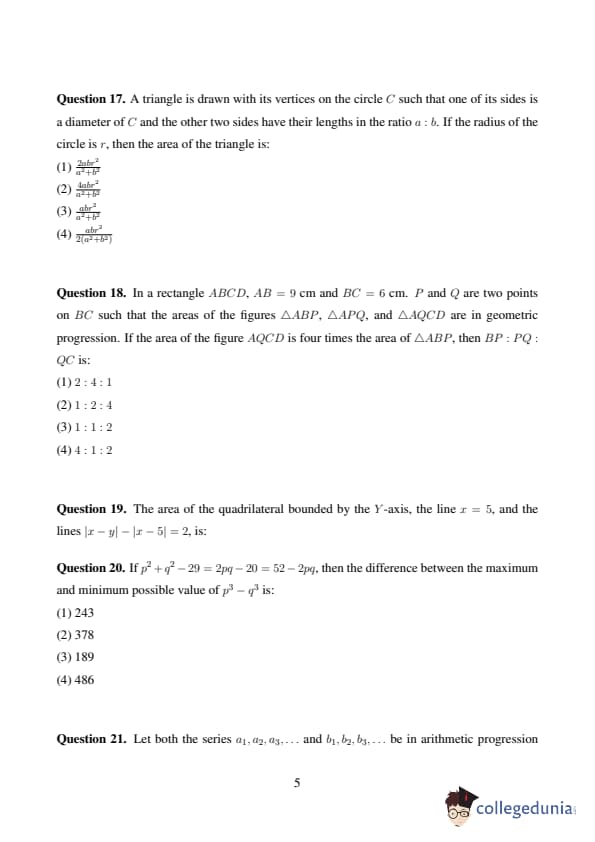
| 17 | A triangle inscribed in a circle with radius r has one side as the diameter, other sides in a:b ratio. Area of the triangle: | 2abr²/(a²+b²) | Using the properties of right triangles inscribed in circles, we apply Pythagorean relationships to find the area. |
| 18 | In rectangle ABCD with AB = 9 cm, BC = 6 cm, points P and Q divide BC such that areas of △ABP, △APQ, and △AQCD are in geometric progression with AQCD = 4×ABP. BP:PQ:QC: | 2 : 4 : 1 | Setting up and solving for geometric progression in areas, we find the length ratios for BP, PQ, and QC. |
| 19 | Area of quadrilateral bounded by Y-axis, x=5, and |x-y| - |x-5| = 2: | 45 | By solving absolute value expressions, we determine the vertices of the quadrilateral and calculate its area. |
| 20 | If p² + q² − 29 = 2pq − 20 = 52 − 2pq, difference between max and min of p³ − q³: | 378 | Solving for p and q and calculating the possible values of p³ - q³, we find the maximum difference. |
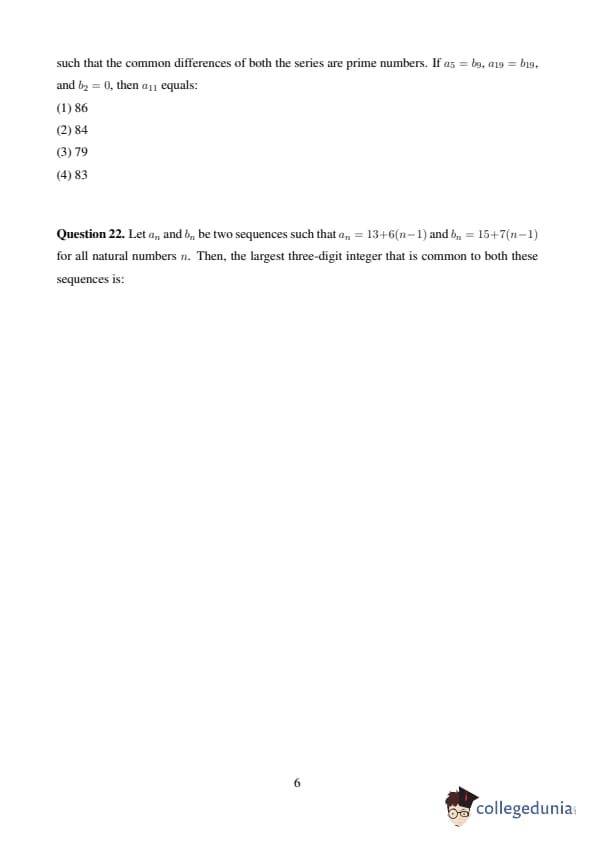
| 21 | Both sequences an and bn are in arithmetic progression. If a5 = b9, a19 = b19, b2 = 0, then a11 equals: | 79 | Using sequence formulas, we solve for common terms and find that a11 equals 79. |
| 22 | Given sequences an = 13 + 6(n−1) and bn = 15 + 7(n−1), largest three-digit integer common to both: | 967 | We determine the LCM of the common differences, and calculate the largest three-digit integer that appears in both sequences. |



Comments