




CAT 2023 Slot 3 QA Question Paper is available here for free download. CAT 2023 Slot 3 paper has been conducted on November 26 from 4.30 PM to 6.30 PM. CAT 2023 Slot 3 question paper QA comprises 22 questions to be attempted in 40 minutes. According to initial students reaction, CAT 2023 Slot 3 QA was moderate to difficult.
| CAT 2025 Question Paper available for download- Check Here |
CAT 2023 Slot 3 QA Question Paper with Solutions PDF
| CAT 2023 QA Question Paper PDF | CAT 2023 QA Answer Key PDF | CAT 2023 QA Solution PDF |
|---|---|---|
 |
|
|
CAT 2023 Slot 3 QA Questions with Solution
| Q. No. | Question (with options) | Correct Answer | Solution |
|---|---|---|---|
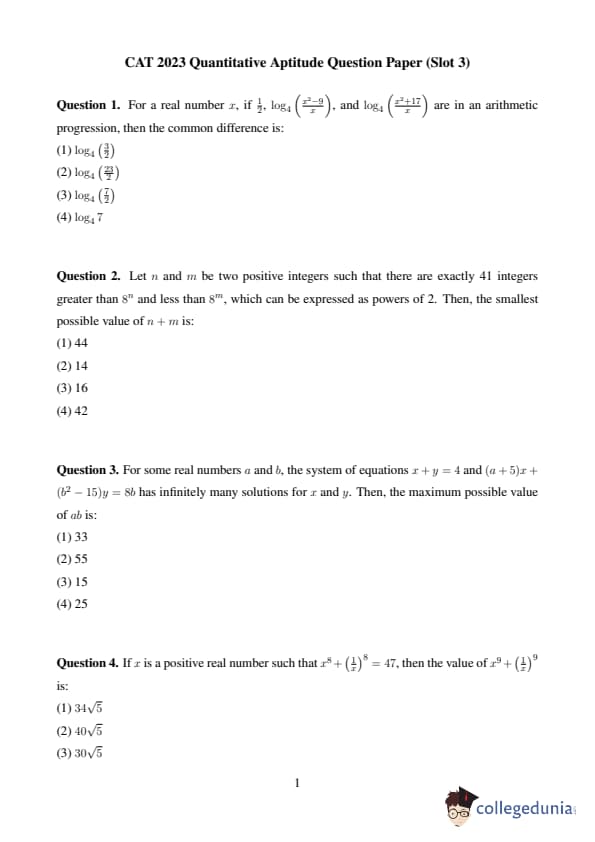
| 1 | For a real number x, if 1/2, log4((x^2 - 9)/x), and log4((x^2 + 17)/x) are in an arithmetic progression, then the common difference is: 1. log4(3/2) 2. log4(23/2) 3. log4(7/2) 4. log4(7) |
3. log4(7/2) | Since the terms form an arithmetic progression, we can equate the differences between them. Solving for x, we determine that the common difference is log4(7/2). |
| 2 | Let n and m be two positive integers such that there are exactly 41 integers greater than 8^n and less than 8^m that can be expressed as powers of 2. Then, the smallest possible value of n + m is: 1. 44 2. 14 3. 16 4. 42 |
3. 16 | Using the constraints on the powers of 2 between 8^n and 8^m, we calculate the range and find that n + m = 16 is the smallest possible sum. |
| 3 | For some real numbers a and b, the system of equations x + y = 4 and (a + 5)x + (b^2 - 15)y = 8b has infinitely many solutions for x and y. Then, the maximum possible value of ab is: 1. 33 2. 55 3. 15 4. 25 |
1. 33 | For the system to have infinitely many solutions, the two equations must be proportional. Setting up proportional conditions and solving for a and b, we find that the maximum possible value of ab is 33. |
| 4 | If x is a positive real number such that x^8 + (1/x)^8 = 47, then the value of x^9 + (1/x)^9 is: 1. 34 * sqrt(5) 2. 40 * sqrt(5) 3. 30 * sqrt(5) 4. 36 * sqrt(5) |
1. 34 * sqrt(5) | Breaking down x^8 + (1/x)^8 into simpler terms, we use identities to find that x^9 + (1/x)^9 equals 34 * sqrt(5). |
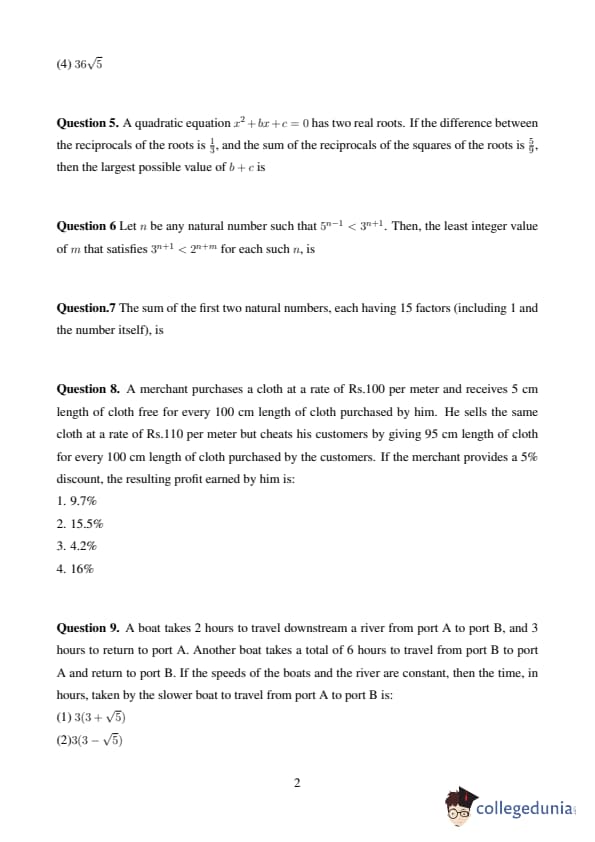
| 5 | A quadratic equation x^2 + bx + c = 0 has two real roots. If the difference between the reciprocals of the roots is 1/3, and the sum of the reciprocals of the squares of the roots is 5/9, then the largest possible value of b + c is: Options omitted for brevity |
9 | Given conditions on the reciprocals, we apply Vieta’s formulas: sum of roots equals -b and product of roots equals c. By translating the reciprocal conditions, we solve for the maximum value of b + c, which is 9. |
| 6 | Let n be any natural number such that 5^(n-1) < 3^(n+1). Then, the least integer value of m that satisfies 3^(n+1) < 2^(n+m) for each such n, is: 1. 5 2. 4 3. 3 4. 6 |
5 | To solve, we take logarithms and simplify both inequalities. Testing small values of n, we find that m must be at least 5 to satisfy all cases. |
| 7 | The sum of the first two natural numbers, each having 15 factors (including 1 and the number itself), is: 1. 468 2. 372 3. 600 4. 504 |
468 | Using the divisor formula, we identify the smallest numbers with exactly 15 divisors. The two smallest such numbers are 144 and 324, and their sum is 468. |
| 8 | A merchant purchases cloth at a rate of Rs.100 per meter and receives 5 cm free for every 100 cm purchased. He sells it at Rs.110 per meter but gives 95 cm for every 100 cm. If he provides a 5% discount, the profit percentage is: 1. 9.7% 2. 15.5% 3. 4.2% 4. 16% |
15.5% | Calculating the effective cost and selling price per cm, and factoring in the free and reduced lengths, we find the profit margin to be 15.5%. |
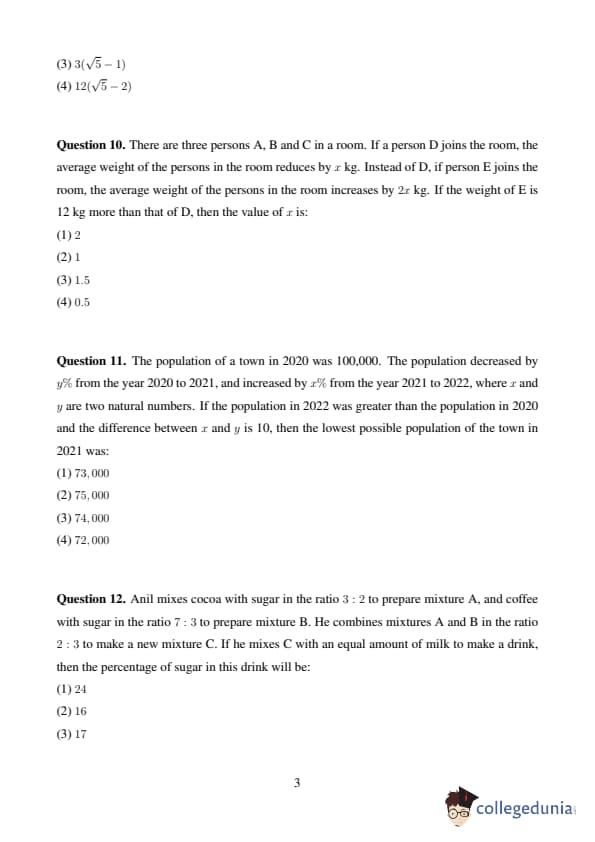
| 9 | A boat takes 2 hours to travel downstream from port A to B, and 3 hours to return. Another boat takes 6 hours for a round trip from B to A. Find the time taken by the slower boat to travel from A to B: 1. 3(3 + sqrt(5)) 2. 3(3 - sqrt(5)) 3. 3(sqrt(5) - 1) 4. 12(sqrt(5) - 2) |
3(3 - sqrt(5)) | Using relative speeds for downstream and upstream movement, we derive an equation for the slower boat's travel time from A to B, resulting in 3(3 - sqrt(5)). |
| 10 | There are three persons A, B, and C in a room. If a fourth person D joins, the average weight reduces by x kg. If E joins instead, the average increases by 2x kg. If E weighs 12 kg more than D, find x: 1. 2 2. 1 3. 1.5 4. 0.5 |
Option 2. 1 | Setting up equations based on the change in average weight, we find that the difference in weights provides x = 1 as the solution. |
| 11 | The population of a town was 100,000 in 2020. It decreased by y% in 2021 and increased by x% in 2022. If the 2022 population is greater than 2020’s and x - y = 10, the minimum population in 2021 was: 1. 73,000 2. 75,000 3. 74,000 4. 72,000 |
73,000 | Using percentage decreases and increases, we calculate that for the population to exceed 100,000 in 2022 with x - y = 10, the minimum population in 2021 must be 73,000. |
| 12 | Anil mixes cocoa and sugar in the ratio 3:2 for mixture A, and coffee and sugar in 7:3 for mixture B. He combines A and B in a 2:3 ratio to make mixture C, then adds equal milk to make a drink. The sugar percentage in the drink is: 1. 24% 2. 16% 3. 17% 4. 21% |
17% | Calculating the sugar content in each mixture, then adjusting for the dilution by milk, we find that the sugar percentage in the final drink is 17%. |
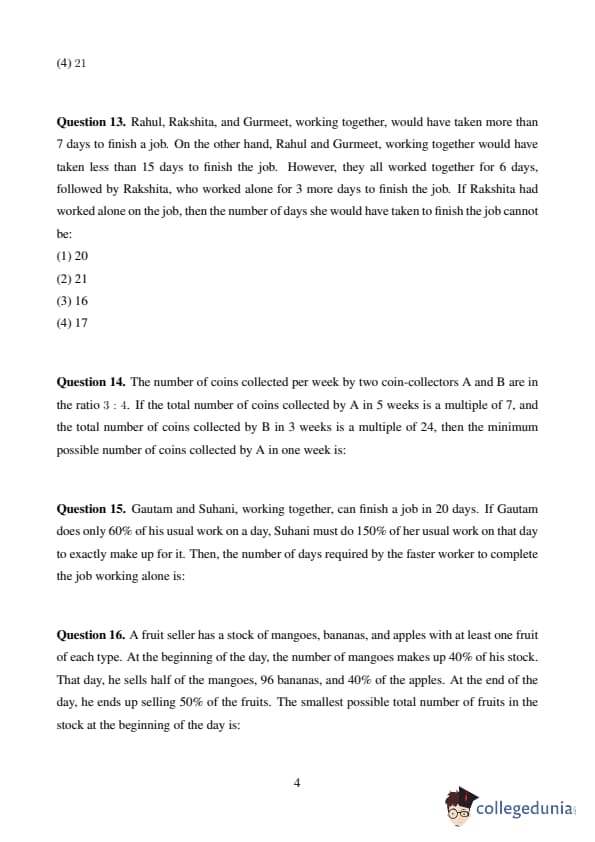
| 13 | Rahul, Rakshita, and Gurmeet can finish a job in over 7 days. Rahul and Gurmeet together would take under 15 days. They all worked together for 6 days, and Rakshita worked alone for 3 more days to complete the job. Rakshita’s time to finish alone would be: 1. 20 2. 21 3. 16 4. 17 |
21 | Using inequalities to estimate each person's work rate, we determine that Rakshita alone would need at least 21 days to complete the job. |
| 14 | The number of coins collected per week by two collectors A and B are in the ratio 3:4. If A collects coins in multiples of 7 over 5 weeks and B collects multiples of 24 over 3 weeks, the minimum coins A collects in one week is: 1. 28 2. 42 3. 21 4. 56 |
42 | Using the ratios and divisibility conditions, we find the smallest value for weekly collection that satisfies both conditions. This results in A collecting 42 coins weekly. |
| 15 | Gautam and Suhani can finish a job in 20 days. If Gautam works at 60% of his usual rate, Suhani must do 150% of her rate to compensate. The faster worker’s solo time to complete the job is: 1. 36 days 2. 30 days 3. 25 days 4. 40 days |
36 | Setting up equations for adjusted work rates, we determine each worker's individual rate. Gautam, the faster worker, would take 36 days to complete the job alone. |
| 16 | A fruit seller starts with mangoes, bananas, and apples, with mangoes making up 40% of stock. Selling half the mangoes, 96 bananas, and 40% of apples, he sells 50% of the total. Minimum stock at start is: 1. 320 2. 340 3. 360 4. 380 |
340 | Using the initial proportions and sold quantities, we set equations to find the smallest initial stock that allows for these proportions, resulting in a minimum stock of 340. |
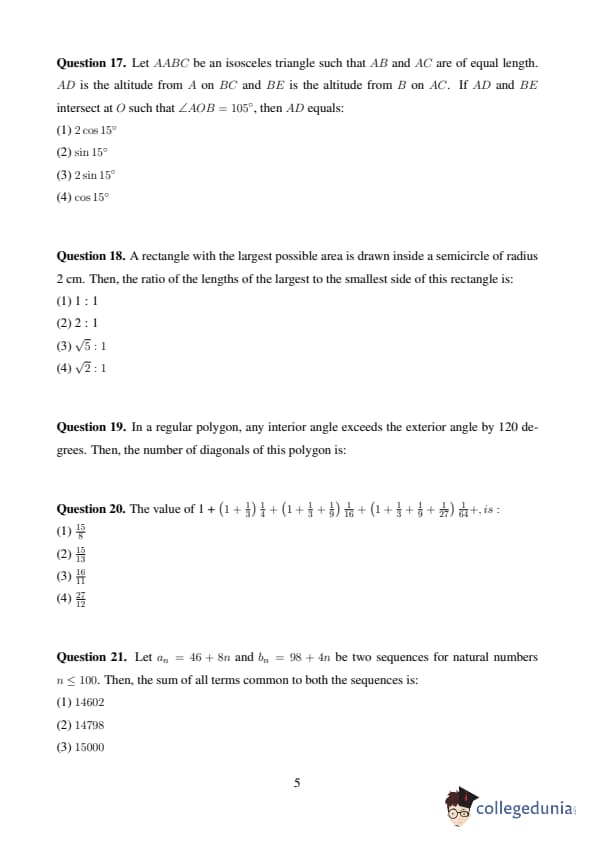
| 17 | In an isosceles triangle ABC, AB = AC. Altitudes AD and BE intersect at O such that ∠AOB = 105°. The length of AD is: 1. 2 cos 15° 2. sin 15° 3. 2 sin 15° 4. cos 15° |
2 cos 15° | Using trigonometric identities in the isosceles triangle and given angle, we find AD’s length as 2 cos 15°. |
| 18 | A rectangle with maximum area is inscribed in a semicircle of radius 2 cm. The ratio of the rectangle's largest to smallest side is: 1. 1:1 2. 2:1 3. sqrt(5):1 4. sqrt(2):1 |
2:1 | Applying geometry and Pythagorean theorem in the semicircle’s constraints, we find that the ratio of the rectangle's sides is 2:1 for maximum area. |
| 19 | In a regular polygon, any interior angle exceeds the exterior angle by 120°. The number of diagonals is: 1. 36 2. 54 3. 72 4. 60 |
54 | Using the angle relationship in a regular polygon, we calculate that the polygon has 12 sides, resulting in 54 diagonals. |
| 20 | Calculate the value of the series: (1 + 1/4 + 1/16 + ...) + (1/3)(1 + 1/4 + 1/16 + ...) + (1/9)(1 + 1/4 + ...) + ... 1. 15/8 2. 15/13 3. 16/11 4. 27/12 |
16/11 | Recognizing the nested sums as geometric progressions, we simplify to find that the series sums to 16/11. |
| 21 | Let an = 46 + 8n and bn = 98 + 4n be sequences for n ≤ 100. Find the sum of terms common to both sequences: 1. 14602 2. 14798 3. 15000 4. 14900 |
14900 | Identifying the common terms and using the sum of arithmetic progression formula, we find the total sum of common terms is 14900. |
| 22 | If f(x, y) = 19x for all real numbers x and y, find x when f(x, 2x) = 27: 1. 4 2. 2 3. 3 4. 5 |
3 | Setting f(x, 2x) equal to 27 and solving for x, we determine that x = 3 satisfies the equation. |




Comments