




CAT 2025 Slot 2 DILR Question Paper is available here for free download. CAT 2025 Slot 2 paper was held on November 30 from 12:30 PM to 2:30 PM. CAT 2025 Slot 2 question paper DILR comprises 22 questions to be attempted in 40 minutes. Based on expert analysis, the difficulty level of the CAT 2025 Slot 2 DILR section was moderate to tough.
Also Check CAT 2025 Question Paper (All Slots)
CAT 2025 Slot 2 DILR Question Paper with Solutions PDF
| CAT 2025 Slot 2 DILR Question Paper with Solutions PDF | |
|---|---|
| Download PDF | Check Solutions |
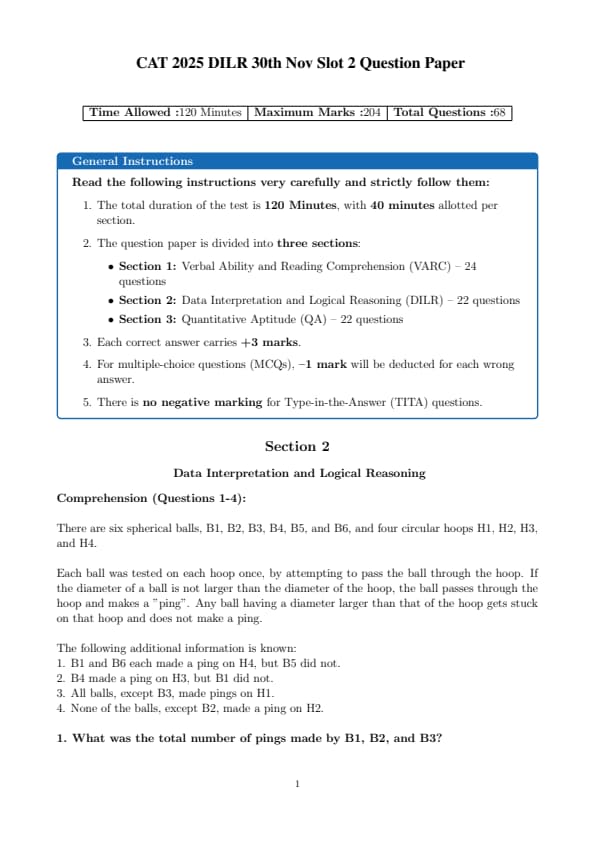
Comprehension (Questions 1-4):
There are six spherical balls, B1, B2, B3, B4, B5, and B6, and four circular hoops H1, H2, H3,
and H4.
Each ball was tested on each hoop once, by attempting to pass the ball through the hoop. If
the diameter of a ball is not larger than the diameter of the hoop, the ball passes through the
Read More
hoop and makes a ”ping”. Any ball having a diameter larger than that of the hoop gets stuckon that hoop and does not make a ping.
The following additional information is known:
1. B1 and B6 each made a ping on H4, but B5 did not.
2. B4 made a ping on H3, but B1 did not.
3. All balls, except B3, made pings on H1.
4. None of the balls, except B2, made a ping on H2.
Question 1:
What was the total number of pings made by B1, B2, and B3?
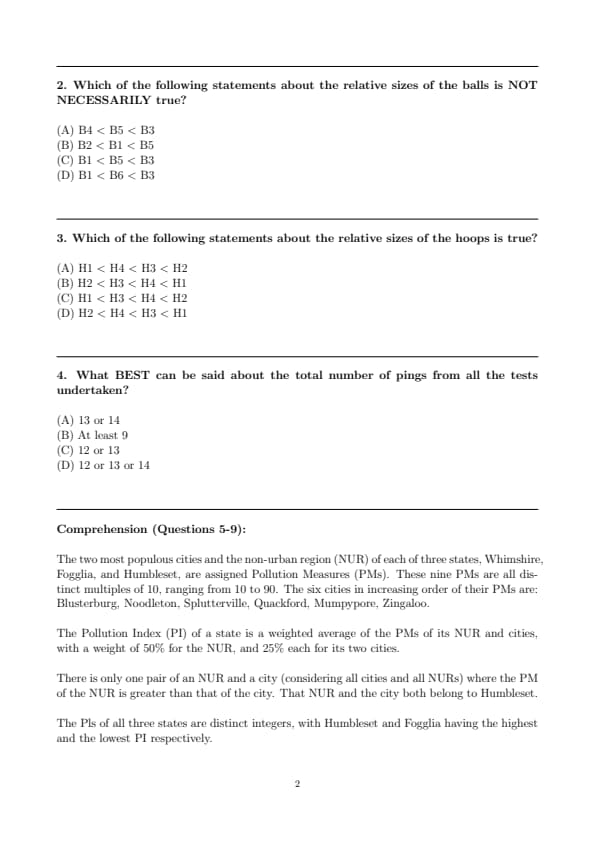
Which of the following statements about the relative sizes of the balls is NOT NECESSARILY true?
Which of the following statements about the relative sizes of the hoops is true?
What BEST can be said about the total number of pings from all the tests undertaken?
Comprehension (Questions 5-9):
The two most populous cities and the non-urban region (NUR) of each of three states, Whimshire,
Fogglia, and Humbleset, are assigned Pollution Measures (PMs). These nine PMs are all dis-
tinct multiples of 10, ranging from 10 to 90. The six cities in increasing order of their PMs are:
Blusterburg, Noodleton, Splutterville, Quackford, Mumpypore, Zingaloo.
Read More
The Pollution Index (PI) of a state is a weighted average of the PMs of its NUR and cities,with a weight of 50% for the NUR, and 25% each for its two cities.
There is only one pair of an NUR and a city (considering all cities and all NURs) where the PM
of the NUR is greater than that of the city. That NUR and the city both belong to Humbleset.
The Pls of all three states are distinct integers, with Humbleset and Fogglia having the highest
and the lowest PI respectively.
Question 5:
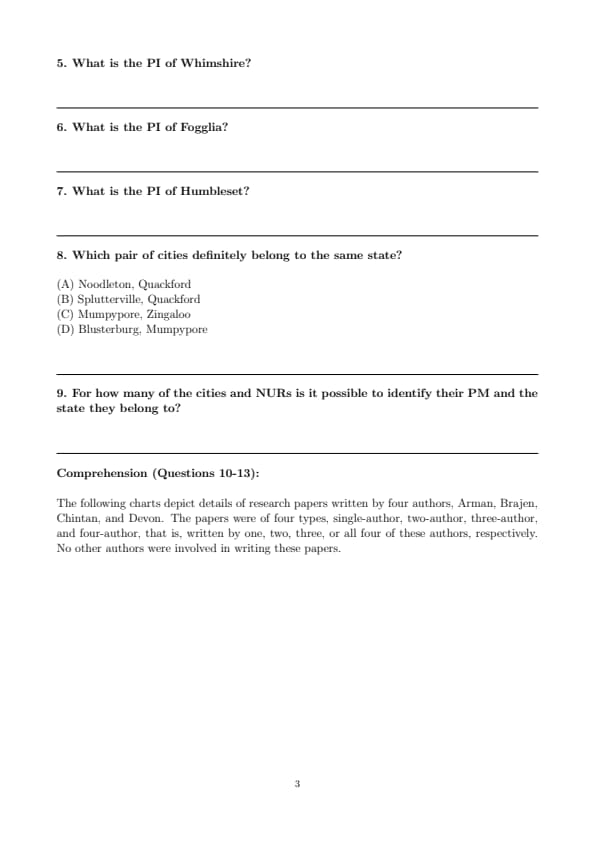
What is the PI of Whimshire?
What is the PI of Fogglia?
What is the PI of Humbleset?
Which pair of cities definitely belong to the same state?
For how many of the cities and NURs is it possible to identify their PM and the state they belong to?
Comprehension (Questions 10-13):
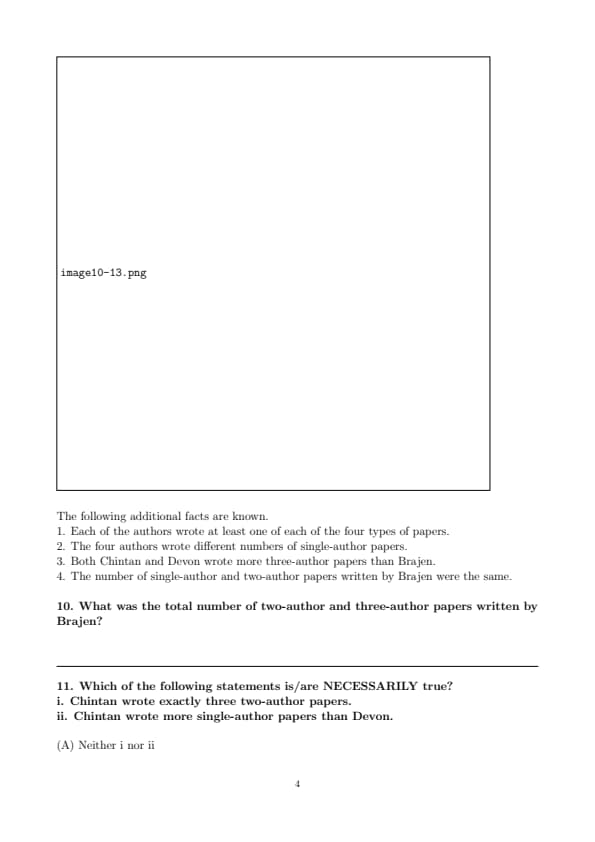
The following charts depict details of research papers written by four authors, Arman, Brajen,
Chintan, and Devon. The papers were of four types, single-author, two-author, three-author,
and four-author, that is, written by one, two, three, or all four of these authors, respectively.
Read More
No other authors were involved in writing these papers.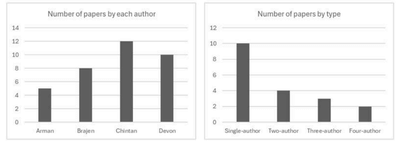
The following additional facts are known.
1. Each of the authors wrote at least one of each of the four types of papers.
2. The four authors wrote different numbers of single-author papers.
3. Both Chintan and Devon wrote more three-author papers than Brajen.
4. The number of single-author and two-author papers written by Brajen were the same.
Question 10:
What was the total number of two-author and three-author papers written by Brajen?
Which of the following statements is/are NECESSARILY true?
i. Chintan wrote exactly three two-author papers.
ii. Chintan wrote more single-author papers than Devon.
Which of the following statements is/are NECESSARILY true?
i. Arman wrote three-author papers only with Chintan and Devon.
ii. Brajen wrote three-author papers only with Chintan and Devon.
If Devon wrote more than one two-author papers, then how many two-author papers did Chintan write?
Comprehension (Questions 14-17):
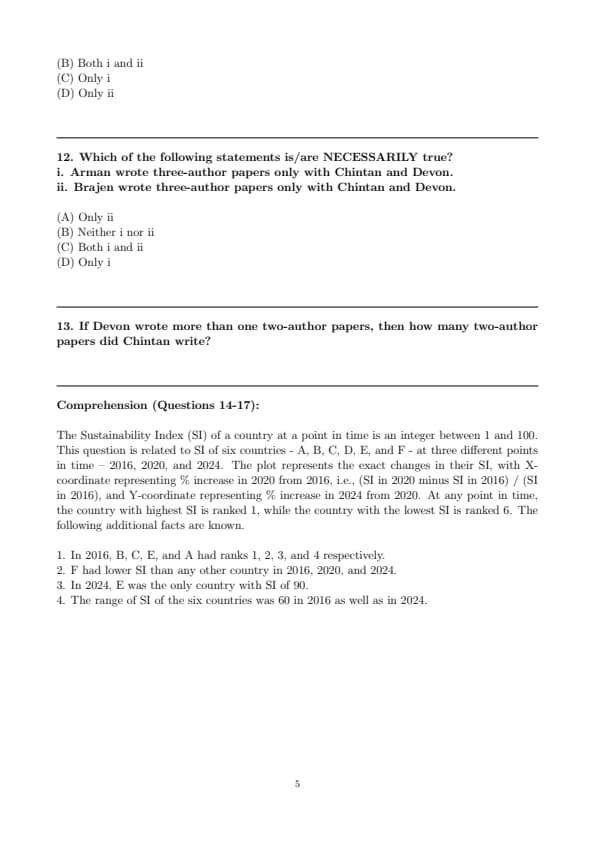
The Sustainability Index (SI) of a country at a point in time is an integer between 1 and 100.
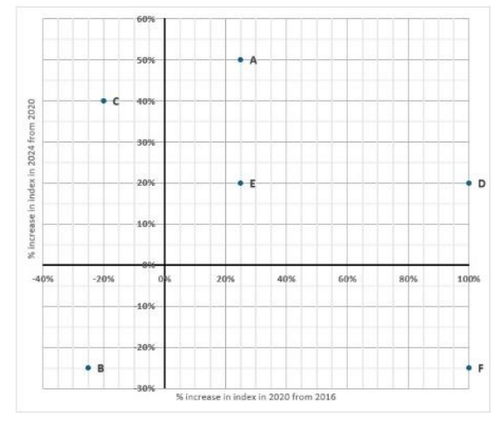
This question is related to SI of six countries - A, B, C, D, E, and F - at three different points
in time – 2016, 2020, and 2024. The plot represents the exact changes in their SI, with X-
Read More
coordinate representing % increase in 2020 from 2016, i.e., (SI in 2020 minus SI in 2016) / (SIin 2016), and Y-coordinate representing % increase in 2024 from 2020. At any point in time,
the country with highest SI is ranked 1, while the country with the lowest SI is ranked 6. The
following additional facts are known.
1. In 2016, B, C, E, and A had ranks 1, 2, 3, and 4 respectively.
2. F had lower SI than any other country in 2016, 2020, and 2024.
3. In 2024, E was the only country with SI of 90.
4. The range of SI of the six countries was 60 in 2016 as well as in 2024.
Question 14:
What was the SI of E in 2016?
What was the SI of F in 2020?
What was the SI of C in 2024?
What was the SI of B in 2024?
Comprehension (Questions 18-22):
Ananya Raga, Bhaskar Tala, Charu Veena, and Devendra Sur are four musicians. Each of them
started and completed their training as students under each of three Gurus - Pandit Meghnath,
Ustad Samiran, and Acharya Raghunath between 2013 and 2024, including both the years.
Read More
under these Gurus; however, they never trained under multiple Gurus in the same year.In none of these years, any of these Gurus trained more than two of these students at the same
time. When two students train under the same Guru at the same time, they are referred to as
Gurubhai, irrespective of their gender.
The following additional facts are known.
1. Ustad Samiran never trained more than one of these students in the same year.
2. Acharya Raghunath did not train any of these students during 2015-2018, as well as during
2021-24.
3. Ananya and Devendra were never Gurubhai; neither were Bhaskar and Charu. All other
pairs of musicians were Gurubhai for exactly 2 years.
4. In 2013, Ananya and Bhaskar started their trainings under Pandit Meghnath and under
Ustad Samiran, respectively.
Question 18:
In which of the following years were Ananya and Bhaskar Gurubhai?
In which year did Charu begin her training under Pandit Meghnath?
In which of the following years were Bhaskar and Devendra Gurubhai?
Which of the following statements is TRUE?
In how many of the years between 2013-24, were only two of these four musicians training under these three Gurus?
CAT 2025 Difficulty Level Analysis
| Section | Difficulty Level | Time Required (Avg.) | Strategy |
|---|---|---|---|
| Verbal Ability and Reading Comprehension (VARC) | Moderate | 60 mins | Focus on speed reading and eliminating incorrect options |
| Data Interpretation and Logical Reasoning (DILR) | High | 40-45 mins | Prioritize easier questions first; manage time carefully |
| Quantitative Ability (QA) | Moderate to High | 60 mins | Solve easy questions first; focus on accuracy |
| Overall | Moderate to High | 180 mins | Time management is key; balance speed and accuracy |



Comments