CAT 2025 Slot 3 VARC Question Paper is available here for free download. CAT 2025 Slot 3 paper was held on November 30 from 4.30 PM to 6.30 PM. CAT 2025 Slot 3 question paper VARC comprises 24 questions to be attempted in 40 minutes. Based on expert analysis, the difficulty level of the CAT 2025 Slot 3 VARC section was moderate to tough.
Also Check CAT 2025 Question Paper (All Slots)
CAT 2025 Slot 3 VARC Question Paper with Solutions PDF

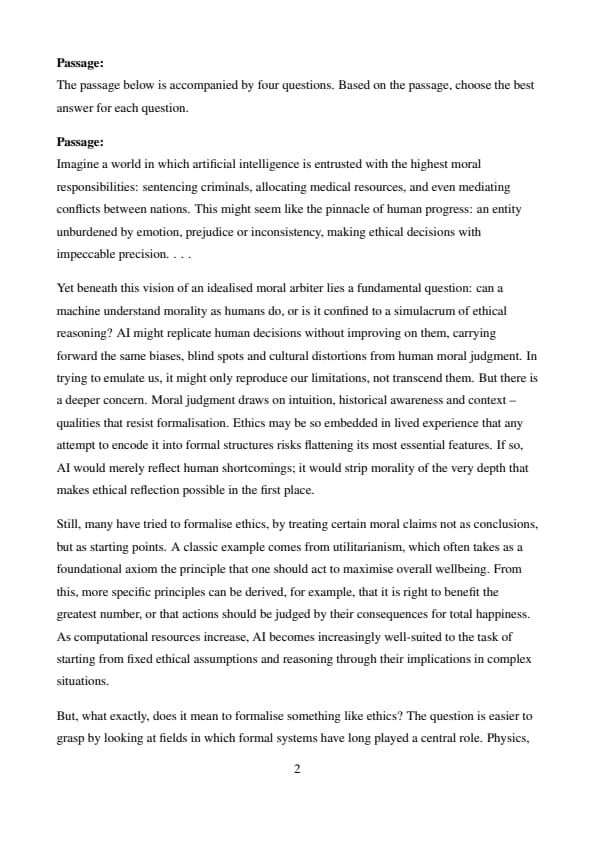
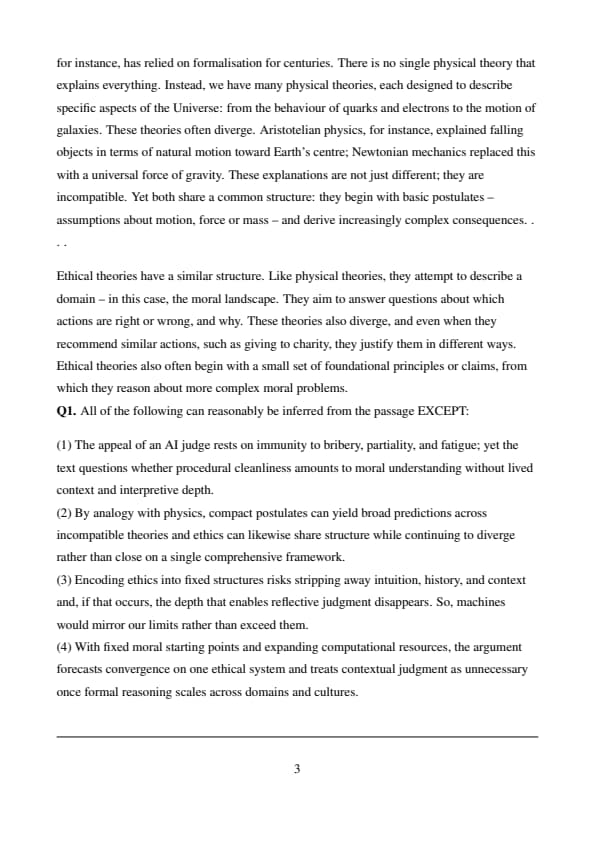
Question 1:
All of the following can reasonably be inferred from the passage EXCEPT:
- (1) The appeal of an AI judge rests on immunity to bribery, partiality, and fatigue; yet the text questions whether procedural cleanliness amounts to moral understanding without lived context and interpretive depth.
- (2) By analogy with physics, compact postulates can yield broad predictions across incompatible theories and ethics can likewise share structure while continuing to diverge rather than close on a single comprehensive framework.
- (3) Encoding ethics into fixed structures risks stripping away intuition, history, and context and, if that occurs, the depth that enables reflective judgment disappears. So, machines would mirror our limits rather than exceed them.
- (4) With fixed moral starting points and expanding computational resources, the argument forecasts convergence on one ethical system and treats contextual judgment as unnecessary once formal reasoning scales across domains and cultures.
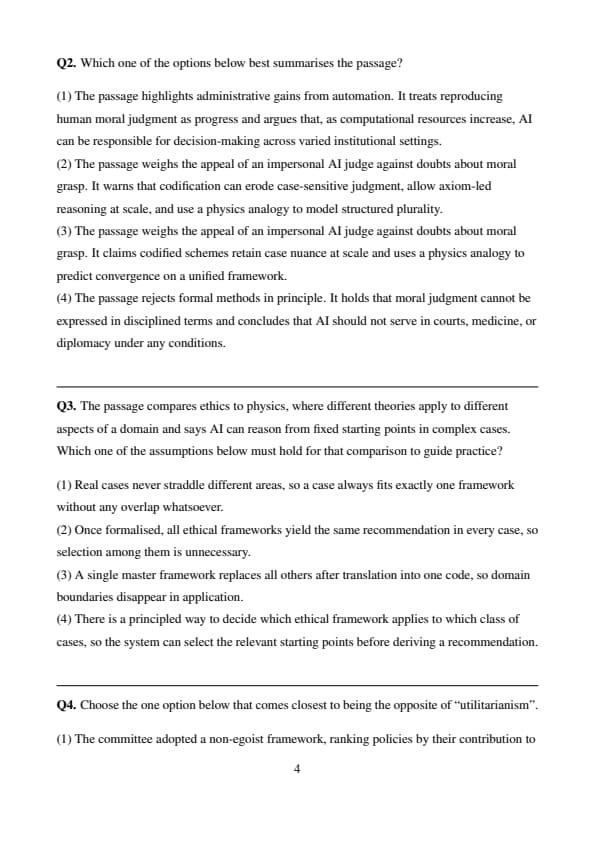
Question 2:
Which one of the options below best summarises the passage?
- (1) The passage highlights administrative gains from automation. It treats reproducing human moral judgment as progress and argues that, as computational resources increase, AI can be responsible for decision-making across varied institutional settings.
- (2) The passage weighs the appeal of an impersonal AI judge against doubts about moral grasp. It warns that codification can erode case-sensitive judgment, allow axiom-led reasoning at scale, and use a physics analogy to model structured plurality.
- (3) The passage weighs the appeal of an impersonal AI judge against doubts about moral grasp. It claims codified schemes retain case nuance at scale and uses a physics analogy to predict convergence on a unified framework.
- (4) The passage rejects formal methods in principle. It holds that moral judgment cannot be expressed in disciplined terms and concludes that AI should not serve in courts, medicine, or diplomacy under any conditions.
Question 3:
The passage compares ethics to physics, where different theories apply to different aspects of a domain and says AI can reason from fixed starting points in complex cases. Which one of the assumptions below must hold for that comparison to guide practice?
- (1) Real cases never straddle different areas, so a case always fits exactly one framework without any overlap whatsoever.
- (2) Once formalised, all ethical frameworks yield the same recommendation in every case, so selection among them is unnecessary.
- (3) A single master framework replaces all others after translation into one code, so domain boundaries disappear in application.
- (4) There is a principled way to decide which ethical framework applies to which class of cases, so the system can select the relevant starting points before deriving a recommendation.
Question 4:
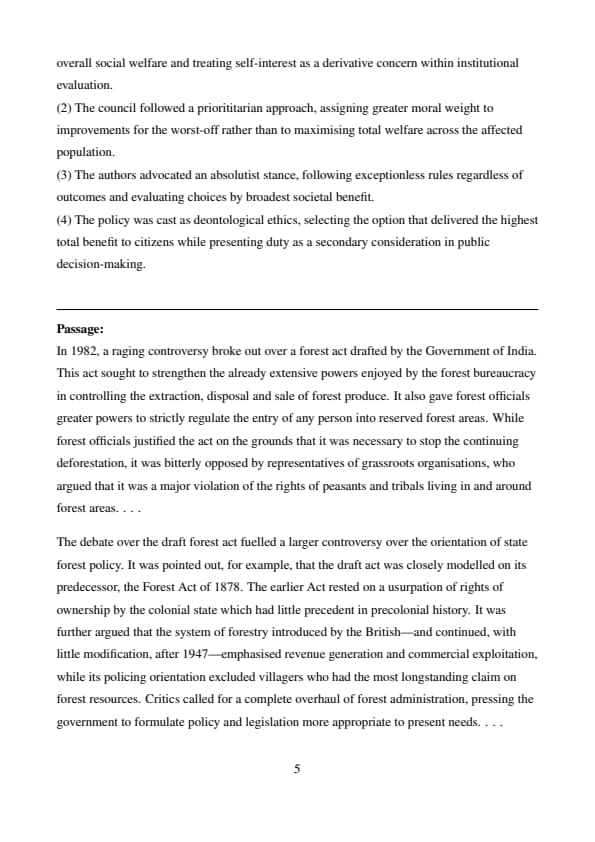
Choose the one option below that comes closest to being the opposite of “utilitarianism”.
- (1) The committee adopted a non-egoist framework, ranking policies by their contribution to overall social welfare and treating self-interest as a derivative concern within institutional evaluation.
- (2) The council followed a priorititarian approach, assigning greater moral weight to improvements for the worst-off rather than to maximising total welfare across the affected population.
- (3) The authors advocated an absolutist stance, following exceptionless rules regardless of outcomes and evaluating choices by broadest societal benefit.
- (4) The policy was cast as deontological ethics, selecting the option that delivered the highest total benefit to citizens while presenting duty as a secondary consideration in public decision-making.
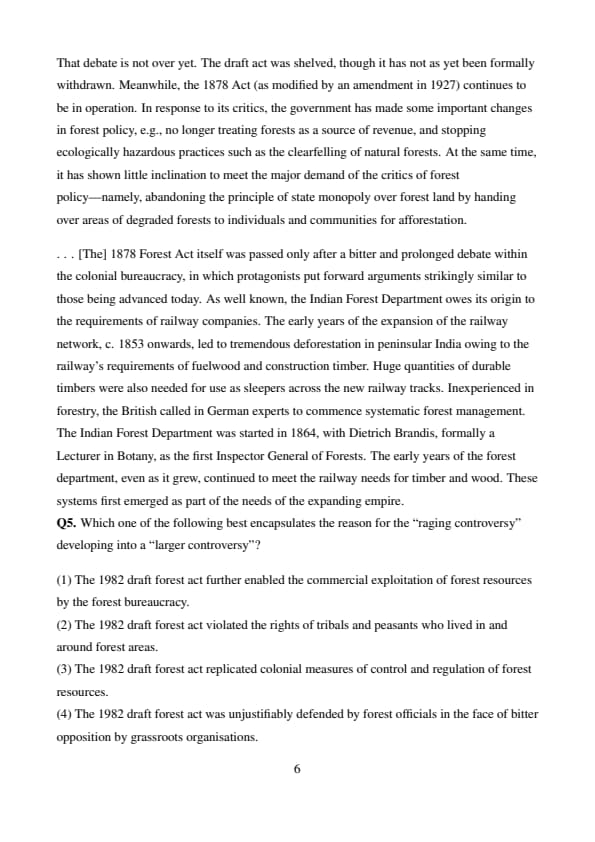
Question 5:
Which one of the following best encapsulates the reason for the “raging controversy” developing into a “larger controversy”?
- (1) The 1982 draft forest act further enabled the commercial exploitation of forest resources by the forest bureaucracy.
- (2) The 1982 draft forest act violated the rights of tribals and peasants who lived in and around forest areas.
- (3) The 1982 draft forest act replicated colonial measures of control and regulation of forest resources.
- (4) The 1982 draft forest act was unjustifiably defended by forest officials in the face of bitter opposition by grassroots organisations.
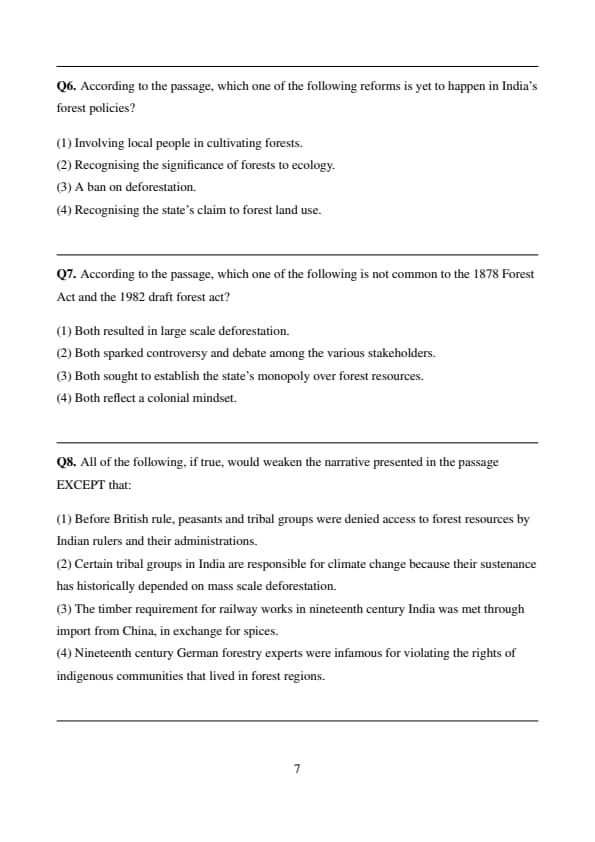
Question 6:
According to the passage, which one of the following reforms is yet to happen in India’s forest policies?
- (1) Involving local people in cultivating forests.
- (2) Recognising the significance of forests to ecology.
- (3) A ban on deforestation.
- (4) Recognising the state's claim to forest land use.
Question 7:
According to the passage, which one of the following is not common to the 1878 Forest Act and the 1982 draft forest act?
- (1) Both resulted in large scale deforestation.
- (2) Both sparked controversy and debate among the various stakeholders.
- (3) Both sought to establish the state’s monopoly over forest resources.
- (4) Both reflect a colonial mindset.
Question 8:
All of the following, if true, would weaken the narrative presented in the passage EXCEPT that:
- (1) Before British rule, peasants and tribal groups were denied access to forest resources by Indian rulers and their administrations.
- (2) Certain tribal groups in India are responsible for climate change because their sustenance has historically depended on mass scale deforestation.
- (3) The timber requirement for railway works in nineteenth century India was met through import from China, in exchange for spices.
- (4) Nineteenth century German forestry experts were infamous for violating the rights of indigenous communities that lived in forest regions.
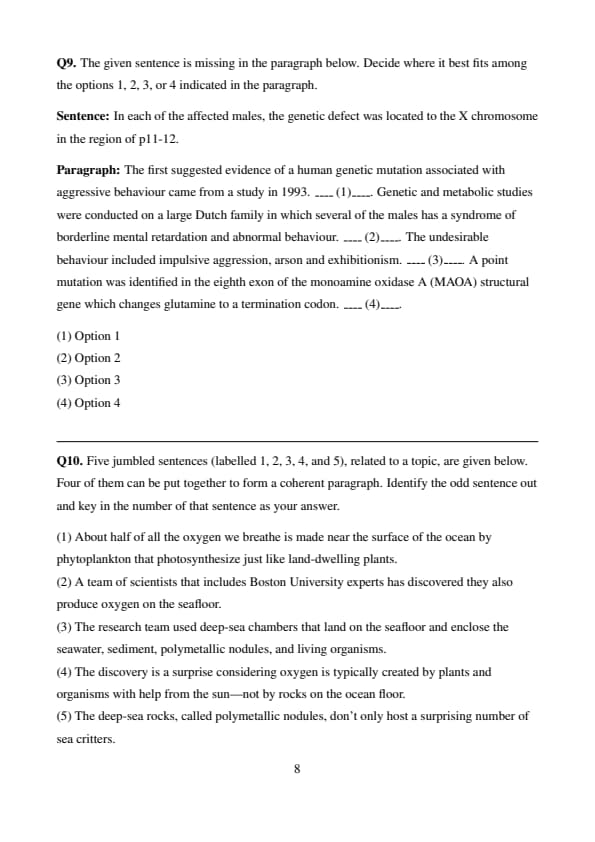
Question 9:
The given sentence is missing in the paragraph below. Decide where it best fits among the options 1, 2, 3, or 4 indicated in the paragraph.
Sentence: In each of the affected males, the genetic defect was located to the X chromosome in the region of p11-12.
Paragraph: The first suggested evidence of a human genetic mutation associated with aggressive behaviour came from a study in 1993. ____ (1)____. Genetic and metabolic studies were conducted on a large Dutch family in which several of the males has a syndrome of borderline mental retardation and abnormal behaviour. ____ (2)____. The undesirable behaviour included impulsive aggression, arson and exhibitionism. ____ (3)____. A point mutation was identified in the eighth exon of the monoamine oxidase A (MAOA) structural gene which changes glutamine to a termination codon. ____ (4)____.
- (1) Option 1
- (2) Option 2
- (3) Option 3
- (4) Option 4
Question 10:
Five jumbled sentences (labelled 1, 2, 3, 4, and 5), related to a topic, are given below. Four of them can be put together to form a coherent paragraph. Identify the odd sentence out and key in the number of that sentence as your answer.
- (1) About half of all the oxygen we breathe is made near the surface of the ocean by phytoplankton that photosynthesize just like land-dwelling plants.
- (2) A team of scientists that includes Boston University experts has discovered they also produce oxygen on the seafloor.
- (3) The research team used deep-sea chambers that land on the seafloor and enclose the seawater, sediment, polymetallic nodules, and living organisms.
- (4) The discovery is a surprise considering oxygen is typically created by plants and organisms with help from the sun—not by rocks on the ocean floor.
- (5) The deep-sea rocks, called polymetallic nodules, don’t only host a surprising number of sea critters.
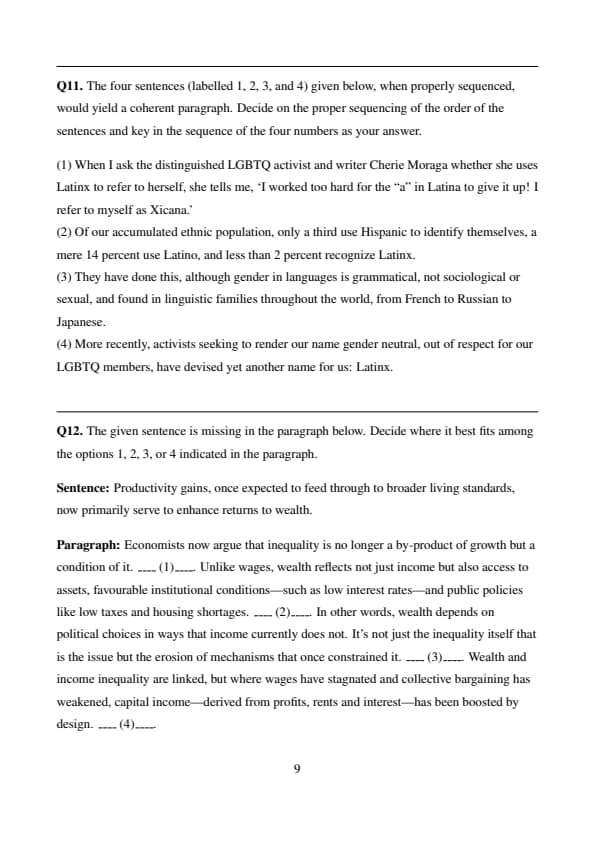
Question 11:
The four sentences (labelled 1, 2, 3, and 4) given below, when properly sequenced, would yield a coherent paragraph. Decide on the proper sequencing of the order of the sentences and key in the sequence of the four numbers as your answer.
- (1) When I ask the distinguished LGBTQ activist and writer Cherie Moraga whether she uses Latinx to refer to herself, she tells me, ‘I worked too hard for the “a” in Latina to give it up! I refer to myself as Xicana.’
- (2) Of our accumulated ethnic population, only a third use Hispanic to identify themselves, a mere 14 percent use Latino, and less than 2 percent recognize Latinx.
- (3) They have done this, although gender in languages is grammatical, not sociological or sexual, and found in linguistic families throughout the world, from French to Russian to Japanese.
- (4) More recently, activists seeking to render our name gender neutral, out of respect for our LGBTQ members, have devised yet another name for us: Latinx.
Question 12:
The given sentence is missing in the paragraph below. Decide where it best fits among the options 1, 2, 3, or 4 indicated in the paragraph.
Sentence: Productivity gains, once expected to feed through to broader living standards, now primarily serve to enhance returns to wealth.
Paragraph: Economists now argue that inequality is no longer a by-product of growth but a condition of it. ____ (1)____. Unlike wages, wealth reflects not just income but also access to assets, favourable institutional conditions—such as low interest rates—and public policies like low taxes and housing shortages. ____ (2)____. In other words, wealth depends on political choices in ways that income currently does not. It’s not just the inequality itself that is the issue but the erosion of mechanisms that once constrained it. ____ (3)____. Wealth and income inequality are linked, but where wages have stagnated and collective bargaining has weakened, capital income—derived from profits, rents and interest—has been boosted by design. ____ (4)____.
- (1) Option 1
- (2) Option 2
- (3) Option 3
- (4) Option 4
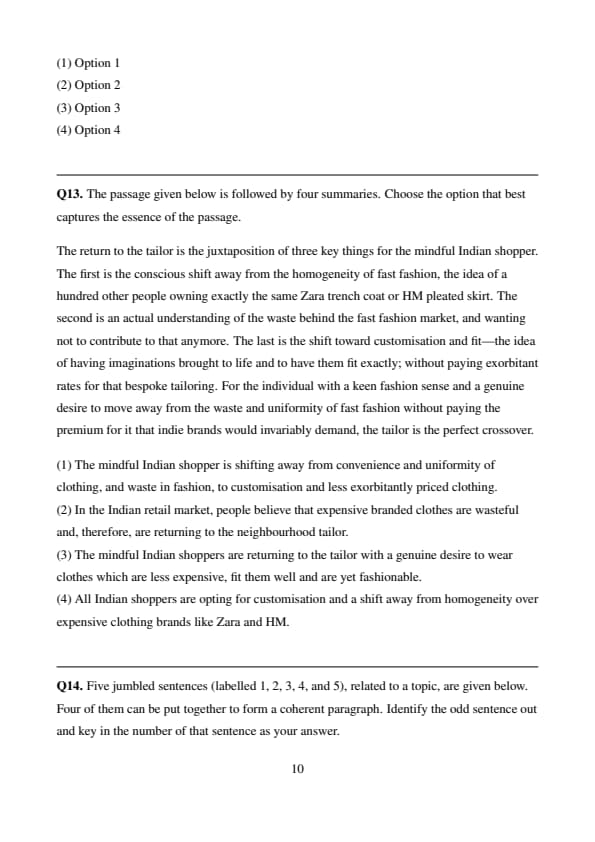
Question 13:
The passage given below is followed by four summaries. Choose the option that best captures the essence of the passage.
The return to the tailor is the juxtaposition of three key things for the mindful Indian shopper. The first is the conscious shift away from the homogeneity of fast fashion, the idea of a
Read More
hundred other people owning exactly the same Zara trench coat or H&M pleated skirt. The second is an actual understanding of the waste behind the fast fashion market, and wanting not to contribute to that anymore. The last is the shift toward customisation and fit—the idea of having imaginations brought to life and to have them fit exactly; without paying exorbitant rates for that bespoke tailoring. For the individual with a keen fashion sense and a genuine desire to move away from the waste and uniformity of fast fashion without paying the premium for it that indie brands would invariably demand, the tailor is the perfect crossover.
- (1) The mindful Indian shopper is shifting away from convenience and uniformity of clothing, and waste in fashion, to customisation and less exorbitantly priced clothing.
- (2) In the Indian retail market, people believe that expensive branded clothes are wasteful and, therefore, are returning to the neighbourhood tailor.
- (3) The mindful Indian shoppers are returning to the tailor with a genuine desire to wear clothes which are less expensive, fit them well and are yet fashionable.
- (4) All Indian shoppers are opting for customisation and a shift away from homogeneity over expensive clothing brands like Zara and H&M.
Question 14:
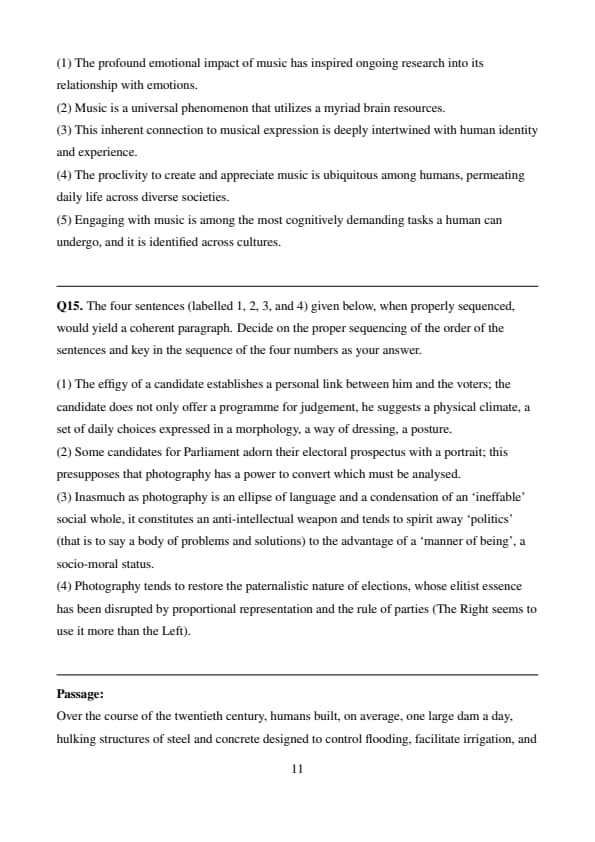
Five jumbled sentences (labelled 1, 2, 3, 4, and 5), related to a topic, are given below. Four of them can be put together to form a coherent paragraph. Identify the odd sentence out and key in the number of that sentence as your answer.
- (1) The profound emotional impact of music has inspired ongoing research into its relationship with emotions.
- (2) Music is a universal phenomenon that utilizes a myriad brain resources.
- (3) This inherent connection to musical expression is deeply intertwined with human identity and experience.
- (4) The proclivity to create and appreciate music is ubiquitous among humans, permeating daily life across diverse societies.
- (5) Engaging with music is among the most cognitively demanding tasks a human can undergo, and it is identified across cultures.
Question 15:
The four sentences (labelled 1, 2, 3, and 4) given below, when properly sequenced, would yield a coherent paragraph. Decide on the proper sequencing of the order of the sentences and key in the sequence of the four numbers as your answer.
- (1) The effigy of a candidate establishes a personal link between him and the voters; the candidate does not only offer a programme for judgement, he suggests a physical climate, a set of daily choices expressed in a morphology, a way of dressing, a posture.
- (2) Some candidates for Parliament adorn their electoral prospectus with a portrait; this presupposes that photography has a power to convert which must be analysed.
- (3) Inasmuch as photography is an ellipse of language and a condensation of an ‘ineffable’ social whole, it constitutes an anti-intellectual weapon and tends to spirit away ‘politics’ (that is to say a body of problems and solutions) to the advantage of a ‘manner of being’, a socio-moral status.
- (4) Photography tends to restore the paternalistic nature of elections, whose elitist essence has been disrupted by proportional representation and the rule of parties (The Right seems to use it more than the Left).
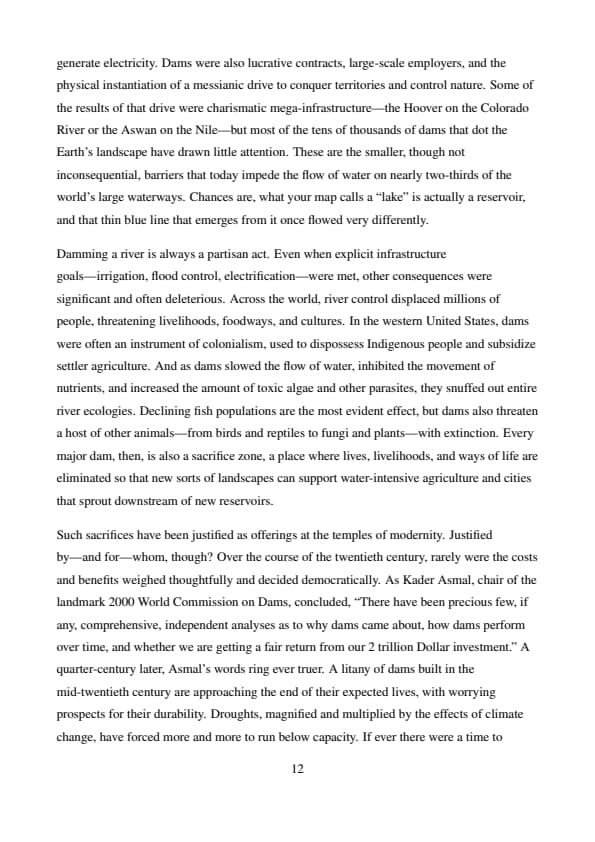
Question 16:
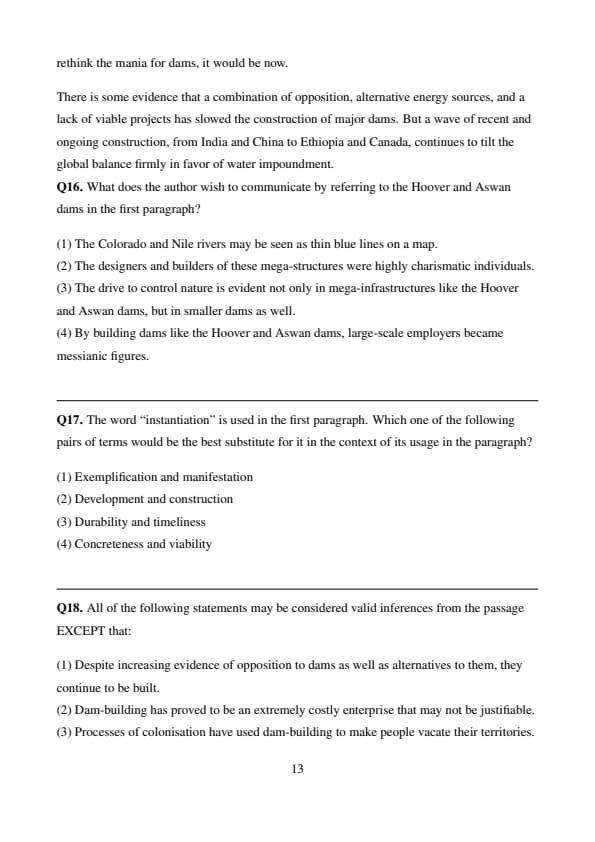
What does the author wish to communicate by referring to the Hoover and Aswan dams in the first paragraph?
- (1) The Colorado and Nile rivers may be seen as thin blue lines on a map.
- (2) The designers and builders of these mega-structures were highly charismatic individuals.
- (3) The drive to control nature is evident not only in mega-infrastructures like the Hoover and Aswan dams, but in smaller dams as well.
- (4) By building dams like the Hoover and Aswan dams, large-scale employers became messianic figures.
Question 17:
The word “instantiation” is used in the first paragraph. Which one of the following pairs of terms would be the best substitute for it in the context of its usage in the paragraph?
- (1) Exemplification and manifestation
- (2) Development and construction
- (3) Durability and timeliness
- (4) Concreteness and viability
Question 18:
All of the following statements may be considered valid inferences from the passage EXCEPT that:
- (1) Despite increasing evidence of opposition to dams as well as alternatives to them, they continue to be built.
- (2) Dam-building has proved to be an extremely costly enterprise that may not be justifiable.
- (3) Processes of colonisation have used dam-building to make people vacate their territories.
- (4) Smaller, though not inconsequential, dams are safer than large dam projects.
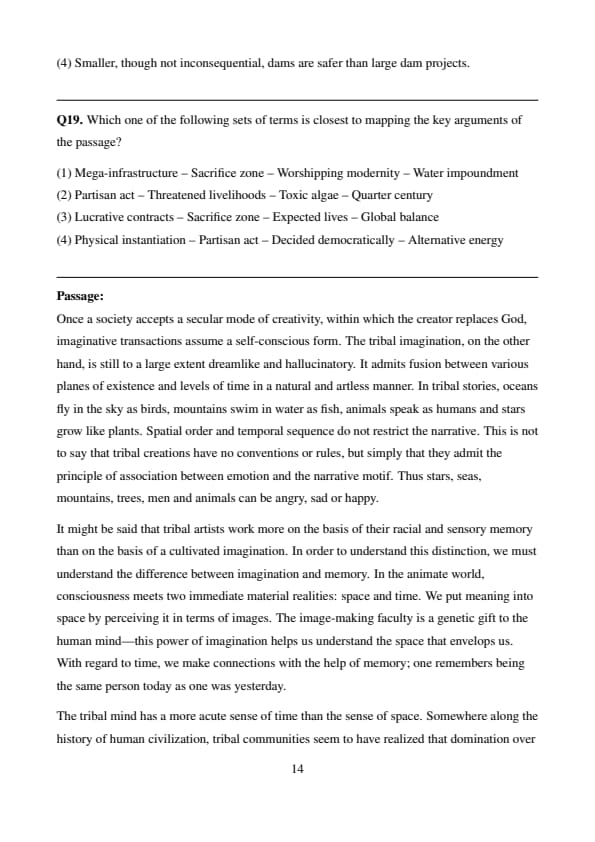
Question 19:
Which one of the following sets of terms is closest to mapping the key arguments of the passage?
- (1) Mega-infrastructure – Sacrifice zone – Worshipping modernity – Water impoundment
- (2) Partisan act – Threatened livelihoods – Toxic algae – Quarter century
- (3) Lucrative contracts – Sacrifice zone – Expected lives – Global balance
- (4) Physical instantiation – Partisan act – Decided democratically – Alternative energy
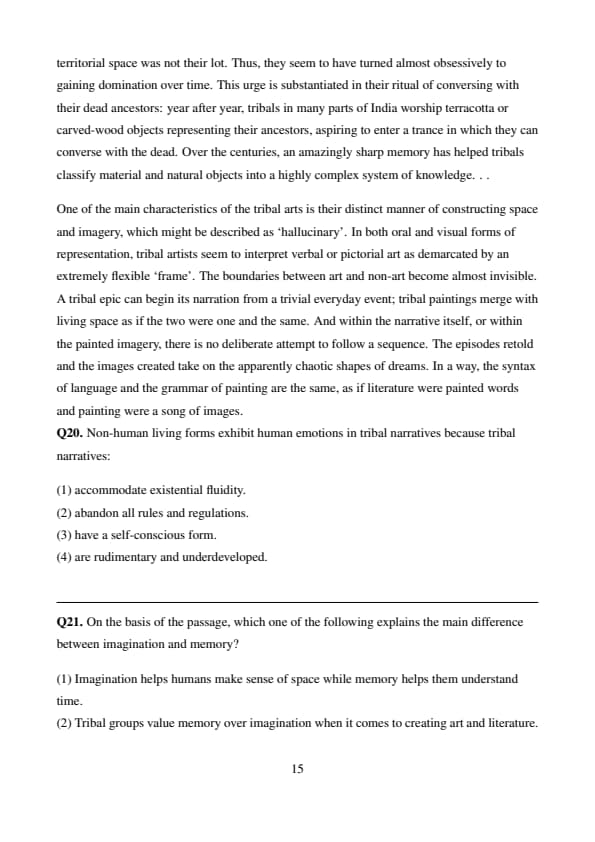
Question 20:
Non-human living forms exhibit human emotions in tribal narratives because tribal narratives:
- (1) accommodate existential fluidity.
- (2) abandon all rules and regulations.
- (3) have a self-conscious form.
- (4) are rudimentary and underdeveloped.
Question 21:
On the basis of the passage, which one of the following explains the main difference between imagination and memory?
- (1) Imagination helps humans make sense of space while memory helps them understand time.
- (2) Tribal groups value memory over imagination when it comes to creating art and literature.
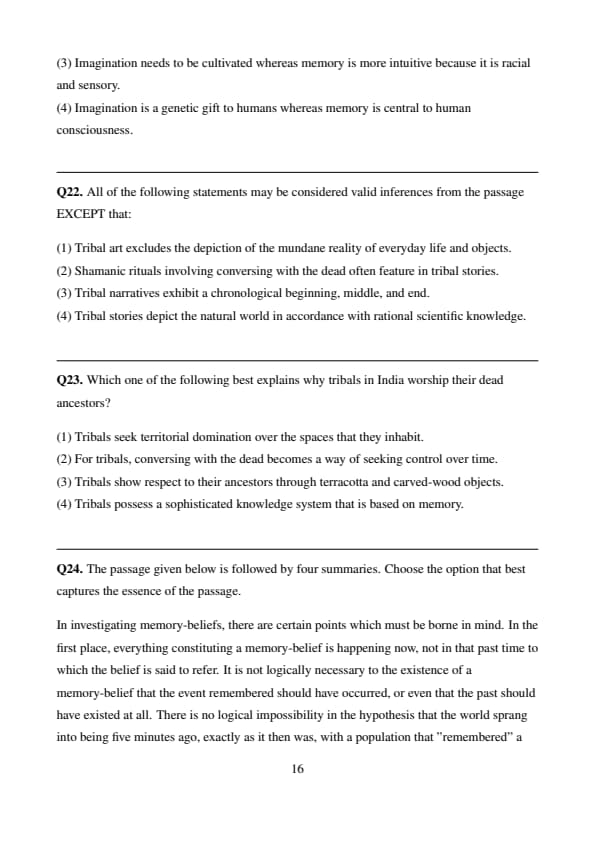
- (3) Imagination needs to be cultivated whereas memory is more intuitive because it is racial and sensory.
- (4) Imagination is a genetic gift to humans whereas memory is central to human consciousness.
Question 22:
All of the following statements may be considered valid inferences from the passage EXCEPT that:
- (1) Tribal art excludes the depiction of the mundane reality of everyday life and objects.
- (2) Shamanic rituals involving conversing with the dead often feature in tribal stories.
- (3) Tribal narratives exhibit a chronological beginning, middle, and end.
- (4) Tribal stories depict the natural world in accordance with rational scientific knowledge.
Question 23:
Which one of the following best explains why tribals in India worship their dead ancestors?
- (1) Tribals seek territorial domination over the spaces that they inhabit.
- (2) For tribals, conversing with the dead becomes a way of seeking control over time.
- (3) Tribals show respect to their ancestors through terracotta and carved-wood objects.
- (4) Tribals possess a sophisticated knowledge system that is based on memory.
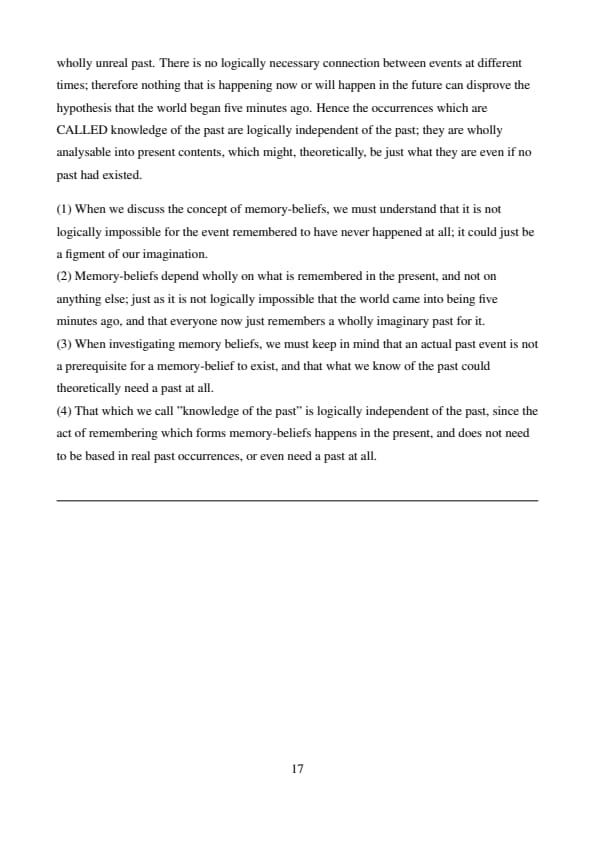
Question 24:
The passage given below is followed by four summaries. Choose the option that best captures the essence of the passage.
In investigating memory-beliefs, there are certain points which must be borne in mind. In the first place, everything constituting a memory-belief is happening now, not in that past time to which the belief is said to refer. It is not logically necessary to the existence of a memory-belief that the event remembered should have occurred, or even
Read More
that the past should have existed at all. There is no logical impossibility in the hypothesis that the world sprang into being five minutes ago, exactly as it then was, with a population that "remembered" a wholly unreal past. There is no logically necessary connection between events at different times; therefore nothing that is happening now or will happen in the future can disprove the hypothesis that the world began five minutes ago. Hence the occurrences which are CALLED knowledge of the past are logically independent of the past; they are wholly analysable into present contents, which might, theoretically, be just what they are even if no past had existed.
- (1) When we discuss the concept of memory-beliefs, we must understand that it is not logically impossible for the event remembered to have never happened at all; it could just be a figment of our imagination.
- (2) Memory-beliefs depend wholly on what is remembered in the present, and not on anything else; just as it is not logically impossible that the world came into being five minutes ago, and that everyone now just remembers a wholly imaginary past for it.
- (3) When investigating memory beliefs, we must keep in mind that an actual past event is not a prerequisite for a memory-belief to exist, and that what we know of the past could theoretically need a past at all.
- (4) That which we call "knowledge of the past" is logically independent of the past, since the act of remembering which forms memory-beliefs happens in the present, and does not need to be based in real past occurrences, or even need a past at all.
CAT 2025 Difficulty Level Analysis
| Section |
Difficulty Level |
Time Required (Avg.) |
Strategy |
| Verbal Ability and Reading Comprehension (VARC) |
Moderate |
60 mins |
Focus on speed reading and eliminating incorrect options |
| Data Interpretation and Logical Reasoning (DILR) |
High |
40-45 mins |
Prioritize easier questions first; manage time carefully |
| Quantitative Ability (QA) |
Moderate to High |
60 mins |
Solve easy questions first; focus on accuracy |
| Overall |
Moderate to High |
180 mins |
Time management is key; balance speed and accuracy |
CAT 2025 Question Paper Analysis - Slot 1, Slot 2 and Slot 3








Comments