




CAT preparation for working professionals can be challenging while pursuing a full-time job. Working professionals do not have to leave their jobs to crack the CAT, it is possible with the appropriate preparation strategy. The working professionals require a proper plan, persistence, and good resources for their CAT preparation process.
- The working professionals should study for 5–8 hours per week, allocate 2–3 hours on weekdays, and 3–5 hours on weekends.
- Starting by focusing on the fundamentals in Quant and VARC, and regular practice of DILR sets. Implement strategies like the Pomodoro technique and monitor progress through weekly achievement.
- After each mock, a thorough analysis of mistakes and a system for tracking performance (such as an Excel sheet) helps with real-time modifications in preparation plans.
Many Reddit users have reported cracking the CAT with 98–99+ percentiles by consistently investing just 2–3 hours per day for 7–8 months.

CAT Preparation for Working Professionals Related Links
|
Key Summary In this article, we have discussed the CAT preparation strategies for the working professionals, how to manage time and stress, and juggle between job and the CAT preparation with the help of some toppers’ insights.
|
CAT 2025 Preparation Strategy for Working Professionals
Toppers have followed this model successfully by focusing on long hours of consistency. The best strategy is to divide the preparation into months. 6–7 month preparation strategy is divided into multiple stages: the first two months for developing fundamentals, the subsequent two for quickness and accuracy, and the last segment for practice tests and intensive analysis.
Experts also suggested that the working professionals can utilize their lunch hours or travel time on light practice, like vocab or RCs.
Weekends can be used well for full mocks and revising, while mock analysis is essential for scoring better. With careful time management, even working professionals with hectic schedules can clear CAT with 95–99 percentile marks.
Time Management Strategies for Working Professionals
The working professionals are required to study for 2-3 hours on weekdays in the early morning or late evening and 6–8 hours on weekends for mocks and revision.
- This is the previous year's CAT toppers’ strategy, where consistent daily study and practicing mock tests on the weekends resulted in high scores in the CAT 2025.
- The monthly breakdown shows that in 1-2 months, the working professionals should focus on the foundation or the basic concepts, then in the 3–4 months, focus on the speed and accuracy.
In the last 2 months, the candidates should attempt as many mock tests as possible and do an analysis of their performance.
| Aspect | Details | Time | Tips |
|---|---|---|---|
| Weekdays | Study during early mornings (6:30–8:00 AM) or late evenings (8:00–10:00 PM). | 2–3 hours/day | Maximize productivity during your most focused hours. |
| Weekends | Use weekends for intensive practice (mock tests, topic-wise revision). Focus on solving complex problems. | 6–8 hours/day | Allocate longer hours for revision and mock tests. |
| Monthly Breakdown | Months 1-2: Focus on building a foundation.Months 3-4: Focus on speed and accuracy.Months 5-6: Focus on mock tests and analysis. | Varies by month | Stick to your monthly goals, and break tasks into manageable chunks. |
How much time is required to prepare for a CAT for working professionals?
According to experts and previous toppers, working professionals should dedicate 3 to 4 hours per day to CAT preparation.
- Start with 2–3 daily hours, increasing gradually if possible.
- Use breaks and commuting time for VOCAB, revision, or light practice.
- On weekends, aim for 6–9 hours of focused study and full/sectional mocks.
- Mock analysis is crucial—spend more time reviewing errors than simply attempting new tests.
- Start your schedule 6–7 months before the exam to balance pacing, revision, and burnout risks.
Time Management for Working Professionals
| Day | Study Plan |
|---|---|
| Weekdays | 2–3 hours/day (split into morning/evening sessions) |
| Lunch Break | ~30 minutes for vocabulary or quick practice |
| Saturday | 4–5 hours — full/full-length sectional mocks & review |
| Sunday | 4–5 hours — revision of weak areas or targeted practice |
Can a working professional crack a CAT?
Yes, a working professional can crack the CAT 2025, and many working professionals have scored in the top percentiles while managing full-time jobs.
Success Stories of Working CAT Aspirants
The success stories are taken from Reddit and Quora.
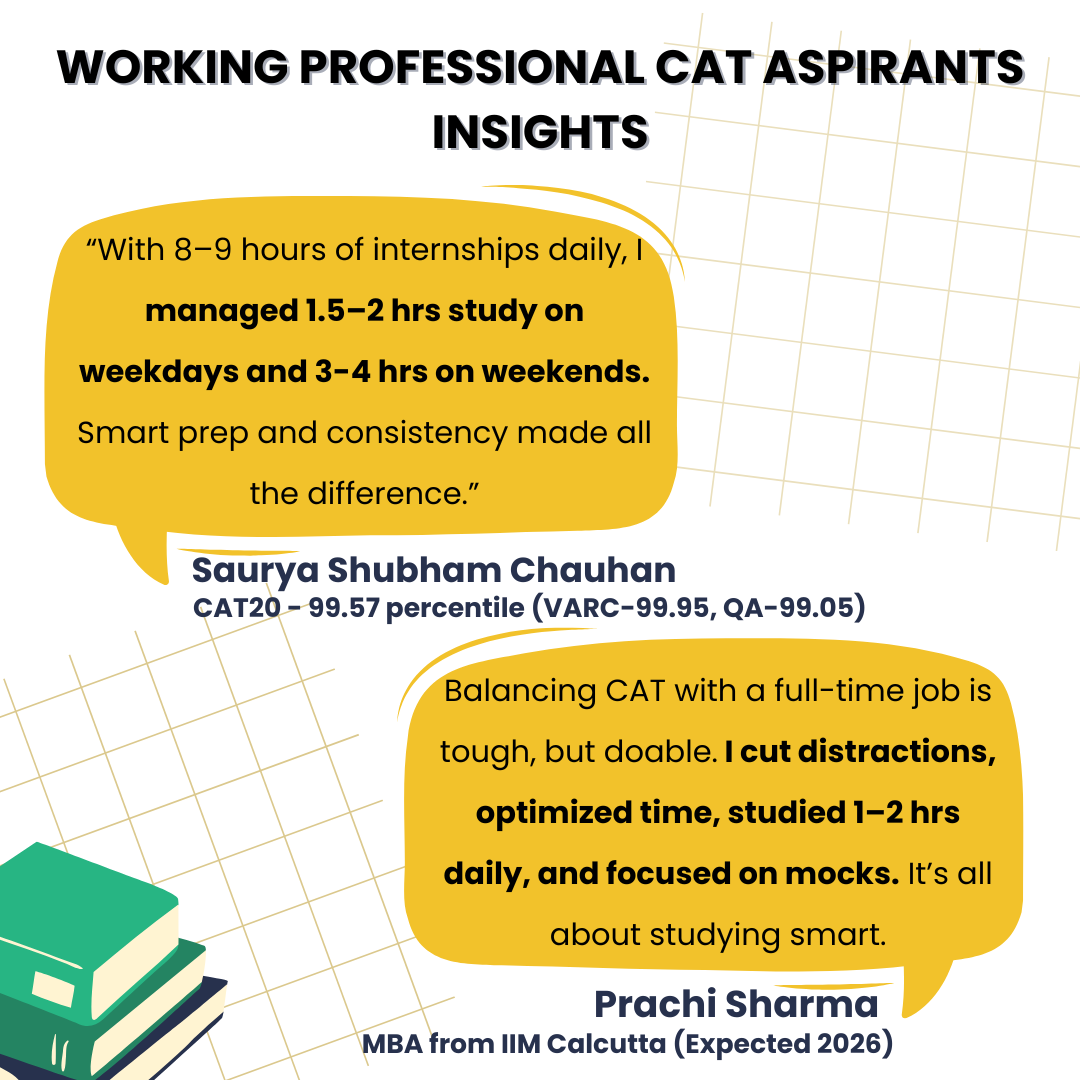
One aspirant with 12-13 hours workdays took nearly 50 mock tests and still managed to score 99.37th percentile with a structured and focused planning and concept-based approach
“Through this process, I marked my strengths in DILR and … After completing around 50 mock tests, I scored 99.37th percentile.”
Another aspirant consistently studied for 2-3 hours on weekdays and 8-10 hours on weekends, as per this aspirant, maintaining quality over quantity was the key to cracking the CAT 2025.
“ Study 2‑3 hrs on weekdays and weekends, try to devote 8‑10 hrs… focus on quality over quantity and take regular mocks”
CAT 2025 Topic-Wise Preparation Strategy
The Topic-wise CAT preparation strategy indicates that preparation of 1-2 hours every day per section with concentration is the most effective method to initiate the prep strategy for working professionals.
- For QA, the working professionals are advised to begin with the Arithmetic and Algebra using study material such as Arun Sharma and Mindworkzz.
- DILR demands the daily practice of 2-3 sets, with a focus on puzzles and data sets; over 100 sets are generally solved by toppers.
- In VARC, the candidate should build a reading habit early and practice 2–3 RCs and 8–10 VA questions daily—RC accounts for over 70% of this section.
Also Read
How to prepare for Quantitative Aptitude for CAT?
To prepare for QA (Quantitative Aptitude) in CAT 2025, focus on the core topics like Arithmetic, Algebra, and Geometry, which have the weightage of about 65–70% of the section.
- The working professionals need to dedicate 1-2 hours daily, starting with the basics in the first two months, by using resources like Arun Sharma, Mindworkzz, and Quantifiers.
- In 3-4 months, the candidate needs to shift to advanced problems by focusing on improving the speed.
Aim to solve 20-30 problems daily, as toppers practice over 2,000+ questions to ace in QA section by consistent practice and increase the difficulty level gradually with regular revision.
| Aspect | Details | Time Commitment | Resources & Tools | Tips |
|---|---|---|---|---|
| Key Topics |
Arithmetic (Percentages, Profit & Loss, Ratios) Algebra (Quadratic Equations, Progressions) Geometry |
1–2 hours/day | Arun Sharma (QA books), Quantifiers, Mindworkzz | Focus on strengthening basics, then move to advanced topics. |
| Study Plan |
Months 1-2: Focus on building a strong foundation. Months 3-4: Advanced topics and application. |
1–2 hours/day | Books: Arun Sharma, Online platforms (Mindworkzz) | Start with easier problems and gradually increase difficulty. |
| Practice | Solve 20–30 problems daily. | 1–2 hours/day | Mindworkzz, iQuanta, Career Launcher | Regular practice will help you improve speed and accuracy. |
How to prepare for DILR Section in CAT?
To prepare for the DILR section in CAT, the working professionals should dedicate 1-2 hours daily to master the key topics like Data Interpretation (Tables, Graphs, Caselets) and Logical Reasoning (Seating Arrangements, Puzzles).
Start with the simpler sets of caselets in the first two months to build conceptual clarity; the shift to moderate and tough sections sets in months 3-4, solving 2-3 sets daily is important to ace in DILR section.
The Toppers suggested solving over 150+ DILR sets before the exam, and focusing on pattern recognition, time-bound practice, and mistake analysis after every test to improve speed and accuracy.
| Aspect | Details | Time Commitment | Tips |
|---|---|---|---|
| Key Topics | Data Interpretation: Tables, Bar Graphs, Line Charts, Caselets. Logical Reasoning: Seating Arrangements, Puzzles | 1–2 hours/day | Focus on pattern recognition and speed. |
| Study Plan | Months 1-2: Focus on solving simple DI/LR sets and building conceptual clarity. Months 3-4: Increase difficulty. | 1–2 hours/day | Solve at least 2–3 sets daily to improve your efficiency. |
| Practice | Regular practice of 2–3 sets daily. | 1–2 hours/day | Analyze mistakes after every test to improve weak areas. |
How to prepare for the VARC section for CAT?
To prepare for the VARC section in CAT, the working professionals should allocate 1-2 hours daily with a regular reading habit and focus on Reading Comprehension (RC), Vocabulary, Grammar, and Para Jumbles.
- As RC has the weightage of over 70% in the VARC section, building a strong reading habit in the 1-2 months is important (reading editorials from The Hindu or Indian Express helps improve comprehension and vocabulary)
- In 3-4 months, focus on solving the RCs by practicing 2–3 RCs and 8–10 VA questions daily to build speed and accuracy.
“Toppers suggested that consistent reading and timed practice can boost the VARC scores over time.”
| Aspect | Details | Time Commitment | Tips |
|---|---|---|---|
| Key Topics |
Reading Comprehension (RC) Vocabulary (Synonyms, Antonyms, Idioms) Grammar & Para Jumbles |
1–2 hours/day | Regularly practice RC passages and grammar exercises. |
| Study Plan |
Months 1-2: Build a reading habit by reading editorials. Months 3-4: Work on solving RC passages efficiently. |
1–2 hours/day | Read newspapers daily (The Hindu, Indian Express) to boost comprehension. |
| Practice | Solve 2–3 RC passages and 8–10 VA questions daily. | 1–2 hours/day | Focus on improving reading speed while maintaining comprehension. |
CAT Mock Test 2025 Strategy
The CAT Mock Test 2025 strategy suggests taking 1 mock test per week during the initial months and gradually increasing it to 2 per week in the last 2 months, and each test should be followed by 1–2 hours of detailed analysis, focusing on identifying and correcting mistakes.
“As per the experts, analysing the mock tests is twice as important as taking them; top scorers have spent 60–70% of their prep time refining their strategies based on the performance.”
| Aspect | Details | Time Commitment | Tips |
|---|---|---|---|
| Frequency | 1 mock test per week in the initial months. Increase to 2 mock tests per week in the last 2 months. | Varies per week | Analyze each mock test thoroughly; it’s as important as the test itself. |
| Analysis | Spend twice the time on analyzing the mock test. Break down each section to understand mistakes. | 1–2 hours per test analysis | Focus on weak areas and revisit concepts. |
Also Read
CAT Mock Test 2025: Free Mock Test SeriesCAT Preparation Weekly Timetable
The CAT weekly timetable for the working professionals focuses on utilizing early mornings and evenings effectively.
- A 6:30–7:30 AM morning session is ideal for core subjects like QA or VARC, when the mind is fresh.
- A light practice of vocabulary or LR puzzles can be done during the commute to the office or lunch breaks.
- The 8:00–9:30 PM evening slot is perfect for DI/LR or sectional tests, allowing deeper focus.
- And before sleeping, a 10-minute pre-bed review with the help of flashcards can retain formulas or vocabulary.
This balanced approach ensures 2.5–3 focused hours daily, which data shows is sufficient for scoring 95+ percentile with consistent effort over 6 months.
| Time Slot | Activity | Focus Area |
|---|---|---|
| 6:30 AM – 7:30 AM | Morning Study Session | Quantitative Aptitude (QA) / VARC |
| Commute / Lunch | Light Practice (30–45 mins) | Vocabulary, RCs, LR puzzles |
| 8:00 PM – 9:30 PM | Evening Study Session | DI/LR Practice or Sectional Tests |
| Before Bed (10 min) | Quick Review or Flashcards | Formulas / Vocabulary |
CAT Preparation Weekend Timetable
The CAT weekend timetable provides a structured plan to maximize CAT preparation time, especially for working professionals.
- Starting with the concept-building sessions from 9:00–11:00 AM, the candidates can understand the fundamentals in QA, VARC, or LR.
- This is followed by the mock test topic-wise or mini mocks from 11:30 AM – 1:30 PM to improve time-bound problem solving.
- A full-length mock test from 2:30 to 4:30 PM can provide a simulation of a real exam, while a slot of 5:00–6:00 PM should be reserved for detailed mock test analysis.
“According to the toppers, allocating 6–8 focused hours on weekends can boost mock test performance and help build exam-day stamina, especially in the final 2–3 months of prep.”
| Time Slot | Activity | Focus Area |
|---|---|---|
| 9:00 AM – 11:00 AM | Concept Building | QA / VARC / LR Basics |
| 11:30 AM – 1:30 PM | Sectional Practice / Mini Mock | Topic-based Timed Tests |
| 2:30 PM – 4:30 PM | Mock Test or Full-Length Test | Mixed Sections |
| 5:00 PM – 6:00 PM | Mock Test Analysis | Error Logs + Strategy Review |
Also Read
6-Month CAT Preparation Strategy for Working Professionals
This 6-month CAT preparation strategy for professionals helps in managing the job and preparing for the CAT. In 1-2 months, the candidate should focus on developing the foundations in QA, VARC, and short weekday sessions, and study longer on weekends.
Months 3–4 cover more challenging subjects like Algebra and LRDI logic, with daily practice and weekend sectional tests. Month 5 is dedicated to practicing hard, daily drills, and full mocks to develop speed and accuracy.
In the 6th Month, test the strategy by using daily mocks and detailed reviews. Ongoing mock tests (10–15 in total) and steady revision are essential to raise scores while working a full-time job.
| Month | Focus Area | Weekday Plan | Weekend Plan |
|---|---|---|---|
| 1–2 | Foundation Building (QA – Arithmetic, VA basics, DI intro) | 1.5–2 hrs/weekdays: morning and evening sessions | 4–6 hrs/day: fundamentals + one sectional test |
| 3–4 | Skill Enhancement (Algebra, Modern Math, VARC RCs, LRDI logic) | Topic-wise practice & revision (2–3 hrs) | Sectional mocks + analysis (5–7 hrs) |
| 5 | Practice Phase (Full CAT mocks, speed drills, QA mixed sets) | Timed QA/LRDI/VARC practice (2–3 hrs) | Full-length mocks + error log review (6–8 hrs) |
| 6 | Mock Test & Strategy Refinement | Daily mock/sectional + revision (2–3 hrs) | 1–2 full mocks + deep review (7–8 hrs) |
CAT Study Material and Books
As per the top scorers, almost 80% of CAT 99+ percentilers use Arun Sharma's books as their sole CAT preparation source because of their systematic concept flow and exam-based content.
For working professionals, the aspect of saving time is most important; therefore, small-sized chapter books are most important, as these enable useful study sessions of only 1 to 1.5 hours on weekdays.
The experts recommend that the best practice is the integration of one regular book in each section and periodic mock tests, as this method guarantees optimum return on investment (ROI) in minimal CAT preparation time.
| Category | Study Material/Platform | Purpose/Use | Why It’s Ideal for Working Professionals |
|---|---|---|---|
| Books - Quantitative Aptitude | Arun Sharma (TMH) Quantum CAT by Sarvesh Verma | Concept building, progressive practice | Self-paced learning builds a strong foundation in Arithmetic, Algebra, Geometry |
| Books - Verbal Ability & Reading Comprehension (VARC) | Word Power Made Easy Wren & Martin | Vocabulary, Grammar, Sentence Correction | Easy to revise during commutes or breaks |
| Books - Logical Reasoning & DI | Arun Sharma LRDI CAT Previous Year Papers | Familiarity with patterns, practice complex sets | Helps identify trends and improve accuracy |
| Online Platforms (Live + Recorded) | Mindworkzz IMSCareer Launcher | Coaching, structured classes, and mocks | Evening/weekend live classes, recorded sessions for flexible access |
| Mock Test Series & Practice Platforms | Cracku Mockat iQuanta Hitbullseye | Mock tests, sectional tests, performance tracking | Short modules, mobile-friendly, AI-driven mock analysis |
| Preparation Schedule Tools | Google Calendar/Notion Trello | Weekly goal setting, tracking consistency | Visual scheduling tools help balance work and preparation effectively |
Also Read
CAT Books 2025 (Available): Check Best Books for CAT PreparationCAT Stress Management for Working Professionals
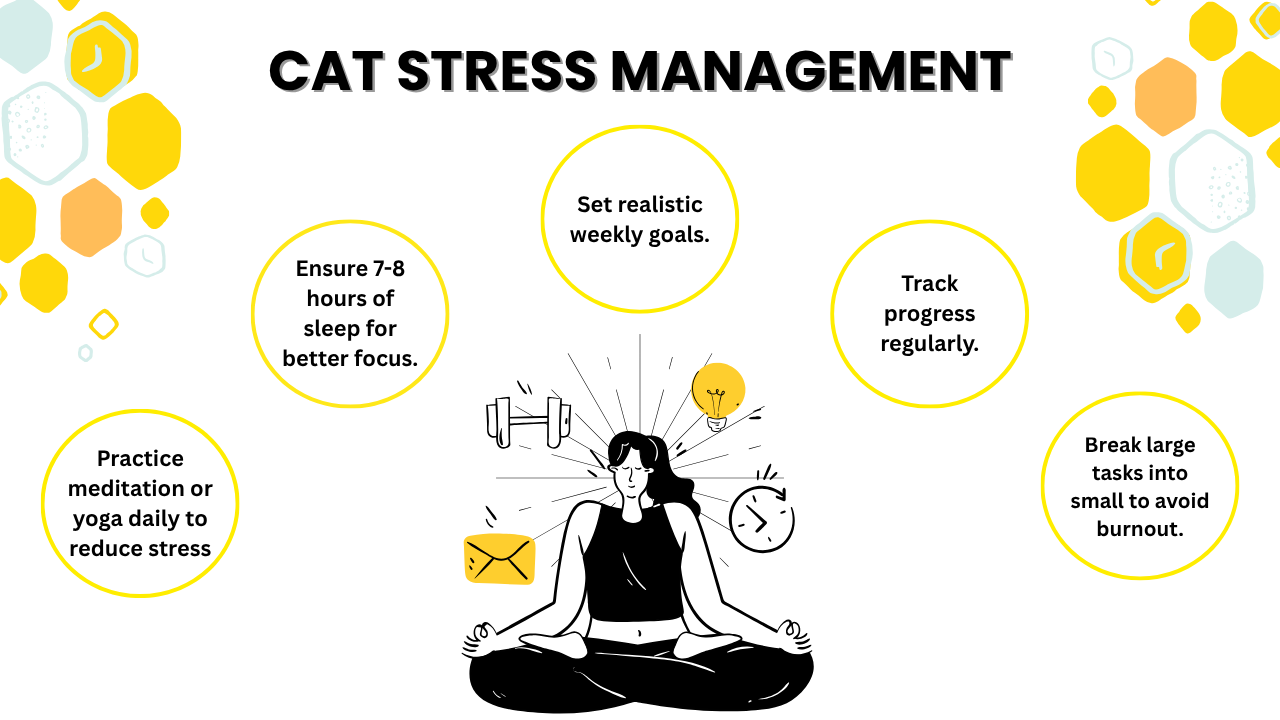
While preparing for the CAT, managing stress and maintaining consistency can sometimes be tricky, particularly for busy professionals. Doing 10–15 minutes of meditation or yoga practice every day and sleeping for 7–8 hours can increase concentration and decrease burnout. To remain consistent, make realistic weekly targets and divide enormous tasks into smaller pieces.
| Aspect | Details | Time Commitment | Tips |
|---|---|---|---|
| Mental Health | Practice meditation or yoga daily to reduce stress. Ensure 7-8 hours of sleep for better focus. | 10-15 mins/day | Meditation can help you stay calm and improve focus. |
| Consistency | Set realistic weekly goals. Track progress regularly. | Ongoing | Break large tasks into small, manageable goals to avoid burnout. |
CAT 2025 Online Coaching
The best period to join online coaching for CAT 2025 varies according to your study plan duration.
- For early birds who plan a complete 12–15 month study plan, July to September 2024 would be the best.
- Candidates who start between October 2024 and January 2025 can also go through the syllabus successfully with a concentrated effort.
- Joining after April 2025 typically involves crash course strategies or individual mentorship for maximum performance.
What’s Usually Included in an Online CAT Course?
- Online coaching provides the flexibility to study at any time and place, which is particularly suitable for students and working professionals. It is also cheaper, generally 30–50% lower than offline versions.
- The courses generally cover a full syllabus (QA, VARC, DILR), 200+ hours of live or recorded classes, 50–100+ sectional tests, more than 30 full-length mock tests, daily or weekly practice exercises, and personalized one-on-one guidance in premium or iconic plans.
- With the added features of mock analysis powered by AI, live doubt-solving, and peer discussion forums, online CAT coaching provides a comprehensive and inclusive preparation experience.
- Mock test analysis, online platforms provide a comprehensive and convenient CAT preparation experience.
Also Read
CAT 2025 Preparation Strategy for Working Professionals FAQs
Ques. When should I start preparing for CAT 2025?
Ans. To maximize performance in the November 30, 2025, CAT exam, you should ideally begin CAT preparation by March–April 2025. That gives a solid 7–9 month window: 3–4 months for building concepts and 3–5 months for test practice and revisions.
- 9 to 12 months before the exam (around March–April 2025) is considered the sweet spot to start serious CAT preparation. This gives enough time to build fundamentals, revise, and take ample mocks.
- Beginners or those from non-quantitative backgrounds should aim for 10–13 months of CAT preparation.
- Repeat test-takers or those with strong basics can begin around 6–7 months before the exam, i.e., May–June 2025.
- Experts suggest January 2025 at the latest, with the core syllabus wrapped up by August, leaving room for focused mock practice.
Ques. Will CAT 2025 be tough?
Ans. CAT 2025 is expected to be moderate to difficult, with DILR as the toughest section, while VARC and QA may stay moderate.
As Prof. Ram Kumar P.N. is the convenor of CAT 2025 and a professor of operations at IIM Kozhikode, he will set the CAT 2025 exam, so, as per his academic background of applied research, military logistics, and supply chain, it is expected that the CAT 2025 will be more difficult, especially the DILR Section.
Ques. What challenges do working aspirants face, and how to tackle them?
Ans. There are many challenges faced by working professionals while preparing for the CAT in India; the candidate needs practical strategies to tackle them.
| Challenge | Typical Impact | Strategy to Mitigate |
|---|---|---|
| Time constraint (2–3 hr/day) | Missed study sessions, delayed preparation | Use micro-sessions, flexible weekly targets |
| Fatigue & burnout | Low focus, skipped study | Schedule naps, breaks, low-intensity days |
| Irregular schedule | Inconsistency in coverage | Contingency plan, front-loading study time |
| Motivation slump & isolation | Drop in morale, feeling detached | Peer support groups, milestone-driven motivation |
| Resource overload | Confusion, wasted time | Stick to one core study resource per section |
| Lack of mock strategy | No insight into weak areas | One full mock per week, rigorous analysis |
CAT Aspirant Tips
One Redditor shared:
“I averaged ~12–13‑hour workdays, but after 50 mocks, I secured a 99.37th percentile in CAT‑23.” -Reddit
Another working aspirant described his routine:
“5:30 am–7:15 am, office slot midday, then 10:15 pm–11:15 pm… weekends of 8–10 hrs/day.” -Reddit
Ques. Is coaching or self-study better?
Ans. In the previous years, 30–40% of CAT toppers have cleared the CAT exam through pure self‑study, which showed the discipline in the aspirants.
Coaching can be beneficial if the working professional needs a structure, motivation, expert feedback, and peer pressure.
Many successful working aspirants use a hybrid model: self-study + mocks or section-specific coaching.
With focus, consistency, and smart planning, the candidate can crack CAT, either through coaching or self-study.
| Factor | Coaching Institutes | Self‑Study |
| Cost | ₹30,000–₹1,50,000+ per year | Minimal—mainly mock series and books |
| Structure & Discipline | Fixed schedule, external accountability via classes & tests | Requires high self‑discipline; flexible timing |
| Expert Guidance & Doubt Clearing | Faculty-led, real-time interactions and doubt-solving sessions | Dependent on forums, peer groups, YouTube, and limited personal feedback |
| Study Materials & Mocks | Comprehensive content + built-in test series (AIMCAT, IMS, etc.) | Self-curated resources + separate test series; must buy mocks separately |
| Peer Motivation & Competition | Classroom atmosphere boosts motivation | Requires external accountability (study groups, mock ranking) |
| Flexibility (work alignment) | Fixed timings may clash with work hours; travel time adds overhead | High flexibility—ideal for working professionals |



Comments