




CAT 2010 Question Paper was rated moderate to difficult. CAT 2010 was conducted from October 27, 2010 to November 24, 2010. CAT 2010 was a computer-based examination consisting of 3 sections namely, Verbal Ability, Quantitative Ability & Data Interpretation, and Logical Reasoning. Each section of the Question Paper had 20 questions. Candidates were awarded 3 marks for every correct answer and 1 mark was deducted for every wrong answer.
Candidates preparing for CAT 2025 can download the CAT VARC question paper with the solution PDF for the Slot 1 exam to get a better idea about the type of questions asked in the paper and their difficulty level.
Also Check:
CAT 2010 VARC Slot 1 Question Paper with Solution PDF
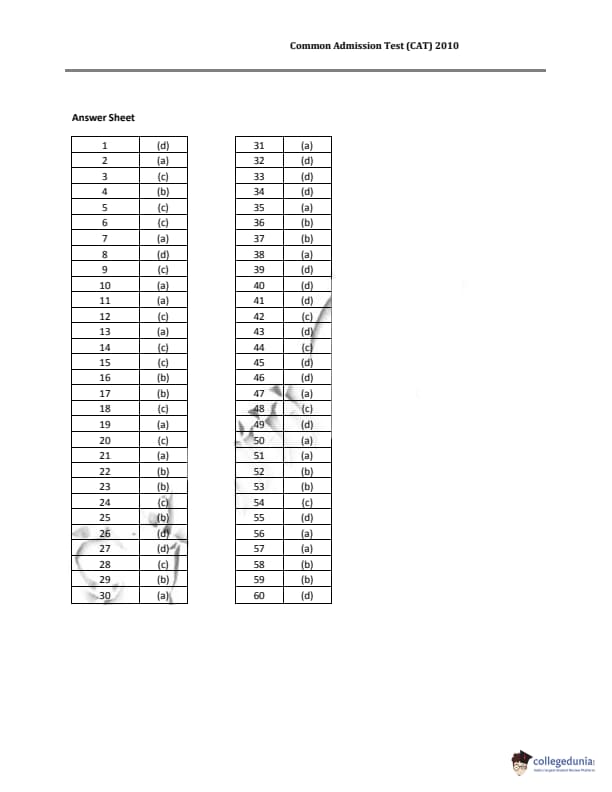
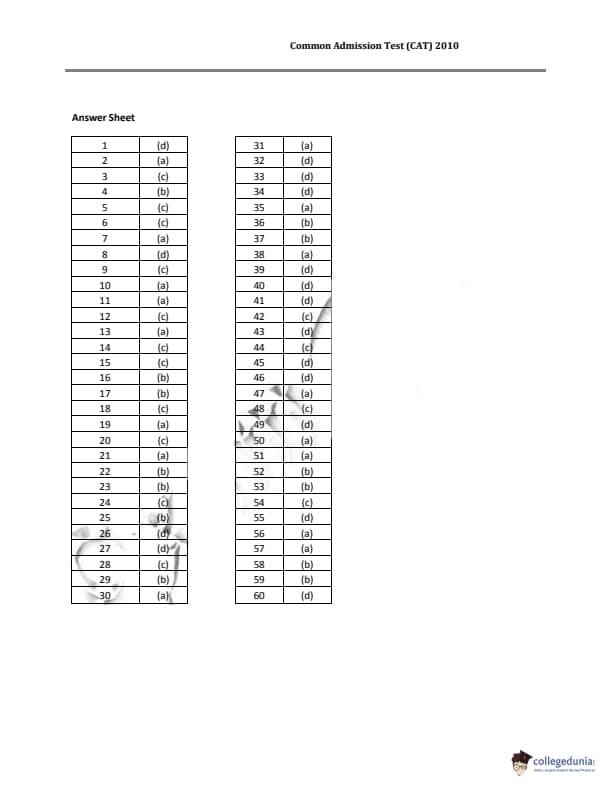
| CAT 2010 Question Paper with Answer Key | Download PDF | Check Solutions |
Question 1:
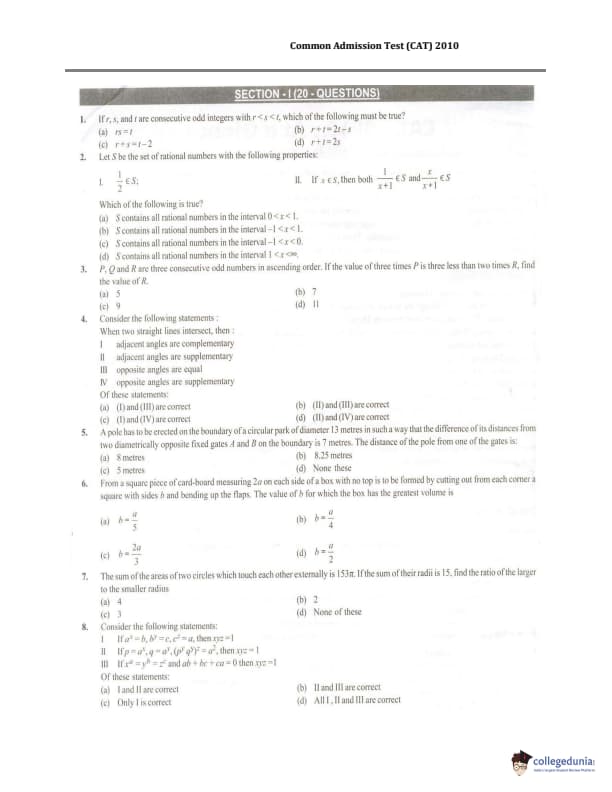
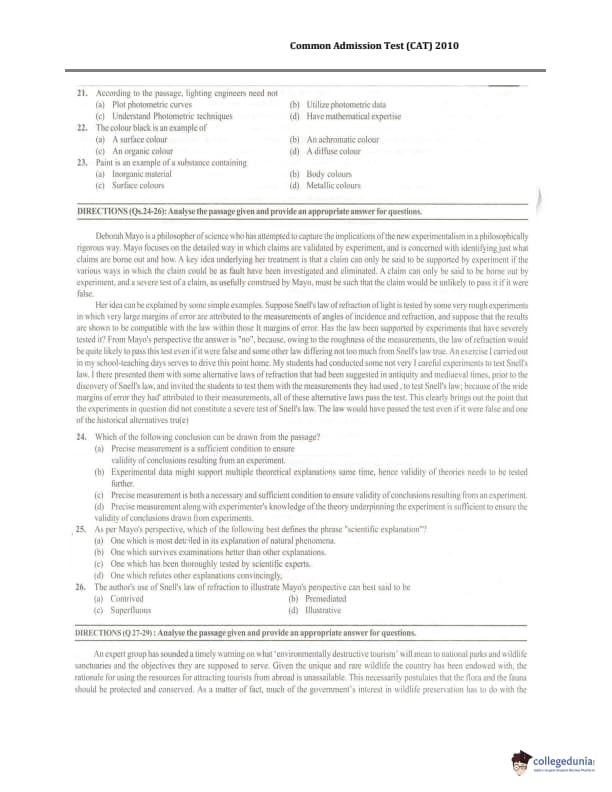
According to the passage, lighting engineers need not:
View Solution
The colour black is an example of:
View Solution
Paint is an example of a substance containing:
View Solution
Which of the following conclusions can be drawn from the passage?
View Solution
As per Mayo’s perspective, which of the following best defines the phrase “scientific explanation”?
View Solution
The author’s use of Snell’s law of refraction to illustrate Mayo’s perspective can best be said to be:
View Solution
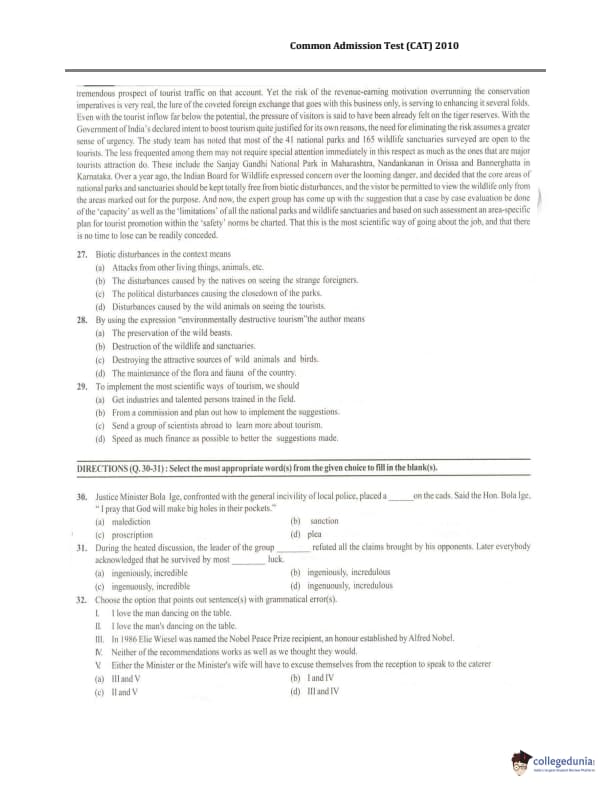
Biotic disturbances in the context means:
View Solution
By using the expression “environmentally destructive tourism” the author means:
View Solution
To implement the most scientific ways of tourism, we should:
View Solution
Justice Minister Bola Ige, confronted with the general incivility of local police, placed a ____ on the cads. Said the Hon. Bola Ige, “I pray that God will make big holes in their pockets.”
View Solution
During the heated discussion, the leader of the group ____ refuted all the claims brought by his opponents. Later everybody acknowledged that he survived by most ____ luck.
View Solution
Choose the option that points out sentence(s) with grammatical error(s):
[I.] I love the man dancing on the table.
[II.] I love the man’s dancing on the table.
[III.] In 1986 Elie Wiesel was named the Nobel Peace Prize recipient, an honour established by Alfred Nobel.
[IV.] Neither of the recommendations works as well as we thought they would.
[V.] Either the Minister or the Minister’s wife will have to excuse themselves from the reception to speak to the caterer.
View Solution
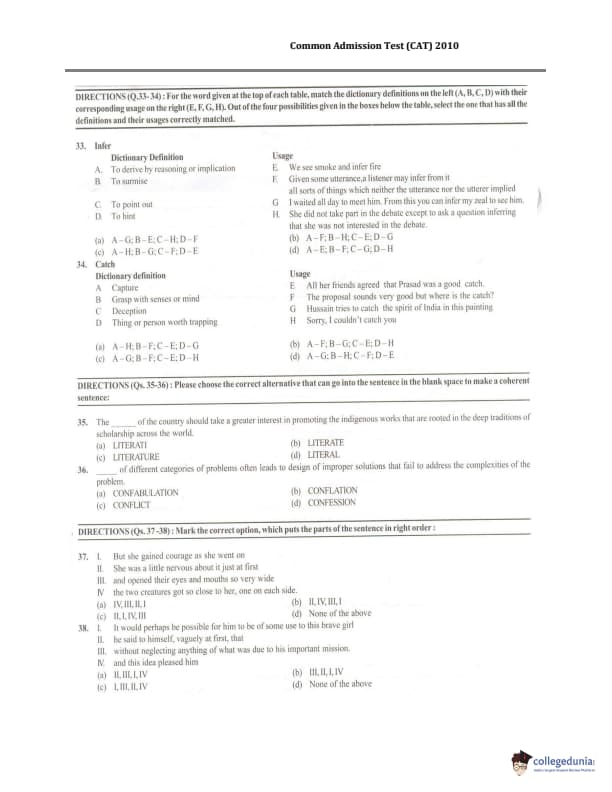
Match the dictionary definitions of the word "Infer" with its correct usage:
[A.] To derive by reasoning or implication
[B.] To surmise
[C.] To point out
[D.] To hint
Usage:
[E.] We see smoke and infer fire
[F.] Given some utterance, a listener may infer from it all sorts of things which neither the utterance nor the utterer implied
[G.] I waited all day to meet him. From this you can infer my zeal to see him.
[H.] She did not take part in the debate except to ask a question inferring that she was not interested in the debate.
View Solution
Match the dictionary definitions of the word "Catch" with its correct usage:
[A.] Capture
[B.] Grasp with senses or mind
[C.] Deception
[D.] Thing or person worth trapping
Usage:
[E.] All her friends agreed that Prasad was a good catch.
[F.] The proposal sounds very good but where is the catch?
[G.] Hussain tries to catch the spirit of India in this painting.
[H.] Sorry, I couldn’t catch you.
View Solution
The _____ of the country should take a greater interest in promoting the indigenous works that are rooted in the deep traditions of scholarship across the world.
View Solution
_____ of different categories of problems often leads to design of improper solutions that fail to address the complexities of the problem.
View Solution
Choose the correct sequence of sentences:
[I.] But she gained courage as she went on
[II.] She was a little nervous about it just at first
[III.] and opened their eyes and mouths so very wide
[IV.] the two creatures got so close to her, one on each side
View Solution
Choose the correct sequence of sentences:
[I.] It would perhaps be possible for him to be of some use to this brave girl
[II.] he said to himself, vaguely at first, that
[III.] without neglecting anything of what was due to his important mission.
[IV.] and this idea pleased him
View Solution
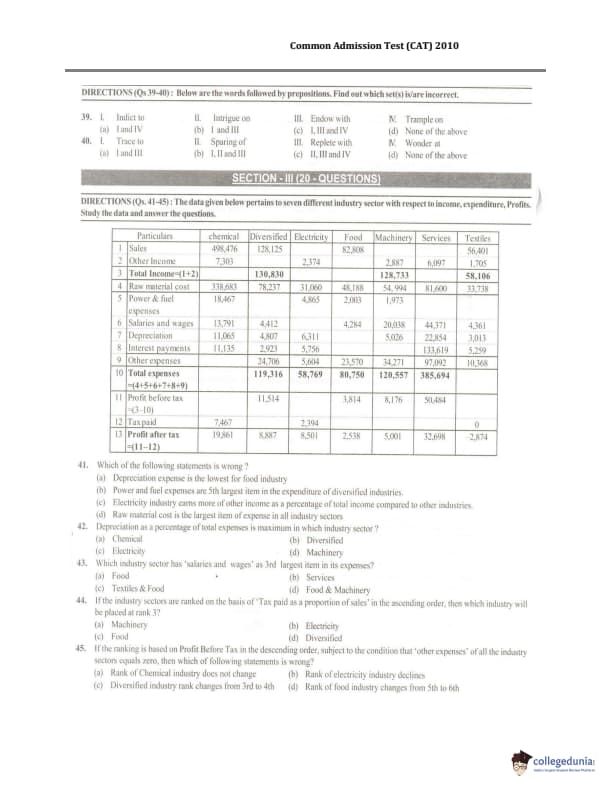
Choose the correct phrasal usage of the given words:
[I.] Indict to
[II.] Intrigue on
[III.] Endow with
[IV.] Trample on
View Solution
Choose the correct phrasal usage of the given words:
[I.] Trace to
[II.] Sparing of
[III.] Replete with
[IV.] Wonder at
View Solution
CAT 2010 Question Paper Analysis
CAT 2010 Quantitative Ability Question Paper Analysis
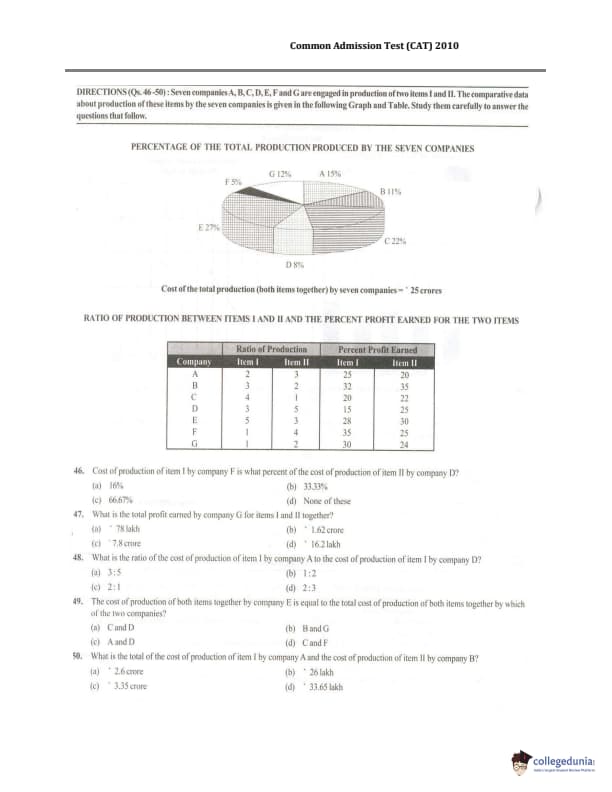
The Quantitative Ability of CAT 2010 Question Paper was rated moderate and included some simple calculations.
- The question paper had 3-4 questions on Geometry, 7-8 questions on Arithmetic and Number System, and a few on Algebra.
- A small application of logarithms, a mix of Higher Math and Modern Math were also included in the question paper.
- Questions from Ratio and Percentage, Volume of Solid, Permutation & combination were also there in the CAT 2010 Question Paper.
Students should follow the below table for a better understanding of question distribution.
| Quantitative Ability Topics | Number of Questions |
|---|---|
| Equations | 1 |
| Functions | 1 |
| Geometry | 2 |
| Logarithms | 1 |
| Mensuration | 3 |
| Number System | 6 |
| Percentage | 2 |
| Permutation and Combinations | 1 |
| Sequence and Series | 2 |
| Time and Distance | 1 |
CAT 2010 Data Interpretation & Logical Reasoning Question Paper Analysis
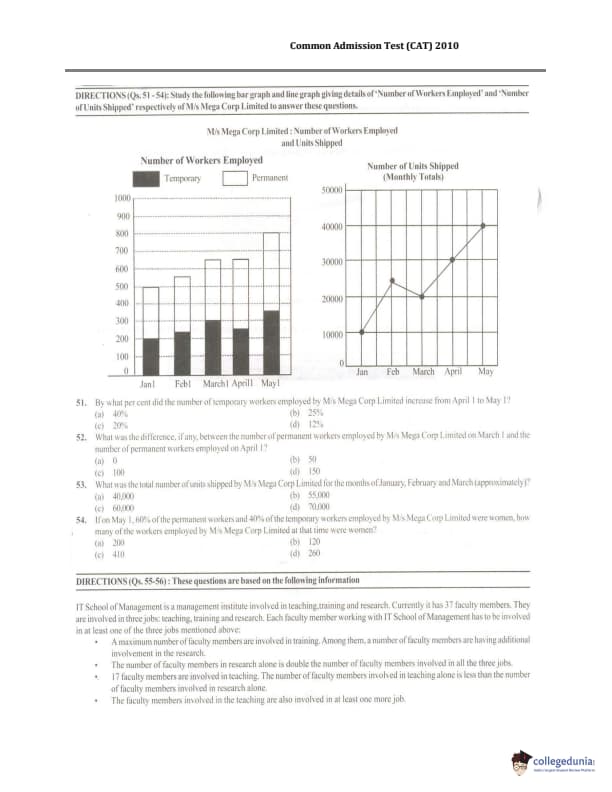
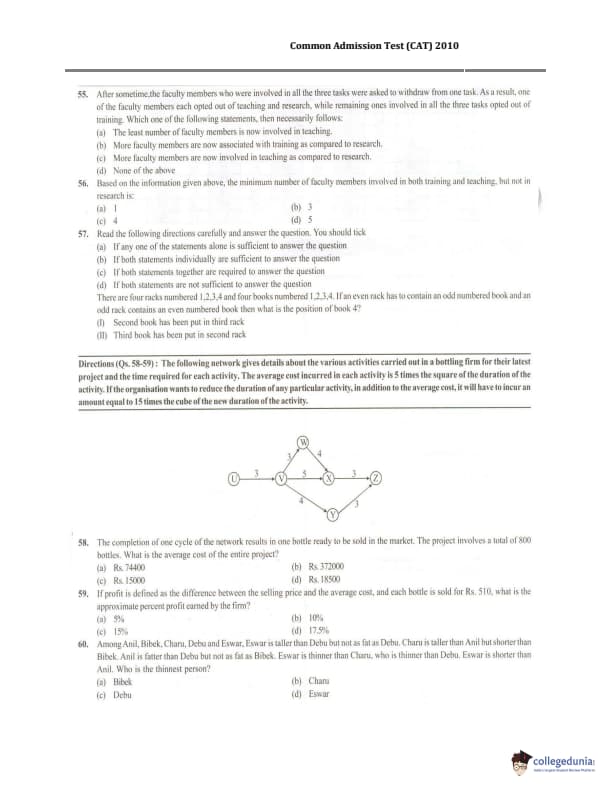
The Data Interpretation & Logical Reasoning section of CAT 2010 Question Paper was a bit lengthy as it included tedious calculations.
- The question paper had sets on Pie charts, Bar graphs, Tables, Line graphs, 3D charts, Maxima & Minima, etc.
- The questions from Logical Reasoning were more or less logical based and required less or no calculations.
- The Logical Reasoning questions were based on a set of conditions, Logical arguments, Puzzles, and Venn diagrams.
Students should follow the below table for a better understanding of question distribution.
| Topic | Number of Questions |
|---|---|
| Data Interpretation | 14 |
| Logical Puzzle | 6 |
CAT 2010 Verbal Ability & Reading Comprehension question Paper Analysis
The Verbal Ability & Reading Comprehension section of CAT 2010 Question Paper was rated moderate.
- The Verbal Ability covered every topic of English usage such as Para completion, Para jumble, Fill in the blanks, Correct usage of words, etc.
- The question paper had a little bit of difficult grammar and vocabulary.
- There were 3 reading comprehension passages with 3 questions each. Lots of reading practice was needed for this part.
Students should follow the below table for a better understanding of question distribution.
| Topics | Number of Questions |
|---|---|
| Error Spotting | 3 |
| Fill in The Blanks | 4 |
| Para Jumbles | 2 |
| Reading Comprehension | 9 |
| Word Meaning | 2 |
CAT Question Papers of Other Years
| CAT 2024 Question Papers | CAT 2023 Question Papers |
| CAT 2022 Question Papers | CAT 2020 Question Papers |
| CAT 2019 Question Papers | CAT 2018 Question Papers |
| CAT 2017 Question Papers | CAT 2016 Question Papers |



Comments