




The Application of Derivatives is a key topic in the Mathematics section of JEE Advanced, which focuses on using ideas from differentiation in real-world problems - and also mathematical problems. The topic covers many important concepts like maxima/minima (optimization), tangents and normals, monotonicity of functions, and rate of change problems.
In terms of weightage, the Application of Derivatives will cover around 2-3% of the exam total marks, so you will expect around 1-2 questions per year in this section. While the weightage is not the most significant in terms of marks, the difficulty of the questions make it an important area for topic quality thinking and study.
Related Articles

Here are some of the important JEE Advanced previous year questions of topic Application of Derivatives
Question 1:
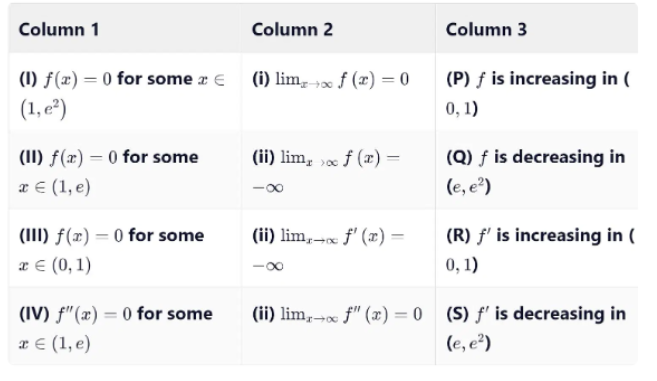
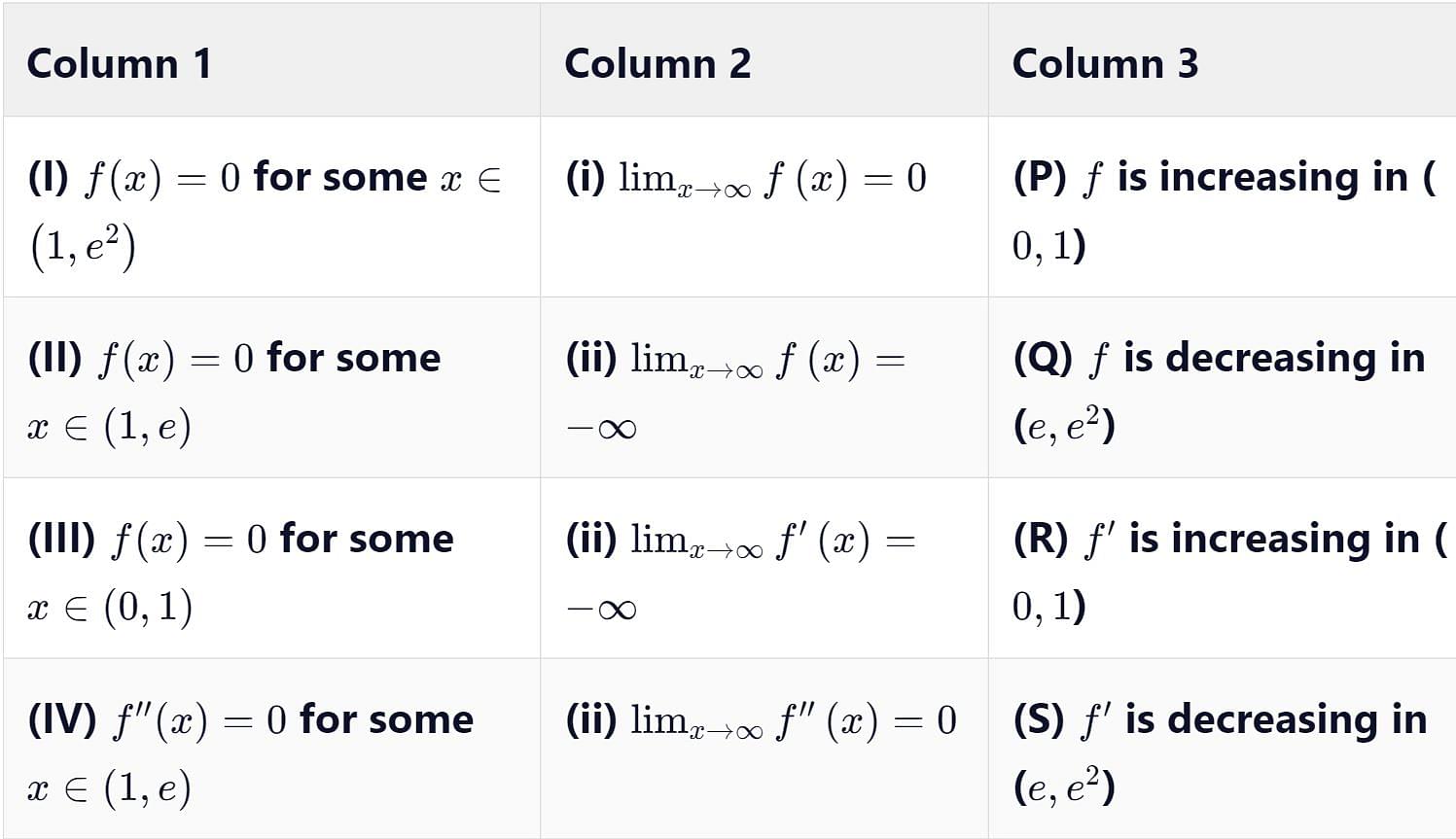
Let \( f(x) = x + \log_e x - x \log x, \, x \in (0, \infty) \).
Column 1 contains information about zeros of \( f(x), f'(x) \) and \( f''(x) \).
Column 2 contains information about the limiting behavior of \( f(x), f'(x) \) and \( f''(x) \) at infinity.
Column 3 contains information about the increasing/decreasing nature of \( f(x) \) and \( f'(x) \).
Question 2:
If \( f : \mathbb{R} \to \mathbb{R} \) is a differentiable function such that \( f'(x) > 2f(x) \) for all \( x \in \mathbb{R} \), and \( f(0) = 1 \), then:
Question 3:
A rectangular sheet of fixed perimeter with sides having their lengths in the ratio \( 8 : 15 \) is converted into an open rectangular box by folding after removing squares of equal area from all four corners. If the total area of removed squares is 100, the resulting box has maximum volume. Then the lengths of the sides of the rectangular sheet are:
Question 4:
\( f(x) \) is cubic polynomial with \( f(2) = 18 \) and \( f(1) = -1 \). Also \( f(x) \) has local maxima at \( x = -1 \) and \( f'(x) \) has local minima at \( x = 0 \), then:
Question 5:
In \( [0, 1] \), Lagrange's Mean Value theorem is NOT applicable to:
Question 7:
Let \( f(x) = (1 + b^2)x^2 + 2bx + 1 \) and let \( m(b) \) be the minimum value of \( f(x) \). As \( b \) varies, the range of \( m(b) \) is:
Question 8:
Let \( f(x) = \begin{cases} |x|, & \text{for } 0 < |x| \leq 2 \\ 1, & \text{for } x = 0 \end{cases} \) then at \( x = 0 \), \( f \) has:
Question 9:
If \( \int_{\sin x}^1 t^2 f(t) dt = 1 - \sin x, \, \forall x \in (0, \pi/2) \), then \( f\left( \frac{1}{\sqrt{3}} \right) \) is:
Question 10:
Let \( \alpha \) be a positive real number. Let \( f : \mathbb{R} \to \mathbb{R} \) and \( g : (\alpha, \infty) \to \mathbb{R} \) be the functions defined by:
\( f(x) = \sin\left( \frac{\pi x}{12} \right) \) and \( g(x) = \frac{2 \log_e \left( \sqrt{x - \sqrt{\alpha}} \right)}{\log_e \left( e^{\sqrt{x}} - e^{\sqrt{\alpha}} \right)} \).
Then the value of \( \lim_{x \to \alpha^+} f(g(x)) \) is ________.
JEE Advanced Application of Derivatives Previous Year Question Analysis
Frequency of Questions:
- Typically, between 1 to 2 questions are examined from Application of Derivatives in JEE Advanced each year.
- The number of questions from this topic may be less, but the level of difficulty is often higher, so understanding the fundamentals of this topic comprehensively is very important.
- It is seen that in some difficult exams, there is just one question from this topic, or in another easier year, there may be 2 questions asked.
Types of Questions:
| Type of Question | Description |
|---|---|
| Maxima and Minima Problems | It consists of the local maxima or minima of a function using the first and second derivative tests. |
| Tangents and Normals | the equation of the tangent or normal to a curve at a given point. |
| Monotonicity of Functions | It assesses about determining the intervals where the function is increasing, decreasing, or constant. |
| Concavity and Convexity | Involves determining the concavity or convexity of the graph using the second derivative. |
| Rate of Change Problems | checking the rate of change of a quantity in real-world scenarios using derivatives. |
| Optimization Problems | testing maximizing or minimizing a quantity in practical scenarios like geometry or economics. |
Weightage of the Topic:
This topic application of derivatives has around 2-3% weightage of total marks in JEE Advanced Exam. While this section does not have significant weightage comparative to the others, the questions here are challenging yet rewarding when approached correctly. While there are only a small number of questions in this section, securing full marks, even with minimal contribution to total marks, will have a big impact on your overall total.
Important Concepts to Focus On:
Based on the analysis of previous year's papers, this is what you should know in regards to Application of Derivatives:
- First Derivative Test to find intervals in which a function is increasing, decreasing, and constant.
- Second Derivative: Test to find local maxima and minima and points of inflection.
- Optimization Problems based on real-life scenarios based application (example include geometry and rates of change).
- Equations of Tangents and Normals to a curve at a specific point.Concavity and Convexity of functions using the second derivative.
- Rate of Change Problems dealing with real-world scenarios, (i.e. motion problems, growth/decay problems)
Key Takeaways:
- Reliable Visibility: Use of Derivatives is always present in previous JEE Advanced questions and is a structure of topics that will serve you well in JEE preparation.
- Real-World Use Case: Many questions emphasize using derivatives in practical applications, such as tangent, normals, and optimization.
- Conceptual Depth: Even though the weightage is low, the depth of concepts and problem solving methods covered in this topic makes it important to focus on.
JEE Advanced Mathematics Paper Analysis (2024 & Trends)
The mathematics syllabus of JEE Advanced assesses students in their analytical thinking, problem-solving abilities, and understanding of concepts. Two papers (Paper 1 and Paper 2), last three hours each, with approximately 15 - 18 questions covering the syllabus collectively. The questions are based/inspired by every part of the syllabus with varying levels of abilities and complexity, ranging from theoretical concepts to challenging numerical problems, requiring a mixture of properties and applications from several disciplines.
Overview (2024)
| Aspect | Details |
|---|---|
| Total Questions | Approximately 15–18 per paper (2 papers) |
| Difficulty | Moderate to Hard; around 30% easy, 40% moderate, and 30% difficult |
| Question Types | Single/Multiple MCQs, Numerical Value, Paragraph-based, Match-the-Column |
| Key Focus Areas | Differential Calculus, Integral Calculus, Matrices & Determinants, Probability, Vector and 3D Geometry |
Chapter-Wise Weightage (2024)
| Topic | Weightage | Difficulty | Remarks |
|---|---|---|---|
| Differential Calculus | 8% | Moderate | Emphasis on application of derivatives and limits |
| Integral Calculus | 19% | Moderate-Hard | Focus on definite integration and differential equations |
| Matrices & Determinants | 8% | Moderate | Application-based questions on matrix operations and properties |
| Probability | 14% | Moderate | Problems involving complex probability distributions |
| Vector and 3D Geometry | 11% | Moderate | Questions on vector algebra and three-dimensional geometry concepts |
Difficulty Trends (2019–2024)
| Year | Difficulty Level | Key Observations |
|---|---|---|
| 2024 | Moderate-Hard | There are an more numerical problems consisting of several concepts |
| 2023 | Moderate | There was a balanced theory and numericals but lengthy problems in calculus |
| 2022 | Hard | Focussed on complex algebraic manipulations and advanced calculus |
| 2021 | Very Hard | It had unusual problems in coordinate geometry and vector algebra |
| 2020 | Moderate | The concept were more NCERT-aligned and straightforward questions in algebra and trigonometry |
Key Takeaways for 2025 Aspirants
- Concentrate on High-Weightage Topics: It may be beneficial to study topics like Integral Calculus, Probability, and Vector & 3D Geometry as they appear frequently.
- Time Management: Some questions are long, so consider practicing problems as if they were timed to help with efficiency.
- Clarity of Concept: Understanding the basic concepts early in the process may be important so that you can apply them effectively to more difficult questions.
JEE Advanced Exam Pattern
The JEE Advanced exam is considered as one of the top engineering entrance examinations in India, which takes place annually for enrollment at IITs and other top institutions to undergraduate programs. JEE Advanced consists of two compulsory papers, Paper 1 and Paper 2, each with three hours of duration. It challenges students’ knowledge of Physics, Chemistry and Mathematics. The exam consists of different question types including Multiple Choice Questions (MCQs), Numerical Value-based Questions and Assertion-Reasoning questions to evaluate the foundational knowledge of topics and ability to solve problems. Both papers have a total of 180 marks, with marks deducted for incorrect answers in a few question types.
| Aspect | Details |
|---|---|
| Mode | Computer-Based Test (CBT) |
| Papers | 2 (Paper 1 & Paper 2) – Both mandatory |
| Duration | 3 hours per paper (with break between papers) |
| Total Subjects | Physics, Chemistry, Mathematics (Equal weightage) |
| Total Questions | ~54–60 (18–20 per subject, split across question types) |
| Language | English & Hindi (option to switch during exam) |
The exam is known for its challenging nature and is conducted in English and Hindi. It is essential to clear the JEE Main exam before appearing for JEE Advanced.
Marking Scheme with Question types in JEE Advanced
Here is a detailed marking scheme for different questions in JEE Advanced exam.
| Question Type | Marks per Q | Negative Marking | Examples |
|---|---|---|---|
| Single Correct MCQ | +3 | -1 | Basic theory/direct formula questions |
| Multiple Correct MCQ | +4 (full) | -2 (if all wrong) / Partial marks* | "Which of the following is/are true?" |
| Numerical Value (NV) | +3 | No negative | Calculations (e.g., wavelength) |
| Paragraph-Based | Varies (2–4) | Depends on sub-type | Linked to a common scenario |
| Match the Following | +2 per match | -1 per wrong match | Column matching (e.g., graphs) |
Partial Marks: For Multiple Correct MCQs, +1 per correct option (if not all selected).
Subject-Wise Distribution
Here is the subject wise questions distribution in the JEE Advanced exam describing number of questions in each subject.
| Subject | MCQs | Numerical | Paragraph/Matching | Total |
|---|---|---|---|---|
| Physics | 6–8 | 4–5 | 2–3 | 12–16 |
| Chemistry | 6–8 | 4–5 | 2–3 | 12–16 |
| Maths | 6–8 | 4–5 | 2–3 | 12–16 |
Subject wise Syllabus: JEE Advanced 2025
Here is a quick syllabus of JEE Advanced 2025 subject wise which helps in preparation of the students. Check JEE Advanced Syllabus for a detailed Syllabus.
| Subject | Key Topics |
|---|---|
| Physics | Mechanics, Electrodynamics, Modern Physics, Optics, Thermodynamics, Error Analysis |
| Chemistry | Physical (Thermo, Kinetics), Organic (Reactions), Inorganic (Coordination, P-Block) |
| Maths | Algebra, Calculus, Coordinate Geometry, Trigonometry, Vectors |
Note:
- Physics: Focus on Modern Physics (20% weightage) & Electrodynamics.
- Chemistry: Organic reactions & Coordination compounds are high-scoring.
- Maths: Calculus (35% weightage) is most critical.
In addition to conceptual knowledge, you should practice multiple mock tests before your exam.
Check:
JEE Advanced Previous Year Question Papers with Detailed Solutions
JEE Advanced 2024 Question Paper Pdf with Solutions
| Paper Name | Question Paper with Solutions |
|---|---|
| JEE Advanced 2024 Paper 1 Question Paper (English) | Check Solutions |
| JEE Advanced 2024 Paper 2 Question Paper (English) | Check Solutions |
| JEE Advanced 2024 Paper 1 Question Paper (Hindi) | Check Solutions |
| JEE Advanced 2024 Paper 2 Question Paper (Hindi) | Check Solutions |
| Architecture Aptitude Test | Check Solutions |
JEE Advanced Question Paper has 4 sections- Section 1 (Maximum marks-12), Section 2 (Maximum marks-12), Section 3 (Maximum marks- 24) and Section 4 (Maximum marks-12)
JEE Advanced 2023 Question Paper PDF Download With Solutions
| Paper | Answer Key PDF |
|---|---|
| Question Paper 1 PDF | Check Solutions |
| Question Paper 2 PDF | Check Solutions |
| Question Paper AAT PDF | Check Solutions |
JEE Advanced 2022 Question Paper
| 2022 Question Paper | PDF Download |
|---|---|
| Question Paper 1 PDF | Click here |
| Question Paper 2 PDF | Click here |
JEE Advanced 2021 Question Paper
| Question Paper | PDF Download | ||
|---|---|---|---|
| Question Paper 1 PDF | Physics | Chemistry | Maths |
| Question Paper 2 PDF | Physics | Chemistry | Maths |
JEE Advanced 2020 Question Paper
| Question Paper | PDF Download |
| Question Paper 1 PDF | Click here |
| Question Paper 2 PDF | Click here |
Frequently Asked Questions (FAQs)
Q1. Are derivative applications of derivatives important for JEE Advanced?
Answer. Certainly! Applications of Derivatives is an important topic for the JEE Advanced. It quite consistently contributes to the Mathematics section and will include key principles like maxima and minima, tangents and normals, and problems involving optimization. Although this question type typically may not have a major weightage - somewhere around 2-3% of the exam - it will help you deal with challenging problems and can even enhance your performance in the exam more broadly. You should spend time to focus on the core concepts and practice lots of different problems to be successful!
Q2. Which is the most scoring subject in JEE Advanced?
Answer. The most scoring subject in JEE Advanced varies from student to student based on their capabilities, but many students often find Chemistry to be the most scoring.
In Chemistry, most students would agree that Physical Chemistry is the easiest part to score in since a lot of the questions are formula-based. Students who practice can get through these questions fairly quickly. For some students, Mathematics is their most scoring subject, especially those who are stronger in their problem-solving abilities. Physics is much more difficult than both Chemistry and Mathematics as it requires a lot of conceptual understanding. However, students who have a grasp on the core concepts and can quickly solve numerical problems will also find success in Physics.
Ultimately, the most scoring subject will depend on how prepared you are and how comfortable you are with the topic. It is important to balance all 3 subjects in order to earn a high overall score in JEE Advanced.
Q3. What are the 5 applications of derivatives?
Answer. Here are a few applications of Derivatives:
- Maxima and Minima (Optimization): It is used in finding the maximum or minimum values of a function. Moreover, it helps in optimization problems (e.g., maximizing area or minimizing cost).
- Monotonicity of Functions: It determines whether a function is increasing or decreasing by analyzing the sign of its derivative, helping in understanding the behavior of functions.
- Tangents and Normals: It uses derivatives to find the equation of tangents and normals to curves, It is also useful in geometry and real-life applications.
- Concavity and Convexity: It helps analyze the concavity or convexity of a function by checking the second derivative, which further helps in identifying points of inflection.
- Rate of Change: It calculates the rate of change of quantities, including velocity in physics or growth rates in biology, where derivatives represent instantaneous rates of change.
Q4. Is 89 percentile enough to qualify for JEE Advanced?
Answer. No, an 89 percentile is typically not enough to qualify for JEE Advanced. The qualifying percentile for JEE Advanced is usually higher, generally around 90-95% depending on factors such as the difficulty level of the exam and the number of candidates. It is important to aim for a higher percentile to secure eligibility for JEE Advanced.



Comments