




The JEE Advanced Exam Pattern 2026 is live and has been published on the official JEE (Advanced) website, jeeadv.ac.in. The exam is scheduled on Sunday, 17 May 2026 (single day, with two shifts).
IIT Roorkee is conducting the JEE Advanced 2026 Exam & it will be held in Computer-Based Test (CBT) mode. The JEE Advanced 2026 consists of 2 papers with each of 3 hours duration. PwD candidates get 4 hours per paper.
- Each paper consists of three sections: Physics, Chemistry, and Mathematics.
- Question types- mix of Multiple Choice Questions (MCQs), Multiple Select Questions (MSQs), and Numerical Answer Type (NAT) questions.
- And sometimes matching/comprehension-based questions are also asked.
- JEE Advanced 2026 total marks are expected to be around 360 (approximately 180 marks per paper).
- The precise total and per-question marking depend on the final structure released on the exam day.
IIT Roorkee has officially clarified that the exam pattern for 2026 is unchanged from previous years (no introduction of adaptive testing or major format overhaul).
To stay updated with the JEE Advanced Exam Pattern 2026, check the JEE Advanced 2026 website regularly.
Related Links:
- JEE Advanced 2026 Syllabus Released by IIT Roorkee; Download PDF @jeeadv.ac.in
- JEE Advanced Chapter-Wise Weightage 2026: Important Topics, Mark Distribution & Previous Year Question
Key Summary
- In this article, we have discussed the marking scheme, types of questions, the structure of Papers 1 and 2, & PYQs.
- Marking Scheme: Questions carry 3-4 marks, so avoiding negative marking is crucial.
- Question Type: Numerical and multiple-choice questions test accuracy and clarity.
- Subject-Wise Distribution: All three subjects contribute almost equally to the total score
- Syllabus for Weightage: Chapters involving multiple concepts appear frequently
- Official Updates: Section rules are shared close to the exam, so flexibility is important.
- Changing Trends: Recent papers focus on reasoning and application rather than formulas.
JEE Advanced Exam Pattern 2026: Highlights
| Particulars | Details |
|---|---|
| Exam Date | May 17, 2026 |
| Mode of the Exam | Online (Computer-based Test) |
| Medium of the Exam | Available in both English and Hindi |
| Papers | 2 Papers– 1 & 2 |
| Timings | Paper 1: 9 am to 12 pmPaper 2: 2:30 pm to 5:30 pm |
| Duration | 3 hours for each paper (6 hours in total) |
| Sections in Each Paper | 3 sections |
| Subjects | Physics, Chemistry, and Maths |
| No. of Questions in Each Paper | 51 questions: 17 questions per subject (Physics, Chemistry, and Mathematics) |
| Total Number of Questions in Both Papers | 102 questions in total (51 in Paper 1 + 51 in Paper 2) |
| Total Marks in Exam | 360 marks in total (180 marks per paper) |
What is the JEE Advanced Exam Pattern?
JEE Advanced 2026 is a Computer-Based Test (CBT) consisting of two compulsory papers (Paper 1 and Paper 2). Each paper lasts 3 hours (total 6 hours on the same day) and covers Physics, Chemistry, and Mathematics. The medium is English and Hindi.
- Questions per Paper: 51 (17 per subject)
- Total Questions (Both Papers): 102
- Total Marks: 360 (180 marks per paper)
The exact number of questions and marking scheme (including negative and partial marking) may vary slightly each year and will be mentioned on the question paper. Both papers are mandatory for ranking.
| JEE Advanced 2026 follows the same pattern as the previous years. There is no major change in the overall structure. |
JEE Advanced Exam Pattern: Minor Changes in the Last 5 Years
Mostly 54 questions (18 per subject) in 2022 and 2023. It was reduced to 51 questions per paper (17 per subject) from 2024 onwards and remained the same in 2025 and 2026.
IIT Roorkee has officially clarified that there will be no major changes (including no adaptive testing) for JEE Advanced 2026. The pattern remains consistent with 2025.
Also Check: JEE Advanced 2026: IIT Kanpur to Pilot Adaptive Test Model; Changes Likely from 2027
JEE Advanced Exam Pattern: Marking Scheme
The marking scheme in JEE Advanced is different for different types of questions. Each subject of JEE Advanced includes four sections with a different number of questions.
JEE Advanced Exam Pattern: Paper 1
Paper 1 will be conducted on 17 May 2026, and timings are 9 am to 12 pm.
- NAT Questions will not have any negative marking, which gives more scoring opportunities.
- There will be partial marking for Multiple correct MCQs, so the selection should be done carefully.
- Paper 1 will test the conceptual clarity along with accuracy for Mixed MCQs, NATs, and Matching Questions.
JEE Advanced Exam Pattern 2026: Marking Scheme for Each Subject
| Section | Types of Questions | No. of Questions | Marking Scheme | Total Marks |
|---|---|---|---|---|
| 1 | Single Correct MCQs | 4 | +3 for correct, -1 for incorrect, 0 for unattempted | 12 |
| 2 | Multiple Correct MCQs | 3 | +4 (all correct), +3 (3 out of 4 correct), +2 (2 correct), +1 (1 correct), 0 (none), -2 (others) | 12 |
| 3 | Numerical Answer Type (NAT) | 6 | +4 for correct, no negative marking | 24 |
| 4 | Matrix Match | 4 (2) | +4 for fully correct, -1 for incorrect, 0 for unattempted | 12 |
| Total | 17 | 60 |
Hence, the total marks for the JEE Advanced 2026 Paper 1 are:
Physics + Chemistry + Mathematics = 60 + 60 + 60 = 180 Marks.
JEE Advanced Exam Pattern: Paper 2
Paper 2 will be conducted on 17 May 2026, and timings are 2:30 pm to 5:30 pm.
- The JEE Advanced Paper 2 will be balanced, including objective-type and numerical solving skills with more NAT Weightage.
- There are more Numerical Answer Questions with an advantage in solving questions.
- Paper 2 is expected to be more lengthy because of complex NATs, so the allocation should be done properly.
JEE Advanced Exam Pattern 2026: Marking Scheme for Each Subject
| Section | Types of Questions | No. of Questions | Marking Scheme | Total Marks |
|---|---|---|---|---|
| 1 | Single Correct MCQs | 4 | +3 for correct, -1 for incorrect, 0 for unattempted | 12 |
| 2 | Multiple Correct MCQs | 3 | +4 (all correct), +3 (3 out of 4 correct), +2 (2 correct), +1 (1 correct), 0 (none), -2 (others) | 12 |
| 3 | Numerical Answer Type (NAT) | 6 | +4 for correct, no negative marking | 24 |
| 4 | Matrix Match | 4 (2) | +4 for fully correct, -1 for incorrect, 0 for unattempted | 12 |
| Total | 17 | 60 |
Hence, the total marks for the JEE Advanced 2026 Paper 1 are:
Physics + Chemistry + Mathematics = 60 + 60 + 60 = 180 Marks.
Ques. Can Paper 2 be tougher than Paper 1?
Ans. Yes, Paper 2 can be tougher than Paper 1 in JEE Advanced, and it often is.
There is no fixed rule that one paper must be tougher than the other. Both papers are designed to be of similar overall difficulty on average.
However, in reality, Paper 2 is frequently reported as slightly tougher or lengthier than Paper 1 by students and experts in many recent years.
Ques. Are the total marks fixed for JEE Advanced 2026?
Ans. No, the total marks for JEE Advanced 2026 are not strictly fixed in advance. The exact total marks, number of questions, and detailed marking scheme are decided by the organising IIT (IIT Roorkee for 2026) and are finalised only in the question paper itself. They are not mentioned as a fixed number in the official Information Brochure before the exam.
JEE Advanced Exam Pattern: Recent Trend (Last Few Years)
- In 2025, most students and experts found Paper 2 tougher and lengthier than Paper 1. It had more numerical/integer-type questions, longer calculations (especially in Physics and Maths), and felt more time-consuming.
- In 2024, Paper 2 was again considered more difficult than Paper 1 by many candidates.
- In previous years (2022–2023), the difference varied; sometimes Paper 1 felt harder, but Paper 2 being tougher has been a common observation.
JEE Advanced Exam Pattern: Types of Questions
JEE Advanced 2026 uses a variety of question formats to thoroughly test conceptual understanding, logical reasoning, and problem-solving skills. The distribution and marks per question may vary slightly between subjects and papers.
| Question Format | Description |
|---|---|
| Multiple Choice Questions (MCQs) |
|
| Numerical Answer Types (NAT) | Answers entered using numerical keypads (no options) |
| Match the Following / Matrix Match | Matching items from two lists or matrix-based matching |
| Paragraph-based/Comprehension | Questions based on a given paragraph or passage (subject-specific) |
JEE Advanced Exam Pattern 2026: Section-Wise Distribution
Based on the previous year's paper pattern, the paper is divided into four sections: 4 questions of 3 marks, 3 questions of 4 marks, 6 questions of 4 marks, and 4 questions of 3 marks.
| Sections | No. of Questions(Paper 1) | Marks(Paper 1) | No. of Questions(Paper 2) | Marks(Paper 2) |
|---|---|---|---|---|
| 1 | 4 | 12 | 4 | 12 |
| 2 | 3 | 12 | 3 | 12 |
| 3 | 6 | 24 | 6 | 24 |
| 4 | 4 | 12 | 4 | 12 |
| Total | 17 | 60 |
For a better understanding of the subject-wise and topic-wise distribution for JEE Advanced 2026 aspirants, watch this video made by the Collegedunia Exams team.
JEE Advanced Exam Pattern 2026: Previous Years’ Papers
To understand the JEE Advanced Exam Pattern and JEE Advanced Syllabus, aspirants must go through the JEE Advanced previous years’ papers.
| Year | Paper | PDF Link |
|---|---|---|
| JEE Advanced 2025 | Paper 1 | Download PDF |
| Paper 2 | Download PDF | |
| JEE Advanced 2024 | Paper 1 | Download PDF |
| Paper 2 | Download PDF | |
| JEE Advanced 2023 | Paper 1 | Download PDF |
| Paper 2 | Download PDF | |
| JEE Advanced 2022 | Paper 1 | Download PDF |
| Paper 2 | Download PDF |
Also Check:
JEE Advanced Exam Pattern 2026: Syllabus
The JEE Advanced 2026 exam covers Physics, Chemistry, and Math topics from both Class 11 and Class 12.
- The exam doesn't test you on facts. Instead, it checks if you truly understand the ideas and concepts and can use them to solve tricky problems.
- Strong basics and regular practice are more important than memorising formulas.
- In Physics, Mechanics accounts for the maximum weightage of around 35-40%. Other important topics are Electrodynamics and Modern Physics, with around 25 and 20% respectively.
- In Chemistry, Physical Chemistry has the maximum weightage of around 35-40%, followed by Organic and Inorganic chemistry with ~30% and ~25%, respectively.
- In Mathematics, Calculus accounts for maximum weightage of around 25-30%, followed by Algebra and Coordinate geometry with ~25% and ~20%, respectively.
Note: The syllabus for the JEE Advanced 2026 has been kept the same as the JEE Advanced 2025 syllabus.
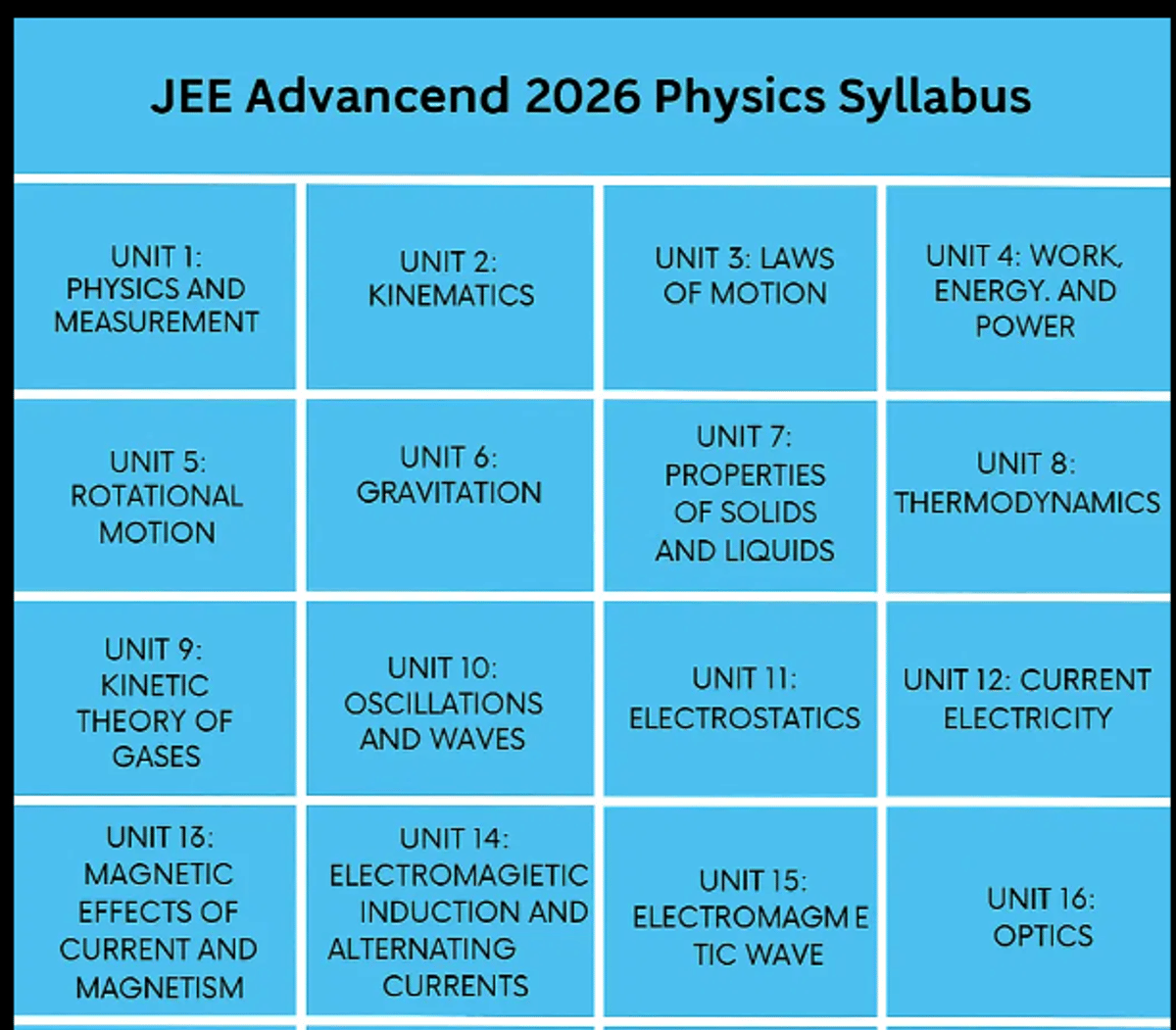
JEE Advanced 2026 Physics Syllabus
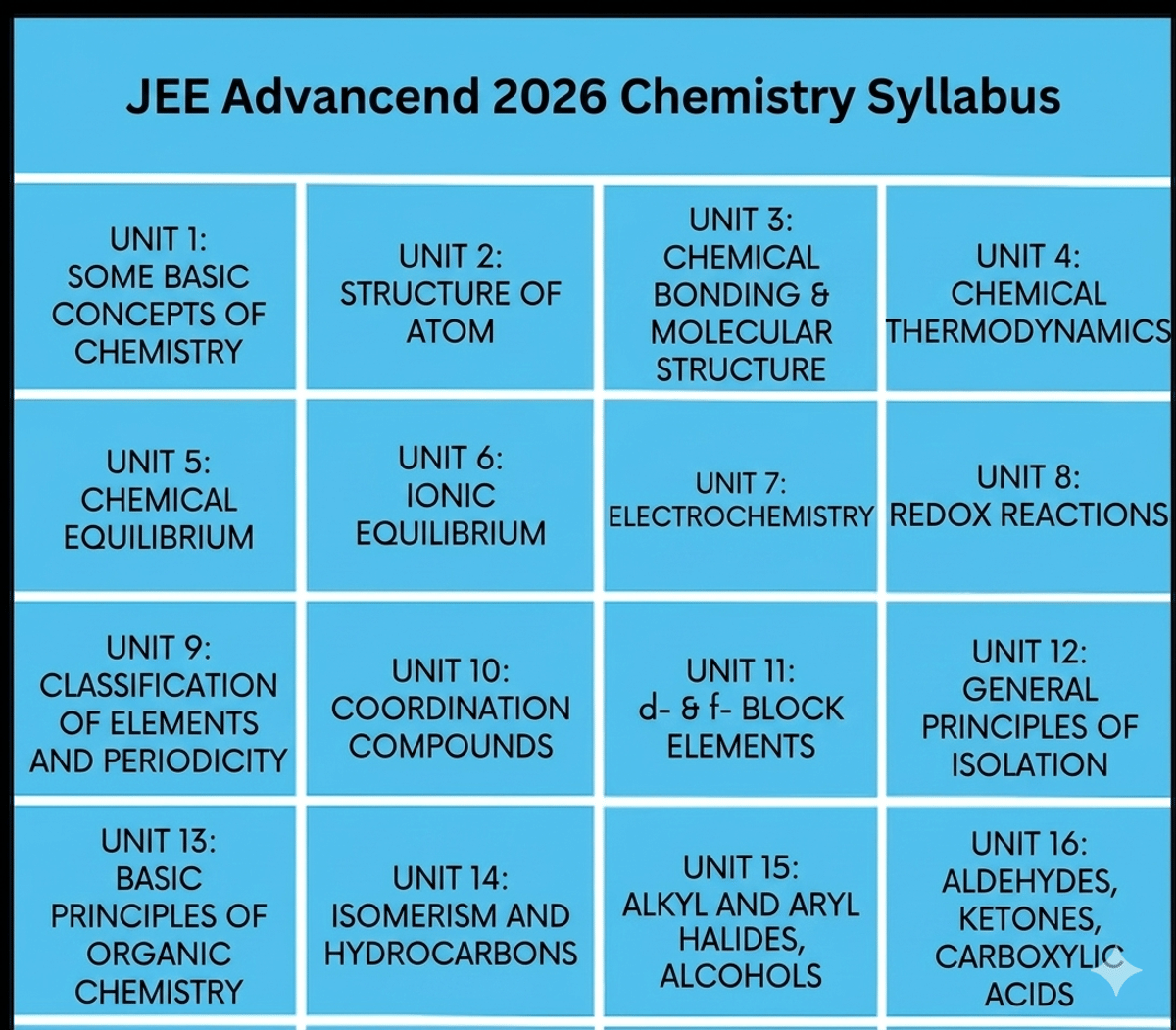
JEE Advanced 2026 Chemistry Syllabus
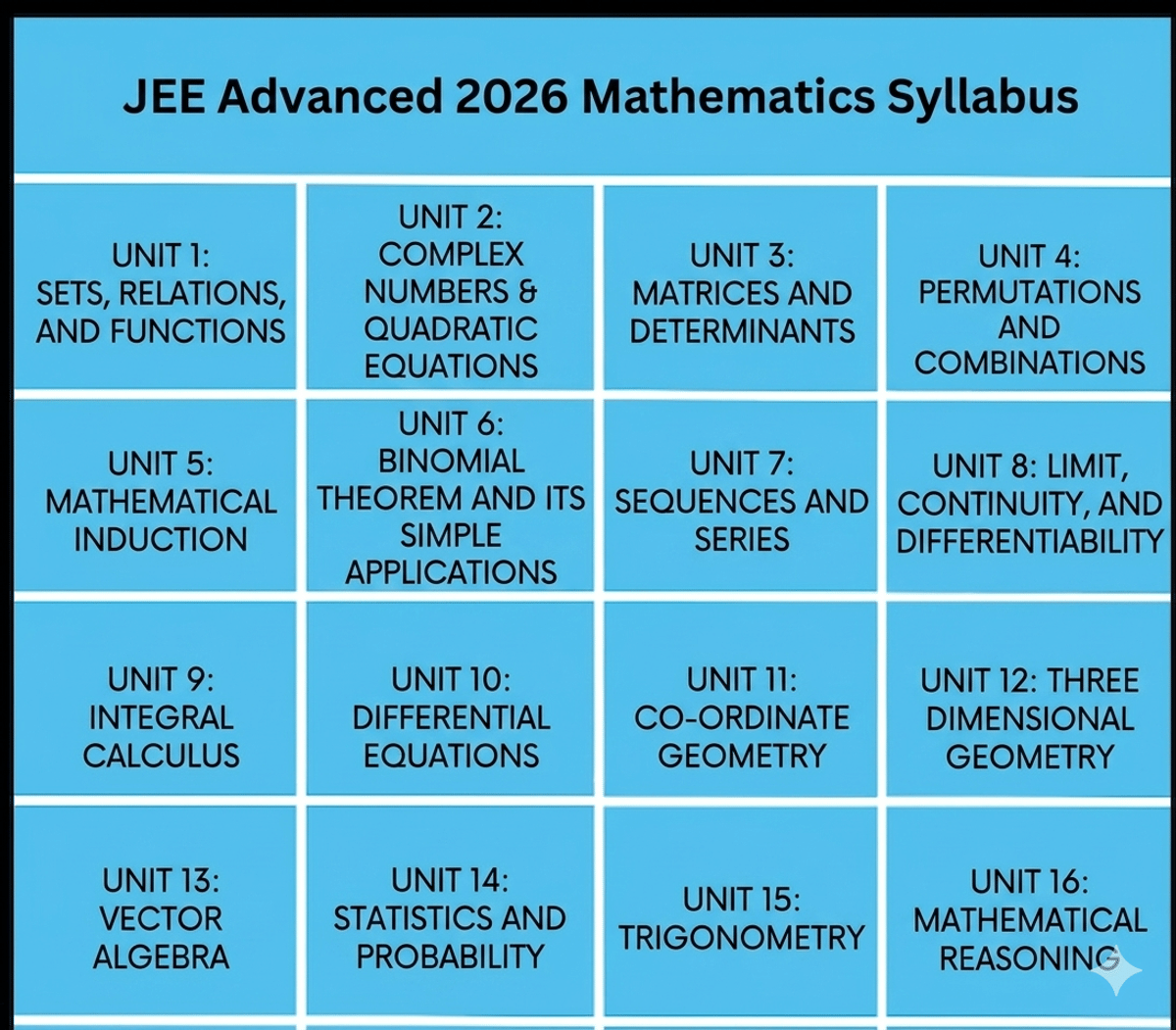
JEE Advanced 2026 Mathematics Syllabus
Also Check:
JEE Advanced Exam Pattern 2026: Weightage
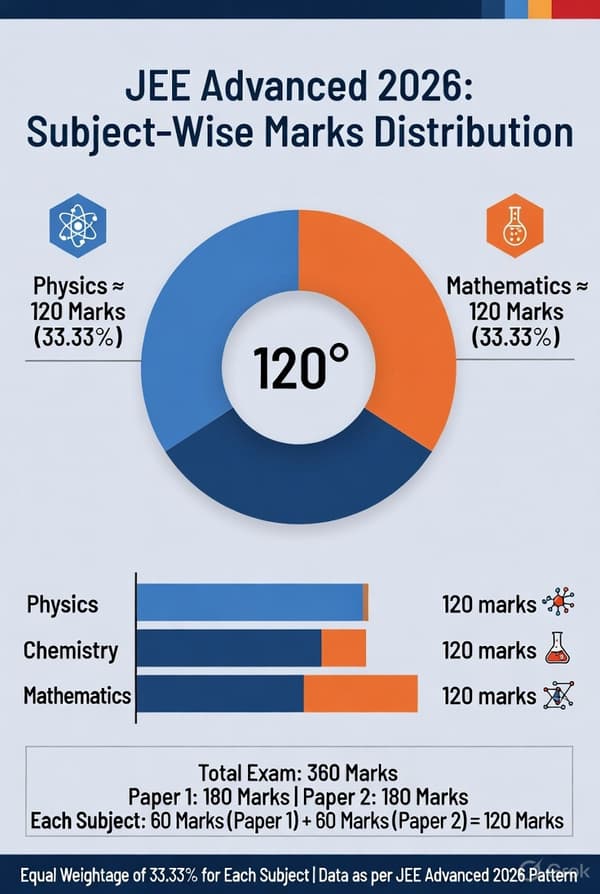
In the JEE Advanced Exam Pattern 2026, each subject carries equal weightage of 120 marks (60 marks in Paper 1 + 60 marks in Paper 2), i.e., exactly 33.33% of the total marks.
| Subjects | Marks | Total Marks | Overall Weightage |
|---|---|---|---|
| Paper 1 & 2 | |||
| Physics | 60 + 60 | 120 | 33.33% |
| Chemistry | 60 + 60 | 120 | 33.33% |
| Mathematics | 60 + 60 | 120 | 33.33% |
Reddit Discussion On JEE Advanced 2026 Pattern Change

On Reddit, candidates were seen discussing the rumours that the authorities are changing the JEE Advanced Exam Pattern in 2026. But IIT Roorkee has put an end to such rumours by releasing its information brochure and keeping the exam pattern the same as last year. Keep yourself updated. Don’t believe in such rumours. Always check the official website for any such information.
Source: Reddit Discussion
FAQs
Ques. What is the paper format for JEE Advanced 2026?
Ans. The papers will include different question types, such as single-correct MCQs, multiple-correct MCQs, numerical answer-based questions, and matching-type questions.
Ques. Is it mandatory to appear for both exams?
Ans. Yes, appearing in both exams (Paper 1 + Paper 2) is compulsory. If a student misses one paper, they will be disqualified and will not receive a rank.
Ques. Which IIT will set the question paper for JEE Advanced 2026?
Ans. The exam date for JEE Advanced 2026 has been announced. IIT Roorkee is the organising institute for the JEE Advanced exam 2026. The exam will be held on May 17, 2026.
Ques. Are numerical questions safer than MCQs in JEE Advanced?
Ans. Most often, it has been observed that in the JEE Advanced exams, numerical questions pose low risk. Usually, there’s no negative marking; accuracy matters more than speed in these types of questions, and also, there’s no guessing advantage.



Comments