




The topic Electromagnetic Waves is important in the Physics syllabus for JEE Advanced. It explores the theory, characteristics, and mathematical expressions related to electromagnetic waves, which are essential in numerous modern technologies like communication systems, radio waves, and optics. This section introduces important concepts including the nature of electromagnetic waves, Maxwell's equations, the electromagnetic spectrum, and how these waves propagate through different media.
Electromagnetic waves are regarded as a core topic of JEE Advanced physics. It also underlies other common topics including optics, modern physics, and electromagnetic radiation.
Electromagnetic waves has a moderate weightage in the Physics section of JEE Advanced. In general, it accounts for about 5 - 6% of total overall marks which is roughly equal to one question per year.
Must Check:
JEE Advanced Previous Year Question Paper
Here are some JEE Advanced Previous Year Questions from the topic Electromagnetic Waves.
Question 1:
A positive, singly ionized atom of mass number \( A_M \) is accelerated from rest by the voltage 192V. Thereafter, it enters a rectangular region of width \( w \) with magnetic field \( B_0 = 0.1 \hat{k} \) Tesla, as shown in the figure. The ion finally hits a detector at the distance \( x \) below its starting trajectory. [Given: Mass of neutron/proton = \(\frac{5}{3} \times 10^{-27} \text{kg}\), charge of the electron = \(1.6 \times 10^{-19} \text{C}\).]
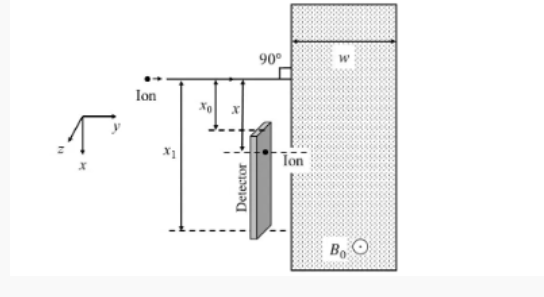
Which of the following option(s) is(are) correct?
View SolutionQuestion 2:
A thin conducting rod MN of mass 20 gm, length 25 cm, and resistance 10 Ω are held on frictionless, long, perfectly conducting vertical rails as shown in the figure. There is a uniform magnetic field \( B_0 = 4 \, \text{T} \) directed perpendicular to the plane of the rod-rail arrangement. The rod is released from rest at time \( t = 0 \) and it moves down along the rails. Assume air drag is negligible. Match each quantity in List-I with an appropriate value from List-II, and choose the correct option. [Given: The acceleration due to gravity \( g = 10 \, \text{m/s}^2 \) and \( e^{-1} = 0.4 \)]
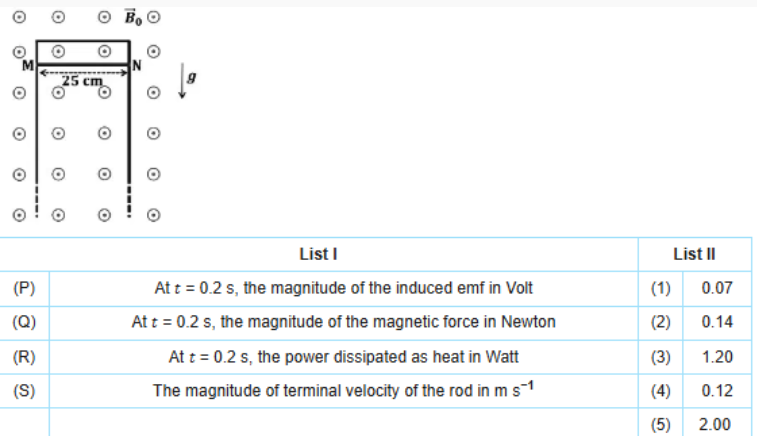
Question 3:
An electric dipole is formed by two charges +q and -q located in the x-y plane at (0, 2) mm and (0, -2) mm as shown in the figure. The electric potential at point P(100, 100) mm due to dipole is \(V_0\). Now the charges +q and -q are moved to (-1, 2) mm and (1, -2) mm respectively. What is the value of the electric potential at point P due to this new dipole?

Question 4:
A rectangular conducting loop of length 4 cm and width 2 cm is in the X-Y plane. It is being moved away from a thin and long conducting wire along the direction \( \left( \frac{\sqrt{3}}{2} \hat{i} + \frac{1}{2} \hat{j} \right) \) with constant speed v. The wire is carrying a steady current \(I = 10 \, \text{A}\) in the +ve X-direction. A current of 10 μA flows through the loop when it is at a distance \(d = 4 \, \text{cm}\) from the wire. If the resistance of the loop is 0.1 Ω, then the value of v is _______ m/s.
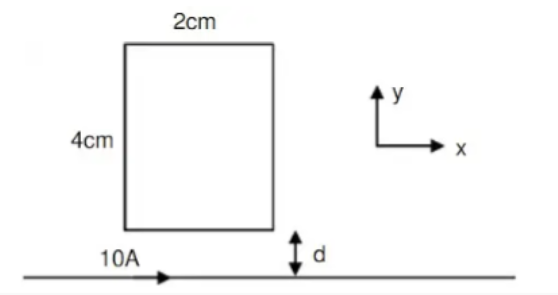
Question 5:
The electric field associated with an electromagnetic wave propagating in a dielectric medium is given by \( \mathbf{E} = 30 \left( 2\hat{i} + \hat{j} \right) \sin \left[ 2 \pi \left( 5 \times 10^{14} - \frac{10^7}{3} z \right) \right] \, \text{V/m}. \) Which of the following is correct? [given: speed of light in vacuum \(c = 3 \times 10^8 \, \text{m/s}\)]
Question 6:
A monochromatic light wave is incident normally on a glass slab of thickness \(d\), as shown in the figure. The refractive index of the slab increases linearly from \(n_1\) to \(n_2\) over the height \(h\). Which of the following statement(s) is(are) true about the light wave emerging out of the slab?
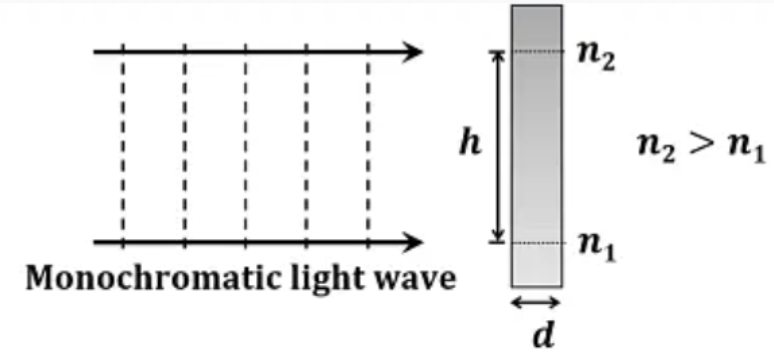
Question 7:
The electric field associated with an electromagnetic wave propagating in a dielectric medium is given by \( \vec{E} = 30 (2 \hat{x} + \hat{y}) \sin \left[ 2\pi \left( 5 \times 10^{14} t - \frac{10^7}{3} z \right) \right] \, \text{Vm}^{-1}. \) Which of the following option(s) is(are) correct? [Given: The speed of light in vacuum \( c = 3 \times 10^8 \, \text{ms}^{-1} \)]
Question 8:
Consider an LC circuit, with inductance \( L = 01 \, \text{H} \) and capacitance \( C = 10^{-3} \, \text{F} \), kept on a plane. The area of the circuit is \( 1 \, \text{m}^2 \). It is placed in a constant magnetic field of strength \( B_0 \) which is perpendicular to the plane of the circuit. At time \( t = 0 \), the magnetic field strength starts increasing linearly as \( B = B_0 + \beta t \) with \( \beta = 004 \, \text{T/s} \). The maximum magnitude of the current in the circuit is _______ mA.
Question 9:
A small circular loop of area \( A \) and resistance \( R \) is fixed on a horizontal \( xy \)-plane with the center of the loop always on the axis \( \hat{n} \) of a long solenoid. The solenoid has \( m \) turns per unit length and carries current \( I \) counterclockwise as shown in the figure. The magnetic field due to the solenoid is in \( \hat{n} \) direction. List-I gives time dependencies of \( \hat{n} \) in terms of a constant angular frequency \( \omega \). List-II gives the torques experienced by the circular loop at time \( t = \pi/ \omega \). Let \( \alpha = \frac{A^2 \mu_0 m^2 I^2}{2R} \)
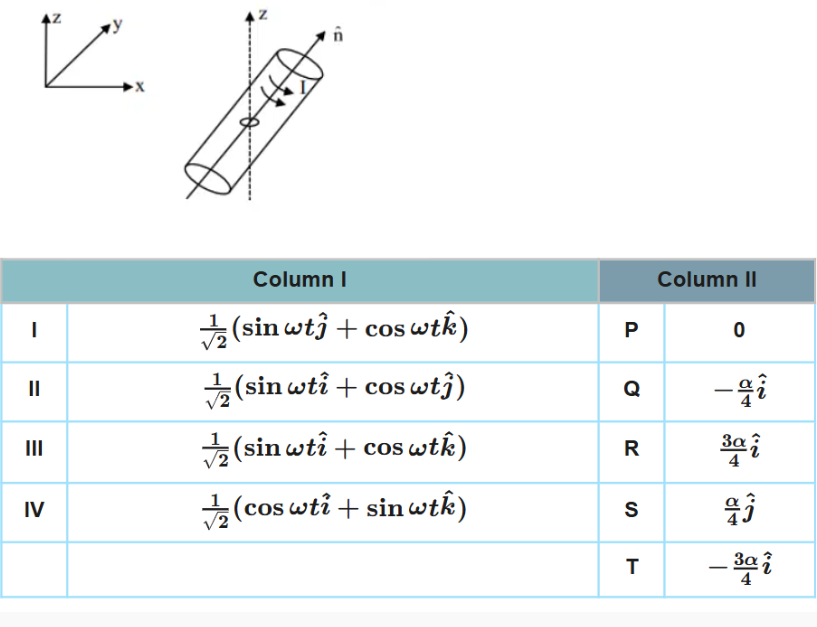
Which of the following option(s) is(are) correct?
Question 10:
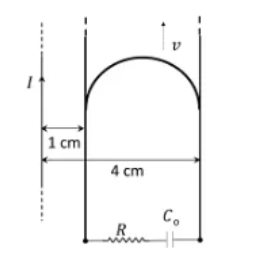
A long straight wire carries a current, \( I = 2 \) ampere. A semi-circular conducting rod is placed beside it on two conducting parallel rails of negligible resistance. Both the rails are parallel to the wire. The wire, the rod and the rails lie in the same horizontal plane, as shown in the figure. Two ends of the semi-circular rod are at distances 1 cm and 4 cm from the wire. At time \( t = 0 \), the rod starts moving on the rails with a speed \( v = 30 \, \text{m/s} \) (see the figure). A resistor \( R = 14 \, \Omega \) and a capacitor \( C_0 = 50 \, \mu F \) are connected in series between the rails. At time \( t = 0 \), \( C_0 \) is uncharged. Which of the following statement(s) is(are) correct? [\( \mu_0 = 4\pi \times 10^{-7} \, \text{SI units} \). Take \( \ln 2 = 0.7 \)]
Question 11:
A physical quantity \( \vec{S} \) is defined as \( \vec{S} = \dfrac{(\vec{E} \times \vec{B})}{\mu_0} \), where \( \vec{E} \) is electric field, \( \vec{B} \) is magnetic field and \( \mu_0 \) is the permeability of free space. The dimensions of \( \vec{S} \) are the same as the dimensions of which of the following quantity(ies)?
Question 12:
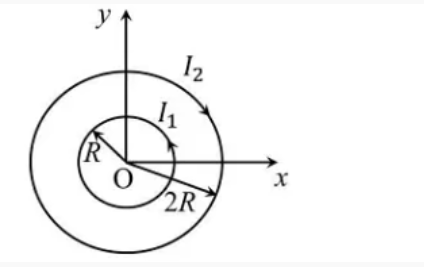
Two concentric circular loops, one of radius \( R \) and the other of radius \( 2R \), lie in the \( xy \)-plane with the origin as their common centre, as shown in the figure. The smaller loop carries current \( I_1 \) in the anti-clockwise direction and the larger loop carries current \( I_2 \) in the clockwise direction, with \( I_2 > 2I_1 \), \( \vec{B}(x, y) \) denotes the magnetic field at a point \( (x, y) \) in the \( xy \)-plane. Which of the following statement(s) is (are) correct?
Question 13:
An \( \alpha \)-particle (mass \( 4 \, \text{amu} \)) and a singly charged sulfur ion (mass \( 32 \, \text{amu} \)) are initially at rest. They are accelerated through a potential \( V \) and then allowed to pass into a region of uniform magnetic field which is normal to the velocities of the particles. Within this region, the \( \alpha \)-particle and the sulfur ion move in circular orbits of radii \( r_{\alpha} \) and \( r_s \), respectively. The ratio \( \frac{r_s}{r_{\alpha}} \) is ______
Question 14:
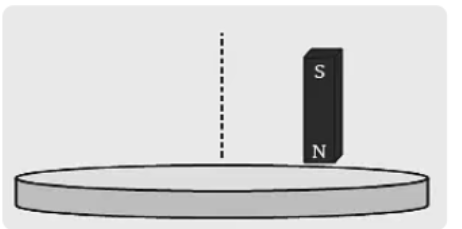
A light disc made of aluminium (a nonmagnetic material) is kept horizontally and is free to rotate about its axis as shown in the figure. A strong magnet is held vertically at a point above the disc away from its axis. On revolving the magnet about the axis of the disc, the disc will (figure is schematic and not drawn to scale).
Question 15:
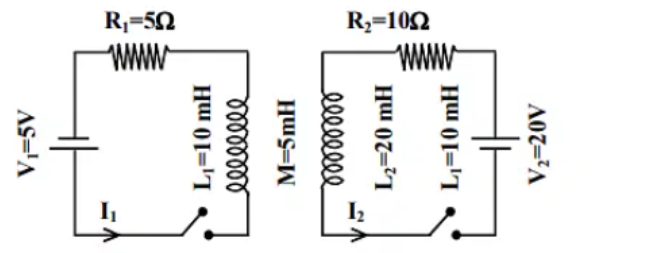
The inductors of two LR circuits are placed next to each other, as shown in the figure. The values of the self-inductance of the inductors, resistances, mutual-inductance and applied voltages are specified in the given circuit. After both the switches are closed simultaneously, the total work done by the batteries against the induced EMF in the inductors by the time the currents reach their steady state values is ________ mJ
JEE Advanced Exam Pattern
The JEE Advanced exam is considered as one of the top engineering entrance examinations in India, which takes place annually for enrollment at IITs and other top institutions to undergraduate programs. JEE Advanced consists of two compulsory papers, Paper 1 and Paper 2, each with three hours of duration. It challenges students’ knowledge of Physics, Chemistry and Mathematics. The exam consists of different question types including Multiple Choice Questions (MCQs), Numerical Value-based Questions and Assertion-Reasoning questions to evaluate the foundational knowledge of topics and ability to solve problems. Both papers have a total of 180 marks, with marks deducted for incorrect answers in a few question types.
| Aspect | Details |
|---|---|
| Mode | Computer-Based Test (CBT) |
| Papers | 2 (Paper 1 & Paper 2) – Both mandatory |
| Duration | 3 hours per paper (with break between papers) |
| Total Subjects | Physics, Chemistry, Mathematics (Equal weightage) |
| Total Questions | ~54–60 (18–20 per subject, split across question types) |
| Language | English & Hindi (option to switch during exam) |
The exam is known for its challenging nature and is conducted in English and Hindi. It is essential to clear the JEE Main exam before appearing for JEE Advanced.
Marking Scheme with Question types in JEE Advanced
Here is a detailed marking scheme for different questions in JEE Advanced exam.
| Question Type | Marks per Q | Negative Marking | Examples |
|---|---|---|---|
| Single Correct MCQ | +3 | -1 | Basic theory/direct formula questions |
| Multiple Correct MCQ | +4 (full) | -2 (if all wrong) / Partial marks* | "Which of the following is/are true?" |
| Numerical Value (NV) | +3 | No negative | Calculations (e.g., wavelength) |
| Paragraph-Based | Varies (2–4) | Depends on sub-type | Linked to a common scenario |
| Match the Following | +2 per match | -1 per wrong match | Column matching (e.g., graphs) |
Partial Marks: For Multiple Correct MCQs, +1 per correct option (if not all selected).
Subject-Wise Distribution
Here is the subject wise questions distribution in the JEE Advanced exam describing number of questions in each subject.
| Subject | MCQs | Numerical | Paragraph/Matching | Total |
|---|---|---|---|---|
| Physics | 6–8 | 4–5 | 2–3 | 12–16 |
| Chemistry | 6–8 | 4–5 | 2–3 | 12–16 |
| Maths | 6–8 | 4–5 | 2–3 | 12–16 |
Subject wise Syllabus: JEE Advanced 2025
Here is a quick syllabus of JEE Advanced 2025 subject wise which helps in preparation of the students. Check JEE Advanced Syllabus for a detailed Syllabus.
| Subject | Key Topics |
|---|---|
| Physics | Mechanics, Electrodynamics, Modern Physics, Optics, Thermodynamics, Error Analysis |
| Chemistry | Physical (Thermo, Kinetics), Organic (Reactions), Inorganic (Coordination, P-Block) |
| Maths | Algebra, Calculus, Coordinate Geometry, Trigonometry, Vectors |
Note:
- Physics: Focus on Modern Physics (20% weightage) & Electrodynamics.
- Chemistry: Organic reactions & Coordination compounds are high-scoring.
- Maths: Calculus (35% weightage) is most critical.
In addition to conceptual knowledge, you should practice multiple mock tests before your exam.
Check:
JEE Advanced Physics Paper Analysis (2024 & Trends)
The JEE Advanced Physics Paper is designed to test a candidate in terms of knowledge in Physics as well as problem-solving skills and capabilities. The test consists of two papers, Paper 1 and Paper 2, with each paper being 3 hours in length and comprising an approximate number of 18-20 questions. The questions in both papers, while relating to a wide range of Physics Topics such as Mechanics, Electromagnetism, Optics, Thermodynamics, Modern Physics, Waves and Oscillations, etc., have the same syllabus in all subjects within the two papers.
Overview (2024)
Here is a basic overview of JEE Advanced Physics Pattern in 2024
| Aspect | Details |
|---|---|
| Total Questions | 12–14 per paper (2 papers) |
| Difficulty | Moderate to Hard (30% easy, 50% moderate, 20% difficult) |
| Question Types | Single/Multiple MCQs, Numerical Value, Paragraph-based, Match-the-Column |
| Key Focus Areas | Modern Physics, Electrodynamics, Mechanics, Error Analysis |
Chapter-Wise Weightage (2024)
The Physics subject in JEE Advanced incorporates a range of chapters from the Class 11 and Class 12 syllabus. The weightage from each chapter varies within each subject. Below is the subject-wise weightage of Physics subjects and possible weightage in JEE Advanced.
| Topic | Weightage | Difficulty | Remarks |
|---|---|---|---|
| Modern Physics | 20–25% | Moderate | Nuclear physics, photoelectric effect, semiconductors |
| Electrodynamics | 18–22% | Hard | EMI, Capacitors, AC circuits, Maxwell’s laws |
| Mechanics | 15–20% | Moderate-Hard | Rotational dynamics, center of mass, collisions |
| Thermodynamics & KTG | 12–15% | Moderate | Laws of thermodynamics, kinetic theory |
| Optics | 10–12% | Easy-Moderate | Wave optics, interference, diffraction |
| Error Analysis | 8–10% | Tricky | Vernier calipers, screw gauge, least count |
| Waves & SHM | 5–8% | Easy | Standing waves, Doppler effect, spring-mass systems |
Difficulty Trends (2019–2024)
Based on previous year trends, here is an overview of the JEE Advanced Question Paper based on its difficulty level and focus points of the exam.
| Year | Difficulty Level | Key Observations |
|---|---|---|
| 2024 | Moderate-Hard | More numerical-based questions, fewer theory MCQs |
| 2023 | Moderate | Balanced mix of conceptual and formula-based Qs |
| 2022 | Hard | Heavy focus on electromagnetism and modern physics |
| 2021 | Very Hard | Unconventional mechanics problems, lengthy solutions |
| 2020 | Moderate | More NCERT-aligned questions |
JEE Advanced Previous Year Question Papers with Detailed Solutions
JEE Advanced 2024 Question Paper Pdf with Solutions
| Paper Name | Question Paper Link | Solutions Link |
|---|---|---|
| JEE Advanced 2024 Paper 1 Question Paper (English) | Download PDF | Check Solutions |
| JEE Advanced 2024 Paper 2 Question Paper (English) | Download PDF | Check Solutions |
| JEE Advanced 2024 Paper 1 Question Paper (Hindi) | Download PDF | Check Solutions |
| JEE Advanced 2024 Paper 1 Question Paper (Hindi) | Download PDF | Check Solutions |
JEE Advanced Question Paper has 4 sections- Section 1 (Maximum marks-12), Section 2 (Maximum marks-12), Section 3 (Maximum marks- 24) and Section 4 (Maximum marks-12)
JEE Advanced Architecture Aptitude Test Question Paper 2024 with Solutions
| Paper Name | Question Paper Link | Solutions Link |
|---|---|---|
| Architecture Aptitude Test | Download PDF | Check Solutions |
JEE Advanced 2023 Question Paper PDF Download With Solutions
| Paper | Question Paper PDF | Answer Key PDF |
|---|---|---|
| Question Paper 1 PDF | Download PDF | Check Solutions |
| Question Paper 2 PDF | Download PDF | Check Solutions |
| Question Paper AAT PDF | Download PDF | Check Solutions |
JEE Advanced 2022 Question Paper
| 2022 Question Paper | PDF Download |
|---|---|
| Question Paper 1 PDF | Click here |
| Question Paper 2 PDF | Click here |
JEE Advanced 2021 Question Paper
| Question Paper | PDF Download | ||
|---|---|---|---|
| Question Paper 1 PDF | Physics | Chemistry | Maths |
| Question Paper 2 PDF | Physics | Chemistry | Maths |
JEE Advanced 2020 Question Paper
| Question Paper | PDF Download |
| Question Paper 1 PDF | Click here |
| Question Paper 2 PDF | Click here |
Frequently Asked Questions (FAQs)
Q1. Is EM waves in JEE Advanced?
Answer. Agreed! Electromagnetic Waves is a core topic in JEE Advanced Physics. The topic title is found in the chapter entitled "Electromagnetic Theory," and is seen as an important topic but with a medium weight. The section covers aspects of electromagnetic wave nature and properties, Maxwell's equations, the electromagnetic spectrum, and the propagation of electromagnetic waves in different media across the spectrum. For JEE Advanced this topic will contribute to about 5-6% of the total marks and is typically 1 question a year. Although this is not the heaviest weight topic and is important in understanding topics in the Physics syllabus and contributes very extensively to the foundation of Electromagnetism with respect to optics, modern physics, and communication systems. Questions can be of conceptual understanding or energy density that may be part of calculations on electromagnetic spectrum properties and waves.
Q2. How hard is physics in JEE Advanced?
Answer. JEE Advanced Physics is deemed tough by many people due to its depth, complexity, and the degree of conceptual understanding, problem-solving abilities, challenging problems that require application of numerous concepts, lengthy calculations, and delays, as compared to overall context. JEE Advanced Physics has significantly more challenge than JEE Main Physics. As a result, deep level of preparation is important to perform well.
Q3. Is it easy to score 120 in Physics?
Answer. It is achievable to score 120 in Physics in JEE Advanced, but it needs hard work and good preparation. Given the exam's difficulty, a strong understanding of the concepts alone will not suffice; you must also be able to apply them to complicated, demanding problems in a limited time frame while being under pressure to perform.
Here's what you need to do in order to achieve this score:
Strong Conceptual Knowledge:
Make sure to have a thorough understanding of the key topics: Mechanics, Electromagnetic Waves, Thermodynamics, and Modern Physics. In JEE Advanced, the majority of questions are fundamentally based on these topics.
Continuous Practice:
Practice many types of problems (including last year's questions). All of those will help you get familiar with the type of question, and improve your skills to do those problems efficiently and accurately.
Time Management:
JEE Advanced is time-pressured, and you must manage your own time during the exam effectively. It is very important to practice with time constraints to get used to managing your own timing.
Problem Solving Skillset:
A lot of problems are also designed to test your analytical skill and your ability to apply multiple concepts simultaneously. Practicing with a variety of problems will help you improve your techniques of solving these problems.
Concentrate on your Weak Areas:Be aware and improve areas in which you struggle. You will be surprised at how much time will benefit you to ensure an easy point that you are comfortable with.
Scoring 120 is difficult but not impossible with the right preparation, consistency, and management of your time.
Q4. Which is the hardest IIT Paper ever?
Answer. The most challenging IIT paper is JEE Advanced 2013, which is known for having the most difficult as well as the trickiest questions - especially in Physics and Mathematics. Other notably challenging years are JEE Advanced 2012 and JEE Advanced 2018, which were also difficult for each of their subjects.





Comments