




Error in Measurement is an important topic in the JEE Advanced Physics syllabus. The main focus is on the accuracy in measurements and the uncertainty in experimental data. This topic covers all types of error in measurements - absolute error, relative error, and percentage error. Moreover, it also covers propagating errors through mathematical operations, and the importance of the error in the final results.
This topic weighs around 2-4% of total marks in the JEE Advanced Physics paper; which equals to 1 question per year. The questions may be for calculating an error given some measurements, finding the uncertainty in a result. The question can also ask to apply the rules of error propagation if there were multiple measurements. Understanding how to analyze the error in measurement can be helpful for solving questions in various physics domains like mechanics, thermodynamics, and electromagnetism.
Must Check:
JEE Advanced Previous Year Question Paper
Here are some of the most important JEE Advanced previous year questions of the error in measurement topic.
Question 1:
The dimensions of a cone are measured using a scale with a least count of 2 mm. The diameter of the base and the height are both measured to be 20.0 cm. The maximum percentage error in the determination of the volume is ______.
Question 2:
Area of the cross-section of a wire is measured using a screw gauge. The pitch of the main scale is 0.5 mm. The circular scale has 100 divisions and for one full rotation of the circular scale, the main scale shifts by two divisions. The measured readings are listed below.
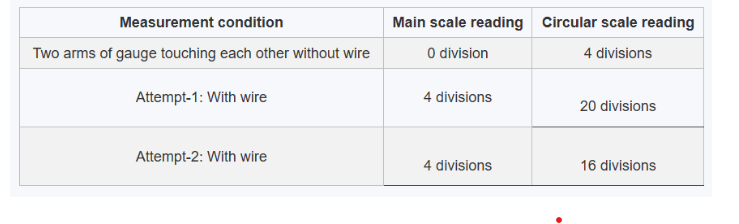
What are the diameter and cross-sectional area of the wire measured using the screw gauge?
Question 3:
The smallest division on the main scale of a Vernier calipers is 0.1 cm. Ten divisions of the Vernier scale correspond to nine divisions of the main scale. The figure below on the left shows the reading of this calipers with no gap between its two jaws. The figure on the right shows the reading with a solid sphere held between the jaws. The correct diameter of the sphere is
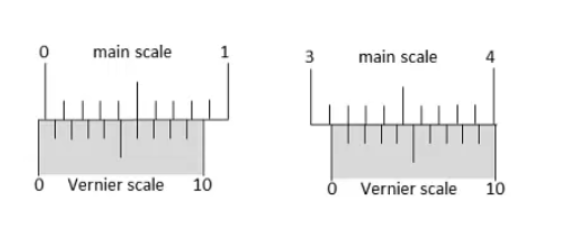
Question 4:
Sometimes it is convenient to construct a system of units so that all quantities can be expressed in terms of only one physical quantity. In one such system, dimensions of different quantities are given in terms of a quantity \( X \) as follows:
\[ [\text{position}] = [X^\alpha]; \]
\[ [\text{Speed}] = [X^\beta]; \]
\[ [\text{acceleration}] = [X^p]; \]
\[ [\text{Linear momentum}] = [X^q]; \]
\[ [\text{force}] = [X^r]. \]
Question 5:
A Vernier calipers has 1 mm marks on the main scale. It has 20 equal divisions on the Vernier scale which match with 16 main scale divisions. For this Vernier calipers, the least count is
JEE Advanced Exam Pattern
The JEE Advanced exam is considered as one of the top engineering entrance examinations in India, which takes place annually for enrollment at IITs and other top institutions to undergraduate programs. JEE Advanced consists of two compulsory papers, Paper 1 and Paper 2, each with three hours of duration. It challenges students’ knowledge of Physics, Chemistry and Mathematics. The exam consists of different question types including Multiple Choice Questions (MCQs), Numerical Value-based Questions and Assertion-Reasoning questions to evaluate the foundational knowledge of topics and ability to solve problems. Both papers have a total of 180 marks, with marks deducted for incorrect answers in a few question types.
| Aspect | Details |
|---|---|
| Mode | Computer-Based Test (CBT) |
| Papers | 2 (Paper 1 & Paper 2) – Both mandatory |
| Duration | 3 hours per paper (with break between papers) |
| Total Subjects | Physics, Chemistry, Mathematics (Equal weightage) |
| Total Questions | ~54–60 (18–20 per subject, split across question types) |
| Language | English & Hindi (option to switch during exam) |
The exam is known for its challenging nature and is conducted in English and Hindi. It is essential to clear the JEE Main exam before appearing for JEE Advanced.
Question Type & Marking Scheme
Here is a detailed marking scheme for different questions in JEE Advanced exam.
| Question Type | Marks per Q | Negative Marking | Examples |
|---|---|---|---|
| Single Correct MCQ | +3 | -1 | Basic theory/direct formula questions |
| Multiple Correct MCQ | +4 (full) | -2 (if all wrong) / Partial marks* | "Which of the following is/are true?" |
| Numerical Value (NV) | +3 | No negative | Calculations (e.g., wavelength) |
| Paragraph-Based | Varies (2–4) | Depends on sub-type | Linked to a common scenario |
| Match the Following | +2 per match | -1 per wrong match | Column matching (e.g., graphs) |
Partial Marks: For Multiple Correct MCQs, +1 per correct option (if not all selected).
Subject-Wise Distribution (Per Paper)
Here is the subject wise questions distribution in the JEE Advanced exam.
| Subject | MCQs | Numerical | Paragraph/Matching | Total |
|---|---|---|---|---|
| Physics | 6–8 | 4–5 | 2–3 | 12–16 |
| Chemistry | 6–8 | 4–5 | 2–3 | 12–16 |
| Maths | 6–8 | 4–5 | 2–3 | 12–16 |
Subject wise Syllabus: JEE Advanced 2025
Here is a quick syllabus of JEE Advanced 2025 subject wise which helps in preparation of the students. Check JEE Advanced Syllabus for a detailed Syllabus.
| Subject | Key Topics |
|---|---|
| Physics | Mechanics, Electrodynamics, Modern Physics, Optics, Thermodynamics, Error Analysis |
| Chemistry | Physical (Thermo, Kinetics), Organic (Reactions), Inorganic (Coordination, P-Block) |
| Maths | Algebra, Calculus, Coordinate Geometry, Trigonometry, Vectors |
Note:
- Physics: Focus on Modern Physics (20% weightage) & Electrodynamics.
- Chemistry: Organic reactions & Coordination compounds are high-scoring.
- Maths: Calculus (35% weightage) is most critical.
In addition to conceptual knowledge, you should practice multiple mock tests before your exam.
Check:
JEE Advanced Physics Paper Analysis (2024 & Trends)
The JEE Advanced Physics Paper is designed to test a candidate in terms of knowledge in Physics as well as problem-solving skills and capabilities. The test consists of two papers, Paper 1 and Paper 2, with each paper being 3 hours in length and comprising an approximate number of 18-20 questions. The questions in both papers, while relating to a wide range of Physics Topics such as Mechanics, Electromagnetism, Optics, Thermodynamics, Modern Physics, Waves and Oscillations, etc., have the same syllabus in all subjects within the two papers.
Overview (2024)
Here is a basic overview of JEE Advanced Physics Pattern in 2024
| Aspect | Details |
|---|---|
| Total Questions | 18–20 per paper (2 papers) |
| Difficulty | Moderate to Hard (30% easy, 50% moderate, 20% difficult) |
| Question Types | Single/Multiple MCQs, Numerical Value, Paragraph-based, Match-the-Column |
| Key Focus Areas | Modern Physics, Electrodynamics, Mechanics, Error Analysis |
Chapter-Wise Weightage (2024)
The Physics subject in JEE Advanced incorporates a range of chapters from the Class 11 and Class 12 syllabus. The weightage from each chapter varies within each subject. Below is the subject-wise weightage of Physics subjects and possible weightage in JEE Advanced.
| Topic | Weightage | Difficulty | Remarks |
|---|---|---|---|
| Modern Physics | 20–25% | Moderate | Nuclear physics, photoelectric effect, semiconductors |
| Electrodynamics | 18–22% | Hard | EMI, Capacitors, AC circuits, Maxwell’s laws |
| Mechanics | 15–20% | Moderate-Hard | Rotational dynamics, center of mass, collisions |
| Thermodynamics & KTG | 12–15% | Moderate | Laws of thermodynamics, kinetic theory |
| Optics | 10–12% | Easy-Moderate | Wave optics, interference, diffraction |
| Error Analysis | 8–10% | Tricky | Vernier calipers, screw gauge, least count |
| Waves & SHM | 5–8% | Easy | Standing waves, Doppler effect, spring-mass systems |
- Main focus should be Modern Physics as it can be a game-changer topic.
- Focus on Electrodynamics and must have in-hand practice for the numerical questions as it is the hardest to score.
- Must have a good knowledge for conceptual topics.
Difficulty Trends (2019–2024)
Based on previous year trends, here is an overview of the JEE Advanced Question Paper based on its difficulty level and focus points of the exam.
| Year | Difficulty Level | Key Observations |
|---|---|---|
| 2024 | Moderate-Hard | More numerical-based questions, fewer theory MCQs |
| 2023 | Moderate | Balanced mix of conceptual and formula-based Qs |
| 2022 | Hard | Heavy focus on electromagnetism and modern physics |
| 2021 | Very Hard | Unconventional mechanics problems, lengthy solutions |
| 2020 | Moderate | More NCERT-aligned questions |
Key Points:
- Focus on numerical based questions more
- NCERT is the key to learn conceptual portion
- Modern Physics is the most important and scoring topic
JEE Advanced Previous Year Question Papers with Detailed Solutions
JEE Advanced 2024 Question Paper Pdf with Solutions
| Paper Name | Question Paper Link | Solutions Link |
|---|---|---|
| JEE Advanced 2024 Paper 1 Question Paper (English) | Download PDF | Check Solutions |
| JEE Advanced 2024 Paper 2 Question Paper (English) | Download PDF | Check Solutions |
| JEE Advanced 2024 Paper 1 Question Paper (Hindi) | Download PDF | Check Solutions |
| JEE Advanced 2024 Paper 1 Question Paper (Hindi) | Download PDF | Check Solutions |
JEE Advanced Question Paper has 4 sections- Section 1 (Maximum marks-12), Section 2 (Maximum marks-12), Section 3 (Maximum marks- 24) and Section 4 (Maximum marks-12)
JEE Advanced Architecture Aptitude Test Question Paper 2024 with Solutions
| Paper Name | Question Paper Link | Solutions Link |
|---|---|---|
| Architecture Aptitude Test | Download PDF | Check Solutions |
JEE Advanced 2023 Question Paper PDF Download With Solutions
| Paper | Question Paper PDF | Answer Key PDF |
|---|---|---|
| Question Paper 1 PDF | Download PDF | Check Solutions |
| Question Paper 2 PDF | Download PDF | Check Solutions |
| Question Paper AAT PDF | Download PDF | Check Solutions |
JEE Advanced 2022 Question Paper
| 2022 Question Paper | PDF Download |
|---|---|
| Question Paper 1 PDF | Click here |
| Question Paper 2 PDF | Click here |
JEE Advanced 2021 Question Paper
| Question Paper | PDF Download | ||
|---|---|---|---|
| Question Paper 1 PDF | Physics | Chemistry | Maths |
| Question Paper 2 PDF | Physics | Chemistry | Maths |
JEE Advanced 2020 Question Paper
| Question Paper | PDF Download |
| Question Paper 1 PDF | Click here |
| Question Paper 2 PDF | Click here |
Frequently Asked Questions (FAQs)
Q1. Can I skip units and measurements for JEE Advanced?
Answer. It is not recommended to skip Units and Measurements in JEE Advanced. Although it has less weightage, around 4-6% of total marks, it is a core topic and provides a foundation for understanding several other concepts in physics. SI units of numerous levels as well as dimensional analysis and error propagation are important in mechanics, electromagnetism, and thermodynamics. If you have a solid understanding of this topic, you will be equipped to address unit conversions and error propagation in calculations, which are likely to be covered in the exam, either directly or in other sections indirectly.
Q2. What is the most scoring subject in JEE Advanced?
Answer. Chemistry is usually considered to be the most scoring subject in the JEE Advanced exam. It tends to be more predictable and has less complicated mathematical problem-solving. In organic and inorganic chemistry, you focus more on memorization and understanding, often leading to easier scoring.
Q3. How to score 40 marks in physics JEE Advanced?
Answer. To achieve 40 marks in Physics in JEE Advanced, have a good understanding of concepts from all topics, namely Mechanics, Electrodynamics, Optics, and Modern Physics. Regularly practice problems from a variety of contexts to sharpen your problem-solving abilities. Solve previous year papers and complete as much mock testing as you can to get to know the testing format and become better at managing your time. You will improve on the test if you are regularly revising material and clearing up confusion on topics where you feel weak.
Q4. Is 95 percentile enough to qualify for JEE Advanced?
Answer. Typically, a 95 percentile will not be enough to qualify for JEE Advanced. JEE Main cutoffs can vary yearly based on the number of candidates that sit for the exam and the degree of difficulty. In past years, those cutoffs for general category candidates have generally ranged higher, typically around the 90-95 percentile cutoffs to qualify for JEE Advanced, and lower cutoffs for categories that are not general. It is best to try to target a higher percentile so that you will have a greater chance at an overall qualification to JEE Advanced.
Q5. Is it easy to score 150 in JEE Advanced?
Answer. Getting a score of 150 in JEE Advanced, even if you have worked hard on all three subjects— Physics, Chemistry, and Mathematics—requires excellent conceptual clarity and lots of hard work. To achieve such a score, you have to be good at all three subjects, practice as much as you can, and follow a targeted strategy of theoretical understanding and problem-solving ability. Consistent revision, JEE Advanced previous year question papers, and mock tests are good practice to get to such a score. The competition is stiff and you want to plan to cover a balanced plan of attack targeting high-weightage topics while also considering all areas as potentially important.




Comments