



.png?h=35&w=35&mode=stretch)
JEE Advanced 2023 AAT Question paper is available for download. JEE Advanced 2023 for AAT paper was conducted on June 21, 2023. The exam was successfully organized by Indian Institute of Technology, Guwahati. The question paper comprised a total of 16 questions.
JEE Advanced 2023 AAT Question Paper with Answer Key PDF
| JEE Advanced 2023 AAT Question Paper with Answer Key |  Download Download |
Check Solution |
SECTION A: Architectural Awareness
This section contains 15 multiple choice questions. Each question has four options, out of which ONLY ONE is correct
Question i:
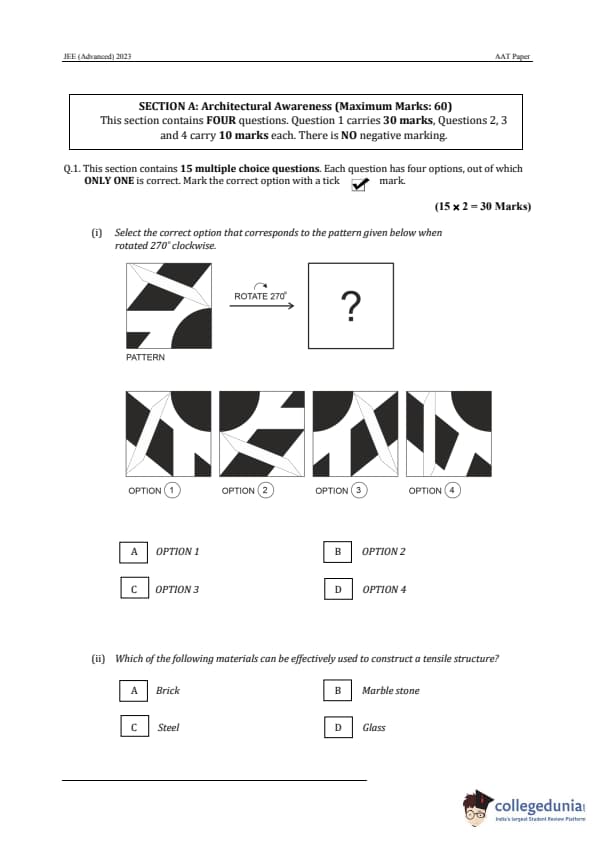
Select the correct option that corresponds to the pattern given below when rotated 270° clockwise.

View Solution
Step 1: Understanding the rotation transformation.
- A 270° clockwise rotation is equivalent to a 90° counterclockwise rotation.
- The shape and orientation of the elements must match after the transformation.
Step 2: Comparing the given options.
- Observing the transformation, OPTION 3 matches the correct rotated orientation.
Thus, the correct answer is option C (OPTION 3). Quick Tip: For rotational transformations, break down the rotation into smaller steps and track key reference points to identify correct orientation.
Which of the following materials can be effectively used to construct a tensile structure?
View Solution
Step 1: Understanding tensile structures.
- Tensile structures require materials that can withstand tension without breaking.
Step 2: Analyzing the given materials.
- Steel is highly ductile and strong in tension, making it ideal for tensile structures.
- Brick, marble, and glass are primarily brittle and not suited for tensile applications.
Thus, the correct answer is option C (Steel). Quick Tip: Tensile structures require materials with high tensile strength, such as steel cables or fabric membranes, to withstand external forces effectively.
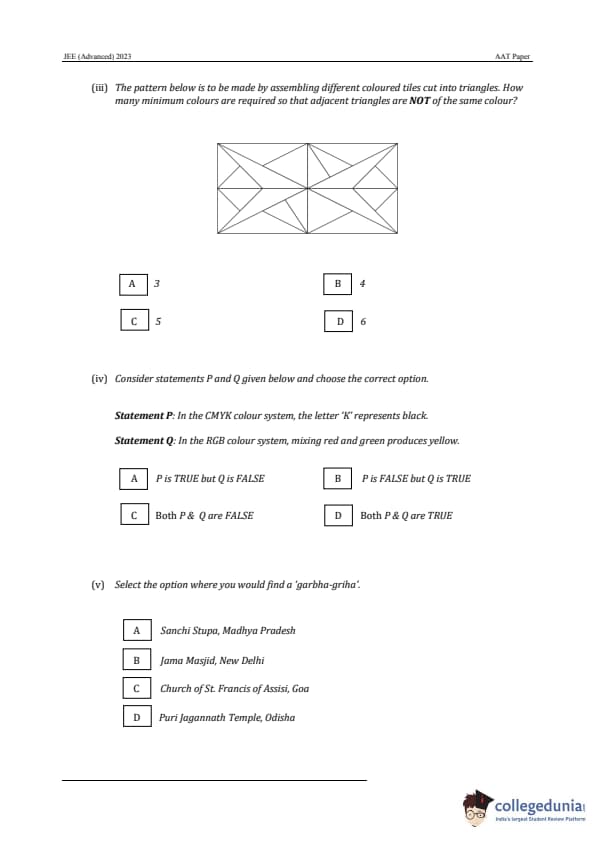
The pattern below is to be made by assembling different coloured tiles cut into triangles. How many minimum colours are required so that adjacent triangles are \textbf{NOT} of the same colour?

View Solution
Step 1: Understanding the colouring problem.
- This is a graph colouring problem, where each triangle is a node.
- The goal is to minimize colours while ensuring no two adjacent triangles share the same colour.
Step 2: Applying the four-colour theorem.
- For a planar tiling of this type, at most four colours are required to ensure no adjacent regions share the same colour.
Thus, the correct answer is option B (4). Quick Tip: Graph colouring problems often use the Four-Colour Theorem, which states that any planar map can be coloured using at most four colours.
Consider statements P and Q given below and choose the correct option.
Statement P: In the CMYK colour system, the letter ‘K’ represents black.
Statement Q: In the RGB colour system, mixing red and green produces yellow.
View Solution
Step 1: Verifying Statement P.
- The CMYK colour model is used in printing.
- Cyan (C), Magenta (M), Yellow (Y), and Black (K) are the four components.
- The letter 'K' stands for black, making Statement P TRUE.
Step 2: Verifying Statement Q.
- In the RGB (Red, Green, Blue) colour model, combining Red and Green produces Yellow.
- This is a property of additive colour mixing, making Statement Q TRUE.
Thus, the correct answer is option D (Both P \& Q are TRUE). Quick Tip: CMYK is a subtractive colour model used in printing, while RGB is an additive model used in digital screens.
Select the option where you would find a ‘garbha-griha’.
View Solution
Step 1: Understanding the term ‘Garbha-Griha’.
- The garbha-griha (meaning ‘sanctum sanctorum’) is the innermost shrine in Hindu temples, where the main deity is placed.
Step 2: Analyzing the given options.
- Sanchi Stupa is a Buddhist monument (not a Hindu temple).
- Jama Masjid is an Islamic mosque (does not have a garbha-griha).
- Church of St. Francis of Assisi is a Christian church.
- Puri Jagannath Temple is a Hindu temple and has a garbha-griha.
Thus, the correct answer is option D (Puri Jagannath Temple, Odisha). Quick Tip: A garbha-griha is always found in Hindu temples, serving as the sacred core where the deity resides.
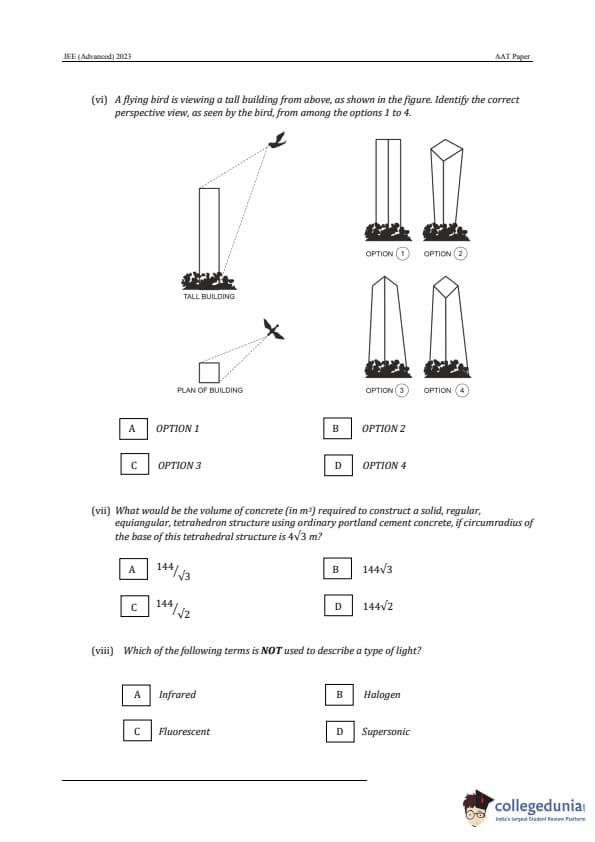
A flying bird is viewing a tall building from above, as shown in the figure. Identify the correct perspective view, as seen by the bird, from among the options 1 to 4.

View Solution
Step 1: Understanding the perspective view.
- A top-down view of the building will show its plan shape rather than its height.
Step 2: Comparing the options.
- Observing the given perspectives, OPTION 3 correctly represents the shape of the building as seen from above.
Thus, the correct answer is option C (OPTION 3). Quick Tip: When determining perspective views, focus on the shape of the object's plan rather than its elevation.
What would be the volume of concrete (in \( m^3 \)) required to construct a solid, regular, equiangular, tetrahedron structure using ordinary Portland cement concrete, if circumradius of the base of this tetrahedral structure is \( 4\sqrt{3} \) m?
View Solution
Given:
The tetrahedron is regular (all edges are equal).
The circumradius \( R \) of the base is given as \( 4\sqrt{3} \) m.
We need to find the volume of the tetrahedron.
\subsection*{Step 1: Relation between Circumradius and Side Length
For a regular tetrahedron, the circumradius \( R \) of its base (which is an equilateral triangle) is related to the side length \( a \) by:
\[ R = \frac{a}{\sqrt{3}} \]
Substituting \( R = 4\sqrt{3} \):
\[ 4\sqrt{3} = \frac{a}{\sqrt{3}} \]
Multiplying both sides by \( \sqrt{3} \), we get:
\[ a = 12 \]
\subsection*{Step 2: Volume of a Regular Tetrahedron
The volume of a regular tetrahedron is given by the formula:
\[ V = \frac{a^3}{6\sqrt{2}} \]
Substituting \( a = 12 \):
\[ V = \frac{12^3}{6\sqrt{2}} \]
\[ V = \frac{1728}{6\sqrt{2}} \]
\[ V = \frac{288}{\sqrt{2}} \]
Rationalizing the denominator:
\[ V = \frac{288\sqrt{2}}{2} = 144\sqrt{2} \]
\subsection*{Final Answer: \[ \boxed{144\sqrt{2}} \quad (Option D) \] Quick Tip: For a regular tetrahedron, the volume formula can be derived using its circumradius relation.
Which of the following terms is \textbf{NOT} used to describe a type of light?
View Solution
Step 1: Understanding types of light.
- Infrared refers to electromagnetic radiation beyond the visible spectrum.
- Halogen light is a type of incandescent light using halogen gas.
- Fluorescent light is a low-pressure mercury vapor gas-discharge lamp.
Step 2: Identifying the incorrect term.
- Supersonic refers to speeds faster than the speed of sound, not a type of light.
Thus, the correct answer is option D (Supersonic). Quick Tip: Types of light include natural (visible, infrared, ultraviolet) and artificial (halogen, fluorescent, LED). Supersonic relates to sound, not light.
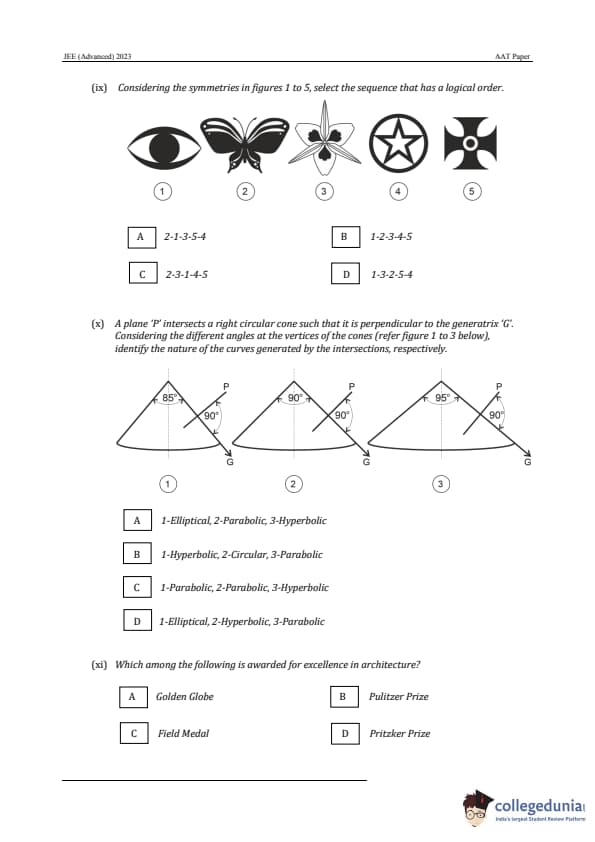
Considering the symmetries in figures 1 to 5, select the sequence that has a logical order.

View Solution
Step 1: Understanding the logical symmetry order.
- The given figures represent different types of symmetry (bilateral, rotational, reflectional, etc.).
- The logical order follows the progression of symmetry complexity.
Step 2: Identifying the correct sequence.
- Arranging based on symmetry transformations, option 1-2-3-4-5 follows a structured order.
Thus, the correct answer is option B (1-2-3-4-5). Quick Tip: When arranging figures in a sequence, look for progressive changes in symmetry, complexity, or structure.
A plane ‘P’ intersects a right circular cone such that it is perpendicular to the generatrix ‘G’. Considering the different angles at the vertices of the cones (refer figure 1 to 3 below), identify the nature of the curves generated by the intersections, respectively.

View Solution
Step 1: Understanding conic section intersections.
- When a plane cuts a cone at different angles, it generates different types of conic sections.
- The key conic sections:
- Elliptical (plane cuts at an acute angle).
- Parabolic (plane cuts exactly parallel to the cone’s slope).
- Hyperbolic (plane cuts at an obtuse angle).
Step 2: Analyzing the given figures.
- Figure 1 (85° cut): Elliptical section.
- Figure 2 (90° cut): Parabolic section.
- Figure 3 (95° cut): Hyperbolic section.
Thus, the correct answer is option A (1-Elliptical, 2-Parabolic, 3-Hyperbolic). Quick Tip: Conic sections depend on how a plane cuts a cone: acute cuts form ellipses, parallel cuts form parabolas, and obtuse cuts form hyperbolas.
Which among the following is awarded for excellence in architecture?
View Solution
Step 1: Understanding prestigious awards.
- Golden Globe is awarded for excellence in film and television.
- Pulitzer Prize is awarded for achievements in journalism, literature, and music.
- Field Medal is awarded for excellence in mathematics.
- Pritzker Prize is awarded for excellence in architecture.
Step 2: Identifying the correct award for architecture.
- Pritzker Prize is considered the Nobel Prize of Architecture.
Thus, the correct answer is option D (Pritzker Prize). Quick Tip: The Pritzker Prize is one of the highest honors in architecture, recognizing outstanding contributions to the field.
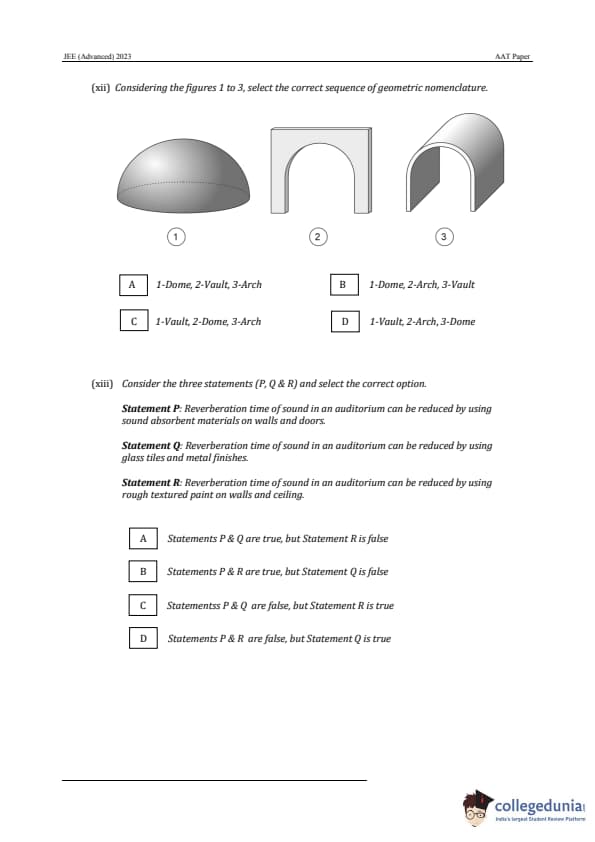
Considering the figures 1 to 3, select the correct sequence of geometric nomenclature.

View Solution
Step 1: Understanding the geometric elements.
- Dome: A three-dimensional hemispherical structure.
- Arch: A curved structure that spans an opening.
- Vault: An arched ceiling or roof, often extending in depth.
Step 2: Identifying the correct sequence.
- Figure 1 represents a Dome (hemispherical shape).
- Figure 2 represents an Arch (single curved span).
- Figure 3 represents a Vault (extended arch).
Thus, the correct answer is option B (1-Dome, 2-Arch, 3-Vault). Quick Tip: Domes are often used in monumental buildings, arches in doorways, and vaults in ceilings to provide structural integrity.
Consider the three statements (P, Q and R) and select the correct option.
Statement P: Reverberation time of sound in an auditorium can be reduced by using sound absorbent materials on walls and doors.
Statement Q: Reverberation time of sound in an auditorium can be reduced by using glass tiles and metal finishes.
Statement R: Reverberation time of sound in an auditorium can be reduced by using rough textured paint on walls and ceiling.
View Solution
Step 1: Understanding reverberation control.
- Reverberation time refers to how long sound persists in an enclosed space after the source stops.
- Absorbent materials such as fabric, carpets, and acoustic panels reduce reverberation.
Step 2: Analyzing the statements.
- Statement P is TRUE: Absorbent materials (e.g., acoustic panels) reduce reverberation.
- Statement Q is FALSE: Glass and metal are reflective, increasing reverberation rather than reducing it.
- Statement R is TRUE: Rough-textured surfaces help diffuse and absorb sound, reducing reverberation.
Thus, the correct answer is option B (Statements P \& R are true, but Statement Q is false). Quick Tip: Sound-absorbing materials (e.g., fabric panels) help reduce echo, while reflective materials (e.g., glass, metal) increase reverberation.
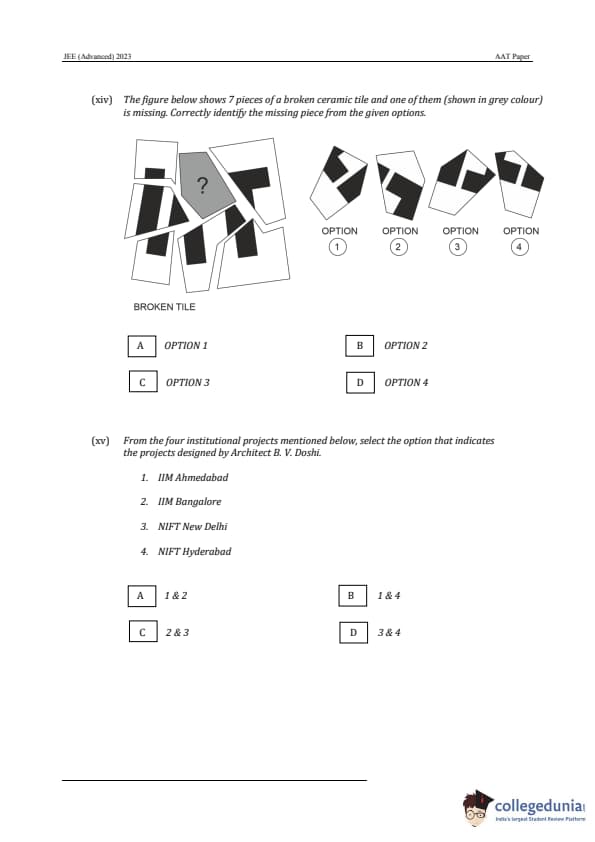
The figure below shows 7 pieces of a broken ceramic tile and one of them (shown in grey colour) is missing. Correctly identify the missing piece from the given options.

View Solution
Step 1: Identifying the missing piece.
- Observing the shape and pattern of the broken ceramic tile, the missing piece must fit perfectly into the empty grey section.
Step 2: Comparing the given options.
- Among Options 1, 2, 3, and 4, OPTION 3 has the exact shape and pattern alignment required to complete the broken tile.
Thus, the correct answer is option C (OPTION 3). Quick Tip: When solving pattern-matching problems, focus on edge alignments, shape congruency, and pattern continuity.
From the four institutional projects mentioned below, select the option that indicates the projects designed by Architect B. V. Doshi.
IIM Ahmedabad
IIM Bangalore
NIFT New Delhi
NIFT Hyderabad
View Solution
Step 1: Identifying B. V. Doshi’s architectural works.
- B. V. Doshi is a renowned Indian architect known for his institutional and sustainable designs.
- He was involved in the design of IIM Ahmedabad and IIM Bangalore.
Step 2: Verifying the given options.
- NIFT New Delhi and NIFT Hyderabad were not designed by B. V. Doshi.
Thus, the correct answer is option A (1 \& 2). Quick Tip: B. V. Doshi is celebrated for designing iconic educational institutions like IIM Bangalore and CEPT University.
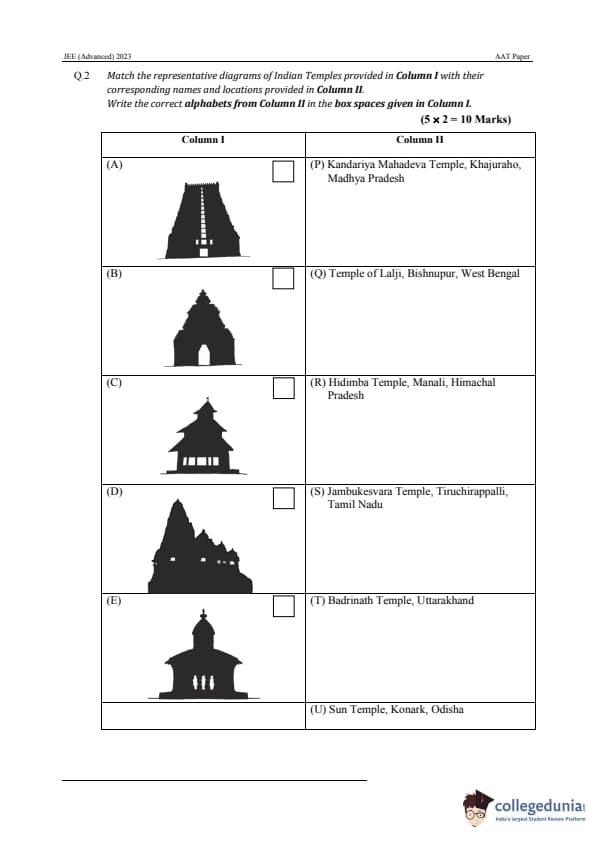
Match the representative diagrams of Indian Temples provided in Column I with their corresponding names and locations provided in Column II. Write the correct alphabets from Column II in the box spaces given in Column I.

View Solution
Step 1: Identifying the temple structures.
- Different temples have distinct architectural styles based on their regions and traditions.
Step 2: Matching them with the given names and locations.
- Temple (A) matches Jambukesvara Temple based on its Dravidian-style architecture.
- Temple (B) is Temple of Lalji, known for its Bengal temple architecture.
- Temple (C) is Hidimba Temple, which follows traditional Himachali wood architecture.
- Temple (D) represents Sun Temple, Konark, famous for its chariot-like structure.
- Temple (E) resembles Badrinath Temple, known for its pagoda-style architecture.
Thus, the correct matching is provided. Quick Tip: Indian temple architecture varies across regions, primarily classified as Nagara (North), Dravidian (South), and Vesara (hybrid).
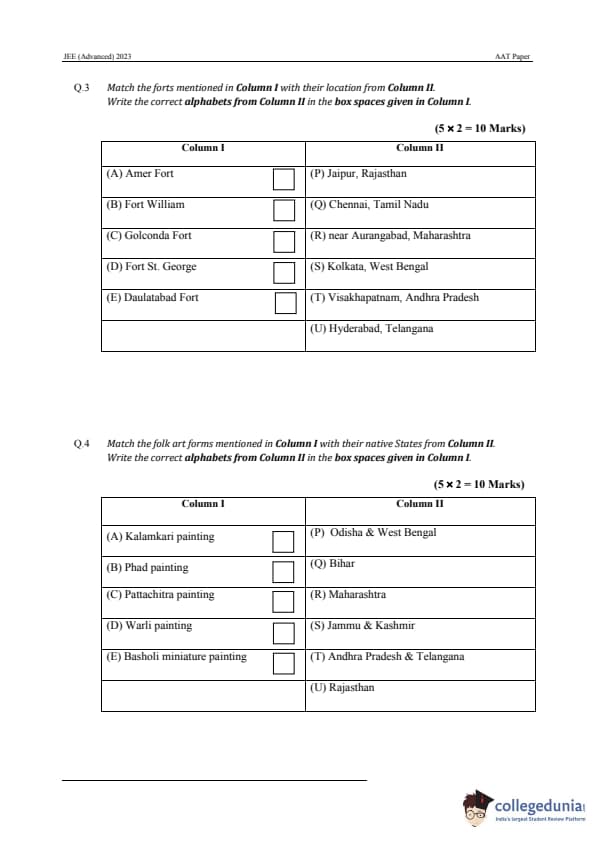
Match the forts mentioned in Column I with their location from Column II. Write the correct \textbf{alphabets from Column II} in the box spaces given in Column I.

View Solution
- (A) - (P) Jaipur, Rajasthan
- (B) - (S) Kolkata, West Bengal
- (C) - (U) Hyderabad, Telangana
- (D) - (Q) Chennai, Tamil Nadu
- (E) - (R) near Aurangabad, Maharashtra
Quick Tip: Many forts in India are historically significant and were built by different dynasties for strategic defense and governance.
Match the folk art forms mentioned in Column I with their native States from Column II. Write the correct alphabets from Column II in the box spaces given in Column I.

View Solution
- (A) - (T) Andhra Pradesh & Telangana
- (B) - (U) Rajasthan
- (C) - (P) Odisha & West Bengal
- (D) - (R) Maharashtra
- (E) - (S) Jammu & Kashmir
Quick Tip: Traditional Indian folk arts reflect the regional culture, history, and mythology, often passed down through generations.
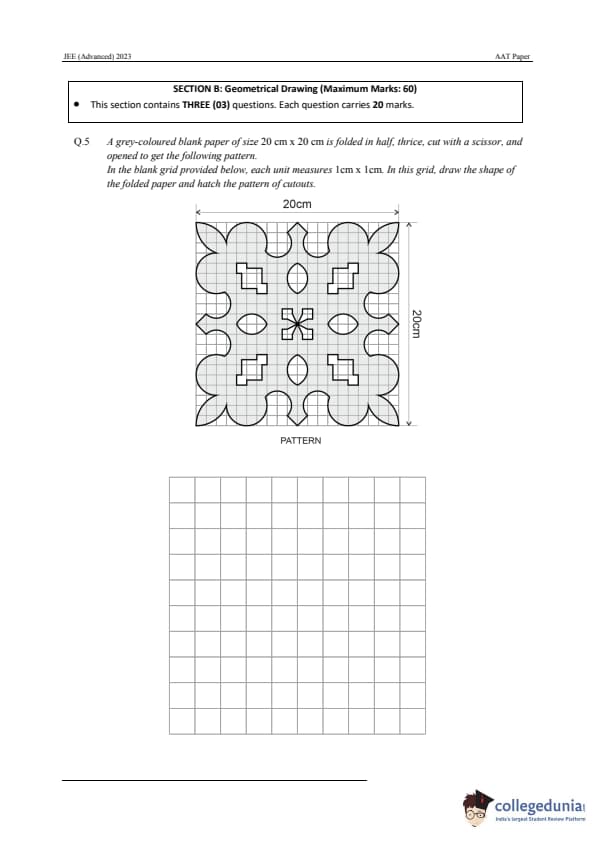
SECTION B: Geometrical Drawing
A grey-coloured blank paper of size 20 cm × 20 cm is folded in half, thrice, cut with a scissor, and opened to get the following pattern.
In the blank grid provided below, each unit measures 1 cm × 1 cm. In this grid, draw the shape of the folded paper and hatch the pattern of cutouts.


View Solution
Step 1: Understanding the folding process.
- The 20 cm × 20 cm paper is folded in half three times:
- First fold: 10 cm × 20 cm.
- Second fold: 10 cm × 10 cm.
- Third fold: 5 cm × 10 cm.
- The cutting pattern is made on the smallest folded section.
Step 2: Identifying the symmetry.
- Since the paper was folded and then cut symmetrically, the final pattern is repeated across all four quadrants.
- The cut shapes are mirrored in all folded sections.
Step 3: Drawing the folded shape on the blank grid.
- The final unfolded pattern (shown in the first figure) helps infer the shape of the folded section where cuts were made.
- Hatching must be used to indicate cutout sections.
Thus, students should replicate the folded shape on the blank grid and hatch the cut-out areas. Quick Tip: When solving paper-folding problems, analyze symmetry, count the folds, and visualize mirrored patterns before making cuts.
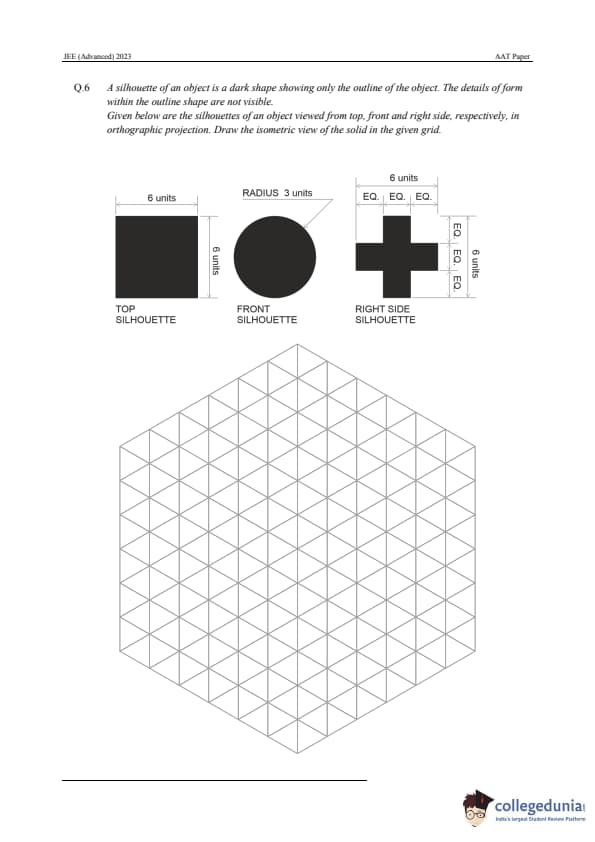
A silhouette of an object is a dark shape showing only the outline of the object. The details of form within the outline shape are not visible.
Given below are the silhouettes of an object viewed from the top, front, and right side, respectively, in orthographic projection. Draw the isometric view of the solid in the given grid.


View Solution
Step 1: Understanding orthographic projections.
- Top view shows a 6×6 square.
- Front view shows a circular silhouette with radius 3 units.
- Right-side view shows a plus-shaped projection with symmetric extensions.
Step 2: Converting orthographic views to an isometric projection.
- The top silhouette provides the overall boundary of the object.
- The front and side silhouettes provide height, shape, and depth details.
- Combining these three views helps reconstruct the 3D isometric projection.
Step 3: Drawing on the isometric grid.
- Use the given triangular isometric grid to visualize depth and align dimensions.
- Represent the solid form by combining the extracted shape from each view. Quick Tip: When drawing isometric views, align the dimensions with the isometric grid, ensuring all features from orthographic projections are accurately represented.
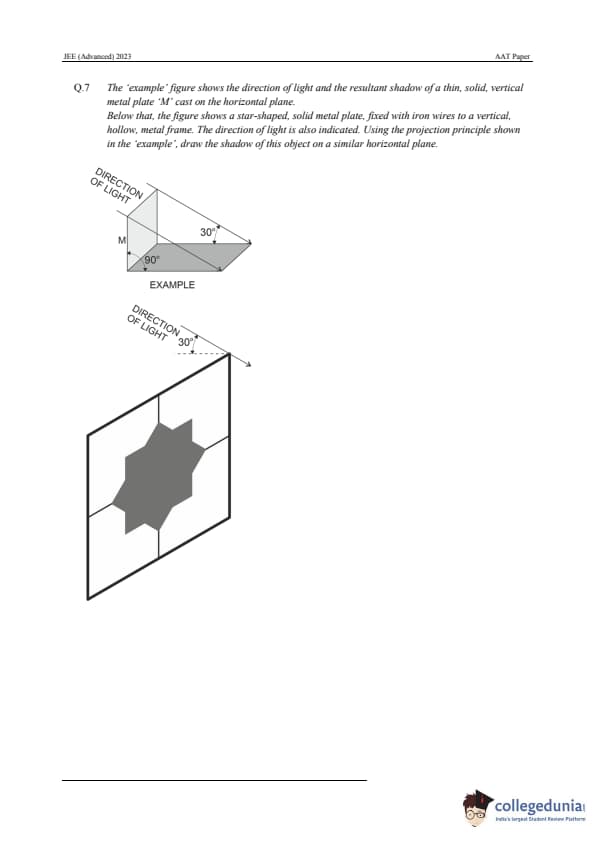
The ‘example’ figure shows the direction of light and the resultant shadow of a thin, solid, vertical metal plate ‘M’ cast on the horizontal plane.
Below that, the figure shows a star-shaped, solid metal plate, fixed with iron wires to a vertical, hollow, metal frame. The direction of light is also indicated. Using the projection principle shown in the ‘example’, draw the shadow of this object on a similar horizontal plane.


View Solution
Step 1: Understanding the projection principle.
- The example figure shows how a light source at 30° casts a shadow of a vertical plane onto a horizontal plane.
- The shadow is proportional to the object’s height and orientation.
Step 2: Applying the principle to the star-shaped plate.
- The star-shaped plate is attached to a vertical frame, meaning its shadow will be projected onto the horizontal plane below.
- The shadow will maintain the star shape but will appear distorted based on the 30° projection angle.
Step 3: Drawing the shadow on the horizontal plane.
- Extend projection lines from the outermost points of the star shape at a 30° angle downward.
- Maintain proportional scaling to ensure the correct transformation from 3D to the 2D shadow. Quick Tip: When drawing shadows in perspective, maintain the correct projection angles and visualize how light interacts with surfaces.
SECTION C: 3D Perception
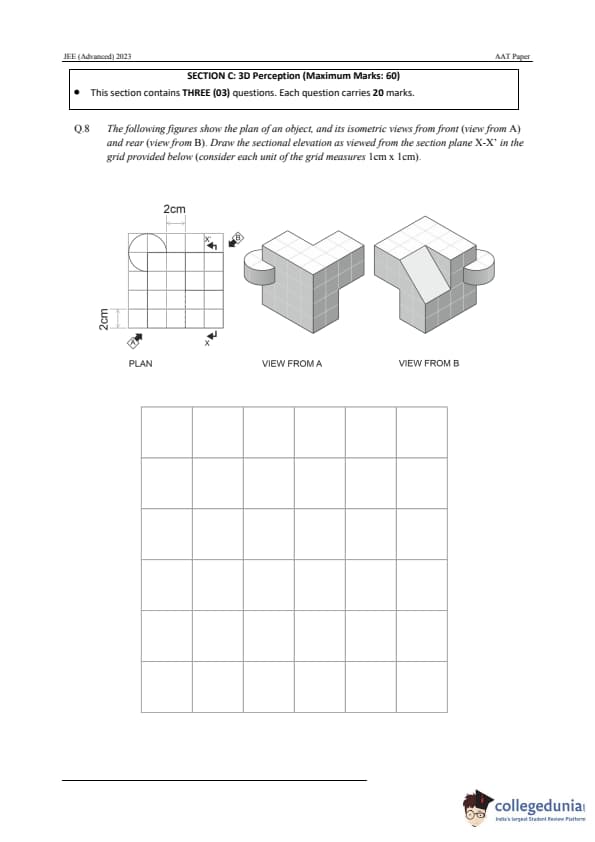
The following figures show the plan of an object, and its isometric views from front (view from A) and rear (view from B).
Draw the sectional elevation as viewed from the section plane X-X’ in the grid provided below (consider each unit of the grid measures 1 cm × 1 cm).


View Solution
Step 1: Understanding sectional views.
- The section plane X-X’ indicates a cut along the object to reveal its internal features.
- Sectional views provide detailed internal structures, helping to interpret how components are arranged.
Step 2: Extracting details from the given views.
- The plan view gives the top layout.
- The front and rear isometric views provide depth and height dimensions.
- By aligning these, the sectional elevation can be constructed on the provided grid.
Step 3: Drawing the sectional elevation on the grid.
- Identify the cut features and represent them with hatching lines.
- Maintain correct proportions and alignments as per the provided dimensions. Quick Tip: When drawing sectional views, always align the features with the cutting plane and use hatching to indicate solid sections.
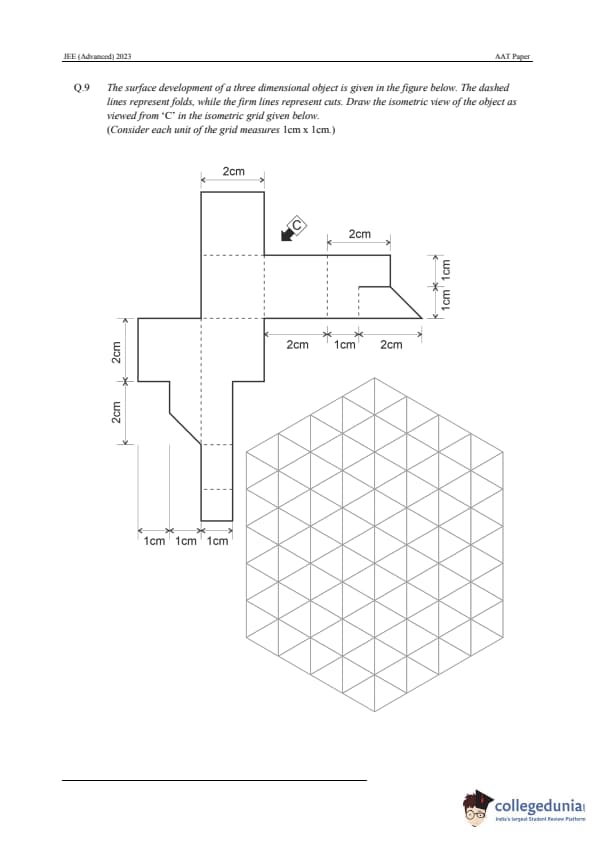
The surface development of a three-dimensional object is given in the figure below. The dashed lines represent folds, while the firm lines represent cuts.
Draw the isometric view of the object as viewed from “C” in the isometric grid given below. (Consider each unit of the grid measures 1 cm × 1 cm.)

View Solution
Step 1: Understanding the surface development diagram.
- The solid lines indicate cuts, while the dashed lines indicate folds.
- This represents the unfolded layout of a 3D object.
Step 2: Converting surface development into an isometric view.
- Fold the dashed sections to form the 3D shape.
- Identify faces and edges that will be visible from view “C”.
- Draw the folded shape using the isometric grid, ensuring alignment and perspective accuracy.
Step 3: Drawing on the isometric grid.
- Use the isometric projection to represent the final folded shape.
- Ensure proportions match the given dimensions. Quick Tip: When converting a surface development to an isometric view, visualize how each folded section aligns with others in 3D space.
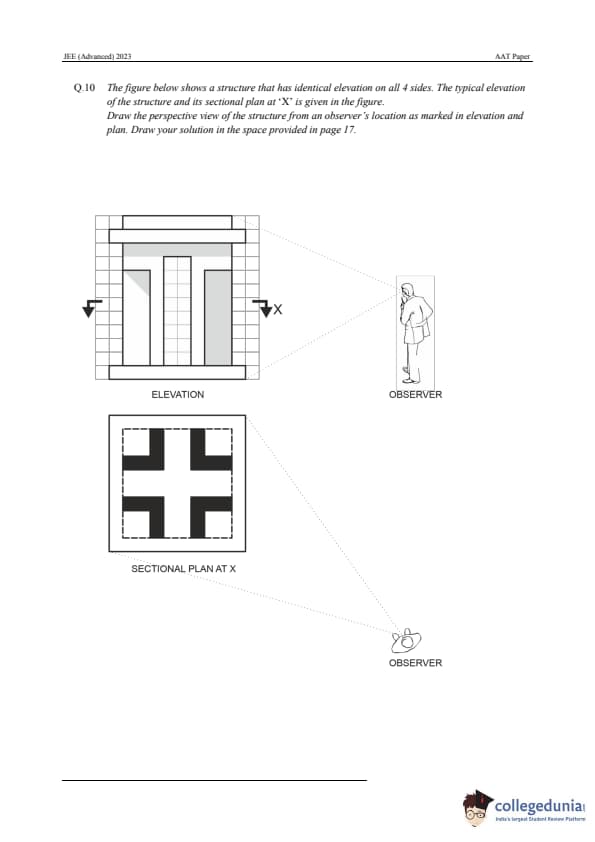
The figure below shows a structure that has identical elevation on all 4 sides. The typical elevation of the structure and its sectional plan at ‘X’ is given in the figure.
Draw the perspective view of the structure from an observer’s location as marked in elevation and plan. Draw your solution in the space provided in page 17.


View Solution
Step 1: Understanding perspective drawing.
- The observer’s position is marked in both plan and elevation, indicating the viewpoint.
- Perspective projection must be drawn from this viewpoint.
Step 2: Constructing the perspective view.
- Identify the vanishing points based on the structure’s orientation.
- Project the visible faces of the structure using perspective principles.
- Maintain proportions and ensure that depth perception follows perspective guidelines.
Step 3: Drawing the perspective view.
- Draw receding lines from the edges toward vanishing points.
- Ensure parallel elements converge correctly in perspective.
- Include depth details and sectional elements visible from the observer’s angle. Quick Tip: When drawing perspective views, use vanishing points to guide receding edges and maintain proportional scaling.
SECTION D: Imagination and Aesthetic Sensitivity
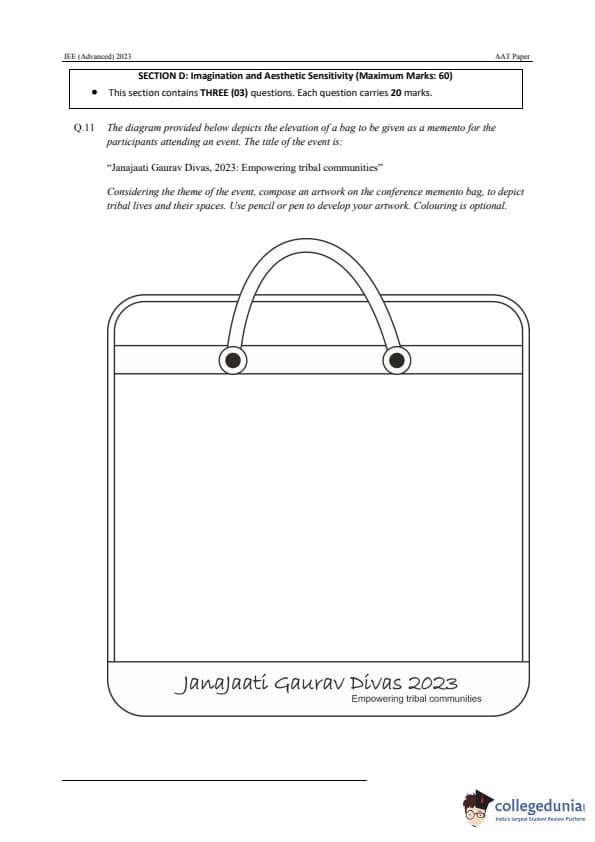
The diagram provided below depicts the elevation of a bag to be given as a memento for the participants attending an event. The title of the event is:
“Janajati Gaurav Divas, 2023: Empowering tribal communities”
Considering the theme of the event, compose an artwork on the conference memento bag, to depict tribal lives and their spaces. Use pencil or pen to develop your artwork. Colouring is optional.

View Solution
Step 1: Understanding the theme of the event.
- The event "Janajati Gaurav Divas" focuses on empowering tribal communities.
- The artwork should reflect tribal life, culture, traditions, and environment.
Step 2: Designing the artwork on the bag.
- Consider tribal patterns, symbols, traditional huts, forests, and lifestyle depictions.
- Use geometric designs inspired by tribal art (e.g., Warli, Gond, Madhubani).
- Ensure the composition complements the given bag space.
Step 3: Executing the drawing.
- Use pencil or pen to sketch the tribal artwork.
- Colouring is optional, but earthy tones (brown, green, red) enhance the tribal aesthetic. Quick Tip: When designing tribal-inspired artwork, research traditional tribal motifs and patterns to create an authentic and meaningful composition.
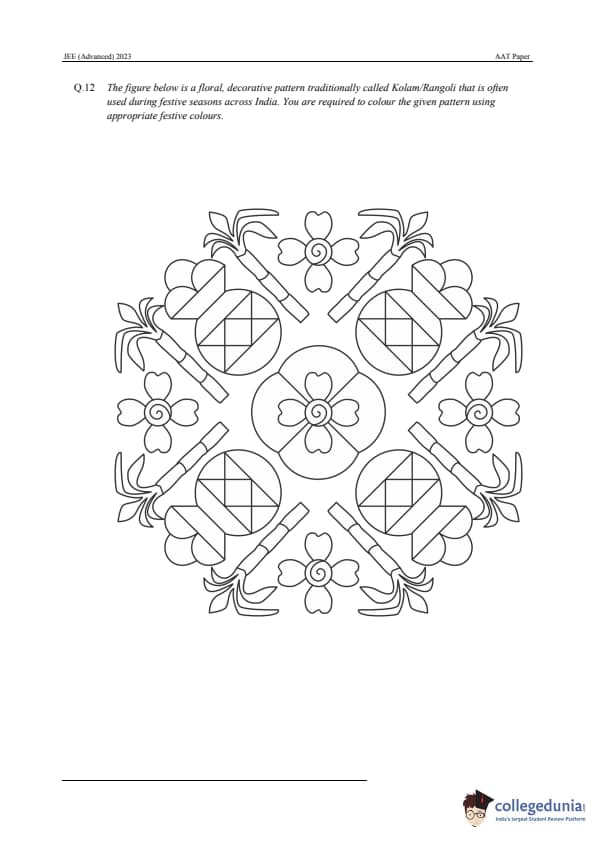
The figure below is a floral, decorative pattern traditionally called Kolam/Rangoli that is often used during festive seasons across India.
You are required to colour the given pattern using appropriate festive colours.

View Solution
Step 1: Understanding Rangoli/Kolam.
- Kolam/Rangoli is a decorative art form created with coloured powders, rice, or flowers.
- These patterns are symmetrical and are drawn during festivals like Diwali, Pongal, and Sankranti.
Step 2: Choosing festive colours.
- Use bright colours like red, yellow, green, blue, and orange to enhance the floral and symbolic elements.
- Traditional white outlines can be maintained for contrast.
Step 3: Colouring the pattern.
- Fill floral motifs with shades of pink, orange, and red.
- Use green for the sugarcane stalks.
- The pots (Kalash) can be shaded in golden yellow and brown.
- Ensure symmetry and balance in colouring for an aesthetic effect.
Quick Tip: Traditional Kolam/Rangoli patterns symbolize prosperity and positivity. Use bright colours to enhance the festive look.
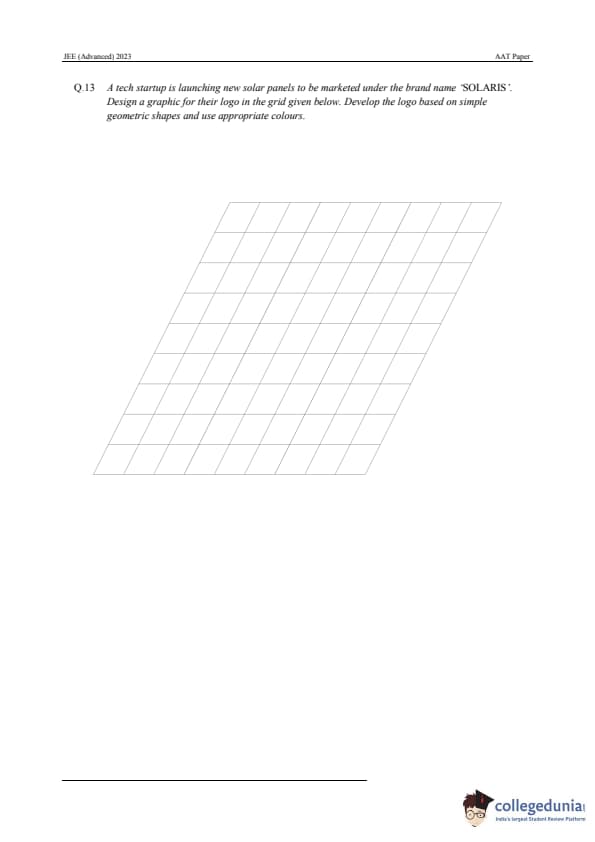
A tech startup is launching new solar panels to be marketed under the brand name ‘SOLARIS’.
Design a graphic for their logo in the grid given below. Develop the logo based on simple geometric shapes and use appropriate colours.

View Solution
Step 1: Understanding the brand theme.
- The name ‘SOLARIS’ suggests solar energy, sustainability, and technology.
- The logo should reflect solar panels, the sun, or clean energy concepts.
Step 2: Choosing geometric shapes and colours.
- Use circles, triangles, and grids to depict the sun, solar rays, and panels.
- The colour scheme should include yellow, orange, blue, and green to symbolize solar energy and sustainability.
Step 3: Developing the logo on the grid.
- Position the solar panel design using geometric patterns.
- Add a stylized sun or energy symbol to reinforce the solar theme.
- Ensure symmetry and modern aesthetics for a clean and professional look. Quick Tip: For solar energy branding, use geometric sun motifs, clean grid structures, and bright, energetic colours like yellow and blue.
SECTION E: Freehand Drawing
In the space provided below, make a pencil sketch of an Electric Kettle, in its appropriate form and proportion, showing various parts, materials, and textures, using shades and shadows.

View Solution
Step 1: Understanding the form of an electric kettle.
- Identify the key components:
- Body (usually cylindrical or conical).
- Handle (ergonomically curved for grip).
- Lid (detachable or hinged).
- Spout (angled for pouring).
- Base (electrical connection point).
Step 2: Using shading and textures.
- Apply gradient shading to represent metallic finishes.
- Use cross-hatching or stippling to differentiate plastic and metal textures.
- Shadows should be aligned with a single light source to enhance realism.
Step 3: Drawing proportions correctly.
- Ensure the spout and handle are symmetrically aligned.
- The base should be circular with perspective corrections.
- Add minor details like buttons, water level indicators, or brand labels. Quick Tip: When sketching products, start with basic geometric shapes, refine the details, and apply shading for realistic depth.
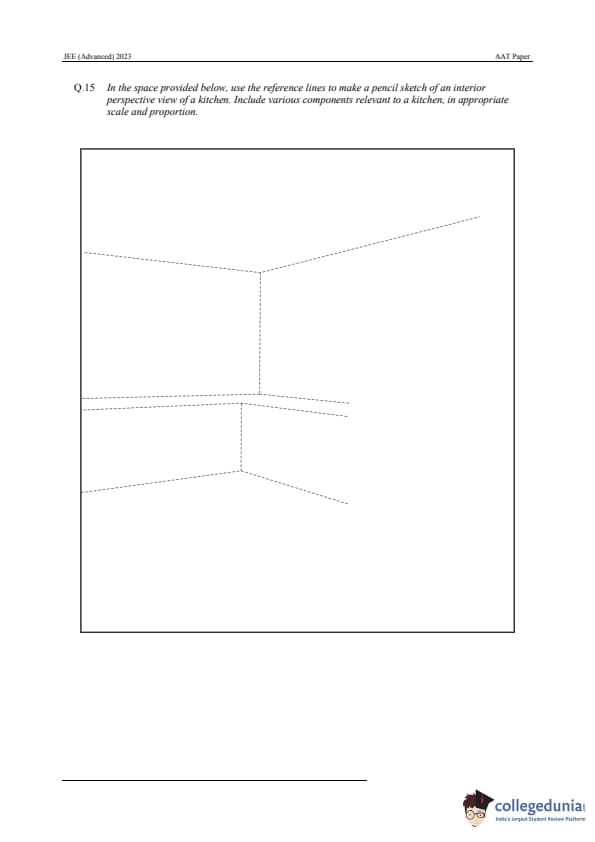
In the space provided below, use the reference lines to make a pencil sketch of an interior perspective view of a kitchen. Include various components relevant to a kitchen, in appropriate scale and proportion.

View Solution
Step 1: Understanding kitchen perspective.
- The reference lines indicate a one-point perspective, guiding depth perception.
- Essential kitchen elements include:
- Cabinets and shelves
- Countertops and storage
- Sink and stove
- Windows and lighting
Step 2: Sketching key components.
- Use vertical and horizontal guidelines to place cabinets and appliances.
- Ensure correct proportions for a realistic interior view.
- Add handles, textures, and shading to highlight depth.
Step 3: Applying shading and detailing.
- Use hatching and cross-hatching for surfaces.
- Shadows should follow the light source direction.
- Keep the layout functional and aesthetically balanced. Quick Tip: For interior sketches, follow perspective lines carefully and ensure proportional placement of furniture and fixtures.
In the space provided below, draw a freehand pencil sketch of a children’s playground, depicting various play equipment being used by children, in appropriate scale and proportion.
View Solution
Step 1: Identifying key elements of a playground.
- Common playground structures include:
- Swings
- Slides
- Seesaws
- Jungle gyms/climbing structures
- Sandbox areas
Step 2: Adding children and interaction.
- Depict children actively using the equipment, ensuring scale accuracy.
- Illustrate movement, such as a child sliding down or swinging.
Step 3: Using shading and depth.
- Apply light shading to create depth and define different materials.
- Ensure the playground environment is detailed with grass, trees, and pathways. Quick Tip: When sketching a playground, use dynamic poses to show children in motion and ensure correct proportions of play structures.





JEE Advanced Previous Year Question Paper with Answer Key PDFs
| JEE Advanced 2021 Question Paper | JEE Advanced 2020 Question Paper | JEE Advanced 2019 Question Paper |
| JEE Advanced 2018 Question Paper | JEE Advanced 2017 Question Paper | JEE Advanced 2016 Question Paper |



Comments