




Rotational motion is an important topic in mechanics, and is a fundamental part of the JEE Advanced Physics syllabus. This topic covers the motion of objects rotating about an axis and is essential for the understanding of the dynamics of rigid bodies. Rotational motion is full of concepts and mathematics that requires deep understanding of concepts such as torque, angular momentum, angular velocity, and the conservation of angular momentum.
For JEE Advanced, rotational motion represents a major section for physics. There can be questions on this topic ranging from basic concepts to more advanced applications, and many times questions will require students to connect competencies from other constituted mechanics concepts such as linear motion, energy and momentum. The weightage of rotational motion is typically between 4-5% for JEE Advanced, it can be higher depending on the complexity of the questions and how much the topic is interacted with other topics. This is about 1-2 questions per year, often with a higher level of difficulty from other mechanics topics.
Most important JEE Advanced Previous Year Questions from Rotational motion in given below
Question 1:
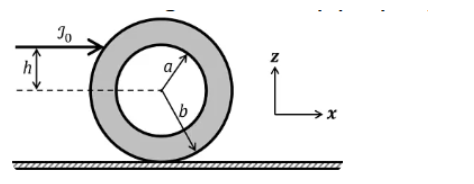
An annular disk of mass \( M \), inner radius \( a \) and outer radius \( b \) is placed on a horizontal surface with coefficient of friction \( \mu \), as shown in the figure. At some time, an impulse \( J_0 \hat{x} \) is applied at a height \( h \) above the center of the disk. If \( h = h_m \), then the disk rolls without slipping along the x-axis. Which of the following statement(s) is/are correct?
Question 2:
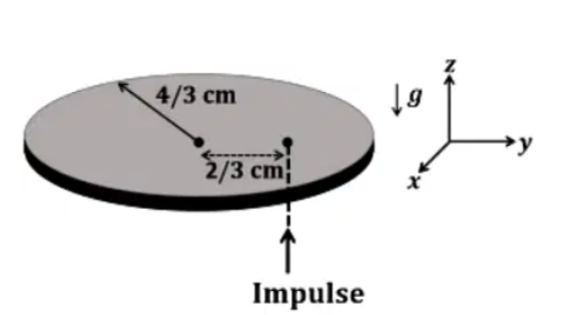
A thin circular coin of mass 5 gm and radius \( \frac{4}{3} \) is initially in a horizontal XY-plane. The coin is tossed vertically up (+Z direction) by applying an impulse of \( \sqrt{\frac{\pi}{2}} \times 10^{-2} \) N-s at a distance of \( \frac{2}{3} \) cm from its center. The coin spins about its diameter and moves along the +z direction. By the time the coin reaches back to its initial position, it completes \( n \) rotations. The value of \( n \) is ______. [Given: The acceleration due to gravity \( g = 10 \, \text{ms}^{-2} \)]
Question 3:
A bar of \( m = 1.00 \, \text{kg} \) and length \( l = 0.20 \, \text{m} \) is lying on a horizontal frictionless surface. One end of the bar is pivoted so that the bar is free to rotate in the vertical plane. A small \( m = 0.10 \, \text{kg} \) is moving on the same horizontal surface with a speed of \( 5.00 \, \text{ms}^{-1} \) on its path, which is perpendicular to the bar. It hits the bar at a distance \( \frac{l}{2} \) from the pivoted end and returns back on the same path with speed \( v \). After this elastic collision, the bar rotates with an angular velocity \( \omega \). Which of the following statement is correct?
Question 4:
A thin circular coin of mass \( 5 \, \text{gm} \) and radius \( \frac{4}{3} \, \text{cm} \) is initially in a horizontal XY-plane. The coin is tossed vertically up (\(+Z\) direction) by applying an impulse of \( \sqrt{\frac{\pi}{2}} \times 10^{-2} \, \text{N-s} \) at a distance of \( \frac{2}{3} \, \text{cm} \) from its center. The coin spins about its diameter and moves along the \( +z \) direction. By the time the coin reaches back to its initial position, it completes \( n \) rotations. The value of \( n \) is ____ . [Given: The acceleration due to gravity \( g = 10 \, \text{ms}^{-2} \)]
Question 5:
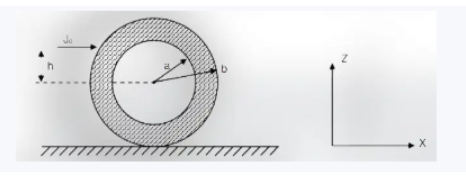
An annular disc of mass \( M \), inner radius \( a \) and outer radius \( b \) is placed on a horizontal surface with a coefficient of friction \( \mu \), as shown in the figure. At some time, an impulse \( J_0 \hat{x} \) is applied at a height of \( h \) at the center of the disc. If \( h = h_m \), then the disc rolls without slipping along the x-axis, which of the following statement is/are correct?
Question 6:
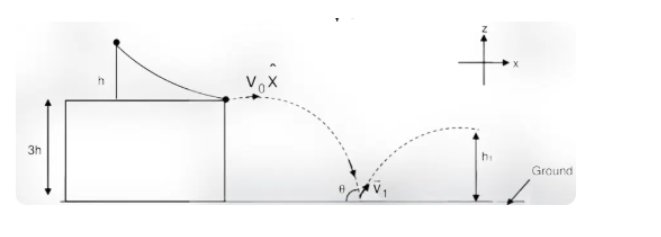
A ball is released on a smooth plane as shown. It strikes with the ground, the coefficient of restitution is \( \frac{1}{\sqrt{3}} \). Choose the correct options
Question 7:
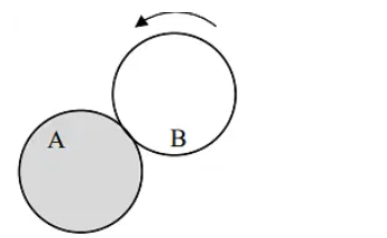
A flat surface of a thin uniform disk \( A \) of radius \( R \) is glued to a horizontal table. Another thin uniform disk \( B \) of mass \( M \) and with the same radius \( R \) rolls without slipping on the circumference of \( A \), as shown in the figure. A flat surface of \( B \) also lies on the plane of the table. The center of mass of \( B \) has fixed angular speed \( \omega \) about the vertical axis passing through the center of \( A \). The angular momentum of \( B \) is \( nM\omega R^2 \) with respect to the center of \( A \). Which of the following is the value of \( n \)?
Question 8:
At time \( t = 0 \), a disk of radius 1 m starts to roll without slipping on a horizontal plane with an angular acceleration of \( \alpha = \frac{2}{3} \, \text{rad/s}^2 \). A small stone is stuck to the disk. At \( t = 0 \), it is at the contact point of the disk and the plane. Later, at time \( t = \sqrt{\pi} \, \text{s} \), the stone detaches itself and flies off tangentially from the disk. The maximum height (in \( m \)) reached by the stone measured from the plane is \( \frac{1}{2} + \frac{x}{10} \). The value of \( x \) is ____ [Take \( g = 10 \, \text{m/s}^2 \)].
Question 9:
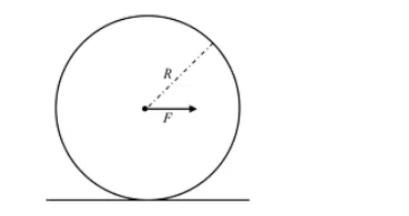
A horizontal force \( F \) is applied at the centre of mass of a cylindrical object of mass \( m \) and radius \( R \), perpendicular to its axis as shown in the figure. The coefficient of friction between the object and the ground is \( \mu \). The center of mass of the object has an acceleration \( a \). The acceleration due to gravity is \( g \). Given that the object rolls without slipping, which of the following statement(s) is/are correct?
Question 10:
A particle of mass \( M = 0.2 \, \text{kg} \) is initially at rest in the \( xy \)-plane at a point \( (x = -\ell, y = -h) \), where \( \ell = 10 \, \text{m} \) and \( h = 1 \, \text{m} \). The particle is accelerated at time \( t = 0 \) with a constant acceleration \( a = 10 \, \text{m/s}^2 \) along the positive \( x \)-direction. Its angular momentum and torque with respect to the origin, in SI units, are represented by \( \mathbf{L} \) and \( \mathbf{\tau} \) respectively. \( \hat{i}, \hat{j} \) and \( \hat{k} \) are unit vectors along the positive \( x, y \) and \( z \)-directions, respectively. If \( \hat{k} = \hat{i} \times \hat{j} \), then which of the following statement(s) is/are correct?
Question 11:
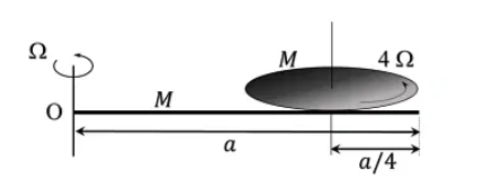
A thin rod of mass \( M \) and length \( a \) is free to rotate in horizontal plane about a fixed vertical axis passing through point \( O \). A thin circular disc of mass \( M \) and of radius \( a/4 \) is pivoted on this rod with its center at a distance \( a/4 \) from the free end so that it can rotate freely about its vertical axis, as shown in the figure. Assume that both the rod and the disc have uniform density and they remain horizontal during the motion. An outside stationary observer finds the rod rotating with an angular velocity \( \Omega \) and the disc rotating about its vertical axis with angular velocity \( 4\Omega \). The total angular momentum of the system about the point \( O \) is \( \left( \frac{M a^2 \Omega}{48} \right) n \). The value of \( n \) is _______
Question 12:
A ring of mass \( M \) and radius \( R \) is rotating with angular speed \( \omega \) about a fixed vertical axis passing through its center \( O \) with two point masses each of mass \( \frac{M}{8} \) at rest at \( O \). These masses can move radially outwards along two massless rods fixed on the ring as shown in the figure. At some instant the angular speed of the system is \( \frac{8}{9} \omega \), and one of the masses is at a distance of \( \frac{3}{5} R \) from \( O \). At this instant the distance of the other mass from \( O \) is _______
Weightage and Trend of Rotational Motion in JEE Advanced
Rotational motion is an integral part of the JEE Advanced Physics syllabus, and its weightage has been relatively consistent over the years. Understanding the weightage and trends from previous years can help you prioritize and prepare effectively for this topic.
| Aspect | Details |
|---|---|
| Weightage in JEE Advanced | 4-5% of total marks (approximately 1-2 questions per year) |
| Frequency of Questions | 1-2 questions per year |
| Topics Covered | 1. Moment of Inertia (I) |
| 2. Angular Kinematics (Angular velocity, angular acceleration) | |
| 3. Torque and Angular Acceleration | |
| 4. Conservation of Angular Momentum | |
| 5. Rolling Motion (rolling without slipping) | |
| 6. Work and Energy in Rotational Motion | |
| Types of Questions | - Direct calculation-based problems |
| - Conceptual and application-based questions | |
| - Composite questions integrating rotational motion with other topics | |
| Typical Questions | - Calculate the moment of inertia for rotating objects |
| - Determine angular acceleration or velocity of rotating objects | |
| - Apply the conservation of angular momentum in dynamic systems | |
| - Rolling motion problems and their energy analysis | |
| Integration with Other Topics | Often combined with linear motion, work-energy, angular momentum, and energy conservation |
| Trend Over the Years | - Increasing complexity in the last few years, often integrating multiple concepts |
| - Multi-concept questions have become more common | |
| - Problems involving rolling motion, angular momentum, and energy conservation | |
| Difficulty Level | Varies from basic to intermediate; higher difficulty in integrated questions |
| Preparation Focus | Master formulas, understand concepts deeply, practice integrated problems |
| Key Formulas to Remember | Moment of Inertia (I), Angular velocity (ω), Angular acceleration (α), Work-Energy in rotational systems |
JEE Advanced Exam Pattern
The JEE Advanced exam is considered as one of the top engineering entrance examinations in India, which takes place annually for enrollment at IITs and other top institutions to undergraduate programs. JEE Advanced consists of two compulsory papers, Paper 1 and Paper 2, each with three hours of duration. It challenges students’ knowledge of Physics, Chemistry and Mathematics. The exam consists of different question types including Multiple Choice Questions (MCQs), Numerical Value-based Questions and Assertion-Reasoning questions to evaluate the foundational knowledge of topics and ability to solve problems. Both papers have a total of 180 marks, with marks deducted for incorrect answers in a few question types.
| Aspect | Details |
|---|---|
| Mode | Computer-Based Test (CBT) |
| Papers | 2 (Paper 1 & Paper 2) – Both mandatory |
| Duration | 3 hours per paper (with break between papers) |
| Total Subjects | Physics, Chemistry, Mathematics (Equal weightage) |
| Total Questions | ~54–60 (18–20 per subject, split across question types) |
| Language | English & Hindi (option to switch during exam) |
The exam is known for its challenging nature and is conducted in English and Hindi. It is essential to clear the JEE Main exam before appearing for JEE Advanced.
Marking Scheme with Question types in JEE Advanced
Here is a detailed marking scheme for different questions in JEE Advanced exam.
| Question Type | Marks per Q | Negative Marking | Examples |
|---|---|---|---|
| Single Correct MCQ | +3 | -1 | Basic theory/direct formula questions |
| Multiple Correct MCQ | +4 (full) | -2 (if all wrong) / Partial marks* | "Which of the following is/are true?" |
| Numerical Value (NV) | +3 | No negative | Calculations (e.g., wavelength) |
| Paragraph-Based | Varies (2–4) | Depends on sub-type | Linked to a common scenario |
| Match the Following | +2 per match | -1 per wrong match | Column matching (e.g., graphs) |
Partial Marks: For Multiple Correct MCQs, +1 per correct option (if not all selected).
Subject-Wise Distribution
Here is the subject wise questions distribution in the JEE Advanced exam describing number of questions in each subject.
| Subject | MCQs | Numerical | Paragraph/Matching | Total |
|---|---|---|---|---|
| Physics | 6–8 | 4–5 | 2–3 | 12–16 |
| Chemistry | 6–8 | 4–5 | 2–3 | 12–16 |
| Maths | 6–8 | 4–5 | 2–3 | 12–16 |
Subject wise Syllabus: JEE Advanced 2025
Here is a quick syllabus of JEE Advanced 2025 subject wise which helps in preparation of the students. Check JEE Advanced Syllabus for a detailed Syllabus.
| Subject | Key Topics |
|---|---|
| Physics | Mechanics, Electrodynamics, Modern Physics, Optics, Thermodynamics, Error Analysis |
| Chemistry | Physical (Thermo, Kinetics), Organic (Reactions), Inorganic (Coordination, P-Block) |
| Maths | Algebra, Calculus, Coordinate Geometry, Trigonometry, Vectors |
Note:
- Physics: Focus on Modern Physics (20% weightage) & Electrodynamics.
- Chemistry: Organic reactions & Coordination compounds are high-scoring.
- Maths: Calculus (35% weightage) is most critical.
In addition to conceptual knowledge, you should practice multiple mock tests before your exam.
Check:
JEE Advanced Physics Paper Analysis (2024 & Trends)
The JEE Advanced Physics Paper is designed to test a candidate in terms of knowledge in Physics as well as problem-solving skills and capabilities. The test consists of two papers, Paper 1 and Paper 2, with each paper being 3 hours in length and comprising an approximate number of 18-20 questions. The questions in both papers, while relating to a wide range of Physics Topics such as Mechanics, Electromagnetism, Optics, Thermodynamics, Modern Physics, Waves and Oscillations, etc., have the same syllabus in all subjects within the two papers.
Overview (2024)
Here is a basic overview of JEE Advanced Physics Pattern in 2024
| Aspect | Details |
|---|---|
| Total Questions | 12–14 per paper (2 papers) |
| Difficulty | Moderate to Hard (30% easy, 50% moderate, 20% difficult) |
| Question Types | Single/Multiple MCQs, Numerical Value, Paragraph-based, Match-the-Column |
| Key Focus Areas | Modern Physics, Electrodynamics, Mechanics, Error Analysis |
Chapter-Wise Weightage (2024)
The Physics subject in JEE Advanced incorporates a range of chapters from the Class 11 and Class 12 syllabus. The weightage from each chapter varies within each subject. Below is the subject-wise weightage of Physics subjects and possible weightage in JEE Advanced.
| Topic | Weightage | Difficulty | Remarks |
|---|---|---|---|
| Modern Physics | 20–25% | Moderate | Nuclear physics, photoelectric effect, semiconductors |
| Electrodynamics | 18–22% | Hard | EMI, Capacitors, AC circuits, Maxwell’s laws |
| Mechanics | 15–20% | Moderate-Hard | Rotational dynamics, center of mass, collisions |
| Thermodynamics & KTG | 12–15% | Moderate | Laws of thermodynamics, kinetic theory |
| Optics | 10–12% | Easy-Moderate | Wave optics, interference, diffraction |
| Error Analysis | 8–10% | Tricky | Vernier calipers, screw gauge, least count |
| Waves & SHM | 5–8% | Easy | Standing waves, Doppler effect, spring-mass systems |
Difficulty Trends (2019–2024)
Based on previous year trends, here is an overview of the JEE Advanced Question Paper based on its difficulty level and focus points of the exam.
| Year | Difficulty Level | Key Observations |
|---|---|---|
| 2024 | Moderate-Hard | More numerical-based questions, fewer theory MCQs |
| 2023 | Moderate | Balanced mix of conceptual and formula-based Qs |
| 2022 | Hard | Heavy focus on electromagnetism and modern physics |
| 2021 | Very Hard | Unconventional mechanics problems, lengthy solutions |
| 2020 | Moderate | More NCERT-aligned questions |
JEE Advanced Previous Year Question Papers with Detailed Solutions
JEE Advanced 2024 Question Paper Pdf with Solutions
| Paper Name | Question Paper Link | Solutions Link |
|---|---|---|
| JEE Advanced 2024 Paper 1 Question Paper (English) | Download PDF | Check Solutions |
| JEE Advanced 2024 Paper 2 Question Paper (English) | Download PDF | Check Solutions |
| JEE Advanced 2024 Paper 1 Question Paper (Hindi) | Download PDF | Check Solutions |
| JEE Advanced 2024 Paper 1 Question Paper (Hindi) | Download PDF | Check Solutions |
JEE Advanced Question Paper has 4 sections- Section 1 (Maximum marks-12), Section 2 (Maximum marks-12), Section 3 (Maximum marks- 24) and Section 4 (Maximum marks-12)
JEE Advanced Architecture Aptitude Test Question Paper 2024 with Solutions
| Paper Name | Question Paper Link | Solutions Link |
|---|---|---|
| Architecture Aptitude Test | Download PDF | Check Solutions |
JEE Advanced 2023 Question Paper PDF Download With Solutions
| Paper | Question Paper PDF | Answer Key PDF |
|---|---|---|
| Question Paper 1 PDF | Download PDF | Check Solutions |
| Question Paper 2 PDF | Download PDF | Check Solutions |
| Question Paper AAT PDF | Download PDF | Check Solutions |
JEE Advanced 2022 Question Paper
| 2022 Question Paper | PDF Download |
|---|---|
| Question Paper 1 PDF | Click here |
| Question Paper 2 PDF | Click here |
JEE Advanced 2021 Question Paper
| Question Paper | PDF Download | ||
|---|---|---|---|
| Question Paper 1 PDF | Physics | Chemistry | Maths |
| Question Paper 2 PDF | Physics | Chemistry | Maths |
JEE Advanced 2020 Question Paper
| Question Paper | PDF Download |
|---|---|
| Question Paper 1 PDF | Click here |
| Question Paper 2 PDF | Click here |
Frequently Asked Questions (FAQs)
Q1. Is rotational motion important for JEE Advanced?
Answer. Absolutely, understanding rotational motion is a significant aspect in JEE Advanced. This topic is basic to the syllabus in Physics and it is an important topic to understand the dynamics of rotating bodies. It does not command as much weightage of marks as some other topics in mechanics, for example, as an average it contributes 4-5% of the total marks, which constitutes approximately 1-2 questions per year. It is consistent every year, therefore, it is an important topic to master if you want to achieve the best possible outcome in the exam.
Q2. What is the toughest chapter in JEE Advanced Physics?
Answer.The difficulty level of an individual chapter in JEE Advanced Physics is dependent on the strengths and weaknesses of the student. However, there are some chapters that collectively many students consider more difficult due to complexity, depth of concepts, and problem solving requirements. In the list below, a collection of chapters that are generally considered the most difficult to the largest group of students overall should be provided.
| Chapter | Why It's Tough | Key Challenges |
| Electrodynamics | Complex electric and magnetic field concepts | Gauss’s law, Ampere’s law, electromagnetic induction |
| Modern Physics | Abstract concepts like quantum mechanics and nuclear physics | Bohr’s model, radioactive decay, photoelectric effect |
| Mechanics | Involves multiple subtopics like rotation and fluid mechanics | Rotational motion, angular momentum, fluid dynamics |
| Thermodynamics | Mathematical rigor with laws of thermodynamics | Thermodynamic processes, entropy, Carnot’s theorem |
| Optics | Ray and wave optics requiring deep understanding of light behavior | Image formation, diffraction, resolving power |
| SHM and Waves | Challenging oscillation and wave phenomena | Damped/forced oscillations, resonance, wave interference |
Q3. What is the most scoring subject in JEE Advanced?
Answer. Mathematics is frequently perceived as the most scoring subject in JEE Advanced, and there are a few reasons for this.
Problem-Solving: Mathematics is mostly a matter of applying concepts to problems, and this repetition allows candidates to quickly and accurately solve questions in nearly every case.
Predictability: In most of Mathematics, especially topics like Calculus, Algebra, and Coordinate Geometry, we see predictive patterns in all of the material, and this allows candidates to expect problem types and solve accordingly.
Straightforward: In Physics and Chemistry, a lot of understanding is often subjective or implies multiple conclusions via a longer series of steps. But Mathematics is more straightforward in its progression toward finding a solution.
Less Memorization: Because Chemistry requires a significant amount of memorization, Mathematics is more about applying concepts or techniques than concrete thoughts.
So, with good preparation and continuous practice, while Mathematics isn't easy, it can help students score well in JEE Advanced.
Q4. Is rotational motion tough?
Answer. Rotational motion can be somewhat difficult due to its conceptual complexity and vulnerability to mathematical calculations. You need to understand things like, torque, moment of inertia, and angular momentum, which are in fact very different from linear motion. and!!! Problems related to rotational motion routinely combine with other topics like energy and work, making problems even more complicated. Nevertheless, with practice and conceptual clarity, it is manageable.





Comments