KEAM 2024 Question Paper (June 10) is available for download here. Office of The Commissioner for Entrance Examinations (CEE Kerala) conducted KEAM Pharmacy exam 2024 in CBT mode on June 10 in afternoon shift from 2 PM to 5 PM. KEAM Pharmacy 2024 Question Paper consists total of 75 questions carrying 4 mark each with negative marking of 1 for each incorrect answer. KEAM 2024 Question Paper includes Physics with 45 questions and Chemistry with 30 questions to be attempted in total of 90 minutes.

KEAM 2024 Question Paper with Answer Key PDF (June 10)

KEAM 2024 (June 10) Question Paper with Answer Key download iconDownload Check Solution

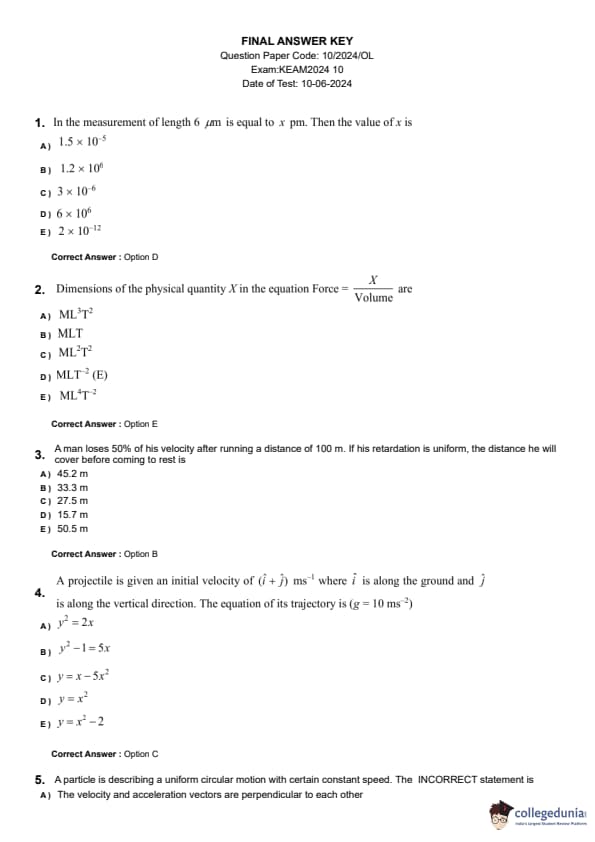
Question 1:

In the measurement of length 6 \(\mu\)m is equal to \(x\) pm. Then the value of \(x\) is

  • (A) \(1.5 \times 10^{-5}\)
  • (B) \(1.2 \times 10^{6}\)
  • (C) \(3 \times 10^{-6}\)
  • (D) \(6 \times 10^{6}\)
  • (E) \(2 \times 10^{-12}\)
Correct Answer: (D) \(6 \times 10^{6}\)
View Solution

Question 2:

Dimensions of the physical quantity \(X\) in the equation \[ Force = \frac{X}{Volume} \]
are

  • (A) \(ML^3T^2\)
  • (B) \(MLT\)
  • (C) \(ML^2T^2\)
  • (D) \(MLT^{-2}\)
  • (E) \(ML^4T^{-2}\)
Correct Answer: (E) \(ML^4T^{-2}\)
View Solution

Question 3:

A man loses 50% of his velocity after running a distance of 100 m. If his retardation is uniform, the distance he will cover before coming to rest is

  • (A) \(45.2\) m
  • (B) \(33.3\) m
  • (C) \(27.5\) m
  • (D) \(15.7\) m
  • (E) \(50.5\) m
Correct Answer: (B) \(33.3\) m
View Solution

Question 4:

A projectile is given an initial velocity of \((\hat{i} + \hat{j})\) ms\textsuperscript{-1 where \(\hat{i}\) is along the ground and \(\hat{j}\) is along the vertical direction. The equation of its trajectory is \((g = 10\) ms\textsuperscript{-2\()\)

  • (A) \(y^2 = 2x\)
  • (B) \(y^2 - 1 = 5x\)
  • (C) \(y = x - 5x^2\)
  • (D) \(y = x^2\)
  • (E) \(y = x^2 - 2\)
Correct Answer: (C) \(y = x - 5x^2\)
View Solution

Question 5:

A particle is describing a uniform circular motion with a certain constant speed. The INCORRECT statement is

  • (A) The velocity and acceleration vectors are perpendicular to each other
  • (B) The velocity vector is tangential to the circular path
  • (C) The centripetal acceleration is a variable acceleration
  • (D) The acceleration vector points to the centre of the circle
  • (E) The acceleration vector is tangential to the circular path
Correct Answer: (E) The acceleration vector is tangential to the circular path
View Solution

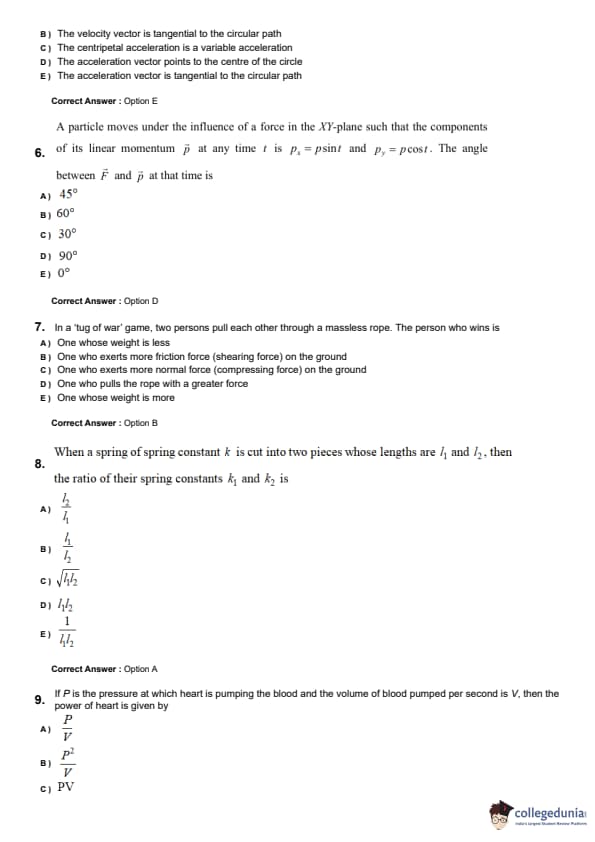
Question 6:

A particle moves under the influence of a force in the XY-plane such that the components of its linear momentum \(\vec{p}\) at any time \(t\) is \(p_x = p \sin t\) and \(p_y = p \cos t\). The angle between \(\vec{F}\) and \(\vec{p}\) at that time is

  • (A) \(45^\circ\)
  • (B) \(60^\circ\)
  • (C) \(30^\circ\)
  • (D) \(90^\circ\)
  • (E) \(0^\circ\)
Correct Answer: (D) \(90^\circ\)
View Solution

Question 7:

In a ‘tug of war’ game, two persons pull each other through a massless rope. The person who wins is

  • (A) One whose weight is less
  • (B) One who exerts more friction force (shearing force) on the ground
  • (C) One who exerts more normal force (compressing force) on the ground
  • (D) One who pulls the rope with a greater force
  • (E) One whose weight is more
Correct Answer: (B) One who exerts more friction force (shearing force) on the ground
View Solution

Question 8:

When a spring of spring constant \(k\) is cut into two pieces whose lengths are \(l_1\) and \(l_2\), then the ratio of their spring constants \(k_1\) and \(k_2\) is

  • (A) \(\frac{l_2}{l_1}\)
  • (B) \(\frac{l_1}{l_2}\)
  • (C) \(\sqrt{l_1 l_2}\)
  • (D) \(l_1 l_2\)
  • (E) \(\frac{1}{l_1 l_2}\)
Correct Answer: (A) \(\frac{l_2}{l_1}\)
View Solution

Question 9:

If \(P\) is the pressure at which the heart is pumping the blood and the volume of blood pumped per second is \(V\), then the power of the heart is given by

  • (A) \(\frac{P}{V}\)
  • (B) \(\frac{P^2}{V}\)
  • (C) \(P V\)
  • (D) \(\frac{P}{V_2}\)
  • (E) \(P^2 V\)
Correct Answer: (C) \(P V\)
View Solution

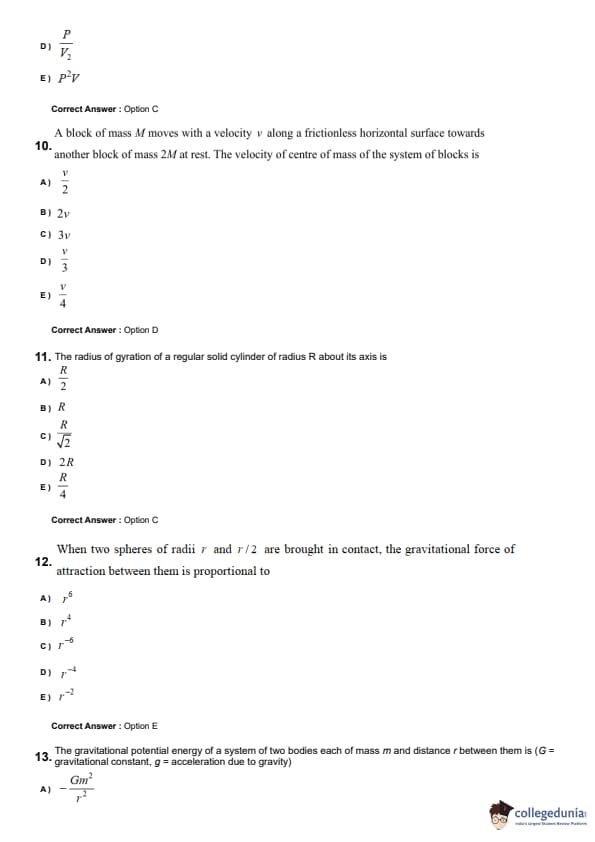
Question 10:

A block of mass \(M\) moves with a velocity \(v\) along a frictionless horizontal surface towards another block of mass \(2M\) at rest. The velocity of the center of mass of the system of blocks is

  • (A) \(\frac{v}{2}\)
  • (B) \(2v\)
  • (C) \(3v\)
  • (D) \(\frac{v}{3}\)
  • (E) \(\frac{v}{4}\)
Correct Answer: (D) \(\frac{v}{3}\)
View Solution

Question 11:

The radius of gyration of a regular solid cylinder of radius \(R\) about its axis is

  • (A) \(\frac{R}{2}\)
  • (B) \(R\)
  • (C) \(\frac{R}{\sqrt{2}}\)
  • (D) \(2R\)
  • (E) \(\frac{R}{4}\)
Correct Answer: (C) \(\frac{R}{\sqrt{2}}\)
View Solution

Question 12:

When two spheres of radii \(r\) and \(\frac{r}{2}\) are brought in contact, the gravitational force of attraction between them is proportional to

  • (A) \(r^6\)
  • (B) \(r^4\)
  • (C) \(r^{-6}\)
  • (D) \(r^{-4}\)
  • (E) \(r^{-2}\)
Correct Answer: (E) \(r^{-2}\)
View Solution

Question 13:

The gravitational potential energy of a system of two bodies each of mass \(m\) and distance \(r\) between them is (G = gravitational constant, g = acceleration due to gravity)

  • (A) \(-\frac{Gm^2}{r^2}\)
  • (B) \(-\frac{Gm^2}{r}\)
  • (C) \(-\frac{gm^2}{r}\)
  • (D) \(-G \frac{gm^2}{r}\)
  • (E) \(\frac{Ggm}{r^2}\)
Correct Answer: (B) \(-\frac{Gm^2}{r}\)
View Solution

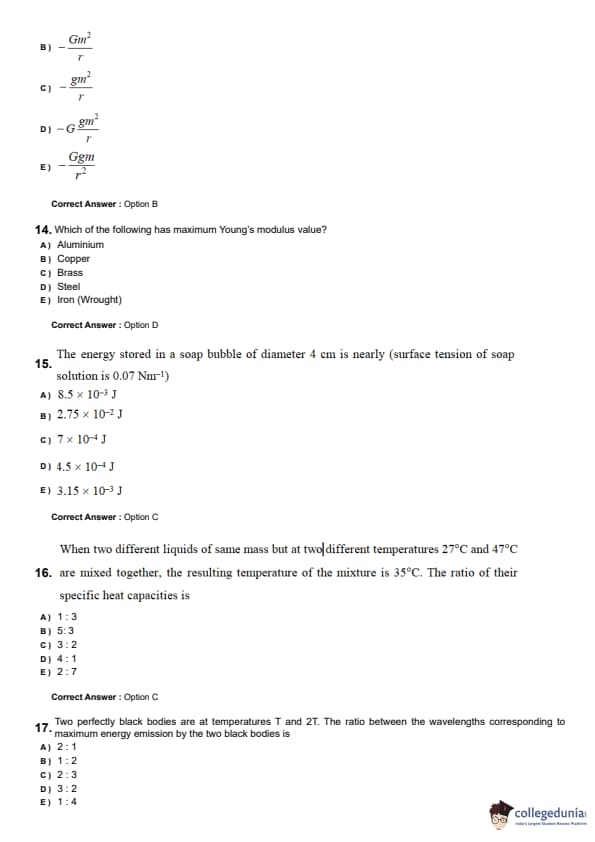
Question 14:

Which of the following has the maximum Young’s modulus value?

  • (A) Aluminium
  • (B) Copper
  • (C) Brass
  • (D) Steel
  • (E) Iron (Wrought)
Correct Answer: (D) Steel
View Solution

Question 15:

The energy stored in a soap bubble of diameter 4 cm is nearly (surface tension of soap solution is 0.07 Nm\textsuperscript{-1})

  • (A) \(8.5 \times 10^{-3}\) J
  • (B) \(2.75 \times 10^{-2}\) J
  • (C) \(7 \times 10^{-4}\) J
  • (D) \(4.5 \times 10^{-4}\) J
  • (E) \(3.15 \times 10^{-3}\) J
Correct Answer: (C) \(7 \times 10^{-4}\) J
View Solution

Question 16:

When two different liquids of same mass but at two different temperatures \(27^\circ C\) and \(47^\circ C\) are mixed together, the resulting temperature of the mixture is \(35^\circ C\). The ratio of their specific heat capacities is

  • (A) 1 : 3
  • (B) 5 : 3
  • (C) 3 : 2
  • (D) 4 : 1
  • (E) 2 : 7
Correct Answer: (C) 3 : 2
View Solution

Question 17:

Two perfectly black bodies are at temperatures \( T \) and \( 2T \). The ratio between the wavelengths corresponding to maximum energy emission by the two black bodies is

  • (A) 2 : 1
  • (B) 1 : 2
  • (C) 2 : 3
  • (D) 3 : 2
  • (E) 1 : 4
Correct Answer: (A) 2 : 1
View Solution

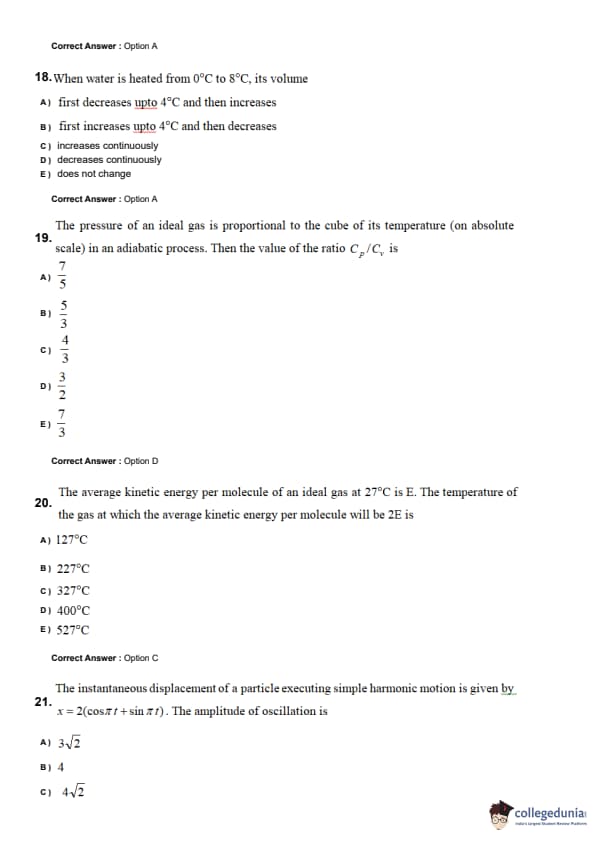
Question 18:

When water is heated from \(0^\circ\)C to \(8^\circ\)C, its volume

  • (A) first decreases upto \(4^\circ\)C and then increases
  • (B) first increases upto \(4^\circ\)C and then decreases
  • (C) increases continuously
  • (D) decreases continuously
  • (E) does not change
Correct Answer: (A) first decreases upto \(4^\circ\)C and then increases
View Solution

Question 19:

The pressure of an ideal gas is proportional to the cube of its temperature (on absolute scale) in an adiabatic process. Then the value of the ratio \(C_p/C_v\) is

  • (A) \(\frac{7}{5}\)
  • (B) \(\frac{5}{3}\)
  • (C) \(\frac{4}{3}\)
  • (D) \(\frac{3}{2}\)
  • (E) \(\frac{7}{3}\)
Correct Answer: (D) \(\frac{3}{2}\)
View Solution

Question 20:

The average kinetic energy per molecule of an ideal gas at \(27^\circ C\) is \(E\). The temperature of the gas at which the average kinetic energy per molecule will be \(2E\) is

  • (A) \(127^\circ C\)
  • (B) \(227^\circ C\)
  • (C) \(327^\circ C\)
  • (D) \(400^\circ C\)
  • (E) \(527^\circ C\)
Correct Answer: (C) \(327^\circ C\)
View Solution

Question 21:

The instantaneous displacement of a particle executing simple harmonic motion is given by \(x = 2(\cos(\pi t) + \sin(\pi t))\). The amplitude of oscillation is

  • (A) \(3\sqrt{2}\)
  • (B) 4
  • (C) \(4\sqrt{2}\)
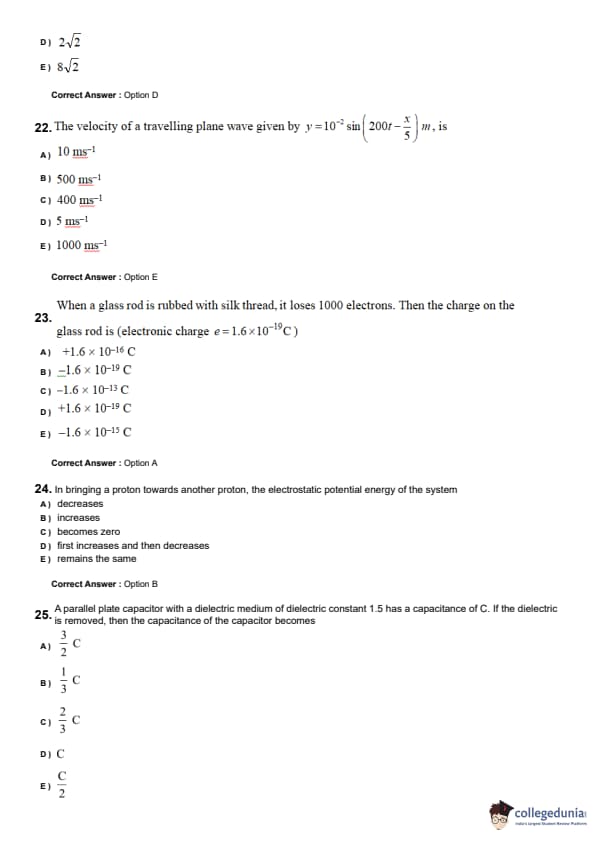
  • (D) \(2\sqrt{2}\)
  • (E) \(8\sqrt{2}\)
Correct Answer: (D) \(2\sqrt{2}\)
View Solution

Question 22:

The velocity of a travelling plane wave given by \[ y = 10^{-2} \sin \left( 200t - \frac{x}{5} \right) m, \]
is

  • (A) \(10\) ms^{-1}
  • (B) \(500\) ms^{-1}
  • (C) \(400\) ms^{-1}
  • (D) \(5\) ms^{-1}
  • (E) \(1000\) ms^{-1}
Correct Answer: (E) \(1000\) ms^{-1}
View Solution

Question 23:

When a glass rod is rubbed with silk thread, it loses 1000 electrons. Then the charge on the glass rod is (electronic charge \(e = 1.6 \times 10^{-19}\) C)

  • (A) \(+1.6 \times 10^{-16}\) C
  • (B) \(-1.6 \times 10^{-19}\) C
  • (C) \(-1.6 \times 10^{-13}\) C
  • (D) \(+1.6 \times 10^{-19}\) C
  • (E) \(-1.6 \times 10^{-15}\) C
Correct Answer: (A) \(+1.6 \times 10^{-16}\) C
View Solution

Question 24:

In bringing a proton towards another proton, the electrostatic potential energy of the system

  • (A) decreases
  • (B) increases
  • (C) becomes zero
  • (D) first increases and then decreases
  • (E) remains the same
Correct Answer: (B) increases
View Solution

Question 25:

A parallel plate capacitor with a dielectric medium of dielectric constant 1.5 has a capacitance of \(C\). If the dielectric is removed, then the capacitance of the capacitor becomes

  • (A) \(\frac{3}{2} C\)
  • (B) \(\frac{1}{3} C\)
  • (C) \(\frac{2}{3} C\)
  • (D) \(C\)
  • (E) \(\frac{C}{2}\)
Correct Answer: (C) \(\frac{2}{3} C\)
View Solution

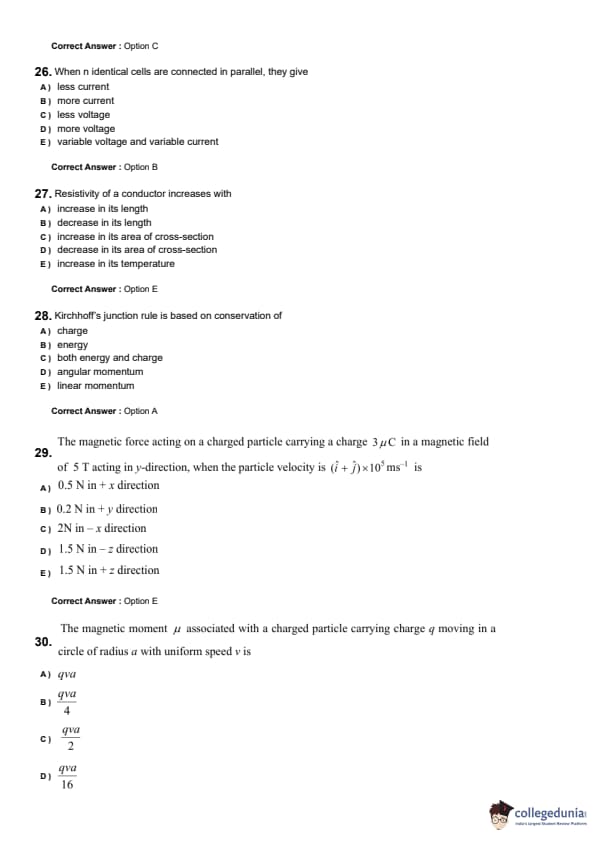
Question 26:

When \(n\) identical cells are connected in parallel, they give

  • (A) less current
  • (B) more current
  • (C) less voltage
  • (D) more voltage
  • (E) variable voltage and variable current
Correct Answer: (B) more current
View Solution

Question 27:

Resistivity of a conductor increases with

  • (A) increase in its length
  • (B) decrease in its length
  • (C) increase in its area of cross-section
  • (D) decrease in its area of cross-section
  • (E) increase in its temperature
Correct Answer: (E) increase in its temperature
View Solution

Question 28:

Kirchhoff’s junction rule is based on conservation of

  • (A) charge
  • (B) energy
  • (C) both energy and charge
  • (D) angular momentum
  • (E) linear momentum
Correct Answer: (A) charge
View Solution

Question 29:

The magnetic force acting on a charged particle carrying a charge \(3 \mu C\) in a magnetic field of \(5\) T acting in the \(y\)-direction, when the particle velocity is \[ (\hat{i} + \hat{j}) \times 10^5 ms^{-1} \]
is

  • (A) \(0.5\) N in \(+x\) direction
  • (B) \(0.2\) N in \(+y\) direction
  • (C) \(2\) N in \(-x\) direction
  • (D) \(1.5\) N in \(-z\) direction
  • (E) \(1.5\) N in \(+z\) direction
Correct Answer: (E) \(1.5\) N in \(+z\) direction
View Solution

Question 30:

The magnetic moment \(\mu\) associated with a charged particle carrying charge \(q\) moving in a circle of radius \(a\) with uniform speed \(v\) is

  • (A) \(qva\)
  • (B) \(\frac{qva}{4}\)
  • (C) \(\frac{qva}{2}\)
  • (D) \(\frac{qva}{16}\)
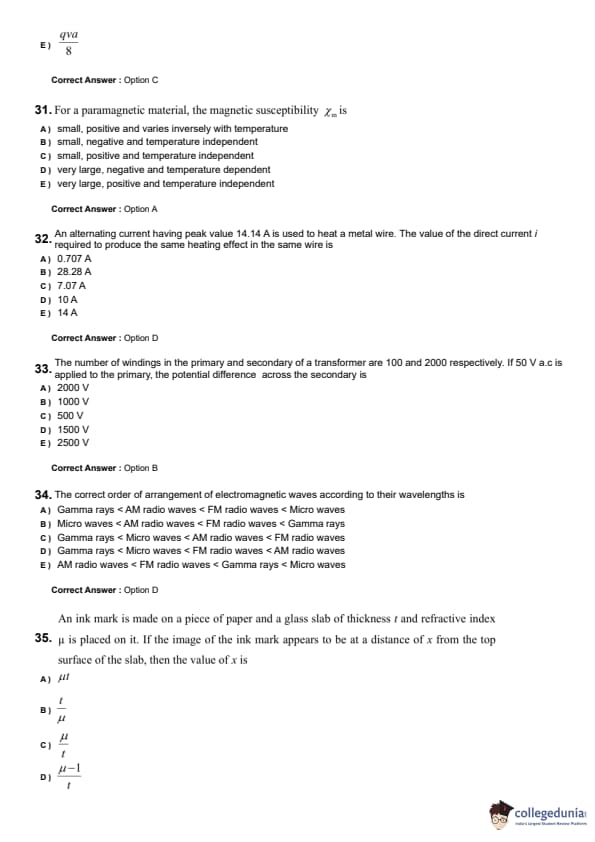
  • (E) \(\frac{qva}{8}\)
Correct Answer: (C) \(\frac{qva}{2}\)
View Solution

Question 31:

For a paramagnetic material, the magnetic susceptibility \( \chi_m \) is

  • (A) small, positive and varies inversely with temperature
  • (B) small, negative and temperature independent
  • (C) small, positive and temperature independent
  • (D) very large, negative and temperature dependent
  • (E) very large, positive and temperature independent
Correct Answer: (A) small, positive and varies inversely with temperature
View Solution

Question 32:

An alternating current having peak value 14.14 A is used to heat a metal wire. The value of the direct current \(i\) required to produce the same heating effect in the same wire is

  • (A) 0.707 A
  • (B) 28.28 A
  • (C) 7.07 A
  • (D) 10 A
  • (E) 14 A
Correct Answer: (D) 10 A
View Solution

Question 33:

The number of windings in the primary and secondary of a transformer are 100 and 2000 respectively. If 50 V a.c is applied to the primary, the potential difference across the secondary is

  • (A) 2000 V
  • (B) 1000 V
  • (C) 500 V
  • (D) 1500 V
  • (E) 2500 V
Correct Answer: (B) 1000 V
View Solution

Question 34:

The correct order of arrangement of electromagnetic waves according to their wavelengths is

  • (A) \(Gamma rays < AM radio waves < FM radio waves < Micro waves\)
  • (B) \(Micro waves < AM radio waves < FM radio waves < Gamma rays\)
  • (C) \(Gamma rays < Micro waves < AM radio waves < FM radio waves\)
  • (D) \(Gamma rays < Micro waves < FM radio waves < AM radio waves\)
  • (E) \(AM radio waves < FM radio waves < Gamma rays < Micro waves\)
Correct Answer: (D) \(Gamma rays < Micro waves < FM radio waves < AM radio waves\)
View Solution

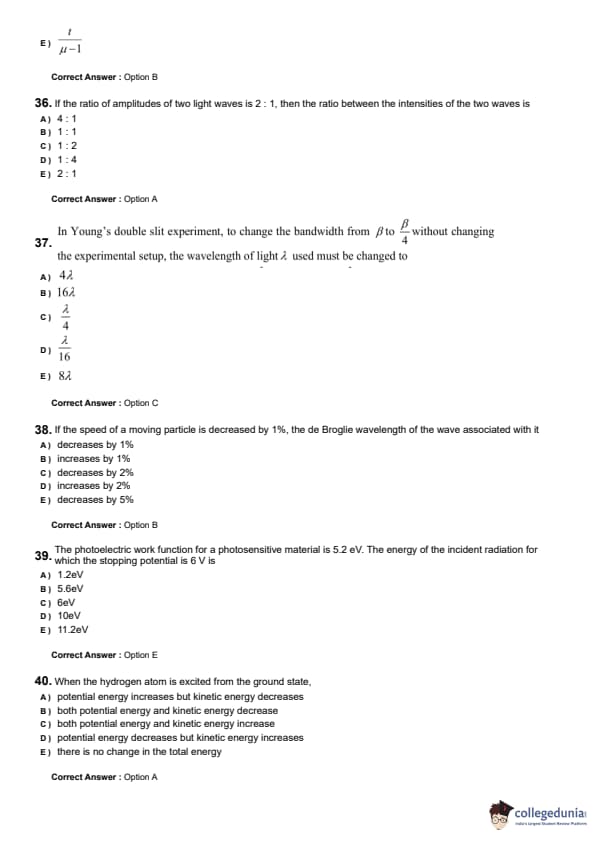
Question 35:

An ink mark is made on a piece of paper and a glass slab of thickness \(t\) and refractive index \(\mu\) is placed on it. If the image of the ink mark appears to be at a distance of \(x\) from the top surface of the slab, then the value of \(x\) is

  • (A) \(\mu t\)
  • (B) \(\frac{t}{\mu}\)
  • (C) \(\frac{\mu}{t}\)
  • (D) \(\frac{\mu - 1}{t}\)
  • (E) \(\frac{t}{\mu - 1}\)
Correct Answer: (B) \(\frac{t}{\mu}\)
View Solution

Question 36:

If the ratio of amplitudes of two light waves is 2 : 1, then the ratio between the intensities of the two waves is

  • (A) \(4 : 1\)
  • (B) \(1 : 1\)
  • (C) \(1 : 2\)
  • (D) \(1 : 4\)
  • (E) \(2 : 1\)
Correct Answer: (A) \(4 : 1\)
View Solution

Question 37:

In Young’s double slit experiment, to change the bandwidth from \(\beta\) to \(\frac{\beta}{4}\) without changing the experimental setup, the wavelength of light \(\lambda\) used must be changed to

  • (A) \(4\lambda\)
  • (B) \(16\lambda\)
  • (C) \(\frac{\lambda}{4}\)
  • (D) \(\frac{\lambda}{16}\)
  • (E) \(8\lambda\)
Correct Answer: (C) \(\frac{\lambda}{4}\)
View Solution

Question 38:

If the speed of a moving particle is decreased by 1%, the de Broglie wavelength of the wave associated with it

  • (A) decreases by 1%
  • (B) increases by 1%
  • (C) decreases by 2%
  • (D) increases by 2%
  • (E) decreases by 5%
Correct Answer: (B) increases by 1%
View Solution

Question 39:

The photoelectric work function for a photosensitive material is 5.2 eV. The energy of the incident radiation for which the stopping potential is 6 V is

  • (A) 1.2 eV
  • (B) 5.6 eV
  • (C) 6 eV
  • (D) 10 eV
  • (E) 11.2 eV
Correct Answer: (E) 11.2 eV
View Solution

Question 40:

When the hydrogen atom is excited from the ground state,

  • (A) potential energy increases but kinetic energy decreases
  • (B) both potential energy and kinetic energy decrease
  • (C) both potential energy and kinetic energy increase
  • (D) potential energy decreases but kinetic energy increases
  • (E) there is no change in the total energy
Correct Answer: (A) potential energy increases but kinetic energy decreases
View Solution

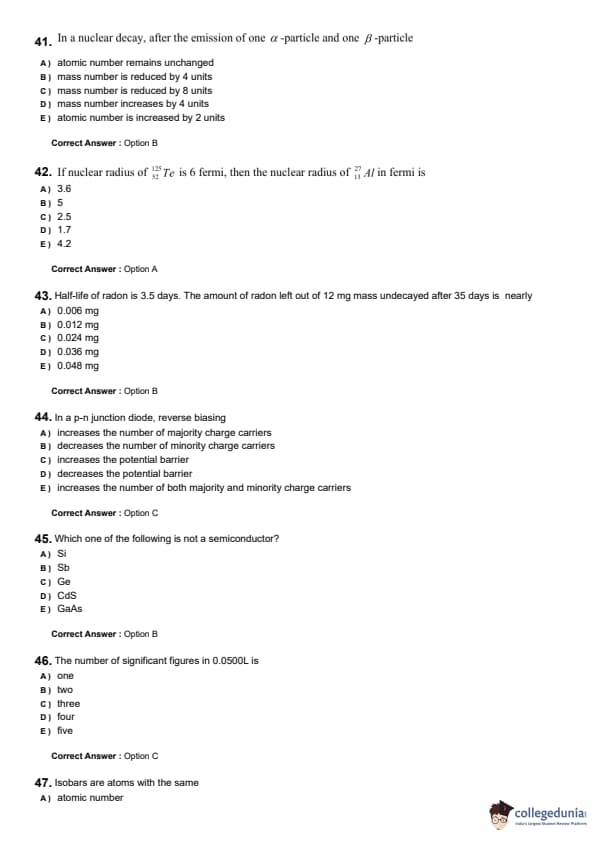
Question 41:

In a nuclear decay, after the emission of one \(\alpha\)-particle and one \(\beta\)-particle

  • (A) atomic number remains unchanged
  • (B) mass number is reduced by 4 units
  • (C) mass number is reduced by 8 units
  • (D) mass number increases by 4 units
  • (E) atomic number is increased by 2 units
Correct Answer: (B) mass number is reduced by 4 units
View Solution

Question 42:

If nuclear radius of \(^{125}_{52}Te\) is 6 fermi, then the nuclear radius of \(^{27}_{13}Al\) in fermi is

  • (A) \(3.6\)
  • (B) \(5\)
  • (C) \(2.5\)
  • (D) \(1.7\)
  • (E) \(4.2\)
Correct Answer: (A) \(3.6\)
View Solution

Question 43:

Half-life of radon is 3.5 days. The amount of radon left out of 12 mg mass undecayed after 35 days is nearly

  • (A) \(0.006\) mg
  • (B) \(0.012\) mg
  • (C) \(0.024\) mg
  • (D) \(0.036\) mg
  • (E) \(0.048\) mg
Correct Answer: (B) \(0.012\) mg
View Solution

Question 44:

In a p-n junction diode, reverse biasing

  • (A) increases the number of majority charge carriers
  • (B) decreases the number of minority charge carriers
  • (C) increases the potential barrier
  • (D) decreases the potential barrier
  • (E) increases the number of both majority and minority charge carriers
Correct Answer: (C) increases the potential barrier
View Solution

Question 45:

Which one of the following is not a semiconductor?

  • (A) Si
  • (B) Sb
  • (C) Ge
  • (D) CdS
  • (E) GaAs
Correct Answer: (B) Sb
View Solution

Question 46:

The number of significant figures in 0.0500L is

  • (A) one
  • (B) two
  • (C) three
  • (D) four
  • (E) five
Correct Answer: (C) three
View Solution

Question 47:

Isobars are atoms with the same

  • (A) atomic number
  • (B) mass number
  • (C) number of electrons
  • (D) number of protons
  • (E) number of neutrons
Correct Answer: (B) mass number
View Solution

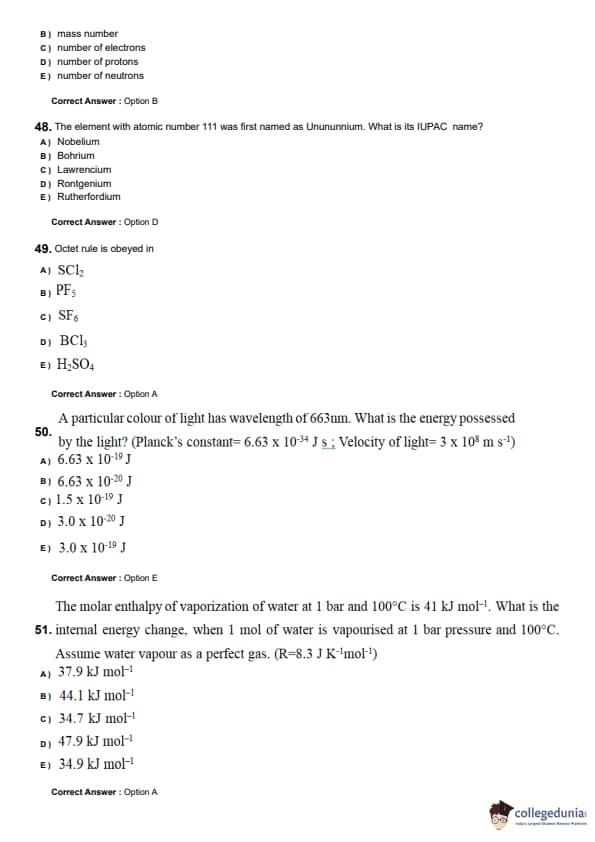
Question 48:

The element with atomic number 111 was first named as Unununnium. What is its IUPAC name?

  • (A) Nobelium
  • (B) Bohrium
  • (C) Lawrencium
  • (D) Roentgenium
  • (E) Rutherfordium
Correct Answer: (D) Roentgenium
View Solution

Question 49:

Octet rule is obeyed in

  • (A) \(SCl_2\)
  • (B) \(PF_5\)
  • (C) \(SF_6\)
  • (D) \(BCl_3\)
  • (E) \(H_2SO_4\)
Correct Answer: (A) \(SCl_2\)
View Solution

Question 50:

A particular color of light has a wavelength of 663 nm. What is the energy possessed by the light?
(Planck’s constant \(h = 6.63 \times 10^{-34}\) J·s; Velocity of light \(c = 3 \times 10^8\) m/s)

  • (A) \(6.63 \times 10^{-19}\) J
  • (B) \(6.63 \times 10^{-20}\) J
  • (C) \(1.5 \times 10^{-19}\) J
  • (D) \(3.0 \times 10^{-20}\) J
  • (E) \(3.0 \times 10^{-19}\) J
Correct Answer: (E) \(3.0 \times 10^{-19}\) J
View Solution

Question 51:

The molar enthalpy of vaporization of water at 1 bar and \(100^\circ\)C is 41 kJ mol\textsuperscript{-1. What is the internal energy change, when 1 mol of water is vaporized at 1 bar pressure and \(100^\circ\)C? Assume water vapor as a perfect gas. (R = 8.3 J K\textsuperscript{-1 mol\textsuperscript{-1)

  • (A) \(37.9\) kJ mol^{-1}
  • (B) \(44.1\) kJ mol^{-1}
  • (C) \(34.7\) kJ mol^{-1}
  • (D) \(47.9\) kJ mol^{-1}
  • (E) \(34.9\) kJ mol^{-1}
Correct Answer: (A) \(37.9\) kJ mol^{-1}
View Solution

Question 52:

0.1 M HCl and 0.1 M H_{2}SO_{4} each of volume 2 mL are mixed and the volume is made up to 6 mL by adding 2 mL of 0.01 N NaCl solution. The pH of the resulting mixture is

  • (A) \(1.17\)
  • (B) \(1.0\)
  • (C) \(0.3\)
  • (D) \(\log 2 - \log 3\)
  • (E) \(\log 3 - \log 2\)
Correct Answer: (B) \(1.0\)
View Solution

Question 53:

Which of the following molecules has two sigma (\(\sigma\)) and two pi (\(\pi\)) bonds?

  • (A) \(N_2\)
  • (B) \(C_2H_6\)
  • (C) \(N_2F_2\)
  • (D) HCN
  • (E) \(C_2H_2Cl_2\)
Correct Answer: (D) HCN
View Solution

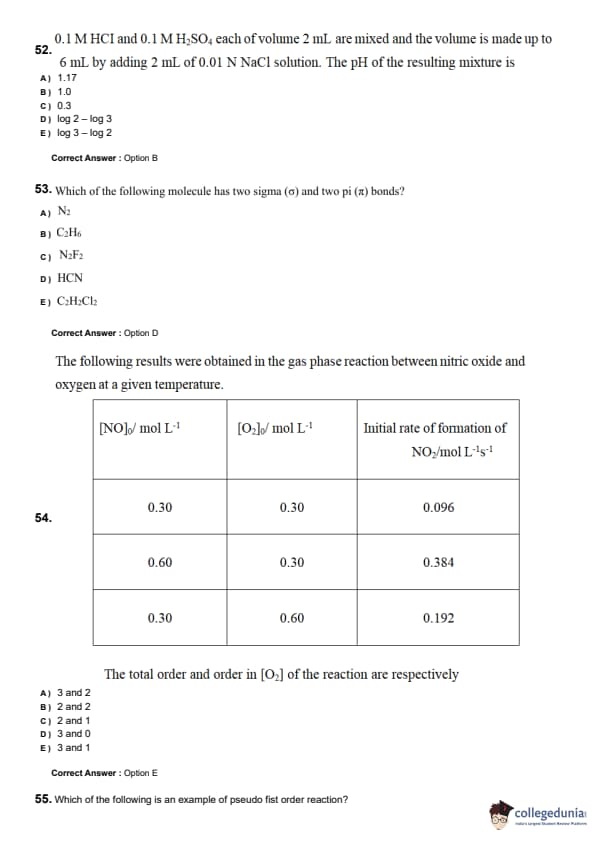
Question 54:

The following results were obtained in the gas phase reaction between nitric oxide and oxygen at a given temperature.

(A) 3 and 2 
(B) 2 and 2 
(C) 2 and 1 
(D) 3 and 0 
(E) 3 and 1 

Correct Answer: (E) 3 and 1
View Solution

Question 55:

Which of the following is an example of pseudo first order reaction?

  • (A) Thermal decomposition of \(N_2O_5\) gas
    (B) Decomposition of HI on gold surface
    (C) Decomposition of \(NH_3\) on platinum surface
    (D) Inversion of sucrose
    (E) Hydrogenation of ethene
Correct Answer: (D) Inversion of sucrose
View Solution

Question 56:

Which of the following changes alone would cause increase in the value of the equilibrium constant of the reaction? \(PCl_5(g) \rightarrow PCl_3(g) + Cl_2(g); \Delta H > 0\)

  • (A) Increasing the volume of the reaction vessel
    (B) Decreasing the volume of the reaction vessel
    (C) Addition of catalyst to equilibrium mixture
    (D) Addition of \(PCl_5(g)\) to the equilibrium mixture
    (E) Increasing the temperature
Correct Answer: (E) Increasing the temperature
View Solution

Question 57:

For the gas phase homogeneous equilibrium, \[ 2X(g) \rightleftharpoons 2Y(g) + Z(g), \]
\(K_C\) at 400K is \(1 \times 10^{-3}\) mol L\textsuperscript{-1. What is the value of \(K_P\) for the equilibrium at 400K? \[ R = 0.082 L atm K^{-1} mol^{-1} \]

  • (A) \(1 \times 10^{-3}\) atm
  • (B) \(3.16 \times 10^{-4}\) atm
  • (C) \(4.24 \times 10^{-4}\) atm
  • (D) \(3.28 \times 10^{-2}\) atm
  • (E) \(1.28 \times 10^{-2}\) atm
Correct Answer: (D) \(3.28 \times 10^{-2}\) atm
View Solution

Question 58:

Which of the following pairs of aquated first transition metal ions have the same color?

  • (A) \(Cr^{3+}, Mn^{3+}\)
  • (B) \(Ti^{3+}, Cu^{2+}\)
  • (C) \(Fe^{2+}, Co^{2+}\)
  • (D) \(Fe^{2+}, Cu^{2+}\)
  • (E) \(Fe^{3+}, Co^{3+}\)
Correct Answer: (A) \(Cr^{3+}, Mn^{3+}\)
View Solution

Question 59:

For the reaction \[ 3Fe_{(s)} + 2O_2{(g)} \rightarrow Fe_3O_4{(s)}, \]
\(\Delta H = -1650\) kJ mol\textsuperscript{-1, \(\Delta S = -600\) J K\textsuperscript{-1 mol\textsuperscript{-1 at 300K. What is the value of free energy change for the reaction at 300K?

  • (A) \(-1470\) J mol\textsuperscript{-1}
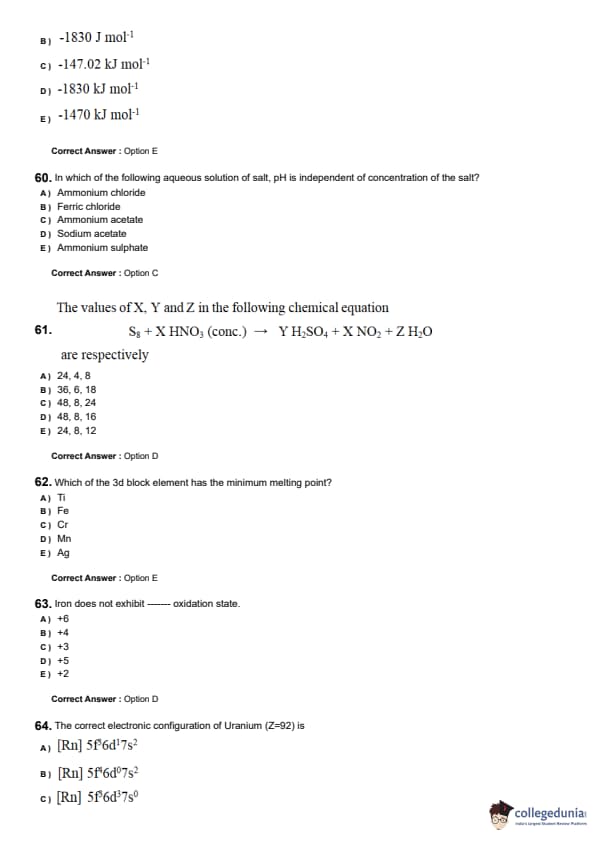
  • (B) \(-1830\) J mol\textsuperscript{-1}
  • (C) \(-147.02\) kJ mol\textsuperscript{-1}
  • (D) \(-1830\) kJ mol\textsuperscript{-1}
  • (E) \(-1470\) kJ mol\textsuperscript{-1}
Correct Answer: (E) \(-1470\) kJ mol\textsuperscript{-1}
View Solution

Question 60:

In which of the following aqueous solutions of salt, is pH independent of the concentration of the salt?

  • (A) Ammonium chloride
  • (B) Ferric chloride
  • (C) Ammonium acetate
  • (D) Sodium acetate
  • (E) Ammonium sulphate
Correct Answer: (C) Ammonium acetate
View Solution

Question 61:

The values of X, Y, and Z in the following chemical equation are respectively: \( S_8 + X HNO_3 (conc.) \rightarrow Y H_2SO_4 + X NO_2 + Z H_2O \)
(A) 24, 4, 8
(B) 36, 6, 18
(C) 48, 8, 24
(D) 48, 8, 16
(E) 24, 8, 12

Correct Answer: (D) 48, 8, 16
View Solution

Question 62:

Which of the 3d block element has the minimum melting point?

  • (A) Ti
  • (B) Fe
  • (C) Cr
  • (D) Mn
  • (E) Ag
Correct Answer: (E) Ag
View Solution

Question 63:

Iron does not exhibit ------- oxidation state.

  • (A) \(+6\)
  • (B) \(+4\)
  • (C) \(+3\)
  • (D) \(+5\)
  • (E) \(+2\)
Correct Answer: (D) \(+5\)
View Solution

Question 64:

The correct electronic configuration of Uranium (Z=92) is

  • (A) \([Rn] 5f^3 6d^1 7s^2\)
  • (B) \([Rn] 5f^4 6d^0 7s^2\)
  • (C) \([Rn] 5f^6 6d^3 7s^0\)
  • (D) \([Rn] 5f^6 6d^1 7s^1\)
  • (E) \([Rn] 5f^6 6d^1 7s^0\)
Correct Answer: (A) \([\text{Rn}] 5f^3 6d^1 7s^2\)
View Solution

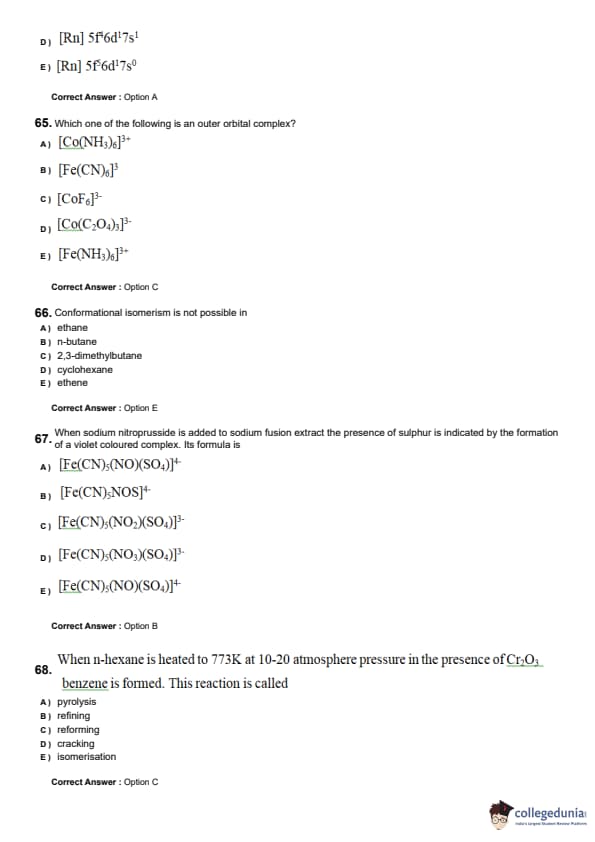
Question 65:

Which one of the following is an outer orbital complex?

  • (A) \([Co(NH_3)_6]^{3+}\)
  • (B) \([Fe(CN)_6]^{3-}\)
  • (C) \([CoF_6]^{3-}\)
  • (D) \([Co(C_2O_4)_3]^{3-}\)
  • (E) \([Fe(NH_3)_6]^{3+}\)
Correct Answer: (C) \([\text{CoF}_6]^{3-}\)
View Solution

Question 66:

Conformational isomerism is not possible in

  • (A) ethane
  • (B) n-butane
  • (C) 2,3-dimethylbutane
  • (D) cyclohexane
  • (E) ethene
Correct Answer: (E) ethene
View Solution

Question 67:

When sodium nitroprusside is added to sodium fusion extract the presence of sulphur is indicated by the formation of a violet colored complex. Its formula is

  • (A) \([Fe(CN)_5(NO)(SO_4)]^{4+}\)
  • (B) \([Fe(CN)_5NOS]^{4-}\)
  • (C) \([Fe(CN)_5(NO_2)(SO_4)]^{3-}\)
  • (D) \([Fe(CN)_5(NO_3)(SO_4)]^{3-}\)
  • (E) \([Fe(CN)_5(NO)(SO_4)]^{4-}\)
Correct Answer: (B) \([Fe(CN)_5NOS]^{4-}\)
View Solution

Question 68:

When n-hexane is heated to 773K at 10-20 atmosphere pressure in the presence of \(Cr_2O_3\), benzene is formed. This reaction is called

  • (A) pyrolysis
  • (B) refining
  • (C) reforming
  • (D) cracking
  • (E) isomerisation
Correct Answer: (C) reforming
View Solution

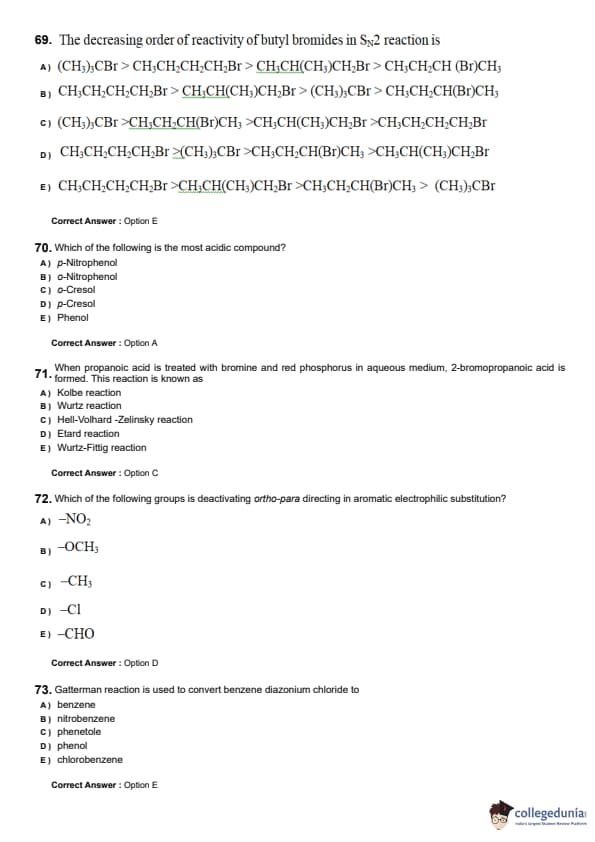
Question 69:

The decreasing order of reactivity of butyl bromides in \(S_N2\) reaction is

  • (A) \((CH_3)_3CBr > CH_3CH_2CH_2CH_2Br > CH_3CH(CH_3)CH_2Br > CH_3CH_2CH(Br)CH_3\)
  • (B) \(CH_3CH_2CH_2CH_2Br > CH_3CH(CH_3)_2Br > (CH_3)_3CBr > CH_3CH_2CH(Br)CH_3\)
  • (C) \((CH_3)_3CBr > CH_3CH(CH_3)CH_2Br > CH_3CH_2CH_2CH_2Br > CH_3CH_2CH(Br)CH_3\)
  • (D) \(CH_3CH_2CH_2CH_2Br > (CH_3)_3CBr > CH_3CH(CH_3)CHBr > CH_3CH(CH_3)CH_2Br\)
  • (E) \(CH_3CH_2CH_2CH_2Br > CH_3CH(CH_3)_2Br > CH_3CH_2CH(Br)CH_3 > (CH_3)_3CBr\)
Correct Answer: (E) \(CH_3CH_2CH_2CH_2Br > CH_3CH(CH_3)_2Br > CH_3CH_2CH(Br)CH_3 > (CH_3)_3CBr\)
View Solution

Question 70:

Which of the following is the most acidic compound?

  • (A) p-Nitrophenol
  • (B) o-Nitrophenol
  • (C) o-Cresol
  • (D) p-Cresol
  • (E) Phenol
Correct Answer: (A) p-Nitrophenol
View Solution

Question 71:

When propanoic acid is treated with bromine and red phosphorus in aqueous medium, 2-bromopropanoic acid is formed. This reaction is known as

  • (A) Kolbe reaction
  • (B) Wurtz reaction
  • (C) Hell-Volhard-Zelinsky reaction
  • (D) Etard reaction
  • (E) Wurtz-Fittig reaction
Correct Answer: (C) Hell-Volhard-Zelinsky reaction
View Solution

Question 72:

Which of the following groups is deactivating ortho-para directing in aromatic electrophilic substitution?

  • (A) \(-NO_2\)
  • (B) \(-OCH_3\)
  • (C) \(-CH_3\)
  • (D) \(-Cl\)
  • (E) \(-CHO\)
Correct Answer: (D) \(-Cl\)
View Solution

Question 73:

Gatterman reaction is used to convert benzene diazonium chloride to

  • (A) benzene
  • (B) nitrobenzene
  • (C) phenetole
  • (D) phenol
  • (E) chlorobenzene
Correct Answer: (E) chlorobenzene
View Solution

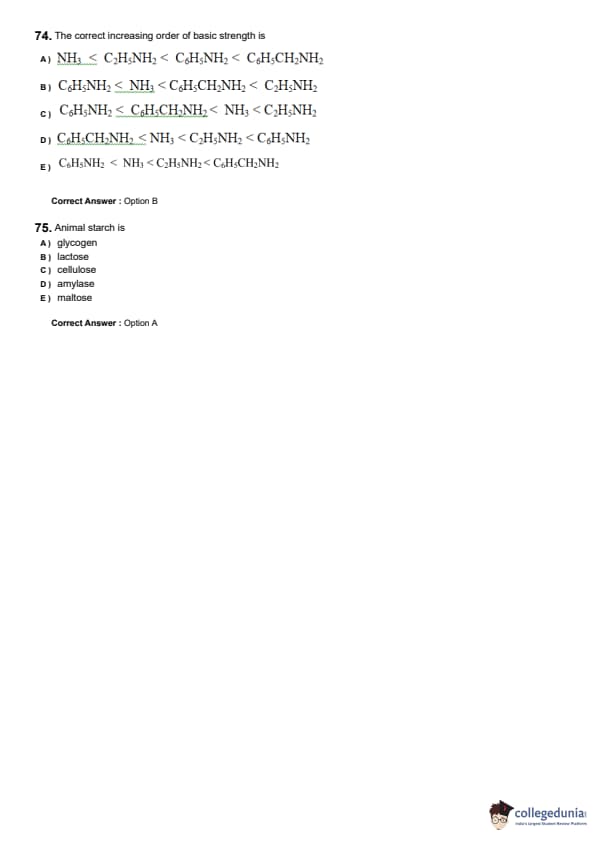
Question 74:

The correct increasing order of basic strength is

  • (A) \(NH_3 < C_2H_5NH_2 < C_6H_5NH_2 < C_6H_5CH_2NH_2\)
  • (B) \(C_6H_5NH_2 < NH_3 < C_6H_5CH_2NH_2 < C_2H_5NH_2\)
  • (C) \(C_6H_5NH_2 < C_6H_5CH_2NH_2 < NH_3 < C_2H_5NH_2\)
  • (D) \(C_6H_5CH_2NH_2 < NH_3 < C_2H_5NH_2 < C_6H_5NH_2\)
  • (E) \(C_6H_5NH_2 < NH_3 < C_2H_5NH_2 < C_6H_5CH_2NH_2\)
Correct Answer: (B) \(C_6H_5NH_2 < NH_3 < C_6H_5CH_2NH_2 < C_2H_5NH_2\)
View Solution

Question 75:

Animal starch is

  • (A) glycogen
  • (B) lactose
  • (C) cellulose
  • (D) amylase
  • (E) maltose
Correct Answer: (A) glycogen
View Solution