KEAM 2024 Question Paper (June 7) is available for download here. Office of The Commissioner for Entrance Examinations (CEE Kerala) conducted KEAM Engineering exam 2024 in CBT mode on June 7 in afternoon shift from 2 PM to 5 PM. KEAM Engineering 2024 Question Paper consists total of 150 questions carrying 4 mark each with negative marking of 1 for each incorrect answer. KEAM 2024 Question Paper includes Mathematics with 75 questions, Physics with 45 questions and Chemistry with 30 questions to be attempted in total of 180 minutes.

KEAM 2024 Question Paper with Answer Key PDF (June 7)

KEAM 2024 (June 7) Question Paper with Answer Key download iconDownload Check Solution

KEAM 2024 Question Paper with Answer Key PDF (June 7)

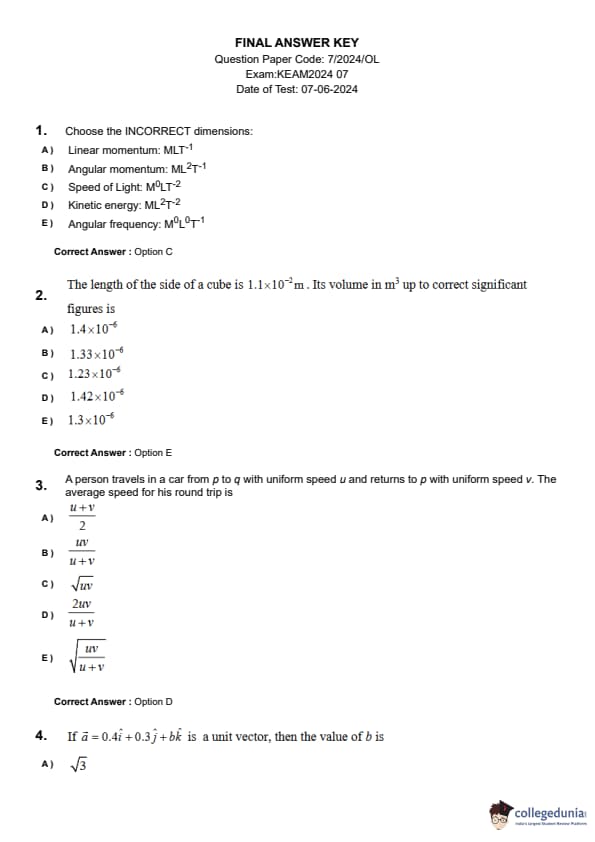
Question 1:

Choose the INCORRECT dimensions:

  • (A) Linear momentum: MLT-1
  • (B) Angular momentum: ML2T-1
  • (C) Speed of Light: M0L T-2
  • (D) Kinetic energy: ML2T-2
  • (E) Angular frequency: M0L0T-1
Correct Answer: (C) Speed of Light: M0L T-2
View Solution

Question 2:

The length of the side of a cube is 1.1 * 10-2 m. Its volume in m3 up to correct significant figures is

  • (A) 1.4 * 10-6
  • (B) 1.33 * 10-6
  • (C) 1.23 * 10-6
  • (D) 1.42 * 10-6
  • (E) 1.3 * 10-6
Correct Answer: (E) 1.3 * 10-6
View Solution

Question 3:

A person travels in a car from p to q with uniform speed u and returns to p with uniform speed v. The average speed for his round trip is

  • (A) \(\dfrac{u+v}{2}\)
  • (B) \(\dfrac{uv}{u+v}\)
  • (C) \(\dfrac{\sqrt{uv}}{u+v}\)
  • (D) \(\dfrac{2uv}{u+v}\)
  • (E) \(\dfrac{uv}{u+v}\)
Correct Answer: (D) \(\dfrac{2uv}{u+v}\)
View Solution

Question 4:

If \(\vec{a} = 0.4\hat{i} + 0.3\hat{j} + b\hat{k}\) is a unit vector, then the value of b is

  • (A) \({\sqrt{3}}\)
  • (B) \(\dfrac{2}{\sqrt{5}}\)
  • (C) \(\dfrac{\sqrt{5}}{2}\)
  • (D) \(\dfrac{1}{\sqrt{3}}\)
  • (E) \(\dfrac{\sqrt{3}}{2}\)
Correct Answer: (E) \(\dfrac{\sqrt{3}}{2}\)
View Solution

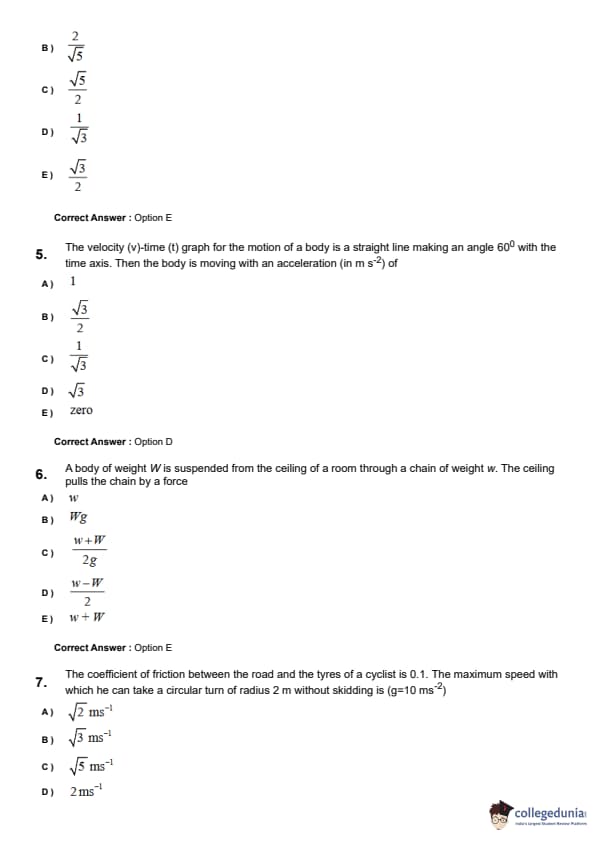
Question 5:

The velocity (v)-time (t) graph for the motion of a body is a straight line making an angle 60° with the time axis. Then the body is moving with an acceleration (in m s\textsuperscript{-2}) of

  • (A) 1
  • (B) \(\dfrac{\sqrt{3}}{2}\)
  • (C) \(\dfrac{1}{\sqrt{3}}\)
  • (D) \(\sqrt{3}\)
  • (E) zero
Correct Answer: (D) \(\sqrt{3}\)
View Solution

Question 6:

A body of weight \( W \) is suspended from the ceiling of a room through a chain of weight \( w \). The ceiling pulls the chain by a force.

  • (A) \( w \)
  • (B) \( {Wg} \)
  • (C) \( \dfrac{w + W}{2g} \)
  • (D) \( \dfrac{w - W}{2} \)
  • (E) \( w + W \)
Correct Answer: (E) \( w + W \)
View Solution

Question 7:

The coefficient of friction between the road and the tyres of a cyclist is 0.1. The maximum speed with which he can take a circular turn of radius 2 m without skidding is (g = 10 m/s^{2})

  • (A) \( \sqrt{2} \, ms^{-1} \)
  • (B) \( \sqrt{3} \, ms^{-1} \)
  • (C) \( \sqrt{5} \, ms^{-1} \)
  • (D) \( 2 \, ms^{-1} \)
  • (E) \( 3 \, ms^{-1} \)
Correct Answer: (A) \( \sqrt{2} \, \text{ms}^{-1} \)
View Solution

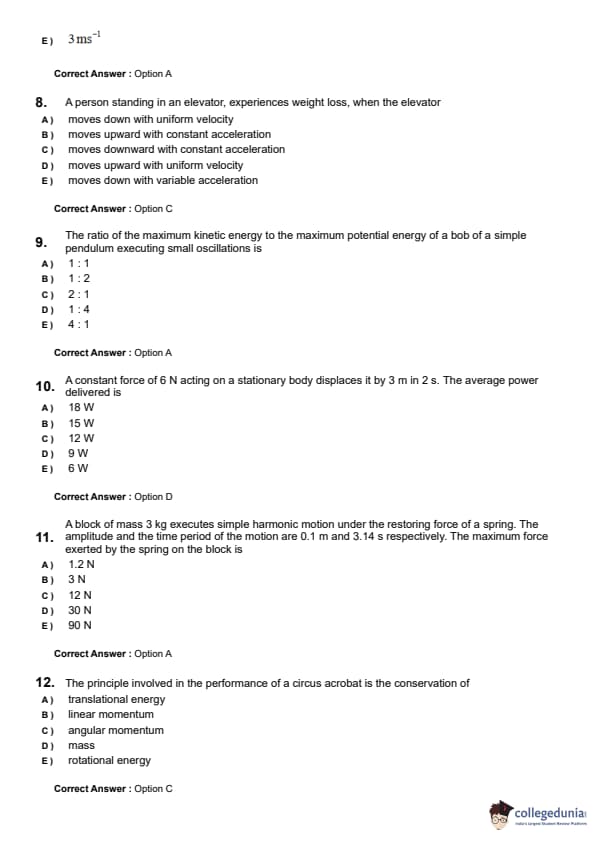
Question 8:

A person standing in an elevator experiences weight loss when the elevator

  • (A) moves down with uniform velocity
  • (B) moves upward with constant acceleration
  • (C) moves downward with constant acceleration
  • (D) moves upward with uniform velocity
  • (E) moves down with variable acceleration
Correct Answer: (C) moves downward with constant acceleration
View Solution

Question 9:

The ratio of the maximum kinetic energy to the maximum potential energy of a bob of a simple pendulum executing small oscillations is

  • (A) 1 : 1
  • (B) 1 : 2
  • (C) 2 : 1
  • (D) 1 : 4
  • (E) 4 : 1
Correct Answer: (A) 1 : 1
View Solution

Question 10:

A constant force of 6 N acting on a stationary body displaces it by 3 m in 2 s. The average power delivered is

  • (A) 18 W
  • (B) 15 W
  • (C) 12 W
  • (D) 9 W
  • (E) 6 W
Correct Answer: (D) 9 W
View Solution

Question 11:

A block of mass 3 kg executes simple harmonic motion under the restoring force of a spring. The amplitude and the time period of the motion are 0.1 m and 3.14 s respectively. The maximum force exerted by the spring on the block is

  • (A) 1.2 N
  • (B) 3 N
  • (C) 12 N
  • (D) 30 N
  • (E) 90 N
Correct Answer: (A) 1.2 N
View Solution

Question 12:

The principle involved in the performance of a circus acrobat is the conservation of

  • (A) translational energy
  • (B) linear momentum
  • (C) angular momentum
  • (D) mass
  • (E) rotational energy
Correct Answer: (C) angular momentum
View Solution

Question 13:

For a smoothly running analog clock, the ratio of the angular velocity of the minute hand to the angular velocity of the hour hand is

  • (A) 2
  • (B) 12
  • (C) 24
  • (D) 60
  • (E) 360
Correct Answer: (B) 12
View Solution

Question 14:

The height above the surface of the earth at which the acceleration due to gravity becomes half of that on the surface of the earth is (R is the radius of earth)

  • (A) \( R \)
  • (B) \( 2R \)
  • (C) \( 4R \)
  • (D) \( \dfrac{R}{2} \)
  • (E) \( \dfrac{R}{4} \)
Correct Answer: Question cancelled
View Solution

Question 15:

A particle of 100 g mass is projected vertically up with a kinetic energy of 20 J. The maximum height reached by the particle is (g = 10 m/s^{2}) (neglecting air resistance)

  • (A) 5 m
  • (B) 10 m
  • (C) 15 m
  • (D) 20 m
  • (E) 25 m
Correct Answer: (D) 20 m
View Solution

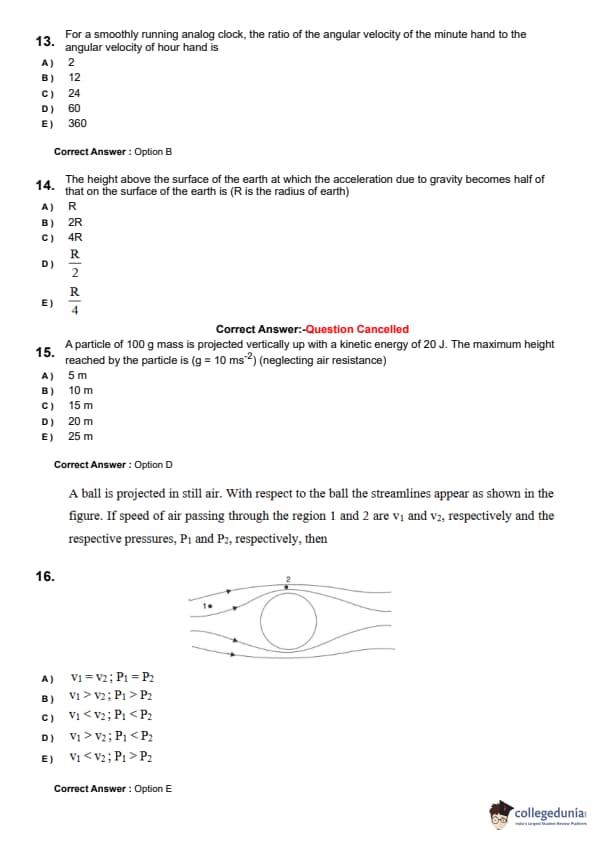
Question 16:

A ball is projected in still air. With respect to the ball the streamlines appear as shown in the figure. If speed of air passing through the region 1 and 2 are \( v_1 \) and \( v_2 \), respectively and the respective pressures, \( P_1 \) and \( P_2 \), respectively, then

  • (A) \( v_1 = v_2 ; P_1 = P_2 \)
  • (B) \( v_1 > v_2 ; P_1 > P_2 \)
  • (C) \( v_1 < v_2 ; P_1 < P_2 \)
  • (D) \( v_1 > v_2 ; P_1 < P_2 \)
  • (E) \( v_1 < v_2 ; P_1 > P_2 \)
Correct Answer: (E) \( v_1 < v_2 ; P_1 > P_2 \)
View Solution

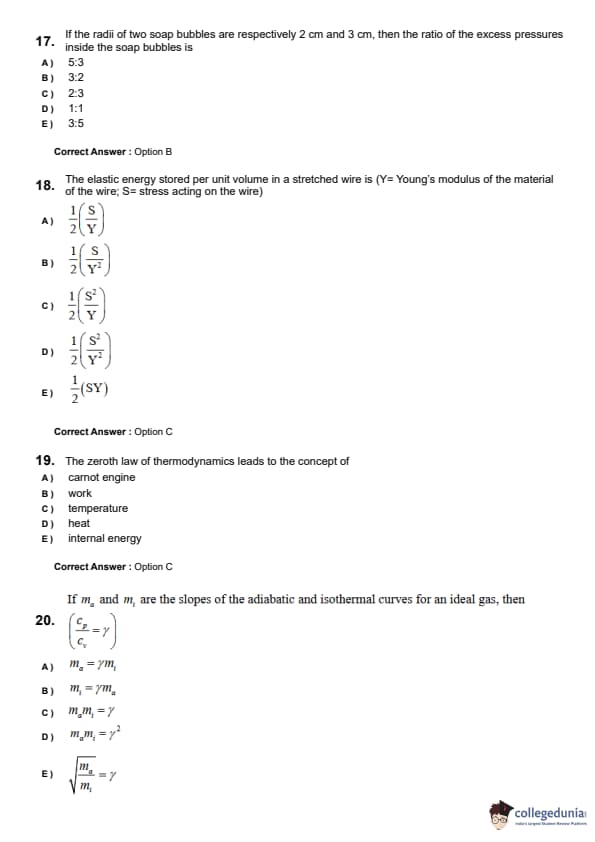
Question 17:

If the radii of two soap bubbles are respectively 2 cm and 3 cm, then the ratio of the excess pressures inside the soap bubbles is

  • (A) 5:3
  • (B) 3:2
  • (C) 2:3
  • (D) 1:1
  • (E) 3:5
Correct Answer: (B) 3:2
View Solution

Question 18:

The elastic energy stored per unit volume in a stretched wire is \((Y = Young's modulus of the material of the wire; S = stress acting on the wire)\)

  • (A) \( \dfrac{1}{2} \left( \dfrac{S}{Y} \right) \)
  • (B) \( \dfrac{1}{2} \left( \dfrac{S}{Y^2} \right) \)
  • (C) \( \dfrac{1}{2} \left( \dfrac{S^2}{Y} \right) \)
  • (D) \( \dfrac{1}{2} \left( \dfrac{S^2}{Y^2} \right) \)
  • (E) \( \dfrac{1}{2} (SY) \)
Correct Answer: (C) \( \dfrac{1}{2} \left( \dfrac{S^2}{Y} \right) \)
View Solution

Question 19:

The zeroth law of thermodynamics leads to the concept of

  • (A) Carnot engine
  • (B) Work
  • (C) Temperature
  • (D) Heat
  • (E) Internal energy
Correct Answer: (C) Temperature
View Solution

Question 20:

If \( m_a \) and \( m_i \) are the slopes of the adiabatic and isothermal curves for an ideal gas, then

  • (A) \( m_a = \gamma m_i \)
  • (B) \( m_i = \gamma m_a \)
  • (C) \( m_a m_i = \gamma \)
  • (D) \( m_a m_i = \gamma^2 \)
  • (E) \( \sqrt{\frac{m_a}{m_i}} = \gamma \)
Correct Answer: (A) \( m_a = \gamma m_i \)
View Solution

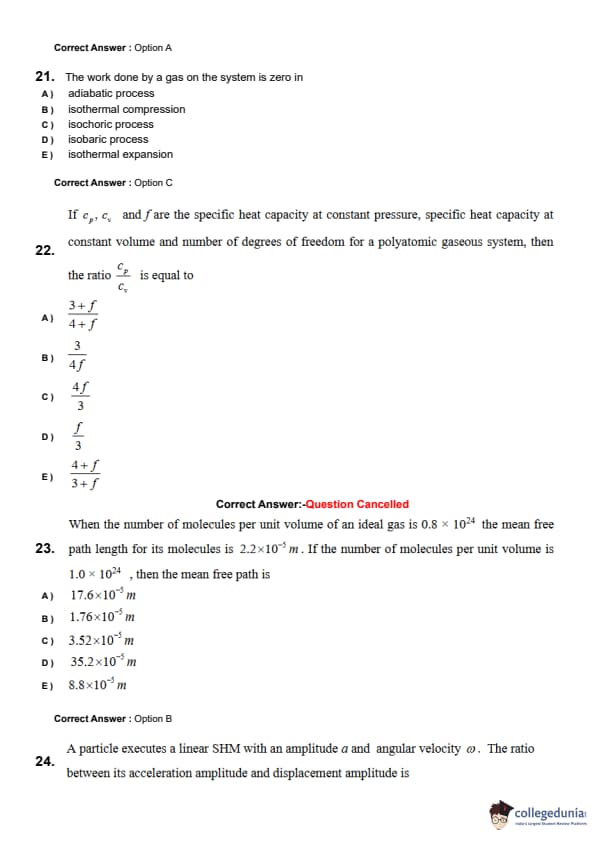
Question 21:

The work done by a gas on the system is zero in

  • (A) adiabatic process
  • (B) isothermal compression
  • (C) isochores process
  • (D) isobaric process
  • (E) isothermal expansion
Correct Answer: (C) isochores process
View Solution

Question 22:

If \( c_p \), \( c_v \), and \( f \) are the specific heat capacity at constant pressure, specific heat capacity at constant volume, and number of degrees of freedom for a polyatomic gaseous system, then the ratio \( \frac{c_p}{c_v} \) is equal to

  • (A) \( \frac{3 + f}{4 + f} \)
  • (B) \( \frac{3}{4f} \)
  • (C) \( \frac{4f}{3} \)
  • (D) \( \frac{f}{3} \)
  • (E) \( \frac{4 + f}{3 + f} \)
Correct Answer: \textit{Question Cancelled}
View Solution

Question 23:

When the number of molecules per unit volume of an ideal gas is \( 0.8 \times 10^{24} \), the mean free path length for its molecules is \( 2.2 \times 10^{-5} \, m \). If the number of molecules per unit volume is \( 1.0 \times 10^{24} \), then the mean free path is

  • (A) \( 17.6 \times 10^{-5} \, m \)
  • (B) \( 1.76 \times 10^{-5} \, m \)
  • (C) \( 3.52 \times 10^{-5} \, m \)
  • (D) \( 35.2 \times 10^{-5} \, m \)
  • (E) \( 8.8 \times 10^{-5} \, m \)
Correct Answer: (B) \( 1.76 \times 10^{-5} \, \text{m} \)
View Solution

Question 24:

A particle executes a linear SHM with an amplitude \(a\) and angular velocity \(\omega\). The ratio between its acceleration amplitude and displacement amplitude is

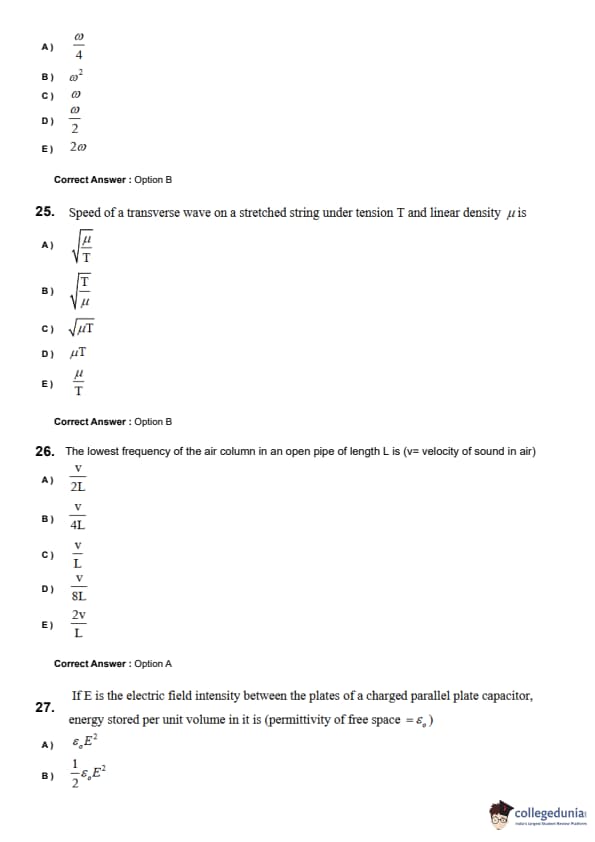
  • (A) \( \frac{\omega}{4} \)
  • (B) \( \omega^2 \)
  • (C) \( \omega \)
  • (D) \( \frac{\omega}{2} \)
  • (E) \( 2\omega \)
Correct Answer: (B) \( \omega^2 \)
View Solution

Question 25:

Speed of a transverse wave on a stretched string under tension \(T\) and linear density \(\mu\) is

  • (A) \( \sqrt{\frac{\mu}{T}} \)
  • (B) \( \sqrt{\frac{T}{\mu}} \)
  • (C) \( \sqrt{\mu T} \)
  • (D) \( \mu T \)
  • (E) \( \frac{\mu}{T} \)
Correct Answer: (B) \( \sqrt{\frac{T}{\mu}} \)
View Solution

Question 26:

The lowest frequency of the air column in an open pipe of length \( L \) is \( v \) (velocity of sound in air)

  • (A) \( \frac{v}{2L} \)
  • (B) \( \frac{v}{4L} \)
  • (C) \( \frac{v}{L} \)
  • (D) \( \frac{v}{8L} \)
  • (E) \( \frac{2v}{L} \)
Correct Answer: (A) \( \frac{v}{2L} \)
View Solution

Question 27:

If \( E \) is the electric field intensity between the plates of a charged parallel plate capacitor, energy stored per unit volume in it is (permittivity of free space = \( \epsilon_0 \))

  • (A) \( \epsilon_0 E^2 \)
  • (B) \( \frac{1}{2} \epsilon_0 E^2 \)
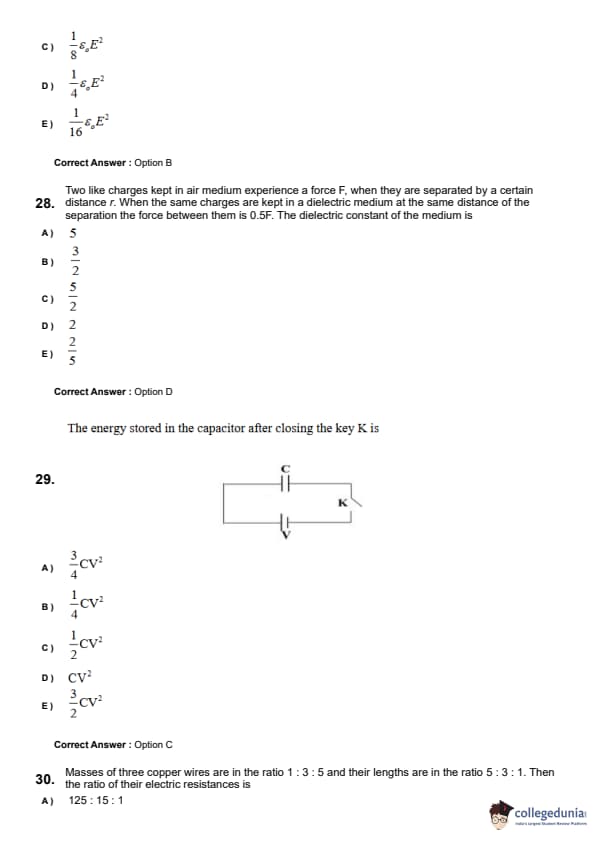
  • (C) \( \frac{1}{8} \epsilon_0 E^2 \)
  • (D) \( \frac{1}{4} \epsilon_0 E^2 \)
  • (E) \( \frac{1}{16} \epsilon_0 E^2 \)
Correct Answer: (B) \( \frac{1}{2} \epsilon_0 E^2 \)
View Solution

Question 28:

Two like charges kept in air medium experience a force \( F \), when they are separated by a certain distance \( r \). When the same charges are kept in a dielectric medium at the same distance of the separation, the force between them is 0.5F. The dielectric constant of the medium is

  • (A) 5
  • (B) \( \frac{3}{2} \)
  • (C) \( \frac{5}{2} \)
  • (D) 2
  • (E) \( \frac{2}{5} \)
Correct Answer: (D) 2
View Solution

Question 29:

The energy stored in the capacitor after closing the key K is

  • (A) \( \frac{3}{4} CV^2 \)
  • (B) \( \frac{1}{4} CV^2 \)
  • (C) \( \frac{1}{2} CV^2 \)
  • (D) \( CV^2 \)
  • (E) \( \frac{3}{2} CV^2 \)
Correct Answer: (C) \( \frac{1}{2} CV^2 \)
View Solution

Question 30:

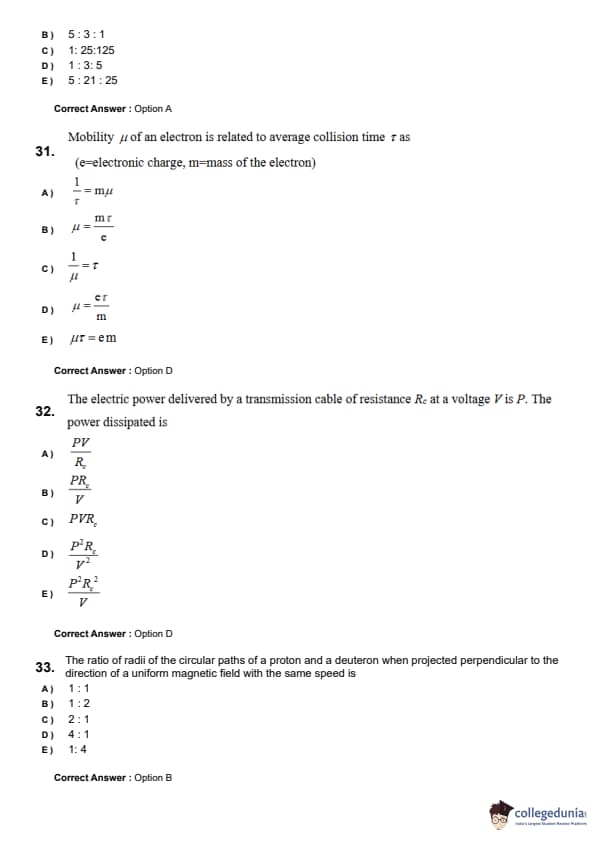
Masses of three copper wires are in the ratio 1:3:5 and their lengths are in the ratio 5:3:1. Then the ratio of their electric resistances is

  • (A) \( 125 : 15 : 1 \)
  • (B) \( 5 : 3 : 1 \)
  • (C) \( 1 : 25 : 125 \)
  • (D) \( 1 : 3 : 5 \)
  • (E) \( 5 : 21 : 25 \)
Correct Answer: (A) \( 125 : 15 : 1 \)
View Solution

Question 31:

Mobility \( \mu \) of an electron is related to average collision time \( \tau \) as
\textit{(e = electronic charge, m = mass of the electron)

  • (A) \( \frac{1}{\tau} = m \mu \)
  • (B) \( \mu =\frac{m \tau}{e} \)
  • (C) \( \frac{1}{\mu} = \tau \)
  • (D) \( \mu = \frac{e \tau}{m} \)
  • (E) \( \mu \tau = e m \)
Correct Answer: (D) \( \mu = \frac{e \tau}{m} \)
View Solution

Question 32:

The electric power delivered by a transmission cable of resistance \( R_c \) at a voltage \( V \) is \( P \). The power dissipated is

  • (A) \( \frac{PV}{R_c} \)
  • (B) \( \frac{PR_c}{V} \)
  • (C) \( PVR_c \)
  • (D) \( \frac{P^2 R_c}{V^2} \)
  • (E) \( \frac{P^2 R_c^2}{V} \)
Correct Answer: (D) \( \frac{P^2 R_c}{V^2} \)
View Solution

Question 33:

The ratio of radii of the circular paths of a proton and a deuteron when projected perpendicular to the direction of a uniform magnetic field with the same speed is

  • (A) 1 : 1
  • (B) 1 : 2
  • (C) 2 : 1
  • (D) 4 : 1
  • (E) 1 : 4
Correct Answer: (B) 1 : 2
View Solution

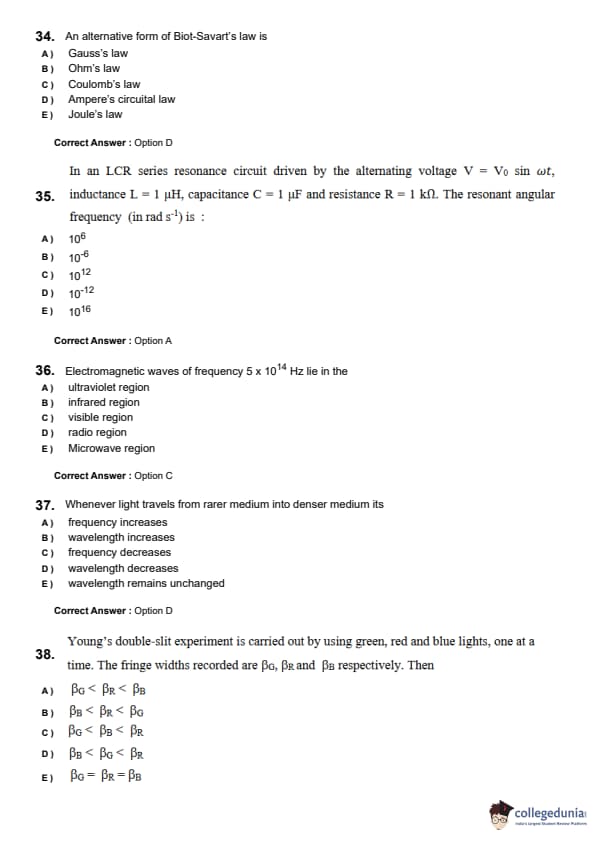
Question 34:

An alternative form of Biot-Savart's law is

  • (A) Gauss's law
  • (B) Ohm's law
  • (C) Coulomb's law
  • (D) Ampere's circuital law
  • (E) Joule's law
Correct Answer: (D) Ampere's circuital law
View Solution

Question 35:

In an LCR series resonance circuit driven by the alternating voltage \( V = V_0 \sin \omega t \), inductance \( L = 1 \, \mu H \), capacitance \( C = 1 \, \mu F \) and resistance \( R = 1 \, k\Omega \). The resonant angular frequency (in rad/s) is:

  • (A) \( 10^6 \)
  • (B) \( 10^{-6} \)
  • (C) \( 10^{12} \)
  • (D) \( 10^{16} \)
  • (E) \( 10^{10} \)
Correct Answer: (A) \( 10^6 \)
View Solution

Question 36:

Electromagnetic waves of frequency \( 5 \times 10^{14} \, Hz \) lie in the

  • (A) ultraviolet region
  • (B) infrared region
  • (C) visible region
  • (D) radio region
  • (E) microwave region
Correct Answer: (C) visible region
View Solution

Question 37:

Whenever light travels from rarer medium into denser medium its

  • (A) frequency increases
  • (B) wavelength increases
  • (C) frequency decreases
  • (D) wavelength decreases
  • (E) wavelength remains unchanged
Correct Answer: (D) wavelength decreases
View Solution

Question 38:

Young’s double-slit experiment is carried out by using green, red and blue lights, one at a time. The fringe widths recorded are \( \beta_G \), \( \beta_R \) and \( \beta_B \) respectively. Then

  • (A) \( \beta_G < \beta_R < \beta_B \)
  • (B) \( \beta_B < \beta_R < \beta_G \)
  • (C) \( \beta_G < \beta_B < \beta_R \)
  • (D) \( \beta_B < \beta_G < \beta_R \)
  • (E) \( \beta_G = \beta_R = \beta_B \)
Correct Answer: (D) \( \beta_B < \beta_G < \beta_R \)
View Solution

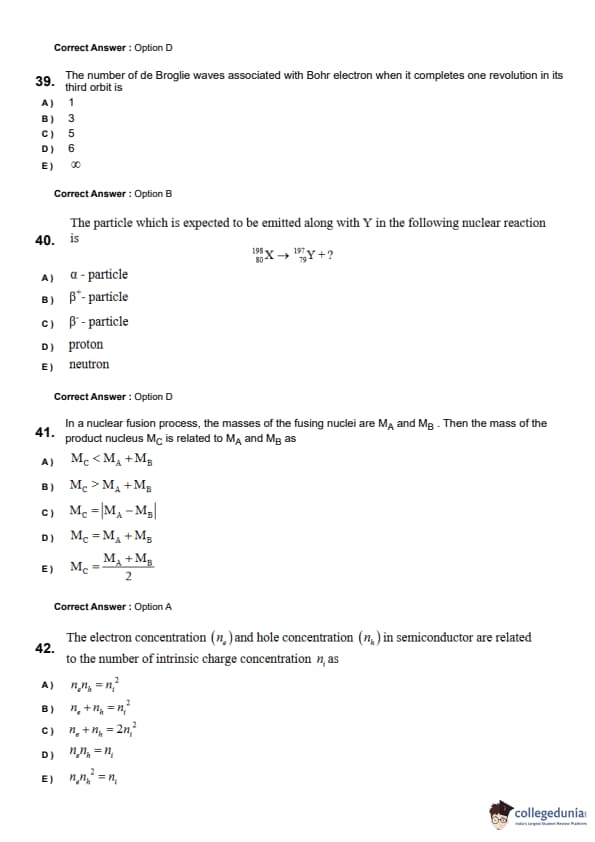
Question 39:

The number of de Broglie waves associated with Bohr electron when it completes one revolution in its third orbit is

  • (A) 1
  • (B) 3
  • (C) 5
  • (D) 6
  • (E) \( \infty \)
Correct Answer: (B) 3
View Solution

Question 40:

The particle which is expected to be emitted along with \( Y \) in the following nuclear reaction is \[ ^{198}_{80}X \rightarrow ^{197}_{79}Y + ? \]

  • (A) \( \alpha \)-particle
  • (B) \( \beta^+ \)-particle
  • (C) \( \beta^- \)-particle
  • (D) proton
  • (E) neutron
Correct Answer: (D) proton
View Solution

Question 41:

In a nuclear fusion process, the masses of the fusing nuclei are \( M_A \) and \( M_B \). Then the mass of the product nucleus \( M_C \) is related to \( M_A \) and \( M_B \) as

  • (A) \( M_C < M_A + M_B \)
  • (B) \( M_C > M_A + M_B \)
  • (C) \( M_C = |M_A - M_B| \)
  • (D) \( M_C = M_A + M_B \)
  • (E) \( M_C = \frac{M_A + M_B}{2} \)
Correct Answer: (A) \( M_C < M_A + M_B \)
View Solution

Question 42:

The electron concentration \( n_e \) and hole concentration \( n_h \) in semiconductor are related to the number of intrinsic charge concentration \( n_i \) as

  • (A) \( n_e n_h = n_i^2 \)
  • (B) \( n_e + n_h = n_i^2 \)
  • (C) \( n_e + n_h = 2n_i^2 \)
  • (D) \( n_e n_h = 2n_i \)
  • (E) \( n_e n_h^2 = n_i \)
Correct Answer: (A) \( n_e n_h = n_i^2 \)
View Solution

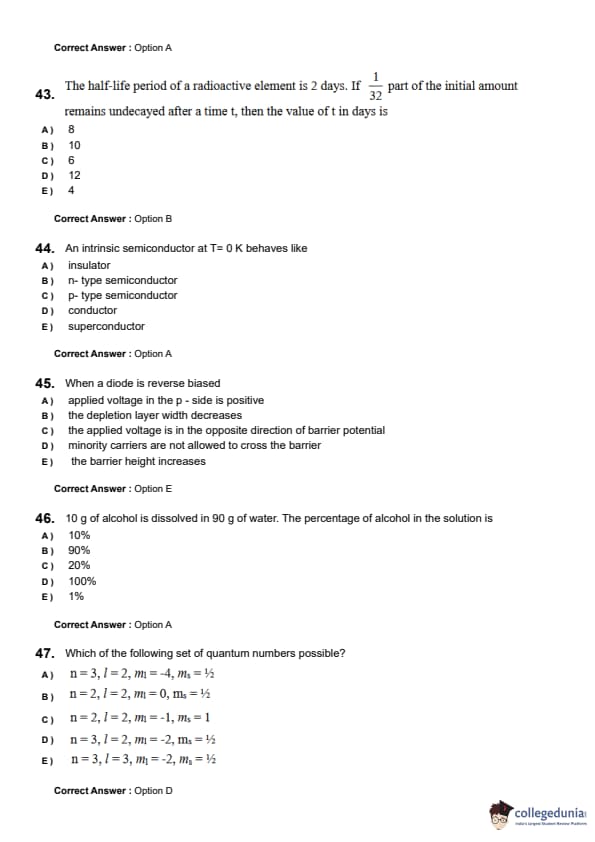
Question 43:

The half-life period of a radioactive element is 2 days. If \( \frac{1}{32} \) part of the initial amount remains undecayed after a time \( t \), then the value of \( t \) in days is

  • (A) 8
  • (B) 10
  • (C) 6
  • (D) 12
  • (E) 4
Correct Answer: (B) 10
View Solution

Question 44:

An intrinsic semiconductor at \( T = 0 \, K \) behaves like

  • (A) insulator
  • (B) n-type semiconductor
  • (C) p-type semiconductor
  • (D) conductor
  • (E) superconductor
Correct Answer: (A) insulator
View Solution

Question 45:

When a diode is reverse biased

  • (A) applied voltage in the p-side is positive
  • (B) the depletion layer width decreases
  • (C) the applied voltage is in the opposite direction of barrier potential
  • (D) minority carriers are not allowed to cross the barrier
  • (E) the barrier height increases
Correct Answer: (E) the barrier height increases
View Solution

Question 46:

10 g of alcohol is dissolved in 90 g of water. The percentage of alcohol in the solution is

  • (A) 10\(% \)
  • (B) 90\(% \)
  • (C) 20\(% \)
  • (D) 100\(% \)
  • (E) 1\(% \)
Correct Answer: (A) 10\(% \)
View Solution

Question 47:

Which of the following set of quantum numbers is possible?

  • (A) \( n = 3, l = 2, m_l = -4, m_s = \frac{1}{2} \)
  • (B) \( n = 2, l = 2, m_l = 0, m_s = \frac{1}{2} \)
  • (C) \( n = 2, l = 2, m_l = -1, m_s = 1 \)
  • (D) \( n = 3, l = 2, m_l = -2, m_s = \frac{1}{2} \)
  • (E) \( n = 3, l = 3, m_l = -2, m_s = \frac{1}{2} \)
Correct Answer: (D) \( n = 3, l = 2, m_l = -2, m_s = \frac{1}{2} \)
View Solution

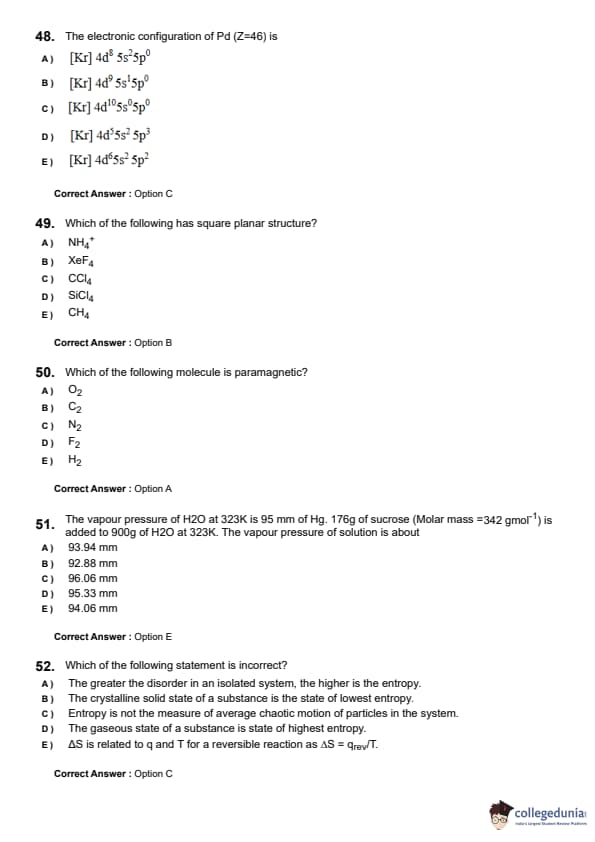
Question 48:

The electronic configuration of Pd (Z = 46) is

  • (A) [Kr] \( 4d^8 5s^2 5p^0 \)
  • (B) [Kr] \( 4d^9 5s^1 5p^0 \)
  • (C) [Kr] \( 4d^{10} 5s^0 5p^0 \)
  • (D) [Kr] \( 4d^5 5s^2 2p^3 \)
  • (E) [Kr] \( 4d^6 5s^2 5p^2 \)
Correct Answer: (C) [Kr] \( 4d^{10} 5s^0 5p^0 \)
View Solution

Question 49:

Which of the following has square planar structure?

  • (A) NH\(_4^+\)
  • (B) XeF\(_4\)
  • (C) CCl\(_4\)
  • (D) SiCl\(_4\)
  • (E) CH\(_4\)
Correct Answer: (B) XeF\(_4\)
View Solution

Question 50:

Which of the following molecule is paramagnetic?

  • (A) \( O_2 \)
  • (B) \( C_2 \)
  • (C) \( N_2 \)
  • (D) \( F_2 \)
  • (E) \( H_2 \)
Correct Answer: (A) \( O_2 \)
View Solution

Question 51:

The vapour pressure of H\(_2\)O at 323K is 95 mm of Hg. 176g of sucrose (Molar mass = 342 gmol\(^{-1}\)) is added to 900g of H\(_2\)O at 323K. The vapour pressure of solution is about

  • (A) 93.94 mm
  • (B) 92.88 mm
  • (C) 96.06 mm
  • (D) 95.33 mm
  • (E) 94.06 mm
Correct Answer: (E) 94.06 mm
View Solution

Question 52:

Which of the following statement is incorrect?

  • (A) The greater the disorder in an isolated system, the higher is the entropy.
  • (B) The crystalline solid state of a substance is the state of lowest entropy.
  • (C) Entropy is not the measure of average chaotic motion of particles in the system.
  • (D) The gaseous state of a substance is state of highest entropy.
  • (E) \( \Delta S \) is related to \( q \) and \( T \) for a reversible reaction as \( \Delta S = \frac{q_{rev}}{T} \)
Correct Answer: (C) Entropy is not the measure of average chaotic motion of particles in the system.
View Solution

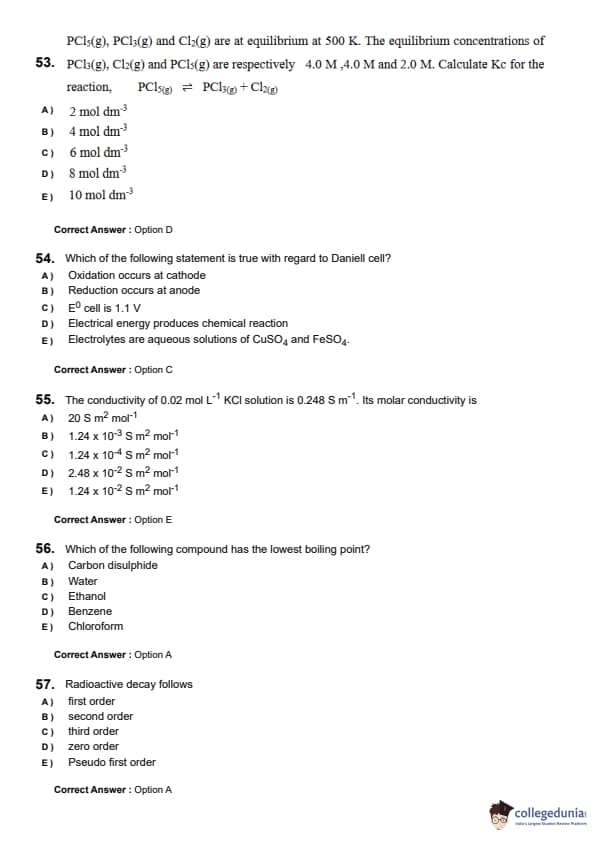
Question 53:

PCl\(_5\)(g), PCl\(_3\)(g) and Cl\(_2\)(g) are at equilibrium at 500 K. The equilibrium concentrations of PCl\(_3\), Cl\(_2\) and PCl\(_5\) are respectively 4.0 M, 4.0 M and 2.0 M. Calculate \( K_c \) for the reaction: \[ PCl_5(g) \rightleftharpoons PCl_3(g) + Cl_2(g) \]

  • (A) 2 mol dm\(^3\)
  • (B) 4 mol dm\(^3\)
  • (C) 6 mol dm\(^3\)
  • (D) 8 mol dm\(^3\)
  • (E) 10 mol dm\(^3\)
Correct Answer: (D) 8 mol dm\(^3\)
View Solution

Question 54:

Which of the following statement is true with regard to Daniell cell?

  • (A) Oxidation occurs at cathode
  • (B) Reduction occurs at anode
  • (C) \( E^\circ_{cell} \) is 1.1 V
  • (D) Electrical energy produces chemical reaction
  • (E) Electrolytes are aqueous solutions of CuSO\(_4\) and FeSO\(_4\).
Correct Answer: (C) \( E^\circ_{\text{cell}} \) is 1.1 V
View Solution

Question 55:

The conductivity of 0.02 mol L\(^{-1}\) KCl solution is 0.248 S m\(^{-1}\). Its molar conductivity is

  • (A) 20 S m\(^2\) mol\(^{-1}\)
  • (B) \( 1.24 \times 10^{-3} \) S m\(^2\) mol\(^{-1}\)
  • (C) \( 1.24 \times 10^{-4} \) S m\(^2\) mol\(^{-1}\)
  • (D) \( 2.48 \times 10^{-2} \) S m\(^2\) mol\(^{-1}\)
  • (E) \( 1.24 \times 10^{-2} \) S m\(^2\) mol\(^{-1}\)
Correct Answer: (E) \( 1.24 \times 10^{-2} \) S m\(^2\) mol\(^{-1}\)
View Solution

Question 56:

Which of the following compound has the lowest boiling point?

  • (A) Carbon disulfide
  • (B) Water
  • (C) Ethanol
  • (D) Benzene
  • (E) Chloroform
Correct Answer: (A) Carbon disulfide
View Solution

Question 57:

Radioactive decay follows

  • (A) first order
  • (B) second order
  • (C) third order
  • (D) zero order
  • (E) Pseudo first order
Correct Answer: (A) first order
View Solution

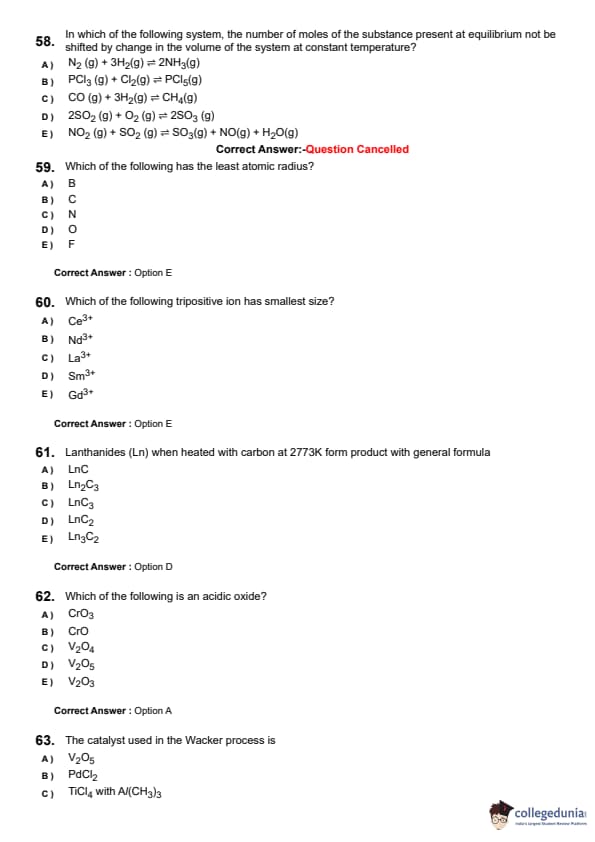
Question 58:

In which of the following system, the number of moles of the substance present at equilibrium not be shifted by change in the volume of the system at constant temperature?

  • (A) \( N_2(g) + 3H_2(g) \rightleftharpoons 2NH_3(g) \)
  • (B) \( PCl_3(g) + Cl_2(g) \rightleftharpoons PCl_5(g) \)
  • (C) \( CO(g) + 3H_2(g) \rightleftharpoons CH_4(g) \)
  • (D) \( 2SO_2(g) + O_2(g) \rightleftharpoons 2SO_3(g) \)
  • (E) \( NO_2(g) + SO_2(g) \rightleftharpoons SO_3(g) + NO(g) + H_2O(g) \)
Correct Answer: Question Cancelled
View Solution

Question 59:

Which of the following has the least atomic radius?

  • (A) B
  • (B) C
  • (C) N
  • (D) O
  • (E) F
Correct Answer: (E) F
View Solution

Question 60:

Which of the following tripositive ion has smallest size?

  • (A) Ce\(^{3+}\)
  • (B) Nd\(^{3+}\)
  • (C) La\(^{3+}\)
  • (D) Sm\(^{3+}\)
  • (E) Gd\(^{3+}\)
Correct Answer: (E) Gd\(^{3+}\)
View Solution

Question 61:

Lanthanides (Ln) when heated with carbon at 2773K form product with general formula

  • (A) \( LnC \)
  • (B) \( Ln_2C_3 \)
  • (C) \( LnC_3 \)
  • (D) \( LnC_2 \)
  • (E) \( Ln_3C_2 \)
Correct Answer: (D) \( \text{LnC}_2 \)
View Solution

Question 62:

Which of the following is an acidic oxide?

  • (A) CrO\(_3\)
  • (B) CrO
  • (C) V\(_2\)O\(_4\)
  • (D) V\(_2\)O\(_5\)
  • (E) V\(_2\)O\(_3\)
Correct Answer: (A) CrO\(_3\)
View Solution

Question 63:

The catalyst used in the Wacker process is

  • (A) V\(_2\)O\(_5\)
  • (B) PdCl\(_2\)
  • (C) TiCl\(_4\) with Al(CH\(_3\))\(_3\)
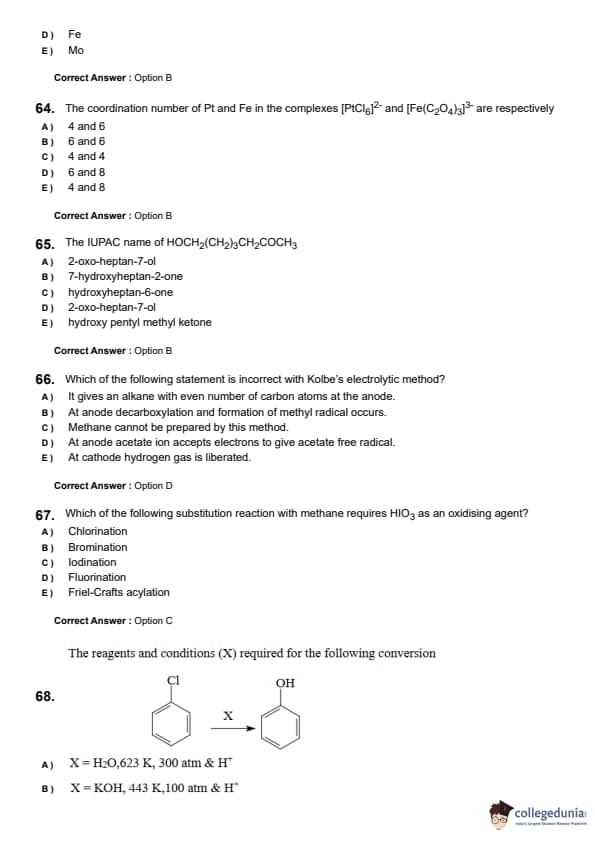
  • (D) Fe
  • (E) Mo
Correct Answer: (B) PdCl\(_2\)
View Solution

Question 64:

The coordination number of Pt and Fe in the complexes [PtCl\(_6\)]\(^{2-}\) and [Fe(C\(_2\)O\(_4\))\(_3\)]\(^{3-}\) are respectively

  • (A) 4 and 6
  • (B) 6 and 6
  • (C) 4 and 4
  • (D) 6 and 8
  • (E) 4 and 8
Correct Answer: (B) 6 and 6
View Solution

Question 65:

The IUPAC name of HOCH\(_2\)(CH\(_2\))\(_3\)CH\(_2\)COCH\(_3\) is

  • (A) 2-oxo-heptan-7-ol
  • (B) 7-hydroxyheptan-2-one
  • (C) hydroxyheptan-6-one
  • (D) 2-oxo-heptan-7-ol
  • (E) hydroxy pentyl methyl ketone
Correct Answer: (B) 7-hydroxyheptan-2-one
View Solution

Question 66:

Which of the following statement is incorrect with Kolbe’s electrolytic method?

  • (A) It gives an alkane with even number of carbon atoms at the anode.
  • (B) At anode decarboxylation and formation of methyl radical occurs.
  • (C) Methane cannot be prepared by this method.
  • (D) At anode acetate ion accepts electrons to give acetate free radical.
  • (E) At cathode hydrogen gas is liberated.
Correct Answer: (D) At anode acetate ion accepts electrons to give acetate free radical.
View Solution

Question 67:

Which of the following substitution reaction with methane requires HIO\(_3\) as an oxidising agent?

  • (A) Chlorination
  • (B) Bromination
  • (C) Iodination
  • (D) Fluorination
  • (E) Friel-Crafts acylation
Correct Answer: (C) Iodination
View Solution

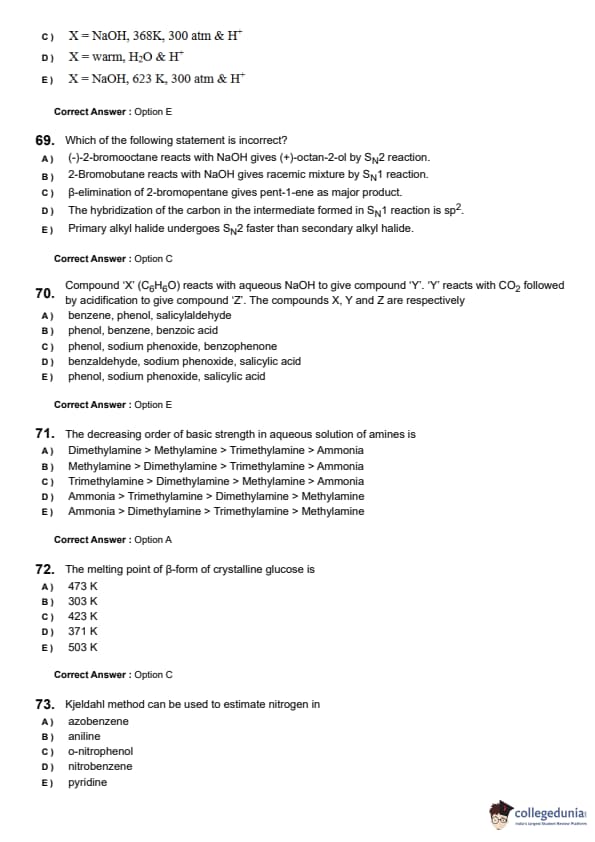
Question 68:

The reagents and conditions (X) required for the following conversion

  • (A) \( X = H_2O, 623 K, 300 atm \& H^+ \)
  • (B) \( X = KOH, 443 K, 100 atm \& H^+ \)
  • (C) \( X = NaOH, 368 K, 300 atm \& H^+ \)
  • (D) \( X = warm, H_2O \& H^+ \)
  • (E) \( X = NaOH, 623 K, 300 atm \& H^+ \)
Correct Answer: (E) \( X = \text{NaOH}, 623 \text{K}, 300 \text{atm} \& \text{H}^+ \)
View Solution

Question 69:

Which of the following statement is incorrect?

  • (A) \( (-) \)-2-bromooctane reacts with NaOH gives (+)-octan-2-ol by \( S_N2 \) reaction.
  • (B) 2-Bromobutane reacts with NaOH gives racemic mixture by \( S_N1 \) reaction.
  • (C) \( \beta \)-elimination of 2-bromopentane gives pent-1-ene as major product.
  • (D) The hybridization of the carbon in the intermediate formed in \( S_N1 \) reaction is sp\(^2\).
  • (E) Primary alkyl halide undergoes \( S_N2 \) faster than secondary alkyl halide.
Correct Answer: (C) \( \beta \)-elimination of 2-bromopentane gives pent-1-ene as major product.
View Solution

Question 70:

Compound ‘X’ (C\(_6\)H\(_6\)O) reacts with aqueous NaOH to give compound ‘Y’. ‘Y’ reacts with CO\(_2\) followed by acidification to give compound ‘Z’. The compounds X, Y and Z are respectively

  • (A) benzene, phenol, salicylaldehyde
  • (B) phenol, benzene, benzoquinone
  • (C) phenol, sodium phenoxide, benzoquinone
  • (D) benzaldehyde, sodium phenoxide, salicylic acid
  • (E) phenol, sodium phenoxide, salicylic acid
Correct Answer: (E) phenol, sodium phenoxide, salicylic acid
View Solution

Question 71:

The decreasing order of basic strength in aqueous solution of amines is

  • (A) Dimethylamine \( > \) Methylamine \( > \) Trimethylamine \( > \) Ammonia
  • (B) Methylamine \( > \) Dimethylamine \( > \) Trimethylamine \( > \) Ammonia
  • (C) Trimethylamine \( > \) Dimethylamine \( > \) Methylamine \( > \) Ammonia
  • (D) Ammonia \( > \) Trimethylamine \( > \) Dimethylamine \( > \) Methylamine
  • (E) Ammonia \( > \) Dimethylamine \( > \) Trimethylamine \( > \) Methylamine
Correct Answer: (A) Dimethylamine \( > \) Methylamine \( > \) Trimethylamine \( > \) Ammonia
View Solution

Question 72:

The melting point of \( \beta \)-form of crystalline glucose is

  • (A) 473 K
  • (B) 303 K
  • (C) 423 K
  • (D) 371 K
  • (E) 503 K
Correct Answer: (C) 423 K
View Solution

Question 73:

Kjeldahl method can be used to estimate nitrogen in

  • (A) azobenzene
  • (B) aniline
  • (C) o-nitrophenol
  • (D) nitrobenzene
  • (E) pyridine
Correct Answer: (B) aniline
View Solution

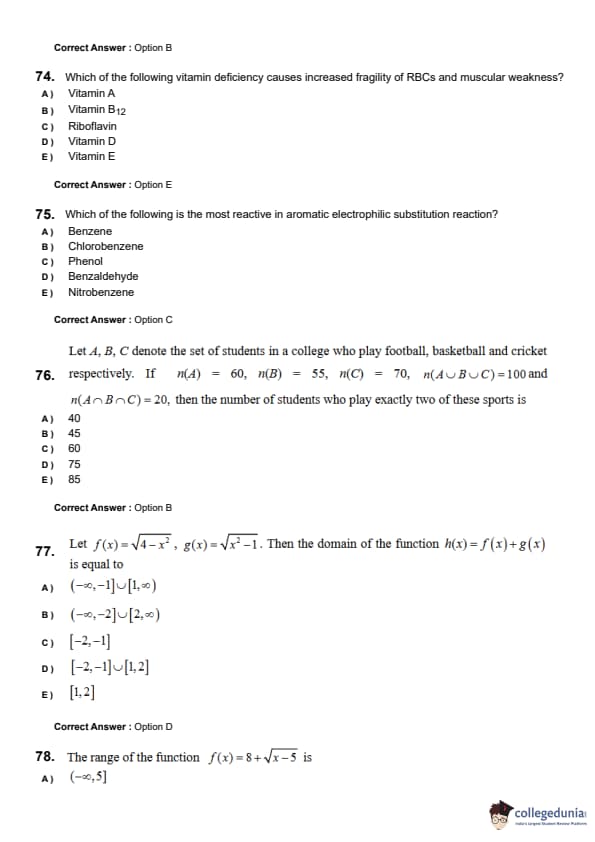
Question 74:

Which of the following vitamin deficiency causes increased fragility of RBCs and muscular weakness?

  • (A) Vitamin A
  • (B) Vitamin B12
  • (C) Riboflavin
  • (D) Vitamin D
  • (E) Vitamin E
Correct Answer: (E) Vitamin E
View Solution

Question 75:

Which of the following is the most reactive in aromatic electrophilic substitution reaction?

  • (A) Benzene
  • (B) Chlorobenzene
  • (C) Phenol
  • (D) Benzaldehyde
  • (E) Nitrobenzene
Correct Answer: (C) Phenol
View Solution

Question 76:

Let A, B, C denote the set of students in a college who play football, basketball, and cricket respectively. If \( n(A) = 60 \), \( n(B) = 55 \), \( n(C) = 70 \), \( n(A \cup B \cup C) = 100 \) and \( n(A \cap B \cap C) = 20 \), then the number of students who play exactly two of these sports is

  • (A) 40
  • (B) 45
  • (C) 60
  • (D) 75
  • (E) 85
Correct Answer: (B) 45
View Solution

Question 77:

Let \( f(x) = \sqrt{4 - x^2} \), \( g(x) = \sqrt{x^2 - 1} \). Then the domain of the function \( h(x) = f(x) + g(x) \) is equal to

  • (A) \( (-\infty, -1] \cup [1, \infty) \)
  • (B) \( (-\infty, -2] \cup [2, \infty) \)
  • (C) \( [-2, -1] \cup [1, 2] \)
  • (D) \( [-2, 1] \cup [1, 2] \)
  • (E) \( [1, 2] \)
Correct Answer: (D) \( [-2, 1] \cup [1, 2] \)
View Solution

Question 78:

The range of the function \( f(x) = 8 + \sqrt{x - 5} \) is

  • (A) \( (-\infty, 5] \)
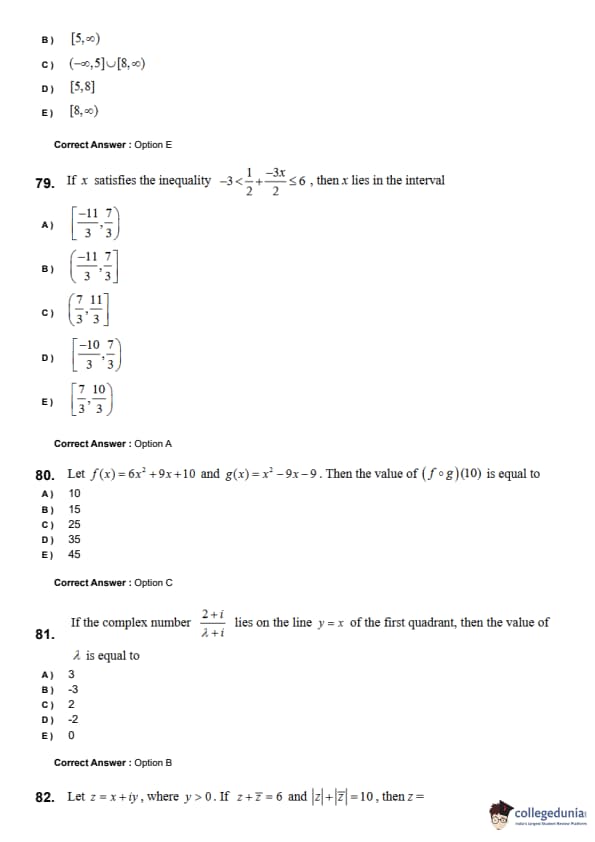
  • (B) \( [5, \infty) \)
  • (C) \( (-\infty, 5] \cup [8, \infty) \)
  • (D) \( [5, 8] \)
  • (E) \( [8, \infty) \)
Correct Answer: (E) \( [8, \infty) \)
View Solution

Question 79:

If \( x \) satisfies the inequality \( -3 < \frac{1}{2} + \frac{-3x}{2} \leq 6 \), then \( x \) lies in the interval

  • (A)
  • (B)
  • (C) \( \left[ \frac{7}{3}, \frac{11}{3} \right] \)
  • (D) \( \left[ \frac{-10}{3}, \frac{7}{3} \right] \)
  • (E) \( \left[ \frac{7}{3}, \frac{10}{3} \right] \)
Correct Answer: (A) \( \left[ \frac{-11}{3}, \frac{7}{3} \right] \)
View Solution
Question 80:

Let \( f(x) = 6x^2 + 9x + 10 \) and \( g(x) = x^2 - 9x - 9 \). Then the value of \( (f \circ g)(10) \) is

  • (A) 10
  • (B) 15
  • (C) 25
  • (D) 35
  • (E) 45
Correct Answer: (C) 25
View Solution
Question 81:

If the complex number \( \frac{2 + i}{\lambda + i} \) lies on the line \( y = x \) of the first quadrant, then the value of \( \lambda \) is equal to

  • (A) 3
  • (B) -3
  • (C) 2
  • (D) -2
  • (E) 0
Correct Answer: (B) -3
View Solution
Question 82:

Let \( z = x + iy \), where \( y > 0 \). If \( z + \overline{z} = 6 \) and \( |z| + | \overline{z} | = 10 \), then \( z = \)

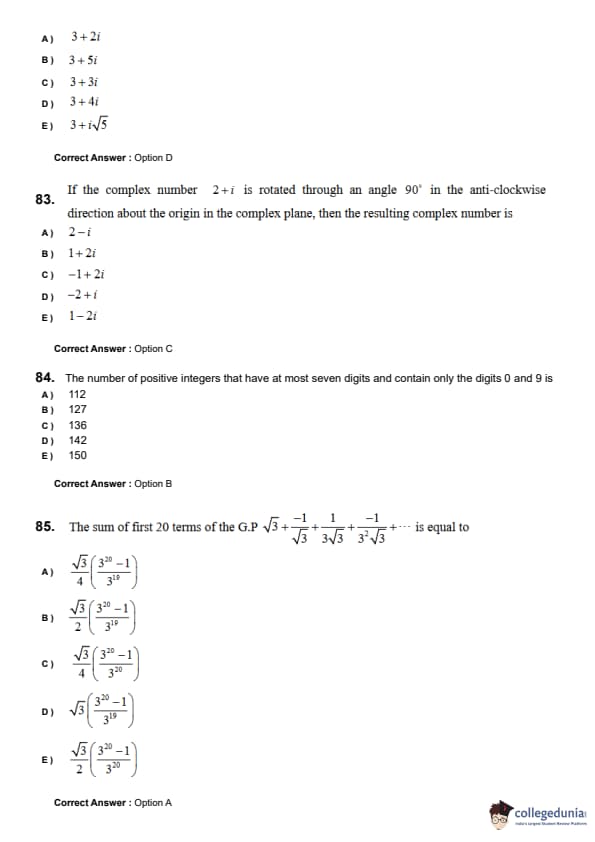
  • (A) \( 3 + 2i \)
  • (B) \( 3 + 5i \)
  • (C) \( 3 + 3i \)
  • (D) \( 3 + 4i \)
  • (E) \( 3 + i\sqrt{5} \)
Correct Answer: (D) \( 3 + 4i \)
View Solution
Question 83:

If the complex number \( 2 + i \) is rotated through an angle \( 90^\circ \) in the anti-clockwise direction about the origin in the complex plane, then the resulting complex number is

  • (A) \( 2 - i \)
  • (B) \( 1 + 2i \)
  • (C) \( -1 + 2i \)
  • (D) \( -2 + i \)
  • (E) \( 1 - 2i \)
Correct Answer: (C) \( -1 + 2i \)
View Solution
Question 84:

The number of positive integers that have at most seven digits and contain only the digits 0 and 9 is

  • (A) 112
  • (B) 127
  • (C) 136
  • (D) 142
  • (E) 150
Correct Answer: (B) 127
View Solution
Question 85:

The sum of the first 20 terms of the G.P. \( \sqrt{3} + \frac{-1}{\sqrt{3}} + \frac{1}{3\sqrt{3}} + \cdots \) is equal to

  • (A) \( \frac{\sqrt{3}(3^{20} - 1)}{4 \cdot 3^{19}} \)
  • (B) \( \frac{\sqrt{3}(3^{20} - 1)}{2 \cdot 3^{19}} \)
  • (C) \( \frac{\sqrt{3}(3^{20} - 1)}{3^{20}} \)
  • (D) \( \frac{\sqrt{3}(3^{20} - 1)}{3^{20}} \)
  • (E) \( \frac{\sqrt{3}(3^{20} - 1)}{2 \cdot 3^{20}} \)
Correct Answer: (A) \( \frac{\sqrt{3}(3^{20} - 1)}{4 \cdot 3^{19}} \)
View Solution
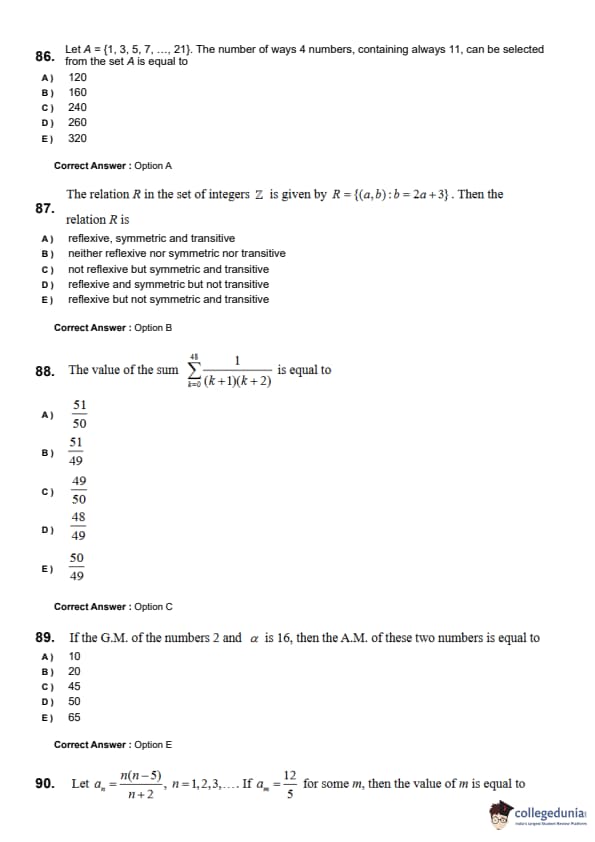
Question 86:

Let \( A = \{ 1, 3, 5, 7, \dots, 21 \} \). The number of ways 4 numbers, containing always 11, can be selected from the set A is equal to

  • (A) 120
  • (B) 160
  • (C) 240
  • (D) 260
  • (E) 320
Correct Answer: (A) 120
View Solution
Question 87:

The relation \( R \) in the set of integers \( \mathbb{Z} \) is given by \( R = \{(a, b) : b = 2a + 3\} \). Then the relation \( R \) is

  • (A) reflexive, symmetric and transitive
  • (B) neither reflexive nor symmetric nor transitive
  • (C) not reflexive but symmetric and transitive
  • (D) reflexive and symmetric but not transitive
  • (E) reflexive but not symmetric and transitive
Correct Answer: (B) neither reflexive nor symmetric nor transitive
View Solution
Question 88:

The value of the sum \[ \sum_{k=0}^{48} \frac{1}{(k + 1)(k + 2)} \]
is equal to

  • (A) \( \frac{51}{50} \)
  • (B) \( \frac{51}{49} \)
  • (C) \( \frac{49}{50} \)
  • (D) \( \frac{48}{49} \)
  • (E) \( \frac{50}{49} \)
Correct Answer: (C) \( \frac{49}{50} \)
View Solution
Question 89:
If the G.M. of the numbers 2 and \( \alpha \) is 16, then the A.M. of these two numbers is equal to

  • (A) 10
  • (B) 20
  • (C) 45
  • (D) 50
  • (E) 65
Correct Answer: Option E
View Solution
Question 90:
Let \[ a_n = \frac{n(n - 5)}{n + 2}, \quad n = 1,2,3, \dots \]
If \( a_m = \frac{12}{5} \) for some \( m \), then the value of \( m \) is equal to

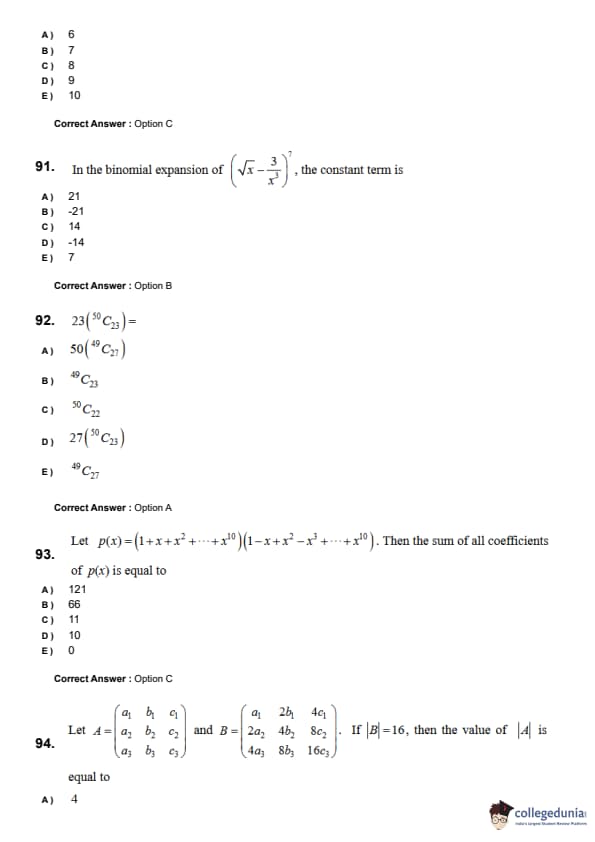
  • (A) 6
  • (B) 7
  • (C) 8
  • (D) 9
  • (E) 10
Correct Answer: Option C
View Solution

Question 91:

In the binomial expansion of \[ \left( \sqrt{x} - \frac{3}{x^3} \right)^7 \]
the constant term is :

  • (A) 21
  • (B) -21
  • (C) 14
  • (D) -14
  • (E) 7
Correct Answer: Option B
View Solution

Question 92:

\[ 23 \binom{50}{23} = \]

  • (A) \quad 50 \( \binom{49}{27}\)
  • (B) \quad 49 \( \binom{23}{23}\)
  • (C) \quad 50 \( \binom{22}{22}\)
  • (D) \quad 27 \( \binom{50}{23}\)
  • (E) \quad 49 \( \binom{27}{27}\)
Correct Answer: Option A
View Solution

Question 93:

Let \[ p(x) = (1 + x + x^2 + \dots + x^{10}) (1 - x + x^2 - x^3 + \dots + x^{10}) \]
Then the sum of all coefficients of \( p(x) \) is equal to

  • (A) 121
  • (B) 66
  • (C) 11
  • (D) 10
  • (E) 0
Correct Answer: Option C
View Solution

Question 94:

Let \[ A = \begin{bmatrix} a_1 & b_1 & c_1
a_2 & b_2 & c_2
a_3 & b_3 & c_3 \end{bmatrix} \quad and \quad B = \begin{bmatrix} a_1 & 2b_1 & 4c_1
2a_2 & 4b_2 & 8c_2
4a_3 & 8b_3 & 16c_3 \end{bmatrix} \]
If \( |B| = 16 \), then the value of \( |A| \) is equal to

  • (A) 4
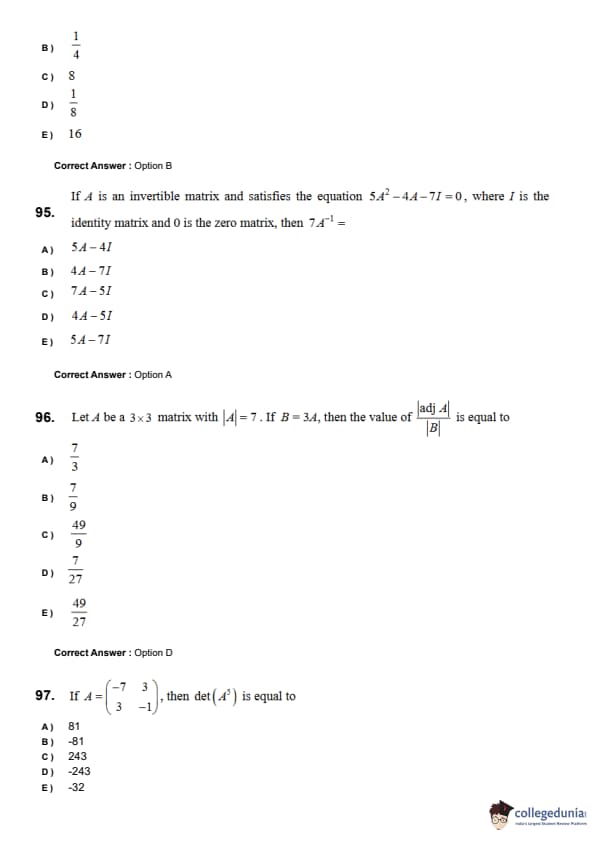
  • (B) \(\frac{1}{4}\)
  • (C) 8
  • (D) \(\frac{1}{8}\)
  • (E) 16
Correct Answer: Option B
View Solution

Question 95:

If \( A \) is an invertible matrix and satisfies the equation
\[ 5A^2 - 4A - 7I = 0 \]

where \( I \) is the identity matrix and 0 is the zero matrix, then
\[ 7 A^{-1} = \]

  • (A) \( 5A - 4I \)
  • (B) \( 4A - 7I \)
  • (C) \( 7A - 5I \)
  • (D) \( 4A - 5I \)
  • (E) \( 5A - 7I \)
Correct Answer: Option A
View Solution

Question 96:

Let \( A \) be a \( 3 \times 3 \) matrix with \( |A| = 7 \). If \( B = 3A \), then the value of
\[ \left| \frac{adj A}{B} \right| \]

is equal to

  • (A) \( \frac{7}{3} \)
  • (B) \( \frac{7}{9} \)
  • (C) \( \frac{49}{9} \)
  • (D) \( \frac{7}{27} \)
  • (E) \( \frac{49}{27} \)
Correct Answer: (D) \( \frac{7}{27} \)
View Solution

Question 97:

If \[ A = \begin{bmatrix} -7 & 3
3 & -1 \end{bmatrix} \]

then \( \det(A^5) \) is equal to

  • (A) \( 81 \)
  • (B) \( -81 \)
  • (C) \( 243 \)
  • (D) \( -243 \)
  • (E) \( -32 \)
Correct Answer: (E) \( -32 \)
View Solution

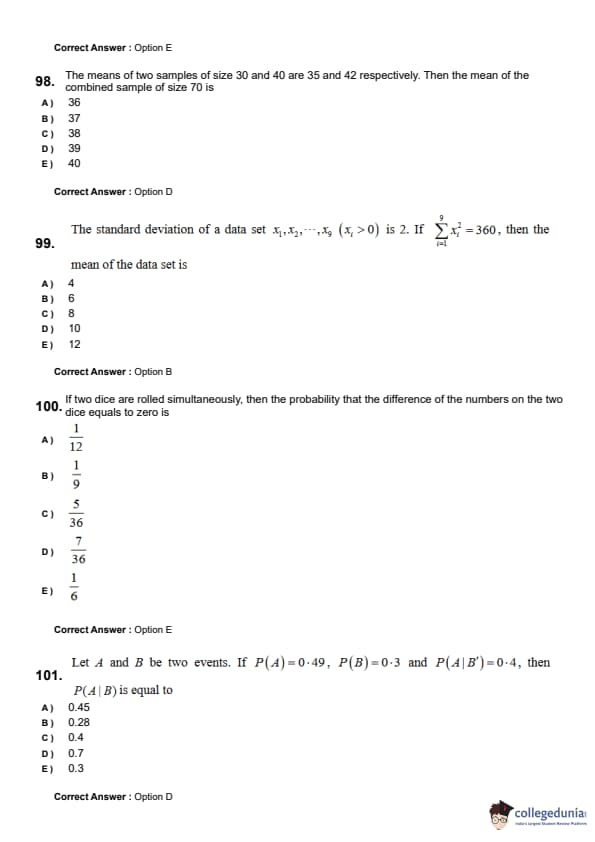
Question 98:

The means of two samples of size 30 and 40 are 35 and 42 respectively. Then the mean of the combined sample of size 70 is

  • (A) \( 36 \)
  • (B) \( 37 \)
  • (C) \( 38 \)
  • (D) \( 39 \)
  • (E) \( 40 \)
Correct Answer: (D) \( 39 \)
View Solution

Question 99:

The standard deviation of a data set \( x_1, x_2, \dots, x_6 \) (\( x_i > 0 \)) is 2. If
\[ \sum_{i=1}^{9} x_i^2 = 360, \]

then the mean of the data set is

  • (A) \( 4 \)
  • (B) \( 6 \)
  • (C) \( 8 \)
  • (D) \( 10 \)
  • (E) \( 12 \)
Correct Answer: (B) \( 6 \)
View Solution

Question 100:

If two dice are rolled simultaneously, then the probability that the difference of the numbers on the two dice equals to zero is

  • (A) \( \frac{1}{12} \)
  • (B) \( \frac{1}{9} \)
  • (C) \( \frac{5}{36} \)
  • (D) \( \frac{7}{36} \)
  • (E) \( \frac{1}{6} \)
Correct Answer: (E) \( \frac{1}{6} \)
View Solution

Question 101:

Let \( A \) and \( B \) be two events. If \( P(A) = 0.49 \), \( P(B) = 0.3 \) and \( P(A | B^c) = 0.4 \), then \( P(A | B) \) is equal to

  • (A) \( 0.45 \)
  • (B) \( 0.28 \)
  • (C) \( 0.4 \)
  • (D) \( 0.7 \)
  • (E) \( 0.3 \)
Correct Answer: (D) \( 0.7 \)
View Solution

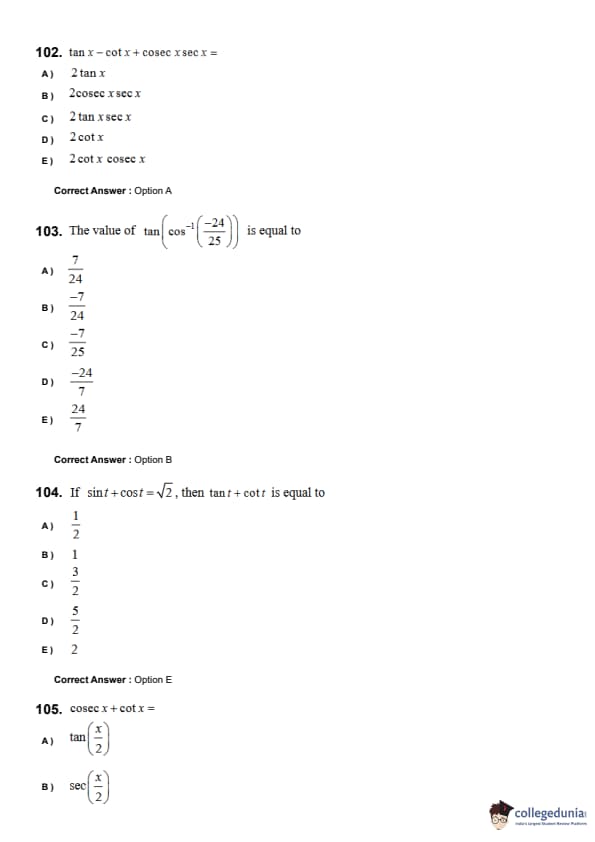
Question 102:

Simplify: \( \tan x - \cot x + \csc x \sec x \)

  • (A) \( 2 \tan x \)
  • (B) \( 2 \csc x \sec x \)
  • (C) \( 2 \tan x \sec x \)
  • (D) \( 2 \cot x \)
  • (E) \( 2 \cot x \csc x \)
Correct Answer: (A) \( 2 \tan x \)
View Solution

Question 103:

The value of \( \tan \left( \cos^{-1} \left( \frac{-24}{25} \right) \right) \) is equal to

  • (A) \( \frac{7}{24} \)
  • (B) \( \frac{-7}{24} \)
  • (C) \( \frac{-7}{25} \)
  • (D) \( \frac{-24}{7} \)
  • (E) \( \frac{24}{7} \)
Correct Answer: (B) \( \frac{-7}{24} \)
View Solution

Question 104:

If \( \sin t + \cos t = \sqrt{2} \), then \( \tan t + \cot t \) is equal to

  • (A) \( \frac{1}{2} \)
  • (B) \( 1 \)
  • (C) \( \frac{3}{2} \)
  • (D) \( \frac{5}{2} \)
  • (E) \( 2 \)
Correct Answer: (E) \( 2 \)
View Solution

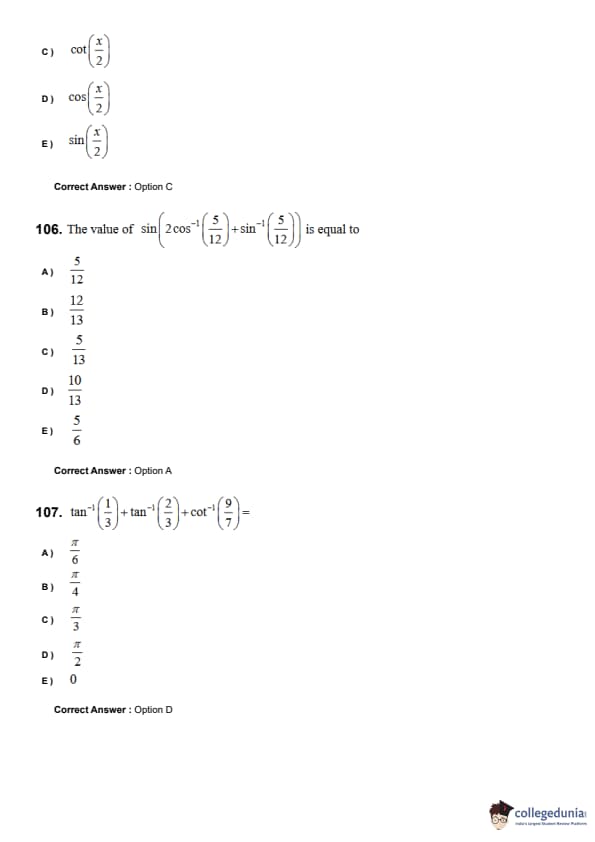
Question 105:

The value of \( \csc x + \cot x \) is

  • (A) \( \tan \left( \frac{x}{2} \right) \)
  • (B) \( \sec \left( \frac{x}{2} \right) \)
  • (C) \( \cot \left( \frac{x}{2} \right) \)
  • (D) \( \cos \left( \frac{x}{2} \right) \)
  • (E) \( \sin \left( \frac{x}{2} \right) \)
Correct Answer: (C) \( \cot \left( \frac{x}{2} \right) \)
View Solution

Question 106:

The value of \( \sin \left( 2 \cos^{-1} \left( \frac{5}{12} \right) + \sin^{-1} \left( \frac{5}{12} \right) \right) \) is equal to

  • (A) \( \frac{5}{12} \)
  • (B) \( \frac{12}{13} \)
  • (C) \( \frac{5}{13} \)
  • (D) \( \frac{10}{13} \)
  • (E) \( \frac{5}{6} \)
Correct Answer: (A) \( \frac{5}{12} \)
View Solution

Question 107:

The value of \[ \tan^{-1} \left( \frac{1}{3} \right) + \tan^{-1} \left( \frac{2}{3} \right) + \cot^{-1} \left( \frac{9}{7} \right) \]
is equal to

  • (A) \( \frac{\pi}{6} \)
  • (B) \( \frac{\pi}{4} \)
  • (C) \( \frac{\pi}{3} \)
  • (D) \( \frac{\pi}{2} \)
  • (E) \( 0 \)
Correct Answer: (D) \( \frac{\pi}{2} \)
View Solution

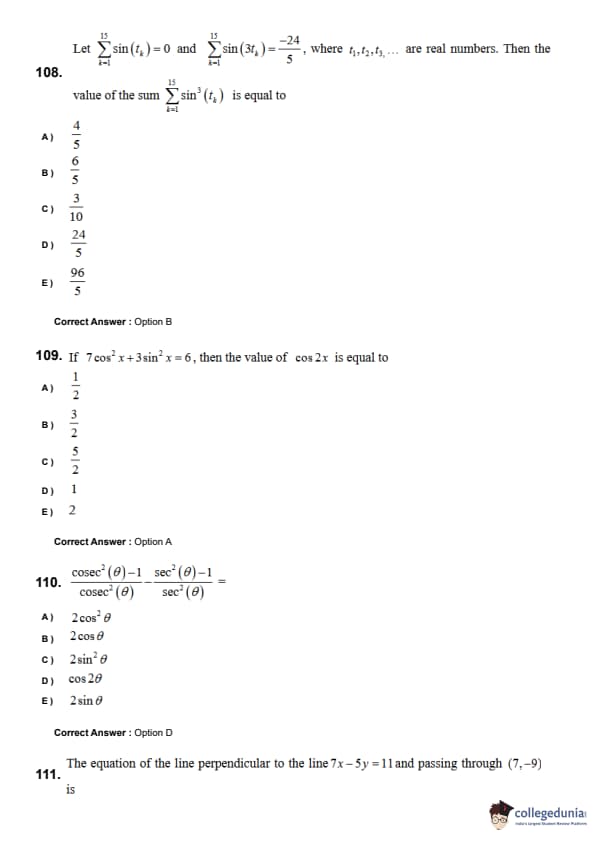
Question 108:

Let \[ \sum_{k=1}^{15} \sin (t_k) = 0 \quad and \quad \sum_{k=1}^{15} \sin (3t_k) = \frac{-24}{5}, \]
where \( t_1, t_2, t_3, \dots \) are real numbers. Then the value of the sum \[ \sum_{k=1}^{15} \sin^3 (t_k) \]
is equal to

  • (A) \( \frac{4}{5} \)
  • (B) \( \frac{6}{5} \)
  • (C) \( \frac{3}{10} \)
  • (D) \( \frac{24}{5} \)
  • (E) \( \frac{96}{5} \)
Correct Answer: (B) \( \frac{6}{5} \)
View Solution

Question 109:

If \[ 7 \cos^2 x + 3 \sin^2 x = 6, \]
then the value of \( \cos 2x \) is equal to

  • (A) \( \frac{1}{2} \)
  • (B) \( \frac{3}{2} \)
  • (C) \( \frac{5}{2} \)
  • (D) \( 1 \)
  • (E) \( 2 \)
Correct Answer: (A) \( \frac{1}{2} \)
View Solution

Question 110:

Evaluate \[ \frac{\csc^2(\theta) - 1}{\csc^2(\theta)} - \frac{\sec^2(\theta) - 1}{\sec^2(\theta)} \]

  • (A) \( 2 \cos^2 \theta \)
  • (B) \( 2 \cos \theta \)
  • (C) \( 2 \sin^2 \theta \)
  • (D) \( \cos 2\theta \)
  • (E) \( 2 \sin \theta \)
Correct Answer: (D) \( \cos 2\theta \)
View Solution

Question 111:

Find the equation of the line perpendicular to the line \[ 7x - 5y = 11 \]
and passing through the point \( (7, -9) \).

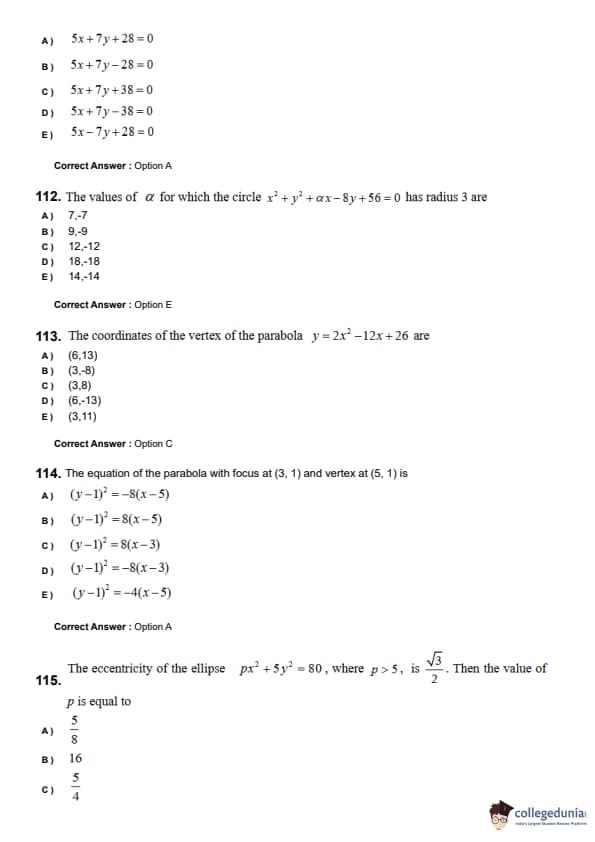
  • (A) \( 5x + 7y + 28 = 0 \)
  • (B) \( 5x + 7y - 28 = 0 \)
  • (C) \( 5x + 7y + 38 = 0 \)
  • (D) \( 5x + 7y - 38 = 0 \)
  • (E) \( 5x - 7y + 28 = 0 \)
Correct Answer: (A) \( 5x + 7y + 28 = 0 \)
View Solution

Question 112:

Find the values of \( \alpha \) for which the circle \[ x^2 + y^2 + \alpha x - 8y + 56 = 0 \]
has radius 3.

  • (A) \( 7, -7 \)
  • (B) \( 9, -9 \)
  • (C) \( 12, -12 \)
  • (D) \( 18, -18 \)
  • (E) \( 14, -14 \)
Correct Answer: (E) \( 14, -14 \)
View Solution

Question 113:

The coordinates of the vertex of the parabola \[ y = 2x^2 - 12x + 26 \]
are

  • (A) \( (6,13) \)
  • (B) \( (3,-8) \)
  • (C) \( (3,8) \)
  • (D) \( (6,-13) \)
  • (E) \( (3,11) \)
Correct Answer: (C) \( (3,8) \)
View Solution

Question 114:

Find the equation of the parabola with focus at \( (3,1) \) and vertex at \( (5,1) \).

  • (A) \( (y - 1)^2 = -8(x - 5) \)
  • (B) \( (y - 1)^2 = 8(x - 5) \)
  • (C) \( (y - 1)^2 = 8(x - 3) \)
  • (D) \( (y - 1)^2 = -8(x - 3) \)
  • (E) \( (y - 1)^2 = -4(x - 5) \)
Correct Answer: (A) \( (y - 1)^2 = -8(x - 5) \)
View Solution

Question 115:

The eccentricity of the ellipse \[ p x^2 + 5y^2 = 80, \quad where p > 5, \]
is \( \frac{\sqrt{3}}{2} \). Then the value of \( p \) is

  • (A) \( \frac{5}{8} \)
  • (B) \( 16 \)
  • (C) \( \frac{5}{4} \)
  • (D) \( 20 \)
  • (E) \( 25 \)
Correct Answer: (D) \( 20 \)
View Solution

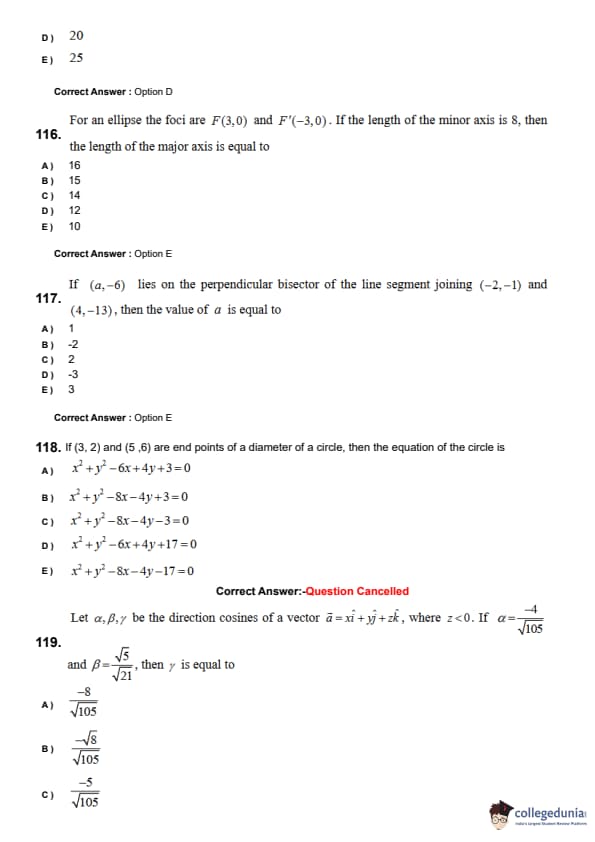
Question 116:

For an ellipse, the foci are \( F(3,0) \) and \( F'(-3,0) \). If the length of the minor axis is 8, then the length of the major axis is equal to

  • (A) \( 16 \)
  • (B) \( 15 \)
  • (C) \( 14 \)
  • (D) \( 12 \)
  • (E) \( 10 \)
Correct Answer: (E) \( 10 \)
View Solution

Question 117:

If \( (a,-6) \) lies on the perpendicular bisector of the line segment joining \( (-2,-1) \) and \( (4,-13) \), then the value of \( a \) is equal to

  • (A) \( 1 \)
  • (B) \( -2 \)
  • (C) \( 2 \)
  • (D) \( -3 \)
  • (E) \( 3 \)
Correct Answer: (E) \( 3 \)
View Solution

Question 118:

If \( (3,2) \) and \( (5,6) \) are end points of a diameter of a circle, then the equation of the circle is

  • (A) \( x^2 + y^2 - 6x + 4y + 3 = 0 \)
  • (B) \( x^2 + y^2 - 8x - 4y + 3 = 0 \)
  • (C) \( x^2 + y^2 - 8x - 4y - 3 = 0 \)
  • (D) \( x^2 + y^2 - 6x + 4y + 17 = 0 \)
  • (E) \( x^2 + y^2 - 8x - 4y - 17 = 0 \)
Correct Answer: \textcolor{red}{\textbf{Question Cancelled}}
View Solution

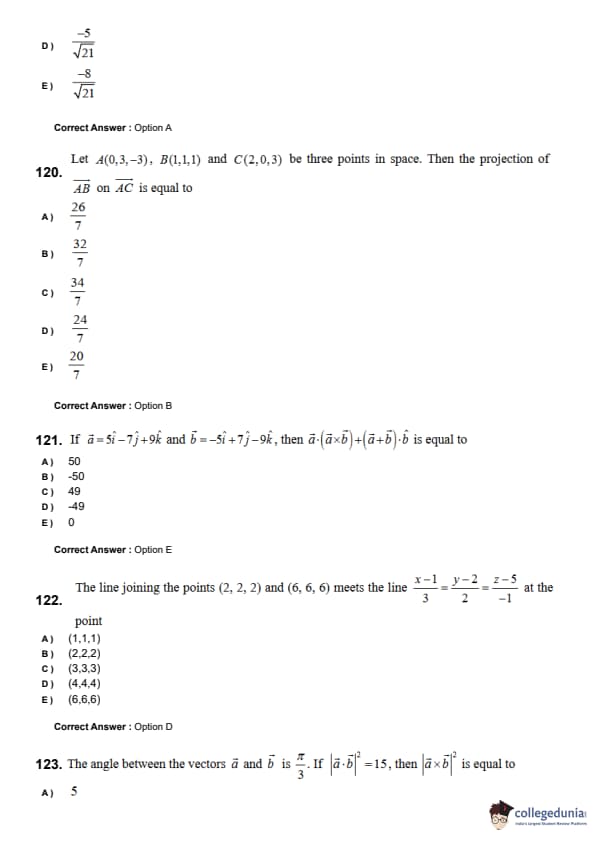
Question 119:

Let \( \alpha, \beta, \gamma \) be the direction cosines of a vector \( \vec{a} = x \hat{i} + y \hat{j} + z \hat{k} \), where \( z < 0 \). If \( \alpha = \frac{-4}{\sqrt{105}} \) and \( \beta = \frac{\sqrt{5}}{\sqrt{21}} \), then \( \gamma \) is equal to

  • (A) \( \frac{-8}{\sqrt{105}} \)
  • (B) \( \frac{-\sqrt{8}}{\sqrt{105}} \)
  • (C) \( \frac{-5}{\sqrt{105}} \)
  • (D) \( \frac{-5}{\sqrt{21}} \)
  • (E) \( \frac{-8}{\sqrt{21}} \)
Correct Answer: (A) \( \frac{-8}{\sqrt{105}} \)
View Solution

Question 120:

Let \( A(0,3,-3) \), \( B(1,1,1) \) and \( C(2,0,3) \) be three points in space. Then the projection of \( \overrightarrow{AB} \) on \( \overrightarrow{AC} \) is equal to

  • (A) \( \frac{26}{7} \)
  • (B) \( \frac{32}{7} \)
  • (C) \( \frac{34}{7} \)
  • (D) \( \frac{24}{7} \)
  • (E) \( \frac{20}{7} \)
Correct Answer: (B) \( \frac{32}{7} \)
View Solution

Question 121:

If \( \vec{a} = 5\hat{i} - 7\hat{j} + 9\hat{k} \) and \( \vec{b} = -5\hat{i} + 7\hat{j} - 9\hat{k} \), then \( \vec{a} \cdot (\vec{a} \times \vec{b}) + (\vec{a} + \vec{b}) \cdot \hat{b} \) is equal to

  • (A) \( 50 \)
  • (B) \( -50 \)
  • (C) \( 49 \)
  • (D) \( -49 \)
  • (E) \( 0 \)
Correct Answer: (E) \( 0 \)
View Solution

Question 122:

The line joining the points \( (2,2,2) \) and \( (6,6,6) \) meets the line
\[ \frac{x - 1}{3} = \frac{y - 2}{2} = \frac{z - 5}{-1} \]

at the point

  • (A) \( (1,1,1) \)
  • (B) \( (2,2,2) \)
  • (C) \( (3,3,3) \)
  • (D) \( (4,4,4) \)
  • (E) \( (6,6,6) \)
Correct Answer: (D) \( (4,4,4) \)
View Solution

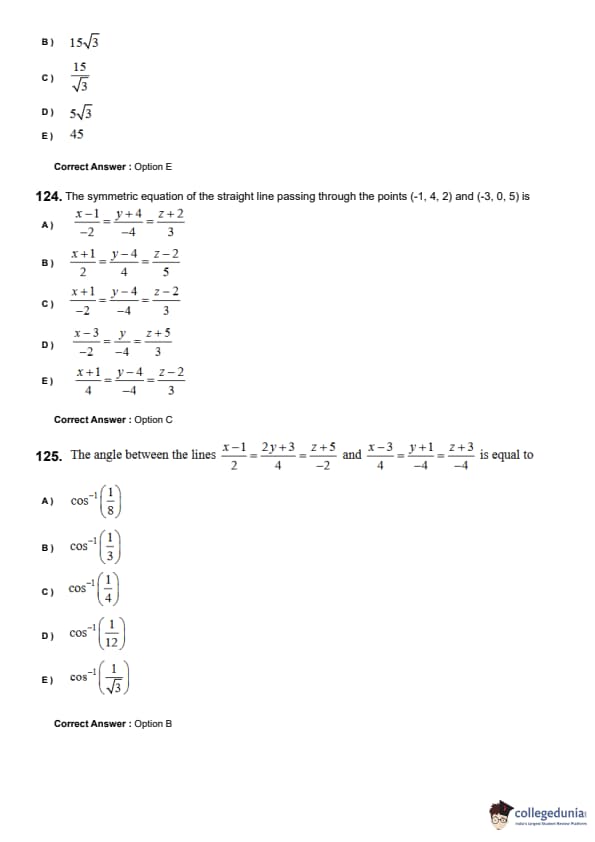
Question 123:

The angle between the vectors \( \vec{a} \) and \( \vec{b} \) is \( \frac{\pi}{3} \). If \( | \vec{a} \cdot \vec{b} |^2 = 15 \), then \( | \vec{a} \times \vec{b} |^2 \) is equal to

  • (A) \( 5 \)
  • (B) \( 15\sqrt{3} \)
  • (C) \( \frac{15}{\sqrt{3}} \)
  • (D) \( 5\sqrt{3} \)
  • (E) \( 45 \)
Correct Answer: (E) \( 45 \)
View Solution

Question 124:

The symmetric equation of the straight line passing through the points \( (-1, 4, 2) \) and \( (-3, 0, 5) \) is

  • (A) \( \frac{x-1}{-2} = \frac{y+4}{-4} = \frac{z+2}{3} \)
  • (B) \( \frac{x+1}{2} = \frac{y-4}{4} = \frac{z-2}{5} \)
  • (C) \( \frac{x+1}{-2} = \frac{y-4}{-4} = \frac{z-2}{3} \)
  • (D) \( \frac{x-3}{-2} = \frac{y+1}{-4} = \frac{z+5}{3} \)
  • (E) \( \frac{x+1}{4} = \frac{y-4}{-4} = \frac{z-2}{3} \)
Correct Answer: (C)
View Solution

Question 125:

The angle between the lines
\[ \frac{x-1}{2} = \frac{2y+3}{4} = \frac{z+5}{-2} \quad and \quad \frac{x-3}{4} = \frac{y+1}{-4} = \frac{z+3}{-4} \]

is equal to

  • (A) \( \cos^{-1} \left(\frac{1}{8} \right) \)
  • (B) \( \cos^{-1} \left(\frac{1}{3} \right) \)
  • (C) \( \cos^{-1} \left(\frac{1}{4} \right) \)
  • (D) \( \cos^{-1} \left(\frac{1}{12} \right) \)
  • (E) \( \cos^{-1} \left(\frac{1}{\sqrt{3}} \right) \)
Correct Answer: (B)
View Solution

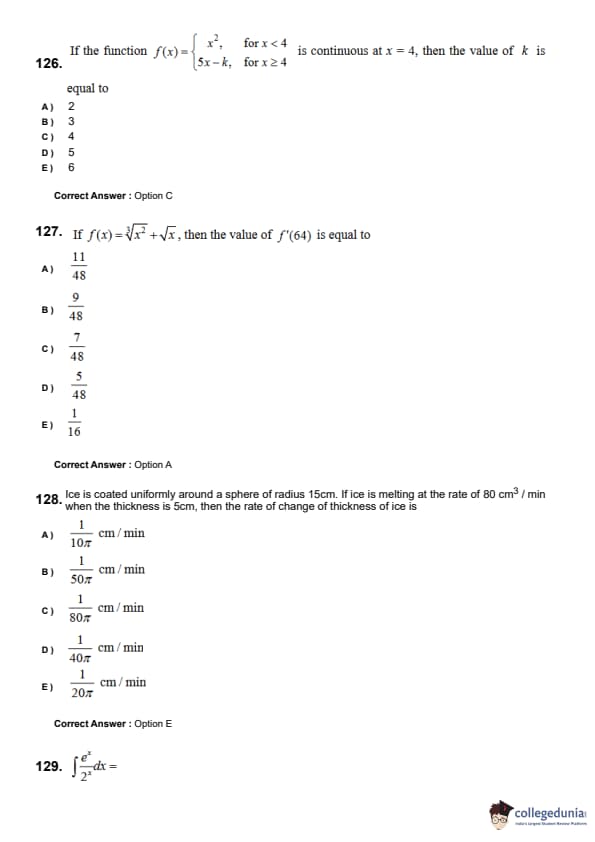
Question 126:

If the function
\[ f(x) = \begin{cases} x^2, & for x < 4
5x - k, & for x \geq 4 \end{cases} \]

is continuous at \( x = 4 \), then the value of \( k \) is equal to

  • (A) \( 2 \)
  • (B) \( 3 \)
  • (C) \( 4 \)
  • (D) \( 5 \)
  • (E) \( 6 \)
Correct Answer: (C)
View Solution

Question 127:

If
\[ f(x) = \sqrt[3]{x^2} + \sqrt{x}, \]

then the value of \( f'(64) \) is equal to

  • (A) \( \frac{11}{48} \)
  • (B) \( \frac{9}{48} \)
  • (C) \( \frac{7}{48} \)
  • (D) \( \frac{5}{48} \)
  • (E) \( \frac{1}{16} \)
Correct Answer: (A)
View Solution

Question 128:

Ice is coated uniformly around a sphere of radius 15 cm. If ice is melting at the rate of \[ 80 cm^3/min \]
when the thickness is 5 cm, then the rate of change of thickness of ice is

  • (A) \( \frac{1}{10\pi} \) cm/min
  • (B) \( \frac{1}{50\pi} \) cm/min
  • (C) \( \frac{1}{80\pi} \) cm/min
  • (D) \( \frac{1}{40\pi} \) cm/min
  • (E) \( \frac{1}{20\pi} \) cm/min
Correct Answer: (E)
View Solution

Question 129:

Evaluate the integral
\[ \int \frac{e^x}{2^x} dx. \]

  • (A) \( \frac{e^x}{(\log_2 2) 2^x} + C \)
  • (B) \( \frac{e^x}{2(2^x)} + C \)
  • (C) \( \frac{2 \left(\frac{e}{2} \right)^{x-1}}{e} + C \)
  • (D) \( \frac{e^x}{(1 - \log_2 2)2^x} + C \)
  • (E) \( \frac{e^x}{2^x} + C \)
Correct Answer: (D)
View Solution

Question 130:

The area bounded by the parabola \[ y = x^2 + 4 \]
and the straight line passing through the points \[ (-1,2) \quad and \quad (1,6) \]
is (in square units)

  • (A) \( \frac{20}{3} \)
  • (B) \( \frac{4}{3} \)
  • (C) \( \frac{8}{3} \)
  • (D) \( \frac{16}{3} \)
  • (E) \( \frac{14}{3} \)
Correct Answer: (B)
View Solution

Question 131:

Let \[ g(x) = 4x + 3 \quad and \quad f(g(x)) = x^2 + 9. \]
Then the value of \( f(7) \) is equal to

  • (A) \( 7 \)
  • (B) \( 9 \)
  • (C) \( 10 \)
  • (D) \( 12 \)
  • (E) \( 14 \)
Correct Answer: (C)
View Solution

Question 132:

The range of the function \( f(x) = 7\cos(10x + 4\pi) \) is

  • (A) \( [-1,1] \)
  • (B) \( [-4\pi, 4\pi] \)
  • (C) \( [-10,10] \)
  • (D) \( [-7,7] \)
  • (E) \( [-2\pi, 2\pi] \)
Correct Answer: (D) \( [-7,7] \)
View Solution

Question 133:

Let \( f(x) = \log_e \left( \frac{x^2 + 30}{11x} \right) \), for \( x \in [5,6] \). Then the point \( c \in (5,6) \) at which \( f'(c) = 0 \) is:

  • (A) \( \sqrt{30} \)
  • (B) \( 4\sqrt{2} \)
  • (C) \( 2\sqrt{7} \)
  • (D) \( \sqrt{35} \)
  • (E) \( \sqrt{26} \)
Correct Answer: (A) \( \sqrt{30} \)
View Solution

Question 134:

Let \( f(x) = ax^3 + bx^2 + cx + d \). If \( f \) has a local maximum value 21 at \( x = -1 \) and a local minimum value 7 at \( x = 1 \), then \( f(0) \) is equal to:

  • (A) \( 10 \)
  • (B) \( 11 \)
  • (C) \( 12 \)
  • (D) \( 13 \)
  • (E) \( 14 \)
Correct Answer: (E) \( 14 \)
View Solution

Question 135:

The value of \( \int_{-2}^{2} x |x| \,dx \) is:

  • (A) \( \frac{1}{8} \)
  • (B) \( \frac{1}{4} \)
  • (C) \( -\frac{1}{4} \)
  • (D) \( -\frac{1}{8} \)
  • (E) \( 0 \)
Correct Answer: (E) \( 0 \)
View Solution

Question 136:

Evaluate the integral
\[ \int x^5 e^{x^3} \,dx. \]

  • (A) \( \frac{e^{x^3}}{3} (x^3 - 1) + C \)
  • (B) \( \frac{e^{x^3}}{5} (x^5 - 1) + C \)
  • (C) \( \frac{e^{x^3}}{4} (x^4 - 1) + C \)
  • (D) \( \frac{e^{x^3}}{3} (x^5 - 1) + C \)
  • (E) \( \frac{x^3 e^{x^3}}{3} + C \)
Correct Answer: (A) \( \frac{e^{x^3}}{3} (x^3 - 1) + C \)
View Solution

Question 137:

Evaluate the limit:
\[ \lim\limits_{x \to 6} \frac{\sqrt{x^2 + 13} - 7}{x^2 - 36}. \]

  • (A) \( \frac{1}{7} \)
  • (B) \( \frac{1}{13} \)
  • (C) \( \frac{13}{36} \)
  • (D) \( \frac{1}{14} \)
  • (E) \( \frac{1}{36} \)
Correct Answer: (D) \( \frac{1}{14} \)
View Solution

Question 138:

If \[ x^4 + 2\sqrt{y} + 1 = 3, \]
then \( \frac{dy}{dx} \) at \( (1,0) \) is equal to

  • (A) \( 4 \)
  • (B) \( 2 \)
  • (C) \( -4 \)
  • (D) \( -2 \)
  • (E) \( -\frac{1}{8} \)
Correct Answer: (C)
View Solution

Question 139:

If
\[ \lim_{x \to 9} f(x) = 6 \quad and \quad \lim_{x \to 9} g(x) = 3, \]

then
\[ \lim_{x \to 9} \frac{f(x) - 2g(x)}{g(x)} \]

is equal to

  • (A) \( 2 \)
  • (B) \( -2 \)
  • (C) \( \frac{1}{3} \)
  • (D) \( -\frac{1}{3} \)
  • (E) \( 0 \)
Correct Answer: (E)
View Solution

Question 140:

For the curve
\[ y = \alpha x^2 + \cos y + \beta, \]

the value of \( \frac{dy}{dx} \) at \( (1,0) \) is 2. Then the value of \( \alpha \beta \) is equal to

  • (A) \( 1 \)
  • (B) \( -1 \)
  • (C) \( 2 \)
  • (D) \( -2 \)
  • (E) \( 0 \)
Correct Answer: (D)
View Solution

Question 141:

Evaluate the limit:
\[ \lim_{x \to 4} \left( \frac{1}{x - 4} - \frac{5}{x^2 - 3x - 4} \right) \]

is equal to

  • (A) \( \frac{1}{4} \)
  • (B) \( \frac{1}{5} \)
  • (C) \( \frac{1}{3} \)
  • (D) \( \frac{1}{2} \)
  • (E) \( 1 \)
Correct Answer: (B)
View Solution

Question 142:

If
\[ y = \log_e \left( \frac{1 + 2x^2}{1 - 3x^2} \right), \]

then \( \frac{dy}{dx} \) is:

  • (A) \( \frac{10x}{1 - x^2 - 6x^4} \)
  • (B) \( \frac{12x^3}{1 - x^2 - 6x^4} \)
  • (C) \( \frac{10x}{1 - 6x^4} \)
  • (D) \( \frac{-10x}{1 - x^2 - 6x^4} \)
  • (E) \( \frac{-12x^3}{1 - x^2 - 6x^4} \)
Correct Answer: (A) \( \frac{10x}{1 - x^2 - 6x^4} \)
View Solution

Question 143:

Let \( \alpha \) and \( \beta \) be real numbers such that \( f(x) \) is defined as:
\[ f(x) = \begin{cases} 2x^2 + 4x + \alpha, & if x < 1
\beta x^2 + 5, & if x \geq 1 \end{cases} \]

and is differentiable at \( x = 1 \). Then \( \alpha + \beta \) is equal to:

  • (A) \( 5 \)
  • (B) \( 6 \)
  • (C) \( 7 \)
  • (D) \( 8 \)
  • (E) \( 9 \)
Correct Answer: (C) \( 7 \)
View Solution

Question 144:

If \( f(x) = x^2 + 2x f'(1) + f''(2) \) for all \( x \), then \( f(0) \) is equal to:

  • (A) \( 4 \)
  • (B) \( 3 \)
  • (C) \( 2 \)
  • (D) \( 1 \)
  • (E) \( 0 \)
Correct Answer: (C) \( 2 \)
View Solution

Question 145:

The function \( f(x) = 6x^4 - 3x^2 - 5 \) is increasing in the set:

  • (A) \( (-\infty, -\frac{1}{2}) \cup (\frac{1}{2}, 1) \)
  • (B) \( (-\frac{1}{2}, 0) \cup (\frac{1}{2}, \infty) \)
  • (C) \( (-\frac{1}{2}, \frac{1}{2}) \)
  • (D) \( (-\infty, \frac{1}{2}) \)
  • (E) \( (-\infty, -\frac{1}{2}) \cup (\frac{1}{2}, \infty) \)
Correct Answer: (B) \( (-\frac{1}{2}, 0) \cup (\frac{1}{2}, \infty) \)
View Solution

Question 146:

The general solution of the differential equation
\[ 2y \tan x + \frac{dy}{dx} = 5 \sin x \]

is:

  • (A) \( y = 5 \sec x + C \sec^2 x \)
  • (B) \( y = 5 + C \cos x \)
  • (C) \( y = 5 \cos x + C \)
  • (D) \( y = 5 \cos x + C \cos^2 x \)
  • (E) \( y = 5 \sec^2 x + C \sec x \)
Correct Answer: (D) \( y = 5 \cos x + C \cos^2 x \)
View Solution

Question 147:

Evaluate the integral:
\[ \int \frac{\sin \theta \sin 2\theta}{1 - \cos 2\theta} d\theta. \]

  • (A) \( 1 + \cos \theta + C \)
  • (B) \( 1 + \sin \theta + C \)
  • (C) \( \sin \theta + C \)
  • (D) \( 1 + \cos 2\theta + C \)
  • (E) \( 1 + \sin 2\theta + C \)
Correct Answer: (C) \( \sin \theta + C \)
View Solution

Question 148:

Evaluate the integral:
\[ \int \frac{6x^3 + 9x^2}{x^4 + 3x^3 - 9x^2} dx. \]

  • (A) \( 3x \log |x^2 + 3x - 9| + C \)
  • (B) \( 6x \log |x^2 + 3x - 9| + C \)
  • (C) \( 6 \log |x^2 + 3x - 9| + C \)
  • (D) \( x \log |x^2 + 3x - 9| + C \)
  • (E) \( 3 \log |x^2 + 3x - 9| + C \)
Correct Answer: (E) \( 3 \log |x^2 + 3x - 9| + C \)
View Solution

Question 149:

Evaluate the integral:
\[ \int_{0}^{3} |x - 2| \,dx \]

is equal to

  • (A) \( \frac{2}{3} \)
  • (B) \( \frac{3}{2} \)
  • (C) \( \frac{5}{2} \)
  • (D) \( \frac{2}{5} \)
  • (E) \( \frac{9}{2} \)
Correct Answer: (C)
View Solution

Question 150:

Find the integrating factor of the differential equation:
\[ (3 \sin x \cos x) \, dy = (1 + 3y \sin^2 x) \, dx, \quad where \quad 0 < x < \frac{\pi}{2} \]

is

  • (A) \( \sec x \)
  • (B) \( \sin x \)
  • (C) \( \tan x \)
  • (D) \( \cos x \)
  • (E) \( \cot x \)
Correct Answer: (D)
View Solution