




Goa Board of Secondary and Higher Secondary Education (GBSHSE) has released the Goa Board HSSC syllabus for the academic year 2025-2026. The Goa Board Class 12 Syllabus has important topics and chapters for Science, Commerce, and Arts streams. Students can download the syllabus from the official website: gbshse.in.
- In the Goa Board HSSC exam, each subject carries 100 marks. The practical subjects carry 70 marks for theory and 30 marks for practicals.
- The non-practical subjects carry 80 marks for theory and 20 marks for internal assessment.
- To pass the exam, students must secure at least 33% in the theory exam and a minimum of 33% in the practical exam.
You can also download the Goa Board HSSC official syllabus PDF from the link mentioned below:
| Goa Board Class 12 Syllabus PDF Download | |
|---|---|
| Subjects | Download PDF |
| Physics | Download |
| Chemistry | Download |
| Biology | Download |
| Accountancy | Download |
| Business Studies | Download |
| Political Science | Download |
| Computer Science | Download |
| Hindi - II | Download |
| Banking | Download |
Also Check:
Key Summary
In this article, we have shared details about the Goa Board HSSC Syllabus 2026, subject-wise syllabus, weightage, and important reference books.
- The Goa Board HSSC syllabus 2026 includes all the subjects from the Science, Commerce, and Arts streams.
- The Goa Board HSSC Syllabus 2026 has different weightage for each topic.
- To pass the exam, students have to secure at least 33% marks in both the theory and practical exams.
- The practical subjects carry 70 marks for theory and 30 for practical.
- Non-practical subjects carry 80 marks for theory and 20 marks for internal assessment.
What is Goa Board HSSC Syllabus 2026?
The Goa Board HSSC syllabus 2026 includes all the subjects from the Science, Commerce, and Arts streams. It is the same as the 2025 syllabus. Each subject carries 100 marks. The practical subjects carry 70 marks for theory and 30 marks for practicals, and the non-practical subjects carry 80 marks for theory and 20 marks for internal assessment.
The main subjects include:
- Science: Physics, Chemistry, Biology, Mathematics, Computer Science
- Commerce: Accountancy, Business Studies, Economics
- Arts: History, Geography, Political Science, Sociology, English
| Particulars | Details |
|---|---|
| Governing Body | Goa Board of Secondary and Higher Secondary Education (GBSHSE) |
| Academic Year | 2025–26 |
| Subjects | According to the 3 StreamsScience, Commerce, and Humanities |
| Total Marks per Subject | 100 MarksNon-Practicals Subjects: (80 written + 20 internal)Practical Subjects: (70 Written + 30 practical) |
| Passing Marks |
|
| Question Type | MCQ, Very Short Answer, Short Answer & Long Answer |
| Exam Mode | Offline (Pen-and-paper) |
| Exam Months | February 2026 |
| Syllabus Availability | Free downloadable PDFs from the Goa Board HSSC website |
How to download Goa Board HSSC Syllabus 2026
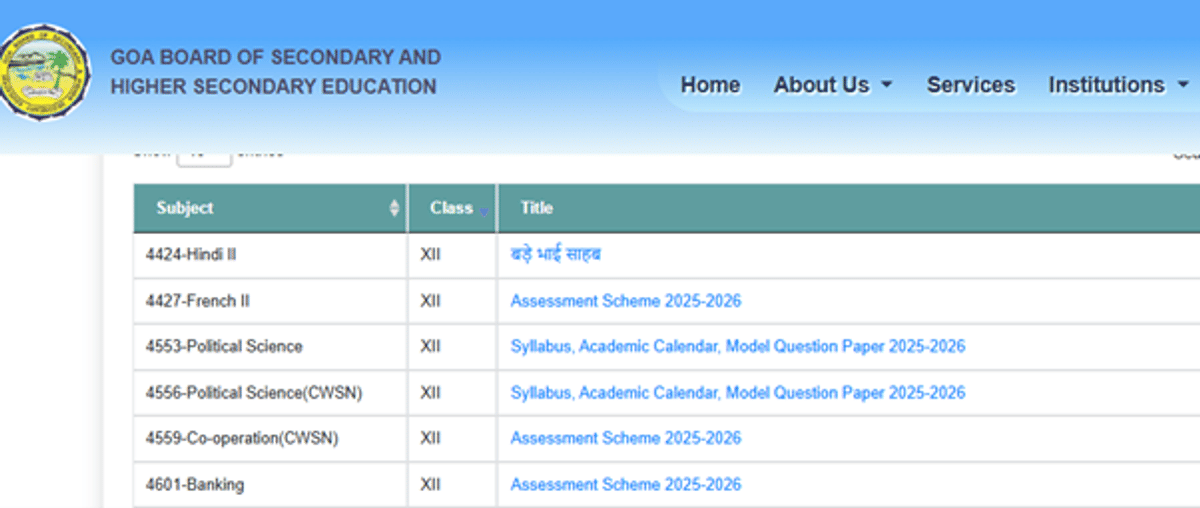
You can download the Goa Board HSSC Syllabus 2026 from the Goa Board's official website gbshse.in.
Source: gbshse.in

Source: gbshse.in
Goa Board HSSC Syllabus 2026 FAQs
Ques. Has the Goa Board HSSC syllabus changed for the academic year 2025-2026?
Ans. The Goa Board HSSC syllabus for 2025–2026 is mostly the same as last year. However, a few chapters and topics have been removed or revised in some subjects. Students should follow the updated syllabus available on the official website.
Ques. From where can I download the Goa Board HSSC syllabus?
Ans. You can download the Goa HSSC Syllabus from the Goa Board of Secondary and Higher Secondary Education official website gbshse.in.
Ques. What are the total marks for the Goa Board HSSC exam?
Ans. The total marks for the Goa Board HSSC exam are 500 marks in total.
Each student appears for five subjects, and every subject carries 100 marks, either 80+20 or 70+30, depending on the subject.
Ques. What are the passing marks for the Goa Board HSSC exam?
Ans. The passing marks for the Goa Board HSSC exam are 33% in each subject.
Ques. Is it important to pass the Goa Board HSSC practical exams?
Ans. Yes, it is important to pass the practical exams. If a student fails in the practical, they will fail the whole subject even if they pass the theory exam.
Goa Board HSSC Syllabus 2026: Subject-Wise
The Goa Board HSSC Syllabus 2026 is available on the official website. The syllabus is different for all the streams: Science, Commerce, and Humanities. We have shared the Subject-wise detailed syllabus of all the subjects below:
Goa Board HSSC Syllabus: Physics
The Goa Board HSSC Syllabus for Physics has a total of 14 chapters, starting from electric charges and fields to Semiconductor electronics. For the academic year 2025-2026, the board has deleted some topics from each of the chapters. You can check the deleted topics from the table below:
| Chapter | Deleted Portions |
|---|---|
| 1. Electric Charges and Fields |
|
| 2. Electrostatic Potential and Capacitance |
|
| 3. Current Electricity |
|
| 4. Moving Charges and Magnetism |
|
| 5. Magnetism and Matter |
|
| 6. Electromagnetic Induction |
|
| 7. Alternating Current |
|
| 8. Electromagnetic Waves |
|
| 9. Ray Optics and Optical Instruments |
|
| 10. Wave Optics |
|
| 11. Dual Nature of Matter and Radiation |
|
| 12. Atoms |
|
| 13. Nuclei |
|
| 14. Semiconductor Electronics: Materials, Devices, and Simple Circuits |
|
Goa Board HSSC Practical Syllabus: Physics
The Goa Board HSSC Physics practical carries 30 marks, and it is important to pass the practical exam. We have shared the physics practical syllabus.
| SECTION–A (Electricity & Electronics) | SECTION–B (Optics) |
|---|---|
| 1. To determine resistance per cm of a wire by plotting a graph for potential difference versus current. | 1. To find the value of v for different values of u in the case of a concave mirror, and to find the focal length. |
| 2. To find the resistance of a given wire using a meter bridge and hence determine the specific resistance of its material. | 2. To find the focal length of a convex mirror using a convex lens. |
| 3. To verify the laws of combination of resistances (Series / Parallel) using a meter bridge. | 3. To find the focal length of a convex lens by plotting a graph between v and u. |
| 4. To determine the resistance of a galvanometer by the half-deflection method and find its figure of merit. | 4. (Alternate) To find the focal length of a convex lens by plotting a graph between 1/v and 1/u. |
| 5. To convert a given galvanometer (of known resistance and figure of merit) into a voltmeter or ammeter of desired range and verify the same. | 5. To determine the angle of minimum deviation for a given prism by plotting a graph between the angle of deviation and the angle of incidence. |
| 6. To find the frequency of AC mains using a sonometer. | 6. To determine the refractive index of a glass slab using a travelling microscope. |
| 7. To draw the I–V characteristic curve for a p–n junction diode in forward bias. | 7. To find the refractive index of a liquid using a convex lens and a plane mirror. |
| 8. To find the refractive index of a liquid using a concave mirror. |
Goa Board HSSC Syllabus: Chemistry
Here is the detailed chemistry syllabus for the Goa Board HSSC, with all the chapters and the topics covered.
| Chapter | Topics |
|---|---|
| Solutions |
|
| Electrochemistry |
|
| Chemical Kinetics |
|
| d and f Block Elements |
|
| Coordination Compounds |
|
| Haloalkanes and Haloarenes |
|
| Alcohols, Phenols, and Ethers |
|
| Aldehydes, Ketones, and Carboxylic Acids |
|
| Amines |
|
| Biomolecules |
|
Goa Board HSSC Syllabus: Biology
The Goa Board HSSC Syllabus for Biology has 5 sections, and each section has different chapters covered under it.
| Unit / Chapter | Topics |
|---|---|
| UNIT VI – REPRODUCTION | |
| Chapter 2: Sexual Reproduction in Flowering Plants |
|
| Chapter 3: Human Reproduction |
|
| Chapter 4: Reproductive Health |
|
| UNIT VII – GENETICS | |
| Chapter 5: Principles of Inheritance and Variation |
|
| Chapter 6: Molecular Basis of Inheritance |
|
| UNIT VIII – BIOLOGY IN HUMAN WELFARE | |
| Chapter 8: Human Health and Diseases |
|
| Chapter 10: Microbes in Human Welfare |
|
| UNIT IX – BIOTECHNOLOGY | |
| Chapter 11: Biotechnology – Principles and Processes |
|
| Chapter 12: Biotechnology and Its Applications |
|
| UNIT X – ECOLOGY | |
| Chapter 13: Organisms and Populations |
|
| Chapter 14: Ecosystem |
|
| Chapter 15: Biodiversity and Its Conservation |
|
Goa Board HSSC Practical Syllabus: Biology
The Biology Practical for the Goa Board HSSC exam has a weightage of 30 marks. There are a total of 19 experiments mentioned in the Biology Practical syllabus that the students have to perform.
| Section | Experiments / Activities |
|---|---|
| SECTION A: Physiology Experiments | 1. To determine the pH and water holding capacity of garden or paddy field soil. 2. To detect the presence of phosphate, nitrate, and sulphate salts in paddy field soil. 3. To study the B.O.D. of the given sample of pond water. 4. To study the effect of different temperatures on the action of salivary amylase on starch. 5. To study the effect of different pH levels on the action of salivary amylase on starch. |
| SECTION B: Preparation of Temporary Stained Slides | 1. Onion root tip for mitosis. 2. Onion / Rheo anther for meiosis. |
| SECTION C: Identification / Spotting | 1. Adaptations in insect-pollinated flowers (Ocimum / Leucas / Salvia). 2. Adaptations in wind-pollinated flowers (Maize / Grass). 3. Study of T.S. of Testis (any vertebrate). 4. Study of T.S. of Ovary (any vertebrate). 5. Study of V.S. of Blastula (any vertebrate). 6. Prepared a pedigree chart of inability to roll the tongue. 7. Prepared pedigree chart of Widow’s peak. 8. Identification of organisms and symptoms of disease caused — Ascaris, Entamoeba, Plasmodium. 9. Adaptation of the plant to dry conditions (suitable specimen). 10. Adaptation of a plant to aquatic conditions (suitable specimen). 11. Adaptation of an animal to dry conditions (specimen/chart/model). 12. Adaptation of an animal to aquatic conditions (suitable specimen). |
Goa Board HSSC Syllabus: Accountancy
The Goa Board HSSC Syllabus for Accountancy has two parts: Partnership Accounts and Accounting for Companies. Each part has different chapters and topics under them.
| Unit Name | Topics |
|---|---|
| Part A: Partnership Accounts | |
| Accounting for Partnership: Basic Concepts |
|
| Reconstitution of Partnership |
|
| Dissolution of Partnership Firm |
|
| Part B: Accounting for Companies | |
| Accounting for Shares |
|
| Issue of Debentures |
|
| Financial Statements of a Company |
|
| Analysis of Financial Statements |
|
| Accounting Ratios |
|
| Cash Flow Statement |
|
Goa Board HSSC Syllabus: Business Studies
We have mentioned the detailed syllabus of Business Studies for the Goa Board HSSC Exam. You can check the syllabus below:
| Unit Name | Topics |
|---|---|
| Part A: Principles and Functions of Management | |
| Nature and Significance of Management |
|
| Principles of Management |
|
| Business Environment |
|
| Planning |
|
| Organizing |
|
| Staffing |
|
| Directing |
|
| Controlling |
|
| Part B: Business Finance and Marketing | |
| Financial Management / Business Finance |
|
| Marketing |
|
| Consumer Protection |
|
Goa Board HSSC Syllabus: Computer Science
The Goa Board HSSC Computer Science syllabus has five units, starting from Programming in C++ to Computer Networks. It helps students understand both coding and computer system concepts.
| Unit | Unit Name | Topic Name |
|---|---|---|
| Unit I | Programming in C++ |
|
| Unit II | Data Structures Using C++ |
|
| Unit III | File Handling |
|
| Unit IV | Boolean Algebra |
|
| Unit V | Computer Networks |
|
Goa Board HSSC Syllabus: Political Science
The Goa Board HSSC Syllabus for Political Science has 2 books: Contemporary World Politics and Politics in India Since Independence. It covers international and national political issues.
| Book | Chapters |
|---|---|
| Contemporary World Politics | The End of Bipolarity |
| Contemporary Centers of Power | |
| Contemporary South Asia | |
| International Organizations | |
| Security in the Contemporary World | |
| Environment & Natural Resources | |
| Globalization | |
| Politics in India Since Independence | Nation Building and Its Problems |
| Era of One-Party Dominance | |
| Politics of Planned Development | |
| India’s External Relations | |
| Challenges to and Restoration of the Congress System | |
| Crisis of the Democratic Order | |
| Regional Aspirations and Conflicts | |
| Recent Issues and Challenges |
Goa Board HSSC Syllabus 2026: Reference Books
The Goa Board has prescribed books for Class 12 students. The students should mainly focus on the main book. Apart from those books, we have mentioned some other important reference books for the subjects that can help the students in understanding the syllabus and clear the concepts.
| Subject | Reference Book Title | Author(s) | Publisher |
|---|---|---|---|
| Physics | Concepts of Physics (Vol I & II) | HC Verma | Bharati Bhawan |
| Fundamental Physics | Pradeep Publications | Pradeep | |
| Chemistry | ABC of Chemistry | Dr. S.P. Jauhar | Modern Publishers |
| Physical, Organic, Inorganic Chemistry | OP Tandon | GRB Publications | |
| Biology | Trueman’s Elementary Biology Vol I & II | K.N. Bhatia, K. Bhatia | Trueman Publishers |
| Accountancy | Accountancy | Sandeep Garg | Dhanpat Rai |
| Economics | Introductory Micro & Macro Economics | Sandeep Garg | Dhanpat Rai |
| Business Studies | Business Studies | Poonam Gandhi | VK Global Publications |
Also Check:
Goa Board HSSC Syllabus 2026: Topic-Wise Weightage
The Goa Board HSSC Syllabus 2026 has different weightage for each topic. Each topic carries its own marks, so students should study accordingly and practice for the exam according to the topic's weightage.
Goa Board HSSC Syllabus: Physics Weightage
In the Goa Board HSSC physics syllabus, ray optics and optical instruments have the highest weightage of 8 marks, followed by current electricity and semiconductor electronics with 7 marks.
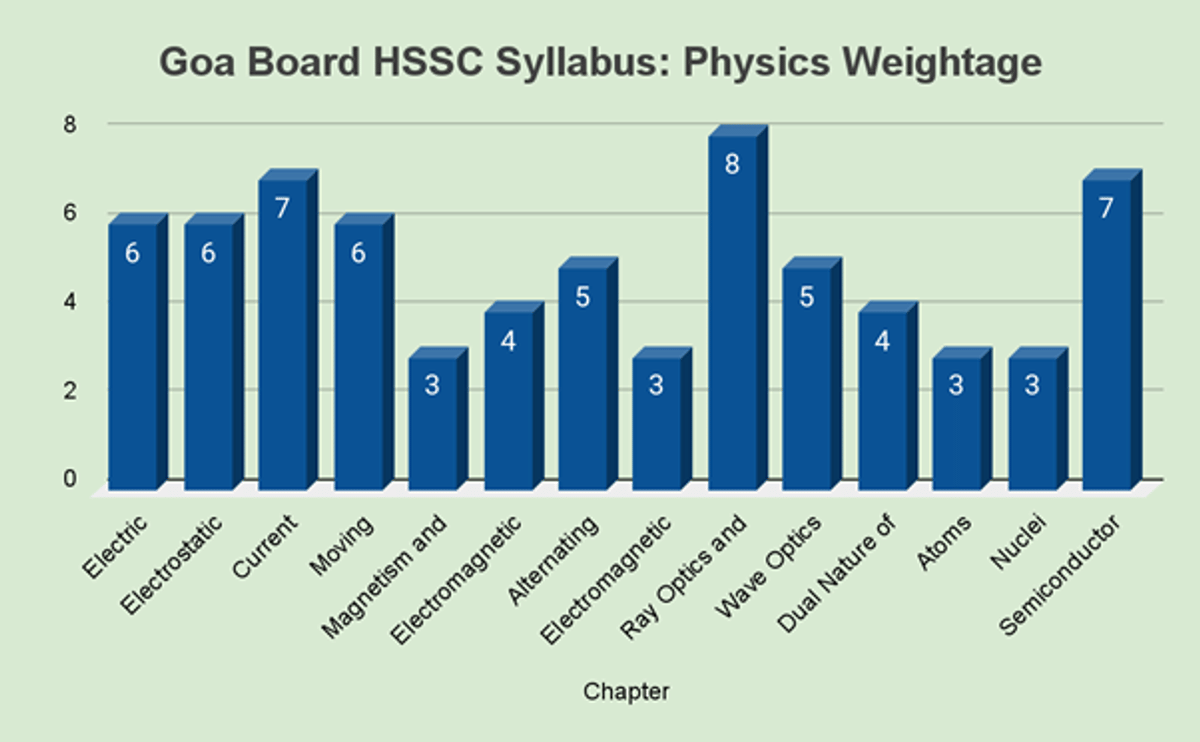
| Chapter | Marks |
|---|---|
| Electric Charges and Fields | 06 |
| Electrostatic Potential and Capacitance | 06 |
| Current Electricity | 07 |
| Moving Charges and Magnetism | 06 |
| Magnetism and Matter | 03 |
| Electromagnetic Induction | 04 |
| Alternating Current | 05 |
| Electromagnetic Waves | 03 |
| Ray Optics and Optical Instruments | 08 |
| Wave Optics | 05 |
| Dual Nature of Matter and Radiation | 04 |
| Atoms | 03 |
| Nuclei | 03 |
| Semiconductor Electronics: Materials, Devices and Simple Circuits | 07 |
| Total | 70 Marks |
Goa Board HSSC Syllabus: Chemistry Weightage
The Goa Board HSSC Chemistry syllabus has a total of 70 marks for the theory exams. Each unit has given different marks, with electrochemistry having the highest marks.
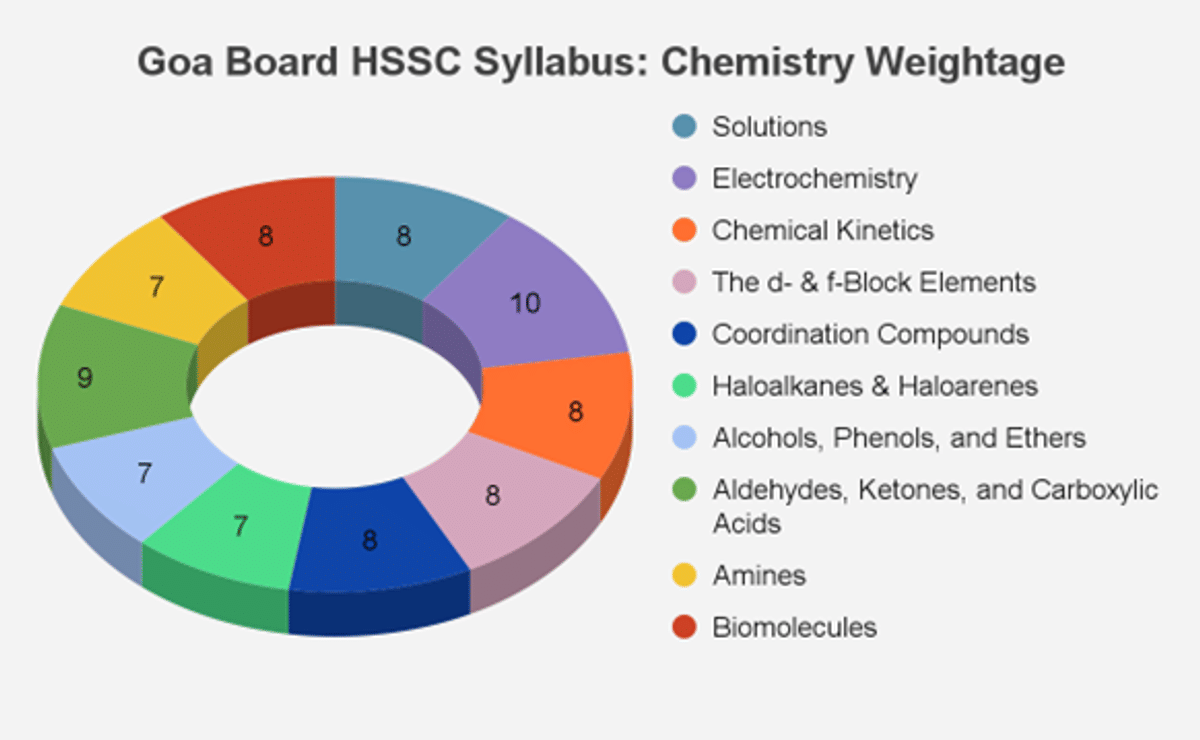
| Unit | Marks |
|---|---|
| Solutions | 8 |
| Electrochemistry | 10 |
| Chemical Kinetics | 8 |
| The d- & f-Block Elements | 8 |
| Coordination Compounds | 8 |
| Haloalkanes & Haloarenes | 7 |
| Alcohols, Phenols, and Ethers | 7 |
| Aldehydes, Ketones, and Carboxylic Acids | 9 |
| Amines | 7 |
| Biomolecules | 8 |
| Total | 70 |
Goa Board HSSC Syllabus: Biology Weightage
We have given the chapter-wise weightage for the Goa Board HSSC Syllabus. Students can prepare according to the marks given to each of the chapters.
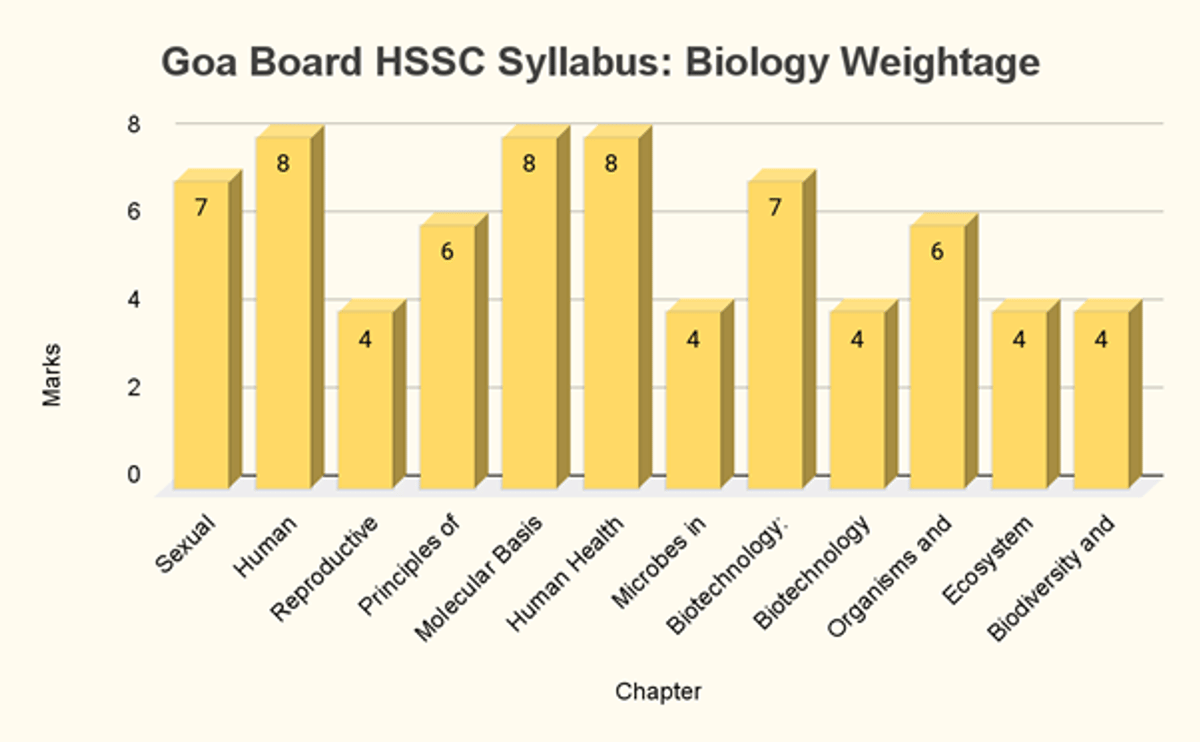
| Chapter No. | Chapter | Marks |
|---|---|---|
| 2 | Sexual Reproduction in Flowering Plants | 7 |
| 3 | Human Reproduction | 8 |
| 4 | Reproductive Health | 4 |
| 5 | Principles of Inheritance and Variation | 6 |
| 6 | Molecular Basis of Inheritance | 8 |
| 8 | Human Health and Diseases | 8 |
| 10 | Microbes in Human Welfare | 4 |
| 11 | Biotechnology: Principles and Processes | 7 |
| 12 | Biotechnology and Its Applications | 4 |
| 13 | Organisms and Populations | 6 |
| 14 | Ecosystem | 4 |
| 15 | Biodiversity and Conservation | 4 |
| Total | 70 |
Goa Board HSSC Syllabus: Accountancy Weightage
The Goa Board HSSC Accountancy Syllabus has 80 marks for the written examination. The units included in the syllabus have different weightage for the exam. You can check the unit-wise weightage from the table below:
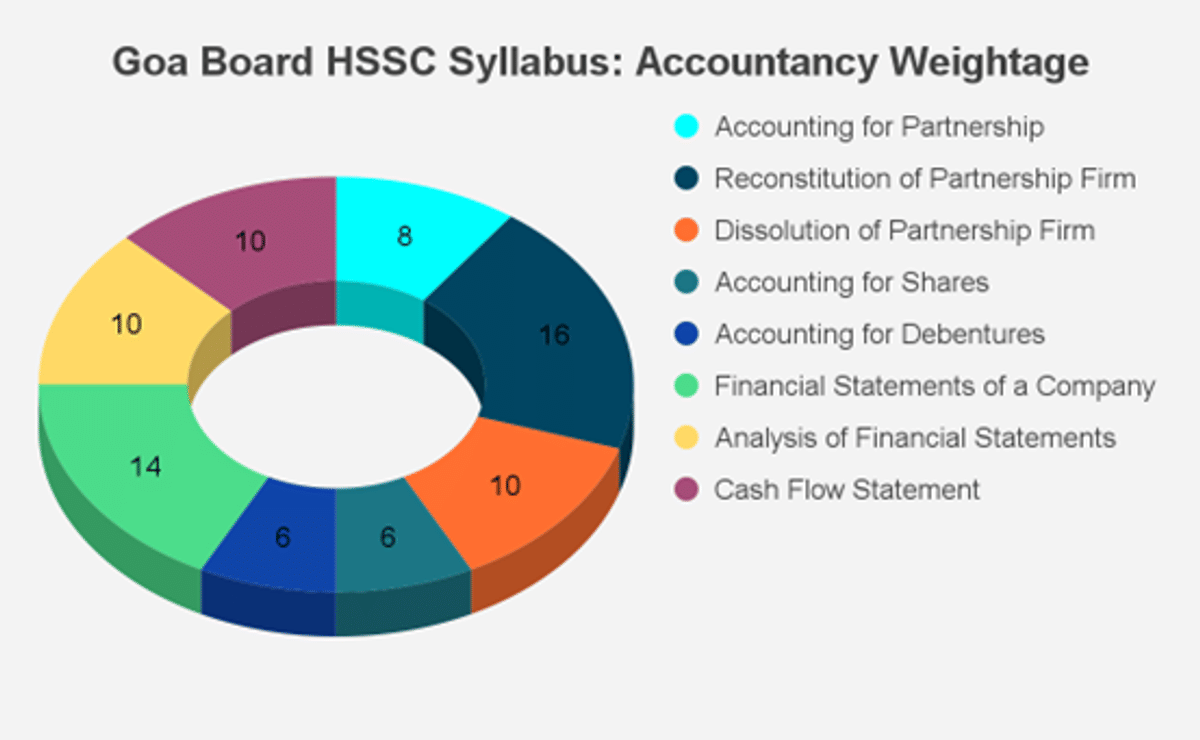
| Units | Marks |
|---|---|
| Accounting for Partnership: Basic Concepts | 08 |
| Reconstitution of Partnership Firm – Admission, Retirement, Death of a Partner | 16 |
| Dissolution of Partnership Firm | 10 |
| Accounting for Shares | 06 |
| Accounting for Debentures | 06 |
| Financial Statements of a Company – Statement of Profit & Loss and Balance Sheet | 14 |
| Analysis of Financial Statements – Ratio Analysis, Common Size Statement, Comparative Statement | 10 |
| Cash Flow Statement | 10 |
| Total | 80 |
Goa Board HSSC Syllabus: Business Studies Weightage
The Goa Board HSSC Syllabus has a total of 11 units. In this, the 10th unit, which is marketing, has the highest weightage for the exam, which is 13 marks.
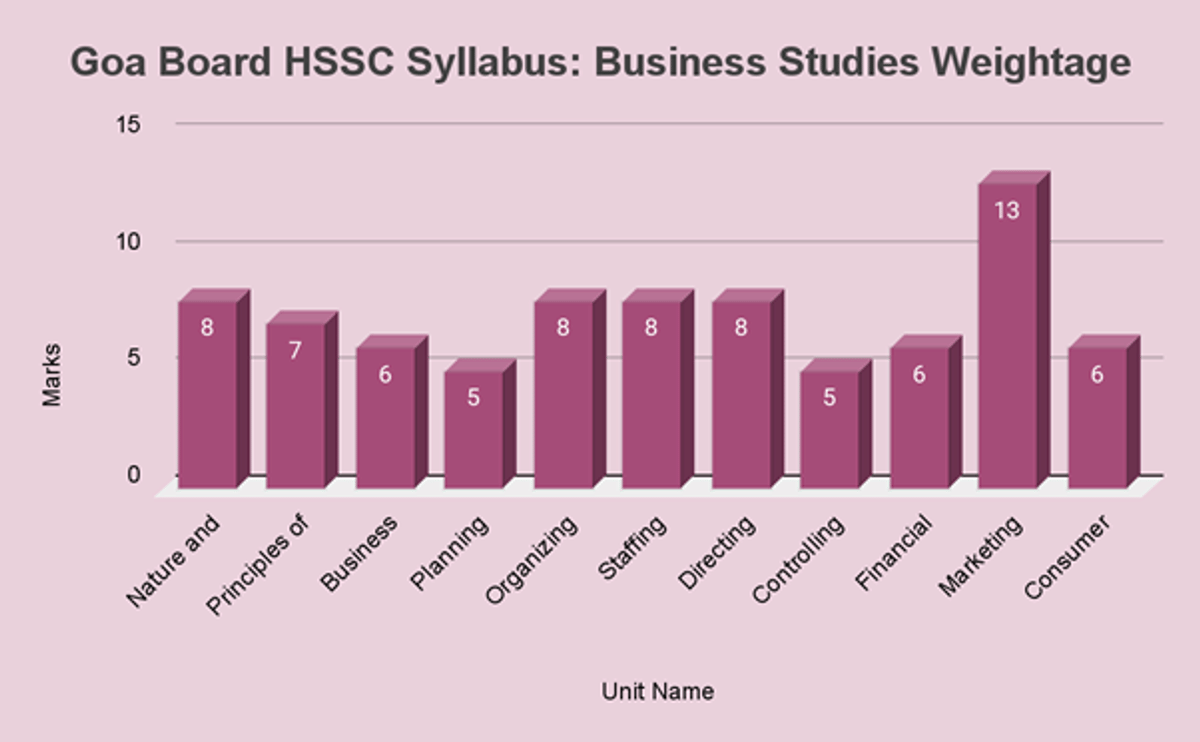
| Unit No. | Unit Name | Marks | Unit Percentage |
|---|---|---|---|
| 1 | Nature and Significance of Management | 08 | 10% |
| 2 | Principles of Management | 07 | 8.75% |
| 3 | Business Environment | 06 | 7.5% |
| 4 | Planning | 05 | 6.25% |
| 5 | Organizing | 08 | 10% |
| 6 | Staffing | 08 | 10% |
| 7 | Directing | 08 | 10% |
| 8 | Controlling | 05 | 6.25% |
| 9 | Financial Management | 06 | 7.5% |
| 10 | Marketing | 13 | 16.25% |
| 11 | Consumer Protection | 06 | 7.5% |
| Total | 80 | 100% |
Goa Board HSSC Syllabus: Political Science Weightage
Here is the unit-wise weightage for the Goa Board HSSC Political Science Syllabus. From Book 1, Contemporary South Asia has the highest weightage for the exam, and from Book 2, challenges to the nation-building have the highest marks.
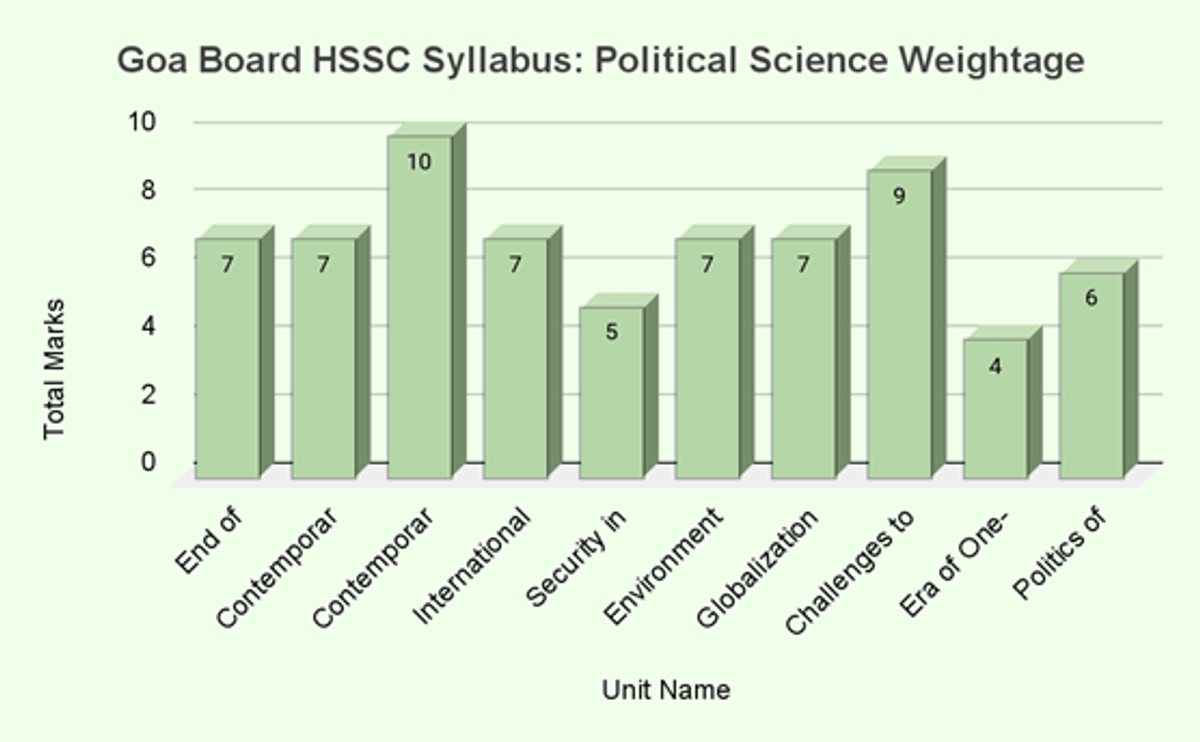
| Unit Name | Total Marks |
|---|---|
| Book I – Contemporary World Politics | |
| End of Bipolarity | 7 |
| Contemporary Centers of Power | 7 |
| Contemporary South Asia | 10 |
| International Organization | 7 |
| Security in the Contemporary World | 5 |
| Environment & Natural Resources | 7 |
| Globalization | 7 |
| Book II – Politics in India Since Independence | |
| Challenges to Nation Building | 9 |
| Era of One-Party Dominance | 4 |
| Politics of Planned Development | 6 |
| India’s External Relations | 7 |
| Challenges to and Restoration of the Congress System | 4 |
| Total | 80 Marks |
Frequently Asked Questions
Ques. When will the Goa Board HSSC exam be held in 2026?
Ans. The Goa Board HSSC exam 2026 is tentatively scheduled from February 10 to February 27, 2026.
Ques. Does the Goa Board HSSC exam follow the CBSE Curriculum?
Ans. No, the Goa Board HSSC exam does not follow the CBSE curriculum. It has its own syllabus, although some of the topics are similar to NCERT.
Ques. Is there any negative marking in the Goa Board HSSC Exam?
Ans. No, there is no negative marking in the Goa Board HSSC exam. Students only lose marks for the wrong or incomplete answers.
Ques. How many students appeared for the Goa Board HSSC Exam 2025?
Ans. In the Goa Board HSSC Exam 2025, 17,686 students appeared, and 16,878 students passed the exam. This makes the overall pass percentage around 95.43%.
Ques. Is it hard to pass the Goa Board HSSC exam?
Ans. No, the Goa Board HSSC exam is not very hard if you prepare well and follow the syllabus properly. Most of the questions are based on what is taught in the class. By studying regularly, clearing the concepts, and solving past year papers, students can pass the exam with good marks.



Comments