



Education Journalist | Study Abroad Strategy Lead
Internal Resistance Formula of primary cell in the form of the balancing length is. r=(ll−l)R. In an electrical circuit, resistance is a measure of opposition to the flow of electric current or electrons. The lesser the current flow, the higher the resistance. Damaged conductors due to burning or corrosion could be one, among many, probable causes of resistance in an electrical circuit if the voltage is too high. Because all conductors emit some heat, overheating is a problem that is frequently related to resistance.
| Table of Content |
Key Terms: Electric Current, Resistance, voltage, Cells, Potential Difference, EMF Formula, current flow, electrical circuits, ohms
What is Internal Resistance?
[Click Here for Sample Questions]
Internal resistance is defined as the barrier to current flow supplied by the cells and batteries themselves, resulting in heat creation.
- The notion applies to all types of electrical sources and can be used to analyze a variety of electrical circuits.
- Internal resistance is measured in terms of ohms.
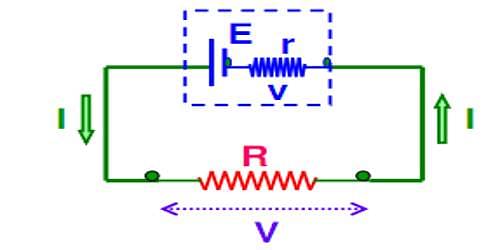
Internal Resistance
Discover about the Chapter video:
Current Electricity Detailed Video Explanation:
Internal Resistance Formula
[Click Here for Previous Year Questions]
We can describe the relationship between Internal Resistance and EMF as:
e = I (r + R)
where, e refers to EMF or electromotive force in volts
I is the current in amperes
R is the load resistance in ohms
r is the internal resistance in ohms
When we rearrange the equation above, we get:
e = IR + Ir
From ohm’s law:
V = IR
Therefore,
e = V+ Ir
r = (e-V)/ I
where,
r is the internal resistance
e is EMF
V is potential difference
I is current
Internal Resistance of a Cell
[Click Here for Sample Questions]
A cell consists of two terminals, of which one is positive while the other is negative. The positive terminal is referred to as the cathode, whereas the negative terminal is referred to as the anode. They're both electrodes in a cell. A battery is made up of two or more cells that are connected serially or parallelly.
To create a closed circuit, the cell's terminal is linked to a wire. Electric current passes through the wire from the positive terminal of the cell to the negative terminal, while positive ions in the electrolyte flow from a lower to a higher potential, providing resistance to the current flow. A cell's internal resistance is:
- based on the cell's electrolyte composition.
- directly proportional to the electrolyte concentration.
- inversely proportional to the area of the electrodes (anode and cathode) in an electrolyte.
- inversely proportional to temperature.
- directly proportional to the distance between cathode and the anode (electrodes).
Read More:
Things to Remember
- The potential difference between all the cells connected in parallel remains the same, but the current flowing through them differs.
- When we repeatedly draw current across a battery, its internal resistance rises. The internal resistance of a new battery or cell is low.
- The energy that moves electric charge through a circuit is known as emf. It comes from a battery or a cell. As a result, emf is measured in volts (V).
- As the battery or cell is continuously used, it consumes electrolytes and undergoes chemical reactions, lowering the concentration of ions in the cell and obstructing the flow of charge through it. As a result, the internal resistance rises over time.
- In reality, a battery's capacity to operate as an ideal voltage source is limited for several reasons. The amount of current a battery can source is affected by its size, chemical characteristics, age, and temperature.
Read More:
Sample Questions
Ques 1. What are the causes of internal resistance in a cell? (2 marks)
Ans. We may state that the acid will lead to the sulfation and grid corrosion, which are the main causes of the rise in internal resistance. The resistance is also affected by temperature, with heat lowering it and cold raising it. We may argue that heating the battery lowers the internal resistance for a short period, allowing for more runtime.
Ques 2. When no current runs through the circuit, the potential difference across the cell is 3 V. The terminal potential difference lowers to 2.8 Volts while current I = 0.37 Ampere is flowing. What is the cell's internal resistance (r)? (2 marks)
Ans. We know that,
e = V + Ir
(e – V)/I = r
Therefore, r = (3.0 – 2.8)/0.37 = 0.54 Ohm.
Ques 3. When a battery with an EMF of 12 V and internal resistance of 0.5 is connected in series with a 10 ohms resistor, what is the terminal voltage? (3 marks)
Ans. We know that,
I = e / (R+r)
I = 12V / 10.5 Ω
I = 1.143 A
V = R x I
V =10 Ω x 1.143A = 11.43V
Ques 4. The internal resistance of a battery is 0.5, and the EMF is 1.5 V. The terminal voltage drops to 1.45 V when connected in series to a load resistance. What is the current flowing through the circuit, and what is the load resistance? (3 marks)
Ans. We know that,
VInternal - VExternal = 1.5 V - 1.45 V = 0.05 V
I = VInternal / RInternal = 0.05 / 0.5 = 0.1 A
RLoad = VExternal / I = 1.45 V / 0.1 A = 14.5 ohm
Ques 5. Two EMFs 1.5 V and 2.0 V cells with internal resistances of 0.2 and 0.3 ohms are linked in parallel. Calculate the equivalent cell's emf and internal resistance. (3 marks)
Ans. We have:
E1 = 1.5V x E2 = 2.0 V
R1 = 0.2Ω x r2 = 0.3 Ω
Equivalent resistance of parallel combination: 1 / req = 1 / r1 + 1 / r2
Therefore 1 / req = 1 / 0.2 + 1 / 0.3 = (0.2 + 0.3) / (0.2 * 0.3)
req = 0.12Ω
Equivalent Emf: Eeq = (E/r + E/r)req
Therefore Eeq = [(1.5 / 0.2) + (2.0 / 0.3)] * 0.12
Eeq = (7.5 + 6.67) * 0.12 =1.7V
Ques 6. The emf of a cell is always greater than its terminal voltage. Why? Give reason. (2 Marks) [Delhi 2013]
Ans. The emf of a cell is greater than its terminal voltage because there is some potential drop across the cell due to its small internal resistance.
Ques 7. A cell of emf E and internal resistance r draws a current Write the relation between terminal voltage V in terms of E, I, and r. (2 Marks) [Delhi 2013]
Ans. When a current I draws from a cell of emf E and internal resistance r, then the terminal voltage is V = E – Ir.
Ques 8. A (i) series (ii) parallel combination of two given resistors is connected, one by one, across a cell. In which case, will the terminal potential difference across the cell have a higher value? (2 Marks) [All India 2008 C]
Ans. The equivalent resistance combination of resistances is (i) greater than the greatest resistance in series combination and (ii) smaller than the least value of resistance in parallel combination.
The terminal potential difference across the cell is higher in series combination as V = E – Ir and due to higher resistance, current I is less in series combination.
Ques 9. The terminal voltage of a cell in an open circuit condition is
a. Less than its emf
b. More than its emf
c. Equal to its emf
d. Depends on its internal resistance (2 Marks)
Ans. Option C. Equal to its emf. The terminal voltage of a cell in an open circuit condition will be equal to the emf of the cell as the circuit is open there won’t be any drop across the internal resistance.
Ques 10. What is the p.d. across the terminals (VT) of a cell with emf E for the open circuit?
a. VT<E
b. VT>E
c. VT=0
d. VT=E (3 Marks)
Ans. Option D. VT=E, When the circuit is closed, the resulting current not only flows through the external circuit but through the source (battery, generator, transformer, etc.) itself. All sources have an internal resistance, which causes an internal voltage drop, slightly reducing the voltage across the terminals.
The larger the current, the larger the internal voltage drop, and the lower the terminal voltage. When the circuit is open, no current flows. So there is no internal voltage drop, and the full voltage appears across the source’s terminals. This is why the potential difference across the terminals of a cell when connected to a circuit is slightly lesser than the emf of the cell.
Ques 11. The common dry cell produces a voltage of:
a. 1.5V.
b. 30V.
c. 60V.
d. 3V (2 Marks)
Ans. Option A. 1.5V, A common dry cell is a type of electricity-producing chemical cell, commonly used today for many home and portable devices, often in form of batteries. By standards, a common dry cell has a constant voltage of 1.5.
Ques 12. A resistance R is connected across a cell of emf ε and internal resistance r. A potentiometer now measures the potential difference between the terminals, of the cell as V., Write the expression for ‘r’ in terms of ε, V and R. (1 Mark) [CBSE Delhi 2011]
Ans. The required relation is r = (ε/V−1)R
Ques 13. A 10 m long wire of uniform cross-section and 20-ohm resistance is used in a potentiometer. The wire is connected in series with a battery of 5 V along with an external resistance of 480 ohms. If an unknown emf E is balanced at 6.0 m length of the wire, calculate:
(i) the potential gradient of the potentiometer wire
(ii) the value of unknown emf E. (3 Marks)
Ans. Total resistance of the circuit
R = 20 + 480 = 500 ohm
Therefore current through the potentiometer
l = V/R=5/500 = 0.01 A
Now potential drop across the potentiometer wire of 20 ohm = 20 × 0.01 = 0.2 V
(i) Potential gradient
V/L=0.2/10 = 0.02 Vm-1
(ii) Unknown emf = balancing length × potential gradient = 6 × 0.02 = 0.12 V
Ques 14. A cell of emf E and internal resistance ‘r’ gives a current of 0.8 A with an external resistor of 24 ohms and a current of 0.5 A with an external resistor of 40 ohms.
Calculate
(i) emf E and
(ii) internal resistance ‘r’ of the cell. (3 Marks)
Ans. Given l1 = 0.8 A, R1 = 24 ohm l2 = 0.5 A, R2 = 40 ohm
Using the equation
E = l(R + r) we have
0.8 × (24 + r) = 0.5 × (40 + r)
Solving for r we have r = 2.67 ohm
Also E = 0.5( 40 + 2.67) = 21.3 V
Previous Year Questions
- The electrical permittivity and magnetic permeability of free space are….[DUET 2003]
- In the circuit shown in figure, neglecting source resistance, the voltmeter and ammeter readings will respectively be...[KCET 2001]
- the value of magnetic field induction BB for which the rod remains stationary on the inclined plane is...[VITEEE 2015]
- A current of 5A is passing through a metallic wire of cross-sectional area….[VITEEE 2006]
- Charge passing through a conductor of cross-section area...[VITEEE 2012]
For Latest Updates on Upcoming Board Exams, Click Here: https://t.me/class_10_12_board_updates
Check-Out:



Comments